
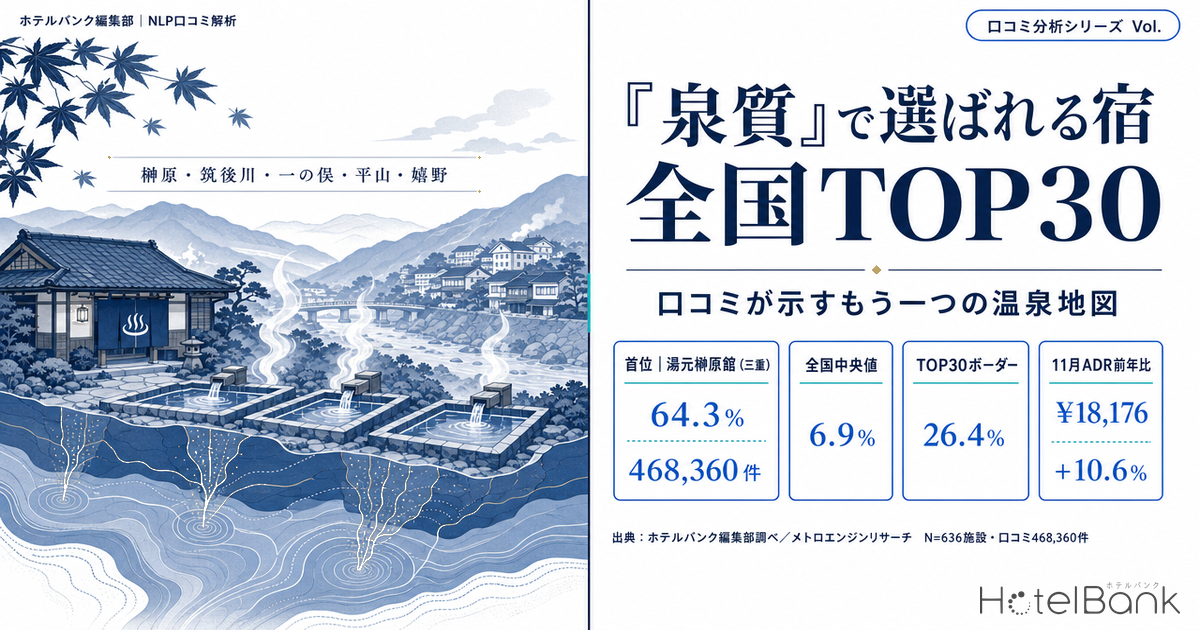
When people choose an onsen inn, “free-flowing spring water” (源泉掛け流し) is an easy label to reason about. Yet what guests actually describe once they are shoulder-deep in the bath is rarely the plumbing. It is the “silky film the water leaves on the skin,” the “smoothness afterwards” — in other words, the quality of the water itself. The HotelBank Editorial Team ran semantic NLP analysis over guest reviews, extracted every mention of water quality (泉質 water quality, 美肌の湯 beauty-bath, とろとろ silky, and similar), and ranked the national Top 30 by mention rate. What emerged is a second map of Japan’s hot springs — one that resembles, but is not the same as, the familiar ranking of famous onsen towns.
Metric Definitions Used in This Article
- Water-quality mention rate: the share of guest reviews from the past 24 months that touch on the quality of the bathing water (spring quality, beauty-bath, silky, smooth, cloudy water, and similar). This is a measure of how often a topic is raised, not a star rating, and is independent of how high or low a property’s review score is.
- ADR (average daily rate): an estimated settled rate (pre-tax equivalent) derived by applying category-specific adjustment coefficients to the lowest published plan level each property lists on OTAs and similar channels (two guests per room, per-room price, tax included). Cross-checked against property-level actuals disclosed by listed hotel REITs (91 properties, most recent three months), the median error was approximately 7%. These figures are estimates and differ from each property’s actual transacted prices or accounting figures. Area-level ADR is the median across the covered properties.
- Occupancy (estimated, OTA-listed inventory basis): sold rooms as a share of total rooms in the area, estimated from inventory offered for sale on OTAs. It reflects how listed inventory is being absorbed and differs from a property’s true overall occupancy.
- LT (lead time): days remaining until the check-in date. LT0 = same day.
- Data sources: reviews = HotelBank Editorial Team analysis (NLP) / prices and inventory = MetroEngines Research
- — Yumoto Sakakibarakan (湯元榊原舘) in Mie takes first place at 64.3%. The top ranks are held not by famous onsen towns but by lesser-known waters — Sakakibara, Kirishima, Chikugogawa (population: 636 properties, 468,360 reviews)
- — “Water quality” and “free-flowing spring water” are separate axes. Only 5 of the 30 ranked inns also draw concentrated free-flowing mentions, so water-quality praise is independent of whether a bath is free-flowing
- — Measured against its own prefecture, Kiyonoya (清乃屋) in Fukuoka runs 10.4x the prefectural median. Rarity of water stands out most in relative, within-area terms
- — For autumn-foliage dates, 48–69% of ryokan inventory is already gone at LT90. Akita reaches 68.8% — two of every three rooms sold 90 days out
- — November sits in the annual peak band for ryokan ADR. Gifu’s estimated settled ADR for November 2026 is ¥18,200, up 10.6% year on year
First, can this metric be trusted? Starting with validation
Any time a mention rate is used as a metric, the first thing to establish is whether the tag genuinely captures what it claims to capture. The editorial team has previously run into cases where a plausible-looking extraction was in fact picking up something else entirely. So before finalizing the ranking, we ran a two-stage validation.
First, we inspected the extracted review text itself. Taking six matched reviews from each of the top 30 properties — 180 in total — and checking them by eye, 92 (51.1%) contained an explicit water-related word (spring quality, the bath water, silky, slippery, beauty-bath, and so on). In other words, roughly half of the extracted passages were a different sentence lifted from a longer review, so the precision of the quotation-level extraction is not high. For that reason, this article does not put individual review quotes forward as evidence.
Second, and more importantly, we tested whether the aggregate result itself holds up. If the tag were failing to capture water quality, the top of the ranking would be filled with properties that have no thematic connection to one another. What actually appeared were inns at Sakakibara Onsen (Mie), Chikugogawa Onsen (Fukuoka), Ichinomata Onsen (Yamaguchi), Hirayama Onsen (Kumamoto) and Ureshino Onsen (Saga) — every one of them long known for silky, skin-softening water. Checking the official information published by the highest-ranked properties: third-placed Kiyonoya at Chikugogawa Onsen markets its own free-flowing “silky water” as its headline feature; fourth-placed Niji no Yado Hana Geshiki has a strongly alkaline spring at pH 9.1; and second-placed Kirishima Yunotani Sanso holds both a sulphur spring and a carbonated spring used for therapeutic bathing. The ordering the data arrived at independently lines up cleanly with real-world assessments of these waters.
The geographic distribution was consistent as well. As set out below, the lowest mention rates belong to Tokyo (median 1.6%), Chiba (1.8%) and Osaka (2.3%) — areas where the population is dominated by urban hotels with no hot spring at all. At the other end sit Akita, Saga and Aomori, prefectures dense with onsen resorts. Our conclusion: although the quotation-level extraction carries noise, the metric is valid at the aggregate level, and the ranking below therefore uses only the aggregated mention rate.
National Top 30 by water-quality mention rate — inns where the bath is the main act
The population covers 636 properties nationwide that had at least 100 reviews in the past 24 months and at least 20 water-quality mentions (468,360 reviews in total). The median water-quality mention rate across that population is 6.9% — roughly one guest in fifteen touching on the water is what a “standard” onsen inn looks like. Entering the Top 30 requires 26.4% or higher, meaning more than one guest in four talks about the bath.
Source: HotelBank Editorial Team analysis (NLP, past 24 months, extracted from N=636 properties / 468,360 reviews)
Top-ranked Yumoto Sakakibarakan (湯元榊原舘, Tsu City, Mie) posts 64.3% — two of every three reviews touch on the water, an outlier standing at more than nine times the population median. Sakakibara Onsen is an ancient spring recorded in the Heian-era Pillow Book as “Nanakuri no Yu,” and the inn markets free-flowing water from its own source. Eighth-placed Sakakibara Onsen Ryokan Seishonagon (36.5%) draws on the same onsen town, and the fact that a single hot-spring town places two properties in the Top 10 suggests what is being rated is the character of the water rather than the efforts of any one operator.
| # | Property | Location | Mention rate | Mentions / reviews | vs. prefecture |
|---|---|---|---|---|---|
| 1 | Yumoto Sakakibarakan (湯元榊原舘) | Mie | 64.3% | 74/115 | ×6.5 |
| 2 | Kirishima Yunotani Sanso (霧島湯之谷山荘) | Kagoshima | 45.6% | 57/125 | ×4.4 |
| 3 | Kiyonoya (清乃屋) | Fukuoka | 44.1% | 49/111 | ×10.4 |
| 4 | Niji no Yado Hana Geshiki (虹の宿 花景色) | Fukuoka | 42.9% | 57/133 | ×10.1 |
| 5 | Shunjuan Takuhide (旬樹庵 琢ひで) | Miyagi | 41.0% | 57/139 | ×6.6 |
| 6 | Akagi Onsen Hotel (赤城温泉ホテル) | Gunma | 39.6% | 59/149 | ×4.6 |
| 7 | Kirari Ryujin (季楽里 龍神) | Wakayama | 38.5% | 47/122 | ×4.6 |
| 8 | Sakakibara Onsen Ryokan Seishonagon (榊原温泉 旅館 清少納言) | Mie | 36.5% | 61/167 | ×3.7 |
| 9 | Minoriso (みのり荘) | Gifu | 34.6% | 70/202 | ×4.0 |
| 10 | Kawayu Kanko Hotel (川湯観光ホテル) | Hokkaido | 34.4% | 43/125 | ×5.6 |
| 11 | Hotel Kameya Honten (ホテル亀屋本店) | Nagano | 34.0% | 84/247 | ×2.8 |
| 12 | Ryokan Kazokuyu Imamura (旅館・家族湯 いまむら) | Kumamoto | 33.8% | 112/331 | ×2.8 |
| 13 | Ichinomata Onsen Grand Hotel (一の俣温泉グランドホテル) | Yamaguchi | 33.6% | 116/345 | ×5.1 |
| 14 | Tamagohada Bijin no Yu Mihaen (たまご肌美人の湯 美榛苑) | Nara | 32.6% | 135/414 | ×6.9 |
| 15 | Hotaru no Yado Ichinomata Onsen Kanko Hotel (蛍の宿 一の俣温泉観光ホテル) | Yamaguchi | 32.6% | 56/172 | ×5.0 |
| 16 | Hotel Pony Onsen (天然温泉掛け流しの宿 ホテル ポニー温泉) | Aomori | 32.5% | 78/240 | ×2.3 |
| 17 | Green View Tateyama (グリーンビュー立山) | Toyama | 30.7% | 31/101 | ×2.6 |
| 18 | Kokumin Shukusha Matsushiroso (国民宿舎 松代荘) | Nagano | 30.6% | 44/144 | ×2.5 |
| 19 | Kawaratei (かわら亭) | Niigata | 29.2% | 31/106 | ×2.6 |
| 20 | Sunset View Hotel Kehi no Umi (サンセットビューホテル けひの海) | Hyogo | 28.1% | 47/167 | ×6.0 |
| 21 | Hikage Onsen (日景温泉) | Akita | 28.0% | 30/107 | ×1.6 |
| 22 | Yumoto Kamiyamada Hotel (湯元 上山田ホテル) | Nagano | 27.9% | 62/222 | ×2.3 |
| 23 | Araki Kosen (新木鉱泉) | Saitama | 27.8% | 57/205 | ×2.0 |
| 24 | Hotel Foresta Chokai (ホテル フォレスタ鳥海) | Akita | 27.5% | 30/109 | ×1.5 |
| 25 | Hotel Grand Spa Avenue (ホテルグランスパアベニュー) | Fukuoka | 27.3% | 84/308 | ×6.4 |
| 26 | Yamaga Onsen Fuji Hotel (山鹿温泉 富士ホテル) | Kumamoto | 26.9% | 32/119 | ×2.2 |
| 27 | Kikuka Onsen Ryokan Kafutei (菊鹿温泉旅館 花富亭) | Kumamoto | 26.9% | 32/119 | ×2.2 |
| 28 | Unzen Iwaki Ryokan (雲仙いわき旅館) | Nagasaki | 26.5% | 35/132 | ×2.3 |
| 29 | Hotel Yokikan (ホテル楊貴館) | Yamaguchi | 26.4% | 53/201 | ×4.0 |
| 30 | Ureshino Motoyu (うれしの元湯) | Saga | 26.4% | 87/330 | ×1.7 |
Source: HotelBank Editorial Team analysis (population = 636 properties nationwide with 100+ reviews and 20+ water-quality mentions over the past 24 months). “vs. prefecture” = multiple of the median water-quality mention rate in the property’s home prefecture.
Third and fourth place deserve a closer look. Kiyonoya at Chikugogawa Onsen (44.1%) and Niji no Yado Hana Geshiki (42.9%) both sit in Furukawa, Ukiha-cho, Ukiha City, Fukuoka — neighbours roughly 100 metres apart in a straight line. Two inns sharing the same spring belt landing in the national top five together is about as strong a demonstration as one could ask for that this metric is surfacing the aquifer rather than the individual property. The prefectural median for Fukuoka is only 4.2%; both inns run at ten times that level.
Similar clusters appear around the country. Ichinomata Onsen in Yamaguchi places two properties — Ichinomata Onsen Grand Hotel (33.6%) and Hotaru no Yado Ichinomata Onsen Kanko Hotel (32.6%) — while the Yamaga and Hirayama area of Kumamoto contributes three: Ryokan Kazokuyu Imamura (33.8%), Yamaga Onsen Fuji Hotel (26.9%) and Kikuka Onsen Ryokan Kafutei (26.9%). Praise for the water comes up out of the ground, not off the signboard — that is what the data says.
A different axis from “free-flowing” — only 5 of the 30 overlap
One check is worth making explicitly: isn’t praise for water quality the same thing as free-flowing spring water? The answer is no — the two are clearly separate axes.
Only 86 properties nationwide accumulate a meaningful volume of free-flowing-water mentions. Properties accumulating water-quality mentions number 636 — a set more than seven times wider. And among the Top 30 by water-quality mention rate, only five properties (Minoriso, Hotel Kameya Honten, Ryokan Kazokuyu Imamura, Hotel Pony Onsen, Yumoto Kamiyamada Hotel) also drew concentrated free-flowing mentions.
That gap says something about where guest attention actually sits. “Free-flowing or not” is a specification the supply side explains; what guests volunteer is how the bath felt to be in. A free-flowing bath whose water has no distinctive feel on the skin does not become a talking point, while a bath running partly on recirculation can fill its reviews with water talk if the silkiness or the scent stands out. The water-quality mention rate measures experience, not specification. For an operator, that is where the opening lies: an inn can be chosen for its water without owning the phrase “free-flowing.” A separate national ranking that evaluates water quality with free-flowing supply as its organizing axis produces a materially different order — the overlap with this ranking is the five properties named above.
Where does the good water surface? A prefectural map
Pulling back from individual properties and lining up the median water-quality mention rate by prefecture, a map of Japan’s water quality appears.
Source: HotelBank Editorial Team analysis (prefectures with 5+ covered properties; within-prefecture median)
First place goes to Akita (median 18.1%), where sulphur springs and cloudy waters draw water talk across the prefecture’s onsen towns regardless of the individual property. Next come Saga (15.8%), home to Ureshino Onsen — one of Japan’s three great beauty-bath springs — followed by Aomori (14.3%), Saitama (13.7%), Nagano (12.1%) and Kumamoto (12.1%). Saitama’s presence near the top may look surprising; it is driven by the mineral springs of the Chichibu area, of which 23rd-ranked Araki Kosen (27.8%) is the representative case.
At the other end sit Tokyo (1.6%), Chiba (1.8%), Hiroshima (1.9%) and Osaka (2.3%). The gap between Akita and Tokyo runs to more than elevenfold. With urban hotels that have no hot spring making up most of the population in those areas this is the expected outcome — but it also confirms that the metric is tracking the actual facility mix rather than something spurious.
It is worth pausing on the assumption that famous onsen towns automatically score well on water quality; it does not reliably hold. Gifu (home to Gero Onsen) sits at 8.6%, Gunma (Kusatsu Onsen) at 8.6% and Wakayama at 8.3% — all mid-table. Ranked by absolute number of mentions, established names such as Suimeikan at Gero Onsen (404 mentions) and Hotel Sakurai (157) come to the front, but that partly reflects their much larger review counts. What steps forward on a rate basis is Sakakibara, Chikugogawa, Ichinomata, Hirayama — hot springs a notch below national fame. Places where the character of the water, not the scale of the operation, is what gets discussed: that is what this ranking really is.
Source: HotelBank Editorial Team analysis, MetroEngines Research (property locations). Circle size = water-quality mention rate.
Rarity within an area — how far a property stands out inside its own prefecture
Separately from the national ranking, the view that matters most in practice when choosing an inn is: given that I am going to this area, whose bath stands out? To answer that, we divided each property’s mention rate by the median for its home prefecture (the “vs. prefecture” column in the table above). This expresses how rare, and how differentiated, the water is within the surrounding area.
The two Fukuoka properties stand out furthest, at more than ten times the prefectural median (Kiyonoya ×10.4, Niji no Yado Hana Geshiki ×10.1). Because urban hotels drag Fukuoka’s population down, the water at Chikugogawa Onsen stands in especially sharp relief. Hotel Grand Spa Avenue (Asakura City), also in Fukuoka, is high at ×6.4, which makes Fukuoka the textbook case of a prefecture that is not an onsen prefecture overall yet has pockets of exceptionally distinctive water.
Tamagohada Bijin no Yu Mihaen in Nara (×6.9), Sunset View Hotel Kehi no Umi in Hyogo (×6.0), Shunjuan Takuhide in Miyagi (×6.6) and Yumoto Sakakibarakan in Mie (×6.5) are exceptional within their prefectures in the same way. These hold a position that is hard to substitute: if you are staying in that prefecture and the bath is the point, this is the inn.
The inverse case is equally interesting — Hikage Onsen in Akita (×1.6), Hotel Foresta Chokai in Akita (×1.5) and Ureshino Motoyu in Saga (×1.7). All three clear the national Top 30 bar at a high level (26–28%) while scoring low against their own prefectures, which means the overall standard of water in the prefecture is high enough that excellent bathing is simply the norm. For a traveller heading to Akita or Saga, that is reassurance that it is hard to go wrong whichever inn they pick. Chase rarity and you go to Fukuoka or Nara; chase certainty and you go to Akita or Saga — the same dataset supports two different ways of choosing.
When to move for an autumn onsen trip — LT90 is the watershed
Autumn is one of the heaviest demand seasons of the year for onsen inns. So when should a traveller move to secure a room during the foliage season? Rather than speculate, we read the lead-time structure off actual data from months whose selling window has already closed.
The chart below shows the inventory absorption curve for the ryokan category across the main onsen prefectures (actuals for June 2026 check-ins, 70–370 properties per prefecture). The horizontal axis is lead time (LT = days to check-in); the further right, the closer to check-in.
Source: MetroEngines Research (June 2026 check-ins, ryokan category; Gifu 179 properties/3,966 rooms, Saga 77/1,669, Nagano 374/8,631, Akita 75/2,425, Wakayama 87/3,249, Gunma 227/6,094)
What the curve shows is unambiguous. By LT90, 48–69% of ryokan inventory listed on OTAs has already been absorbed. Akita reaches 68.8% at LT90 — two of every three rooms already gone at that stage. And across the 76 days from LT90 to LT14, the figure advances by only around ten points.
In other words, onsen ryokan bookings are largely settled by three months before check-in. This is not a market where waiting until the last minute leaves a wide field of choice. If a particular bath is the objective, the decisive window sits earlier than LT90.
Applying that structure to this autumn: as of the survey date for this article (16 July 2026), early November — the period generally cited for peak foliage in Tohoku, including Naruko Gorge — sits at LT108, the mid-November weekend at LT122, and the late-November three-day weekend at LT128. None of them has reached LT90 yet. Working backwards, 1 November check-ins hit LT90 on 3 August, and 15 November check-ins on 17 August.
Put differently, the roughly one month from now until mid-August is the last substantial window in which foliage-season onsen inns can be secured while the field of choice is still wide. Many of the inns in the Top 30 are small or mid-sized ryokan with room counts in the dozens, and a small denominator means options converge quickly. If any inn will do there is no need to hurry; if the goal is one specific bath, moving early is the rational play. For a data-based view of how fast onsen areas actually fill up in early autumn, see our analysis of Silver Week 2026, 76 days out: booking pace across 6 onsen areas.
Prices rise in autumn too — November is the annual peak band for ryokan ADR
Alongside lead time, the seasonality of price is worth having in view. The chart below overlays estimated settled ADR for the ryokan category in Gifu Prefecture year by year.
Source: MetroEngines Research (Gifu Prefecture, ryokan category, estimated settled ADR, monthly N=133–240 properties). December 2026 is not shown because the number of covered properties falls below 60% of the population median. Figures from July 2026 onward are estimates based on listed price levels as of the survey date.
The seasonality is clear: November forms an annual price peak alongside August. Estimated settled ADR for November 2025 was ¥16,400, about 20% above September (¥13,700). November 2026 is tracking at ¥18,200 as of the survey date, up 10.6% year on year. Ryokan in Saga show the same pattern, with November 2025 at ¥23,000 — a substantial step up from September (¥19,600).
Demand concentrates, inventory moves early, and prices rise — in autumn all three happen at once. That is precisely why, for a trip organized around the bath, deciding early tends to pay off on price as well. Note, however, that figures for future months are estimates based on currently listed prices and are not settled values. Autumn price levels in the major onsen towns, read against the prior year, move in the same direction as the Gifu pattern shown here, with the November step-up appearing consistently across established resort areas.
⚠ Note on ADR for future dates: ADR figures in this article from July 2026 onward are estimates based on selling prices published on OTAs and similar channels as of the survey date, and they move as the check-in date approaches. Current levels will not necessarily be realized as shown. This article also makes no “sold out” or equivalent judgement about inventory conditions in November: every foliage-season date was still earlier than LT90 as of the survey, which is too early to speak definitively about supply and demand.
Conclusion — the bath as another yardstick
What surfaced from 468,360 guest voices was neither grade nor fame, but the character of the water as an axis of evaluation. Against a median water-quality mention rate of 6.9% across 636 properties nationwide, the Top 30 starts at 26.4% — inns where more than one guest in four talks about the bath genuinely exist.
And their distribution traces a different shape from the hierarchy of famous onsen towns: Sakakibara (Mie), Chikugogawa (Fukuoka), Ichinomata (Yamaguchi), Hirayama (Kumamoto), Ureshino (Saga). Two neighbouring inns land in the top ranks together, and single hot-spring towns place several properties at once — the reputation of a bath comes from what is underground as much as from the sum of an operator’s efforts. For an inn, that carries an implication: putting the character of its own water into words and getting it in front of guests can itself become the reason it is chosen.
Autumn foliage and hot springs are the classic Japanese trip. More than half of ryokan inventory moves by LT90, and November prices form the annual peak band. As of the survey date there is still around a month before LT90 arrives. Choosing an inn by its water, this summer, is one rather good way to build an autumn trip.
Related reading
- Silver Week 2026, 76 Days Out: Booking Pace Across 6 Onsen Areas
- Hotels Where Room-View Ratings Are Rising: National TOP 30 (Summer 2026 Fireworks)
References and Sources
■ Review and market data
- HotelBank Editorial Team analysis (NLP analysis of guest reviews, past 24 months, population of 636 properties / 468,360 reviews)
- MetroEngines Research — estimated settled ADR, inventory absorption curves on an OTA-listed inventory basis
■ Official property information (used to verify water quality)
- Yumoto Sakakibarakan official site (Tsu City, Mie)
- Kirishima Yunotani Sanso official site (Kirishima City, Kagoshima)
- Chikugogawa Onsen Kiyonoya official site (Ukiha City, Fukuoka)
- Niji no Yado Hana Geshiki official site — hot spring (Ukiha City, Fukuoka)
- Sakakibara Onsen Tourism Association official site
■ Foliage timing references