


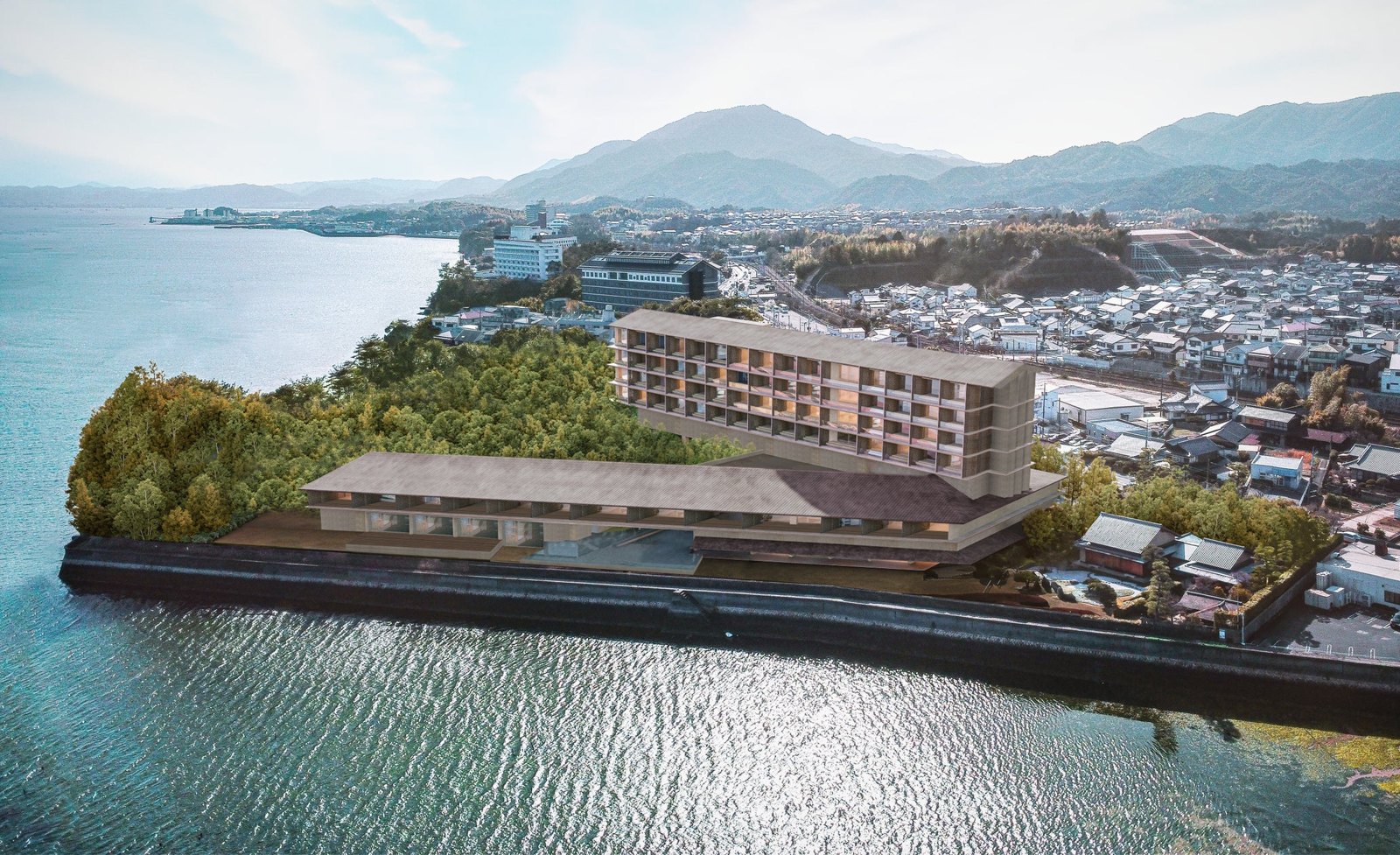
On July 6, 2026, Hilton published the plan outline for a new luxury-brand hotel, “Umiuta Hiroshima, LXR Hotels & Resorts” (61 rooms), in Miyajimaguchi-nishi, Hatsukaichi City, Hiroshima. The building — seven floors above ground and one basement level, with a total floor area of 12,106.99 m² — will stand on the waterfront facing the Great Torii of Itsukushima Shrine. Construction is scheduled to start in August 2026, with opening planned for 2028. For anyone weighing hotel investment in Miyajimaguchi, the project sets a new yardstick on two fronts: the way it uses floor area — 198 m² of gross floor area per room — and the distance between its price point and existing local rates. This article overlays the hotel room stock within 2 km of Miyajimaguchi Station, Hatsukaichi City’s estimated settled ADR, and location data from the Ministry of Land, Infrastructure, Transport and Tourism (MLIT) to back out the room rate a small luxury hotel needs to make the numbers work.
- Project outline / 61 rooms, 12,106.99 m² gross floor area, 7 floors above ground and 1 below. Gross floor area per room is 198.5 m²; on a 15,864.82 m² site, the floor area equals just 76.3% of the site area
- Nearby supply / Rooms within 2 km of Miyajimaguchi Station grew from 5 properties / 370 rooms in 2018 to 9 properties / 693 rooms in 2026. Of these, 7 properties / 627 rooms are actively selling; 61 rooms equals +9.7% of active rooms
- Rate level / Hatsukaichi City’s estimated settled ADR was ¥28,800 in October 2026 (N=35, +13.2% YoY) — 2.4x Hiroshima City’s Naka Ward (¥12,200, N=63) in the same month
- Required ADR / Assuming construction costs of ¥2.5m–4.0m per tsubo, construction cost per room is ¥150m–241m. The ADR required to hit a 5% GOP yield at 70% full-year occupancy is ¥86,800–¥125,600 (tax-exclusive equivalent)
- Gap to the existing top tier / Within 5 km, only 4 properties have a full-year average estimated settled ADR above ¥50,000 (¥50,200–¥61,700). The required ADR is roughly 1.4–2.5x that level — the project would bring an entirely new price tier to the area
• ADR (average daily rate) = an estimated settled rate (tax-exclusive equivalent), calculated by applying segment-specific adjustment factors to the lowest-plan rate level each property publishes on OTAs (per room, two adults, tax-inclusive). Checked against property-level results disclosed by listed hotel REITs (91 properties, most recent 3 months), the median error is about 7%. These are estimates and differ from each property’s actual settled rates and accounting figures.
• Area-level ADR (prefecture, city, ward) is the median of the estimated settled rates of the covered properties (the level of a typical property in the area).
• References to listed prices mean the per-room rate for two adults sharing one room (tax-inclusive).
• OCC (occupancy) = rooms sold as a share of total rooms in the area (an estimate based on OTA sales inventory).
• Source: MetroEngines Research (continuously tracking OTA public prices for approx. 168,000 properties, of which approx. 27,000 are confirmed as actively selling)
Room stock in this article covers accommodation properties with 10 or more rooms (excluding leisure/love hotels) within a 2,000 m radius and a 5,000 m radius of Miyajimaguchi Station. “Active” means a selling price was confirmed on major booking sites in the most recent 3 months (September–November 2026) (as of November 11, 2026; compiled by MetroEngines Research).
MetroEngines Research tracks approx. 168,000 properties and analyzes the approx. 27,000 properties (approx. 1.26 million rooms) confirmed as actively selling on OTAs. Where booking curves are used, LT (lead time) refers to the number of days to check-in; this article uses only monthly estimated occupancy.
Summary — A 198 m²-per-Room Waterfront Luxury Hotel Enters a ¥20,000s Market
The conclusion first. Umiuta Hiroshima is a plan that deliberately leaves the site’s allowable floor area unused and narrows the hotel down to 61 rooms. Dividing the 12,106.99 m² of gross floor area by 61 rooms gives 198.5 m² per room — more than the projects we have previously analyzed, Palace Hotel Hakone (186 m² of floor area per room) and the 135-room project in Shokokuji Monzencho, Kyoto (152 m² per room). The design can be read as allocating generous floor area not only to the guest rooms themselves but also to shared facilities such as three food-and-beverage outlets, a spa and an indoor pool.
The market that will absorb this product, however, prices in the ¥20,000s. Hatsukaichi City’s estimated settled ADR was ¥28,800 in October 2026 (N=35), up 13.2% year on year — yet the required ADR backed out from the economics of the floor area comes to ¥112,700 in the base case (¥3.5m per tsubo, 70% full-year occupancy, 5% GOP yield), about 3.9x the city median. In other words, the plan is premised not on competing within the existing price range but on creating a new tier of around ¥100,000 in Miyajimaguchi. The evidence is laid out step by step below.
Project Outline — The 61 Rooms as Described in Hilton’s Announcements
Let us start with the primary sources. According to the release Hilton issued on July 6, 2026, the address is 1-266-3 Miyajimaguchi-nishi, Hatsukaichi City, Hiroshima (and adjacent lots); the developer is Miyajima Kaihatsu GK and Hilton will operate the hotel. Penta-Ocean Construction’s Chugoku branch is responsible for design, supervision and construction, while Yuko Nagayama & Associates handles the basic design and design supervision. Hilton’s “Company Overview” (updated August 25, 2026) lists the project as one of 13 hotels in its Japanese pipeline with an “opening in 2028”; no firm opening date has been announced.
| Item | Details |
|---|---|
| Name | Umiuta Hiroshima, LXR Hotels & Resorts |
| Address | 1-266-3 Miyajimaguchi-nishi, Hatsukaichi City, Hiroshima, and adjacent lots |
| Developer / Operator | Miyajima Kaihatsu GK / Hilton |
| Site area | 15,864.82 m² |
| Hotel gross floor area | 12,106.99 m² (76.3% of site area; 198.5 m² per room) |
| Building size | 7 floors above ground, 1 basement level |
| Rooms | 61 |
| Facilities | All-day dining, bar, specialty restaurant, spa, indoor pool, fitness center, etc. |
| Design / Construction | Design, supervision and construction: Penta-Ocean Construction, Chugoku branch; basic design and design supervision: Yuko Nagayama & Associates |
| Schedule | Construction start August 2026; completion planned June 2028; opening 2028 (as stated in materials) |
This will be Hilton’s second hotel in Hiroshima Prefecture, following Hilton Hiroshima (420 rooms), which opened in 2022. In contrast to that large full-service hotel in the city center, this is a 61-room small luxury property across the water from Miyajima, so the two hotels play clearly distinct roles within the same prefecture. LXR Hotels & Resorts currently operates one property in Japan, ROKU KYOTO, LXR Hotels & Resorts (114 rooms, opened 2021); besides this project, the pipeline includes Hakone Gora (94 rooms, opening 2028) and Niseko Village (8 buildings, timing undecided).
| Status | Name | Location | Size | Opening (as stated in materials) |
|---|---|---|---|---|
| Operating | ROKU KYOTO, LXR Hotels & Resorts | Kyoto | 114 rooms | 2021 |
| Pipeline | LXR Hotels & Resorts (tentative name) Hakone Gora hotel project | Kanagawa | 94 rooms | Opening 2028 |
| Pipeline | Umiuta Hiroshima, LXR Hotels & Resorts | Hiroshima | 61 rooms | Opening 2028 |
| Pipeline | Kasara Niseko Village, LXR Hotels & Resorts | Hokkaido | 8 buildings | TBD |
Set side by side, the four properties show that 61 rooms is the most compact room count of any LXR in Japan (excluding Niseko, which is stated in buildings). The fewer the rooms, the more shared floor area each room has to carry, so the economics lean on rate rather than occupancy. This structure feeds directly into the required ADR discussed below.
Market Environment — Hatsukaichi’s Estimated Settled ADR Hit ¥28,800 in October, +13.2% YoY
Next, the level of the market that will absorb the hotel. On MetroEngines Research’s estimated settled ADR (median of properties in the city), Hatsukaichi City reached ¥28,800 in October 2026 (N=35), up 13.2% from ¥25,400 a year earlier. August came in at ¥26,200 (+4.0% YoY) and September at ¥23,200 (+14.1% YoY), so the city has been running above the prior year from summer into autumn. The simple average for the most recent 12 months (November 2025–October 2026) is ¥25,300.
The annual curve peaks in November, during the autumn-foliage season. November 2025 rose to ¥28,400, while June, the rainy season, dropped to around ¥20,000 (¥19,800 in 2025, ¥20,200 in 2026). The peak-to-trough ratio is about 1.4x, a direct reflection of Miyajima’s seasonality in room rates. The November 2026 estimate based on listed rates at the time of research is ¥30,400 (N=36, +7.0% YoY), above ¥30,000, so this autumn’s peak is running higher than last year’s.
These figures need careful reading, however. Hatsukaichi City’s ADR includes ryokan on Miyajima island itself, which pull up the city-wide median. By segment, in October 2026 ryokan stood at ¥32,700 (N=22, +20.6% YoY) and resort hotels at ¥24,600 (N=6, +2.7% YoY) — growth is being driven by ryokan.
| Segment | Oct 2026 | Oct 2025 | YoY | Properties |
|---|---|---|---|---|
| All (median of verified segments) | ¥28,786 | ¥25,432 | +13.2% | N=35 |
| Ryokan | ¥32,678 | ¥27,088 | +20.6% | N=22 |
| Resort hotels | ¥24,578 | ¥23,940 | +2.7% | N=6 |
Compared with the city center, the price gap is stark. Hiroshima City’s Naka Ward posted an estimated settled ADR of ¥12,200 in October 2026 (N=63, +5.2% YoY); Hatsukaichi was 2.4x that. In every month from January to October, Hatsukaichi was more than double Naka Ward, which shows how differently rates are formed in the business-driven city center and on the Miyajima side, where the stay itself is the purpose of the trip. Prefecture-wide trends are also covered in our analysis of Hiroshima’s settled September estimated ADR.
Occupancy also confirms the depth of demand. Hatsukaichi City’s occupancy (estimated, based on OTA-listed inventory) stepped up toward autumn: 70.8% in June 2026 (28 properties / 883 rooms), 73.1% in July (28 / 862), 82.3% in August (30 / 964), 83.5% in September (25 / 847) and 90.4% in October (41 / 1,076) (all based on listings on major booking sites). The ryokan segment reached 95.1% in October (15 properties / 404 rooms). These are estimates based on how fast OTA-sold inventory is absorbed; they differ from each property’s actual occupancy, and the set of covered properties changes from month to month, so they should be read with some discount.
As for the source of demand, visitors to Miyajima reached 4,854,369 in 2024 according to press reports, surpassing 4,657,343 in 2019 to set a new record. Hatsukaichi City introduced a ¥100-per-person Miyajima Visitor Tax in October 2023, and Miyajimaguchi — the gateway to the island — draws a steady flow of people waiting for the ferry throughout the year.
Location — Station-Front Land Prices Up 28.8% in Four Years; the Waterfront Is a Neighborhood Commercial Zone
Next, we checked the site conditions using MLIT’s Real Estate Information Library. The official land price benchmark in front of Miyajimaguchi Station (1-5-13 Miyajimaguchi, commercial zone, 400% floor area ratio) stood at ¥197,000/m² in 2026, up 8.2% year on year. It has risen 28.8% in four years from ¥153,000/m² in 2022, and the annual rate of increase has widened every year.
Looking at zoning, the station front is a commercial zone (400% floor area ratio, 80% building coverage), while the waterfront in Miyajimaguchi-nishi 1-chome, where the site sits, is a neighborhood commercial zone (200% FAR, 80% coverage), backed by a Category 1 residential zone (200%, 60%). The announced gross floor area equals 76.3% of the site area, which indicates the plan leaves considerable headroom against the designated floor area ratio. The layout appears to prioritize waterfront views and low density.
Transport indicators are also solid. In the National Land Numerical Information station ridership data, JR Miyajimaguchi Station rose 12.4%, from 8,618 passengers/day in 2019 to 9,688/day in 2024. Hiroden Miyajimaguchi Station (Hiroshima Electric Railway) handled 5,536/day in 2024, still short of 6,349/day in 2019, but the two stations combined reached 15,224/day in 2024, above the 14,967/day of 2019.
Hazard assumptions should also be noted in neutral terms. In the library’s tsunami inundation assumption zones (Hiroshima Prefecture, 2016 data), a zone is designated along the shoreline of Miyajimaguchi-nishi 1-chome, with assumed inundation depths ranging from the under-0.3 m class to, in places, the 3 m–4 m class. On the mountain-side slopes, there are landslide (steep-slope failure) warning zones, part of which are special warning zones. No flood inundation assumption zones were displayed in the vicinity. Storm-surge inundation assumption zones were not displayed for this area in the library, so separate confirmation against Hiroshima Prefecture’s published storm-surge maps is required.
| Item | Findings |
|---|---|
| Zoning (waterfront) | Neighborhood commercial zone (200% FAR, 80% coverage). Category 1 residential zone behind it (200%, 60%) |
| Zoning (Miyajimaguchi Station front) | Commercial zone (400% FAR, 80% coverage) |
| Official land price (station front, commercial) | ¥197,000/m² (2026, +8.2% YoY) |
| Tsunami inundation assumption | Zone designated along the shoreline. Assumed depths range from the under-0.3 m class to the 3 m–4 m class |
| Landslides | Steep-slope failure warning zones on mountain-side slopes (partly special warning zones) |
| Flood inundation assumption | No zones displayed in the vicinity |
| Storm-surge inundation assumption | Not displayed in the library (confirm separately with the prefecture’s published maps) |
For a waterfront hotel, tsunami and storm-surge assumptions are conditions inseparable from the value of the location. Given that the plan includes a basement level, the placement of plant rooms and back-of-house space and the design of evacuation routes become issues that will be reflected in construction costs and insurance premiums. The description in this article is a block-level overview and does not identify the assumed inundation depth for the site itself.
Room Stock — 370 Rooms Within 2 km in 2018, 693 Today; 61 Rooms Adds 9.7% to Active Supply
How has nearby supply evolved? Room stock within a 2 km radius of Miyajimaguchi Station (an area that does not include Miyajima island across the water) grew by 323 rooms (+87.3%) over eight years, from 5 properties / 370 rooms in 2018 to 9 properties / 693 rooms in 2026. The increase came in three stages: a 25-room ryokan in 2019 and a 210-room resort hotel in 2020 took the total to 605 rooms; nothing changed through 2025; then two properties with 54 and 34 rooms opened in 2026, bringing the total to 693.
Of the 693 rooms, the active properties — those with selling prices confirmed on major booking sites in the most recent three months — number 7 properties / 627 rooms. By segment, the core is two resort hotels (264 rooms), two city hotels (228 rooms) and one business hotel (92 rooms). By size, there is one property each with 201+ rooms and 101–200 rooms, two with 51–100 rooms, and three active properties with 50 rooms or fewer (77 rooms in total). Adding Umiuta Hiroshima’s 61 rooms would bring the total to 754 rooms on a listed basis (+8.8%) and 688 rooms on an active basis (+9.7%).
| Property | Segment | Rooms | Opened | Distance from station |
|---|---|---|---|---|
| Grandvrio Hotel Miyajima Wakura (グランヴィリオホテル宮島 和蔵) | Resort hotel | 210 | 2020 | approx. 883 m |
| Aki Grand Hotel (安芸グランドホテル) | City hotel | 194 | 1987 | approx. 1,077 m |
| Miyajima Coral Hotel (宮島コーラルホテル) | Business hotel | 92 | 1986 | approx. 136 m |
| KAI Miyajima (界 宮島) | Resort hotel | 54 | 2026 | approx. 1,122 m |
| HOTEL FORK & KNIFE Miyajima | City hotel | 34 | 2026 | approx. 420 m |
| Aki no Oyado Miyajima-an Hiroshima (安芸の御宿 みやじま庵廣島) | Ryokan | 25 | 2019 | approx. 640 m |
| Simple Stay Miyajima (シンプルステイ宮島) | Guesthouse | 18 | 2011 | approx. 103 m |
Both properties that opened in 2026 pushed Miyajimaguchi’s price range upward. HOTEL FORK & KNIFE Miyajima (34 rooms, opened in March) and KAI Miyajima (54 rooms, opened in summer) have both run at estimated settled ADRs in the ¥50,000s since opening. Widening the radius to 5 km, which includes the island across the water, yields 30 listed properties / 1,380 rooms and 25 active properties / 1,240 rooms, with ryokan the largest segment at 12 properties / 447 rooms. Only by combining the island’s long-established ryokan with the Miyajimaguchi hotels does a market of around 1,200 rooms come into view.
Positioning — Rate Distribution of 21 Properties Within 5 km, and the Empty ¥100,000 Tier
Now to the price distribution. Of the 25 active properties within 5 km, 21 have a calculable estimated settled ADR; the chart below plots their average for the most recent 12 months (November 2025–October 2026; for the two properties that opened in 2026, months since opening) against room count. The median of the 21 properties is ¥28,200, distributed as 6 properties below ¥20,000, 10 at ¥20,000–40,000, 1 at ¥40,000–50,000 and 4 at ¥50,000 or more.
The four properties above ¥50,000 are Kinsuikan (錦水館; 39 rooms, ¥61,700), Kurayado Iroha (蔵宿いろは; 18 rooms, ¥55,900), HOTEL FORK & KNIFE Miyajima (34 rooms, 8-month post-opening average ¥55,800) and KAI Miyajima (54 rooms, 2-month post-opening average ¥50,200) — all small properties of 54 rooms or fewer. The model of keeping room counts small and earning rate through views and cuisine is already proven in this market. Kinsuikan in particular reached a monthly ¥90,300 in October 2026, showing that settled rates in the ¥90,000s are achievable during the foliage season.
Core tier ¥20,000–40,000
10 properties · 10–194 rooms
The central band where island ryokan and large Miyajimaguchi hotels sit. The city median of ¥28,800 also falls here.
Upper tier ¥50,000s–60,000s
4 properties · 18–54 rooms
Small properties that lead with food and views. The tier thickened with the two 2026 openings.
New territory Above ¥80,000, full year
None
Zero of the 21 properties average above ¥80,000 over the year. This project’s required-ADR band sits here.
Listed prices paint a slightly different picture. Within 5 km, five properties have an annual average listed price (two adults per room, tax-inclusive, average of all plans) above ¥100,000, with the top ones reaching the ¥130,000s. Listed prices and estimated settled ADR are on different bases and cannot be compared directly, but the very fact that upper-grade rooms with dinner and breakfast are priced above ¥100,000 is circumstantial evidence that demand for the high-rate tier exists.
Floor-Area Economics — Construction Cost of ¥150m–240m per 198 m² Room
So how much will it cost to build this floor area? Because the project’s construction cost has not been disclosed, we estimate it as a range using our own method. The 12,106.99 m² of gross floor area equals about 3,669 tsubo, or about 60 tsubo per room. According to MLIT’s Statistics on Building Construction Starts, planned construction costs for hotels and ryokan in 2025 were ¥2.405m per tsubo for steel-frame and ¥2.026m per tsubo for reinforced-concrete structures. Turner & Townsend forecasts Japanese construction cost inflation of 5.3% in 2026 and 5.0% in 2027; extending to the midpoint of construction (mid-2027) for a project starting in August 2026 and completing in June 2028, even the national-average steel-frame cost comes to about ¥2.6m per tsubo.
Given the luxury interiors, spa and indoor pool, basement level and waterfront foundations, it is reasonable to expect costs above the national average. We therefore set four cost levels — ¥2.5m, ¥3.0m, ¥3.5m and ¥4.0m per tsubo — with ¥3.5m as the base case. Because the land acquisition price has not been disclosed, we add a reference land valuation of about ¥3.1bn, multiplying the official land price in front of Miyajimaguchi Station (¥197,000/m²) by the 15,864.82 m² site. Using the station-front commercial unit price makes this a conservative assumption that places the land value on the high side.
| Item | ¥2.5m/tsubo | ¥3.0m/tsubo | ¥3.5m/tsubo Base | ¥4.0m/tsubo |
|---|---|---|---|---|
| Construction cost (12,106.99 m² = 3,669 tsubo) | ¥9.17bn | ¥11.01bn | ¥12.84bn | ¥14.68bn |
| Construction cost per room (61 rooms) | ¥150m | ¥180m | ¥211m | ¥241m |
| Reference land value (¥197,000/m² × 15,864.82 m² site) | ¥3.13bn | ¥3.13bn | ¥3.13bn | ¥3.13bn |
| Total investment (reference) | ¥12.30bn | ¥14.13bn | ¥15.97bn | ¥17.80bn |
| Total investment per room | ¥202m | ¥232m | ¥262m | ¥292m |
In the base case, construction cost is about ¥12.8bn, or about ¥210m per room. Adding the reference land value brings total investment to about ¥16.0bn, or about ¥260m per room. Rising construction costs push up investment per room, but they also make it harder for new supply at the same level to follow later. For a project that has already secured its floor area, limited competitive entry works as upside.
Backing Out the Required ADR — ¥87,000–126,000 at 70% Full-Year Occupancy
We back out the required ADR by setting a target of a 5% annual yield on total investment at the GOP (gross operating profit) level. Assumptions: a full-service GOP margin of 25%, rooms revenue at 55% of total revenue (the rest from F&B, spa, etc.), 61 rooms and 365 operating days. For the GOP margin, we used the 38.9% achieved by the 91 MHM-operated properties disclosed by Invincible Investment Corporation (8963) (fiscal period ended December 2024) as an upper reference, and set 25% for a format carrying three F&B outlets and a spa.
In the base case (total investment ¥15.97bn), the hotel needs annual GOP of about ¥800m, total revenue of about ¥3.19bn and rooms revenue of about ¥1.76bn. Dividing by 61 rooms × 365 days gives a required RevPAR of ¥78,900; at 70% full-year occupancy the required ADR is ¥112,700 (tax-exclusive equivalent). At ¥2.5m per tsubo it is ¥86,800 and at ¥4.0m it is ¥125,600 — a spread of about ¥40,000 depending on the construction cost assumption.
| Construction cost scenario | 60% full-year OCC | 70% full-year OCC | 80% full-year OCC | Required RevPAR |
|---|---|---|---|---|
| ¥2.5m/tsubo (total investment ¥12.30bn) | ¥101,300 | ¥86,800 | ¥75,900 | ¥60,800 |
| ¥3.0m/tsubo (total investment ¥14.13bn) | ¥116,400 | ¥99,700 | ¥87,300 | ¥69,800 |
| ¥3.5m/tsubo (total investment ¥15.97bn) | ¥131,500 | ¥112,700 | ¥98,600 | ¥78,900 |
| ¥4.0m/tsubo (total investment ¥17.80bn) | ¥146,600 | ¥125,600 | ¥109,900 | ¥87,900 |
Now compare this level with the market. The required ADR of ¥86,800–¥125,600 (70% full-year occupancy) is about 1.4–2.0x the highest annual average within 5 km (¥61,700), and up to 2.5x the ¥50,200 floor of the four properties above ¥50,000. On the other hand, a property in the area recorded a monthly ¥90,300 in October, during the foliage season, so the required ADR in the ¥2.5m-per-tsubo case falls within the same band as existing peak-month levels. Whether peak-month rates can be sustained across the whole year is what will decide the project’s economics.
The 70% occupancy assumption also deserves a check. Hatsukaichi City’s estimated occupancy ran between 70.8% and 90.4% from June to October 2026, a simple five-month average of about 80%. Since even the trough month of June held at 70%, a full-year 70% is within the range of actual market performance. That said, rooms in the ¥100,000 tier will not necessarily fill at the same pace as the market average, so the 60% case should be read alongside it.
Sensitivity Analysis — A 10% Move in Rate Shifts the GOP Yield by 0.5pt
Here is the range of outcomes around the base case. If ADR falls 10%, the GOP yield drops to 4.5%; if occupancy falls 5pt, to 4.6%; if both happen, to 4.2%. Both rate and occupancy affect the yield, but at a scale of 61 rooms there is more room to lift the rate per room-night.
| Scenario | Base case | ADR −10% | OCC −5pt | Both |
|---|---|---|---|---|
| ADR / full-year OCC | ¥112,700 / 70% | ¥101,400 / 70% | ¥112,700 / 65% | ¥101,400 / 65% |
| Rooms revenue | ¥1.76bn | ¥1.58bn | ¥1.63bn | ¥1.47bn |
| GOP | ¥800m | ¥720m | ¥740m | ¥670m |
| GOP yield (on total investment of ¥15.97bn) | 5.0% | 4.5% | 4.6% | 4.2% |
This estimate puts F&B and spa revenue at 45% of total revenue. Miyajimaguchi sees day-trippers passing through all year, and if the hotel can capture restaurant and spa use from non-staying guests, the lower rooms-revenue share brings the required ADR down. For example, if the rooms-revenue share falls to 50%, the base-case required ADR drops to about ¥102,400. F&B designed to draw outside customers is likely to be a powerful way to ease the burden on room rates. Note that this article presents a simplified estimate; an actual investment decision requires a detailed feasibility study.
Supply Pipeline — 61 Rooms Following Two 2026 Openings Take Miyajimaguchi’s High-Rate Tier to 149 Rooms in Three Years
Viewed chronologically, small high-rate properties are arriving one after another in Miyajimaguchi. 34 rooms opened in March 2026 and 54 rooms in summer 2026, and this project’s 61 rooms are due in 2028. Together the three properties total 149 rooms — equal to about a quarter of the 605 rooms within 2 km at the end of 2025 — all targeting the ¥50,000-plus tier.
| Timing | Property | Rooms | Notes |
|---|---|---|---|
| Opened March 2026 | HOTEL FORK & KNIFE Miyajima | 34 | Within walking distance of Miyajimaguchi Station. 8-month post-opening average estimated settled ADR ¥55,800 |
| Opened summer 2026 | KAI Miyajima (界 宮島) | 54 | Miyajimaguchi-nishi. 2-month post-opening average estimated settled ADR ¥50,200 |
| Opening 2028 (as stated in materials) | Umiuta Hiroshima, LXR Hotels & Resorts | 61 | Miyajimaguchi-nishi. Construction start August 2026, completion planned June 2028 |
That the two earlier entrants achieved settled rates in the ¥50,000s right after opening is a tailwind for later projects. When high-rate properties cluster in the same area, recognition as a destination grows, making it easier to attract long-staying international visitors who are hard to capture alone. The supply outlook for Hiroshima Prefecture as a whole points to continued new openings in Hiroshima City through 2029, but the Miyajimaguchi pipeline is distinctive in being concentrated in small, high-rate properties.
Investment Considerations — Year-Round Rates, Outside F&B Sales and Waterfront Design
Pulling this together, the investment case comes down to three issues. The first is making the rate hold year-round. In a market that has recorded ¥90,000s during the foliage season, how far the June trough can be lifted will determine how close the hotel comes to its required ADR. A brand with a global loyalty base may be able to capture demand that moves in different waves from domestic seasonality.
The second is selling F&B and spa to outside guests. A configuration with three F&B outlets suits a location through which some 4.85 million visitors to the island pass each year. The thicker non-rooms revenue becomes, the less dependent the hotel is on room rates. The third is waterfront design: an architectural plan that reconciles plant placement informed by tsunami and storm-surge assumptions with views of the Great Torii will determine both construction cost and product value.
| Category | Factor | Impact on the estimate |
|---|---|---|
| Market | Seasonal gap of about 1.4x between June and November | How full-year ADR is set. Lifting the trough months drives the yield |
| Demand | 149 rooms of small high-rate properties in 2026–2028 | Clustering as a destination advances, but choices in the upper tier also increase |
| Construction | Construction cost inflation forecast at 5.3% in 2026 and 5.0% in 2027 | A ¥0.5m/tsubo move in cost shifts the required ADR by about ¥13,000 (at 70% occupancy) |
| Location | Tsunami inundation assumption along the shore; landslide warning zones on the mountain side | Design conditions for plant placement, insurance premiums and evacuation planning |
Conclusion — 61 Rooms That Create a ¥100,000 Tier in Miyajimaguchi
In terms of volume, Umiuta Hiroshima is a modest plan: 61 rooms, +9.7% against the 627 active rooms within 2 km of Miyajimaguchi Station. But its use of 198 m² of floor area per room means bringing a new tier — a required ADR of ¥86,800–¥125,600 — into a market whose city median is ¥28,800. The four upper-tier properties above ¥50,000 already have proven demand, settled rates in the ¥90,000s are achieved in the foliage season, and the two earlier entrants have realized high rates right after opening — all signs that a path toward that tier is taking shape within the market.
The implication for operators and investors is that the value of Miyajimaguchi as a location is shifting from a “transit point to the island” to a “destination in its own right.” For existing nearby properties, too, the arrival of a ¥100,000-tier hotel is an opportunity to revisit pricing for their own upper-grade rooms. Heading toward the 2028 opening, we will track in our monthly estimated settled ADR how far rates rise not only at the autumn peak but also in winter and the rainy season.
⚠ Note on ADR for future dates: ADR figures in this article are averages of selling prices published on OTAs at the time of research and will change as check-in dates approach. Prices currently set high may fall through last-minute discounting. Values for November and December 2026 are estimates based on listed rates at the time of research (early November 2026).
Methodology and Sources
■ Data sources
Room stock is compiled by MetroEngines Research (2,000 m / 5,000 m radius of Miyajimaguchi Station, 10+ rooms, as of November 2026). Estimated settled ADR at the city/ward level is the median of covered properties (Hatsukaichi City N=32–36 properties/month; Hiroshima City Naka Ward N=56–64 properties/month); at the property level it is the monthly average over the most recent 12 months. Occupancy is an estimate based on OTA-listed inventory, with the number of properties and rooms shown for each month. Location data come from MLIT’s Real Estate Information Library, and the project outline from Hilton’s announcements.
■ Estimate assumptions
Gross floor area 12,106.99 m² = 3,669 tsubo (1 tsubo = 3.3 m²); construction cost ¥2.5m / ¥3.0m / ¥3.5m / ¥4.0m per tsubo; land at a reference valuation of the official land price in front of Miyajimaguchi Station (¥197,000/m²) × 15,864.82 m² site; GOP margin 25%; rooms revenue share 55%; 61 rooms, 365 days; target GOP yield 5% (on total investment). Required ADR is on a tax-exclusive equivalent basis.
■ Limitations
Construction cost and land acquisition price have not been disclosed; the figures in this article are estimates based on our assumptions. Hatsukaichi City’s estimated settled ADR includes ryokan on Miyajima island. For the two properties opened in 2026, averages cover only the months since opening and may differ from full-year levels. Hazard assumptions are block-level overviews, not assessments of the project site. The opening timing is as stated in Hilton’s materials, not a confirmed opening date.
Frequently Asked Questions
Q. Where is Umiuta Hiroshima, LXR Hotels & Resorts, and how many rooms will it have?
A. It is a 61-room hotel planned at 1-266-3 Miyajimaguchi-nishi, Hatsukaichi City, Hiroshima, and adjacent lots. The building will have 7 floors above ground and 1 basement level with a gross floor area of 12,106.99 m²; it is being developed by Miyajima Kaihatsu GK and will be operated by Hilton (Hilton news release, July 6, 2026).
Q. When will it open?
A. Hilton’s “Company Overview” (updated August 25, 2026) states “opening in 2028.” The release gives a construction start of August 2026 and planned completion in June 2028; no firm opening date has been announced.
Q. How many hotels are there around Miyajimaguchi?
A. Within a 2 km radius of Miyajimaguchi Station there are 9 listed properties / 693 rooms, of which 7 properties / 627 rooms are active (selling prices confirmed in the most recent 3 months). Within a 5 km radius, which includes Miyajima island across the water, there are 30 listed properties / 1,380 rooms and 25 active properties / 1,240 rooms (as of November 2026, properties with 10+ rooms).
Q. What is the hotel rate level in Hatsukaichi City?
A. MetroEngines Research’s estimated settled ADR (median of properties in the city) was ¥28,800 in October 2026 (35 properties), up 13.2% year on year. That is about 2.4x Hiroshima City’s Naka Ward in the same month (¥12,200, 63 properties).
Q. What required ADR does the estimate produce?
A. With construction cost of ¥3.5m per tsubo, a reference land value of about ¥3.1bn, a 25% GOP margin, a 55% rooms-revenue share and 70% full-year occupancy, the ADR required for a 5% GOP yield is about ¥112,700 (tax-exclusive equivalent). Across ¥2.5m–4.0m per tsubo, it ranges from ¥86,800 to ¥125,600. Construction cost is undisclosed, so these are estimates; an actual investment decision requires detailed study.
Related Articles
- Hiroshima Settled Sept 2026 ADR: City +18.9%, Business +12.1% YoY
- Palace Hotel Hakone 2029: 69 Rooms, 186 m² per Key, +5.0% Supply
- Rosewood Kyoto Shokokuji: 135 Rooms at 152 m² Each Need ¥82,600 ADR
- Hakone Gora Ryokan Appraised at ¥390mn a Room: REIT Equity, 184 Keys
- Waldorf Astoria Tokyo Nihonbashi: 197 Rooms in 2027, 12,270 Within 1km
- Mandarin Oriental Setouchi Takamatsu Needs ¥71k–128k ADR on ¥34bn Cost
- 15 Foreign-Brand Hotels, 2,709 Rooms: Japan’s 2026-2031 Pipeline
- Todaiji Precinct Hotel: 25 Rooms at 140 m² Each Need ~¥97k ADR
- Onomichi Hotel ADR 21% Above Hiroshima Naka: 7 Sanyo Cities, 2026
- 5 Station Areas, 29,764 Hotel Rooms: 24% Face 3–5m Flood Depths
References and Sources
■ Primary sources (Hilton)
| Hilton news release: plan outline of “Umiuta Hiroshima, LXR Hotels & Resorts” (July 6, 2026; Japanese) |
| Hilton Stories — LXR Hotels & Resorts to make Hiroshima debut with Miyajimaguchi property in 2028 (December 4, 2024) |
| Hilton “Company Overview” (updated August 25, 2026) — 37 hotels operating in Japan, 13 in the pipeline; Hilton Hiroshima (opened 2022, 420 rooms); ROKU KYOTO, LXR Hotels & Resorts (opened 2021, 114 rooms) |
■ Market data
| MetroEngines Research & Consulting — room stock (2 km / 5 km radius of Miyajimaguchi Station, as of November 2026), estimated settled ADR (Hatsukaichi City N=32–36 properties, Hiroshima City Naka Ward N=56–64 properties, 21 properties within 5 km), estimated occupancy (OTA-listed inventory basis), listed prices |
■ Government statistics and public data
| MLIT Real Estate Information Library — official land prices (Hatsukaichi 5-4), zoning, tsunami inundation assumptions, landslide warning zones, flood inundation assumption zones, station ridership |
| MLIT Statistics on Building Construction Starts — 2025 planned construction cost for hotels and ryokan (steel frame ¥2.405m/tsubo, reinforced concrete ¥2.026m/tsubo) |
■ REIT and industry reports
| Invincible Investment Corporation — GOP margin of 38.9% for 91 MHM-operated properties (fiscal period ended December 2024) |
| Turner & Townsend, “Trends shaping Japan’s construction market in 2026” (March 12, 2026) — construction cost inflation forecast (5.3% in 2026, 5.0% in 2027) |
■ News and press releases
Source: Hilton “Company Overview” (updated August 25, 2026)