

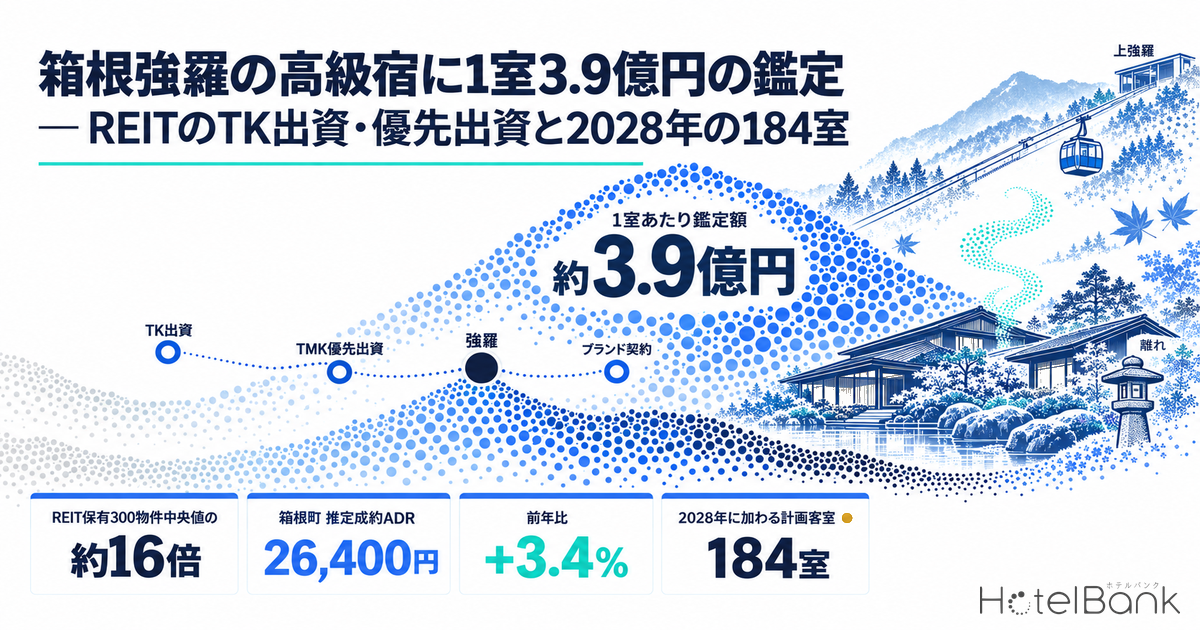
Three different ways for capital to enter high-end lodging in an onsen resort surfaced in the same month in Gora, Hakone. On September 14, 2026, Star Asia Investment Corporation (スターアジア不動産投資法人, 3468) disclosed that it will acquire a tokumei kumiai (TK, silent partnership) equity interest backed by the Former Kan’in-no-miya Gora Villa (旧閑院宮強羅別邸) for ¥1,679 million. The underlying real estate is appraised at ¥16,400 million; divided by its 42 guest rooms, that comes to roughly ¥390 million per room. Ten days earlier, United Urban Investment Corporation (ユナイテッド・アーバン投資法人, 8960) announced that it will subscribe to preferred equity in a tokutei mokuteki kaisha (TMK, special-purpose company) that owns a 90-room hotel about to be developed in Kami-Gora. Hilton’s list of planned openings also carries the 94-room “LXR Hotels & Resorts (tentative name) Hakone Gora Hotel Project” (opening in 2028). This article reads the capital vehicles entering an established luxury ryokan and two new developments at the same time, using the original disclosures, 300 hotel properties held by J-REITs, and the estimated settled ADR for the town of Hakone.
Metric Definitions Used in This Article
- ADR (average daily rate): An estimated settled rate (tax-exclusive equivalent) calculated by applying a property-type adjustment factor to the lowest-plan price level each property publishes on OTAs (two guests per room, per-room rate, tax-inclusive). In a reconciliation against property-level results disclosed by listed hotel REITs (91 properties, most recent three months), the median error is about 7%. These are estimates and differ from each property’s actual settled prices and accounting figures. Area-level ADR is the median of the properties covered (the level of a typical property in the area). This article uses closed months only (through August 2026).
- Acquisition price per room: The acquisition price disclosed by a J-REIT divided by the number of guest rooms (our calculation). Appraisal value per room: The appraisal value divided by the number of guest rooms (our calculation). An acquisition price is the amount agreed in a sale, while an appraisal value is a real estate appraiser’s valuation as of a given date; because the two differ in nature, placing them side by side is a rough guide only.
- Data sources: MetroEngines Research, timely disclosures of each investment corporation, MLIT Real Estate Information Library
- — 49.5%: In the established luxury ryokan, the REIT holds 49.5% of the equity through a tokumei kumiai (TK) investment, with a ¥10,000 million non-recourse loan (61.0% of appraisal value) ranking above it.
- — 14.3% / end of September 2031: In the 90-room new development in Kami-Gora, the REIT subscribes to about 14.3% of the preferred equity and obtains a preferential negotiation right running from completion (scheduled for September 2028) to the end of September 2031.
- — About 16x: The appraisal value of roughly ¥390 million per room is about 16 times the ¥24.4 million median acquisition price per room across 300 hotel properties in Japan held by J-REITs.
- — ¥26,400 / +3.4%: Hakone’s estimated settled ADR averaged ¥26,400 from September 2025 to August 2026, up 3.4% YoY; resort hotels rose 9.7%, with the higher price tiers growing faster.
- — About 320 m² per room: Land with roughly 320 m² of site per room and a disclosed floor-area ratio of 90% makes it hard to build another property of the same form, while 184 rooms in 2028 (about 7.8% of the rooms within 1.5 km) join the upper tier.
Three Vehicles at Work in Gora — TK Equity, TMK Preferred Equity, and a Brand Deal
All three are stories of “a REIT or an operator getting involved in high-end lodging in Gora,” but the vehicles differ. The Star Asia Investment Corporation deal is a tokumei kumiai investment in a godo kaisha (GK) that holds a completed, operating ryokan as a trust beneficiary interest. The United Urban Investment Corporation deal is preferred equity in a TMK that acquires land and will build on it, and it comes with a right to buy the property itself after completion (a preferential negotiation right). The LXR project appears in Hilton’s materials as a planned opening, so it is a move seen from the brand and operating side.
For investors, the difference lies in which point in time’s risk is held, and at what ranking. The former is tied to the earnings of an operating ryokan; the latter runs through a development period up to completion and then leads to a decision on acquiring the finished property. With both types of vehicle used in the same district at once, the picture of capital flowing into both established luxury ryokan and new luxury hotels has become clear.
| Item | Former Kan’in-no-miya Gora Villa | Nowa by RIHGA Hakone Gora (tentative name) | LXR (tentative name) Hakone Gora Hotel Project |
|---|---|---|---|
| Announced by / date | Star Asia Investment Corporation (September 14, 2026) | United Urban Investment Corporation (September 4, 2026) | Hilton “Company Overview” (updated August 25, 2026) |
| Vehicle | TK investment in Akatsuki GK (合同会社あかつき) | Preferred equity in Hakone Kami-Gora Project TMK | Planned hotel opening (brand) |
| REIT’s investment | ¥1,679 million (49.5% of total TK equity) | Round 1: ¥166.5 million; Round 2: ¥77.3 million (about 14.3% of total preferred equity) | — |
| Guest rooms | 42 rooms (incl. 4 detached villas) | 90 rooms (East Wing 55, West Wing 35) | 94 rooms |
| Stage | Operating (built December 1989) | Completion scheduled for September 2028 (development to start at end of October 2026) | Opening in 2028 |
| Operation / contract | Master lessee: Akatsuki Unei GK (合同会社あかつき運営), pass-through | Reservation agreement for a fixed-term building lease with The Royal Hotel, Limited (株式会社ロイヤルホテル) | Not stated in the materials |
| Underlying asset / valuation | Appraisal value ¥16,400 million (Japan Real Estate Institute) | TMK assets ¥4,912.2 million (mainly land and cash; assumed figures) | Not stated in the materials |
Source: Compiled by MetroEngines Research & Consulting from timely disclosures of Star Asia Investment Corporation and United Urban Investment Corporation, and Hilton “Company Overview” (updated August 25, 2026)
Former Kan’in-no-miya Gora Villa — 49.5% TK Equity and a ¥10,000 Million Non-Recourse Loan
The name used in the disclosure is “Former Kan’in-no-miya Gora Villa and attached lodging facilities” (旧閑院宮強羅別邸及び付属する宿泊施設); the property’s trade name is not given. However, the address (1300 Gora, Hakone-machi, Ashigarashimo-gun, Kanagawa) and its origin as the Kan’in-no-miya villa match the description on the official website of Gora Kadan (強羅花壇). The disclosure introduces the property as “one of Japan’s leading luxury ryokan and a member of Relais & Châteaux” (an international association of independent luxury hotels and restaurants), and cites as strengths its onsen fed by three hot-spring sources, facilities such as a pool, and its Japanese-style detached villas and guest rooms with open-air baths.
Looking at how the capital is stacked, the TK operator, Akatsuki GK, holds the trust beneficiary interest, funded by a ¥10,000 million non-recourse loan and ¥3,392 million of TK equity. The TK equity breaks down into ¥1,679 million from ML Estate Co., Ltd. (エムエル・エステート株式会社), ¥1,679 million from Star Asia Investment Corporation, and ¥33 million from the Star Asia Group. Star Asia Investment Corporation explains that it used a bridge scheme provided by ML Estate, its sub-sponsor, and in effect takes half of the equity up front. Dividing the non-recourse loan by the appraisal value gives 61.0% (our calculation), leaving the remaining roughly 39% as the cushion on the equity side.
Source: Compiled by MetroEngines Research & Consulting from Star Asia Investment Corporation “13th Asset Replacement” (September 14, 2026) and United Urban Investment Corporation “Notice Concerning Acquisition of Domestic Assets” (September 4, 2026). The TMK structure reflects assumed figures as of Rounds 1–2
The security arrangements are also disclosed. Pledges have been created over the trust beneficiary interest, with the senior lender of the non-recourse loan ranking first and the mezzanine lender ranking third. In other words, the loan is structured in two layers, senior and mezzanine, and the TK equity sits beneath them. The TK agreement runs until the end of April 2045, with a calculation period every three months; losses are allocated to the TK investors in proportion to their contributions, and any portion exceeding the amount contributed is borne by the TK operator. From the REIT’s standpoint, the downside is limited to its ¥1,679 million contribution, while growth in the ryokan’s earnings is captured in proportion to its share.
Star Asia Investment Corporation cites internal growth through investment in “luxury ryokan with room for lodging demand to expand” as an aim of this asset replacement. The replacement also involves acquiring a limited-service hotel in Osaka and disposing of an Osaka hotel more than 10 years old, and the luxury ryokan was added through an equity interest rather than as a physical asset. The monthly rent is undisclosed because the TK operator’s consent has not been obtained.
The Kami-Gora Development TMK — 14.3% Preferred Equity and a Negotiation Right Through September 2031
The United Urban Investment Corporation deal is a vehicle entered before development begins. Hakone Kami-Gora Project TMK acquired the development site on September 30, 2026, and plans to start developing the hotel from the end of October 2026. The plan consists of three buildings: a North Wing with a restaurant, bar lounge and large communal bath, and two guest-room wings, the East Wing (55 rooms) and West Wing (35 rooms). Every room will have an open-air bath and measure at least 50 m² including the terrace. The site is a one-minute walk from Kami-Gora Station on the Hakone Tozan Cable Car; the disclosure gives the land as 9,359.78 m² and the building as 10,104.86 m² (reinforced concrete, one basement level and four floors above ground, among others).
The TMK’s funding structure (assumed figures as of Rounds 1–2) is ¥4,912.2 million of assets against a ¥2,957.9 million senior loan, a ¥116.7 million mezzanine loan, a ¥134.6 million consumption-tax loan, and ¥1,703 million of preferred equity. Senior plus mezzanine divided by assets comes to 62.6% (our calculation). Most of the assets are land and cash; the construction costs for the building will be funded through, among other things, additional preferred equity issues scheduled for the end of September 2027 and the end of August 2028. United Urban Investment Corporation’s subscription totals ¥243.8 million across Rounds 1 and 2, about 14.3% of total preferred equity.
| Timing (planned) | Details |
|---|---|
| End of September 2026 | United Urban Investment Corporation acquires Round 1 preferred equity and signs the preferential negotiation agreement |
| End of October 2026 | Additional preferred equity issue (Round 2). Development starts from the end of the month |
| End of September 2027 | Additional preferred equity issue (Round 3), planned |
| End of August 2028 | Additional preferred equity issue (Round 4), planned |
| September 2028 | Building completion (planned). Rent to the TMK scheduled to begin in January 2029 |
| Around September 2028 to end of September 2031 | United Urban Investment Corporation may exercise its preferential negotiation right |
Source: United Urban Investment Corporation “Notice Concerning Acquisition of Domestic Assets (Preferred Equity Securities of Hakone Kami-Gora Project (Hotel Development) TMK)” (September 4, 2026)
As for the opening date, the operator, The Royal Hotel, Limited, announced in a press release dated September 4, 2026 that it will be “around the end of December 2028,” making this the brand’s second property after Nowa by RIHGA Kobe Arima (ノワ・バイ・リーガ 神戸有馬, 93 rooms), scheduled to open in February 2028. The sequence runs from the disclosed completion date (September 2028) through a pre-opening period and into operation. The preferential negotiation right carries no obligation to acquire, and the sale price is to be decided through discussion in light of sales performance and the financing environment. Being able to decide whether to buy after seeing actual results post-opening is the option value this vehicle provides.
Where Does a ¥390 Million-per-Room Appraisal Sit Among 300 REIT-Held Properties?
Using J-REIT portfolio data (our compilation as of September 21, 2026; some properties as of July 27 and September 14, 2026), we tabulated the 300 hotels in Japan held by seven hotel REITs for which both acquisition price and room count are available. The median acquisition price per room was ¥24.4 million. The top-25% threshold is about ¥40.6 million and the top-10% threshold about ¥66.5 million; only 16 properties exceed ¥100 million. The seven REITs covered are Ichigo Hotel REIT Investment Corporation (いちごホテルリート投資法人, 3463), Invincible Investment Corporation (インヴィンシブル投資法人, 8963), Nippon Hotel & Residential Investment Corporation (日本ホテル&レジデンシャル投資法人, 3472), Japan Hotel REIT Investment Corporation (ジャパン・ホテル・リート投資法人, 8985), Hoshino Resorts REIT (星野リゾート・リート投資法人, 3287), MORI TRUST REIT (森トラストリート投資法人, 8961), and Kasumigaseki Hotel REIT Investment Corporation (霞ヶ関ホテルリート投資法人, 401A).
Source: Compiled by MetroEngines Research & Consulting from J-REIT portfolio data (our compilation as of September 21, 2026; N=300 properties, Japan only) and Star Asia Investment Corporation’s timely disclosure
Among the 300 properties covered, the highest acquisition price per room is ¥246.0 million for Shangri-La Tokyo (シャングリ・ラ 東京), held by MORI TRUST REIT (¥49,200 million / 200 rooms). In Gora itself, Japan Hotel REIT Investment Corporation’s Hakone Gora Onsen Tokinoyu Setsugetsuka (箱根強羅温泉 季の湯 雪月花) comes to ¥25.8 million (¥4,070 million / 158 rooms) and Hoshino Resorts REIT’s KAI Hakone (界 箱根) to ¥27.9 million (¥950 million / 34 rooms), both close to the overall median. Even as a rough comparison that allows for the difference between acquisition prices and appraisal values, the roughly ¥390 million appraisal value per room of the former Kan’in-no-miya Gora Villa sits above every property in the dataset.
Source: Compiled by MetroEngines Research & Consulting from J-REIT portfolio data (our compilation as of September 21, 2026) and Star Asia Investment Corporation’s timely disclosure. Acquisition prices (REIT-held properties) and the appraisal value (Former Kan’in-no-miya Gora Villa) differ in nature, so the comparison is a rough guide
The gap shows how completely different the form of lodging can be within the same onsen resort. Setsugetsuka is a 158-room property that accommodates a broad range of guests, whereas the former Kan’in-no-miya Gora Villa spreads 42 rooms across a site of about 1.3 ha. Price divided by room count directly reflects the room rate and the depth of land and building behind each room.
| Cap rate assumption | Annual NOI per room | NOI per room per day (365 days) |
|---|---|---|
| 3.5% | ¥13.7 million | approx. ¥37,400 |
| 4.0% | ¥15.6 million | approx. ¥42,800 |
| 4.5% | ¥17.6 million | approx. ¥48,100 |
Source: Estimated by MetroEngines Research & Consulting based on Star Asia Investment Corporation’s timely disclosure (appraisal value ¥16,400 million, 42 rooms). The cap rate is not disclosed and is an assumption. NOI is net income from the real estate, not room revenue
Converting the appraisal value into NOI per room, a 4.0% cap rate implies that about ¥42,800 of net income per room per day is required. This is not room revenue but real estate income after operating expenses and the rent structure are deducted. It is far above the estimated settled ADR for Hakone as a whole (about ¥26,400, discussed below), which suggests the valuation assumes not the town’s average rate but the very top price tier and a per-stay spend that includes food and beverage and onsen.
| Cap rate \ NOI margin | 25% | 30% | 35% | 40% |
|---|---|---|---|---|
| 3.5% | approx. ¥149,800 | approx. ¥124,800 | approx. ¥107,000 | approx. ¥93,600 |
| 4.0% | approx. ¥171,200 | approx. ¥142,600 | approx. ¥122,300 | approx. ¥107,000 |
| 4.5% | approx. ¥192,600 | approx. ¥160,500 | approx. ¥137,500 | approx. ¥120,400 |
Source: Estimated by MetroEngines Research & Consulting based on Star Asia Investment Corporation’s timely disclosure (appraisal value ¥16,400 million, 42 rooms). Required total revenue = NOI per room per day in Table 3 ÷ NOI margin. Per available room per day (assuming every room is sold every day), including ancillary revenue such as food and beverage and onsen. Neither the cap rate nor the NOI margin is disclosed; both are assumptions. The shaded cell is the mid case
Converting NOI into total revenue requires an assumption about how much of total revenue remains as NOI (the NOI margin). In the mid case of a 4.0% cap rate and a 30% NOI margin, about ¥142,600 of total revenue per available room per day is needed (Table 4). Even the most lenient combination (3.5% cap rate, 40% NOI margin) requires about ¥93,600, and the strictest (4.5%, 25%) about ¥192,600. The top-10% threshold of estimated settled ADR within 1.5 km of Gora, discussed below, is ¥64,700, so the mid-case required total revenue is about 2.2 times that level. ADR is the lodging rate per room sold, whereas Table 4 is expressed per available room with every room sold every day and includes ancillary revenue; because the definitions differ, the two cannot be compared directly. Still, it shows that room rates alone do not get there: the level only works when a per-stay spend including food and beverage and onsen and high occupancy both come together.
Hakone’s Estimated Settled ADR Is ¥26,400, Up 3.4% YoY — Resorts Up 9.7%
According to MetroEngines Research data, Hakone’s estimated settled ADR averaged ¥26,400 over the 12 months from September 2025 to August 2026 (N=170–187 properties). That is up 3.4% from ¥25,500 in the same 12 months a year earlier (September 2024 to August 2025). By month, November 2025 (¥28,900), March 2026 (¥28,800) and August 2026 (¥28,200) were high, and June 2026 (¥22,700), in the rainy season, was low. The pattern typical of an onsen resort, with rate peaks in the autumn-foliage season, spring break and summer holidays, has appeared in the same places two years running.
Source: Compiled by MetroEngines Research & Consulting (Hakone, all property types, N=170–193 properties, closed months only)
Broken down by property type, growth differs. Resort hotels averaged ¥33,700 over the 12 months, up 9.7% YoY, while ryokan averaged ¥25,600, up 2.5%. The resort sample is small at 27–29 properties, but the direction, with higher price tiers growing faster, is consistent with capital heading toward high-end lodging in the current deals.
| Property type | Sep 2024–Aug 2025 | Sep 2025–Aug 2026 | YoY | N (latest 12 months) |
|---|---|---|---|---|
| All types | ¥25,500 | ¥26,400 | +3.4% | 170–187 properties |
| Ryokan | ¥25,000 | ¥25,600 | +2.5% | 138–155 properties |
| Resort hotels | ¥30,700 | ¥33,700 | +9.7% | 27–29 properties |
Source: Compiled by MetroEngines Research & Consulting
The 184 Rooms Arriving in 2028 and Price Tiers Within 1.5 km of Gora
In 2028, the 90 rooms in Kami-Gora and the 94 rooms planned under LXR will add a combined 184 rooms. Within a 1.5 km radius centered on the location of the former Kan’in-no-miya Gora Villa, MetroEngines Research confirmed 104 properties with 2,366 rooms (the sum of each property’s registered room count) on sale in at least six of the past 12 months; 184 rooms is about 7.8% of that. The LXR project is listed in the planned openings of Hilton’s “Company Overview” (updated August 25, 2026) as “LXR Hotels & Resorts (tentative name) Hakone Gora Hotel Project,” with 94 rooms and a 2028 opening. Because the materials give no detailed location, the map shows only the Kami-Gora project site.
1: Former Kan’in-no-miya Gora Villa (42 rooms) 2: Hakone Gora Onsen Tokinoyu Setsugetsuka (158 rooms, held by Japan Hotel REIT Investment Corporation) 3: Planned site of Nowa by RIHGA Hakone Gora (tentative name) (near Kami-Gora Station, 90 rooms) Gray circles: lodging properties confirmed on sale within the 1.5 km radius (circle size reflects room count)
Source: MetroEngines Research & Consulting; timely disclosures of each investment corporation. The Kami-Gora project site is an approximate location based on the station
Looking at the distribution of the 64 properties in the same 1.5 km radius for which estimated settled ADR is available, the median is ¥27,200, the top-25% threshold ¥43,200, and the top-10% threshold ¥64,700. Twelve properties sit in the ¥50,000-and-above band. The two additions are rooms of 50 m² or more, all with open-air baths (Kami-Gora), and a luxury brand (LXR), so the new supply thickens the existing upper tier. For which price tiers high-priced new supply across Hakone falls into, see also Hakone’s 126-Room Luxury Supply: Listed +30.9%, Settled ADR +5.7%.
Source: Compiled by MetroEngines Research & Consulting (1.5 km radius; 12-month average for the 64 properties with estimates in at least six months between September 2025 and August 2026)
Scarcity Protected by Low-Density Land — About 320 m² of Site per Room
The site of the former Kan’in-no-miya Gora Villa covers 13,431.75 m²; the disclosed zoning is Category 1 Residential, with a building coverage ratio / floor-area ratio of 30% / 90%. Dividing the total floor area of 9,698.21 m² (the sum of nine registered buildings) by the site area gives about 72% (our calculation). Per room, that is roughly 320 m² of site and 231 m² of floor area. The Kami-Gora plan works out to about 104 m² of site and 112 m² of floor area per room, so even within Gora the former uses land far more generously.
Checking the zoning for the same point in the Ministry of Land, Infrastructure, Transport and Tourism (MLIT) Real Estate Information Library shows Category 1 Residential (designated building coverage ratio 60%, floor-area ratio 200%). The disclosed 30% / 90% is below these designated values, and the disclosure does not state the reason for the difference. Almost all of Hakone lies within Fuji-Hakone-Izu National Park, so the area is subject to regulation under the Natural Parks Act in addition to city planning (Town of Hakone). Either way, it is not easy in Gora to assemble a new site of the same scale and build a low-rise property with detached villas, and this works as scarcity supporting the asset value of established properties.
| Item | Former Kan’in-no-miya Gora Villa | Nowa by RIHGA Hakone Gora (tentative name) |
|---|---|---|
| Site area | 13,431.75m² | 9,359.78m² |
| Total floor area | 9,698.21m² | 10,104.86m² |
| Guest rooms | 42 rooms | 90 rooms |
| Site per room | approx. 320 m² | approx. 104 m² |
| Floor area per room | approx. 231 m² | approx. 112 m² |
| Zoning (Real Estate Information Library) | Category 1 Residential | Category 1 Residential (near Kami-Gora Station) |
| Structure | RC, two floors with seven basement levels (main building) | RC, one basement level and four floors above ground, among others |
Source: Compiled by MetroEngines Research & Consulting from timely disclosures of each investment corporation and the MLIT Real Estate Information Library (zoning)
Checking Disaster Risk — PML of 14.8%, Sediment Disaster Warning Areas, and Mt. Hakone
On earthquake risk, Star Asia Investment Corporation discloses a PML of 14.8% for the former Kan’in-no-miya Gora Villa (also 14.8% for the staff dormitory). On sediment disasters, checking the area around Gora in the Real Estate Information Library shows many sediment disaster warning areas and special warning areas designated on slopes in Gora, Kiga, Ninotaira and elsewhere (113 areas within the same map sheet). The representative points for the former Kan’in-no-miya Gora Villa and the vicinity of Kami-Gora Station, however, fell within none of these areas. A determination for each site as a whole needs to be confirmed individually against its boundaries.
On volcanic risk, the Japan Meteorological Agency has issued a volcanic forecast for Mt. Hakone (Volcanic Alert Level 1: be mindful that it is an active volcano). The Town of Hakone compiled a report on its response during the period from May 19 to October 7, 2019, when the alert level was raised; access restrictions were in place around Owakudani during that time. For investors, the practical point is to factor in, alongside insurance, that changes in volcanic activity affect demand not through the lodging buildings themselves but through the surrounding sightseeing routes.
How Investors Can Read This — Equity Share, Negotiation Right, Non-Recourse
Look at the equity share
A 49.5% TK stake means the REIT participates substantially in the earnings of a completed ryokan. A 14.3% preferred equity stake keeps involvement small during development while securing an entry point for acquisition. The difference in share is a difference in which stage’s risk is held.Look at the negotiation right
The Kami-Gora preferential negotiation right runs from around September 2028 to the end of September 2031. There is no obligation to acquire, and the decision can be made after seeing post-opening sales. It is an option to bring in a development property together with a track record.Look at the non-recourse debt
For the former Kan’in-no-miya Gora Villa, a ¥10,000 million non-recourse loan (61.0% of appraisal value) comes in two layers, senior and mezzanine. The REIT’s downside is capped at its contribution, and earnings growth is captured in proportion to its share.Seen from the real estate finance desk of a regional bank, both deals are non-recourse loans to the vehicle (GK or TMK), with repayment limited to the property’s earnings. For the former Kan’in-no-miya Gora Villa, disclosure of a capital structure split into three layers (senior, mezzanine and TK) showed that even a luxury ryokan deal can raise funds by dividing risk by layer. For ryokan owners, the fact that both GK-TK and TMK structures are already in use in onsen resorts is a useful reference, whether as a way to bring in outside capital without giving up ownership or as a vehicle for a future buyer.
For acquisition teams, the issue is that the per-room price range is on a different level from ordinary hotels. Measured against the ¥24.4 million median acquisition price per room for REIT-held hotels, the appraisal value of the 42-room luxury ryokan is 16 times as high. What supports that price is not the number of rooms but the size of the site and the upper price tier, and the next indicator to watch is how far that upper tier thickens after 184 rooms of luxury supply are added to the same district in 2028.
Frequently Asked Questions
Q. In what form did a REIT invest in a luxury ryokan in Gora?
A. Star Asia Investment Corporation acquired, for ¥1,679 million (49.5% of total TK equity), a tokumei kumiai equity interest in Akatsuki GK, which holds the former Kan’in-no-miya Gora Villa as a trust beneficiary interest. Rather than owning the property itself, it participates in the earnings through an investment in the TK operator.
Q. How is the figure of roughly ¥390 million per room calculated?
A. It is our calculation: the appraisal value of ¥16,400 million divided by 42 guest rooms. Because it differs in nature from the ¥24.4 million median acquisition price per room for J-REIT-held hotels (300 properties in Japan), it is shown as a rough guide for comparison.
Q. When will the new hotel in Kami-Gora open?
A. United Urban Investment Corporation’s disclosure gives completion as scheduled for September 2028, and the operator, The Royal Hotel, Limited, has announced an opening around the end of December 2028. It will have 90 rooms, all with open-air baths.
Q. What is a preferential negotiation right?
A. It is a right to negotiate a sale and purchase agreement for a property ahead of others. In the Kami-Gora deal, it is valid from the date the building is delivered (planned for around September 2028) to the end of September 2031 and carries no obligation to acquire. The price is decided through discussion in light of sales performance and the financing environment.
Summary
In September 2026, Gora saw two vehicles announced in quick succession: one entering an operating luxury ryokan through a tokumei kumiai investment, the other entering a hotel under development through preferred equity. The roughly ¥390 million appraisal value per room of the former Kan’in-no-miya Gora Villa is about 16 times the ¥24.4 million median acquisition price per room for J-REIT-held hotels, a level supported by the depth of land (about 320 m² of site per room) and the very top price tier. Hakone’s estimated settled ADR averaged ¥26,400 over 12 months, up 3.4% YoY, with resort hotels up 9.7% as the higher tiers grew faster. In 2028, the 90 rooms in Kami-Gora and the 94 rooms planned under LXR will be added, widening the options in the luxury tier. By combining equity interests, preferred equity and preferential negotiation rights, high-end onsen lodging is becoming an investment target that REITs and regional banks can engage with stage by stage.
Note: ADR in this article is an estimate (median error of about 7% in reconciliation against REIT-disclosed results). Settled ADR disclosed by REITs is shown excluding consumption tax, and the estimated settled ADR in this article is also at a tax-exclusive equivalent level. Figures for development plans (completion timing, funding structure, room counts) are plans and assumptions as of the date of each disclosure or document and may change. Estimates using cap rates are reference values based on assumptions.
Related Articles
References and Sources
■ Data sources
Timely disclosures of Star Asia Investment Corporation (September 14, 2026) and United Urban Investment Corporation (September 4, 2026); press release of The Royal Hotel, Limited (September 4, 2026); Hilton “Company Overview” (updated August 25, 2026). Market data: MetroEngines Research estimated settled ADR (Hakone; all types / ryokan / resort hotels; closed months September 2024 to August 2026; N=170–193 properties), properties confirmed on sale within 1.5 km of Gora (104 properties, 2,366 rooms; estimated settled ADR for 64 properties), and J-REIT portfolio data (seven hotel REITs, 300 properties in Japan, as of September 21, 2026). Zoning and sediment disaster warning areas are from the MLIT Real Estate Information Library.
■ Estimation assumptions
Appraisal value per room = appraisal value of ¥16,400 million ÷ 42 rooms; acquisition price per room = acquisition price ÷ number of rooms. NOI per room in Table 3 = appraisal value per room × cap rate (assumed at 3.5–4.5%); the per-day figure divides by 365 days. Required total revenue in Table 4 = NOI per room per day ÷ NOI margin (assumed at 25–40%). Loan ratio = ¥10,000 million non-recourse loan ÷ appraisal value; for the TMK, (senior + mezzanine) ÷ assets of ¥4,912.2 million (assumed figures as of Rounds 1–2). The 1.5 km radius is centered on the location of the former Kan’in-no-miya Gora Villa and covers properties confirmed on sale in at least six of the past 12 months. Hakone’s estimated settled ADR is the simple 12-month average of monthly values.
■ Limitations and caveats
Estimated settled ADR is an estimate (median error of about 7% in reconciliation against REIT-disclosed results); it is a tax-exclusive equivalent lodging rate per room, and its definition differs from total revenue including ancillary revenue. Appraisal values and acquisition prices differ in nature, so the per-room comparison is a rough guide. The cap rate and NOI margin are not disclosed and are assumptions. Completion timing, funding structure and room counts for development plans are plans and assumptions as of each disclosure date and may change. The number of properties within 1.5 km is based on confirmed sales and excludes properties that are closed or not listed. Zoning and sediment disaster warning areas were checked at representative points and are not a determination for the entire site.
■ Timely disclosures and materials
- Star Asia Investment Corporation “Notice Concerning Acquisition of Domestic Real Estate Trust Beneficiary Interests and a Tokumei Kumiai Equity Interest and Disposition of a Domestic Real Estate Trust Beneficiary Interest (13th Asset Replacement)” (September 14, 2026)
- United Urban Investment Corporation “Notice Concerning Acquisition of Domestic Assets (Preferred Equity Securities of Hakone Kami-Gora Project (Hotel Development) TMK)” (September 4, 2026)
- The Royal Hotel, Limited: Nowa by RIHGA Hakone Gora to open in December 2028 (September 4, 2026)
- Hilton “Company Overview” (updated August 25, 2026)
- Gora Kadan official website
■ Government statistics and public data
- MLIT Real Estate Information Library — zoning and sediment disaster warning areas
- Town of Hakone “City Planning (Zoning, etc.)”
- Japan Meteorological Agency “Volcanic Activity Status (Mt. Hakone)”
- Town of Hakone “Report on the Response to the Raising of the Volcanic Alert Level for Mt. Hakone” (March 2020)
■ Market data
- MetroEngines Research & Consulting — Estimated settled ADR (Hakone N=170–187 properties; around Gora N=64 properties), J-REIT portfolio data (300 properties in Japan, as of September 21, 2026)