


Split Gunma Prefecture’s lodging market by municipality and room rates fall cleanly into three tiers. In MetroEngines Research’s count as of November 8, 2026, the estimated settled ADR (hereafter ADR) for September 2026 was led by hot-spring and highland towns: Kawaba Village at ¥30,786 (N=3), Kusatsu Town at ¥17,003 (N=94) and Minakami Town at ¥16,995 (N=51). The prefectural capital Maebashi came in at ¥7,502 (N=30) and Takasaki at ¥7,397 (N=31), roughly half the level of the onsen towns or less. As the Gunma edition of our prefectural investment map series, this article reads the market as a single map: ADR and occupancy for 18 municipalities, room supply in 2025–2026, the competitive structure within 3km of Kusatsu Onsen and 1.5km of Takasaki Station, acquisition prices and disclosed results for the three J-REIT-owned properties, and feasibility estimates for new builds and acquisitions.
• ADR (average daily rate) = estimated settled rate (tax-exclusive equivalent), calculated by applying a property-type adjustment factor to the lowest published OTA plan rate (per room, two guests per room, tax included). Checked against property-level results disclosed by listed hotel REITs (91 properties, latest three months), the median error is about 7%. These are estimates and differ from each property’s actual settled prices and accounting figures.
• Area-level ADR (prefecture or municipality) is the median of the estimated settled rates of the covered properties (the level of a typical property in the area).
• Where published prices are cited, they are per-room rates for two guests per room (tax included).
• OCC (occupancy) = rooms sold as a share of total rooms in the area (an estimate based on OTA sales inventory).
• Source: MetroEngines Research (continuous tracking of OTA published rates for about 168,000 properties in Japan, of which about 27,000 are confirmed operating)
Occupancy (OTA listed-inventory basis, estimated) is an estimate based on how OTA inventory sells through and differs from a property’s actual overall occupancy. Booking curve = change in remaining OTA rooms toward the check-in date. LT (lead time) = days until check-in.
- — Gunma’s estimated settled ADR (September 2026) was ¥11,817 (+4.4% YoY, N=440 properties). Against the onsen/highland tier’s Kusatsu at ¥17,003 and Minakami at ¥16,995, the urban tier’s Maebashi (¥7,502) and Takasaki (¥7,397) sit at less than half that level.
- — Estimated occupancy (September 2026) was 81.4% prefecture-wide (278 properties, 12,866 rooms). Takasaki held 84.2% while lifting ADR 13.2% YoY, absorbing the large 2025–2026 supply additions.
- — Within 3km of Kusatsu Onsen, 80% of the 74 operating properties have 50 rooms or fewer. Only one property, Naraya, sits at 20–60 rooms × over ¥40,000, making the mid-size high-end ryokan the thinnest zone on the price map.
- — J-REITs own 3 properties in the prefecture (as of November 2, 2026). Kamenoi Hotel Kusatsu Yubatake was acquired at ¥58.5 million per room, and its disclosed September 2026 results were ADR ¥26,932 and occupancy 97.2% (that month, REIT disclosure).
- — Simple estimates put GOP yield at 7.0% for a 150-room new build in Takasaki, 3.5% for a 40-room new ryokan in Kusatsu, and 8.9% for acquiring and renovating an existing Takasaki hotel. Acquisition/repositioning plays come out ahead of new builds.
Conclusion — Onsen/highland tier at ¥15,000–31,000, urban tier at ¥6,000–7,500, and a middle tier around ¥10,000 in between
Start with the big picture. Gunma’s prefecture-wide ADR was ¥11,817 in September 2026, up 4.4% YoY, and estimated occupancy that month was 81.4% (278 properties, 12,866 rooms, based on listings on major booking sites). Looking only at the prefectural average, Gunma reads as a mid-ranking prefecture on the edge of the Tokyo metro area, but breaking it down by municipality changes the picture. The top six (Kawaba, Naganohara, Kusatsu, Minakami, Nakanojo and Shibukawa) all exceed ¥15,000, while the bottom six cities (Maebashi, Takasaki, Kiryu, Ota, Tatebayashi and Isesaki) cluster at about ¥7,500 or below, with a middle tier of Tsumagoi, Numata, Katashina and Fujioka at around ¥10,000 in between. We tested this tiering across municipalities with 12 months of time-series data in Gunma ADR Gap Hits 3.5x: Minakami vs Isesaki; this article takes the latest month’s cross-section and carries it through to feasibility.
The investment implications also differ by tier. The onsen/highland tier commands high rates, but within 3km of Kusatsu Onsen 59 of the 74 operating properties have 50 rooms or fewer, a cluster of small ryokan, and the room-count × rate map leaves the zone of 20–60 rooms above ¥40,000 almost empty. In the urban tier, Takasaki (+13.2% YoY) and Kiryu (+21.9%) rank near the top of the prefecture for growth, but with absolute levels in the ¥7,000 range, new builds only pencil out if rates keep rising. In the scenario estimates later in this article, a 150-room limited-service new build yields around 7%, while acquiring and renovating an existing hotel yields around 9%, putting the advantage of acquisition/repositioning into numbers.
ADR by municipality — Split 18 municipalities into three tiers and the top six exceed ¥15,000
Table 1 lists the September 2026 estimated settled ADR for the 18 municipalities with three or more covered properties. ADR is each municipality’s median (the level of a typical property); YoY compares with September 2025, and estimated occupancy for the same month (OTA listed-inventory basis) is shown alongside. Kawaba Village tops the prefecture at ¥30,786, but that is the median of just three properties and should be read only as a rough guide. Naganohara Town (including Kita-Karuizawa) stands out at ¥19,435, up 57.5% YoY, but with only nine properties the sample is small and swings widely from month to month (¥8,338 in November 2025 vs ¥19,435 in September 2026), so it is more reasonable to read this as variation in which high-priced properties were selling that month than as a trend.
| Municipality | Tier | ADR Sep 2026 | YoY | N (properties) | Occupancy (est.) |
|---|---|---|---|---|---|
| Kawaba Village | Onsen/highland | ¥30,786 | +5.7% | 3 | — |
| Naganohara Town | Onsen/highland | ¥19,435 | +57.5% | 9 | — |
| Kusatsu Town | Onsen/highland | ¥17,003 | +0.8% | 94 | 85.2% |
| Minakami Town | Onsen/highland | ¥16,995 | +2.4% | 51 | 81.1% |
| Nakanojo Town | Onsen/highland | ¥16,954 | -1.9% | 36 | 84.8% |
| Shibukawa City | Onsen/highland | ¥15,368 | -2.7% | 46 | 83.0% |
| Tsumagoi Village | Middle | ¥12,771 | +13.2% | 21 | 69.3% |
| Numata City | Middle | ¥11,533 | +11.3% | 19 | 86.4% |
| Katashina Village | Middle | ¥9,955 | -0.1% | 23 | 93.4% |
| Fujioka City | Middle | ¥9,320 | +27.7% | 8 | — |
| Annaka City | Urban | ¥7,948 | +35.8% | 13 | — |
| Tomioka City | Urban | ¥7,626 | +27.2% | 4 | — |
| Maebashi City | Urban | ¥7,502 | -2.2% | 30 | 74.1% |
| Takasaki City | Urban | ¥7,397 | +13.2% | 31 | 84.2% |
| Kiryu City | Urban | ¥7,014 | +21.9% | 10 | — |
| Ota City | Urban | ¥6,239 | -6.1% | 13 | — |
| Tatebayashi City | Urban | ¥5,810 | -3.8% | 6 | — |
| Isesaki City | Urban | ¥5,619 | -1.7% | 12 | — |
On the map, the high-rate municipalities form a band across Agatsuma District in the northwest (Kusatsu, Naganohara, Tsumagoi, Nakanojo) and Tone District (Minakami, Kawaba, Katashina), while the low-rate cities line the plains along the Kan-etsu and Kita-Kanto expressways. Shibukawa (Ikaho Onsen) sits at the bottom of the onsen tier at ¥15,368, and Numata stands out within the middle tier at ¥11,533, up 11.3% YoY. On the plains, many cities are above last year: Takasaki +13.2%, Kiryu +21.9% and Annaka +35.8%. That rates rose despite large supply additions such as the 199-room APA Hotel Takasaki-Eki Higashiguchi (November 2025) and the 243-room Hotel Route Inn Grand Maebashi (February 2026) points to resilient demand in the urban tier. The direction is not uniform across the plains, however: Maebashi was down 2.2% and Ota down 6.1%.
Seasonality — Prefectural ADR peaks twice, in summer and at New Year; onsen towns peak in December–January
Next, add the time axis. Figure 3 plots Gunma’s prefecture-wide ADR by month, overlaying 2024, 2025 and 2026. There are two peaks, in August and in December–January; in 2026 ADR moved from ¥13,182 in August (+1.8% YoY) to ¥11,817 in September (+4.4%) and ¥11,676 in October (−0.3%). After some months below the prior year in June–July, 2026 returned to levels at or above last year from August, so on a full-year view rates are edging up within a broadly flat range.
By municipality, the seasonal shape is even sharper. Kusatsu’s high over the latest 13 months was ¥21,261 in December 2025 and its low ¥14,599 in June 2026, a peak-to-trough gap of about 46%. Minakami also peaked at ¥20,362 in August 2026, Tsumagoi peaked in winter at ¥16,810 in January 2026 during ski season, and Shibukawa (Ikaho) reached ¥20,929 in the autumn-foliage month of November 2025. Takasaki, by contrast, moved in a narrow ¥6,537–¥7,755 range and Maebashi in ¥6,830–¥8,808, with almost no seasonal price swing. The difference in business model shows up directly in the numbers: in the onsen/highland tier, revenue hinges on pricing that fully captures the winter peak, while in the urban tier it rests on building occupancy across the year. How onsen towns split into peak-month types, such as Kusatsu’s December peak versus the October peaks of Takayama and Nikko, is laid out across 16 onsen municipalities in Onsen Rate Peaks: Kusatsu in December, Takayama & Nikko in October.
Estimated occupancy — Ryokan 84.9%, business hotels 83.4%; Numata, Kusatsu and Nakanojo around 85%
After rates comes occupancy. Gunma’s estimated occupancy (OTA listed-inventory basis) in September 2026 was 81.4% overall (278 properties, 12,866 rooms). By category, ryokan were at 84.9% (145 properties, 4,887 rooms), business hotels 83.4% (48 properties, 4,588 rooms), resort hotels 73.1% (22 properties, 1,855 rooms) and city hotels 73.2% (9 properties, 897 rooms). Ryokan and business hotels sit side by side in the mid-80s, while resort and city hotels stay in the low 70s.
By municipality, Numata led at 86.4% (11 properties, 562 rooms), followed by Kusatsu 85.2% (47 properties, 1,804 rooms), Nakanojo 84.8%, Takasaki 84.2% (21 properties, 2,053 rooms), Shibukawa 83.0% and Minakami 81.1%, while Tsumagoi (69.3%) and Maebashi (74.1%) have relatively more room to spare. Figure 4 plots ADR against occupancy: Kusatsu and Nakanojo sit top right (high rate, high occupancy), Takasaki and Numata bottom right (low rate, high occupancy), and Tsumagoi and Maebashi on the left. For Tsumagoi, September is the shoulder season between summer and winter; its rate of ¥12,771 (+13.2% YoY) is rising, which suggests there is still occupancy left on the table.
*Estimated occupancy covers stay dates from May 7, 2026 onward, each with an observation window of at least 60 days. For long-term occupancy trends, refer to the Japan Tourism Agency’s Overnight Travel Statistics Survey.
Room supply — 35 properties / 926 rooms in 2025, 46 / 675 in 2026, with vacation rentals 60% of the count
What about supply? Within MetroEngines Research’s coverage, 35 lodging properties with 926 rooms opened in Gunma in 2025, and 46 with 675 rooms in 2026 (based on confirmed OTA listings, as of November 8, 2026). In 2025, APA Hotel Takasaki-Eki Higashiguchi (199 rooms, November), APA Hotel Gunma Ota-Eki Kita (127 rooms, December), Kamenoi Hotel Kusatsu Resort (103 rooms, December), HOTEL R9 Premium Kawamata-Ekimae (97 rooms, September) and Akagi Natural Hot Spring Hana Hotel & Spa Shibukawa (86 rooms, August) led the way, with seven business hotels and two resorts accounting for most of the rooms. In 2026, Hotel Route Inn Grand Maebashi (243 rooms, February), B/C HOTEL Kusatsu (97 rooms, July) and KAI Kusatsu (94 rooms, June) together made up 434 rooms, or 64% of the total, while by count 27 vacation rentals made up 59% of openings, as small one- or two-room additions spread mainly around Kita-Karuizawa and Minakami.
| Opened | Property | Type | Rooms |
|---|---|---|---|
| Mar 2025 | HOTEL R9 The Yard Kiryu | Business hotel | 41 |
| Jun 2025 | HOTEL R9 The Yard Tomioka Nanokaichi | Business hotel | 38 |
| Aug 2025 | Akagi Natural Hot Spring Hana Hotel & Spa Shibukawa | Resort hotel | 86 |
| Sep 2025 | HOTEL R9 Premium Kawamata-Ekimae | Business hotel | 97 |
| Sep 2025 | HOTEL R9 The Yard Shibukawa | Business hotel | 45 |
| Nov 2025 | APA Hotel Takasaki-Eki Higashiguchi | Business hotel | 199 |
| Nov 2025 | Mirai Hotel | Cottage | 37 |
| Dec 2025 | Kamenoi Hotel Kusatsu Resort | Resort hotel | 103 |
| Dec 2025 | APA Hotel Gunma Ota-Eki Kita | Business hotel | 127 |
| Feb 2026 | Hotel Route Inn Grand Maebashi | Business hotel | 243 |
| Apr 2026 | Hotel Livemax Numata GRANDE | Business hotel | 37 |
| Jun 2026 | Hoshino Resorts KAI Kusatsu | Ryokan | 94 |
| Jul 2026 | B/C HOTEL Kusatsu | Resort hotel | 97 |
| Oct 2026 | Business Hotel Marina | Business hotel | 58 |
The confirmed pipeline ahead is thin. Based on building-confirmation applications in the Ministry of Land, Infrastructure, Transport and Tourism (MLIT) Building Activity Statistics, the only hotel plan identifiable in Gunma is a 10-story, 150-room hotel in Kasakake, Midori City (3,219㎡ total floor area, scheduled for completion in April 2027). Among rebrands of existing properties, Oedo Onsen Monogatari Premium Matsunoi, which took over the former Matsunoi at Minakami Onsen, opened on August 7, 2026, the series’ second property in the prefecture after Ikaho. That supply is tilting toward revival of existing ryokan and small vacation rentals rather than large new hotels supports the acquisition/repositioning scenario discussed later.
*New openings are based on confirmed OTA listings; because listings appear several months before opening, counts for recent and future months may rise as more listings appear. Building plans are based on confirmation applications as of the survey date and are expected to grow as more applications are filed, so treat them as a floor for the currently confirmed pipeline.
Kusatsu Onsen 3km radius — 103 listed properties / 3,230 rooms; 80% of 74 operating properties (2,551 rooms) have 50 rooms or fewer
Now draw a radius around Kusatsu Onsen, the core of the onsen/highland tier. Room stock in this article covers lodging properties with 10 or more rooms (excluding leisure hotels) within 3,000m of Kusatsu Onsen’s Yubatake hot-spring field; “operating” refers to properties with selling prices confirmed on major booking sites in the latest three months (September–November 2026) (as of November 9, 2026, MetroEngines Research count).
Listed stock within 3km of Yubatake comes to 103 properties and 3,230 rooms, of which 74 properties and 2,551 rooms are operating. By type, ryokan account for two-thirds of operating rooms (53 properties, 1,700 rooms), followed by resort hotels (9 properties, 654 rooms). By size band, properties with 50 rooms or fewer make up 80% of operating properties (59 properties, 1,016 rooms), while those with 101–200 rooms number just six (826 rooms). Room stock grew 18.4% from 2,355 rooms in 2017 to 2,788 in 2026, with 315 rooms added in the three years since 2023. Mid-size newcomers such as Kamenoi Hotel Kusatsu Yubatake (80 rooms, 2023), Kamenoi Hotel Kusatsu Resort (103 rooms, 2025), KAI Kusatsu (94 rooms, 2026) and B/C HOTEL Kusatsu (97 rooms, 2026) have joined a town lined with small ryokan opened around the 1990s.
| Type | Listed props | Listed rooms | Operating props | Operating rooms |
|---|---|---|---|---|
| Ryokan | 67 | 2,073 | 53 | 1,700 |
| Resort hotel | 12 | 699 | 9 | 654 |
| Pension | 12 | 170 | 7 | 87 |
| Company/group lodge | 4 | 136 | 0 | 0 |
| Deluxe hotel | 1 | 56 | 1 | 56 |
| Business hotel | 2 | 22 | 0 | 0 |
| Size | Listed props | Listed rooms | Operating props | Operating rooms |
|---|---|---|---|---|
| 50 rooms or fewer | 87 | 1,589 | 59 | 1,016 |
| 51–100 rooms | 9 | 709 | 9 | 709 |
| 101–200 rooms | 7 | 932 | 6 | 826 |
Figure 8 is a positioning map of the 62 operating properties for which an estimated settled ADR could be calculated, with room count on the horizontal axis and September 2026 ADR on the vertical. The median is ¥18,739, and 22 properties crowd into the band of 15 rooms or fewer × ¥10,000–25,000. Among large properties with over 100 rooms, Kusatsu Onsen Hotel Ichii (124 rooms, ¥39,226) and Kusatsu Now Resort Hotel (154 rooms, ¥35,297) sit above ¥35,000, while in the 50–100-room mid-size band KAI Kusatsu (94 rooms, ¥36,286), Yuyado Toki no Niwa (64 rooms, ¥35,428) and La Vista Kusatsu Hills (69 rooms, ¥32,005) line up in the ¥30,000s. Notably, only one property with 20–60 rooms exceeds ¥40,000, Naraya (36 rooms, ¥48,202), and small high-end properties are limited to the 10–12-room Tenojiya and Tsutsujitei (¥55,000–60,000). The 20–60 rooms × over ¥40,000 zone, in other words a mid-size, high-rate ryokan built around rooms with private open-air baths, is the thinnest zone on this onsen town’s price map.
Dense Crowded zone
¥10,000–25,000 × 15 rooms or fewer
22 small ryokan, mostly opened around the 1990s. New entrants need to differentiate on something other than price.
WS1 Mid-size high-end ryokan
Over ¥40,000 × 20–60 rooms
Only Naraya qualifies. The mid-size, high-rate band built around rooms with private open-air baths is a gap that extensions or renovations of existing ryokan can target.
WS2 Large upper-midscale
Over ¥40,000 × over 100 rooms
None. Among properties with over 100 rooms, Ichii and Now Resort top out at ¥35,000–39,000; a large property that combines scale and rate is untapped.
Three J-REIT properties — Kusatsu Yubatake’s 80 rooms at ¥58.5M per room, disclosed ADR ¥27K and 97% occupancy
Listed REIT holdings let us check the level of acquisition prices. The listed hotel REITs referenced in this article are seven: Ichigo Hotel REIT (3463), Invincible Investment Corporation (8963), Japan Hotel & Residential Investment Corporation (3472), Japan Hotel REIT Investment Corporation (8985), Hoshino Resorts REIT (3287), Mori Trust REIT (8961) and Kasumigaseki Hotel REIT (401A). Extracting Gunma properties from MetroEngines Research’s ownership master (as of November 2, 2026) yields just three. Invincible owns Kamenoi Hotel Kusatsu Yubatake (80 rooms, acquired August 2025, acquisition price ¥4,682 million) and Comfort Hotel Maebashi (153 rooms, acquired January 2016, ¥1,128 million), and Japan Hotel & Residential owns Oedo Onsen Monogatari Premium Ikaho (40 rooms, acquired September 2016, ¥1,299 million).
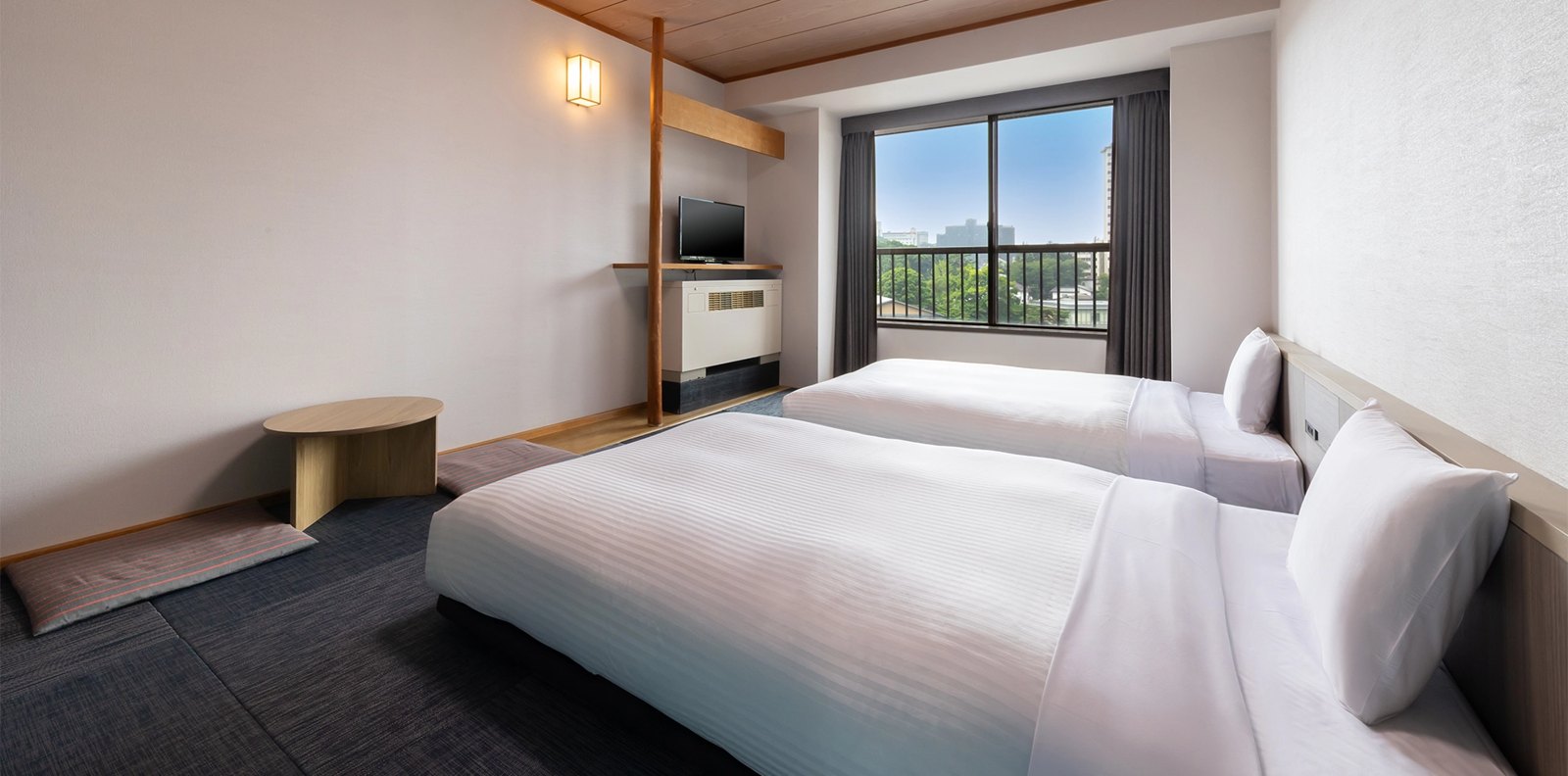
| Property | REIT owner | Rooms | Acquired | Acquisition price | Per room | Sep 2026 occupancy | ADR | RevPAR |
|---|---|---|---|---|---|---|---|---|
| Kamenoi Hotel Kusatsu Yubatake | Invincible | 80 | Aug 2025 | ¥4,682 million | ¥58.5 million | 97.2% | ¥26,932 | ¥26,180 |
| Oedo Onsen Monogatari Premium Ikaho | Japan H&R | 40 | Sep 2016 | ¥1,299 million | ¥32.5 million | 93.7% | ¥47,989 | ¥44,950 |
| Comfort Hotel Maebashi | Invincible | 153 | Jan 2016 | ¥1,128 million | ¥7.4 million | — | — | — |
Acquisition price per room is ¥58.5 million for Kusatsu Yubatake (acquired 2025), ¥32.5 million for Ikaho (acquired 2016) and ¥7.4 million for the Maebashi business hotel (also acquired 2016), a gap of about 8x between the onsen and urban tiers. Kusatsu Yubatake’s disclosed September 2026 results were occupancy of 97.2% (September 2026, REIT-disclosed, N=1 property), ADR ¥26,932 and RevPAR ¥26,180, which annualizes to about ¥9.56 million in revenue per room. Assuming a 35% GOP margin gives about ¥3.35 million per room, roughly 5.7% of the acquisition price. MetroEngines Research’s estimated settled ADR for the same property in September 2026 was ¥28,305, within +5.1% of the disclosed figure. Even allowing for the fact that this article’s ADR figures are estimates (median error about 7% against disclosed REIT results), it confirms that a mid-size new build right by Yubatake commands 1.6–1.7 times Kusatsu Town’s ADR of ¥17,003. Settled ADR in REIT disclosures is shown excluding consumption tax, and this article’s estimated settled ADR is likewise a tax-exclusive equivalent.
Takasaki Station 1.5km radius — 21 operating properties / 2,632 rooms, business hotels 80% of rooms, rates ¥7,000–13,000
For the core of the urban tier, look at the Takasaki Station area. Room stock here covers lodging properties with 10 or more rooms (excluding leisure hotels) within 1,500m of Takasaki Station; “operating” refers to properties with selling prices confirmed on major booking sites in the latest three months (September–November 2026) (as of November 9, 2026, MetroEngines Research count).
Listed stock within 1.5km of Takasaki Station is 28 properties and 2,952 rooms, of which 21 properties and 2,632 rooms are operating; business hotels account for 80% of operating rooms (18 properties, 2,168 rooms). Four large properties with 201 or more rooms hold 987 rooms, making this, in contrast to Kusatsu, a market of large limited-service hotels. Room stock rose 11.8% from 2,379 rooms in 2017 to 2,660 in 2026, with the 199-room APA Hotel Takasaki-Eki Higashiguchi (2025) the most recent addition. Takasaki’s ADR was ¥7,397 in September 2026 (N=31), up 13.2% YoY, with estimated occupancy of 84.2% (21 properties, 2,053 rooms), meaning the city raised rates while absorbing the new supply.
| Size | Listed props | Listed rooms | Operating props | Operating rooms |
|---|---|---|---|---|
| 50 rooms or fewer | 10 | 302 | 5 | 212 |
| 51–100 rooms | 4 | 272 | 4 | 272 |
| 101–200 rooms | 10 | 1,391 | 8 | 1,161 |
| 201 rooms or more | 4 | 987 | 4 | 987 |
| Property (top 8 by ADR) | Type | Rooms | Opened | ADR Sep 2026 |
|---|---|---|---|---|
| Hotel Cocogrand Takasaki | Business hotel | 119 | 2012 | ¥13,016 |
| Hotel Metropolitan Takasaki | City hotel | 141 | 1982 | ¥10,573 |
| Dormy Inn Takasaki (Haruna no Yu) | Business hotel | 119 | 2009 | ¥10,558 |
| Hotel Grandview Takasaki | City hotel | 111 | 2018 | ¥10,213 |
| HOTEL1-2-3 Takasaki | Business hotel | 119 | 2007 | ¥10,148 |
| APA Hotel Takasaki-Ekimae | Business hotel | 233 | 2004 | ¥8,933 |
| Harris Hotel WEST | Business hotel | 45 | 2023 | ¥8,395 |
| Takasaki Washington Hotel Plaza | City hotel | 212 | 1990 | ¥8,346 |
By property, Hotel Cocogrand Takasaki (119 rooms, opened 2012) is the highest in the radius at ¥13,016, followed by Hotel Metropolitan Takasaki (141 rooms) at ¥10,573 and Dormy Inn Takasaki (119 rooms) at ¥10,558; five properties exceed ¥10,000. The radius median is about ¥8,020 and the room-weighted average about ¥8,500, with properties offering large public baths, breakfast and station-front locations beating the city median of ¥7,397 by ¥3,000–5,000. That gap shows the upside in repositioning: renovating existing business hotels opened around 1990 to move them into a higher rate band.
Land prices and location — Takasaki ¥83K/㎡ and Maebashi ¥57K/㎡ vs Kusatsu ¥36K/㎡, with Yubatake-front up 13.6%
Check the land-cost assumption against MLIT’s 2026 Official Land Price Publication (as of January 1). The all-use average by municipality puts Takasaki at the top of the prefecture at ¥82,900/㎡ (+0.9% YoY), followed by plains cities Maebashi at ¥57,000/㎡ (+0.4%) and Ota at ¥42,200/㎡ (+1.0%), while Kusatsu is ¥36,400/㎡ (+1.6%), Shibukawa ¥35,500/㎡ (−0.5%), Nakanojo ¥24,200/㎡ (−2.2%), Minakami ¥19,900/㎡ (−2.2%), Naganohara ¥9,200/㎡ (−1.2%) and Tsumagoi ¥3,700/㎡ (±0%). Gunma’s prefecture-wide all-use average is ¥46,000/㎡, essentially flat at +0.1% YoY. The higher the room rates, the lower the land prices in the onsen/highland tier, an inverse correlation that is favorable for investment returns.
| Municipality | Tier | All-use average land price (¥/㎡) | YoY | ADR Sep 2026 |
|---|---|---|---|---|
| Takasaki City | Urban | 82,900 | +0.9% | ¥7,397 |
| Maebashi City | Urban | 57,000 | +0.4% | ¥7,502 |
| Ota City | Urban | 42,200 | +1.0% | ¥6,239 |
| Numata City | Middle | 40,400 | −0.6% | ¥11,533 |
| Kusatsu Town | Onsen/highland | 36,400 | +1.6% | ¥17,003 |
| Shibukawa City | Onsen/highland | 35,500 | −0.5% | ¥15,368 |
| Isesaki City | Urban | 34,800 | +0.2% | ¥5,619 |
| Kiryu City | Urban | 28,200 | −0.9% | ¥7,014 |
| Nakanojo Town | Onsen/highland | 24,200 | −2.2% | ¥16,954 |
| Minakami Town | Onsen/highland | 19,900 | −2.2% | ¥16,995 |
| Naganohara Town | Onsen/highland | 9,200 | −1.2% | ¥19,435 |
| Tsumagoi Village | Middle | 3,700 | ±0% | ¥12,771 |
The center of the onsen town, however, is moving differently. The benchmark site in front of Kusatsu Onsen’s Yubatake was valued at ¥125,000/㎡ in the 2026 publication, up 13.6% YoY, one of the steepest rises in the prefecture, and the town’s commercial land as a whole was reported up 5.86%. Kusatsu’s tourist visits in FY2025 reached 4,053,223, a record for the third straight year (Yomiuri Shimbun report), and that strong demand is starting to show up in land prices around Yubatake. Even so, buying a 2,500㎡ site at the Yubatake-front price would cost about ¥310 million, only around 15% of the investment compared with the roughly ¥1.8 billion construction cost of the 40-room ryokan discussed below. In the onsen tier, returns are decided by construction cost and operating efficiency, not land price.
On access, Takasaki Station is North Kanto’s largest hub, served by the Joetsu and Hokuriku Shinkansen and six conventional lines, and its proximity of about 50 minutes from Tokyo Station by Shinkansen underpins business and event demand in the urban tier. Kusatsu Onsen is about 25 minutes by bus from Naganohara-Kusatsuguchi Station and about 2.5 hours by limited express from Ueno, with most visitors driving via the Kan-etsu and Joshin-etsu expressways; its role as a one-night weekend trip from the Tokyo area shows up in the height of its winter peak.
Development and acquisition scenarios — 150-room new build yields 7.0%, 40-room Kusatsu ryokan 3.5%, acquisition + renovation 8.9%
Using the rates, occupancy and land prices above, we model returns for three scenarios. All are simple estimates; actual investment decisions require a detailed feasibility study. For construction cost, we note that, based on MLIT’s Building Construction Starts Statistics, hotel construction cost in 2024 averaged ¥1.95 million per tsubo across all structures (RC ¥1.738 million, steel ¥1.650 million), up 41% in two years from ¥1.38 million in 2022, and that secondary tallies for 2025 show costs holding high at ¥1.952 million for all structures and ¥2.405 million for steel; we then adopted the upper end of type-specific guides (¥1.0–1.5 million per tsubo for limited-service hotels, ¥1.6–2.5 million for ryokan). For GOP margin, we referenced Invincible’s 38.9% for 91 MHM-operated properties (fiscal period ended December 2024) and type-specific guides (40–60% for limited-service, 5–15% for ryokan), and set conservative first-year values of 45% for limited-service, 20% for onsen ryokan and 42% for acquisition + renovation.
| Item | A. Takasaki new limited-service | B. Kusatsu new onsen ryokan | C. Takasaki acquisition + renovation Recommended |
|---|---|---|---|
| Rooms | 150 rooms (18㎡) | 40 rooms (45㎡, with open-air bath) | 100 rooms (existing, 1990s) |
| ADR assumption | ¥7,397 (Takasaki median) | ¥30,000 (local mid-size band) | ¥9,000 (post-renovation, local upper band) |
| Occupancy assumption | 84.2% | 85.2% | 84.2% |
| Floor area / tsubo | 3,971㎡ / 1,201 tsubo | 3,000㎡ / 908 tsubo | — |
| Construction / renovation cost | ¥1.5M/tsubo · ¥1.80bn | ¥2.0M/tsubo · ¥1.82bn | Renovation ¥3M/room · ¥0.30bn |
| Land / acquisition | Station-front 1,300㎡ · ¥0.39bn (assumed) | Yubatake-front 2,500㎡ · ¥0.31bn | Acquisition ¥10M/room · ¥1.00bn (assumed) |
| Total investment | ¥2.19bn | ¥2.13bn | ¥1.30bn |
| Annual revenue | ¥341M | ¥373M | ¥277M |
| GOP (margin) | ¥153M (45%) | ¥75M (20%) | ¥116M (42%) |
| GOP yield | 7.0% | 3.5% | 8.9% |
| After construction inflation (built 2027–28, +5%/yr compounded) | Construction ¥1.94bn · total ¥2.33bn · yield 6.6% | Construction ¥1.96bn · total ¥2.27bn · yield 3.3% | — |
The results are clear. Scenario A, a new build at the city’s median ADR of ¥7,397, yields 7.0%, or 6.6% once construction inflation is factored in, implying a payback of over 15 years. Scenario B, the 40-room Kusatsu ryokan, has the highest revenue of the three at ¥373 million, but the low GOP margin typical of ryokan holds it to 3.5%; for a new build to work in the onsen tier, it must either go after the “over ¥40,000 × 20–60 rooms” band seen in WS1 above or keep construction costs down by extending or renovating an existing ryokan. Scenario C assumes buying a business hotel near Takasaki Station opened around 1990 at ¥10 million per room and renovating it at ¥3 million per room to lift the rate to ¥9,000; at 8.9% it yields the most. The fact that top properties within 1.5km of Takasaki Station already achieve ¥10,000–13,000 supports that rate uplift. For buyers of onsen ryokan, the next step is to work backward from ADR, occupancy and target yield to the maximum price per room they can pay.
| Sensitivity analysis (GOP yield) | Base case | ADR −10% | Occupancy −5pt | Both |
|---|---|---|---|---|
| A. Takasaki new limited-service | 7.0% | 6.3% | 6.6% | 5.9% |
| B. Kusatsu new onsen ryokan | 3.5% | 3.2% | 3.3% | 3.0% |
| C. Takasaki acquisition + renovation | 8.9% | 8.0% | 8.4% | 7.6% |
Because the table above only looks at one-sided downside, we also set out a two-way sensitivity that moves ADR and occupancy together. For Scenario A (Takasaki new build, 150 rooms, total investment ¥2.19bn, GOP margin 45%) and Scenario C (Takasaki acquisition + renovation, 100 rooms, total investment ¥1.30bn, GOP margin 42%), we took five ADR levels and five occupancy levels centered on Takasaki’s estimated 84.2% for September 2026, and recalculated GOP yield. Scenario A reaches an 8% yield only from around ADR ¥8,500 combined with 84.2% occupancy (estimate, September 2026, Takasaki aggregate, N=21 properties), which requires a rate about 15% above the city median. Scenario C still secures 8.1% even if occupancy falls to 76%, provided ADR holds at ¥9,000, and even with the rate held to ¥8,000 it yields 7.9% at 84.2% occupancy (same basis), above Scenario A’s 7.0% base case. The advantage of the acquisition/renovation model holds up whether rate or occupancy disappoints.
| ADR \ Occupancy | 72% | 76% | 80% | 84.2% (base) | 88% |
|---|---|---|---|---|---|
| ¥6,500 | 5.3% | 5.6% | 5.9% | 6.2% | 6.4% |
| ¥7,000 | 5.7% | 6.0% | 6.3% | 6.6% | 6.9% |
| ¥7,397 (base) | 6.0% | 6.3% | 6.7% | 7.0% | 7.3% |
| ¥8,000 | 6.5% | 6.8% | 7.2% | 7.6% | 7.9% |
| ¥8,500 | 6.9% | 7.3% | 7.6% | 8.1% | 8.4% |
| ADR \ Occupancy | 72% | 76% | 80% | 84.2% (base) | 88% |
|---|---|---|---|---|---|
| ¥8,000 | 6.8% | 7.2% | 7.5% | 7.9% | 8.3% |
| ¥8,500 | 7.2% | 7.6% | 8.0% | 8.4% | 8.8% |
| ¥9,000 (base) | 7.6% | 8.1% | 8.5% | 8.9% | 9.3% |
| ¥9,500 | 8.1% | 8.5% | 9.0% | 9.4% | 9.9% |
| ¥10,000 | 8.5% | 9.0% | 9.4% | 9.9% | 10.4% |
High construction costs also work to restrain new supply. That Gunma’s confirmed pipeline is a single 150-room project and that 2026 openings lean toward vacation rentals and revived ryokan can be read as an upside factor for acquiring and repositioning existing properties, since the competitive environment is likely to stay moderate.
Demand assumptions and risk factors — 9.75 million guest nights (−4.9% YoY), foreign guests up 36.6%
Check the demand base against public statistics. According to Gunma Prefecture’s 2024 Tourist Visitor Statistics Survey, tourist visits in 2024 were 64.35 million (102.3% of the prior year), total guest nights 9.751 million (95.1%), foreign guest nights 432,000 (136.6%) and tourism spending ¥280.9 billion (106.2%), with spending per overnight guest of ¥23,506 (111.7%). Fewer guests alongside higher spending and more foreign visitors fits the “rate over occupancy” direction seen in this article. Nationally, the Japan Tourism Agency’s Overnight Travel Statistics Survey for August 2026 (first preliminary) showed 62.68 million guest nights, down 6.7% YoY, with room occupancy of 64.4% (August 2026, first preliminary). Even allowing for the different definition (an estimate based on listed inventory), Gunma’s estimated occupancy of 81.4% suggests relatively strong sell-through continues.
| Risk factor | Level | Details and interpretation |
|---|---|---|
| Demand (domestic) | Medium | Total guest nights in the prefecture in 2024 were 95.1% of the prior year. As a one-night weekend destination from the Tokyo area, the market is sensitive to weather, gasoline prices and the timing of holidays |
| Demand (inbound) | Low–medium | Foreign guest nights grew to 432,000 (+36.6%) but are only 4.4% of the prefectural total. There is plenty of room to add more, but for now domestic guests are what support rates |
| Supply | Low | The confirmed pipeline is one 150-room project. 27 of the 46 openings in 2026 are vacation rentals, and large new hotels are limited |
| Construction cost | High | Steel-frame cost per tsubo in 2025 was ¥2.405 million, near record highs. This directly lowers yields in new-build scenarios |
| Seasonality | Medium | Kusatsu’s peak-to-trough gap over the latest 13 months is about 46%. Pricing that captures the winter peak and occupancy measures for the off-season are prerequisites |
| Land prices | Low | Land in the onsen tier is cheap at ¥3,700–36,000/㎡ and, apart from Yubatake-front’s +13.6%, flat to slightly down. Land is not what drives returns here |
Summary — Gunma’s investment map runs on two tracks: mid-size high-end in the onsen tier, acquisition and renovation in the urban tier
Putting it all together, Gunma’s lodging market splits into three tiers by rate and two tracks by return profile. The onsen/highland tier (Kusatsu, Minakami, Nakanojo, Shibukawa, Naganohara, Kawaba) posts ADR of ¥15,000–31,000 and estimated occupancy of 81–86%, high on both counts, but on the Kusatsu Onsen 3km price map only Naraya sits at 20–60 rooms × over ¥40,000, leaving a gap for mid-size high-end ryokan. Because the low GOP margin holds new builds to yields in the 3% range, the realistic way in is to extend or renovate an existing ryokan, or convert to rooms with private open-air baths. Kamenoi Hotel Kusatsu Yubatake, acquired at ¥58.5 million per room and posting ADR ¥26,932 and 97.2% occupancy (September 2026, REIT disclosure), is a real-world example that a mid-size new build right by Yubatake can command 1.6 times the town’s median rate.
The urban tier (Takasaki, Maebashi, Ota, Isesaki, Kiryu, Tatebayashi) has low ADR of ¥5,600–7,500, but Takasaki is up 13.2% YoY with estimated occupancy of 84.2%, absorbing the recent large additions of the 199-room APA Hotel Takasaki-Eki Higashiguchi and the 243-room Hotel Route Inn Grand Maebashi. New builds yield only around 7% at ADR in the ¥7,000 range, while the scenario of buying and renovating a business hotel opened around 1990 to move it toward the local upper band of ¥10,000–13,000 yields the most at 8.9%. A supply environment where the confirmed pipeline is a single 150-room project is a tailwind for this acquire-and-renovate approach. As of the November 8, 2026 survey, Gunma’s investment map converges on two tracks: in the onsen tier, “mid-size high-end that fills the gap in scale and rate”; in the urban tier, “acquiring and repositioning existing stock.”
Frequently Asked Questions
On estimated settled ADR (median) for September 2026, Kawaba Village is highest at ¥30,786 (3 properties), followed by Naganohara Town at ¥19,435 (9 properties), Kusatsu Town at ¥17,003 (94 properties), Minakami Town at ¥16,995 (51 properties) and Nakanojo Town at ¥16,954 (36 properties). The four municipalities with enough properties for stable levels are Kusatsu, Minakami, Nakanojo and Shibukawa.
Estimated settled ADR in September 2026 was ¥7,502 in Maebashi (30 properties) and ¥7,397 in Takasaki (31 properties). Takasaki is up 13.2% YoY, and within 1.5km of Takasaki Station, top properties with large public baths and breakfast achieve rates of ¥10,000–13,000.
Room stock within 3km of Yubatake grew about 18%, from 2,355 rooms in 2017 to 2,788 in 2026. Since 2023, mid-size properties such as Kamenoi Hotel Kusatsu Yubatake (80 rooms), Kamenoi Hotel Kusatsu Resort (103 rooms), KAI Kusatsu (94 rooms) and B/C HOTEL Kusatsu (97 rooms) have been added.
Three properties as of November 2, 2026. Invincible Investment Corporation owns Kamenoi Hotel Kusatsu Yubatake (80 rooms, acquisition price ¥4,682 million) and Comfort Hotel Maebashi (153 rooms, ¥1,128 million), and Japan Hotel & Residential Investment Corporation owns Oedo Onsen Monogatari Premium Ikaho (40 rooms, ¥1,299 million).
In this article’s simple estimates, a new 150-room limited-service hotel in Takasaki yields a GOP return of 7.0% (6.6% after construction inflation), and a new 40-room onsen ryokan in Kusatsu yields 3.5%. Acquiring and renovating an existing business hotel to lift its rate to ¥9,000 yields 8.9%, so acquisition/repositioning comes out relatively ahead. Actual investment decisions require a detailed feasibility study.
Related Articles
References and Sources
■ Data sources
Estimated settled ADR calculated from OTA published rate and inventory data continuously tracked by MetroEngines Research (municipal medians, 18 municipalities with 3 or more properties, September 2026, retrieved November 8, 2026); estimated occupancy on an OTA listed-inventory basis (278 properties / 12,866 rooms prefecture-wide); room stock within 3km of Kusatsu Onsen Yubatake and 1.5km of Takasaki Station (as of November 9, 2026); IR disclosures of listed hotel REITs (property lists and monthly operating results); and public statistics from MLIT, the Japan Tourism Agency and Gunma Prefecture.
■ Estimate assumptions
GOP yield = rooms × 365 days × ADR × occupancy × GOP margin ÷ total investment. Annual revenue is rooms revenue only, with no ancillary revenue added. ADR is the municipal median (A), the local mid-size band (B) and the local upper band (C); occupancy is the September 2026 estimate; GOP margin is 45% for limited-service, 20% for onsen ryokan and 42% for acquisition + renovation; construction cost is ¥1.5 million/tsubo (A) and ¥2.0 million/tsubo (B); renovation cost ¥3 million/room (C); construction cost escalation +5%/yr compounded (built 2027–28). Land and acquisition prices are assumed values.
■ Limitations
ADR and occupancy are estimates (median error about 7% against disclosed REIT results) and differ from each property’s actual settled prices and accounting figures. This is a single-month cross-section for September 2026; in municipalities such as Kusatsu, where the peak-to-trough gap over the latest 13 months is about 46%, full-year yields will move up or down. Municipalities with fewer than 10 covered properties (Kawaba, Naganohara, Fujioka, Tomioka, Tatebayashi) swing widely and should be treated as rough guides. The estimates are simplified and do not deduct taxes and public charges, insurance, FF&E reserves or financing costs; investment decisions require a detailed feasibility study.
■ Market data
- MetroEngines Research & Consulting — estimated settled ADR (by municipality, September 2026, N=3–94 properties), occupancy (OTA listed-inventory basis, estimated, 278 properties / 12,866 rooms prefecture-wide), room stock (Kusatsu Onsen Yubatake 3km radius and Takasaki Station 1.5km radius, as of November 9, 2026), new openings (confirmed OTA listings, 35 properties in 2025 and 46 in 2026), J-REIT ownership master (as of November 2, 2026)
■ Government statistics and public data
- Gunma Prefecture, 2024 Tourist Visitor Statistics Survey Report (summary) / full report
- Japan Tourism Agency, Overnight Travel Statistics Survey: August 2026 (first preliminary) and July 2026 (second preliminary)
- MLIT Official Land Price Publication 2026, Gunma municipal averages (compiled by Diamond Real Estate Research Institute)
- MLIT, Building Construction Starts Statistics / MLIT, Building Activity Statistics (hotel plans based on confirmation applications)
- archi-book, 2025 Construction Cost per Tsubo by Structure
■ REIT and industry reports
- Invincible Investment Corporation, September 2026 Monthly Operating Results / Portfolio list
- Japan Hotel & Residential Investment Corporation, portfolio materials
- HOTELISM, Hotel Construction Cost Guide by Property Type / Relo Hotel Solutions, GOP Margin by Property Type
- JLL, Japan Hotel Investment Market 2025
■ News and press releases
- Kenbiya, “Kusatsu FY2025 tourist visits 4.05 million; Yubatake-front official land price +13.6%” (September 25, 2026, citing Yomiuri Shimbun and Asahi Shimbun reports)
- Travel.jp, “Oedo Onsen Monogatari Premium Matsunoi grand opening August 7, 2026”
- Travel Voice, “Hoshino Resorts to open KAI Kusatsu in spring 2026” (April 23, 2025)