

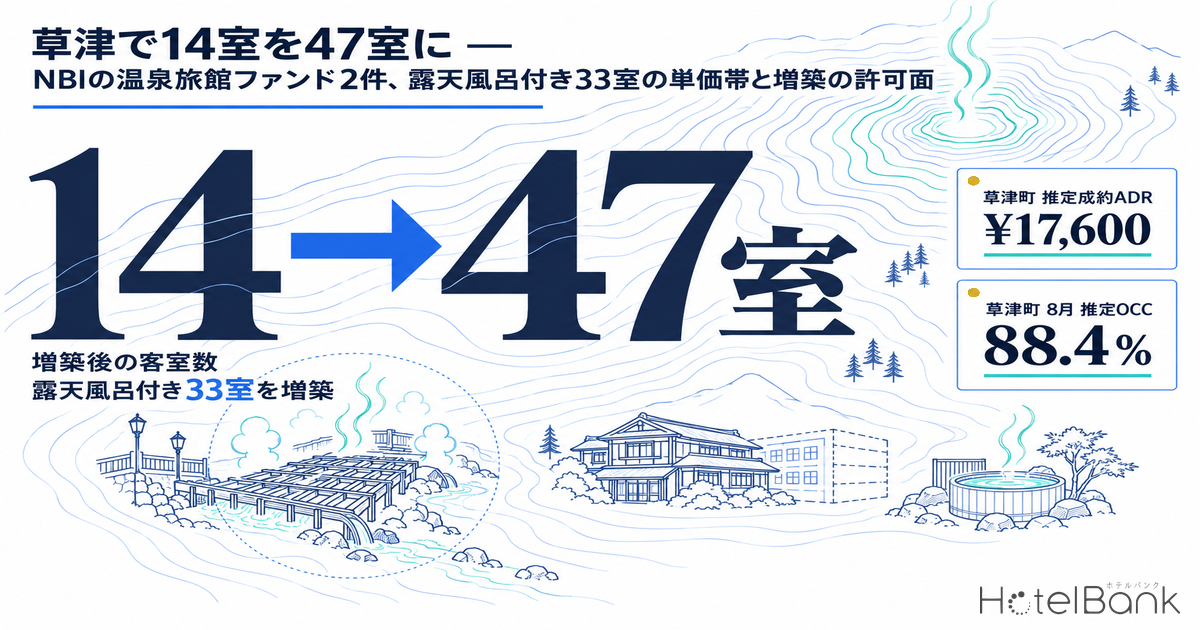
The “NBI Kusatsu Onsen Project” announced by NBI Holdings on January 30, 2026 involved acquiring the existing ryokan Fortreat Kusatsu (フォートリート草津) at 553 Kusatsu, Kusatsu Town (14 rooms, site area 29,148.15 m²), and adding an annex with 33 guest rooms featuring private open-air baths plus a restaurant, designed and built by Sekisui House, to reposition it as a 47-room luxury onsen ryokan. Then on August 3, NBI Kusatsu Kaihatsu GK — for which NBI acts as asset manager — received a tokumei kumiai (silent partnership) investment from ER27, an SBI Securities group company, and acquired Ura-Kusatsu TOU (裏草津 蕩 TOU; 56 rooms, 4 with private open-air baths), a three-minute walk from Yubatake, launching NBI’s Onsen Ryokan Fund No. 2. Within six months, two vehicles of very different character have appeared in the same hot-spring town: one a value-add play that “builds to grow”, the other an income play that “buys to hold”.
Using these two deals, this article examines five points: (1) a comparison of the acquisition vehicles (SPC, investors, lenders); (2) where 33 rooms with private open-air baths would sit within Kusatsu Town’s estimated settled ADR and the price distribution within 2 km of Yubatake; (3) a sensitivity table of the annual revenue uplift from 33 rooms under different occupancy scenarios; (4) room supply within 2 km of Yubatake; and (5) zoning, landslide and volcanic designations checked via the MLIT Real Estate Information Library. The intended readers are ryokan owners considering adding rooms on an existing site, the regional banks they consult, funds investing in onsen ryokan, and construction companies selling to lodging operators.
Metric Definitions Used in This Article
- ADR (Average Daily Rate): An estimated settled rate (tax-exclusive equivalent), calculated by applying segment-specific adjustment factors to the lowest plan price each property publishes on major booking sites (per room, 2 guests, tax-inclusive). Validation against property-level results disclosed by listed hotel REITs (91 properties, most recent 3 months) shows a median error of about 7%. These are estimates and differ from each property’s actual settled prices and accounting figures. Area-level ADR is the median of the properties covered (the level of a typical property in the area). Where the text says “listed price”, it refers to the selling price published on major booking sites (per room, 2 guests, tax-inclusive), which is distinct from ADR.
- OCC (Occupancy): The share of rooms sold relative to total rooms in the area (an estimate based on OTA sales inventory; consistency checks against REIT monthly disclosures confirm accuracy within roughly a few points). It is an estimate based on how inventory sold on major booking sites is consumed and differs from a property’s actual overall occupancy.
- Booking curve / LT: Booking curve = the trend in remaining rooms toward the check-in date. LT (lead time) = days until check-in (LT0 = same day). This article uses observations from LT45 to LT1 only. Early sell-out LT = the lead time at which remaining rooms first reached zero.
- Data sources: MetroEngines Research & Consulting (listing data from major booking sites covering approx. 27,000 properties and 1.26 million rooms in Japan), MLIT Real Estate Information Library, and company disclosures.
- — Two vehicles in six months: Fortreat Kusatsu (January 2026) is a value-add play going from 14 to 47 rooms (adding 33 rooms with open-air baths), while Ura-Kusatsu TOU (56 rooms, August) is an income play funded by ER27’s silent partnership equity and loans from Gunma Bank and Towa Bank.
- — Kusatsu Town’s estimated settled ADR is ¥17,600 (Sep 2025 – Aug 2026 average, N=77-92 properties). The peak is ¥21,300 in December and the trough ¥14,600 in June, a ratio of 1.46x.
- — Within 2 km of Yubatake, only 12 of 88 properties (731 rooms) exceed ¥30,000. Three existing properties built mainly around rooms with open-air baths sit in the ¥33,400-¥39,900 band, a guide to the price band the new annex would enter.
- — The uplift from 33 rooms is ¥55-88 million per year (base case, calculated). Room revenue ranges from ¥210 million to ¥530 million, construction cost from ¥1.78 billion to ¥2.49 billion, and a simple yield on construction cost of 3.0-6.2% in our estimates.
- — Permitting weighs as much as economics: The Fortreat Kusatsu building sits in a Category 1 Medium-to-High-Rise Exclusively Residential Zone. If it is a non-conforming existing building, extensions are limited to 1.2x the floor area at the reference date (about 390 m²), making an Article 48 proviso permit or a zoning revision the key issue.
Two Vehicles — A Value-Add Play with an Extension, and an Income Play Backed by Two Lenders
Placing the two disclosures side by side shows clearly different structures. January’s Fortreat Kusatsu was announced as NBI Holdings’ own seventh “investment execution project”, with no mention of an SPC, investors or lenders. What was disclosed is an outline of the existing building — site area 29,148.15 m² (8,187 tsubo), a reinforced-concrete, stainless-steel-roofed, three-story building with one basement level and 1,952.98 m² (591 tsubo) of floor area, 14 rooms at acquisition — and the framework of a plan to develop a 33-room annex, every room with a private open-air bath, together with a restaurant, designed and built by Sekisui House (construction planned). By contrast, for August’s Ura-Kusatsu TOU every party is disclosed: the borrower is NBI Kusatsu Kaihatsu GK, the silent-partnership investor is ER27 Co., Ltd. (an SBI Securities group company), the financial advisor is Showa Leasing, the lenders are Gunma Bank and Towa Bank, and the asset manager is NBI Holdings. The investment strategy is explicitly stated as “income gain management”, with a small renewal added to a property that completed a full renovation in 2022.
In other words, the former is a deal that takes on development risk to grow room count 3.4x around an existing building, while the latter holds an already-renovated property with senior loans from two regional banks and equity from a securities group. The fact that the same manager is running both in the same onsen town at the same time shows where private capital flowing into onsen ryokan currently stands. Since starting investment in April 2025, NBI has executed about ¥20 billion with the cooperation of domestic institutional investors and financial institutions; its January release revised its investment plan upward, stating that it plans to invest ¥30 billion over the following year and a cumulative ¥50 billion by the fiscal year ending March 2027.
| Item | Fortreat Kusatsu (Jan 2026) | Ura-Kusatsu TOU (Aug 2026, Fund No. 2) |
|---|---|---|
| Location | 553 Kusatsu, Kusatsu Town (approx. 15 min walk from the bus terminal) | 300 Oaza Kusatsu, Kusatsu Town (3 min walk from the bus terminal and Yubatake) |
| Rooms | 14 at acquisition → 47 after extension (33 rooms with open-air baths added) | 56 (4 with open-air baths) |
| Building / site | Site 29,148.15 m² (8,187 tsubo) / RC, 3 floors + 1 basement, 1,952.98 m² | Full renovation completed in 2022 (area not disclosed) |
| Investment type | Value-add (operator change + annex and restaurant) | Income (stable revenue + small renewal) |
| Vehicle (SPC) | Not stated in disclosure (announced as an NBI investment project) | NBI Kusatsu Kaihatsu GK |
| Equity | Not stated | Silent-partnership investment by ER27 Co., Ltd. (SBI Securities group) |
| Debt | Not stated | Gunma Bank, Towa Bank |
| FA / AM | Not stated / NBI Holdings | Showa Leasing / NBI Holdings |
| Design / construction | Sekisui House (design and construction planned) | — |
Source: Compiled by HotelBank Editorial Team from NBI Holdings, “Notice of Launch of NBI Kusatsu Onsen Project” (January 30, 2026) and SBI Securities, NBI Holdings and Showa Leasing, “Launch of Onsen Ryokan Fund No. 2” (August 3, 2026)
For reference, the table below lists NBI’s investment projects as disclosed in January. Floor areas are pre-renovation figures; Kusatsu ranks fifth of seven by size, but after the extension a new building for 33 rooms will be added to the existing 1,952.98 m². The range runs from a small 881 m² luxury ryokan to a 9,514 m² mid-sized property, with NBI spanning onsen towns through two formats, “Luxury Grade” and “Middle-Upper Grade”.
| No. | Project | Investment month | Floor area (m², pre-renovation) | Type |
|---|---|---|---|---|
| 1 | Fukuoka Itoshima Project | Apr 2025 | 4,235.09 | Middle-Upper Grade |
| 2 | Gensen Itto Iwate Shizukuishi Project | Apr 2025 | 9,514.43 | Middle-Upper Grade |
| 3 | Aso Kurokawa Onsen Project | May 2025 | 1,554.50 | Luxury Grade |
| 4 | Gensen Itto Minami-Izu Project | Aug 2025 | 6,611.19 | Middle-Upper Grade |
| 5 | Hakone Gora Project | Oct 2025 | 1,959.81 | Luxury Grade |
| 6 | Atami Sanga Project | Nov 2025 | 881.47 | Luxury Grade |
| 7 | Kusatsu Onsen Project | Jan 2026 | 1,952.98 | Luxury Grade |
Source: NBI Holdings, “Notice of Launch of NBI Kusatsu Onsen Project” (January 30, 2026), list of investment projects
Kusatsu Town Rates — ¥17,600 12-Month Average, a 1.5x Gap Between the December Peak and June Trough
Next, let us pin down rates in the market the annex will enter. Averaging MetroEngines Research & Consulting’s estimated settled ADR (by municipality) for Kusatsu Town over the 12 settled months from September 2025 to August 2026 gives ¥17,600 across all property types (N=77-92 properties) and ¥17,100 for ryokan only (N=68-83 properties). The monthly peak is ¥21,300 in December 2025 and the trough ¥14,600 in June 2026, a ratio of 1.46x — a wide seasonal swing. The most recent settled month, August 2026, came in at ¥19,500, −5.6% versus ¥20,600 a year earlier, and September was ¥17,000, +0.8% YoY, so rates from summer into autumn are tracking roughly flat on last year.
Meanwhile, estimated OCC (listed-inventory basis) was 88.4% in August 2026 (57 properties / 1,867 rooms) and 85.2% in September (47 properties / 1,804 rooms), and 90.5% for ryokan alone in August (39 properties / 1,194 rooms). Gunma Prefecture’s year-end and New Year survey (December 27, 2025 to January 4, 2026) also recorded 60,187 overnight guests at Kusatsu Onsen (9 days, 6,687 per day on average), 108.0% of the prior year — the most overnight guests among the prefecture’s seven main onsen towns and the second-highest growth rate after Isobe Onsen (120.1%). This is consistent with the Fund No. 2 materials describing “high occupancy throughout the year”. Forward months listed as of the survey date, October 2026 to January 2027, are at ¥17,000-¥20,000 (estimates based on listings at the time of the survey); the pattern of rates rising toward December and January matches last year, but these are not compared with settled months.
Source: MetroEngines Research & Consulting (Kusatsu Town, all property types, estimated settled ADR, N=73-96 properties per month. Oct-Dec 2026 are estimates based on listings at the time of the survey)
Price Distribution Within 2 km of Yubatake — 12 of 88 Properties Above ¥30,000; Three Existing Open-Air-Bath Properties at ¥33,000-¥40,000
So where would 33 rooms, all with private open-air baths, sit in this market? We inventoried, at the property level, the 150 properties and 2,925 rooms within a 2 km radius of Yubatake (36.6226°N, 138.5961°E) whose sales were observed on major booking sites in July-September 2026 (each property counted once), and grouped the 88 properties and 2,325 rooms with at least six months of estimated settled ADR over the 12 settled months into price bands, as shown below. The ¥15,000-¥30,000 range holds a majority of both properties and rooms at 47 properties and 1,193 rooms, while the ¥30,000-¥50,000 band has only 10 properties and 718 rooms, and ¥50,000 and above just 2 properties and 13 rooms.
| Est. settled ADR band (12-month avg) | Properties | Rooms | Room share |
|---|---|---|---|
| Under ¥10,000 | 11 | 135 | 5.8% |
| ¥10,000-¥15,000 | 18 | 266 | 11.4% |
| ¥15,000-¥20,000 | 22 | 541 | 23.3% |
| ¥20,000-¥30,000 | 25 | 652 | 28.0% |
| ¥30,000-¥50,000 | 10 | 718 | 30.9% |
| ¥50,000 and above | 2 | 13 | 0.6% |
| Total | 88 | 2,325 | 100% |
Source: MetroEngines Research & Consulting (2 km radius of Yubatake, estimated settled ADR Sep 2025 – Aug 2026 average, N=88 properties)
Picking out three existing properties built mainly around rooms with private open-air baths, Yuyado Toki no Niwa (湯宿 季の庭; 64 rooms) is at ¥39,900, Kusatsu Onsen Yubatake Sensui (草津温泉 湯畑泉水; 33 rooms) at ¥34,300 and La Vista Kusatsu Hills (ラビスタ草津ヒルズ; 69 rooms) at ¥33,400 — all in the ¥30,000-¥40,000 band. In guest reviews, the mention rate for “rooms with open-air baths” is 30.7% for Yubatake Sensui (N=508 reviews), 25.4% for La Vista Kusatsu Hills (N=1,113) and 19.5% for Toki no Niwa (N=953), all among the highest in Gunma Prefecture, suggesting the in-room open-air bath functions as a reason guests choose these properties. Fortreat Kusatsu’s existing 14 rooms sat in the ¥31,200 band (¥28,300-¥34,400) over the 12 settled months of 2025; in guest reviews (most recent 24 months, 158 reviews, HotelBank Editorial Team research, NLP analysis), positive mentions of room size and quietness each account for 12.0%, and mentions of meals 36.1% (49 of them positive). Ura-Kusatsu TOU, based on 2,020 guest reviews, scores 4.29 for location (N=894), 4.41 for cleanliness (N=399) and 4.34 for meals (N=409), with its location three minutes on foot from Yubatake and its post-renovation finish forming the core of its evaluation (HotelBank Editorial Team research). If the annex enters the ¥30,000-¥50,000 band, rooms in that band within 2 km currently total 718 (30.9% of the 88 properties’ rooms), so 47 rooms would expand that band by 6.5%.
Source: MetroEngines Research & Consulting (2 km radius of Yubatake, N=88 properties. Bubble size = room count. Estimated settled ADR is the Sep 2025 – Aug 2026 average)
We also look at how price band relates to sell-out speed. For Kusatsu Town on August 13, 2026 (Thursday), the peak day of the Obon holiday, we took properties that published 30% or more of their total rooms on major booking sites (78 properties, narrowed from the 112 with observation data among 338 in scope), and among them the 56 within 2 km that have a 12-month estimated settled ADR, broken down by price band below. In the under-¥15,000 band, 5 of 18 properties were sold out 45 or more days before the stay date, whereas all 8 properties at ¥30,000 and above did sell out, but remaining rooms reached zero at a median of just 2 days before the stay. Higher-priced properties appear to hold inventory until close to arrival and still sell out.
| Est. settled ADR band | Properties | Rooms | Sold out 45+ days prior | 14-44 days prior | 13 days prior to same day | Median early sell-out LT |
|---|---|---|---|---|---|---|
| Under ¥15,000 | 18 | 205 | 5 | 6 | 7 | 16 days prior |
| ¥15,000-¥20,000 | 17 | 359 | 5 | 6 | 6 | 26 days prior |
| ¥20,000-¥30,000 | 13 | 302 | 1 | 4 | 8 | 7 days prior |
| ¥30,000 and above | 8 | 552 | 0 | 0 | 8 | 2 days prior |
Source: MetroEngines Research & Consulting (Kusatsu Town, stay date August 13, 2026, only properties publishing 30% or more of total rooms on major booking sites, N=56 properties)
Ura-Kusatsu TOU’s curve for the same date showed 29 of 56 rooms remaining 45 days out, 21 at 30 days, 4 at 14 days, 1 the day before and 0 on the day — filling sharply in the final two weeks (its allocation on major booking sites peaked at 34 rooms, 60.7% of total rooms). Estimated OCC for Kusatsu Town as a whole (55 properties / 1,809 rooms) was 67.6% at 45 days out, 87.2% at 14 days and 95.7% the day before. October 3 (Saturday) went from 65.9% at 45 days to 93.7% the day before, while October 10 (Saturday), the first day of a three-day weekend, was already at 78.9% 45 days out and 94.6% at 7 days — long weekends fill early.
Source: MetroEngines Research & Consulting (Kusatsu Town, all property types, LT45-LT1. Aug 13: 55 properties / 1,809 rooms; Oct 3: 73 properties / 2,141 rooms; Oct 10: 78 properties / 2,190 rooms. Ura-Kusatsu TOU: 56 rooms, based on major booking site listings)
Revenue Sensitivity of 33 Rooms — ¥55-88 Million a Year from the Open-Air Bath Premium Alone, ¥210-530 Million in Room Revenue
From here on, figures are calculated values. Our earlier article “In-Room Open-Air Baths Add ~¥10,000/Night (+23%)” compared the cheapest two-meal plans for standard rooms and rooms with private open-air baths at the same property, finding a median premium of +23.4%, or about ¥10,000, across 792 properties nationwide (+24.4%, ¥10,900 for 691 ryokan, tax-inclusive), and set three tax-exclusive cases: conservative ¥5,300, base ¥9,100 and upper ¥18,600. Applying these premiums to 33 rooms × 365 days = 12,045 room-nights multiplied by occupancy gives the revenue uplift from adding open-air baths shown in the table below. In the base case, it is ¥65.8 million a year at 60% annual occupancy and ¥87.7 million at 80%.
| Open-air bath uplift (annual, ¥ million) | Conservative ¥5,300/night | Base ¥9,100/night | Upper ¥18,600/night |
|---|---|---|---|
| Annual occupancy 50% (6,022 room-nights sold) | 31.9 | 54.8 | 112.0 |
| Annual occupancy 60% (7,227 room-nights sold) | 38.3 | 65.8 | 134.4 |
| Annual occupancy 70% (8,431 room-nights sold) | 44.7 | 76.7 | 156.8 |
| Annual occupancy 80% (9,636 room-nights sold) | 51.1 | 87.7 | 179.2 |
Calculated: 33 rooms × 365 days × occupancy × premium (tax-exclusive equivalent). Premiums are editorial assumptions based on the same-property comparison in our earlier article “In-Room Open-Air Baths Add ~¥10,000/Night (+23%)”
Looking at total room revenue rather than just the premium gives a sense of the investment’s scale. Setting estimated settled ADR at three cases matched to the ¥30,000-¥50,000 band within 2 km — ¥35,000, ¥45,000 and ¥55,000 (per room, 2 guests, tax-exclusive equivalent) — and occupancy at 50-80%, annual room revenue for 33 rooms ranges from ¥210 million to ¥530 million. Given that the existing 14 rooms operated in the ¥31,200 band in 2025, the annex is designed to stack a new price tier on top of that.
| Annual room revenue, 33 rooms (¥ million) | ADR ¥35,000 | ADR ¥45,000 | ADR ¥55,000 |
|---|---|---|---|
| Annual occupancy 50% | 211 | 271 | 331 |
| Annual occupancy 60% | 253 | 325 | 397 |
| Annual occupancy 70% | 295 | 379 | 464 |
| Annual occupancy 80% | 337 | 434 | 530 |
Calculated: 33 rooms × 365 days × occupancy × ADR (tax-exclusive equivalent, per room for 2 guests). Excludes food and beverage, bathing tax and accommodation tax
Construction cost is set in two steps. Based on MLIT’s Building Construction Starts statistics, hotel construction costs in 2025 averaged ¥1.952 million per tsubo across all structures, ¥2.026 million for RC and ¥2.405 million for steel frame, with a guideline of ¥2.5-3.5 million per tsubo for the luxury segment. Assuming an annex floor area of 2,350 m² (33 rooms × 50 m² plus 700 m² for restaurant and common areas, about 711 tsubo), building construction cost comes to ¥1.78-2.49 billion, or ¥54-75 million per room (excluding hot-spring piping, exterior works, furniture and fixtures, and design and supervision). Further, setting the construction midpoint at mid-2027 and compounding Turner & Townsend’s forecasts (+5.3% in 2026, +5.0% in 2027) adds roughly 8%, so a range of up to ¥1.92-2.69 billion should be allowed for. Rising construction costs also act to restrain new supply, which in turn supports the scarcity of existing properties.
On these assumptions, with a GOP margin of 25% (an editorial assumption), the simple yield on a construction cost of ¥2.13 billion (midpoint) is 4.5% at ADR ¥45,000 and 70% annual occupancy, and 6.2% at ADR ¥55,000 and 80% occupancy. Because the land has already been acquired, these figures use construction cost alone as the denominator; the acquisition price of the existing building has not been disclosed. All are simple estimates based on assumptions, and an actual investment decision requires a detailed feasibility study.
| Simple yield (GOP ÷ ¥2.13bn construction cost) | ADR ¥35,000 | ADR ¥45,000 | ADR ¥55,000 |
|---|---|---|---|
| Annual occupancy 60% | 3.0% | 3.8% | 4.7% |
| Annual occupancy 70% | 3.5% | 4.5% | 5.4% |
| Annual occupancy 80% | 4.0% | 5.1% | 6.2% |
Calculated: annual room revenue × GOP margin 25% ÷ construction cost ¥2.13 billion (2,350 m² floor area × ¥3 million per tsubo). Construction cost source: MLIT Building Construction Starts statistics (archi-book 2025 compilation); segment guideline from HOTELISM
Supply Within 2 km of Yubatake — 150 Properties, 2,925 Rooms; Half Have Fewer Than 10 Rooms; 7 Properties and 210 Rooms Added in 2026
Looking at supply property by property, of the 150 properties and 2,925 rooms with observed sales within 2 km of Yubatake, ryokan account for 87 properties and 1,902 rooms (65.0% of rooms), resort hotels 9 properties and 654 rooms (22.4%), and deluxe hotels 1 property with 56 rooms; the rest are small properties such as minshuku, pensions, vacation rentals and guesthouses. By size, properties with fewer than 10 rooms make up a majority at 78, with 48 at 10-29 rooms, 9 at 30-49 rooms, 8 at 50-99 rooms and only 7 with 100 rooms or more. With 47 rooms after the extension, Fortreat Kusatsu will fall into the 30-49-room band, the thinnest size tier within 2 km.
Tracking new supply since 2019 among properties with a known opening year (based on major booking site listings), there were 5 properties / 95 rooms in 2019, 7 / 109 in 2023, 5 / 107 in 2025 and 7 / 210 in 2026 (including the 94-room KAI Kusatsu), adding more than 300 rooms over the past two years. This comes as the market continues to absorb the 191 newly opened rooms examined in our earlier article “Kusatsu Onsen ADR Holds Flat in Summer 2026”, and the 88.4% estimated OCC for August 2026 noted above demonstrates that absorptive capacity. Note that listings for the most recent months are not yet complete, so the 2026 count may rise as more listings appear.
Source: MetroEngines Research & Consulting (2 km radius of Yubatake, based on OTA listings, 90 properties with a known opening year. Recent years may increase as listings appear)
Location and Permitting — TOU Is in a Commercial Zone; the Fortreat Building Sits in a Category 1 Medium-to-High-Rise Exclusively Residential Zone
Finally, we check the permitting side of the extension using public data. Querying the building locations of the two properties in MLIT’s Real Estate Information Library (National Land Numerical Information, zoning data updated July 2026), Ura-Kusatsu TOU falls in the same Commercial Zone as Yubatake (floor area ratio 500%, building coverage ratio 80%). The Fortreat Kusatsu building, on the other hand, lies in a Category 1 Medium-to-High-Rise Exclusively Residential Zone (FAR 200%, BCR 60%), with the boundary of a Category 2 Medium-to-High-Rise Exclusively Residential Zone 18 m away, a Category 2 Residential Zone 160 m away and a Commercial Zone 313 m away. Under the use restrictions by zoning district, hotels and ryokan are a “use that cannot be built” in Category 1 and 2 Medium-to-High-Rise Exclusively Residential Zones, are permitted only up to 3,000 m² in Category 1 Residential Zones, and are unrestricted from Category 2 Residential Zones through Commercial Zones (Tokyo Metropolitan Government Bureau of Urban Development, “Overview of Building Use Restrictions by Zoning District”).
This is also the first issue many operators run into when trying to add rooms to an existing onsen ryokan. If the existing building predates the zoning designation and is a non-conforming existing building, extensions are limited under Article 137-7 of the Building Standards Act Enforcement Order to a range such as “total floor area after extension within 1.2x that at the reference date”. Applying this to Fortreat Kusatsu’s existing 1,952.98 m² building gives a cap of 2,343.6 m², meaning only about 390 m² of floor space could be added. Fitting a 33-room annex within that limit would be difficult, so the realistic routes are either an Article 48 proviso permit under the Building Standards Act — granted by the designated administrative agency after a public hearing and with the consent of the building review board — or a revision of the zoning by the town. The 29,148 m² site is large, and depending on where the annex is placed it may fall partly in a different zoning district, so the actual application must be confirmed against Kusatsu Town’s urban planning map and the planned layout. The public disclosures do not mention how zoning is handled, and this article only sets out the general issues based on public data.
Source: MetroEngines Research & Consulting; MLIT Real Estate Information Library
Land price trends are also split between the center of the onsen town and its periphery. The two benchmark sites in the Commercial Zone around Yubatake have kept rising by double digits over the two years from 2024 to 2026, from ¥110,000 to ¥138,000 (+25.5%) and from ¥84,300 to ¥98,500 (+16.8%), with 2026 YoY gains of +14.0% and +10.1% respectively. In contrast, the official land price point in the same Category 1 Medium-to-High-Rise Exclusively Residential Zone as Fortreat Kusatsu is ¥17,800/m², down 0.6% for three consecutive years, and the point in the Category 2 Residential Zone is ¥33,700/m², only slightly lower. While central commercial land is rising at over ¥100,000 per m², sites of the 8,000-tsubo class are available only in peripheral residential zones. The coexistence in one town of an extension model that keeps acquisition costs down and makes use of a large site, and an acquisition model that holds a renovated central property for income, corresponds to this two-tier land price structure.
Source: Compiled by MetroEngines Research & Consulting from MLIT Real Estate Information Library (Prefectural Land Price Survey, as of July 1 each year, two Commercial Zone sites in Kusatsu Town)
Implications — How Ryokan Owners, Regional Banks, Funds and Construction Companies Should Read This
For ryokan owners, the implication lies in the order of steps: a zoning check comes before “if we have the land, we can add rooms”. The center of an onsen town is typically a Commercial Zone with loose restrictions, but the periphery where large sites remain is often residential, in which case it is worth determining early whether the path is the 1.2x allowance for non-conforming buildings, an Article 48 permit or a zoning revision. The premium for rooms with open-air baths is about ¥10,000 per night based on same-property comparisons, which for 33 rooms works out to a calculated uplift of ¥55-88 million a year. On the other hand, construction costs fall in the ¥2.5-3.5 million per tsubo range, implying an investment of ¥50-70-odd million per room. Rather than recovering the investment through the premium alone, pricing designed to capture the ¥30,000-¥50,000 band across total room revenue is the prerequisite.
For regional banks, the structure of Fund No. 2 serves as a direct reference. Gunma Bank and Towa Bank provide senior loans on a local renovated property, the equity comes from ER27 of a securities group, Showa Leasing acts as FA, and NBI handles management. Precisely because it is an income vehicle that takes no renovation risk, regional banks can play the lead role, and it forms a counterpart to the regional-bank-led small-scale funds discussed in our earlier article “Regional Bank-Led Small-Scale Continuous Hotel Funds”, differing in who provides the equity. For funds, in a market where Kusatsu Town’s estimated OCC is high at 88.4% in August and 85.2% in September and the seasonal rate gap is 1.46x, capturing the December peak is central to management. For construction companies, the very fact that projects adding an annex of several thousand m² to an existing 2,000 m²-class building are actually moving forward in onsen towns is useful sales material.
Summary
In January 2026, NBI Holdings announced the acquisition of Fortreat Kusatsu (14 rooms, 8,187-tsubo site) with a plan to expand it to 47 rooms by adding 33 rooms with open-air baths, and in August it acquired Ura-Kusatsu TOU (56 rooms) through Fund No. 2, with equity from SBI Securities group company ER27 and loans from Gunma Bank and Towa Bank. Kusatsu Town’s estimated settled ADR averages ¥17,600 over 12 months (N=77-92 properties); within 2 km of Yubatake only 12 of 88 properties (731 rooms) exceed ¥30,000, and three existing properties built mainly around open-air-bath rooms sit in the ¥33,000-¥40,000 band. The 33 rooms with private open-air baths carry a range of ¥55-88 million a year from the premium alone and ¥210-530 million in room revenue, against an estimated construction cost of ¥1.78-2.49 billion. The zoning query shows the Fortreat Kusatsu building in a Category 1 Medium-to-High-Rise Exclusively Residential Zone, so the extension route (the 1.2x non-conforming allowance, an Article 48 permit or a zoning revision) becomes an item to weigh as heavily as investment economics. Private capital is beginning to flow into onsen ryokan through both vehicles: those that build to grow and those that buy to hold.
⚠ Note on ADR for future dates: Estimated settled ADR cited in this article for months from October 2026 onward is an estimate based on selling prices published on major booking sites as of the survey date and will change as new plans are added and prices adjusted closer to check-in. These are not compared on equal terms with settled months (September 2026 and earlier). The revenue, construction cost and yield tables are calculated values based on assumptions and do not represent the financials of any individual project.
Frequently Asked Questions
Q. How far can an existing ryokan be extended?
A. In zoning districts where ryokan are permitted, extensions are allowed within form restrictions such as floor area ratio, building coverage ratio and height. If the ryokan stands as a non-conforming existing building in a residential district where ryokan cannot be built, extensions are limited to the range in Article 137-7 of the Building Standards Act Enforcement Order (such as total floor area after extension within 1.2x that at the reference date); anything beyond that requires an Article 48 proviso permit under the Building Standards Act or a zoning revision. Confirm individual cases with the competent designated administrative agency.
Q. How much of a premium can rooms with private open-air baths command?
A. Comparing the cheapest two-meal plans for standard rooms and rooms with open-air baths at the same property, the median across 792 properties nationwide is +23.4%, or about ¥10,000 (tax-inclusive); for ryokan alone it is +24.4%, ¥10,900. This is a difference in listed prices that also reflects differences in room size and finish, not the effect of the open-air bath alone.
Q. Which months have the highest rates in Kusatsu Town?
A. Among settled months for estimated settled ADR (all property types), the peak is ¥21,300 in December 2025 and the trough ¥14,600 in June 2026; December, November and August are high, while June and July are low. For ryokan only, the peak is likewise December 2025 (¥20,600) and the trough June 2026 (¥14,600), in the same order.
Related Articles
- In-Room Open-Air Baths Add ~¥10,000/Night (+23%): 5.7–11.1yr Payback
- 529 Inns Sit in Residential-Only Zones: Extensions Capped at 1.2x
- Kusatsu Onsen ADR Holds Flat in Summer 2026: 191 New Rooms, +94 Net
- Regional Bank-Led Small-Scale Continuous Hotel Funds — Capital Supply vs. Large REIT Acquisitions
- Whole-Hotel Fund Yields 4.2%→10.0%: Japan’s 327 Licensed Operators
- Japan Onsen Bathing + Lodging Tax: 7.2% of ADR at Inns Under ¥10,000
- Gunma ADR Gap Hits 3.5x: Minakami ¥18,200 vs Isesaki ¥5,270
References and Sources
■ Data sources
MetroEngines Research & Consulting listing data from major booking sites (estimated settled ADR: Kusatsu Town, Sep 2025 – Aug 2026, N=77-92 properties / 150 properties and 2,925 rooms within a 2 km radius of Yubatake, of which N=88 properties for the price-band tabulation / estimated OCC and booking curves: Kusatsu Town, 47-78 properties), guest review analysis (HotelBank Editorial Team research), MLIT Real Estate Information Library (zoning, land prices, disaster-related designations), and disclosures by NBI Holdings and SBI Securities.
■ Calculation assumptions
The base is 33 added rooms × 365 days = 12,045 room-nights, with annual occupancy of 50-80%. The open-air bath premium uses three tax-exclusive cases (¥5,300 / ¥9,100 / ¥18,600) based on the same-property comparison in our earlier article, and room rates of ¥35,000 / ¥45,000 / ¥55,000 (per room, 2 guests, tax-exclusive equivalent). The annex floor area of 2,350 m² (about 711 tsubo) and ¥2.5-3.5 million per tsubo are editorial assumptions; the simple yield is a GOP margin of 25% (an editorial assumption) divided by a construction cost of ¥2.13 billion.
■ Limitations
Estimated settled ADR and estimated OCC are estimates based on listing data, not the actual results of each property. The annex’s floor area, room rates and construction cost and the acquisition price of the existing building are not disclosed, and revenue, construction cost and yield are all calculated values. Hot-spring piping, exterior works, furniture and fixtures, design and supervision costs, food and beverage revenue, bathing tax and accommodation tax are excluded. Zoning is based on public data queried at the building locations; the actual application depends on Kusatsu Town’s urban planning map and the planned layout.
■ Primary sources (acquisitions and fund)
- NBI Holdings, “Notice of Launch of NBI Kusatsu Onsen Project” (January 30, 2026, Japanese)
- NBI Holdings, “Notice Regarding Acquisition of Ura-Kusatsu TOU: NBI Holdings and SBI Securities Launch Onsen Ryokan Fund No. 2” (PR TIMES, August 3, 2026, Japanese)
- SBI Securities, NBI Holdings and Showa Leasing, “SBI Securities and NBI Holdings Launch Onsen Ryokan Fund No. 2” (August 3, 2026, Japanese)
■ Market data
- MetroEngines Research & Consulting — estimated settled ADR (Kusatsu Town, by municipality, N=77-92 properties), inventory of properties within 2 km of Yubatake (150 properties), estimated OCC and booking curves (Kusatsu Town, 55-78 properties), NLP analysis of guest reviews (HotelBank Editorial Team research)
■ Government statistics and public data
- MLIT Real Estate Information Library — zoning (National Land Numerical Information, updated July 2026), Prefectural Land Price Survey and official land prices (Kusatsu Town), landslide warning zones, flood inundation zones, liquefaction tendency
- Tokyo Metropolitan Government Bureau of Urban Development, “Overview of Building Use Restrictions by Zoning District” (Japanese)
- Gunma Prefecture, “Designation of Landslide Warning Zones (Kusatsu Town)” (Japanese)
- Japan Meteorological Agency, “Volcanic Alert Level for Kusatsu-Shiranesan (Shiranesan, Yugama area) Lowered to 1” (May 15, 2026, Japanese)
- Cabinet Office, “Volcanic Disaster Alert Areas” (designation map, Japanese)
- Gunma Prefecture, “Visitor Numbers at Major Onsen Towns and Ski Resorts in the Prefecture over the FY2025 Year-End and New Year Holidays” (January 16, 2026, Japanese)
- MLIT, “Building Construction Starts Statistics” / archi-book 2025 edition (cost per tsubo by structure, Japanese)
■ Industry reports
- HOTELISM, “Hotel Construction Cost Guidelines by Segment” (Japanese)
- Relo Hotel Solutions, “GOP Margin Guidelines by Segment” (Japanese)
- Turner & Townsend, “International Construction Market Survey” (construction cost escalation forecast for Japan)