

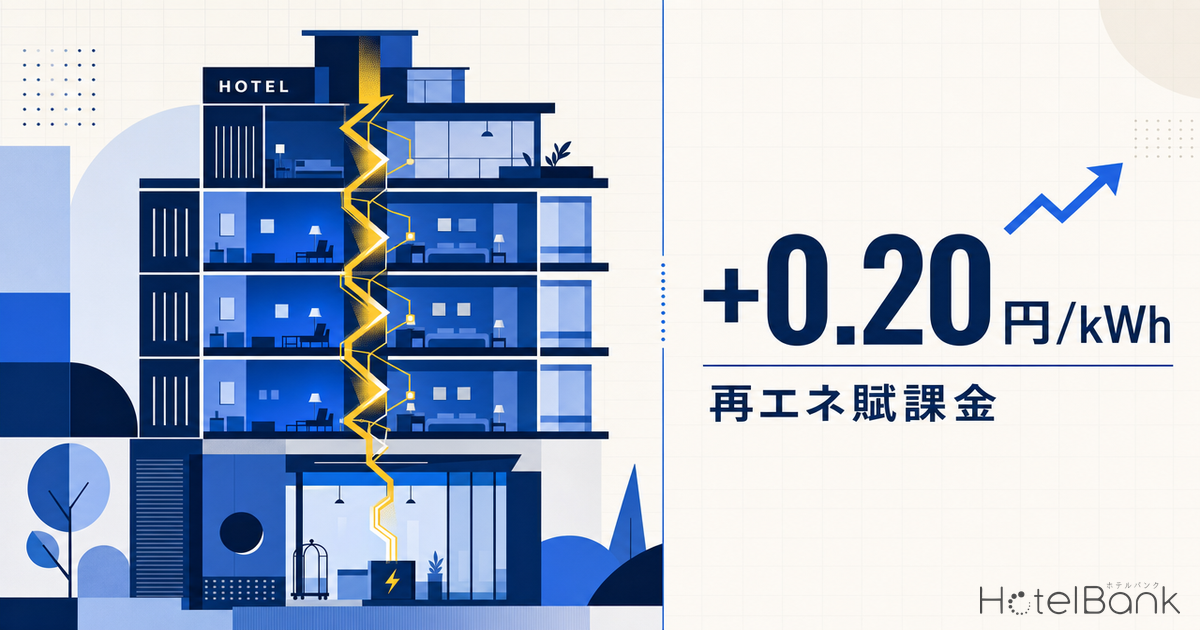
From the May 2026 usage period, Japan’s Renewable Energy Promotion Surcharge (Renewable Energy Surcharge) rose from ¥3.98/kWh to ¥4.18/kWh. The ¥0.2 increase is modest in absolute terms, but it marks the first time the rate has crossed the ¥4 threshold — a symbolic shift. In parallel, fuel cost adjustment unit prices have risen across all nine major power utilities during the same period, while the government’s electricity and gas price support program ended with the March 2026 usage period. With 90.9% of businesses unable to pass costs through to prices, how is the supply-side cost structure of hotel operations changing? Drawing on real data, this analysis examines monthly electricity consumption by room-count tier, pass-through difficulty by ADR band, and the penetration of energy-efficient specifications among 2025-2026 newly opened hotels.
Metric Definitions Used in This Article
- ADR (Average Daily Rate): The average of published sales prices on OTAs and other channels. Differs from actual transaction prices. Per-room rate (tax included) for double occupancy, averaged across all plan types (from room-only to meal-inclusive plans).
- Electricity Consumption: This article estimates total facility-wide electricity consumption — including common areas and ancillary equipment — by room-count tier, based on measured business hotel guestroom values (102 kWh/month in spring, 178 kWh/month in summer; source: Transactions of the Society of Heating, Air-Conditioning and Sanitary Engineers of Japan).
- Data Sources: MetroEngines Research (メトロエンジンリサーチ), Ministry of Economy, Trade and Industry, Japan Tourism Agency, Japan Meteorological Agency, and various public sources.
Structural Changes in 2026 Electricity Pricing — A Triple Burden Hitting Simultaneously
First, let us organize what is happening in 2026. On March 19, 2026, the Ministry of Economy, Trade and Industry (METI) announced the renewable energy surcharge rate would be set at ¥4.18/kWh. This represents a ¥0.2 increase from the FY2025 rate of ¥3.98, applicable from the May 2026 meter-reading period through the April 2027 meter-reading period. It marks the first time the rate has reached the ¥4 level since the program began.
In addition, nine major utilities — TEPCO Energy Partner, Chubu Electric Power Miraiz, Hokkaido Electric Power, Tohoku Electric Power, Hokuriku Electric Power, Chugoku Electric Power, Shikoku Electric Power, Kyushu Electric Power, and Okinawa Electric Power — raised rates in the June 2026 meter-reading period (May usage) on the back of rising average fuel prices. Furthermore, the government’s “Electricity and Gas Price Support” program, which had been applied through the January-March 2026 usage period, ended with the March usage period. In other words, the industry is now facing three simultaneous upward pressures: (1) the renewable energy surcharge hike, (2) rising fuel cost adjustment rates, and (3) the termination of government subsidies.
For TEPCO Energy Partner’s high-voltage A standard plan, the post-revision energy unit price is ¥16.56/kWh, transmission fees are approximately ¥4/kWh, and the renewable energy surcharge is ¥4.18/kWh. Factoring in the fuel cost adjustment unit price, the effective total unit price for commercial high-voltage service ranges roughly ¥22-26/kWh. For low-voltage / metered-light C service, prices can reach ¥28-32/kWh.
Source: Compiled by HotelBank Editorial Team based on METI “Renewable Energy Promotion Surcharge Unit Prices” published figures
Monthly Electricity Consumption and Utility Cost Estimates by Room-Count Tier
To estimate hotel electricity consumption, we use as a baseline the measured values per occupied room per day (3,426 Wh in spring, 5,920 Wh in summer) reported in the paper “Reduction of Energy and Environmental Loads at Business Hotels” published in the Transactions of the Society of Heating, Air-Conditioning and Sanitary Engineers of Japan. To this we must add common-area consumption (lobby, corridors, elevators, kitchen, laundry, etc.); industry sources indicate that facility-wide total consumption is typically 1.5-2.0 times the guestroom consumption. Our estimate assumes 70% occupancy, a common-area multiplier of 1.7×, and a commercial high-voltage unit price of ¥24/kWh.
Results are as follows. A 30-room small city hotel consumes approximately 11,400 kWh/month in summer with an electricity bill of about ¥274,000; an 80-room mid-size business hotel, approximately 30,500 kWh and ¥731,000; a 150-room property, approximately 57,100 kWh and ¥1.37 million; and a 300-room large city hotel, approximately 114,300 kWh and ¥2.74 million. Isolating just the impact of the ¥0.2 rise in the renewable energy surcharge, a 300-room class hotel faces approximately ¥23,000 in additional monthly costs on average, or about ¥270,000 annually. Combined with the recent fuel cost adjustment increase (approximately ¥1-2/kWh), the estimate suggests an annual cost increase of ¥1.2-2.5 million for a 300-room property.
Source: Estimated by HotelBank Editorial Team based on Transactions of the Society of Heating, Air-Conditioning and Sanitary Engineers of Japan and METI’s Commercial Building Energy Conservation Program (assumptions: OCC 70%, common-area multiplier 1.7×, ¥24/kWh)
Additional Per-Room-Night Utility Cost Burden
Converting this estimate to “additional cost burden per room-night” brings it closer to operational reality. Assuming a combined unit-price increase of ¥1.7/kWh (renewable surcharge +¥0.2 plus fuel cost adjustment +¥1.5) and dividing back by 70% occupancy, the additional electricity cost per occupied room-night comes to roughly ¥10-15 regardless of property size. However, this is electricity only; once simultaneous gas price increases (hot water, kitchen), rising labor costs, and surging linen costs are included, the additional cost burden per room-night across the full cost structure typically reaches ¥200-500.
Looking at scale efficiency, common-area electricity consumption per room becomes more diluted as room count rises. A 30-room small property consumes approximately 380 kWh/month per room in summer, while a 300-room large property consumes approximately 381 kWh/month per room — a small gap. However, the headroom for reductions through Building Energy Management Systems (BEMS) is larger at larger scales, and properties of 150+ rooms have meaningfully greater capital recovery potential for equipment investment. Conversely, small-to-mid-size properties of 30-80 rooms struggle to capture scale-efficiency benefits and are structurally exposed to direct impact from unit-price increases.
Source: Compiled by HotelBank Editorial Team from the above estimates (assumptions: OCC 70%, summer peak, ¥1.7/kWh unit-price increase)
Pass-Through Difficulty Assessment by ADR Band
Surveys by Tokyo Shoko Research and Teikoku Databank show that approximately 60-91% of companies have been “completely unable to pass through” electricity price increases. The figure is particularly high in service industries; fewer than 20% of firms responded that they would raise prices in FY2025. So what about the hotel industry? Based on MetroEngines Research (メトロエンジンリサーチ) ADR data for the six major prefectures in April 2026, and the structural characteristics by hotel format, we evaluate pass-through difficulty by ADR band.
First, April 2026 ADRs (double occupancy, tax included) were as follows: Kyoto ¥48,300 (+14.6% YoY), Tokyo ¥36,800 (+1.6%), Fukuoka ¥29,300 (+4.3%), Hokkaido ¥29,700 (+10.2%), Okinawa ¥27,200 (+6.2%), and Osaka ¥26,000 (+4.5%). The strong gains in Kyoto and Hokkaido are demand-led, driven by inbound recovery, giving these markets the greatest room for cost pass-through. Meanwhile, Osaka and Tokyo face limited upside, in part due to the 2025 Osaka Expo aftermath and oversupply pressures. For the structural background behind the +19% growth in nationwide average ADR over the past three years, our analysis in Nationwide Average ADR Hits Record ¥32,340 (May 2026): Structural Breakdown of the +19% Three-Year Surge Driven by Inflation and Labor Cost Pass-Through decomposes the gain into three factors: CPI linkage, format shift, and regional polarization.
Source: Compiled by HotelBank Editorial Team based on MetroEngines Research (メトロエンジンリサーチ) (N=7,173 properties, April 2026)
Examining ADR and property counts by hotel format (April 2026 nationwide data, MetroEngines Research), the picture is: Deluxe Hotels ¥88,000 (N=188), Resort Hotels ¥42,900 (N=1,537), Ryokan ¥31,400 (N=6,358), City Hotels ¥24,600 (N=1,092), and Business Hotels ¥14,900 (N=7,193) — a price gap of more than 5× across formats. Assuming a ¥300 per-room-night electricity unit-price increase, this translates to a 0.3% rate increase for Deluxe Hotels, 0.7% for Resort Hotels, 1.2% for City Hotels, and 2.0% for Business Hotels.
Source: Compiled by HotelBank Editorial Team based on MetroEngines Research (メトロエンジンリサーチ)
The essence of pass-through difficulty lies in price elasticity and customer loyalty. Customers in the Deluxe / Resort bands seek added value and often do not perceive a +¥300-500 increase. By contrast, the Business Hotel band is structurally subject to corporate travel rate ceilings and constant competitive price comparison, so even a ¥1 rate increase carries direct occupancy-decline risk. Business Hotels also have a relatively high utility-cost ratio in their cost structure (10-12% of sales), making them the format most acutely exposed to cost-side shocks. For the specific line at which properties unable to pass costs through lose sustainability, Labor Cost Pass-Through and Bankruptcy Risk in the Lodging Industry: Reading the Sustainability Inflection Point in ADR Data provides quantitative analysis, and reading it together with this article sharpens management decision-making.
El Niño Heat Wave Amplifies Cost Pressure
In its May 12, 2026 El Niño monitoring bulletin, the Japan Meteorological Agency forecast a 90% probability of an El Niño event occurring by summer. The U.S. National Oceanic and Atmospheric Administration (NOAA) similarly indicates a high probability of El Niño onset in the June-August window, with the event likely to persist at least through year-end 2026. The Japan Weather Association announced that the number of “extreme heat day” locations (max temperature above 40°C) is expected to match or slightly exceed the average of the most recent 10 years, suggesting air-conditioning load is highly likely to be equal to or greater than the prior year.
Guestroom electricity consumption shows strong seasonality, rising +73% in summer versus spring (3,426 Wh → 5,920 Wh per room per day). The earlier estimate (¥24/kWh) puts a 300-room property’s summer monthly consumption at 114,300 kWh with a bill of approximately ¥2.74 million. Once the ¥1.7/kWh unit-price increase plus a temperature-driven 5% consumption increment are layered on top, monthly costs are on track to reach the ¥3 million range. For full-year utility costs, mid-to-large properties of 150+ rooms can expect a +5-10% increase versus 2025 to be all but certain.
Energy-Efficiency Specification Trends in 2025-2026 New-Build Hotels
Within the scope tracked by MetroEngines Research (メトロエンジンリサーチ), 1,603 lodging properties opened nationwide in 2025, and 573 properties have opened in 2026 as of May (based on OTA listing confirmation; the count for future months is expected to grow as new listings appear). The 2025 breakdown by format shows: vacation rentals 661, business hotels 266, guesthouses 113, cottages 105, resort hotels 98, and others. Mid-to-large properties of 100+ rooms are centered on business hotels and city hotels.
Organizing energy-efficiency specification trends in new-build hotels from industry sources: (1) 100% LED lighting adoption has been effectively standard since 2020; (2) inverter-controlled air conditioning is also de facto standard in new builds; (3) BEMS (Building Energy Management Systems) adoption rates are rising in new mid-to-large builds of 150+ rooms; and (4) high-efficiency water heaters (heat pumps) are adopted in over half of new builds excluding hot-spring properties. Beyond these, examples are emerging such as “ITOMACHI HOTEL 0” (Saijo City, Ehime Prefecture), which holds ZEB (Net Zero Energy Building) certification.
Source: MetroEngines Research & Consulting (メトロエンジンリサーチ) (OTA listing confirmation basis, N=1,603 properties)
Notable examples of business hotels and city hotels with 100+ rooms opening in 2025 include Maihama View Hotel by HULIC (428 rooms), Hotel Route Inn Omuta (328 rooms), Hotel Livemax Sakishima Cosmo Tower (263 rooms), Hotel Amanek Osaka Namba (232 rooms), Caption by Hyatt Kabutocho Tokyo (195 rooms), and Four Points Flex by Sheraton Tokyo Ueno (199 rooms). These properties were designed to meet the 2020s energy-efficiency standards (Building Energy Conservation Act) at the planning stage, and their post-opening utility-cost intensity tends to operate at a level 20-30% lower than existing properties more than 10 years old.
Energy-Efficiency Investment ROI — 2-4 Year Payback for 150+ Room Properties
Let us estimate ROI for existing hotels executing new energy-efficiency investments. Representative investment items and their effects are as follows. Full LED retrofit at a 150-room property: initial investment approximately ¥7.5 million, annual savings approximately ¥1.8 million (payback approximately 4.2 years). BEMS installation at 150 rooms: initial investment approximately ¥5 million, annual savings approximately ¥1.5 million (payback approximately 3.3 years). High-efficiency HVAC replacement at 150 rooms: initial investment approximately ¥35 million, annual savings approximately ¥5 million (payback approximately 7 years). Heat-pump water heater replacement varies with scale, but for large ryokan with hot springs — including gas-cost savings — payback of 3-5 years is typical.
In the 2026 electricity price-rising phase, these ROI estimates shorten further. Assuming a continued +5-10% annual cost rise from the renewable surcharge and fuel cost adjustment, LED retrofit payback compresses from 4.2 years to approximately 3.7 years, and BEMS from 3.3 years to 2.9 years. For mid-to-large properties of 150+ rooms that have yet to retrofit LEDs or install BEMS, 2026-2027 becomes the decision window for capital deployment. Beyond utility costs, this is also a phase where labor-saving capex must run in parallel against structural rises in labor costs; for the economics of those investments, Riding Out the Labor-Cost Shock with Face Recognition Check-In: Labor-Saving Strategy and 80-Room / 150-Room GOP Impact Analysis for Small-to-Mid Business Hotels models the GOP impact.
Source: Estimated by HotelBank Editorial Team based on METI “Commercial Building Energy Conservation Program,” ZEB case studies, and industry sources
Management Implications — The Intersection of Scale Efficiency and Energy Investment ROI
The management implications from this analysis can be organized in three layers. First, cost-structure impact varies sharply by format and scale. The Business Hotel band, with a utility-cost ratio of 10-12% of sales, faces the strongest unit-price-increase exposure but struggles to pass costs through given an ADR of approximately ¥15,000. By contrast, the Deluxe / Resort bands have relatively low utility-cost ratios (6-8% of sales) and room to pass a +¥300-500 increase through to rates.
Second, the scale-efficiency threshold sits around 150 rooms. Properties of 30-80 rooms incur fixed common-area electricity consumption and struggle to capture scale efficiency. At 150+ rooms, BEMS-driven savings and capital recovery potential rise together. At 300+ rooms, most properties have already completed an initial round of energy-efficiency investment with limited remaining headroom, but new levers are emerging in energy procurement optimization (PPA contracts, self-consumption solar, demand response).
Third, a competitive structural shift is underway between the 2025-2026 new-build cohort and incumbent properties. New-build hotels clear energy-efficiency standards at the design stage and operate with low utility-cost intensity from day one. Existing properties more than 20 years old, by contrast, must embed energy-efficiency investment into renovation cycles; otherwise operating margins will be squeezed under the cost pressures from 2026 onward. For mid-to-large incumbent properties of 150+ rooms, 2026-2027 is highly likely to mark the decision window for LED, BEMS, and HVAC replacement capex.
Notes on the estimation assumptions in this article: Electricity consumption and utility costs by room-count tier are approximations based on measured values from the Transactions of the Society of Heating, Air-Conditioning and Sanitary Engineers of Japan (3,426 Wh in spring / 5,920 Wh in summer per room-day) and industry sources. Actual figures vary widely with location, occupancy, and ancillary equipment configuration of individual properties. For investment decisions, we recommend an energy audit by a specialist firm.
Related Articles
- Nationwide Average ADR Hits Record ¥32,340 (May 2026): Structural Breakdown of the +19% Three-Year Surge Driven by Inflation and Labor Cost Pass-Through
- Labor Cost Pass-Through and Bankruptcy Risk in the Lodging Industry: Reading the Sustainability Inflection Point in ADR Data
- The Real Nature of Labor-Cost-Driven ADR Increases: Decoding the Structural Shift in 2026 Hotel Pricing Through OCC × ADR Divergence
- Riding Out the Labor-Cost Shock with Face Recognition Check-In: Labor-Saving Strategy and 80-Room / 150-Room GOP Impact Analysis for Small-to-Mid Business Hotels
- Tokyu Stay × Mercure Hiroshima: A Dual-Brand Strategy Signals a New Opening Format for Mid-Sized Cities
References & Sources
- METI: “Setting FY2025 Onward Purchase Prices Under the Renewable Energy FIT/FIP System and the FY2025 Surcharge Unit Price”
- ENECHANGE: “Latest Information on June 2026 Electricity Price Hikes”
- TEPCO Energy Partner: “Notice on Fuel Cost Adjustment (May 2026)”
- Energy Conservation Center, Japan: “Energy Conservation Guide for the Hotel Industry” (METI commissioned project)
- Transactions of SHASE Japan: “Reduction of Energy and Environmental Loads at Business Hotels, Part 2”
- Agency for Natural Resources and Energy: “Overview of the Hotel Industry Benchmark System”
- Agency for Natural Resources and Energy: “Energy Conservation Act Manual: Factories and Workplaces Edition, FY2023 Revision”
- Japan Meteorological Agency: “Probability of El Niño Onset Has Increased”
- Japan Weather Association tenki.jp: “High Probability of El Niño Onset by This Summer — May 12 Monitoring Bulletin”
- Tokyo Shoko Research: “More than 90% of Companies See Electricity Costs Rise, but Cannot Pass Through to Prices”
- Teikoku Databank: “Survey on the State of Price Pass-Through (February 2025)”
- Hikariiku: “Essential and Enriching Lighting at the ZEB-Certified Hotel ‘ITOMACHI HOTEL 0′”
- Ministry of the Environment: “ZEB PORTAL — Net Zero Energy Building Portal”
- Ryoken Inc.: “FY2022 Operating Status and Financial / P&L Survey Report”
- MetroEngines Research & Consulting (メトロエンジンリサーチ) — OTA published price data (April 2026: N=7,173 properties, ADR, etc.); new opening data (2025: N=1,603 properties; as of May 2026: N=573 properties)