

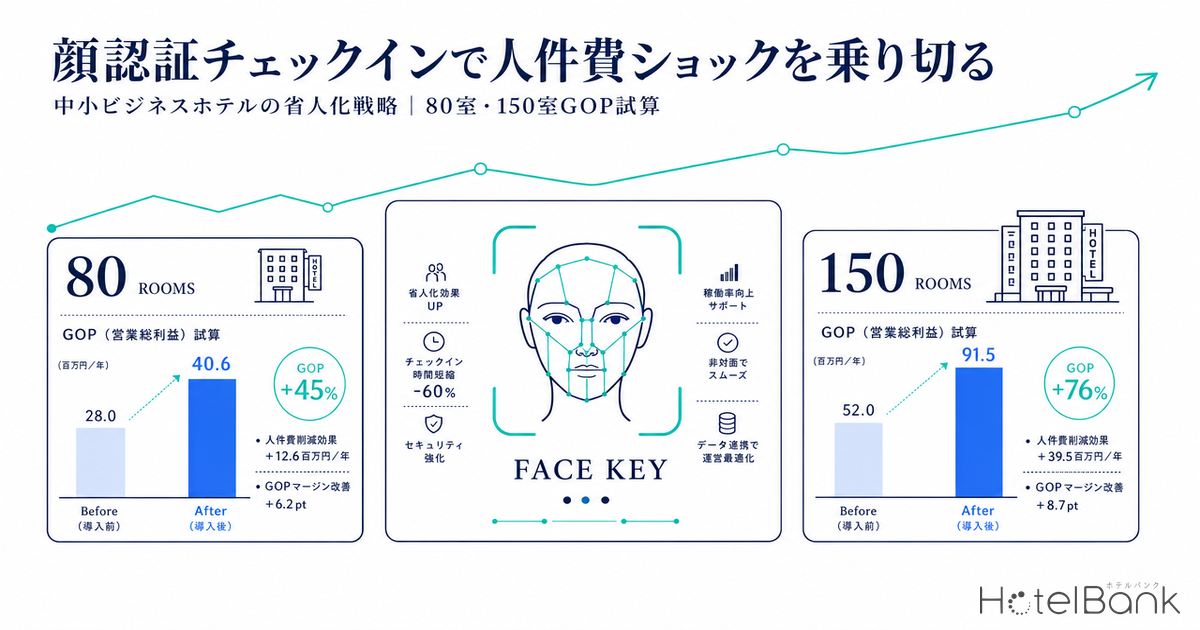
As Japan moves toward its goal of a ¥1,500 minimum wage and simultaneously expands social insurance coverage in 2026, front-desk operations have become the most labor-cost-intensive area of business hotel management. With Super Hotel rolling out its “Face Key” facial-recognition check-in nationwide, Tokyu Hotels deploying web check-in across 39 properties, and Henn-na Hotel sustaining virtually unmanned front-desk operations, labor reduction is shifting from a strategic option to a survival requirement for mid-size business hotels. This article uses Japan Tourism Agency case studies and ADR data from chains that have adopted facial recognition to estimate the GOP impact at 80- and 150-room properties.
Metric Definitions Used in This Article
- ADR (Average Daily Rate): Average of publicly listed prices on OTAs and similar channels. May differ from actual transacted rates. Per-room rate (tax-included) for 2 adults / room, averaged across all plans (room-only through meal-inclusive).
- GOP (Gross Operating Profit): Operating profit before fixed asset taxes, depreciation, and interest expense — calculated by deducting operating costs, labor, utilities, OTA fees, etc. from revenue.
- Data Source: MetroEngines Research
Anatomy of the Labor Cost Shock — From Optional to Existential
The Japanese government has set a target of “a national average minimum wage of ¥1,500 within the 2020s,” and as of October 2025 all 47 prefectures have already crossed the ¥1,000 mark. According to estimates by Nikkei, achieving the ¥1,500 target by 2029 requires annual increases exceeding 7%. On top of that, the so-called “¥1.06 million wall” will be abolished in October 2026: at companies with 51 or more employees, every employee working 20+ hours per week will be enrolled in social insurance regardless of monthly earnings. From October 2027, the company-size threshold will be lowered in stages, and by October 2035 every company will be covered.
The lodging industry is one of the sectors most affected by minimum wage hikes, and the simultaneous rise in wages and social insurance contributions is a structural pressure on profitability for labor-cost-heavy business hotels. Front-desk operations require 24/7 coverage; including night-shift premiums, four to six staff per property is the norm, and total labor costs move directly with the minimum wage. As we examined in our analysis of labor-cost pass-through and bankruptcy risk, the combination of ¥1,500 wages and expanded social insurance is set to add over ¥20 million in annual costs at a typical 80-room business hotel.
Major Chains Lead Facial-Recognition Check-In — Mapping Domestic Adoption
Adoption of facial recognition and self-check-in technology has spread rapidly among major business hotel chains since 2022. Looking at the leading deployments, three distinct patterns emerge from the combinations of technology and operational design.
1. Super Hotel “Face Key”: In June 2022, Super Hotel Co., Ltd., together with USEN-ALMEX, launched the “Cyphy-inn” facial-recognition reception service at Super Hotel Premier Tokyo Yaesu-Chuoguchi. Guests who pre-register their facial data through the official app complete identity verification at an in-house check-in terminal in 0.1 seconds and can also unlock the building entrance via face recognition. Facial image data is encrypted and stored on the user’s own device, then completely deleted at check-out — addressing privacy concerns by design. The chain plans a phased nationwide rollout based on regional and property characteristics.
2. Tokyu Hotels — 39 Properties Nationwide: In October 2021, Tokyu Hotels rolled out QR-code and facial-recognition web check-in at 39 properties using NEC’s “Smart Hospitality Service” and “Bio-IDiom” facial-recognition technology. Properties span the full portfolio from full-service hotels — The Capitol Hotel Tokyu, Cerulean Tower Tokyu Hotel, Yokohama Bay Hotel Tokyu — through Tokyu Stay-branded properties. By completing check-in formalities and payment in advance, guests can proceed straight to their rooms without queuing during peak times.
3. Henn-na Hotel (H.I.S. Hotel Holdings): As of May 2025, Henn-na Hotel — billed as “the world’s first robot hotel” — operates 21 domestic and 2 overseas properties. At a typical ~100-room property the chain runs with just 7–8 employees and 2 staff per shift, roughly one-third of the ~30 employees needed at comparably sized peers. Robots handle front-desk duties; humans staff only back-of-house roles such as cleaning and security monitoring.
4. APA Hotel “APA Direct” / Toyoko Inn: APA Hotel has rolled out an “App Check-in Dedicated Terminal” jointly developed with OMRON Social Solutions; guests simply hold a QR code over the reader to receive their room key. Toyoko Inn equips every property with self-check-in kiosks that use the “Toyoko Inn Club Card” as a smart key. Neither chain uses facial recognition, but both share the same unmanned-operation philosophy.
In 2025, the Japan Tourism Agency published its “Lodging Industry Labor Reduction Case Studies” as part of its workforce-shortage countermeasures. The collection — organized by category (front desk, housekeeping, food service, back-office support, reservations) — features adoption examples of automated check-in kiosks, cleaning robots, food-service robots, and AI concierges, complete with on-site testimonials, reflecting industry-wide momentum toward labor reduction.
| Chain | Technology | Scale | Key Feature |
|---|---|---|---|
| Super Hotel | Facial Recognition (Face Key) | Phased nationwide rollout | App-linked, 0.1-second auth |
| Tokyu Hotels | Facial Recognition + QR (NEC) | 39 properties nationwide | Including full-service hotels |
| Henn-na Hotel | Robot front desk | 21 domestic properties | 100 rooms run with 7–8 staff |
| APA Hotel | App + QR Code | Nationwide | “APA Direct” app check-in |
| Toyoko Inn | Club card auth | All properties | Membership card as smart key |
Source: Compiled by HotelBank Editorial Team from each company’s press releases and Japan Tourism Agency “Lodging Industry Labor Reduction Case Studies”
ADR Comparison Across Major Business and City Hotel Chains
We compared major chains that pioneered facial-recognition / self-check-in deployment with category-level market averages, using OTA listed-price data for April 2026 compiled by MetroEngines Research. The data set covers N=12,722 business hotels nationwide for which active OTA listings were confirmed.
Source: MetroEngines Research, compiled by HotelBank Editorial Team (April 2026, N=properties per chain)
The highest-priced chain is Tokyu Stay at ¥40,000 (N=32 properties), positioned in the full-service city hotel range. Tokyu Hotels overall sits at ¥38,800 (N=57), Henn-na Hotel at ¥27,800 (N=24), and Dormy Inn at ¥25,400 (N=37) — all four chains command rates at or above the major city hotel average (¥24,600). Among traditional low-priced business hotel segments, Super Hotel posts ¥19,400 (N=174), APA Hotel ¥19,000 (N=280), and Toyoko Inn ¥12,400 (N=346); their relationship to the business hotel category average of ¥14,900 reveals the hierarchy within the segment.
What is striking is that Super Hotel — the chain that has most systematically adopted facial recognition / self-check-in (¥19,400) — sits at nearly the same price level as APA Hotel (¥19,000), which has comparable room counts and locations, while Toyoko Inn operates at ¥12,400, below the business hotel average. Pricing is not determined solely by the presence of labor-saving technology; it is a composite function of location, customer base, and service level. But what the data suggests is that labor reduction functions less as a tool for sustaining premium pricing and more as an efficiency foundation that enables a low-price strategy.
Category-Level ADR Trends and the Leverage of Labor Reduction
Tracking ADR by category over time clarifies the structural pricing differences between business hotels and city hotels.
Source: MetroEngines Research, compiled by HotelBank Editorial Team
Business hotel ADR moved only +2.5% YoY, from ¥14,500 in April 2025 to ¥14,900 in April 2026. Over the same period city hotels fell from ¥26,600 to ¥24,600 (-7.4%), resort hotels rose from ¥41,700 to ¥42,900 (+2.9%), and ryokan rose from ¥30,400 to ¥31,400 (+3.3%). Business hotels are not only the lowest-priced segment in absolute terms but also have the least room to push rates higher. Our deeper analysis of the prefecture-level distribution of business hotel ADRs and the most cost-effective destinations for business travel is available in our piece on the reality of business hotel price surges. Sustaining current labor structures at a ¥15,000 ADR level under the ¥1,500-wage scenario will be extremely difficult.
Take an 80-room business hotel running at an ADR of ¥15,000 and 80% OCC: annual room revenue is roughly ¥350 million. If front-desk labor consists of 4 staff at an average annual salary of ¥4 million (¥16 million total), reducing to 2 staff via labor-saving technology yields ¥8 million in annual savings. That equates to ~2.3% of revenue and, against the typical 10–20% GOP margin of a business hotel, represents 12–23% of GOP. Conversely, a direct application of the ¥1,500 minimum wage implies a 34% labor-cost increase from the current national average of ¥1,118, making continued operations difficult without offsetting savings.
GOP Sensitivity Simulation: 80- vs 150-Room Properties
We simulate front-desk staffing reductions enabled by facial-recognition / self-check-in deployment, by property scale. Assumptions: ADR at the business hotel category average of ¥14,900; OCC 80%; current front-desk staffing of 4–6 (4 at 80 rooms, 6 at 150 rooms); average annual salary of ¥4 million (employer-burden-included real cost ≈ 1.15× salary).
| Item | 80-Room Property | 150-Room Property |
|---|---|---|
| Annual Room Revenue (ADR × OCC × 365) | ¥347M | ¥652M |
| Current Front-Desk Staff | 4 | 6 |
| Post-Reduction Staff | 2 | 3 |
| Annual Labor Savings (true cost basis) | ¥9.2M | ¥13.8M |
| Savings as % of Revenue | 2.7% | 2.1% |
| Current GOP (15% margin assumed) | ¥52M | ¥98M |
| GOP Impact from Labor Reduction | +17.7% | +14.1% |
Source: MetroEngine Co., Ltd., compiled by HotelBank Editorial Team (simplified estimate; ADR from MetroEngines Research)
Source: MetroEngine Co., Ltd., compiled by HotelBank Editorial Team
An 80-room property gains ¥9.2M in annual labor savings; a 150-room property gains ¥13.8M — equivalent to GOP improvements of +17.7% and +14.1%, respectively. The Japan Tourism Agency’s case-study figure of “¥5–7M in annual labor savings per one-staff reduction at the front desk” is consistent with our estimate when extended to two or more reductions. A note of caution: front-desk reductions do not mean fully unmanned operation. Security, overnight response, and trouble-shooting backup staff are typically retained. Our simulation conservatively models the “effective staff reduction” at 2–3 positions.
Three Implementation Challenges — Capex, Usability, and Security
Facial-recognition check-in delivers significant impact, but adoption involves three structural challenges.
Challenge 1: Initial Investment: A high-spec KIOSK-type automated check-in terminal alone costs several million yen; including PMS (Property Management System) integration, in-room smart-lock deployment, and in-house network upgrades, total capex for an 80–150 room property ranges from ¥10 million to ¥30 million. Monthly operating fees of ¥15,000+ also apply. The Japan Tourism Agency continues its labor-saving investment subsidy program in FY2025, and the workforce-shortage subsidy pathway can substantially reduce the effective burden. Details are available on the Japan Tourism Agency’s dedicated site; for a comparison of the seven subsidy programs applicable to PMS and smart check-in adoption, see our FY2026 Tourism DX Subsidy Guide.
Challenge 2: Usability Barriers: A non-trivial share of senior travelers and inbound guests are uncomfortable with smartphone app pre-registration or facial-recognition terminal operation. This is precisely why both Super Hotel and Tokyu Hotels run their facial-recognition deployments alongside conventional staffed check-in. Even Henn-na Hotel — the chain most committed to full automation — keeps staff on hand for trouble-shooting and inquiries. For mid-size hotels, the realistic answer is hybrid operation: run self-check-in only during peak hours and keep backup staff available.
Challenge 3: Personal Information Protection: Facial data is sensitive biometric information and may qualify as “Special Care-Required Personal Information” under Japan’s amended Act on the Protection of Personal Information. Both Super Hotel and Tokyu Hotels address this through data encryption, automatic deletion at check-out, and strict device-side storage. For mid-size hotels operating their own systems, locking in security specifications at the vendor selection stage is essential. Trusted vendors such as NEC, USEN-ALMEX, and OMRON provide systematic security specifications for major chains, but smaller-vendor products require careful security review.
A Decision Framework for Mid-Size Business Hotels
We propose evaluating facial-recognition / self-check-in adoption from the following three perspectives.
1. Payback Period: At an 80-room property with ¥15M capex and ¥9.2M annual labor savings, the simple payback period is roughly 1.6 years. At a 150-room property with ¥25M capex and ¥13.8M savings, it is about 1.8 years. With Japan Tourism Agency labor-saving subsidies, the effective burden can be halved and payback may shrink to roughly 1 year. Once the ¥1,500 wage scenario materializes, labor-cost pressure will only intensify — meaning the earlier the move, the higher the return.
2. Hybrid Operation Design: Full automation does not have to be the starting point. Phased rollout — beginning with high-volume off-peak windows (e.g., 22:00 to 7:00) and concentrating staffed coverage on the 15:00–21:00 check-in surge — accommodates customers who struggle with the technology while still enabling overall headcount reduction. The result: lower total front-desk staffing without sacrificing service levels at peak hours.
3. Alignment with Pricing Strategy: Our data shows facial-recognition adopters spread across the pricing spectrum, from low-cost (Super Hotel ¥19,400) to premium (Tokyu Stay ¥40,000, Tokyu Hotels ¥38,800, Henn-na Hotel ¥27,800) — meaning labor reduction does not equate to discount positioning. Reinvesting GOP gains from labor reduction into ADR maintenance, service enhancement, or property renewal expands the strategic options for sustained mid- to long-term competitiveness.
Note: This is a simplified model. Actual investment decisions require property-level feasibility studies, verification of subsidy eligibility, and vendor selection. ADR figures in this article are averages of OTA-listed prices at the time of survey and may differ from actual transacted rates.
Conclusion
The simultaneous arrival of the ¥1,500 minimum wage target and expanded social insurance coverage will have a defining impact on business hotel labor structures. Super Hotel’s “Face Key,” Tokyu Hotels’ 39-property nationwide deployment, and Henn-na Hotel’s proven operational efficiency demonstrate that facial-recognition / self-check-in technology already underpins the competitive position of major chains. Our simulation shows that an 80-room property gains ¥9.2M, and a 150-room property ¥13.8M, in annual labor savings — a +14–18% impact on current GOP. The three challenges — ¥10–30M in capex, usability barriers, and security — can each be addressed through Japan Tourism Agency subsidies, hybrid operations, and trusted vendor selection. For mid-size business hotels, labor reduction is no longer one strategic choice among many: it is becoming a substantive condition for surviving the ¥1,500-wage scenario.
Related Articles
- Labor Shortage x ADR x Bankruptcy Risk: Japan’s Unsustainable 47-Prefecture Map
- Labor Cost Pass-Through ADR Surge: Decoding Japan’s 2026 Hotel Pricing via OCC-ADR Divergence
- FY2026 Tourism DX Subsidy Guide for Hotels: 7 Programs for PMS & Smart Check-In
- Tourism DX Subsidy Up to ¥15M: Step-by-Step Guide for Hotels
- Business Hotel Price Surge: National ADR Analysis & 10 Cost-Effective Prefectures
- National Avg ADR Hits Record ¥32,340 (May 2026): +19% in 3 Years from CPI & Cost Pass-Through
References & Sources
- Super Hotel “Face Key Check-In” Official Page
- Super Hotel × USEN-ALMEX “Launch of Advanced Facial Recognition Reception Service” Press Release (June 2022)
- Tokyu Hotels “Contactless QR Web Check-In Deployed at 39 Properties Nationwide”
- NEC “NEC Smart Hospitality Service Provided to Tokyu Hotels’ Web Check-In System”
- Henn-na Hotel Official Reservation Site
- Japan Tourism Agency, “Lodging Industry Labor Reduction Case Studies” (Released 2025)
- Japan Tourism Agency “Labor-Saving Investment Subsidy Program” Dedicated Site
- Japan Tourism Agency / Ministry of Health, Labour and Welfare, “Labor-Saving Investment Promotion Plan — Lodging Industry” (June 2025)
- Nikkei: “Minimum Wage and the Distant ‘¥1,500 Goal’ — Annual Hikes of 7%+ Required in the 2020s”
- Roumu SEARCH: “Social Insurance Eligibility Reforms from 2026 — Toward Further Expansion”
- APA Hotel Official “Contactless App Check-In Plus”
- MetroEngines Research — National OTA listed-price data (April 2026; business hotels N=7,193, city hotels N=1,092, resort hotels N=1,537, ryokan N=6,358)