

On 17 July 2026 Japan’s Ministry of Land, Infrastructure, Transport and Tourism (MLIT) announced that its road-safety measures for inbound visitors driving rental cars would move from pilot trials to full rollout. The areas chosen to go first are the zones around three airports: New Chitose, Fukuoka and Naha. It looks like a roads story, but for hotels it is also the government naming, out loud, where inbound travellers who move by car actually cluster. This article analyses guest reviews by language and by prefecture, quantifies which languages and which prefectures talk about parking and car access, and then overlays room stock and prevailing rates by distance band from each airport.
Metric Definitions Used in This Article
- Mention rate: the share of all reviews in the period that touch on a given topic. This measures how often something is talked about, not the star rating — the two are separate metrics.
- Review language: the language a review was written in, not the nationality of the reviewer. This article consistently says “reviews in X”. Traditional Chinese reviews cannot be equated with travellers from Taiwan or Hong Kong.
- Parking: mentions of whether parking exists and how easy it is to use (mentions of parking fees are handled separately on the pricing side). Car access: mentions of reachability by car — expressway interchanges, proximity to trunk roads.
- ADR (average daily rate): an estimated settled rate (tax-exclusive equivalent) derived by applying a facility-type correction factor to each property’s lowest published plan on OTA sites (double occupancy, per-room, tax-included). Cross-checked against property-level results disclosed by listed hotel REITs (91 properties, most recent 3 months), the median error is about 7%. These are estimates and differ from each property’s actual transacted rates or accounting figures. Area-level ADR is the median of the properties covered — the level of a typical property in that area.
- Distance bands: straight-line distance from the airport’s coordinates — not road distance or actual travel time.
- Data sources: review analysis — HotelBank Editorial Team; pricing and supply — MetroEngines Research
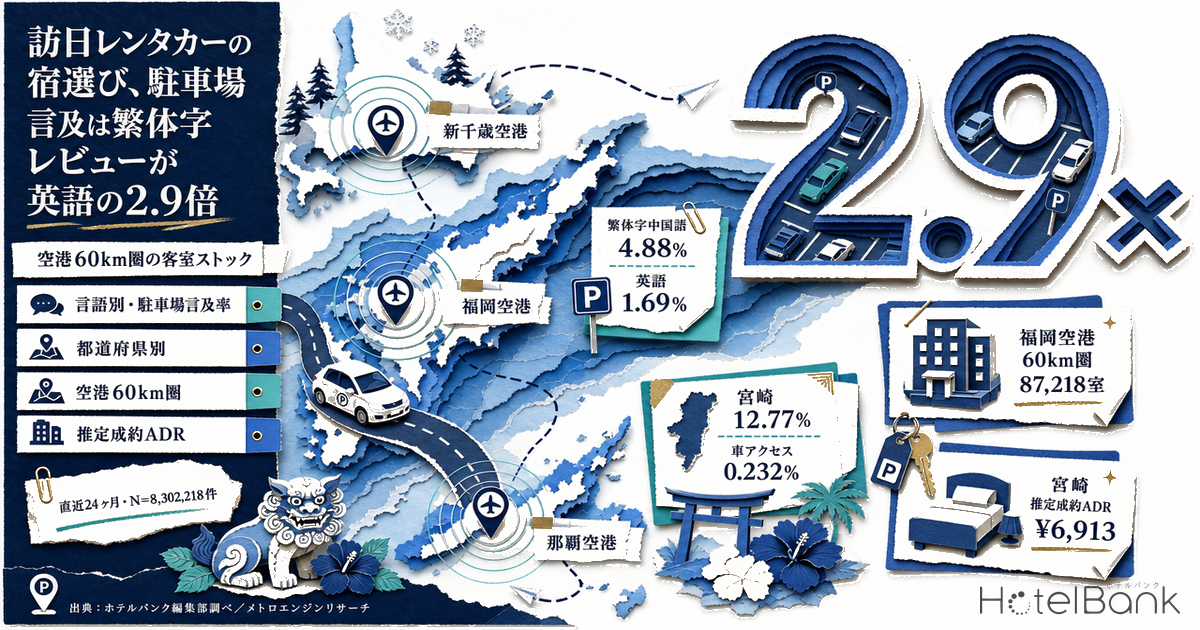
- — Traditional Chinese reviews mention parking at 4.88%, 2.9x the 1.69% seen in English reviews. Korean follows at 3.14% (most recent 24 months, N=8,302,218).
- — Miyazaki 12.77%, Kochi 11.01%, Okinawa 9.17%. Across Kyushu, Shikoku and Okinawa, foreign-language reviews mention car-related topics more often than Japanese-language reviews do.
- — Reachability by car is mentioned in just 0.232% of reviews — less than one twentieth of parking’s 4.85%. It sits in the bottom 50 rare tags: an information gap nobody is filling yet.
- — Rooms within 60km of the airport: Fukuoka 87,218, New Chitose 59,489, Naha 55,833. New Chitose has only 7,525 rooms within 30km, so a long drive on arrival day is built into the geography.
- — The areas with the most headroom carry the lowest rates — Miyazaki’s estimated settled ADR is ¥6,913, Kochi ¥7,912. The prefectures with the highest mention rates sit at the bottom of the rate range.
The Three Airports MLIT Named — Right-Turn Crashes at 2.7x the Japanese Rate
According to MLIT’s press release of 17 July 2026, crashes involving drivers on international or foreign licences rose from 47 in 2020 to 212 in 2025. Follow-up coverage puts the share of crashes occurring on right turns at intersections at 2.7x the rate for Japanese drivers. The countermeasures are physical: coloured pavement marking the right-turn path, rubber posts to stop drivers straying into oncoming lanes, and signage reminding people that Japan drives on the left. Work starts on nationally administered highways around the three airports — New Chitose, Fukuoka and Naha.
Why these three? MLIT explains that they are the areas with the heaviest rental-car use by travellers from countries and regions that drive on the right. There are supporting numbers. A survey published by the Shikoku District Transport Bureau in 2026 found that of 290 inbound travellers who rented cars in Shikoku, 90.6% came from East Asia (Taiwan, Hong Kong, Korea). And in material prepared when the Japan Tourism Agency reviewed inbound readiness at roadside stations (March 2019), the rental-car usage rate among inbound visitors overall was 12%, while in Okinawa it reached 61% (on a party basis). The Okinawa figure is seven years old and does not describe the current level, but it is a useful reference point for how wide the regional spread is.
In other words, inbound travellers who move by car are not spread evenly across Japan; they concentrate around particular airport catchments. So what do those guests themselves say about their stays?
Traditional Chinese Reviews Mention Parking 2.9x More Than English — Split by Language, It Is a Different Market
We analysed 8,302,218 guest reviews posted over the most recent 24 months across all 47 prefectures, broken out by language. Overall, 402,438 reviews touch on parking — a mention rate of 4.85%. Split by language, however, the picture changes completely.
English reviews (N=1,184,847) mention parking just 1.69% of the time. Traditional Chinese reviews (N=239,583) sit at 4.88% — 2.9x English. Korean reviews (N=228,690) follow at 3.14%, and Thai reviews (N=21,210, a smaller sample than the others) at 7.49%. Simplified Chinese reviews (N=61,883) come in at 1.91%, close to English. Japanese-language reviews (N=6,144,379) were at 5.78%.
Source: HotelBank Editorial Team (NLP analysis of guest reviews)
To be clear again: review language is not nationality. Travellers writing in Traditional Chinese are not necessarily from Taiwan or Hong Kong, and English reviews include plenty of travellers from non-English-speaking countries. Even so, the shape of the Shikoku bureau’s finding — nine in ten rental-car users from East Asia — and the pattern here, where parking is discussed relatively more in Traditional Chinese and Korean reviews, point in the same direction. Read the other way: in areas dominated by English reviews, pitching parking may reach comparatively few people, which feeds directly into which languages a property markets in. For the wider picture of what tends to get discussed in each language, What Guests Write About in 8 Languages — 3.46M Review Tag Analysis sets out the tag distribution across eight languages.
Prefectures Where Foreign-Language Reviews Beat Japanese — Miyazaki 12.8%, Okinawa 9.2%
Next, prefecture by prefecture, we look at the combined “car-related mention rate” — parking plus car access. Here all non-Japanese reviews are grouped as “foreign-language reviews”, and the table is limited to prefectures with at least 300 of them.
Miyazaki is highest at 12.77% (foreign-language N=3,799), followed by Kochi at 11.01% (N=2,570), Okinawa at 9.17% (N=80,227), Kumamoto at 8.16% (N=21,839) and Saga at 8.06% (N=4,688). Kyushu, Shikoku and Okinawa dominate the top of the table.
The more interesting read is the gap between foreign-language and Japanese reviews. In most prefectures it is the Japanese reviews that discuss car-related topics more — unsurprising, given how much domestic travel in Japan is done in a private car. But in Miyazaki (foreign 12.77% vs Japanese 10.35%), Okinawa (9.17% vs 7.44%), Saga (8.06% vs 6.56%) and Kumamoto (8.16% vs 7.44%), the foreign-language reviews come out on top. The catchments of Fukuoka and Naha — two of the three airports MLIT chose to go first — overlap with this set of prefectures.
| Prefecture | Foreign-language reviews | Parking | Car access | Car-related total | Japanese reviews (ref.) | Gap |
|---|---|---|---|---|---|---|
| Miyazaki | 3,799 | 12.66% | 0.11% | 12.77% | 10.35% | +2.42pt |
| Kochi | 2,570 | 10.97% | 0.04% | 11.01% | 10.87% | +0.14pt |
| Okinawa | 80,227 | 9.1% | 0.07% | 9.17% | 7.44% | +1.73pt |
| Kumamoto | 21,839 | 8.13% | 0.03% | 8.16% | 7.44% | +0.72pt |
| Saga | 4,688 | 8.0% | 0.06% | 8.06% | 6.56% | +1.50pt |
| Ibaraki | 2,857 | 7.7% | 0.14% | 7.84% | 8.68% | -0.84pt |
| Yamaguchi | 2,619 | 7.29% | 0.15% | 7.45% | 8.89% | -1.44pt |
| Tokushima | 3,913 | 7.31% | 0.13% | 7.44% | 9.75% | -2.31pt |
| Fukushima | 4,054 | 7.28% | 0.15% | 7.42% | 7.82% | -0.40pt |
| Tottori | 4,281 | 7.24% | 0.02% | 7.26% | 8.67% | -1.41pt |
| Fukui | 1,863 | 6.82% | 0.21% | 7.03% | 6.47% | +0.56pt |
| Nagasaki | 12,684 | 6.78% | 0.04% | 6.82% | 6.77% | +0.05pt |
| Oita | 25,742 | 6.67% | 0.03% | 6.7% | 7.31% | -0.61pt |
| Hokkaido | 114,876 | 5.67% | 0.02% | 5.7% | 6.87% | -1.17pt |
Source: HotelBank Editorial Team (NLP analysis of guest reviews)
Hokkaido runs 5.70% in foreign-language reviews against 6.87% in Japanese — the reverse of the pattern above. The New Chitose catchment is one of the first rollout areas, yet car-related talk in foreign-language reviews is not as prominent as in Kyushu and Okinawa. Winter driving conditions, the long distances involved in touring the island, and the depth of rail and urban lodging are all plausible factors. Turned around, Hokkaido is a market where parking and car-access messaging in foreign languages is still thin — which leaves differentiation upside on the table. The idea that what gets praised differs by prefecture is visible from another angle in 16M Reviews: Japan’s 47 Prefectures Split Into 4 Review Profile Types.
“Easy to Reach by Car” Is Barely Mentioned — a Topic in the Bottom 50 Rare Tags
The asymmetry between parking and car access is the part not to miss. Of 8,302,218 reviews nationwide, 402,438 (4.85%) touch on parking, while only 19,236 (0.232%) touch on reachability by car — expressway interchanges, proximity to trunk roads. Less than one twentieth.
In our rare-tag screen, which pulls out the least-mentioned topics from reviews nationwide (N=6,785,528), car access ranks 47th among the bottom 50 tags, appearing for just 2,371 properties. The same band contains topics such as dietary-restriction handling and multilingual service — things the market has yet to settle on.
What that gap means is clear enough. Guests talk about whether they could park at the property they stayed in; they do not talk about whether it was easy to drive there. Which suggests reachability by car is largely not being presented as information by properties in the first place. How many minutes from the interchange, how many kilometres from the airport, where to refuel on the way — this is exactly the information that matters most to a traveller from a right-hand-traffic country who is not used to the roads. A topic nobody is addressing is differentiation upside sitting in plain sight.
Room Stock Within 60km of the Airport — Fukuoka 87,218, New Chitose 59,489, Naha 55,833
So how many rooms are there around these airports to absorb travellers arriving by car? To MLIT’s three first-rollout airports we added two more — Kumamoto and Miyazaki, both in prefectures with high car-related mention rates in foreign-language reviews — and totalled room stock by distance band from each airport’s coordinates. As noted, these are straight-line distances, not road distances or actual travel times. On expressway-served corridors, a straight-line 60km is roughly a 60-90 minute drive, but in mountainous areas and on islands it takes longer. On the separate question of whether airport catchments hold enough rooms for the flights being operated, Winter Schedule Oct 25: Do 20 Regional Airports Have Enough Rooms? tests the question across 20 regional airports.
| Airport | Prefecture | Properties within 30km | Rooms within 30km | Properties within 60km | Rooms within 60km | Properties within 90km | Rooms within 90km |
|---|---|---|---|---|---|---|---|
| New Chitose Airport | Hokkaido | 175 | 7,525 | 890 | 59,489 | 2,313 | 83,207 |
| Fukuoka Airport | Fukuoka | 1,121 | 59,188 | 1,901 | 87,218 | 3,251 | 120,224 |
| Naha Airport | Okinawa | 1,428 | 41,436 | 2,506 | 55,833 | 3,138 | 59,241 |
| Aso Kumamoto Airport | Kumamoto | 653 | 22,746 | 1,662 | 39,633 | 3,485 | 85,110 |
| Miyazaki Airport | Miyazaki | 229 | 10,915 | 510 | 17,181 | 971 | 26,909 |
Source: compiled by the HotelBank Editorial Team from MetroEngines Research
Fukuoka Airport holds 59,188 rooms within 30km alone, reaching 87,218 within 60km — the direct consequence of an airport sitting right next to the city centre. Naha Airport has 41,436 rooms within 30km and 55,833 within 60km; widening from 60km to 90km adds only 3,408 more. The geography of Okinawa’s main island is itself the ceiling on room stock.
New Chitose is the opposite case, with only 7,525 rooms within 30km. Stock only appears as the radius widens: 59,489 within 60km and 83,207 within 90km, because central Sapporo sits well away from the airport. There is an implication in that. A traveller who lands at New Chitose and picks up a rental car structurally does not stay near the airport. The first night is always some distance away, which means the longest drive of the trip happens immediately on arrival, on the unfamiliar left-hand side of the road. Properties positioned to reduce that arrival-day driving load are worth the most as landing points.
Aso Kumamoto Airport more than doubles from 39,633 rooms within 60km to 85,110 within 90km — capacity dispersed over a wide area, as befits a touring base for central Kyushu. Miyazaki Airport is the thinnest, at 26,909 rooms even within 90km, yet as the previous section showed it sits in the prefecture with Japan’s highest car-related mention rate in foreign-language reviews, at 12.77%. Dense demand-side conversation, thin supply-side stock. In terms of headroom, it is the clearest combination on the list.
Where Are the Properties Whose Parking Gets Talked About in Foreign Languages?
It is worth looking at the property level too. Over the most recent 24 months, 273 properties nationwide — 52,107 rooms — drew 25 or more parking mentions in non-Japanese reviews. By prefecture: Okinawa 78 properties, Hokkaido 61, Gifu 18, Kumamoto 17, Fukuoka 14, Yamanashi 11, Oita 10. The map below plots the top 130 of those by mention count; circle size represents the number of parking mentions in foreign-language reviews. The 60km radius around each of the five airports is shown as a dashed circle.
Source: compiled by the HotelBank Editorial Team from MetroEngines Research
The density sits on Okinawa’s main island and in Hokkaido, dotted with touring areas that are hard to cover by rail alone — Takayama in Gifu, the Fuji Five Lakes in Yamanashi, Kumamoto and Oita. Almost no points appear in the urban cores of Greater Tokyo or Kansai, because inbound visitors there move by rail and parking simply never comes up. Read the other way: wherever a point appears on this map, foreign-language-speaking travellers moving by car are already staying — and are writing about it in their reviews.
Properties Whose Parking Is Most Talked About in Foreign-Language Reviews — Top 14
Here are the leading individual properties. All of them draw repeated praise for parking in non-Japanese reviews, and as a group they already function as landing points for inbound travellers moving by car. “Languages” counts the distinct languages in which parking mentions were found — a higher count means the property is being recognised by travellers across a wider range of language groups.
| # | Property | Prefecture | Rooms | Parking mentions in foreign-language reviews | Languages |
|---|---|---|---|---|---|
| 1 | Hotel Amanek Asahikawa Ekimae | Hokkaido | 221 | 156 | 7 |
| 2 | Amanek Inn Beppu | Oita | 64 | 143 | 12 |
| 3 | Toyoko Inn Fuji Kawaguchiko Ohashi | Yamanashi | 381 | 141 | 12 |
| 4 | JR Inn Asahikawa | Hokkaido | 198 | 141 | 8 |
| 5 | Hotel Hoku Lea | Okinawa | 28 | 128 | 6 |
| 6 | La Vista Furano Hills | Hokkaido | 180 | 120 | 6 |
| 7 | fav Kumamoto | Kumamoto | 67 | 110 | 8 |
| 8 | Hotel Wood Takayama | Gifu | 70 | 110 | 12 |
| 9 | Hotel Amanek Kanazawa | Ishikawa | 200 | 100 | 9 |
| 10 | Stay’s OTARU | Hokkaido | 35 | 99 | 7 |
| 11 | JR Kyushu Hotel Blossom Naha | Okinawa | 218 | 96 | 6 |
| 12 | THE BLOSSOM KUMAMOTO | Kumamoto | 203 | 91 | 9 |
| 13 | Hotel MyStays Mt. Fuji Observation Onsen | Yamanashi | 159 | 89 | 11 |
| 14 | Tokyu Stay Okinawa Naha | Okinawa | 199 | 83 | 5 |
Quoting fragments of the actual comments: English reviews include lines such as “…great location, large parking area”, and Traditional Chinese reviews lines such as “…有多個免費停車場…有專車接送去車站…” (several free parking spaces… a shuttle to the station). What stands out is that parking is discussed together with the shuttle to the station, not on its own. It suggests travellers who arrived by car are using the property as a base and switching part of their movement to public transport.
The mix of names is telling as well. Properties of 221 and 381 rooms sit in the same table as ones with 28, 35 and 64. Praise for parking is not determined by property size. It is determined by operational design — whether enough spaces are secured, whether guests can pull up at the door, whether it is free. This is a field where a small property can reach the top.
Prevailing Rates in the Landing-Point Areas — Miyazaki ¥6,900, Hokkaido ¥10,100, Oita ¥14,900
Finally, the prevailing rates in these areas. For the 12 months from August 2025 to July 2026, we averaged the monthly estimated settled ADR.
| Prefecture | Estimated settled ADR (12-month average) | Properties covered (median) | Car-related mention rate, foreign-language reviews |
|---|---|---|---|
| Oita | ¥14,909 | 466 | 6.7% |
| Okinawa | ¥11,793 | 493 | 9.17% |
| Fukuoka | ¥11,781 | 469 | — |
| Kumamoto | ¥10,579 | 394 | 8.16% |
| Hokkaido | ¥10,137 | 918 | 5.7% |
| Kochi | ¥7,912 | 119 | 11.01% |
| Miyazaki | ¥6,913 | 163 | 12.77% |
Source: compiled by the HotelBank Editorial Team from MetroEngines Research
Miyazaki is the lowest of the prefectures covered here at ¥6,900. Highest car-related mention rate in foreign-language reviews in the country, thin room stock at 26,909 within 90km of the airport, and the lowest rate — those three together say there is a block of unclaimed headroom. Kochi, at ¥7,900, sits in the same configuration.
Oita, at ¥14,900, is the highest of the group. Onsen demand at Beppu and Yufuin lifts rates there, and the prefecture is well represented with 10 properties drawing parking mentions in foreign-language reviews. Both rate and demand already stand up in this market, so the upside here lies less in building new landing points than in sharpening how information is presented to guests arriving by car.
Okinawa at ¥11,800 and Fukuoka at ¥11,800 line up at a similar level, but they are not the same underneath. Okinawa is a closed market whose stock plateaus at 59,241 rooms even within 90km; Fukuoka is an open one that keeps expanding to 120,224 rooms within 90km. At the same rate band, the former has far more room for price to move in peak periods.
Conclusion — What Nobody Is Talking About Is Exactly Where the Room Is
To pull the findings together.
First, parking is discussed in completely different ways depending on the language. Traditional Chinese reviews mention it at 4.88%, 2.9x the 1.69% in English reviews, and Korean reviews also come in above English at 3.14%. Publishing parking information without choosing which languages to publish it in means reaching a skewed slice of the audience.
Second, in Miyazaki, Kochi, Okinawa, Kumamoto and Saga the car-related mention rate in foreign-language reviews exceeds that in Japanese reviews, and those prefectures overlap geographically with the airport catchments MLIT selected for first rollout. The demand the government has begun addressing on the roads side and what guests are actually writing about point the same way.
Third, against parking at 4.85%, reachability by car at 0.232% is barely discussed at all — a topic that lands in the bottom 50 of the rare-tag screen. Travel time from the interchange, distance from the airport, a route that lowers the arrival-day driving load: almost none of this is currently being presented, which makes it a field the first property to move can own.
Fourth, the headroom sits thickest in the lower-rate areas. Levels of ¥6,900 in Miyazaki and ¥7,900 in Kochi show how much upside is available, depending on how a property designs its approach to capturing inbound travellers who move by car.
Inbound travellers who move by car need different information from those who move by rail. Very few properties are providing it. That is where the differentiation upside is.
Related Reading
- Double Ten x Sports Day: Japan’s Oct 9-12 Capacity at 76 Days Out
- City Hotels: 45.9% of Guest Nights Are Foreign — Ryokan +3.7%
- Inbound Share vs Weekday Gap: −0.13 Across Japan’s 47 Prefectures
- Saga Balloon Fiesta 2026: 2,567 Rooms Within 10km, 12,157 Within 30km
- What Guests Write About in 8 Languages — 3.46M Review Tag Analysis
- Winter Schedule Oct 25: Do 20 Regional Airports Have Enough Rooms?
- 16M Reviews: Japan’s 47 Prefectures Split Into 4 Review Profile Types
References and Sources
■ Data sources
NLP analysis of guest reviews (most recent 24 months, all 47 prefectures, N=8,302,218); rare-tag screen (N=6,785,528); geographic aggregation of properties and room stock; monthly series of estimated settled ADR (August 2025 to July 2026); and published material from MLIT, the Shikoku District Transport Bureau and the Japan Tourism Agency.
■ Calculation assumptions
Airport-catchment room stock is the sum of properties with a registered room count inside straight-line circles of 30km, 60km and 90km centred on the airport coordinates. Mention rates by language use each language’s total review count as the denominator, and the prefecture-level tabulation is limited to prefectures with 300 or more foreign-language reviews. The property-level tabulation uses as its population the 273 properties nationwide with 25 or more parking mentions in non-Japanese reviews. Estimated settled ADR is the simple average of monthly values over the 12 months covered, every month on an actuals basis (the median number of properties covered ranges from 119 to 921 depending on the prefecture).
■ Limitations and caveats
Review language does not indicate the reviewer’s nationality. Mention rate measures how often something is talked about and is a separate metric from the star rating; more mentions does not mean higher satisfaction. Distance bands are straight-line distances, not road distances or actual travel times. Some languages, such as Thai (N=21,210), and prefectures with few foreign-language reviews have small samples and correspondingly volatile values. Estimated settled ADR is an estimate and differs from each property’s actual transacted rates or accounting figures.
■ Government and public bodies
- MLIT, “Full rollout of road-safety measures for inbound rental-car drivers in areas around airports” (press release, 17 July 2026, in Japanese)
- Shikoku District Transport Bureau, “FY2025 survey on inbound rental-car use in Shikoku — final report” (in Japanese)
- Japan Tourism Agency, “Current status and issues in inbound readiness at roadside stations” (Study Group on the Future of Roadside Stations, Document 3, 19 March 2019, in Japanese)
■ Media coverage
- Travel Voice, “Road-safety measures for inbound rental-car drivers scale up; right-turn crashes at 2.7x the Japanese rate” (21 July 2026, in Japanese)
- TRAICY, “MLIT begins full rollout of road-safety measures for inbound rental-car drivers” (18 July 2026, in Japanese)
- Honichi Lab, “90.6% of inbound rental-car users come from East Asia (Shikoku District Transport Bureau)” (25 June 2026, in Japanese)
■ Proprietary data
- HotelBank Editorial Team — NLP analysis of guest reviews (most recent 24 months, all 47 prefectures, N=8,302,218) / rare-tag screen (N=6,785,528)
- MetroEngines Research — estimated settled ADR (August 2025 to July 2026), geographic aggregation of properties and room stock