

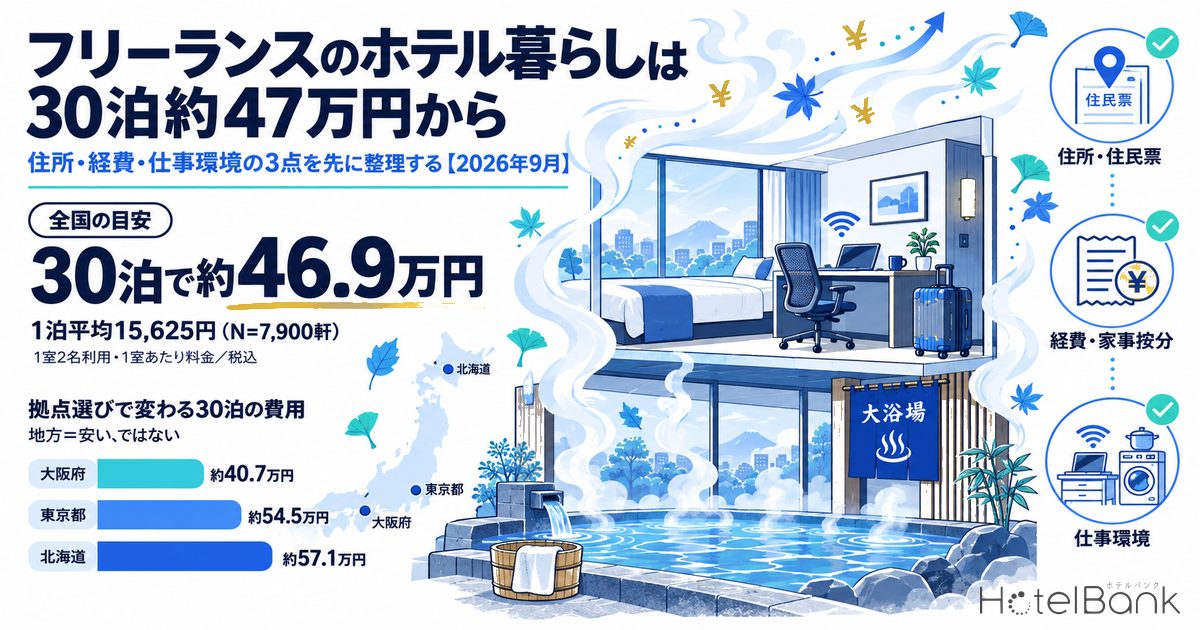
If you are a freelancer or sole proprietor who gives up a rental flat to live in hotels, the benchmark cost is about ¥469,000 for 30 nights (an average of ¥15,625 a night), based on OTA-listed prices for business hotels nationwide (as of September 2026, N=7,900 properties). (The price basis is “per room, two guests, tax included”; what a solo guest actually pays will differ.) Consecutive-night and monthly plans push the amount paid down from here, so this figure can be read as an upper-end guide. Unlike company employees, though, freelancers have two issues to settle for themselves before the money: how to handle their residence registration and business address, and how to think about expenses. This article works through the latest measured costs, the freelancer-specific issues, and how to choose a hotel as a place to work, in that order.
- — About ¥469,000 for 30 nights is the national benchmark: ¥15,625 a night on OTA-listed business-hotel prices (as of September 2026, N=7,900 properties). The price basis is “per room, two guests, tax included,” so a solo guest’s bill will differ.
- — Your choice of base moves 30 nights by more than ¥160,000. Osaka (about ¥407,300) and Fukuoka (about ¥410,800) contrast with Hokkaido (about ¥570,700) and Aichi (about ¥555,900), both more expensive than Tokyo (about ¥545,000). “Regional” does not mean “cheap.”
- — Check with the municipality where you will register your residence before cancelling your lease. Each municipality decides differently whether it will accept the registration, and where you file for National Health Insurance, the National Pension and your tax return follows your registered address.
- — There is no one-size-fits-all answer on claiming hotel costs or apportioning them between business and personal use. This article stays at a general level; read it on the assumption that you will confirm your own case with a tax accountant.
What 30 nights cost — measured as of September 2026
When the HotelBank Editorial Team aggregated OTA-listed prices for business hotels across Japan, the average listed price per night as of September 2026 was ¥15,625 nationwide (N=7,900 properties). Tokyo came in at ¥18,166 (N=968), Osaka at ¥13,578 (N=537) and Fukuoka at ¥13,694 (N=349), so where you base yourself changes the cost of 30 nights by more than ¥100,000.
| Area | Average listed price per night | 30-night equivalent | Properties |
|---|---|---|---|
| Business hotels nationwide | ¥15,625 | approx. ¥468,800 | 7,900 |
| Tokyo | ¥18,166 | approx. ¥545,000 | 968 |
| Osaka | ¥13,578 | approx. ¥407,300 | 537 |
| Fukuoka | ¥13,694 | approx. ¥410,800 | 349 |
| Hokkaido | ¥19,024 | approx. ¥570,700 | 413 |
| Aichi | ¥18,530 | approx. ¥555,900 | 308 |
| Miyagi | ¥15,145 | approx. ¥454,400 | 139 |
Table 1: Listed business-hotel prices and their 30-night equivalent (as of September 2026, HotelBank Editorial Team research). Price basis: “per room, two guests, tax included.” For business hotels, where single occupancy is the norm, this is a reference value, and what a solo guest actually pays may differ. The figures simply stack listed prices; consecutive-night and monthly plans push the amount paid down.
The figure this site measured and published for August 2026 was ¥15,959 a night nationwide, or about ¥478,800 for 30 nights (N=7,792 properties). On a 30-night basis that is a drop of about ¥10,000 (about ¥330 a night) — essentially flat. It is a more realistic level than the popular image that “hotel living costs ¥500,000 a month.”
One point is worth settling early, though: leaving Tokyo does not necessarily make it cheaper. In the same data, Osaka (about ¥407,300 for 30 nights) and Fukuoka (about ¥410,800) come in below the national average, while Hokkaido, at ¥19,024 a night (N=413), works out to about ¥570,700 for 30 nights and Aichi, at ¥18,530 (N=308), to about ¥555,900 — both higher than Tokyo (about ¥545,000). Miyagi, at ¥15,145 (N=139), comes to about ¥454,400, roughly the national average. The saving comes not from “going regional” but from “choosing a relatively cheap city,” and freelancers, who are not tied to one location, are best placed to capture that gap.
Residence registration and business address — the usual options and whom to ask
The first thing freelancers get stuck on when moving into hotels is not rent but their address. The issue splits in two: the “living address” (resident registration, or juminhyo) and the “business address” (used on your business-commencement notification, invoices, bank accounts and licences).
Resident registration is, in principle, supposed to sit at your “principal place of living.” People moving into hotels usually either register at a place they can explain as that base, such as their parents’ or a family member’s home, or consult the municipality where their long-stay hotel is located. Because each municipality decides differently whether it will accept the registration and on what conditions, the safe order is to always check with the office of the municipality where you want to register before you cancel your lease. Where you file for National Health Insurance, the National Pension and your tax return also follows your registered address, so it matters not to move while this is still unclear. The other everyday sticking points that come up alongside registration — receiving mail, laundry and storage — are laid out with fixes in 6 Downsides of Hotel Living in Japan and How to Fix Them.
For a business address, a common option is the address service offered by virtual offices or coworking spaces. It keeps the address on invoices, business cards and your website stable and gives you somewhere to receive mail. Depending on your line of business, however, the address can affect licences and bank-account requirements, so check with a tax accountant — including how your business-commencement notification and tax filing location are handled — before you switch.
Can hotel costs be business expenses? — the general picture
As a general rule, only the part of your hotel costs that you can explain as used for the business can be counted as an expense; spending on daily living (household expenses) is excluded. By analogy with apportioning the rent of a home, people sometimes argue that “the room is used as a workplace during the day,” but whether costs can be apportioned, and in what ratio, varies widely with how the business actually operates and how records are kept, and there is no one-size-fits-all answer. This article is a general overview only; always confirm your own case with a tax accountant. Deciding at the outset how to separate, in your books, stays near a client as business travel from consecutive nights at your living base will also make things easier later.
Choosing for the work environment — Wi-Fi, desk, communal bath, laundry
Unlike sightseeing or business trips, a freelancer has to choose a hotel on the assumption that “the room becomes the office.” The general checklist for long-stay business travellers comes down to six items — route from the station, laundry, breakfast hours, desk, cleaning frequency and cancellation policy (covered in detail in Business Hotels for Long Stays: 6 Checks) — but for freelancers who turn the room into their workplace, the following four carry particular weight.
- Wi-Fi and desk: if you take video calls, hotels that advertise wired LAN or a high-speed connection are the safer bet. Desk width and chair feed directly into productivity over a long stay.
- Large communal bath: when you spend your days working shut in a room, being able to switch off with a hot soak helps. Chains such as Dormy Inn, which as standard offer a natural hot-spring communal bath and a sauna, are popular with remote workers on long stays.
- Laundry: whether there is an on-site coin laundry changes both living costs and effort. At an apartment-style property with a washer-dryer in the room, you do not even have to leave the room to do laundry.
- Kitchen: over 30 nights, eating out can cost as much as the room. For a stay of a month or more, a long-stay property with a kitchen is worth considering. For concrete options in central Tokyo, see a comparison of five long-stay hotels in Tokyo’s three central wards (innippon, in Japanese).
How this article fits with the employee and remote-work guides
This article focuses on the freelancer and sole-proprietor perspective. If your situation or approach is different, the following articles pick up from here.
- If you are a company employee and housing allowances, company housing or notifying your employer are involved: check your company’s rules on housing allowances, commuter passes and notification before you move, and see 30 Nights of Hotel Living in Japan: Tokyo, Osaka and Nagoya for measured costs at station-front business hotels.
- If you mainly work remotely and want to start from the types of plan: Remote Work Hotel Living in Japan: 3 Options.
- For the full sequence, including booking, belongings and resident registration: How to Start Hotel Living in Japan: 5 Steps.
Where to look next
For comparisons of specific properties, these articles go deeper (both in Japanese).
Five long-stay hotels in Tokyo’s three central wards (Minato, Chiyoda, Chuo) — compared on kitchen, washer-dryer and monthly plans (innippon, in Japanese)
Five properties picked from 341 in Minato, Chiyoda and Chuo wards on three conditions: cooking facilities, an in-room washer-dryer and long-stay rates. Oakwood Premier Tokyo (オークウッドプレミア東京) has a full kitchen and washer-dryer in all 123 units; Ascott Marunouchi Tokyo (アスコット丸の内東京) centres on kitchen-equipped rooms with long-stay rates for 30 nights or more; and Tokyu Stay Takanawa (東急ステイ高輪) and Tokyu Stay Ginza (東急ステイ銀座) offer weekly plans for 7–29 nights.
Once a business trip passes three nights, stop staying in a “hotel” — top 5 apartment-style stays with a kitchen and washer-dryer (HotelPicks, in Japanese)
Five apartment-style properties in Tokyo, Osaka, Fukuoka and Sapporo, compared on per-night rate over a long stay and living infrastructure. Tokyu Stay Hakata (東急ステイ博多) has a washer-dryer in all 216 rooms, adds a mini kitchen in its Residential Double and Residential Twin rooms and offers a standing long-stay plan for 7 nights or more; MIMARU Tokyo Ueno East (MIMARU東京 上野EAST) has a kitchen and dining area and works well as a long-term workspace.
Frequently asked questions
Q. How much does hotel living cost a freelancer for one month?
A. The average OTA-listed price of business hotels nationwide (as of September 2026, N=7,900 properties) is ¥15,625 a night, which comes to about ¥468,800 when simply multiplied by 30 nights. Tokyo is ¥18,166 (N=968) or about ¥545,000, and Osaka is ¥13,578 (N=537) or about ¥407,300. The price basis is “per room, two guests, tax included,” so what a solo guest actually pays will differ. Consecutive-night and monthly plans push the amount paid down, so treat these figures as an upper-end guide.
Q. Will moving to a regional city make hotel costs cheaper?
A. It depends on the city. In the same September 2026 data, Osaka (about ¥407,300 for 30 nights) and Fukuoka (about ¥410,800) come in below the national average, but Hokkaido (about ¥570,700) and Aichi (about ¥555,900) are more expensive than Tokyo (about ¥545,000), and Miyagi (about ¥454,400) is roughly at the national average. The saving comes not from “going regional” but from choosing a base by looking at each city’s price level.
Q. Where should I register my residence (juminhyo) while living in hotels?
A. The principle is that your resident registration (juminhyo) belongs at your “principal place of living.” The common options are to register at a place you can explain as that base, such as your parents’ or a family member’s home, or to consult the municipality where your long-stay hotel is located. Whether registration is accepted, and on what conditions, is decided differently by each municipality, so always check with the office of the municipality where you want to register before you cancel your lease. Where you file for National Health Insurance, the National Pension and your tax return also follows your registered address.
Q. What should I do about a business address?
A. A common option is the address service offered by virtual offices or coworking spaces, which keeps the address on invoices, business cards and your website stable and gives you somewhere to receive mail. Depending on your line of business, however, the address can affect licences and bank-account requirements, so it is safest to check with a tax accountant, including how your business-commencement notification and tax filing location are handled, before you switch.
Q. Can hotel costs be claimed as business expenses?
A. As a general rule, only the part you can explain as used for the business can be counted as an expense; spending on daily living (household expenses) is excluded. Whether costs can be apportioned, and in what ratio, varies widely with how the business actually operates and how records are kept, and there is no one-size-fits-all answer. This article is a general overview only; always confirm your own case with a tax accountant.
Q. What should I look for when choosing a hotel as a place to work?
A. On the assumption that the room becomes your office, four things weigh most: Wi-Fi and whether wired LAN is available, desk width and chair, a large communal bath, and an on-site coin laundry. If you stay a month or longer, eating out can cost as much as the room, so long-stay properties with a kitchen are also worth considering.
Method and sources
■ Data source
Hotel prices are OTA public data aggregated by the HotelBank Editorial Team, using the average listed price per night for the “business hotel” category collected as of September 2026. Price basis: “per room, two guests, tax included.” Property counts are N=7,900 nationwide, N=968 for Tokyo, N=413 for Hokkaido, N=308 for Aichi, N=537 for Osaka, N=349 for Fukuoka and N=139 for Miyagi, all shown in the text and in Table 1. The August 2026 comparison figure of ¥15,959 a night nationwide (N=7,792) is the measured value this site published that month.
■ Calculation assumptions
The 30-night amounts are a simple stack of the average listed price per night above multiplied by 30, rounded to the nearest ¥100. Consecutive-night discounts, monthly plans, member rates, campaigns, locally specific taxes such as accommodation tax, and living costs such as food and coin laundry are not included. The discussion of address, resident registration and expenses is a general overview and does not determine any individual case.
■ Limitations
Listed prices are not actual transaction prices, and consecutive-night or monthly plans push the amount paid down, so the amounts in this article are an upper-end guide. Because the price basis is two guests per room, the figures are reference values for business hotels, where single occupancy is the norm, and will not match what a solo guest pays. The set of properties aggregated each month changes, so read the month-on-month difference as a guide to the level, and always confirm resident-registration and tax matters with your municipal office and a tax accountant.
Related articles
- 30 Nights of Hotel Living in Japan: ¥494,700 Tokyo, ¥209,300 Nagoya
- Business Hotels for Long Stays: 6 Checks and ¥16,722 a Night in Tokyo
- 6 Downsides of Hotel Living in Japan: ¥502,000 per 30 Nights & Fixes
- Hotel Living for Two in Tokyo: ¥8,361 a Night, ¥251,000 a Month
- Two Weeks of Hotel Living in Japan: ¥234,108 in Tokyo for 14 Nights