

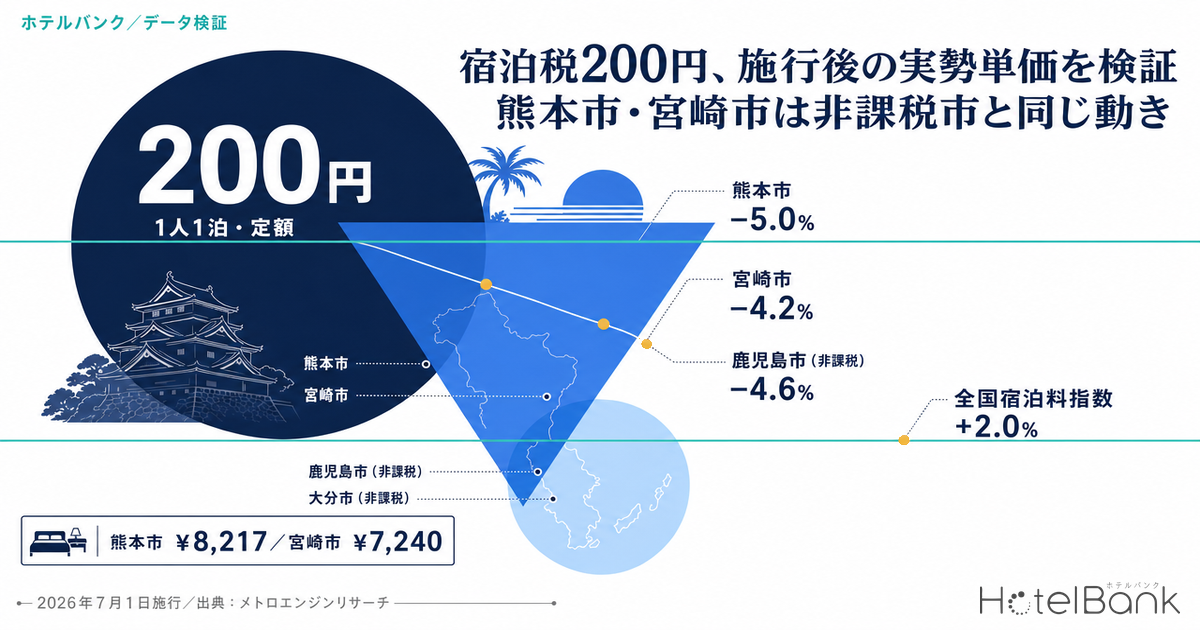
On 1 July 2026, Kumamoto City and Miyazaki City introduced a lodging tax on the same day. Both charge a flat ¥200 per person per night, with no tax-free threshold. Three months later, on 1 October, Morioka City and Nasu Town follow. The lodging tax is borne by the guest; the property acts as a special collecting agent, holding the money and remitting it. So did room rates themselves move across the start date? This article is not a list of planned schemes — it is narrowly a verification that compares actual market rates before and after implementation for a system already in force.
The conclusion first. In July 2026, the month of implementation, estimated settled ADR was down 5.0% year on year in Kumamoto City and down 4.2% in Miyazaki City. But that is not a tax effect. In the same month, Kagoshima City — which has no lodging tax — was down 4.6%, Oita City down 2.5%, the Miyazaki Prefecture average down 2.7% and the Kumamoto Prefecture average down 10.0%. The two taxed cities sit squarely inside the same band as the untaxed areas. Meanwhile, Japan’s national lodging price index was up 2.0% year on year. In short, the data shows no sign that room rates shifted upward in the implementation month, and no sign that they were pushed down by the amount of the tax either. Given how the scheme is built, that is the natural result. Below we work through the detail.
Metric Definitions Used in This Article
- ADR (average daily rate) = an estimated settled rate (tax-exclusive equivalent), calculated by applying a property-type correction factor to the lowest published plan level each property lists on OTAs and similar channels (two guests in one room, per-room price, tax-inclusive). Cross-checked against property-level results disclosed by listed hotel REITs (91 properties, most recent three months), the median error is roughly 7%. These are estimates and differ from each property’s actual transacted prices and accounting figures. Area-level ADR is the median of the properties covered (the level of a typical property in that area).
- Listed price = the average of all published sales plans on OTAs and similar channels (two guests in one room, per-room price, tax-inclusive, from room-only through meal-inclusive plans). It rests on a different basis from ADR, so the two are never mixed in a comparison.
- Year-on-year = calculated throughout on a like-for-like basis (confirmed figures against confirmed figures). Month-on-month is not used, because seasonality dominates it.
- Data source = MetroEngines Research
On the coverage period: to keep every year-on-year comparison on a confirmed basis, this article covers data through July 2026. Months from August 2026 onward are calculated as forward estimates from listed levels at the time of the survey rather than on a confirmed basis; placing those alongside confirmed figures would change what the comparison means, so they are excluded here. Kumamoto City is a government-designated city, so its city-wide figure is a facility-count-weighted composite of five wards (Chuo, Higashi, Nishi, Minami and Kita). Roughly 70% of that composite comes from properties in Chuo Ward.
- — The implementation month came in at −5.0% and −4.2%. July 2026 estimated settled ADR was ¥8,217 in Kumamoto City and ¥7,240 in Miyazaki City, both below the same month a year earlier.
- — That cannot be read as a tax effect. It falls inside the same band as untaxed Kagoshima City (−4.6%) and Oita City (−2.5%); the two taxed cities did not move on their own.
- — The national lodging price index was +2.0%. These four regional municipalities and their surroundings were in a softer phase than the country as a whole, whether taxed or not.
- — ¥200 equals 2.4–5.6% of per-room ADR (flat-rate schemes, two guests). Tiered Nasu Town comes to 1.1% for two guests — lighter than the 1.7% for a single guest.
- — What matters is how the money is spent. Tax revenue amounts to roughly ¥450,000–5.53 million per property in tourism-promotion funding, and properties have room to join the discussions that decide where it goes.
Three flat-rate schemes and one tiered scheme across the four municipalities
Start by lining up the schemes themselves. Of the four municipalities introducing a lodging tax in 2026, three — Kumamoto City, Miyazaki City and Morioka City — use a flat ¥200 per person per night, unchanged whatever the room rate, with no tax-free threshold. Nasu Town alone uses a six-band tiered scheme keyed to the accommodation charge, ranging from ¥100 to ¥3,000. Nasu Town also differs from the other three in exempting children under 12, along with pupils, students and accompanying staff on school trips and other school events.
One more point worth noting about Nasu Town is how it defines the tax base. Its “accommodation charge” means the room-only rate plus any service charge on it, and excludes meal charges and consumption tax. At onsen ryokan where two meals are standard, the tax base therefore comes out considerably smaller relative to the total bill. That distinction matters for the burden-rate discussion later on.
| Municipality | Effective date | Method and rate | Tax-free threshold | Main exemptions |
|---|---|---|---|---|
| Kumamoto City (Kumamoto) | 1 July 2026 | Flat ¥200 per person per night | None | Stays in the course of duties by foreign ambassadors and equivalent |
| Miyazaki City (Miyazaki) | 1 July 2026 | Flat ¥200 per person per night | None | Stays with no accommodation charge are outside the scope of the tax |
| Morioka City (Iwate) | 1 October 2026 | Flat ¥200 per person per night (regardless of age) | None | — |
| Nasu Town (Tochigi) | 1 October 2026 | Six tiers: under ¥10,000 → ¥100 / ¥10,000–20,000 → ¥300 / ¥20,000–30,000 → ¥500 / ¥30,000–50,000 → ¥800 / ¥50,000–100,000 → ¥1,500 / ¥100,000 and above → ¥3,000 | None | Children under 12; pupils and students on school trips or school events, and accompanying staff |
Source: compiled by the HotelBank Editorial Team from the official websites of Kumamoto City, Miyazaki City, Morioka City and Nasu Town
For a side-by-side view of every municipality in Japan that has adopted the tax, see Japan Lodging Tax 2026: All 62 Municipalities, Rates and ADR Burden. This article pulls four of them out of that list and tracks actual market rates across the start date.
Kumamoto ¥8,200 and Miyazaki ¥7,200 in the implementation month — both on last year’s track
Now to the market itself. The chart below plots monthly estimated settled ADR for Kumamoto City and Miyazaki City, with 2025 and 2026 overlaid on the same month axis. The lines stop at July because July 2026 is the most recent month comparable on a confirmed basis.
Source: MetroEngines Research; compiled by the HotelBank Editorial Team (as of July 2026, N = 84 properties in Kumamoto City, 58 in Miyazaki City)
Kumamoto City came in at ¥8,200 in July 2026, down 5.0% from ¥8,700 a year earlier. Miyazaki City was ¥7,200, down 4.2% from ¥7,600. There is no jump in the lines at the 1 July start date. If anything, both cities have been running slightly below the same months of the previous year since the start of 2026, and July sits on that same trajectory.
The spike to ¥12,600 visible in Miyazaki City in February is the usual seasonality driven by professional baseball spring training. That peak makes Miyazaki City look elevated on an annual average, but on a single-month July comparison the year-on-year figure is in negative territory.
Set against untaxed neighbours, the two taxed cities did not move on their own
Viewed in isolation, “−5%” looks like movement. So let us line the taxed cities up against nearby cities with no lodging tax, and against prefectural averages, for the same month on the same basis. To strip out confounders, this is the most straightforward approach available.
Source: MetroEngines Research; compiled by the HotelBank Editorial Team. National lodging price index from the Ministry of Internal Affairs and Communications, Consumer Price Index (e-Stat)
Kumamoto City (−5.0%) and Miyazaki City (−4.2%), which began taxing, sit between untaxed Kagoshima City (−4.6%) and Oita City (−2.5%). Look at the prefectural averages and Miyazaki Prefecture is −2.7% while Kumamoto Prefecture is −10.0% — the taxed cities are steadier than their prefectures as a whole. Morioka City (−2.1%) and Nasu Town (−12.7%), both facing an October start, likewise move with the Iwate Prefecture average (−1.5%) and with Nikko City (−10.3%) and the Tochigi Prefecture average (−6.6%) respectively. For where Kagoshima City — used here as a comparison — sits within its own prefecture’s rate structure, see Kagoshima’s Capital Is Its Cheapest: ADR ¥6,819 vs Kirishima ¥14,330.
As a yardstick, the national lodging price index went from 165.8 in July 2025 to 169.1 in July 2026, up 2.0%. The four municipalities covered here and their surroundings were in a softer phase than the national index, and that softness was shared regardless of whether a tax applied. There is therefore no basis for attributing the implementation-month rate movement to the lodging tax — that is the conclusion the data will support.
| Area | Lodging tax | Jul 2025 ADR | Jul 2026 ADR | YoY | N (Jul 2026) |
|---|---|---|---|---|---|
| Kumamoto City | In force since 1 Jul | ¥8,651 | ¥8,217 | −5.0% | 84 |
| Miyazaki City | In force since 1 Jul | ¥7,560 | ¥7,240 | −4.2% | 58 |
| Kagoshima City | None | ¥6,687 | ¥6,380 | −4.6% | 73 |
| Oita City | None | ¥6,608 | ¥6,442 | −2.5% | 42 |
| Morioka City | From 1 Oct | ¥7,308 | ¥7,154 | −2.1% | 42 |
| Nasu Town | From 1 Oct | ¥20,486 | ¥17,884 | −12.7% | 53 |
| Nikko City | None | ¥16,961 | ¥15,210 | −10.3% | 116 |
| Nasushiobara City | None | ¥13,241 | ¥12,516 | −5.5% | 69 |
| Akita City | None | ¥7,870 | ¥9,102 | +15.7% | 30 |
| Aomori City | None | ¥10,504 | ¥9,684 | −7.8% | 39 |
| Miyazaki Pref. average | — | ¥6,677 | ¥6,498 | −2.7% | 166 |
| Kumamoto Pref. average | — | ¥10,228 | ¥9,205 | −10.0% | 401 |
| Iwate Pref. average | — | ¥7,042 | ¥6,936 | −1.5% | 255 |
| Tochigi Pref. average | — | ¥10,306 | ¥9,629 | −6.6% | 403 |
Source: MetroEngines Research; compiled by the HotelBank Editorial Team (N = number of properties used to calculate estimated settled ADR)
The tax barely shows up in listed prices because of how the scheme is built
The lodging tax is not, in the first place, a price added to a property’s revenue. All four municipalities use a special collection mechanism: the property receives the tax from the guest and files and remits it to the municipality by the end of the following month. In other words, the tax is money held on deposit and settled outside the accommodation charge, and in accounting terms it is separate from how the room itself is priced. Whether the tax is folded into the displayed price or collected separately at the front desk is an operational choice, but either way it is not a factor that moves the level of room rates.
For reference, here is the same month viewed through listed prices (all-plan average, tax-inclusive). Miyazaki City went from ¥15,000 in July 2025 to ¥16,300 in July 2026, up 9.1%; Kumamoto City went from ¥18,100 to ¥18,300, up 1.5%. But here too the untaxed Miyazaki Prefecture average rose 10.6%, Oita City 5.0% and the Iwate Prefecture average 8.7% — again, not a movement confined to taxed areas. Listed prices and estimated settled ADR split on sign because the two rest on different bases. The structure of that gap is set out in What Is Hotel ADR? Settled Rates 34-57% of Listed Prices, 2026.
Nasu Town and Morioka City, starting in October — the base the tax will sit on
Morioka City and Nasu Town start on 1 October, so within this article’s coverage period only the pre-tax months are observable. That makes it worth checking the base level the tax will sit on. Nasu Town matters especially: it is the first lodging tax in Tochigi Prefecture, and because the scheme is tiered, the base level directly determines which tax band applies. How the ratio applied to actual market rates differs between tiered and flat schemes is also compared in Nasu vs Morioka Lodging Tax Oct 1: Tiered 1.0-3.0% vs Flat ¥200.
Source: MetroEngines Research; compiled by the HotelBank Editorial Team (as of July 2026, N = 53 properties in Nasu Town, 116 in Nikko City)
Nasu Town came in at ¥17,900 in July 2026, down 12.7% from ¥20,500 a year earlier. Nikko City, another sightseeing destination in the same prefecture, moved in parallel at ¥15,200 and −10.3%, so Nasu Town’s level reads as tracking tourism demand in the north of the prefecture. Look at Nasu Town’s annual shape and the summer-driven curve is unmistakable, with a sharp August jump: August 2025 reached ¥28,600. The first month of the October start falls in the stable band after that summer peak has receded. For the rate structure across Tochigi Prefecture’s cities and towns, see Tochigi Hotel ADR: 3.6x City Gap, Nasu ¥20,192 vs Utsunomiya ¥7,349.
Morioka City was ¥7,200 in July 2026, down 2.1% from ¥7,300 a year earlier. That is almost identical to the Iwate Prefecture average (−1.5%), leaving the market broadly flat. Morioka City uses a flat ¥200, so the base level has no bearing on the tax amount. The pace of recovery by property type within Iwate Prefecture is covered in Iwate Settled ADR H1 2026: Business −3.2% in June, City +4.3%.
What percentage of the rate is ¥200? Flat schemes 2.4–5.6%, tiered 1.1–1.7%
Let us work out how much weight the lodging tax carries in the guest’s total payment, dividing through by actual market rates. The denominator here is July 2026 estimated settled ADR (per room), calculated for two cases: one guest per room and two guests per room. In the three flat-rate cities, two guests means ¥400 per room.
Source: MetroEngines Research; compiled by the HotelBank Editorial Team (calculated using July 2026 estimated settled ADR)
| Municipality | Jul 2026 ADR (per room) | 1 guest: tax / burden rate | 2 guests: tax / burden rate |
|---|---|---|---|
| Miyazaki City | ¥7,240 | ¥200 / 2.8% | ¥400 / 5.5% |
| Kumamoto City | ¥8,217 | ¥200 / 2.4% | ¥400 / 4.9% |
| Morioka City | ¥7,154 | ¥200 / 2.8% | ¥400 / 5.6% |
| Nasu Town (tiered, illustrative) | ¥17,884 | ¥300 / 1.7% | ¥200 / 1.1% |
Source: MetroEngines Research; compiled by the HotelBank Editorial Team. Because Nasu Town’s band is set by the per-person, per-night accommodation charge excluding meals and consumption tax, the single-guest case is assumed to fall in the ¥10,000–20,000 band and the two-guest case in the under-¥10,000 band.
The design logic of the tiered scheme shows up clearly here. In the three flat-rate cities, the per-room tax rises in proportion to headcount, so the two-guest burden rate is exactly double the single-guest rate, at 4.9–5.6%. In Nasu Town, by contrast, the same per-room rate split between two guests lowers the per-person accommodation charge, which moves the tax band down a step. The result is a per-room burden rate of 1.1% for two guests — lighter than the 1.7% for a single guest. The more a property caters to families and groups, the relatively lighter the tiered scheme is; the higher the share of single occupancy, as at business locations, the more the weight of a flat rate shows.
That said, every one of these levels falls within 1–6% of the total payment for one night. Compared with municipalities using a percentage-of-price scheme, this is on the light side. Tokyo moves to a 3% percentage scheme on 1 April 2027, and the Hakone Town proposal put forward as an ordinary tax rather than an earmarked one offers another contrast — both are covered separately in our lodging tax coverage.
Seen from the property side, tax revenue creates a tourism budget worth millions of yen per property
All four lodging taxes are non-statutory earmarked taxes, restricted to tourism promotion. Kumamoto City will apply the revenue to new and expanded projects under its Kumamoto City Tourism Marketing Strategy; Miyazaki City to improving the reception environment, polishing tourism assets and promotion at home and abroad; Morioka City to raising the appeal of tourism assets and encouraging visits and exchange; and Nasu Town to polishing tourism assets and developing tourism infrastructure.
Read that from the property side and the picture changes. Dividing the reported revenue projections by the number of operating properties we track in each municipality gives a sense of the scale of tourism-promotion budget per property.
| Municipality | Projected revenue (full year) | Assumed taxable person-nights | Properties tracked | Per property |
|---|---|---|---|---|
| Kumamoto City | approx. ¥700 million/year | approx. 3.5 million | 128 | approx. ¥5.47 million |
| Miyazaki City | approx. ¥560 million/year | approx. 2.8 million | 115 | approx. ¥4.87 million |
| Morioka City | approx. ¥260 million/year | approx. 1.3 million | 47 | approx. ¥5.53 million |
| Nasu Town | ¥114 million in year one | not converted (tiered scheme) | 254 | approx. ¥450,000 |
Source: revenue projections from the Minister for Internal Affairs and Communications consent documents (Miyazaki City, Morioka City) and press reports (Kumamoto City, Nasu Town); property counts from MetroEngines Research (properties confirmed as operating on OTAs as of July 2026), compiled by the HotelBank Editorial Team
On these figures, tourism-promotion funding equivalent to roughly ¥5.47 million per property in Kumamoto City, ¥4.87 million in Miyazaki City and ¥5.53 million in Morioka City comes into being every year. Nasu Town works out to about ¥450,000 per property because it has as many as 254 of them — but its tiered design collects more heavily from the higher rate bands, so the funding pool grows as rates rise.
For properties, this is concrete upside. Promotion, secondary transport, multilingual support, Wi-Fi and signage, and the creation of destination-based content are all line items that are heavy for an individual property to fund alone, yet feed straight back into the value of the room once in place. Joining the forums that decide how lodging tax money is spent, and proposing projects that work on your own property’s demand funnel, is the most realistic way to get a return on the administrative work of collecting money held on deposit. In a market with few properties, such as Morioka City with 47, each property’s voice carries relatively more weight.
There is room on the pricing side too. The measurements here put ¥200 at 2.4–5.6% of per-room ADR. Small ancillary services such as breakfast and late checkout, meanwhile, are an area where a property can capture more than that. A tax that moves the guest’s total payment by a few percent is also an occasion to revisit the structure of the rate itself. In central Kumamoto City, for instance, supply has grown 26.0% above 2019 levels, so there is room on the market side to go after rate as well.
Conclusion — the effect of implementation shows up in spending, not in rates
Estimated settled ADR in Kumamoto City and Miyazaki City, which introduced a lodging tax on 1 July 2026, came in at −5.0% and −4.2% year on year in the implementation month. But in the same month untaxed Kagoshima City was −4.6%, Oita City −2.5% and Nikko City −10.3%: the two taxed cities’ movement sits entirely inside the band of the untaxed areas. Combined with a national lodging price index at +2.0%, the natural reading is that these four municipalities and their surroundings were in a soft phase during this period regardless of whether a tax applied.
That result is consistent with how the scheme is built. The lodging tax is money held on deposit under a special collection mechanism, settled outside the room rate. Looking for a trace of the tax in actual market rates over a span of a few months from implementation is therefore, from the outset, out of step with the design. What matters to a property is not the level of the rate but the workload at the front desk and where the revenue goes.
On 1 October, Morioka City and Nasu Town follow. Flat-rate Morioka City’s base level will not affect the tax amount, but in tiered Nasu Town the per-person, per-night accommodation charge (excluding meals and consumption tax) sets the band, so plan design and rate level feed directly into which tax band applies. After implementation we intend to track confirmed-basis year-on-year figures for these two municipalities within the same framework and revisit the question.
Related Reading
- Japan Lodging Tax 2026: All 62 Municipalities, Rates and ADR Burden
- Onsen Bathing Tax Rises: ¥350 Aizuwakamatsu, ¥300 Izu, 1.1–1.6% of ADR
- Tochigi Hotel ADR: 3.6x City Gap, Nasu ¥20,192 vs Utsunomiya ¥7,349
- Nasu vs Morioka Lodging Tax Oct 1: Tiered 1.0-3.0% vs Flat ¥200
- Iwate Hotel Market 2026: 2.2x ADR Gap, Morioka ¥200 Lodging Tax
- Kagoshima’s Capital Is Its Cheapest: ADR ¥6,819 vs Kirishima ¥14,330
- Japan Lodging Tax 2026: ¥100–200 per Night, Kyoto Up to ¥10,000
References and Sources
■ Municipal official sources (scheme details)
- Kumamoto City, “Lodging Tax: Overview”
- Miyazaki City, “About the Lodging Tax”
- Morioka City, “Introduction of the Lodging Tax”
- Nasu Town, “Introduction of the Nasu Town Lodging Tax”
- Nasu Town, “Frequently Asked Questions on the Nasu Town Lodging Tax”
- Ministry of Internal Affairs and Communications, “Establishment of a Lodging Tax in Nasu Town, Tochigi Prefecture (consent dated 30 September 2025)”
- Ministry of Internal Affairs and Communications, “Establishment of a Lodging Tax in Miyazaki City, Miyazaki Prefecture (consent dated 13 February 2026)”
- Ministry of Internal Affairs and Communications, “Establishment of a Lodging Tax in Morioka City, Iwate Prefecture”
■ Government statistics
- Ministry of Internal Affairs and Communications, Consumer Price Index, accommodation charges (national, monthly; e-Stat statistics ID: 0003427113)
■ Press reports (revenue projections)
- KAB Kumamoto Asahi Broadcasting, “¥200 per person per night: Kumamoto City introduces a lodging tax, projecting ¥700 million a year”
- Kumamoto Nichinichi Shimbun, “Kumamoto City begins collecting its lodging tax at ¥200 per person per night”
- Nikkei, “Miyazaki City’s ¥200 lodging tax from July, with hopes of using it to draw visitors in the off season” (30 June 2026)
- Iwate Nippo, “Morioka City introduces the prefecture’s first lodging tax at ¥200 a night; public facility fees to rise by up to 1.5x” (23 December 2025)
- Shimotsuke Shimbun, “Nasu Town projects ¥114 million in lodging tax revenue in year one”
■ Data sources
Monthly aggregates of estimated settled ADR and listed prices for Kumamoto City, Miyazaki City, Morioka City, Nasu Town and each comparison municipality (MetroEngines Research). The national lodging price index is from the Ministry of Internal Affairs and Communications, Consumer Price Index (e-Stat statistics ID: 0003427113). Scheme details, rates, effective dates and permitted uses are from municipal official sources and the Minister for Internal Affairs and Communications consent documents; revenue projections are from those consent documents and press reports.
■ Calculation assumptions
All year-on-year figures are calculated on a confirmed basis against a confirmed basis, with July 2026 as the most recent month (forward estimates from August 2026 onward are excluded from the comparison). Kumamoto City is a government-designated city, so its five wards are combined on a facility-count-weighted basis (roughly 70% of the composite is Chuo Ward). Burden rates are calculated using each municipality’s July 2026 estimated settled ADR (per room) as the denominator, for two cases: one guest per room and two guests per room. Because Nasu Town’s band is set by the per-person, per-night accommodation charge excluding meals and consumption tax, the single-guest case is assumed to fall in the ¥10,000–20,000 band and the two-guest case in the under-¥10,000 band.
■ Limitations and caveats
ADR is an estimate and differs from each property’s actual transacted prices and accounting figures. Area-level ADR is the median of the properties covered, so bias in the property mix and differences in the number of properties covered (N) affect the level. Within this article’s coverage period, only pre-tax months are observable for Morioka City and Nasu Town, so post-implementation market conditions are not included. Rate movements reflect multiple factors including seasonality, supply changes and demand structure, so this article goes no further than showing whether a correlation exists between taxation and rates; it does not infer causation. The per-property revenue conversion is a mechanical division of published revenue projections by the property counts we track, and is not an actual allocation.
■ Market data
- MetroEngines Research — monthly aggregates of estimated settled ADR and listed prices (Kumamoto City five-ward composite N=84, Miyazaki City N=58, Morioka City N=42, Nasu Town N=53 and others, all as of July 2026)