

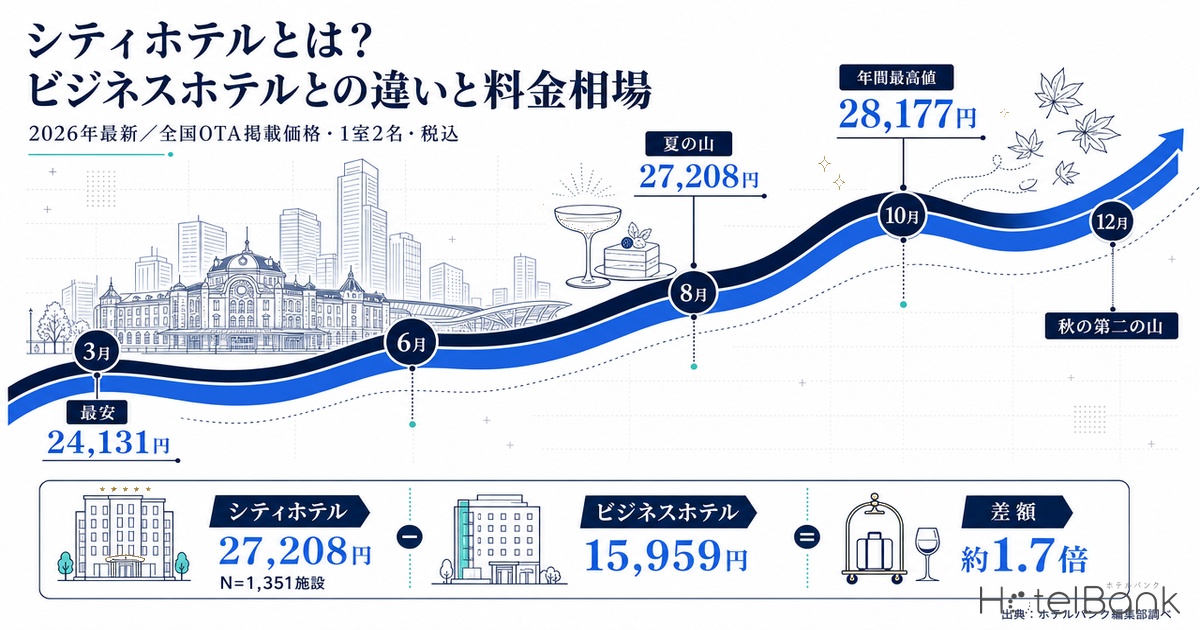
A city hotel is a full-service hotel located in an urban centre that adds restaurants, banquet halls, bars and lounges to the basic function of accommodation. There is in fact no strict legal definition of the term — it is a classification that grew out of industry practice. As a price benchmark, listed prices on booking sites across Japan (as of August 2026, double occupancy, per room, tax included) averaged ¥27,208 (N=1,351 properties). That is roughly 1.7 times the ¥15,959 average for accommodation-focused business hotels (N=7,792), but the gap becomes easy to understand once you read it as the price of “everything other than sleeping” — the restaurants, the banquet facilities, the fuller service. This article walks through what a city hotel is, how it differs from business hotels, ryokan and resort hotels, what each category costs, and which kinds of stays it suits.
- — A city hotel is a full-service urban hotel that adds restaurants, banquet halls and bars to guest rooms. It has no legal definition; it is a customary category used by the industry and by official statistics.
- — The national average listed price is ¥27,208 for two people in one room (August 2026, per room, tax included, N=1,351 properties) — about 1.7 times the ¥15,959 of business hotels.
- — The roughly ¥11,000 difference is not about a grander building; it is the price of “everything other than sleeping.” Neither category is superior — they are built for different purposes.
- — Month to month the figure swings between ¥24,131 and ¥28,177 (March–December 2026). The peak is not August but October–November, and the swing is wider than for business hotels.
- — City hotels suit anniversaries, stays of two or more people, location-driven itineraries and trips that involve dining or ceremonies. For a solo business trip, or when room cost comes first, a business hotel is the rational choice.
Defining a city hotel — industry practice, not law
Under Japan’s Hotel Business Act (旅館業法), hotels and ryokan have been grouped into a single business category, “ryokan/hotel business,” since the 2018 amendment, and the term “city hotel” appears nowhere in the statute. In other words, a city hotel is not a legal term but a customary classification used by the industry and in statistics.
For an official reference point, the terminology used by the Japan Tourism Agency’s Overnight Travel Statistics Survey (宿泊旅行統計調査) is useful. That survey divides hotels into three groups and defines a city hotel as “a hotel located in an urban area that is neither a resort hotel nor a business hotel”, a business hotel as one “primarily serving business travellers,” and a resort hotel as one “built in a recreational or leisure area, primarily serving tourists.” Which category a property reports itself under is self-declared, so the boundaries are not strict.
In practice, a hotel tends to be called a city hotel when these three conditions come together.
- An urban or major-terminal-station location — somewhere that works for sightseeing and for business alike
- Full-service in-house facilities — restaurants (usually several), banquet halls, a bar or lounge, room service and so on
- A broad range of room types — mainly doubles and twins, extending to stays of two or more people and up to suites
The difference from business hotels is “everything other than sleeping”
What separates the two is not how lavish the building is but how much non-accommodation function the property keeps in-house. A business hotel holds prices down by narrowing its functions to the stay itself, optimised for solo travellers and business trips. A city hotel is built so that the whole stay — dinner in the restaurant, a banquet or wedding, a drink at the bar — can be completed inside the building. Neither is above the other; they serve different purposes.
| Item | City hotel | Business hotel |
|---|---|---|
| Location | City centres and around major terminal stations | In front of stations, in office districts — spread widely across Japan |
| In-house facilities | Full service: restaurants, banquet halls, bar, room service | Concentrated on the stay itself; many offer breakfast or a large communal bath |
| Room mix | Mainly doubles and twins, built for two or more guests | Mainly singles, optimised for solo use |
| Best use | Anniversaries, city sightseeing, stays of two or more, dining and ceremonies | Business trips, a solo sightseeing base, itineraries that keep room cost down |
Price benchmark — ¥27,208 on average for two people in one room (August 2026)
Based on listed prices aggregated from publicly available booking-site data across Japan by the HotelBank Editorial Team as of August 2026 (double occupancy, per room, tax included), the averages for the four main categories are as follows.
| Category | Average listed price (per room, tax incl.) | Properties in sample |
|---|---|---|
| Business hotel | ¥15,959 | N=7,792 |
| City hotel | ¥27,208 | N=1,351 |
| Ryokan | ¥35,252 | N=6,559 |
| Resort hotel | ¥52,006 | N=1,792 |
Source: HotelBank Editorial Team analysis (listed prices on booking sites across Japan, as of August 2026). Prices are per room for two-person occupancy, tax included. Actual booking prices vary by plan, season and meal arrangements.
At ¥27,208 for two people in one room, the per-person benchmark is just under ¥14,000. The gap to a business hotel is about ¥11,000 per room, but for a city hotel that price includes full-service in-house facilities and a city-centre location. Set against ryokan (¥35,252), where dinner and breakfast are the norm, or resort hotels in leisure destinations (¥52,006), the city hotel sits in the most accessible price band among full-service properties. Room-only and breakfast-only plans are available, which also makes it a good fit for city sightseeing where you would rather eat out.
By month, the peak is October–November, not August
The instinct that “August is expensive because of the summer holidays” is only half right. Lining up the monthly average listed price from March to December 2026, the city-hotel low is ¥24,131 in March and the high is ¥28,177 in October, which puts August (¥27,208) third for the year. The swing is about ¥4,000, or roughly 17%.
| Month | City hotel | Business hotel | Ratio | Basis |
|---|---|---|---|---|
| March 2026 | ¥24,131 | ¥14,741 | 1.64x | Actual |
| April 2026 | ¥24,529 | ¥14,858 | 1.65x | Actual |
| May 2026 | ¥25,983 | ¥15,377 | 1.69x | Actual |
| June 2026 | ¥24,317 | ¥14,686 | 1.66x | Actual |
| July 2026 | ¥24,662 | ¥14,860 | 1.66x | Actual |
| August 2026 | ¥27,208 | ¥15,959 | 1.70x | Actual |
| September 2026 | ¥26,696 | ¥15,741 | 1.70x | Listed |
| October 2026 | ¥28,177 | ¥15,996 | 1.76x | Listed |
| November 2026 | ¥28,116 | ¥15,913 | 1.77x | Listed |
| December 2026 | ¥27,011 | ¥15,831 | 1.71x | Listed |
Figure 1: Monthly average listed price (nationwide, double occupancy, per room, tax included). September onward reflects prices listed as of 4 September 2026.
Two things stand out. First, autumn is a second high season. October and November, when the foliage season overlaps with urban demand from conferences and trade shows, run ¥900–1,000 above August. Second, city hotels move more from month to month. Over the same period business hotels ranged from ¥14,686 to ¥15,996 — a swing of about 9%, roughly half the city hotels’ 17%. The ratio between them also widens, from 1.64x in spring to 1.77x in autumn.
Read the other way, choosing March, April or June tends to loosen the terms at the same hotel. Weekdays and Sunday nights also tend to carry lower listed prices at the same property, so shifting an itinerary by a single day can make a difference. For how wide that day-to-day swing actually gets, our analysis comparing daily price ranges by area and property category puts numbers to it.
Who and what kind of stay a city hotel suits
Anniversaries and special occasions
Being able to finish the evening in the hotel’s own restaurant or bar is where a city hotel is at its best. The ease of taking the lift back to your room after dinner suits a birthday or wedding-anniversary meal, and there are more options for staging the occasion — room service, arranging a cake and so on. Stays built around “everything other than sleeping” — the bar itself as the reason for the trip, for instance — have become a recognisable way to travel.
City stays for two or more, and for families
Doubles and twins form the core of the room mix, and some properties offer triples or connecting rooms, which suits couples and families. They also work well as a base: leave your bags, head out into the city, come back and rest in the lounge.
Itineraries where location comes first
City hotels are usually in the heart of the city or right next to a terminal station, which pairs well with theatre, concerts and sport, or with an early Shinkansen or airport connection the next morning. Being able to walk back after a late night out is part of what the location premium buys.
Stays that involve dining, banquets or ceremonies
With banquet halls and meeting rooms on site, a reunion, a memorial service, a wedding or a business dinner can be handled in the same building as the stay. Guests travelling from far away can simply stay the night — an advantage particular to full-service properties.
Conversely, for a solo business trip or an itinerary where room cost comes first, a business hotel with its functions narrowed to the stay is the rational choice. Inbound usage has also come to differ structurally by category; the statistics on foreign-guest share by property type are covered in detail in our analysis of foreign guest nights by facility type.
Where to look next
For comparisons of specific properties, these articles go deeper (both in Japanese).
Compares five properties — The Tokyo Station Hotel (東京ステーションホテル), Shangri-La Tokyo (シャングリ・ラ 東京), Nagoya JR Gate Tower Hotel (名古屋JRゲートタワーホテル), InterContinental Osaka (インターコンチネンタル大阪) and Miyako Hotel Hakata (都ホテル 博多) — on station-connected circulation, room count and benchmark price for two people in one room. A concrete set of examples for choosing a city hotel on location.
Reads The Tokyo Station Hotel (東京ステーションホテル), Akakura Kanko Hotel (赤倉観光ホテル) and Unzen Kanko Hotel (雲仙観光ホテル) through “the design of a single drink” — bar opening hours, house-made liqueurs and the rest. A concrete shortlist for anyone who wants the restaurant or bar to be the reason for the stay.
There is no strict definition of the words “city hotel,” but if you read them as “a hotel in the centre of the city where the hours other than sleeping can also be enjoyed indoors,” you are unlikely to choose wrongly. Use the national average of a high-¥20,000s listed price for two people in one room, tax included (as of August 2026, N=1,351), as your yardstick, and pick the property that matches the purpose of the trip.
Frequently asked questions
What is the difference between a city hotel and a business hotel?
The dividing line is not how lavish the building is but how much non-accommodation function the property keeps in-house. A city hotel is full-service — restaurants, banquet halls, a bar and room service — with a room mix centred on doubles and twins. A business hotel narrows its functions to the stay itself, is centred on single rooms and is optimised for solo business travel. Neither is superior; they serve different purposes.
How much does a city hotel cost?
The national average is ¥27,208 per room for two-person occupancy, tax included (as of August 2026, N=1,351 properties). Per person, that works out to just under ¥14,000 as a benchmark. It is about 1.7 times the ¥15,959 of business hotels, and the roughly ¥11,000 difference is the price of full-service in-house facilities and a city-centre location.
Is “city hotel” defined in law?
No. Under the Hotel Business Act (旅館業法), hotels and ryokan have been grouped into a single business category, “ryokan/hotel business,” since the 2018 amendment, and the term “city hotel” does not appear in the statute. As a statistical category, the Japan Tourism Agency’s Overnight Travel Statistics Survey (宿泊旅行統計調査) defines a city hotel as “a hotel located in an urban area that is neither a resort hotel nor a business hotel.”
When are city hotels cheapest?
By month, March, April and June tend to be lower, and in 2026 the cheapest was March at ¥24,131. The most expensive months are October and November (¥28,177 and ¥28,116), which run higher than August and its summer holidays. The annual swing is about ¥4,000, or roughly 17%, so if your dates are flexible, simply shifting the month changes the terms.
How do city hotels differ from ryokan and resort hotels?
Even among full-service properties, the assumptions about location and meals differ. Ryokan are built mainly in Japanese style with dinner and breakfast included as the norm, averaging ¥35,252 nationwide; resort hotels sit in recreational and leisure areas at ¥52,006 (both August 2026, two people per room, tax included). At ¥27,208, city hotels are the most accessible price band among full-service properties, and room-only or breakfast-only plans are available.
Can one person stay at a city hotel?
Yes. But because rooms are centred on doubles and twins and designed around stays of two or more people, the per-room rate does not fall much when only one person stays. For a solo business trip, or an itinerary where room cost comes first, a business hotel centred on single rooms is the more rational choice.
Methodology and sources
■ Data source
The prices in this article are listed prices published on accommodation booking sites across Japan, aggregated by property category by the HotelBank Editorial Team. For each month from March to December 2026 we calculated the average per-room price for two-person occupancy, tax included. Sample sizes run 1,089–1,425 properties per month for city hotels and 6,639–8,083 for business hotels. Category assignment is based on the properties’ own declarations.
■ Calculation assumptions
All prices are listed prices per room, tax included, for two-person occupancy. The “per person” figures in the text are the per-room price divided by two, given for reference only; they are not the rate for single occupancy. Comparisons between categories use the same month and the same price basis. Definitions are quoted following the categories used in the Japan Tourism Agency’s Overnight Travel Statistics Survey.
■ Limitations and caveats
Listed prices are the prices displayed on booking sites, not transacted prices. Months from September 2026 onward are prices listed as of the time of writing (4 September 2026) and may change. Local taxes such as lodging tax and bathing tax, and differences arising from plan, meal arrangements and cancellation terms, are not reflected. Because category boundaries rest on self-declaration by each property, similar properties may fall into different categories.
■ Regulatory and statistical sources
- Japan Tourism Agency, Overnight Travel Statistics Survey — survey outline (definitions of accommodation types)
- Japan Tourism Agency, Overnight Travel Statistics Survey
- Ministry of Health, Labour and Welfare, Overview of the Hotel Business
- e-Gov Law Search, Hotel Business Act (Act No. 138 of 1948)
Related reading
- City Hotels: 45.9% of Guest Nights Are Foreign — Ryokan +3.7%
- Monthly Hotels in Japan: No Lease, 20% Off at 30 Nights (Aug 2026)
- Japan Autumn 2026 Hotel Price Range: 3.3x CV Gap Across 47 Prefectures
- Japan Lodging Tax 2026: ¥100–200 per Night, Kyoto Up to ¥10,000
- Business Hotels for Long Stays: 6 Checks and ¥16,722 a Night in Tokyo
- What Price Gets Called “Good Value”? 2.9M Reviews Map a U-Curve