

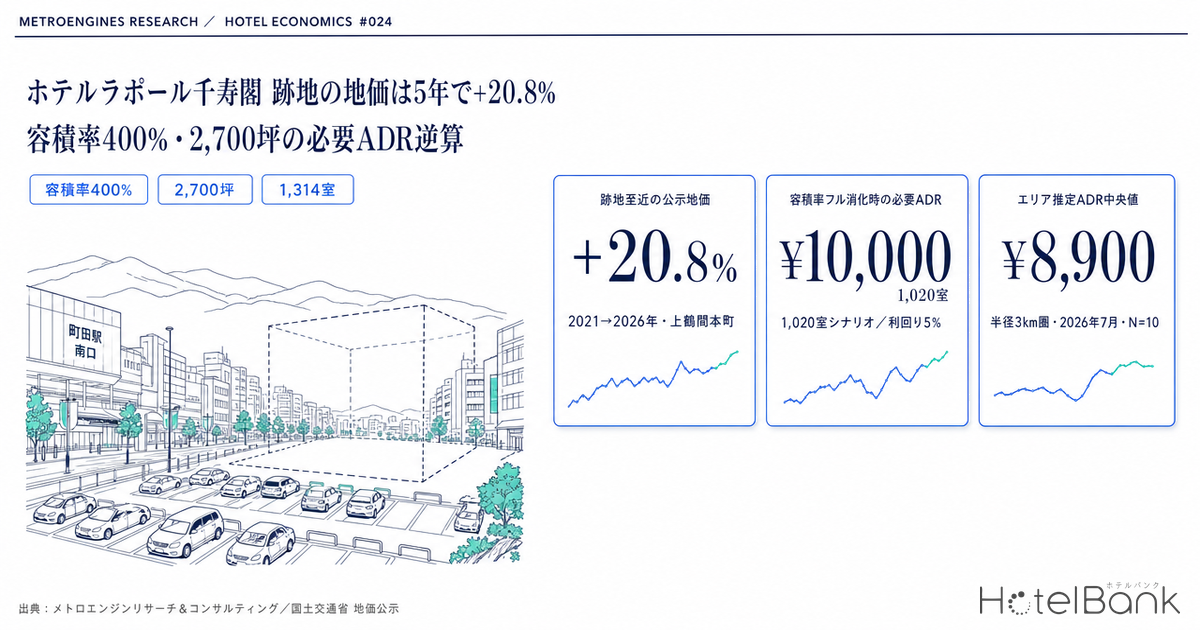
Hotel Rapport Senjukaku (ホテルラポール千寿閣) stood in Kamitsuruma-honcho, Minami-ku, Sagamihara City, Kanagawa — about a five-minute walk from the south exit of JR Machida Station. Five years have passed since it closed. The site is now a 305-space hourly parking lot. This article is not about how the hotel came to close; it is about the economics of the land underneath it. Published land prices began rising the year after the closure and, by 2026, stood 20.8% above their 2021 level. So why has a prime site next to a major station — commercial zoning, a 400% floor area ratio, roughly 2,700 tsubo (about 8,926 m²) — not returned to hotel use in five years? We put land cost, construction cost and achievable room rates side by side and work backwards to the required ADR (average daily rate).
Metric Definitions Used in This Article
- ADR (average daily rate): An estimated settled rate (tax-excluded equivalent) calculated by applying a property-type correction factor to the lowest published plan rate each property lists on OTAs and similar channels (double occupancy, per-room, tax-included). Cross-checked against per-property results disclosed by listed hotel REITs (91 properties, most recent three months), the median error is roughly 7%. These are estimates and differ from each property’s actual transacted rates and accounting figures. Area-level ADR is the median of the properties covered (the level of a typical property in that area).
- Required ADR: The room rate needed for the combined land acquisition and construction cost to meet an assumed investment yield. Figures here are simplified estimates using common assumptions of 85% annual occupancy, a 40% GOP ratio and a 5% yield; an actual investment decision requires a detailed feasibility study.
- Published land price (koji chika): The standard-site price under the Ministry of Land, Infrastructure, Transport and Tourism (MLIT) Land Price Publication (as of January 1 each year). It is not an actual transaction price.
- Data sources: MetroEngines Research & Consulting / MLIT Real Estate Information Library
- — +20.8% — the published land price next to the site (2021→2026). That beats the Tokyo side of Machida Station (+14.2% to +14.8%), and the turn came two years after the hotel closed.
- — Commercial zoning, 400% FAR, a site of roughly 2,700 tsubo. Building out the full FAR yields 1,020 rooms — equal to 77.6% of the 1,314 rooms of general lodging stock within a 3 km radius.
- — Required ADR is ¥17,100 at 200 rooms, ¥12,700 at 400 rooms and ¥10,000 at 1,020 rooms — 1.13x to 1.92x the area median of ¥8,900.
- — Across 20 combinations of 4.0–6.0% yields and 75–90% occupancy, the required ADR for a 400-room scheme bottoms out at ¥9,600 — still above the area median.
- — A hotel-only scheme has no solution at either end of the size range. Mixed use spreads the land cost across uses — consistent with the fact that the buyer was a condominium developer.
The site is a 305-space hourly car park — what can be confirmed as of September 2026
Start with primary sources on the current state. Park24’s car park directory lists “Times Machida Station South Exit” (3-11 Kamitsuruma-honcho, Minami-ku, Sagamihara City, Kanagawa), and as of September 2, 2026 it shows 305 spaces, 24-hour access, a standard rate of ¥200 per 30 minutes, and a 24-hour cap of ¥600 Monday to Friday and ¥700 on weekends and holidays. According to on-site records kept by the local information site “Sagamihara Atari,” the car park opened on June 1, 2025.
The path to that point can also be traced through public information. Town News Sagamihara Minami-ku edition (June 3, 2021) reported that Senju Sangyo, the operator, planned to wind up the business by selling the roughly 2,700-tsubo site and buildings that housed both the hotel and the bowling alley. Kentsu Shimbun subsequently reported in May 2023 that Goldcrest had acquired the site, and the real estate title Realnet recorded in a February 2024 site report that “Goldcrest acquired the land and buildings and has been carrying out demolition work since April 2023; the site is now cleared.” In other words, about a year from acquisition to completed demolition, then a further year or so before the interim-use car park opened. As of September 2, 2026, no official announcement of a permanent use has been confirmed.
| Date | Confirmed fact | Source |
|---|---|---|
| April 28, 2021 | Closure announced (decided in January that year; explained to all employees and shareholders on April 27) | Town News (June 3, 2021) |
| August 31, 2021 | Hotel (48 rooms) closes. The adjoining Machida Bowling Center closes the same day | Operator announcement / prior reporting |
| May 2023 | Goldcrest reported to have acquired the site | Kentsu Shimbun (May 10, 2023) |
| From April 2023 | Demolition begins; site confirmed cleared as of February 2024 | Realnet (February 5, 2024) |
| June 1, 2025 | Hourly car park “Times Machida Station South Exit” opens (305 spaces) | Local information site, on-site record (June 3, 2025) |
| September 2, 2026 | Car park still listed. No official announcement of a permanent use confirmed | Park24 car park directory |
The circumstances of the closure itself were covered in our May 2021 news report, and the changes in the Machida Station hotel market over the five years since are examined in Senjukaku Site Now a 305-Car Park: Machida Hotel Market 5 Years On. This article deals only with the economics of the land.
Land prices turned the year after closure — Kamitsuruma-honcho up 20.8% in five years, outpacing the Machida Station side
Tracking the MLIT Land Price Publication standard site “Sagamihara Minami 5-3” (3-10-7 Kamitsuruma-honcho, 200 m from JR Machida Station), which sits in the same block as the former hotel, the turn around the closure is unmistakable. 2021 was down 1.5% year on year and 2022 was flat (0.0%). The reversal came in 2023 (+1.5%), and it has accelerated since: +5.4% in 2024, +6.0% in 2025 and +6.6% in 2026. The ¥404,000/m² of 2021 became ¥488,000/m² in 2026 — up 20.8% over five years.
What stands out is that this growth rate exceeds that of the standard sites on the Tokyo side of Machida Station. Harara-machida 4-1-7 (Machida 5-2) rose 14.2% over the same period, and 6-3-9 Harara-machida (Machida 5-9), close to Odakyu Machida Station, rose 14.8%. In absolute terms the Tokyo side is four to six times higher at ¥2,010,000–¥3,110,000/m², but over these five years the Kanagawa side of the prefectural border grew faster. It reads as a phase in which a relative lag is being closed.
| Standard site | Location | 2021 | 2026 | 5-year change | 2026 YoY |
|---|---|---|---|---|---|
| Sagamihara Minami 5-3 | 3-10-7 Kamitsuruma-honcho, Minami-ku, Sagamihara City | ¥404,000 | ¥488,000 | +20.8% | +6.6% |
| Machida 5-2 | 4-1-7 Harara-machida, Machida City | ¥1,760,000 | ¥2,010,000 | +14.2% | +5.2% |
| Machida 5-9 | 6-3-9 Harara-machida, Machida City (120 m from Odakyu Machida Station) | ¥2,710,000 | ¥3,110,000 | +14.8% | +4.7% |
The regulatory side is worth confirming too. The block containing the site is commercial zoning, 400% floor area ratio, 80% site coverage (MLIT Real Estate Information Library “use districts” data, as designated by Sagamihara City). Against a site of roughly 2,700 tsubo — about 8,926 m² — full use of the FAR gives a maximum gross floor area of about 35,700 m². The city-planning potential is large. Note that a large lodging facility would also face mandatory parking provision as a design constraint, and the required number of spaces varies by as much as 2.5x between Japanese cities, which is worth checking early in any scheme.
Surrounding demand — 2,739 establishments and 34,517 workers within 1 km, but only 17.2% in office sectors
The demand base deserves a look as well. Within a 1 km radius of the site there is a cluster of 2,739 establishments and 34,517 workers (Ministry of Internal Affairs and Communications / Ministry of Economy, Trade and Industry “Economic Census — Activity Survey,” boundaries from Population Census small areas). However, office-sector workers account for only 17.2%. The area in front of Machida Station is a retail and service cluster rather than a business district, so the structure leans less on weekday corporate travel and more on visitor traffic tied to the catchment population plus event demand such as entrance exams and training programs. The relationship between lodging supply and employment structure across three cities in the Tama area is examined in Tachikawa, Hachioji & Machida: 94% Occupancy, 66-79% of Tokyo ADR.
Room rates, meanwhile, are rising steadily. The median estimated settled ADR for Machida City compiled by MetroEngines Research (11 properties covered) was up 8.8% year on year on a six-month average for February to July 2026. By month, April 2026 was ¥8,700 (+11.5% YoY), May ¥8,700 (+10.4%) and July ¥8,300 (+3.7%). Across the 10 principal properties within a 3 km radius of the site, the median estimated settled ADR rose from ¥8,000 in July 2025 to ¥8,900 in July 2026, up 10.4% (N=10 properties).
Lodging stock within 3 km is 13 properties and 1,314 rooms — the upper band tops out at ¥12,800
The premise for working backwards is “what can this location actually charge,” and that is best anchored in local market data. Searching lodging facilities within a 3 km radius of the site, general lodging properties excluding leisure formats number 13 properties with 1,314 rooms in total. Adding Senjukaku’s 48 rooms, the pre-closure figure was 1,362 rooms, so 3.5% of the area’s stock has left the market in these five years.
| Price band | Properties | Total rooms | Main format | Estimated settled ADR range, July 2026 |
|---|---|---|---|---|
| ¥11,000 and above | 2 | 220 | City hotel (banquet and restaurant facilities) | ¥11,100–¥12,800 |
| ¥8,000–¥10,999 | 5 | 736 | Limited service | ¥8,300–¥10,200 |
| Below ¥8,000 | 3 | 271 | Limited service | ¥5,800–¥7,000 |
| 10 properties with an estimated settled ADR | 10 | 1,227 | — | Median ¥8,900 |
Two things stand out. First, the median has risen to ¥8,900, but the ceiling of the upper band is ¥12,800. Second, that upper band is carried by just two city-hotel-format properties. The Machida Station catchment is a market built up thickly on limited-service product; a band above ¥13,000 has not yet formed. Note that Odakyu Hotel Century Sagamiono (小田急ホテルセンチュリー相模大野), which like Senjukaku had large banquet halls, ended banquet operations in August 2021 and converted to a lodging-focused format that September — and it still runs at the top of the area’s rate range. The fact that an operator that shifted full-service floor space toward rooms now carries the area’s rate ceiling five years later is instructive when thinking about what to do with the Senjukaku site.
Working backwards to required ADR — ¥17,100 at 200 rooms, ¥12,700 at 400, ¥10,000 at full FAR
Now combine the figures. Land cost on a published-land-price basis is about ¥4.36 billion (¥488,000/m² × 8,926 m²). At 2021 levels it would have been about ¥3.61 billion, so the land has become ¥750 million heavier over these five years. For construction cost we use the ¥20.67 million per hotel room (35.0 m² of floor area per room) that we derived from 31 schemes at the building-confirmation stage. That is broadly consistent with the 2024 hotel construction cost in MLIT’s “Statistics on Building Construction Starts” (¥1.95 million per tsubo, all structures average).
Holding 85% annual occupancy, a 40% GOP ratio and a 5% investment yield constant, the required ADR by scheme size works out as follows.
| Scenario | A. 200 rooms | B. 400 rooms | C. 1,020 rooms (full FAR) |
|---|---|---|---|
| Gross floor area (35.0 m² per room) | 7,000 m² | 14,000 m² | 35,700 m² |
| FAR used | 78% | 157% | 400% |
| Land cost (published-price basis) | ¥4.36bn | ¥4.36bn | ¥4.36bn |
| Land cost per room | ¥21.8m | ¥10.9m | ¥4.3m |
| Construction cost | ¥4.13bn | ¥8.27bn | ¥21.08bn |
| Total investment | ¥8.49bn | ¥12.62bn | ¥25.44bn |
| Required ADR (5% yield) | ¥17,100 | ¥12,700 | ¥10,000 |
| Multiple of the area median (¥8,900) | 1.92x | 1.43x | 1.13x |
| Total investment after construction-cost inflation* | ¥9.63bn | ¥14.90bn | ¥31.24bn |
| Required ADR, same basis | ¥19,400 | ¥15,000 | ¥12,300 |
The structure the table shows is straightforward. Land cost is fixed at ¥4.36 billion regardless of scheme size, so the more rooms you add, the lower the land burden per room and the lower the required ADR. The ¥21.8 million per room at 200 rooms falls to ¥4.3 million at the 1,020 rooms of a full FAR build-out. Required ADR moves from ¥17,100 to ¥10,000 — from 1.92x the area median down to 1.13x.
But that runs into a wall on the demand side. The 1,020 rooms of a full FAR build-out equal 77.6% of the 1,314 rooms of general lodging stock currently within a 3 km radius. A single site would add close to 80% to the area’s stock, and the area’s upper band tops out at ¥12,800. The premise of running 1,020 rooms at ¥10,000 and 85% occupancy year-round far exceeds what this catchment can absorb. Factor in construction cost inflation and the required ADR becomes ¥12,300, level with the highest rates in the area. The rate level needed when hotel floor space is acquired as reserved floor area in a redevelopment is examined within the same framework in Kobe Sannomiya Redevelopment: ¥52.2bn Floors, ¥44,000 Required ADR.
Sensitivity analysis — none of the 20 yield × occupancy combinations reaches the area median
The required ADRs above rest on a single set of assumptions: 85% annual occupancy and a 5% yield. To test whether the conclusion depends on those choices, we ran 20 combinations of a 4.0–6.0% investment yield and 75–90% occupancy for the most realistic scheme size, B. 400 rooms (total investment ¥12.62 billion). Shaded cells fall at or below the ¥12,800 ceiling of the area’s upper band.
| Yield \ Occupancy | 75% | 80% | 85% | 90% |
|---|---|---|---|---|
| 4.0% | ¥11,530 | ¥10,800 | ¥10,170 | ¥9,600 |
| 4.5% | ¥12,970 | ¥12,160 | ¥11,440 | ¥10,800 |
| 5.0% | ¥14,410 | ¥13,510 | ¥12,710 | ¥12,010 |
| 5.5% | ¥15,850 | ¥14,860 | ¥13,980 | ¥13,210 |
| 6.0% | ¥17,290 | ¥16,210 | ¥15,250 | ¥14,410 |
Of the 20 cells, nine fall at or below the ¥12,800 ceiling, and all of them require either holding the yield at 5.0% or below or setting occupancy at 85% or above. More importantly, not one cell falls below the area median of ¥8,900. Even on the loosest assumptions (4.0% yield, 90% annual occupancy) the required ADR stays at ¥9,600, or 1.08x the median. However the assumptions are moved, a standalone 400-room hotel does not reach a level that “works at the area’s typical rate.”
Three scenarios — the range when land terms and construction cost move
Alongside yield and occupancy, we set out three scenarios that also move the land acquisition multiple and construction cost inflation. Taking the ¥4.36 billion published land price as the base, land cost is set at 0.9x where there is room to negotiate and 1.1x where competitive bidding pushes it up.
| Assumption | Optimistic | Base | Pessimistic |
|---|---|---|---|
| Land cost (vs. published price) | 0.9x — ¥3.92bn | 1.0x — ¥4.36bn | 1.1x — ¥4.80bn |
| Construction cost | Base ¥8.27bn | Base ¥8.27bn | Post-inflation ¥10.54bn |
| Total investment | ¥12.19bn | ¥12.63bn | ¥15.34bn |
| Investment yield / occupancy | 4.5% / 88% | 5.0% / 85% | 5.5% / 82% |
| Required ADR | ¥10,700 | ¥12,700 | ¥17,600 |
| Multiple of the ¥8,900 area median | 1.20x | 1.43x | 1.98x |
| Versus the ¥12,800 area ceiling | Below | Roughly level | Far above |
Even in the optimistic scenario the required ADR is ¥10,700, or 1.20x the area median. That sits inside the area’s current upper band (two city-hotel-format properties at ¥11,100–¥12,800), which means launching something closer to full service than limited service, at rates equal to the existing top of the market from day one. The base case is roughly level with the ceiling, and the pessimistic case reaches ¥17,600 — close to 1.4x the highest rate in the area. Widen the range as you like, and the viable zone exists only at the optimistic edge.
A hotel alone does not get there
Go small and the required ADR is roughly 1.9x local market rates; go large and the room count reaches 80% of the area’s stock. The weight of the land and the absorption capacity of the catchment bind at both ends of the size range.
Mixed use leaves room
Combine residential and retail and the land cost can be shared across uses while the FAR is absorbed. That a condominium developer is the buyer is consistent with these economics.
The car park as interim use
Annual gross revenue from a 305-space hourly car park is roughly ¥28–53 million depending on utilization and rate assumptions. Against a land value of ¥4.36 billion that is a gross yield of 0.6–1.2% — less a revenue business than a way to hold down carrying costs until the plan is fixed.
Sites of banquet-and-wedding hotels rarely return to hotel use
This structure is not unique to Machida. In the same year, 2021, Utsunomiya Grand Hotel in Utsunomiya City — founded in 1954 and converted to a Western-style hotel in 1971 — closed on July 31 and received a bankruptcy commencement order on August 20 with liabilities of ¥1.08 billion. Both the closure and the bankruptcy were covered in our earlier news reports, but what followed on the site is the instructive part. At the end of 2022, Grandy House acquired 35,000 m² including the gardens and announced in January 2023 a plan to develop the land as 138 residential lots. It did not return to hotel use.
Local full-service hotels with banquet halls and wedding facilities share a common real estate profile: close to a station, a large site, and low-rise. That form was dictated by the banquet demand and back-of-house circulation of their opening era, and at today’s land values it means a large amount of unused floor area ratio. That surplus FAR is straightforward development capacity for residential and retail uses, but absorbing it through hotel use pushes the room count beyond what the catchment can take, as shown above. The result is that sites of banquet-and-wedding hotels tend toward residential, retail or interim parking use. The economics of converting existing banquet halls into guestrooms are covered in Banquet Floors to Guestrooms: 20 Markets Clear the ¥9,600 ADR Line, and required ADR levels for site conversions more broadly in Department Store Sites: 6 of 14 Go Hotel, ADR Needs 1.4-3.1x Market.
Implications for investment and operations
First, the timing of a closure decision and the land value cycle do not line up. Senjukaku’s closure was decided in January 2021, when published land prices were down 1.5% year on year. Two years later prices turned, and five years on they are up 20.8%. The unremarkable fact that exiting a business and selling an asset are governed by different variables is made visible here as five years of numbers.
Second, when re-acquiring a low-rise, large site near a station for hotel use, the required-ADR calculation should start from land cost per room. Where land cost exceeds ¥20 million per room, as here, it becomes a burden equal to or greater than construction cost — more than limited-service product can absorb. Building higher dilutes that per-room figure, but runs into the separate constraint of catchment absorption. For the mirror image — how far a low land acquisition cost can push required ADR down — Corporate Retreat Conversions: 8.27% GOP Yield Across 5 Onsen Areas is a useful contrast.
Third, the Machida Station lodging market itself remains strong. Estimated settled ADR is running up 8.8% year on year (February–July 2026 average) and the area median has reached ¥8,900. Access of around 30 minutes to both Shinjuku and Yokohama, a deep catchment population and a demand base of 34,517 workers within 1 km are all intact. What has room to improve is not the market but the deal structure needed to make this prime site work for lodging. Building a mid-sized block of hotel floor space into a mixed-use scheme, or allocating only part of the site to lodging — designs of that kind bring the required ADR well below the levels shown here. When the permanent use of the site is announced, it should be possible to read how these five years of land price growth were allocated.
⚠ A note on the estimates: The required ADRs in this article are simplified estimates using the published land price as a proxy for land cost and common assumptions of 85% occupancy, a 40% GOP ratio and a 5% yield. Actual acquisition prices, building plans and deal structures will change the figures substantially. In addition, estimated settled ADRs for months from August 2026 onward are based on selling prices published on OTAs and similar channels at the time of research and will move as the check-in date approaches (the analysis here covers months through July 2026 on a settled basis). An actual investment decision requires a detailed feasibility study.
Summary
As of September 2026, five years after the closure, the former Hotel Rapport Senjukaku site is in use as a 305-space hourly car park. The published land price for that land is 20.8% above its 2021 level, growth that exceeds the Tokyo side of Machida Station (+14.2% to +14.8%). The regulatory envelope — commercial zoning, 400% FAR — is generous, but a full FAR build-out means 1,020 rooms, equal to 77.6% of the 1,314 rooms of general lodging stock within a 3 km radius. Shrink the scheme instead and the land burden swells to ¥21.8 million per room, putting required ADR at ¥17,100, or 1.92x the ¥8,900 area median. For hotel-only use, there is no solution at either end of the size range. That the buyer was a condominium developer is a natural consequence of those economics. Sites left behind by local full-service hotels with banquet and wedding facilities do not necessarily return to lodging use even after lodging demand recovers — Machida and Utsunomiya show the same structure in two different forms.
Related reading
- Senjukaku Site Now a 305-Car Park: Machida Hotel Market 5 Years On
- Hotel Construction Cost ¥20.67M/Room: 35.0m² Floor Area in 31 Plans
- Banquet Floors to Guestrooms: 20 Markets Clear the ¥9,600 ADR Line
- Department Store Sites: 6 of 14 Go Hotel, ADR Needs 1.4-3.1x Market
- Tachikawa, Hachioji & Machida: 94% Occupancy, 66-79% of Tokyo ADR
- Kobe Sannomiya Redevelopment: ¥52.2bn Floors, ¥44,000 Required ADR
- Corporate Retreat Conversions: 8.27% GOP Yield Across 5 Onsen Areas
- 61% of 2026 Hotel Openings Fall Outside Urbanization Promotion Areas
References and Sources
■ Data sources
Estimated settled ADRs are compiled by MetroEngines Research & Consulting (Machida City = median of 11 properties covered; 3 km radius = median of the 10 properties for which an estimated settled ADR could be tracked continuously; both as monthly series from September 2024 through July 2026). Published land prices and use districts come from the MLIT Real Estate Information Library; establishment and worker counts within 1 km come from the Ministry of Internal Affairs and Communications / Ministry of Economy, Trade and Industry “Economic Census — Activity Survey” (boundaries from Population Census small areas). Construction cost draws on MLIT’s “Statistics on Building Construction Starts” and our own figure of ¥20.67 million per room (35.0 m² of floor area per room) derived from 31 schemes at the building-confirmation stage.
■ Calculation assumptions
Required ADR = total investment × investment yield ÷ (rooms × 365 days × occupancy × GOP ratio). The base case uses 85% annual occupancy, a 40% GOP ratio and a 5% investment yield. Land cost uses the published land price (Sagamihara Minami 5-3, 2026: ¥488,000/m²) × site area 8,926 m² = ¥4.36 billion as a proxy. The construction cost inflation case assumes a 2030 opening with 2029 as the mid-point of construction, compounding +5.6% in 2025, +5.3% in 2026, +5.0% in 2027 and +4.5% from 2028 (cumulative +27.5%). The sensitivity analysis covers 20 combinations of a 4.0–6.0% investment yield and 75–90% occupancy; the three scenarios combine land acquisition multiples (0.9 / 1.0 / 1.1x) with construction cost, yield and occupancy.
■ Limitations and caveats
Estimated settled ADR applies a property-type correction factor to selling prices published on OTAs and similar channels and differs from each property’s actual transacted rates and accounting figures (median error of roughly 7% when cross-checked against per-property disclosure by listed hotel REITs). The published land price is a standard-site price as of January 1 each year, not an actual transaction price. The required ADRs here are simplified estimates with land cost, construction cost, occupancy, GOP ratio and investment yield as the only variables; interest and incidental costs during development, non-room revenue, subsidies and structures such as fixed-term land leases are not included. No official announcement of a permanent use for the site has been confirmed as of September 2, 2026. An actual investment decision requires a detailed feasibility study.
■ Market data
- MetroEngines Research & Consulting — estimated settled ADR (11 properties in Machida City / 10 properties within 3 km), area lodging facility search (13 properties, 1,314 rooms)
■ Government statistics and public data
- MLIT Real Estate Information Library — Land Price Publication (Sagamihara Minami 5-3 / Machida 5-2 / Machida 5-9), use districts (commercial zone, 400% FAR, 80% site coverage)
- MLIT “Statistics on Building Construction Starts” — hotel construction cost per tsubo
- Ministry of Internal Affairs and Communications / Ministry of Economy, Trade and Industry “Economic Census — Activity Survey” (boundaries from Population Census small areas, e-Stat statistical GIS) — establishments and workers within 1 km
■ News reports and operator disclosures
- Town News, Sagamihara Minami-ku edition, “Rapport Senjukaku to close at the end of August amid COVID-19 difficulties” (June 3, 2021)
- Kentsu Shimbun, “Goldcrest acquires the former Rapport Senjukaku site” (May 10, 2023)
- Realnet, “Newsworthy property: the former Hotel Rapport Senjukaku / Machida Bowling Center site south of JR Machida Station, Goldcrest” (February 5, 2024)
- Sagamihara Atari, “The former Rapport Senjukaku site near JR Machida Station is now a Times car park” (June 3, 2025)
- Park24 Times car park directory, “Times Machida Station South Exit” (confirmed September 2, 2026)
- HotelBank, “Utsunomiya Grand Hotel to close at the end of July, ending 67 years of history”
- HotelBank, “Utsunomiya Grand Hotel in Tochigi goes bankrupt with ¥1bn in liabilities after banquet demand collapsed during COVID-19”