

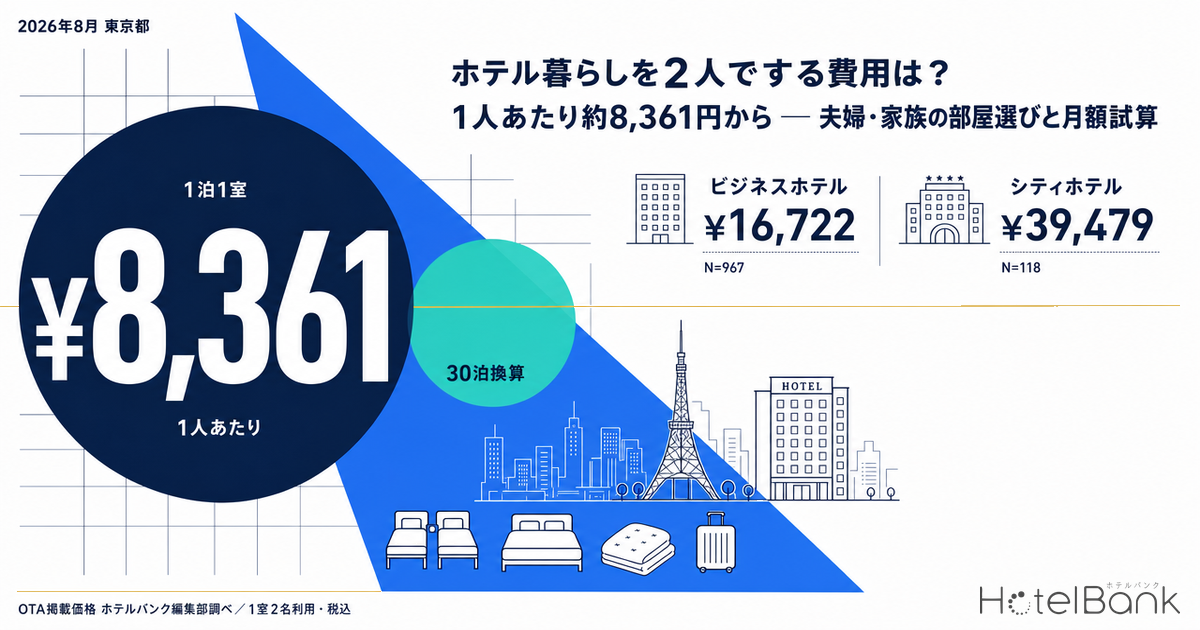
When two people start hotel living, the first thing to grasp is that room rates are priced for two occupants to begin with. Most prices listed on OTAs are shown as a rate per room for two guests (tax included), and the average listed price for a business hotel in Tokyo is ¥16,722 per night (N=967 properties, as of August 2026, a HotelBank Editorial Team analysis based on publicly available OTA data). In other words, the room rate is quoted on the same basis whether one person or two people stay, so the cost per person falls to about ¥8,361. Hotel living as a couple, a pair, or a family becomes far easier to plan once you understand that the cost is set by the room, not by the head. This article works through the cost structure for two, how to choose a room type, what couples should settle before a long stay, and how co-sleeping rules work when children are involved.
- — ¥16,722 per night (Tokyo, business hotels / rate per room for two guests, tax included / as of August 2026, N=967 properties). Listed prices are quoted for two occupants from the start, so with two people staying it works out to about ¥8,361 per person.
- — Over 30 nights that is about ¥502,000 per room and about ¥251,000 per person. At a city hotel (¥39,479, N=118 properties) it is about ¥1,184,000 per room and about ¥592,000 per person.
- — Room types come down to three options: a double (bed width 140cm or more), a twin, or two connecting rooms. Two people on different daily rhythms are better off with a twin; if you both work from home, connecting rooms suit you.
- — Co-sleeping rules differ by hotel. Toyoko Inn (東横イン) officially offers it free for children of elementary school age or younger, up to one child per bed, in which case two parents plus one child can still stay at the two-guests-per-room rate.
- — If you switch to a city hotel only on weekends, the 30-night cost per person moves continuously between about ¥251,000 and ¥592,000 (see the sensitivity table in this article).
Hotel Living for Two Is Priced by the Room
Just as rent on an apartment is set per unit, a hotel rate is set per room. Here is how listed prices in Tokyo as of August 2026 break down by category (a HotelBank Editorial Team analysis based on publicly available OTA data; every price basis is a rate per room for two guests, tax included).
| Category | Per night (per room, two guests, tax incl.) | Per person / night | 30 nights (per room) | 30 nights (per person) | Properties covered |
|---|---|---|---|---|---|
| Business hotels | ¥16,722 | About ¥8,361 | About ¥502,000 | About ¥251,000 | N=967 |
| City hotels | ¥39,479 | About ¥19,740 | About ¥1,184,000 | About ¥592,000 | N=118 |
Note: Listed OTA prices for Tokyo as of August 2026 (HotelBank Editorial Team analysis). The 30-night figures are calculated mechanically as the average nightly rate × 30 nights and do not account for consecutive-night discounts, variation by day of week or season, or differences in housekeeping frequency. Your actual monthly cost will move up or down with the plans and the days of the week you combine.
The key point is that the nightly rate in this table is a two-occupancy price from the outset. Because the room rate is listed on essentially the same basis whether one or two people stay, living as a pair simply halves the burden per person. At a business hotel, a couple pays about ¥502,000 a month for the room (¥16,722 × 30 nights), or about ¥251,000 each. At a city hotel, the benchmarks are about ¥1,184,000 per room and about ¥592,000 per person.
For a detailed comparison of solo hotel living against rent and living costs, see “Is Hotel Living Cheaper Than Rent in Tokyo? Break-Even at 24 Nights.” This article focuses on living with two or more people.
Twin, Double, or Connecting — Choosing a Room Type
After cost, the next factor that matters most in hotel living for two is the room type. Even within the same “two guests, one room,” how comfortable daily life feels varies a great deal with the layout.
A double (one bed) is the most widely available and gives you the broadest range of price options. A bed width of 140cm or more is standard, but for a long stay, choosing 160cm (queen) or wider makes it easier to protect the quality of your sleep. A twin (two beds) suits two people on different daily rhythms. Couples where one leaves early for work and the other works from home often find a twin, with its separate beds, easier to live in. Rooms billed as “twin plus two desks” are an especially good match for couples who both work from home.
A connecting room (two rooms joined by an internal door) costs you two rooms’ worth of rate, but in exchange you get two sets of bathroom facilities and two desks. For dual-income couples whose online meetings overlap, and for families with children as discussed below, the ability to separate the sleeping area from the living area carries real value.
National chains have an advantage here in how easy they are to choose. Toyoko Inn (東横イン) has a nationwide network, so you can count on the same sense of twin and double layouts and free breakfast service in any city. APA Hotel (アパホテル) offers its best rates through its own website and app, and you can filter for properties with a large communal bath. Comfort Hotel (コンフォートホテル) has an established free breakfast service, which compresses your monthly food costs. Dormy Inn (ドーミーイン), with its natural hot-spring communal baths and saunas, is strong for a change of pace during a long stay, and its late-night “yonaki soba” service is popular with consecutive-night guests. Hotel Gracery (ホテルグレイスリー) has roomier doubles and twins in central locations such as Shinjuku, which suits a base for two people working in the city center. Each has different strengths, so choose based on whether a communal bath, breakfast, or location is the axis of your daily life.
What to Settle Before a Long Stay as a Couple
There are three things a couple should decide in advance before hotel living.
First, how to handle your residence registration. If a hotel becomes the base of your daily life, where you register your residence bears directly on administrative procedures, mail, and address verification for banks and credit cards. The criteria for deciding — including the option of keeping it at a family home, and the 14-day deadline for filing a moving-in notification if you transfer it — are laid out in detail in “Hotel Living: Keep Residence Registration Home, or File Within 14 Days,” which is worth reading before you start.
Second, belongings and laundry. Clothing and daily necessities for two people are double what one person needs. Either choose an apartment-style property with a washing machine in the room, or check the number of machines in the on-site coin laundry and how busy they get before you check in — that alone removes a lot of friction once you have settled in. Putting off-season belongings into a storage unit or at a family home, and holding what is in the room to about two suitcases’ worth, is the trick to making it last.
Third, how you structure your bookings. On OTAs you can find consecutive-night plans aimed at stays of 7 nights or more and 30 nights or more, as well as plans where the total you pay shifts with how you combine days of the week. Being able to change room type — or hotel entirely — mid-month is a flexibility unique to hotel living, and a combination such as “business hotel on weekdays, city hotel on weekends” costs a pair only half the extra per person. For how many nights it takes before consecutive-night discounts start to bite, “Japan Hotel Long-Stay Discounts: 15% at 7 Nights, 20% at 30 Nights” tests the thresholds night by night, so it is worth a look before you lock in your bookings.
Room Types With Children and How “Co-Sleeping” Rules Work
Hotel living as a family becomes predictable in cost once you understand how “co-sleeping” is treated. Many hotels operate a rule under which children up to a certain age are not counted toward the guest headcount if they co-sleep (share a bed without an extra bed being added), in which case two parents plus one co-sleeping child can still stay at the two-guests-per-room rate. The age up to which co-sleeping applies (preschool age, elementary school age, and so on) and the number of children allowed per bed differ by hotel, so checking the official website before booking is the reliable approach. For how the age thresholds differ by chain, “Vessel Hotels: Under-18s Sleep Free — 7 Japanese Chains Compared” tabulates them from the chains’ official wording.
If you are co-sleeping, bed width translates directly into comfort. A queen (160cm) or wider beats a double (140cm), and for a twin, rooms that can be configured as a “Hollywood twin” with the two beds pushed together are easier to use with children. Once a child is old enough to need a bed of their own, think in three stages: (1) a twin plus an extra bed for three occupants, (2) connecting rooms that separate the parents’ and children’s rooms, or (3) an apartment hotel with a kitchen and washing machine where the sleeping area can be separated. On family stays running beyond a week in particular, the livability of an apartment-style property — where you can prepare breakfast in the room and run laundry — stands out. A comparison of five family-oriented properties including apartment hotels with a full kitchen in every room, such as MIMARU TOKYO IKEBUKURO (kazokustay, in Japanese) is also a useful reference.
Choosing a property with a Japanese-style room is another option. A washitsu, where futons can be laid side by side so the whole family sleeps in one space, removes any worry about a child rolling off a bed and remains popular for long stays with preschool-age children.
The 30-Night Cost Moves Continuously With Your City-Hotel Share
The two listed prices above can be read directly as the range of ways you might live. The “business hotel on weekdays, city hotel on weekends” pattern mentioned earlier is, in cost terms, equivalent to prorating between ¥16,722 a night at a business hotel and ¥39,479 a night at a city hotel according to the share of nights spent at the city hotel. Start with three cases for a couple over 30 nights.
| Case | Weekend city-hotel share | Average per room, per night | 30-night total per person |
|---|---|---|---|
| Optimistic (lightest cost) | 0% (business hotel every night) | ¥16,722 | ¥250,830 (about ¥251,000) |
| Middle | 30% (9 of 30 nights) | ¥23,549 | ¥353,236 (about ¥353,000) |
| Pessimistic (heaviest cost) | 100% (city hotel every night) | ¥39,479 | ¥592,185 (about ¥592,000) |
The 0% and 100% rows match the 30-night equivalents for business hotels and city hotels in Table 1 respectively. In other words, these three cases introduce no new prices — they simply prorate between the two values in Table 1. The same logic lets us lay out how the numbers move as you change the length of stay.
| Nights \ City-hotel share | 0% | 25% | 50% | 75% | 100% |
|---|---|---|---|---|---|
| 7 nights | ¥58,527 | ¥78,439 | ¥98,352 | ¥118,264 | ¥138,176 |
| 14 nights | ¥117,054 | ¥156,879 | ¥196,704 | ¥236,528 | ¥276,353 |
| 21 nights | ¥175,581 | ¥235,318 | ¥295,055 | ¥354,792 | ¥414,530 |
| 30 nights | ¥250,830 | ¥336,169 | ¥421,508 | ¥506,846 | ¥592,185 |
| 60 nights | ¥501,660 | ¥672,338 | ¥843,015 | ¥1,013,692 | ¥1,184,370 |
Note: Each cell is calculated mechanically as “(¥16,722 × (1 − share) + ¥39,479 × share) ÷ 2 people × nights.” Both unit prices are listed prices for Tokyo as of August 2026 (rate per room for two guests, tax included; business hotels N=967 properties, city hotels N=118 properties, HotelBank Editorial Team analysis), and the intermediate shares are a linear proration between those two values rather than an assumption of any new price band. Consecutive-night discounts, variation by day of week or season, differences in housekeeping frequency, food costs, and laundry costs are excluded. Nor is this an expected value weighted by how likely each share is; it is an estimate intended to show the range.
What this shows is that which category you stay in for how many nights matters more to the total than the number of nights itself. On the 30-night row, the gap between a 0% and a 100% share is ¥341,355 per person, whereas doubling the stay from 30 nights to 60 nights at a 0% share adds only ¥250,830. The first thing to decide in hotel living for two is not how long you will stay, but which category you will make your weekday base.
If You Want to Search in Detail
For hands-on comparisons of specific properties, these articles go deeper.
Five Properties With Family Rooms and a Mini Kitchen for Self-Catering — A Summer Long Stay With Children Aged 4 to 10 Over Three Nights, Preparing a Light Breakfast in the Room and Switching to the Property’s Dinner in the Evening (kazokustay, in Japanese)
Compares five properties by layout and indicative price where a family of four to six can sleep in separate bedrooms, including MIMARU TOKYO IKEBUKURO, a five-minute walk from Ikebukuro Station with a full kitchen in every room, and Wisteria Condominium Resort in Motobu, Okinawa, with an induction kitchen and washing machine in every unit.
Five Extended-Stay Hotels With Kitchens in Nagoya’s Fushimi–Marunouchi Area — Comparing a Month-Long Base in the Chukyo Region by In-Room Facilities and Monthly Cost Structure (innippon, in Japanese)
Organizes five properties suited to month-long stays by facilities and walking time from the station, including the Nagoya B’s Hotel ANNEX with its mini kitchen and drum-type washer-dryer, and Espacio Time Sharing For Urban with an induction kitchen and washer-dryer in all 54 rooms.
Frequently Asked Questions
Q. How much does hotel living for two cost per person?
A. The listed price for a business hotel in Tokyo is ¥16,722 per night (rate per room for two guests, tax included / as of August 2026, N=967 properties). Listed prices are quoted for two occupants from the start, so with two people staying it comes to about ¥8,361 per person. Over 30 nights, the guide figures are about ¥502,000 per room and about ¥251,000 per person.
Q. How much does it change at a city hotel?
A. The listed price for a city hotel in Tokyo is ¥39,479 per night (N=118 properties, same price basis). That is about ¥19,740 per person, or about ¥1,184,000 per room and about ¥592,000 per person over 30 nights. The gap against a business hotel comes to about ¥341,000 per person per month.
Q. For a couple, is a twin or a double better?
A. Two people on different daily rhythms (one leaving early for work, the other working from home, for example) are better suited to a twin, where the beds are separate, and a “twin plus two desks” is a good match if you both work from home. Doubles are more widely available and give you a broader range of prices, but for a long stay, choosing a bed width of 160cm (queen) or more makes it easier to protect the quality of your sleep.
Q. Can we still pay the two-guests-per-room rate with a child?
A. At hotels that treat children up to a certain age as co-sleeping (accompanying without an extra bed), those children are not counted toward the guest headcount, so two parents plus one co-sleeping child can stay at the two-guests-per-room rate. Toyoko Inn (東横イン) officially treats it as free “when a child of elementary school age or younger co-sleeps in the same bed as an adult,” and states alongside it that this applies to “up to one child per bed.” The rules differ by hotel, so always confirm the wording on the official website before booking.
Q. How should we handle residence registration during hotel living?
A. If a hotel becomes the base of your daily life, where you register your residence bears directly on administrative procedures, mail, and address verification for banks and credit cards. The criteria for deciding — including the option of keeping it at a family home and the 14-day deadline for filing a moving-in notification if you transfer it — are set out in the related article. Practice varies between municipalities, so confirming at the counter before you start is the reliable approach.
Q. Will the cost come out exactly as the 30-night estimate says?
A. No. The 30-night figures in this article are calculated mechanically as the average nightly rate × 30 nights and exclude consecutive-night discounts, variation by day of week or season, and differences in housekeeping frequency. Your actual monthly cost will move up or down with the plans and the days of the week you combine.
Related Reading
- Is Hotel Living Cheaper Than Rent in Tokyo? Break-Even at 24 Nights
- 6 Downsides of Hotel Living in Japan: ¥502,000 per 30 Nights & Fixes
- Hotel Living in Japan: 4 Room Criteria, Packing & Daily Routines
- Hotel Living: Keep Residence Registration Home, or File Within 14 Days
- Japan Hotel Long-Stay Discounts: 15% at 7 Nights, 20% at 30 Nights
- Vessel Hotels: Under-18s Sleep Free — 7 Japanese Chains Compared
- Hotel Living for a New Job: 1 Month Max, ¥17,238 Median Night in Tokyo
About the Data in This Article
■ Data Sources
The prices in this article are listed prices for Tokyo as of August 2026, compiled by the HotelBank Editorial Team from publicly available OTA data. The price basis throughout is “rate per room for two guests (tax included),” and the properties covered number 967 business hotels and 118 city hotels. These are category-level averages, not the actual transacted prices of any single property.
■ Calculation Assumptions
The 30-night figures are calculated mechanically as the average nightly rate × 30 nights. The per-person amounts divide the room rate between two adults. The “weekend city-hotel share” in Tables 2 and 3 is a linear proration between the two values of ¥16,722 for business hotels and ¥39,479 for city hotels, and the 0% and 100% rows match the 30-night equivalents in Table 1. No new price band is assumed for the intermediate shares. Nor is this an expected value weighted by how likely each share is; it is an estimate intended to show the range.
■ Limitations and Caveats
Listed prices are not actual transacted prices and vary with timing, day of week, and availability. Category averages smooth over differences between properties in location, building age, and room size, and do not indicate the price of any individual property. Consecutive-night discounts, differences in housekeeping frequency, food costs, and laundry costs are excluded from the estimates. Age thresholds for co-sleeping and the number of people permitted per bed differ by hotel, so the criteria cited here for specific chains cannot be applied as-is to other chains. The treatment of residence registration and moving-in notifications depends on each municipality’s practice, so always confirm at the municipal counter.
■ Market Data
Listed prices by category in Tokyo (as of August 2026, rate per room for two guests, tax included): business hotels ¥16,722 (N=967 properties), city hotels ¥39,479 (N=118 properties) | HotelBank Editorial Team analysis
■ Official Company Materials and Legislation
- Toyoko Inn, “Free Co-Sleeping Service for Children” (elementary school age or younger, up to one child per bed; breakfast also free for co-sleeping children) toyoko-inn.com/campaign/child
- Toyoko Inn, “Breakfast” (original breakfast provided free to guests) toyoko-inn.com/campaign/breakfast
- Comfort Hotel, “Breakfast Information” (free breakfast; menus differ at some brands and properties) choice-hotels.jp/brand/tagline/eat/breakfast/
- Dormy Inn, “Services” (communal bath, sauna and cold plunge; late-night “yonaki soba”) dormy-hotels.com/dormyinn/service/
- Hotel Gracery Shinjuku (a five-minute walk from the east exit of JR Shinjuku Station / three minutes from Seibu-Shinjuku Station, 970 rooms) gracery.com/shinjuku/
- Basic Resident Registration Act (Article 22, setting the filing period for a moving-in notification), e-Gov Law Search laws.e-gov.go.jp