

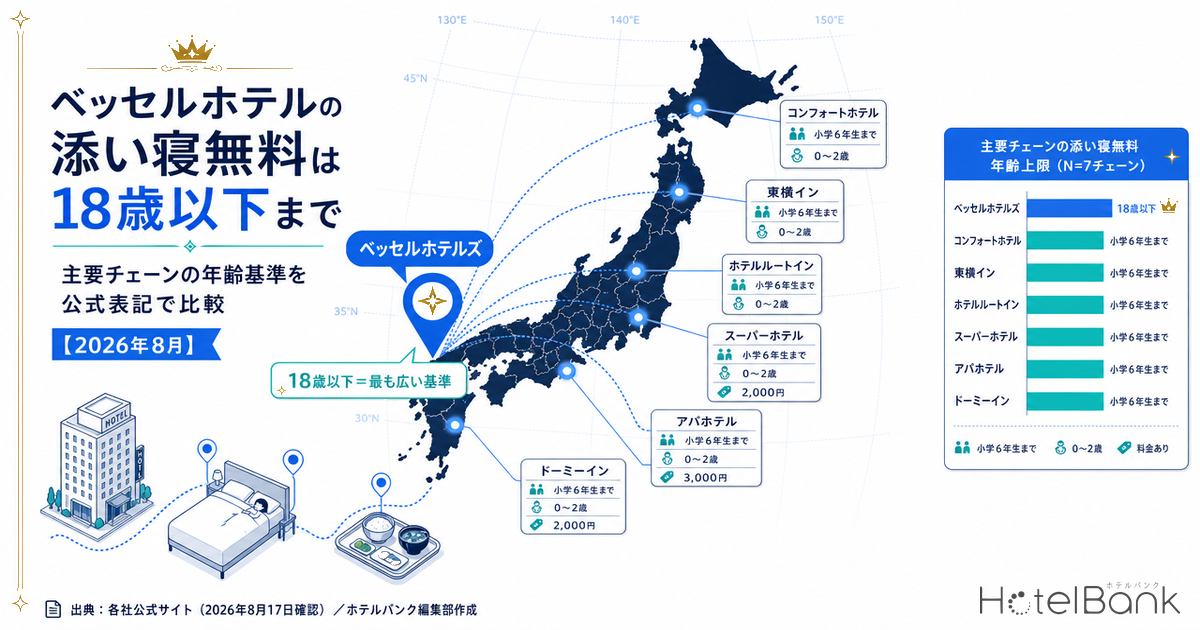
Vessel Hotels (ベッセルホテルズ — comprising Vessel Hotel, Vessel Inn and Vessel Hotel Campana) states in the FAQ on its official site that “children aged 18 or under may stay free of charge when sharing a room and sharing a bed with their parents or grandparents” (verified 17 August 2026). Because free co-sleeping at Japanese business hotel chains is usually capped at preschoolers or elementary school children, a threshold of 18 and under — which reaches high-school age — is unusually broad. Breakfast, however, is charged separately: free for ages 0-5, paid from age 6. This article sets out the Vessel conditions as officially worded, then compares the co-sleeping age thresholds of Japan’s major chains as stated on each company’s own website.
- — Free co-sleeping up to age 18 — Vessel Hotels charges nothing for the stay of guests aged 18 or under, provided they share a room and a bed with parents or grandparents (official site, verified 17 August 2026).
- — A free stay is not a free breakfast — Breakfast is free for ages 0-5 and charged from age 6. Even when the room costs nothing extra, breakfast is billed per person.
- — The broadest threshold among seven major chains — Against elementary school age (Comfort Hotel, Toyoko Inn), preschool age (Route-Inn, Super Hotel, APA) and ages 0-2 (Dormy Inn), 18 and under stands well clear.
- — The paid threshold differs too — Route-Inn charges ¥2,000 for elementary school children; Dormy Inn charges ¥3,000 from age 3 through elementary school and full adult rates from junior high. The older the child, the more the difference shows up on the bill.
- — After age, what matters is how occupancy is counted — Super Hotel counts a co-sleeping child toward the room’s maximum occupancy. Limits of one child per bed, bed widths and how you declare children when booking also vary by chain.
Free co-sleeping at Vessel Hotels — the conditions are age 18 or under, sharing a room with parents or grandparents
The wording on the Vessel Hotels official site comes down to three conditions (as of 17 August 2026).
- The threshold is age 18 or under. The stay is free when the child shares a room with parents or grandparents and shares a bed with them.
- Breakfast is free for ages 0-5 and charged from age 6. The breakfast charge is not included in the booking total and is paid separately at check-in.
- When booking, enter children from elementary school age through 18 in the “elementary school child” field, and note the age and number of any co-sleeping children of junior high age or older in the “requests” field of the booking page.
In other words, a free stay and a free breakfast are two separate matters: bring two elementary school children and the room costs nothing extra, but adding breakfast means paying for two breakfasts. Because co-sleeping assumes the child shares a bed, it is worth checking the bed width (Vessel rooms offer doubles, queens and other configurations depending on room type) and whether you remain within the room’s maximum occupancy before booking.
What “free co-sleeping” actually means — the premise is that no bed is added
“Free co-sleeping” is an arrangement under which no room charge applies when a child shares a single bed with an adult and no extra bedding or amenities are provided. Read across the chains’ official wording, four caveats recur.
- Many chains allow only one child per bed (Toyoko Inn, APA Hotel and Dormy Inn state this explicitly). Two adults plus two children works; one adult plus two children may not.
- Some chains count co-sleeping children toward maximum occupancy. Super Hotel advises guests to book a room whose stated capacity includes the children, since co-sleeping children count toward it.
- Adding a futon or a bed means an extra charge. Dormy Inn states that where a futon or bed is required, the same rate as an adult applies regardless of age.
- Breakfast, towels and amenities may be charged separately. Toyoko Inn notes that co-sleeping children are not provided with a towel or pillow, and Comfort Hotel notes that at hotels where breakfast is not complimentary, a co-sleeping child’s breakfast is charged.
Cabin-style rooms (such as Dormy Inn’s Global Cabin) and compact room types may not accept co-sleeping at all, and conditions can differ by property and room type within the same chain. Beyond chain-level rules, the factors that separate genuinely child-friendly properties are set out — alongside a nationwide ranking — in our analysis of what makes a hotel kid-friendly.
Co-sleeping age thresholds at major chains (N=7 chains, verified on official sites 17 August 2026)
The table below reflects the wording on each chain’s official site (FAQ and service information pages) as verified on 17 August 2026. Age thresholds and charges are subject to revision, so always confirm the current conditions on the chain’s own site before booking.
| Chain | Eligible for free co-sleeping | Main conditions as officially stated | Breakfast treatment (where confirmed officially) |
|---|---|---|---|
| Vessel Hotels (ベッセルホテルズ) | Age 18 or under | Co-sleeping while sharing a room with parents or grandparents | Free for ages 0-5, charged from age 6 |
| Comfort Hotel (コンフォートホテル) | Through 6th grade of elementary school | Same room as an adult and sharing the same bed. As a rule, one-bed rooms take one adult plus one child; two-bed rooms take two adults plus two children | Free for co-sleeping children at hotels with complimentary breakfast (charged at some hotels where breakfast is not complimentary) |
| Toyoko Inn (東横イン) | Elementary school age or younger | One child per bed. No towel or pillow provided | Breakfast free for co-sleeping children too |
| Hotel Route-Inn (ホテルルートイン) | Preschool age | Co-sleeping covers elementary school age and younger; elementary school children are charged ¥2,000 (tax incl.). This co-sleeping charge applies where the room’s maximum occupancy is exceeded | — |
| Super Hotel (スーパーホテル) | Preschool age | Co-sleeping children count toward maximum occupancy, so book a room whose capacity includes the children | — |
| APA Hotel (アパホテル) | Preschool age | One child per bed (except at some hotels). No amenities provided for co-sleeping children | — |
| Dormy Inn (ドーミーイン) | Ages 0-2 | One child per bed. Co-sleeping from age 3 through elementary school costs ¥3,000; junior high age and above pay the adult rate. An added futon or bed is charged at the adult rate | — |
Note: wording on each chain’s official site was verified on 17 August 2026. “—” indicates that no chain-wide statement on children’s breakfast could be confirmed (it varies by property). Exceptions apply by property and room type, so confirm the applicable conditions on the official page of the property you are booking.
Laid out side by side, the upper age limit for a free stay is broadest at Vessel Hotels with 18 and under, followed by Comfort Hotel and Toyoko Inn at elementary school age, then the chains capped at preschool age. For family trips with junior high or high school children — or for stays accompanying a child to a club tournament or an entrance exam — the gap in age thresholds translates directly into a difference in room cost. With preschool children, by contrast, free co-sleeping usually applies at any of these chains, and the comparison shifts away from age toward how occupancy is counted, bed width and the treatment of breakfast. How far provision for infants and babies now extends is covered in our analysis of baby-friendly hotels in Japan.
Three things to check after the age threshold — occupancy, bed width and declaring children
How maximum occupancy is counted
Whether a co-sleeping child counts toward maximum occupancy differs by chain. Where they do count, a double room for two cannot take two adults plus one child. Entering the correct number of children in the room search on a booking site returns only rooms you can actually stay in, so searching with adults alone is the thing to avoid. How rooms themselves are designed with families in mind is explored — from both the room-design and pricing angles — in our review-based analysis of connecting and family rooms.
Bed width
Even where co-sleeping is permitted, a double of about 140cm and a queen of 160cm or more make a very different proposition for sharing with an elementary school child. Some chains, such as Vessel, have many properties with beds in the 150cm-wide class, while at others the width varies considerably by room type.
Declaring children when booking
As Vessel’s rule shows — children from elementary school age through 18 go in the “elementary school child” field, with junior high age and above noted in the requests field — co-sleeping children are expected to be entered at the time of booking. Failing to declare them until arrival invites trouble, so communicate ages and numbers at the booking stage.
Note also that free co-sleeping at Vessel applies to grandparents sharing the room as well, which makes it workable for three-generation trips where the parents’ household and the grandparents’ household take separate rooms.
Where to look next
For choosing specific properties for trips with children or across three generations, these articles go deeper (both in Japanese).
Five family properties offering two-room sets connected by a single door — putting grandparents in one room and parents and children in the adjoining Japanese-style room, for three-generation summer trips with different bedtimes (kazokustay, in Japanese)
Compares five properties — including Shiratama no Yu Kaho (Tsukioka Onsen), Asaya Hotel (Kinugawa Onsen) and Gero Onsen Suimeikan — on whether their adjoining and connecting rooms can be used “open by day, closed by night”. The worked examples of splitting grandparents’ and parents’ rooms to resolve mismatched bedtimes are usefully concrete.
Top 5 for walking the kochia of Hitachi Seaside Park with children in October, when Miharashi Hill turns crimson — family stays around Katsuta Station and the Hitachinaka Seaside Railway, linked to the Ferris wheel and 13km of cycling (HotelPicks, in Japanese)
Compares five properties around Katsuta Station and the Minato Line from a family-logistics perspective, including Comfort Inn Hitachinaka with free co-sleeping through age 12 and bunk-bed rooms, and Hotel Route-Inn Hitachinaka with a large communal bath, free breakfast and 109 free parking spaces.
Frequently asked questions
Q. Up to what age is co-sleeping free at Vessel Hotels?
A. Age 18 or under. The room charge is waived when the child shares a room with parents or grandparents and shares a bed with them (as stated on the official site as of 17 August 2026). Because free co-sleeping at business hotel chains is usually capped at preschool or elementary school age, a threshold of 18 and under — reaching high-school age — is a notably broad one.
Q. If co-sleeping is free, is breakfast free too?
A. No. At Vessel Hotels breakfast is free for ages 0-5 and charged from age 6. The breakfast charge is not included in the booking total and is paid separately at check-in. Bring two elementary school children and the room costs nothing extra, but adding breakfast means paying for two breakfasts.
Q. What should I enter when booking?
A. At Vessel, enter children from elementary school age through 18 in the “elementary school child” field of the booking screen, and note the age and number of any co-sleeping children of junior high age or older in the “requests” field. Co-sleeping children are expected to be entered in the guest count, so include them in your search rather than searching for adults only.
Q. What are the co-sleeping age thresholds at other chains?
A. As stated on each company’s official site as of 17 August 2026: Comfort Hotel through 6th grade of elementary school; Toyoko Inn elementary school age or younger; Hotel Route-Inn, Super Hotel and APA Hotel preschool age; and Dormy Inn ages 0-2. Route-Inn charges ¥2,000 (tax incl.) for co-sleeping elementary school children, applied where the room’s maximum occupancy is exceeded; Dormy Inn charges ¥3,000 from age 3 through elementary school, with junior high age and above paying the adult rate.
Q. If we meet the age threshold, is co-sleeping always possible?
A. Not necessarily. Many chains allow only one child per bed, and some — Super Hotel among them — count co-sleeping children toward maximum occupancy. Cabin-style and compact room types may not accept co-sleeping at all, so confirm the conditions property by property and room type by room type.
Related reading
References and sources
■ Data sources
The age thresholds, charges and conditions in this article were compiled from the official websites of Vessel Hotels, Comfort Hotel, Toyoko Inn, Hotel Route-Inn, Super Hotel, APA Hotel and Dormy Inn (FAQ and family service information pages), verified on 17 August 2026 (N=7 chains). No individual guest reviews or figures reproduced from third-party sites were used.
■ Basis of estimates
This article makes no independent estimates. The “upper age limit for a free co-sleeping stay” in the chart is a charting value derived by converting each company’s official wording into an age: “preschool age” is treated as pre-enrolment, roughly age 5; “elementary school age or younger” and “through 6th grade of elementary school” as age 12; and “age 18 or under” as age 18. The comparison covers only the upper age limit at which the room charge is waived, and excludes conditions on breakfast, additional bedding and amenities.
■ Limitations and caveats
Age thresholds, charges and conditions may be revised without notice, and exceptions apply by property and room type even within the same chain (some cabin-style rooms do not accept co-sleeping; Vessel Inn Shiga Moriyama Ekimae, for example, charges children the same as adults for breakfast). The “—” entries in Table 1 indicate that no chain-wide official statement on children’s breakfast could be confirmed, and imply neither that it is free nor that it is charged. The APA Hotel official site blocks automated access, so that entry was verified by manual browsing and no link is given for it here. Always confirm the current conditions on each company’s official site before booking.
■ Official company websites (primary sources)
- Vessel Hotels official site, “Frequently Asked Questions” (verified 17 August 2026: conditions for free co-sleeping for ages 18 and under, and breakfast age bands)
- Comfort Hotel official site, “Free co-sleeping for children” (verified 17 August 2026: free co-sleeping through 6th grade of elementary school, and bed-sharing conditions)
- Toyoko Inn official site, “Free co-sleeping service for children” (verified 17 August 2026: elementary school age or younger, one child per bed, treatment of breakfast and towels)
- Route-Inn Hotels official site, “Frequently Asked Questions” (verified 17 August 2026: preschool children free, ¥2,000 for elementary school children, application where occupancy is exceeded)
- Super Hotel official site, “Free co-sleeping service” (verified 17 August 2026: preschool children free, co-sleeping children counted toward maximum occupancy)
- APA Hotel official site, “Accommodation guide (co-sleeping children)” (apahotel.com) (verified 17 August 2026: preschool children free, one child per bed, treatment of amenities)
- Dormy Inn official site, “Frequently Asked Questions” (verified 17 August 2026: ages 0-2 free, ¥3,000 from age 3 through elementary school, adult rate from junior high age)