

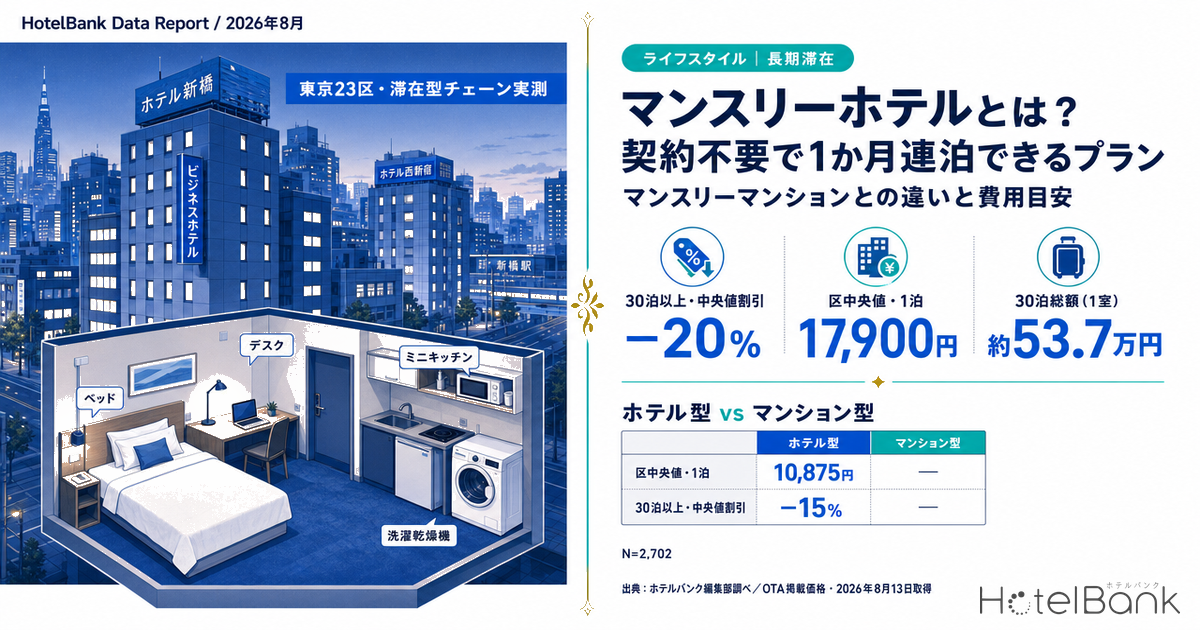
A monthly hotel is a lodging plan that lets you stay in a hotel room by the month — roughly 30 consecutive nights. There is no lease agreement, no deposit and no key money; you book it the same way you book any hotel stay. Utilities, Wi-Fi, furniture and appliances, bedding and periodic housekeeping are all included in the room rate, so it is best understood as a product designed to cover a one- to three-month stay in a “live at a hotel” format. A similar-sounding option is the monthly furnished apartment (manthurii manshon), but that is a form of furnished rental housing, and the paperwork and move-out treatment are fundamentally different. This article sets out what a monthly hotel is, how it differs from a monthly furnished apartment, and what it costs (measured OTA listed prices, as of August 2026) — to the level of detail you need to make a decision.
- — A monthly hotel is a lodging plan for roughly 30 consecutive nights at a hotel. No lease, no screening, no guarantor, no deposit or key money — you book it the same way as any hotel stay.
- — The rate is all-inclusive. Utilities, Wi-Fi, furniture and appliances, bedding and periodic housekeeping are covered by the room rate; separate utility billing is the exception, not the rule.
- — Discounts deepen in steps as the night threshold rises. On median measured OTA listed prices: −10% at 2+ nights, −15% at 7+ nights, −20% at 30+ nights (30+ nights: 13 properties, N=2,702; retrieved 13 August 2026).
- — In a real example, the same room on the same date ran ¥14,500 on the standard plan versus ¥10,875 on the monthly plan (−25%). Over 30 nights that is roughly ¥326,000 per person (per person on double occupancy, tax included).
- — The price of the discount is prepayment in a single lump sum, no reduction in nights mid-stay, and housekeeping roughly once a week. For stays beyond three months, or if you plan to cook for yourself, put the monthly furnished apartment back into the comparison.
What a monthly hotel is — a lease-free plan for booking a month in one go
What the Japanese hotel industry calls a “monthly plan” or “monthly-type plan” is a lodging plan carrying a minimum-nights condition of around 30 nights or more. Operators draw the line slightly differently — “30 nights or more,” “28 nights or more,” “flat rate for one month” — but three things are common to all of them.
- Booking is all it takes to start. It is treated as an ordinary hotel reservation under the accommodation terms and conditions: no lease, no guarantor, no screening, no deposit or key money.
- The rate is all-inclusive. In-room furniture and appliances, bedding and towels, electricity, water and gas, and Wi-Fi are all covered by the room rate. Separate utility billing is the exception.
- The nightly rate is lower than standard. In exchange for committing to a block of nights, the listed price per night is set below the standard plan.
The properties offering these plans are extended-stay chains such as Tokyu Stay (東急ステイ), apartment hotels equipped with kitchens and washer-dryers, and some urban business hotels. There are two entry points: the mid-to-long-stay plans on a hotel’s official site, and OTA plans carrying a night-count condition (with the threshold written into the plan name, e.g. “30 nights or more”). The official route holds the same rate for the whole period, so the total is easy to read; the OTA route makes it easier to layer loyalty-point rebates on top.
How it differs from a monthly furnished apartment — contract, upfront costs, cleaning, residence registration
On the surface — “renting a furnished room by the month” — a monthly hotel and a monthly furnished apartment look alike. But the former is an accommodation contract and the latter is a lease agreement (usually a fixed-term lease), and everything from the paperwork to the move-out differs. The main differences are set out below.
| Item | Monthly hotel | Monthly furnished apartment |
|---|---|---|
| Contract procedure | Same as an ordinary hotel booking. No contract document, screening or guarantor as a rule | A lease agreement (most often a fixed-term lease). Application form, identity verification and screening apply, and move-in can take several days |
| Upfront costs (deposit / key money) | None. The room rate only (usually with prepayment in a single lump sum attached as a condition) | Most units waive deposit and key money, but cleaning fees, guarantee fees and lock-change fees are typical upfront costs |
| Furniture, appliances and utilities | All included in the room rate. Wi-Fi is generally included as well | Furnished and equipped. Utilities are billed separately at most units, either at a flat rate or at actual cost |
| Cleaning and linen | Handled by the hotel. On long-stay plans this is usually around once a week and on request | You do it yourself during the stay. A move-out cleaning fee is typically paid in advance |
| Residence registration and address | For a temporary stay you can leave your residence registration where it is. Whether a hotel address can be registered is up to the local municipality (covered in detail in Hotel Living: Keep Residence Registration Home, or File Within 14 Days) | Some units allow you to move your residence registration. Most units can receive mail |
| Early termination and extension | Governed by the cancellation policy. Long-stay plans usually prohibit reducing nights mid-stay and offer no refund. Extension is handled as an additional booking if rooms are available | Terminating mid-term usually triggers a penalty or payment for the remaining term. Extension means signing a new contract |
Source: HotelBank Editorial Team research (compiled from the general content of operators’ published plan conditions and accommodation terms. Always confirm the conditions of a specific property or unit before booking).
In short, the strengths of the monthly hotel are light paperwork and an all-inclusive rate that is easy to understand; the strengths of the monthly furnished apartment are the ability to run for several months and a lower nightly cost. If your stay is one to two months, the dates are fixed, and you want the hotel to handle the housework, the hotel format fits. If you expect to run past three months and want to cook for yourself with cost as the top priority, put the apartment format back into the comparison. For the specific case of bridging the month around a job start or a transfer until permanent housing is settled, Hotel Living for a New Job: 1 Month Max, ¥17,238 Median Night in Tokyo is concrete on both the cost and the paperwork.
What it costs — 20% off the standard rate is the measured going rate at 30+ nights
You can get a working estimate of a monthly hotel’s cost from “standard nightly rate × 30 nights × discount rate.” When the HotelBank Editorial Team compared OTA listed prices at extended-stay chains (tax included, room only, displayed per person on double occupancy) for the same property, the same room type and the same stay date, monthly-type plans at 30+ nights came in a median 20% below the standard plan, weekly-type plans at 7+ nights 15% below, and consecutive-night plans at 2+ nights 10% below — a stepped structure (30+ nights: 13 properties, N=2,702; 7+ nights: 21 properties, N=5,603; 2+ nights: 18 properties, N=9,223; all counted as room × stay date. Retrieved 13 August 2026, stay dates 14 August to 31 December 2026). The measurement detail and the break-even point are set out in Japan Hotel Long-Stay Discounts: 15% at 7 Nights, 20% at 30 Nights.
| Night-count condition | Discount vs standard plan (median) | Coverage |
|---|---|---|
| 2+ nights (consecutive-night plan) | −10% | 18 properties, N=9,223 |
| 7+ nights (weekly type) | −15% | 21 properties, N=5,603 |
| 30+ nights (monthly type) | −20% | 13 properties, N=2,702 |
Source: HotelBank Editorial Team research based on public OTA data (tax included, room only, displayed per person on double occupancy; only observations where the standard plan could be compared for the same room type on the same date). Retrieved 13 August 2026, stay dates 14 August to 31 December 2026.
To put actual yen figures on it: in the worked example from that article, a central-Tokyo extended-stay hotel (Tokyu Stay Shimbashi (東急ステイ新橋), 15 sqm double, check-in 9 November 2026) listed a room at ¥14,500 on the standard plan versus ¥10,875 per night on the monthly plan (both per person on double occupancy, tax included; OTA listed prices as of 13 August 2026). For that property on that date the discount is −25%, deeper than the −20% median. Stack that nightly rate over 30 nights and it comes to roughly ¥326,000 per person, or about ¥653,000 per room. As a reference point, the ward-level median for business hotels across Tokyo’s 23 wards is about ¥17,900 per night (per room on double occupancy, tax included; OTA listed prices as of August 2026. N=886 properties across the 21 wards with listings; ward-level figures range from about ¥11,800 to about ¥32,600), which works out to roughly ¥537,000 per room over 30 nights. The breakdown and the comparison against rent are in Is Hotel Living Cheaper Than Rent in Tokyo? Break-Even at 24 Nights. Note that the first figure is a single case at an extended-stay hotel with a kitchen and washer-dryer while the second is the median across all business hotels in the 23 wards, and that the two sit at different levels — including the pricing basis (per person versus per room). Because the monthly total moves a great deal with the area and with whether a discount plan is available, use Is Hotel Living Cheaper Than Rent in Tokyo? Break-Even at 24 Nights as the reference for how to frame the comparison against rent.
How far the 30-night total can move — a conversion across the measured range
What follows is a conversion, not a forecast. It multiplies the measured figures given above (ward-level levels for business hotels in Tokyo’s 23 wards, and the measured discount rates by night-count condition) to lay out mechanically the range the 30-night total falls into. No new price survey was carried out.
| Case | Discount | Per night | 30-night total (per room) | Difference vs standard rate |
|---|---|---|---|---|
| Pessimistic (shallow-discount property) | −18% | ¥14,678 | approx. ¥440,000 | approx. ¥97,000 |
| Middle (median) | −20% | ¥14,320 | approx. ¥430,000 | approx. ¥107,000 |
| Optimistic (deep-discount property) | −25% | ¥13,425 | approx. ¥403,000 | approx. ¥134,000 |
The three discount cases simply place the bottom, middle and top of the property-to-property range measured on 30+ night plans (−18% to −25%, median −20%). The nightly anchor is the ward-level median for business hotels in Tokyo’s 23 wards (per room on double occupancy, tax included, as of August 2026). Source: HotelBank Editorial Team research based on public OTA data.
| Standard nightly rate level | Standard plan no night condition |
−10% 2+ nights |
−15% 7+ nights |
−20% 30+ nights, median |
−25% 30+ nights, deep end |
|---|---|---|---|---|---|
| Cheapest ward level ¥11,800 / night |
approx. ¥354,000 | approx. ¥319,000 | approx. ¥301,000 | approx. ¥283,000 | approx. ¥266,000 |
| Ward median ¥17,900 / night |
approx. ¥537,000 | approx. ¥483,000 | approx. ¥456,000 | approx. ¥430,000 | approx. ¥403,000 |
| Most expensive ward level ¥32,600 / night |
approx. ¥978,000 | approx. ¥880,000 | approx. ¥831,000 | approx. ¥782,000 | approx. ¥733,000 |
Rows are ward-level rates for business hotels in Tokyo’s 23 wards (cheapest level, median, most expensive level); columns are the discount rates measured by night-count condition. Each cell is the simple conversion “nightly rate × (1 − discount) × 30 nights” and does not indicate that any particular property offers that price. Because rates move with area and season, when you actually book, compare the standard plan against the night-conditioned plan at the same property on the same stay date.
In exchange for the discount, monthly-type plans usually carry conditions such as “prepayment in a single lump sum,” “no reduction in nights mid-stay,” and “room cleaning roughly once a week, on request.” Read all the way down to the conditions field of the plan details before you book.
How to choose a monthly hotel — four things to look at
- The night threshold and the depth of the discount. Compare the “30 nights or more” / “28 nights or more” in the plan name against the gap in nightly rate versus the standard plan on the same date. If your stay runs past 24 nights, there are cases where extending to a 30-night plan brings the total down.
- The living equipment in the room. Whether there is a kitchenette, a washer-dryer and a microwave changes what you spend on eating out and on laundry. At the 30-night scale, “compressing living costs as a whole with equipment you can actually live with” often does more work than the discount rate itself. For city-by-city apartment-format options, Apartment-format hotels with kitchens and washer-dryers, Top 5 (HotelPicks, in Japanese) is concrete.
- The frequency of cleaning and linen changes. Check whether it is daily or weekly, and whether extra cleaning costs money.
- Official site or OTA. An official flat-rate long-stay plan holds one price for the whole period, which makes the total easy to read. An OTA plan with a night condition lets you layer point rebates on top. For a stay that spans a peak season, the flat-rate format tends to be the more stable choice.
For specific properties by area and purpose, HotelBank covers Tokyo and Kyoto in dedicated Japanese-language guides to long-stay hotels and their costs; this article stays with the definition and the comparison. On how to read equipment and cleaning frequency — and what it takes to spend a month comfortably, from choosing the room to what to pack — Hotel Living in Japan: 4 Room Criteria, Packing & Daily Routines sets it out concretely.
Looking further
For property-by-property comparisons, these articles go deeper. Both are published in Japanese.
Nagoya Fushimi–Marunouchi: 5 extended-stay hotels with kitchens — comparing a month-long posting in the Chukyo region by in-room equipment and monthly cost structure (innippon, in Japanese)
Compares five properties on in-room equipment, indicative pricing and the structure of their monthly plans: Espacio Time Sharing For Urban (all 54 rooms with an induction kitchen and a washer-dryer, three minutes’ walk from Fushimi Station), Nagoya B’s Hotel ANNEX (kitchenette and drum-type washer-dryer in the annex), the single-building Grand Base Osu (full kitchen in every room), and GOLD STAY Nagoya Sakae and Osu.
When a business trip runs past three nights, stop booking a “hotel” — Top 5 apartment-format properties with kitchens and washer-dryers where you stay as if you live there (HotelPicks, in Japanese)
Compares five properties across Tokyo, Osaka, Fukuoka and Sapporo on consecutive-night rates and in-room equipment: Tokyu Stay Hakata (東急ステイ博多) with a washer-dryer and kitchenette in all 216 rooms and a standing long-stay plan from seven nights, Tokyu Stay Sapporo Odori (東急ステイ札幌大通) three minutes’ walk from Odori Station, and MIMARU Osaka Namba STATION and MIMARU Tokyo Ueno EAST with kitchens and dining areas in 40 sqm-class rooms.
Frequently asked questions
What is a monthly hotel?
It is a lodging plan that lets you stay in a hotel room by the month — roughly 30 consecutive nights. There is no lease, no screening, no guarantor and no deposit or key money; you book it the same way as any hotel stay. Utilities, Wi-Fi, furniture and appliances, bedding and periodic housekeeping are generally included in the room rate.
How does it differ from a monthly furnished apartment?
The biggest difference is the contract type. A monthly hotel is an accommodation contract; a monthly furnished apartment is a lease agreement (usually a fixed-term lease), which means an application form, identity verification and screening, and move-in can take several days. Utilities are included in the rate at a hotel, whereas most apartment units bill them separately at a flat rate or at actual cost — and you generally handle the cleaning yourself during the stay.
From how many nights does a monthly hotel get cheaper?
It gets cheaper in steps tied to the night-count condition. On measured OTA listed prices, the median discount versus the standard plan was −10% at 2+ nights, −15% for weekly-type plans at 7+ nights, and −20% for monthly-type plans at 30+ nights (30+ nights: 13 properties, N=2,702; retrieved 13 August 2026, stay dates 14 August to 31 December 2026).
How much does one month cost?
It moves a great deal with the nightly rate level. In the worked example, the same room at an extended-stay hotel on the same stay date went from ¥14,500 on the standard plan to ¥10,875 per night on the monthly plan, giving roughly ¥326,000 per person over 30 nights (per person on double occupancy, tax included). For business hotels in Tokyo’s 23 wards the ward median is about ¥17,900 per night (per room on double occupancy, tax included), so roughly ¥537,000 per room over 30 nights is the starting point.
Do I need to move my residence registration?
For a temporary stay of one to a few months, you can leave your residence registration where it is. Whether a move-in to a hotel address is accepted is at the discretion of the local municipality, so if you are planning on moving it, check with the municipality where you will be staying.
Can I shorten or extend the stay partway through?
Long-stay plans are usually prepaid in a single lump sum and carry conditions prohibiting a reduction in nights mid-stay with no refund, so they are not suited to shortening. Extension can be handled as an additional booking if rooms are available. Cleaning and linen changes on long-stay plans are also often around once a week and on request, so read all the way down to the conditions field of the plan details before booking.
Related reading
- Japan Hotel Long-Stay Discounts: 15% at 7 Nights, 20% at 30 Nights
- Is Hotel Living Cheaper Than Rent in Tokyo? Break-Even at 24 Nights
- Hotel Living for a New Job: 1 Month Max, ¥17,238 Median Night in Tokyo
- Hotel Living: Keep Residence Registration Home, or File Within 14 Days
- Hotel Living in Japan: 4 Room Criteria, Packing & Daily Routines
- Hotels Near Convenience Stores & Supermarkets: National Ranking
References and sources
■ Data sources
The discount rates and yen figures are measurements by the HotelBank Editorial Team comparing OTA listed prices at extended-stay chains (tax included, room only, displayed per person on double occupancy) for the same property, the same room type and the same stay date. Retrieved 13 August 2026, stay dates 14 August to 31 December 2026. Coverage by night-count condition: 2+ nights, 18 properties, N=9,223; 7+ nights, 21 properties, N=5,603; 30+ nights, 13 properties, N=2,702 (all counted as room × stay date). Detail in Japan Hotel Long-Stay Discounts: 15% at 7 Nights, 20% at 30 Nights. The ward-level figures for business hotels in Tokyo’s 23 wards (ward median about ¥17,900 per night, distribution about ¥11,800 to about ¥32,600, N=886 properties across the 21 wards with listings, per room on double occupancy, tax included, as of August 2026) come from Is Hotel Living Cheaper Than Rent in Tokyo? Break-Even at 24 Nights. The institutional points — contracts, cleaning, residence registration — are compiled from the general content of operators’ published plan conditions and accommodation terms.
■ Calculation assumptions
The 30-night totals are the simple conversion “nightly rate × (1 − discount) × 30 nights,” stacking listed prices inclusive of tax and service charge as they stand. The pricing basis in Tables 3 and 4 is per room on double occupancy, while the worked example in the body text (¥14,500 / ¥10,875) is per person on double occupancy; because the bases differ, the two are not compared directly. The three sensitivity cases (−18% / −20% / −25%) simply place the bottom, middle and top of the property-to-property range measured on 30+ night plans, and no new price survey was carried out. Living costs such as food, transport and laundry, peak-season variation, and loyalty-point rebates are not included.
■ Limitations and caveats
Listed prices differ from actual transacted prices, and even at the same property they move with booking timing, availability and campaigns. The discount measurements draw their population from the plans listed by extended-stay chains and do not represent an average across business hotels or apartment hotels as a whole. Table 4 is a conversion rather than an indication of prices offered by any specific property; when booking, compare the standard plan against the night-conditioned plan at the same property on the same stay date. Whether residence registration is permitted, how mail is handled and what the early-termination conditions are all vary by property and by municipality, so make the final confirmation with the property and the municipality before booking.