

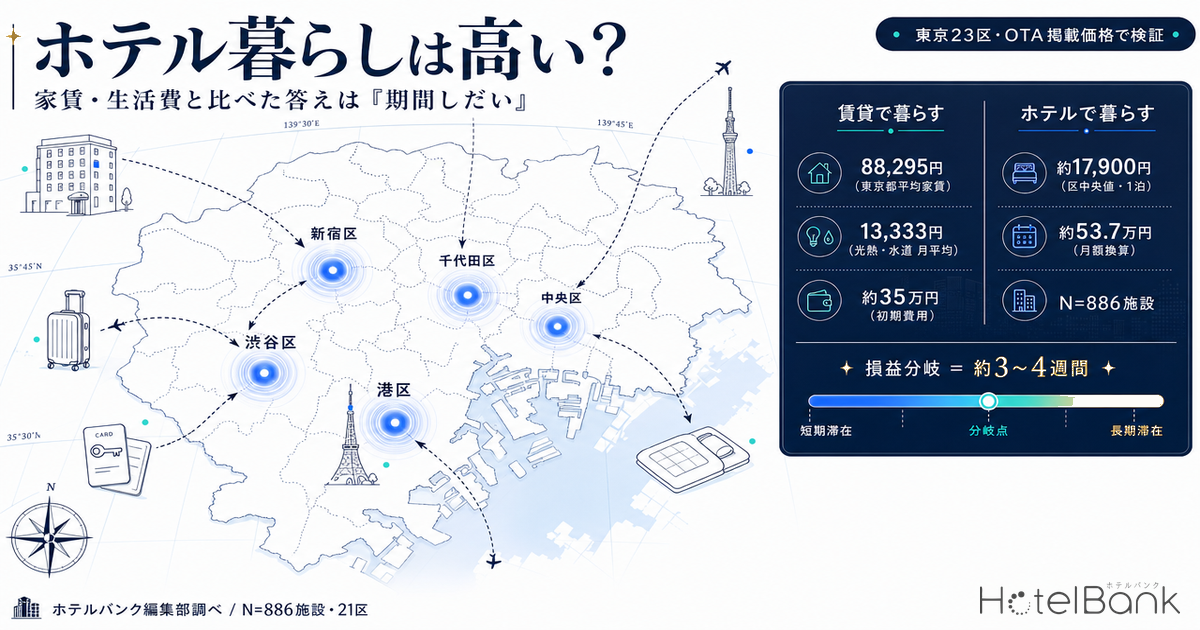
The belief that “hotel living is expensive” is half right and half a problem of how the comparison is framed. Line up a nightly room rate against a daily share of rent and the hotel is indeed several times more expensive. But a rental carries move-in costs on top — a security deposit, key money, an agency fee and the first month’s rent paid up front — plus monthly utilities and water, communications charges, the cost of buying furniture and appliances, and restoration charges when you move out. A hotel room rate is an all-inclusive price that already covers most of those items, so once you compare total outlays, the gap narrows sharply depending on how long you stay. This article puts measured OTA listed prices from Tokyo’s 23 wards and official statistics on rent and living costs onto the same footing, and shows how many months hotel living stays worth it.
- — Business hotels in Tokyo’s 23 wards run about ¥17,900 per night at the median ward. Listed prices as of August 2026 (N=886 properties across the 21 wards with listings; per room, two guests per room, tax included). A simple 30-night multiple puts the starting point at roughly ¥537,000.
- — Within those same 23 wards, ward-level rates differ by about 2.8 times. The cheapest tier of wards sits near ¥11,800 per night (about ¥354,000 for 30 nights); the most expensive near ¥32,600 (about ¥978,000). Choice of area moves the total more than anything else.
- — A rental does not stop at the monthly rent. Tokyo’s average rent of ¥88,295 plus ¥13,333 in utilities and water comes to roughly ¥102,000 a month. On top of that, the deposit, key money, agency fee and advance rent add about ¥350,000 in move-in costs.
- — At standard rates, the break-even point is about 24 nights (three to four weeks). Stacking cumulative spending at the median ward’s nightly rate, the hotel total passes the rental total beyond that point.
- — The break-even point moves by more than a factor of two across price tiers. In the cheapest tier of wards it stretches to about 42 nights (roughly 1.4 months); in the most expensive it pulls in to about 12 nights. Extended-stay discounts push it further out.
What a Month of Hotel Living Costs — Measuring OTA Listed Prices in Tokyo’s 23 Wards
When the HotelBank Editorial Team aggregated OTA listed prices in the business hotel category across Tokyo’s 23 wards by ward (as of August 2026, N=886 properties across 21 wards; per-room rate for two guests per room, tax included), nightly levels ranged from about ¥11,800 to about ¥32,600 by ward, with the median ward at about ¥17,900. Simply stacking 30 nights at that median comes to roughly ¥537,000 a month. In a low-rate ward, 30 nights runs about ¥354,000; in the most expensive, about ¥978,000 — close to a threefold spread inside the same 23 wards.
That figure is close to an upper bound, however: it assumes 30 separate nights all booked at standard rates. Real hotel living assumes you use OTA extended-stay discounts and the long-stay plans hotels sell direct, so the amount actually paid has considerable room to fall below this. The aggregation is also based on two guests per room, so per-night rates on single-occupancy plans may differ.
What You Are Comparing Against — Rent and Living Costs in Official Statistics
The rental side can be checked against official statistics. According to the Ministry of Internal Affairs and Communications’ 2023 Housing and Land Survey (as of October 1, 2023), monthly rent for rented dwellings (exclusively residential) in Tokyo averaged ¥88,295 — about 1.5 times the national average of ¥59,656. Actual rates for central-Tokyo single-occupant units often run above that average. Monthly living costs come on top. In the same ministry’s Family Income and Expenditure Survey (2025 average, single-person households), utilities and water averaged ¥13,333 a month, and a fixed home internet line adds a communications charge separately. Rent plus utilities and water alone puts roughly ¥102,000 a month near the floor of what renting costs.
A rental also carries costs at entry and exit. In the Ministry of Land, Infrastructure, Transport and Tourism’s FY2023 Housing Market Trends Survey (private rental housing results), 51.5% of households paid a security deposit, and among them “exactly one month” was the most common amount at 63.4%. Key money was paid by 38.3% of households, with “exactly one month” accounting for 75.9%. Adding the agency fee (capped at one month’s rent plus consumption tax) and advance rent, move-in costs of around four months’ rent — about ¥350,000 at Tokyo’s average rent — is the standard case. Furniture, appliances and moving costs come on top of that, and restoration charges can arise on move-out. In the same survey, 22.0% of households reported trouble with “unclear repair charges” when moving out.
A Line-Item Comparison — Comparing Only “Rent vs Room Rate” Gets It Wrong
To compare the two totals correctly, you have to align which line items are included in which payment.
| Line item | Living in a rental | Living in a hotel |
|---|---|---|
| Rent / room rate | Rent + common-area and management fees | Consolidated into the room rate (tax included) |
| Move-in costs | Deposit, key money, agency fee, advance rent, guarantor fee and similar (around four months’ rent is standard) | None in principle (a reservation is all you need) |
| Utilities and water | You contract and pay by usage (single-person average ¥13,333/month) | Included in the room rate |
| Communications | Line contract and installation charged separately | In-room Wi-Fi is generally included in the rate |
| Furniture and appliances | Purchase, delivery and disposal at your own cost | Provided |
| Cleaning and linen | You do it yourself (supplies at your own cost) | Cleaning and towel changes included (frequency varies by plan) |
| Move-out | Restoration and cleaning charges may apply | None (just check out) |
As the right-hand column shows, a hotel room rate absorbs almost every item that is billed separately on the rental side. The nightly rate exceeds a daily share of rent partly because it includes so much more. The flip side is that how livable it feels depends on how much of the laundry and cooking you can hand to the hotel, so for practical guidance on choosing a room and paring down what you bring, see Hotel Living in Japan: 4 Room Criteria, Packing & Daily Routines.
How Many Months Hotel Living Stays Worth It — A Benchmark with Stated Assumptions
Consider cumulative spending under the following assumptions. On the hotel side, the median ward rate for business hotels in the 23 wards, about ¥17,900 per night (two guests per room, tax included, listed prices as of August 2026). On the rental side, Tokyo’s average rent of ¥88,295 plus ¥13,333 in utilities and water — roughly ¥102,000 a month — with about ¥350,000 in move-in costs added (one month each of deposit, key money, agency fee and advance rent; furniture, appliances and moving costs are excluded).
Under these conditions the two totals draw level at roughly three to four weeks, and beyond that the hotel total pulls ahead. In other words, if you keep paying standard listed rates, hotel living is worth it up to “just under a month” as a rule of thumb. Two variables move that, though. The first is area: pick a ward at around ¥12,000 per night and 30 nights comes to about ¥354,000, pushing the break-even point out to roughly 42 nights, or about 1.4 months. The second is the plan: many properties list standing extended-stay discounts such as “7 nights or more” on OTAs, and combining these with a direct long-stay plan lowers the nightly rate further. Measured discount levels run around 15% at 7 nights and around 20% at 30 nights, and how far rates drop at each night-count threshold is examined in detail in Japan Hotel Long-Stay Discounts: 15% at 7 Nights, 20% at 30 Nights. Conversely, because move-in costs thin out the longer you stay, settling in for six months or a year tends to favor renting on a total basis. The only thing that can be stated firmly is the structure — shorter favors the hotel, longer favors the rental — while the break-even point itself moves with rates and plans.
| Nights | Hotel, low tier (¥11,800/night) |
Hotel, median ward (¥17,900/night) |
Hotel, high tier (¥32,600/night) |
Rental (move-in costs included) |
|---|---|---|---|---|
| 7 nights | ¥82,600 | ¥125,300 | ¥228,200 | ¥376,700 |
| 14 nights | ¥165,200 | ¥250,600 | ¥456,400 | ¥400,400 |
| 24 nights | ¥283,200 | ¥429,600 | ¥782,400 | ¥434,300 |
| 30 nights | ¥354,000 | ¥537,000 | ¥978,000 | ¥454,600 |
| 45 nights | ¥531,000 | ¥805,500 | ¥1,467,000 | ¥505,400 |
| 60 nights | ¥708,000 | ¥1,074,000 | ¥1,956,000 | ¥556,300 |
Reading across each row, the point at which a hotel column first exceeds the rental column is that price tier’s break-even point. The low tier flips at about 42 nights (roughly 1.4 months), the median ward at about 24 nights (three to four weeks), and the high tier at about 12 nights. The table builds in no extended-stay discount at all on the hotel side, so it is an upper-bound benchmark; with a long-stay plan the break-even point moves further out in every tier. On the rental side, conversely, furniture and appliance purchases, moving costs and move-out restoration charges are excluded, so real rental totals are more likely to run above this column.
Note that once a stay reaches two months, or 60 nights, the more relevant comparison is not a hotel but a monthly apartment that comes furnished with utilities included. That break-even is a separate question and is not covered here.
Where to Look Next
For property-by-property comparisons, these articles go into detail (both are published in Japanese).
Five Extended-Stay Hotels with Kitchens in Nagoya’s Fushimi–Marunouchi Area — Comparing a Month in the Chukyo Region by In-Room Facilities and Monthly Rate Structure (innippon, in Japanese)
Compares five properties by monthly plan and extended-stay discount structure alongside in-room facilities, including Nagoya B’s Hotel ANNEX (名古屋ビーズホテル ANNEX) (mini kitchen plus drum-type washer-dryer), Grand Base Osu (グランドベース大須) with full kitchens in every room and a discount from four nights, and Espacio Time Sharing For Urban (エスパシオ タイムシェアリング フォーアーバン) inside Nagoya Kanko Hotel (名古屋観光ホテル), where all 54 rooms have an induction kitchen and a washer-dryer.
When a Business Trip Runs Past Three Nights, Stop Booking “Hotels” — Top 5 Apartment-Style Properties with Kitchens and Washer-Dryers (HotelPicks, in Japanese)
Compares five apartment-style properties in Tokyo, Osaka, Fukuoka and Sapporo by extended-stay nightly rate and living facilities, including Tokyu Stay Hakata (東急ステイ博多), which has a washer-dryer and mini kitchen in all 216 rooms and a standing long-stay plan from seven nights, and MIMARU Osaka Namba STATION (MIMARU大阪 難波STATION) and MIMARU Tokyo Ueno EAST (MIMARU東京 上野EAST), where 40-square-meter-class rooms offer a kitchen and dining area.
Conclusion — Whether It Is “Expensive” Comes Down to the Number of Nights
Comparing hotel living with renting goes wrong almost the moment you set a nightly rate beside a monthly rent. Put the rental side’s move-in costs, utilities, water, communications, furniture and appliances onto the same footing, and even at the median ward rate for business hotels in Tokyo’s 23 wards (about ¥17,900 per night) the break-even point arrives at roughly 24 nights. A stay of a few weeks to just under a month tends to favor the hotel on a total basis; settle in for six months or more and the rental wins as move-in costs thin out. Two questions decide it — how many months you will stay, and which ward you will stay in — and once those are settled, the rest comes down to choosing a plan.
Frequently Asked Questions
Q. Is hotel living more expensive than renting?
A. Compare a nightly room rate against a daily share of rent and the hotel is more expensive, but on a total basis it depends on how long you stay. A rental adds move-in costs such as the deposit, key money, agency fee and advance rent (about ¥350,000 at Tokyo’s average rent), utilities and water (¥13,333 a month on average for single-person households), and the cost of furniture and appliances. A hotel room rate is a price that includes most of those, so shorter stays favor the hotel and longer stays favor the rental.
Q. How much does a month of hotel living in Tokyo’s 23 wards cost?
A. Based on listed prices in the business hotel category (as of August 2026, N=886 properties across the 21 wards with listings, per room for two guests, tax included), the median ward is about ¥17,900 per night, and a simple 30-night multiple comes to roughly ¥537,000. A low-rate ward runs about ¥354,000 and the most expensive about ¥978,000 — close to a threefold spread inside the same 23 wards. This is an upper-bound benchmark that assumes no extended-stay discount; with a long-stay plan the amount paid falls.
Q. Up to how many nights is a hotel cheaper?
A. Assuming you keep paying standard listed prices, the break-even point at the median ward rate is about 24 nights (three to four weeks). Choose a low-rate ward and it stretches to about 42 nights (roughly 1.4 months); in a high-rate ward it flips at about 12 nights. Combine an extended-stay discount with a direct long-stay plan and the break-even point moves further out in every tier.
Q. How much are the move-in costs on a rental?
A. In the Ministry of Land, Infrastructure, Transport and Tourism’s FY2023 Housing Market Trends Survey, 51.5% of households paid a security deposit (with “exactly one month” accounting for 63.4% of those), and 38.3% paid key money (with “exactly one month” at 75.9%). Add the agency fee (capped at one month’s rent plus consumption tax) and advance rent, and around four months’ rent — about ¥350,000 at Tokyo’s average rent of ¥88,295 — is the standard level. Furniture, appliances and moving costs are required on top of that.
Q. Do utilities and communications cost extra during hotel living?
A. As a rule, no. Electricity, gas and water are included in the room rate, and in-room Wi-Fi is generally usable within that rate. Cleaning and towel and linen changes are included as well (frequency varies by plan). In a rental, utilities and water average ¥13,333 a month for single-person households, with a line contract and installation charges on top, and that difference tells in a total comparison.
Q. What should I do if I want to stay longer than two months?
A. At around 60 nights, the more relevant comparison is not a hotel but a monthly apartment that comes furnished with utilities included. If you stay with a hotel, the premise is to narrow the search to properties offering a direct long-stay plan or an extended-stay discount. For a bridging stay with a known end date, decide in advance how you will handle your residence registration and mail, and there is far less to sort out later.
Methodology and Sources
Hotel-side prices are OTA public data aggregated by the HotelBank Editorial Team (HotelBank Editorial Team research). The scope is the business hotel category in Tokyo’s 23 wards, N=886 properties (across the 21 wards with listings), listed prices as of August 2026, per-room rate for two guests per room, tax included. Median and range are shown for ward-level aggregates. Listed prices may differ from actual booking rates and vary by period and plan.
Rental-side sources are as follows. Rent comes from the Ministry of Internal Affairs and Communications’ 2023 Housing and Land Survey (as of October 1, 2023; monthly rent for rented, exclusively residential dwellings). Utilities and water come from the monthly average for single-person households in the same ministry’s Family Income and Expenditure Survey (Income and Expenditure Edition), 2025 average. The incidence and number of months of deposits and key money, and reported trouble on move-out, come from the Ministry of Land, Infrastructure, Transport and Tourism’s FY2023 Housing Market Trends Survey Report (private rental housing results).
■ Data Sources
Hotel side = OTA public data aggregated by the HotelBank Editorial Team (Tokyo’s 23 wards, business hotel category, as of August 2026, N=886 properties across the 21 wards with listings, per-room rate for two guests per room, tax included). Rental side = Ministry of Internal Affairs and Communications, 2023 Housing and Land Survey (rent); Ministry of Internal Affairs and Communications, Family Income and Expenditure Survey (Income and Expenditure Edition), 2025 average (utilities and water); Ministry of Land, Infrastructure, Transport and Tourism, FY2023 Housing Market Trends Survey Report (deposits, key money and move-out costs).
■ Calculation Assumptions
The cumulative-spending comparison is calculated as follows: hotel side = nightly rate x number of nights (an upper bound that builds in no extended-stay discount or long-stay plan); rental side = about ¥350,000 in move-in costs (equivalent to four months of Tokyo’s average rent of ¥88,295, assuming one month each of deposit, key money, agency fee and advance rent) plus ¥101,628 a month (rent of ¥88,295 plus ¥13,333 in utilities and water) added on a prorated daily basis. Three rate tiers are used: the median ward at ¥17,900, a low tier at ¥11,800 and a high tier at ¥32,600.
■ Limitations and Caveats
Listed prices differ from amounts actually booked and vary by period, plan and number of guests. The aggregation is based on two guests per room, so single-occupancy rates differ. Move-in costs on the rental side depend on whether a given property charges a deposit or key money (statistically, 51.5% charge a deposit and 38.3% key money), and furniture and appliance purchases, moving costs and move-out restoration charges are not included in the calculation. The break-even point is therefore a benchmark with a range around it, and will shift for any individual property or plan.
Related Reading