
Some in-house facilities keep coming up in guest reviews even though they require nothing like the capital outlay of a large public bath or a sauna. The massage chair is one of them. When the HotelBank Editorial Team ran natural-language processing over guest reviews from the past 24 months, 68 properties nationwide had 15 or more positive reviews mentioning a massage chair, and at the top property 18.67% of all reviews touched on this single amenity. This article reads where those mentions occur and through what guest flow, cross-referenced against property category, room count, and estimated settled ADR.
Metric Definitions Used in This Article
- Mention rate: the share of a property’s total guest reviews that consists of positive reviews mentioning a massage chair. This is a measure of how often something is talked about, not a satisfaction score, and it is a different thing from star ratings. It is strongly influenced by how frequently guests come into contact with the amenity — for example, whether it sits inside the guest room or in a shared area.
- ADR (average daily rate): an estimated settled rate (pre-tax equivalent) calculated by applying category-specific adjustment coefficients to the lowest published plan level each property lists on OTAs and elsewhere (two guests per room, per-room price, tax included). Cross-checked against property-level results disclosed by listed hotel REITs, the median error is approximately 7.5%. These are estimates and differ from each property’s actual transacted prices and accounting figures. This article uses the median of monthly values from August 2025 to July 2026.
- Scope: guest reviews from the past 24 months. Limited to properties with 20 or more total reviews and 15 or more mentions of this amenity (N=68 properties).
- Data sources: HotelBank Editorial Team research (aggregation via natural-language processing of guest reviews), MetroEngines Research (price data)
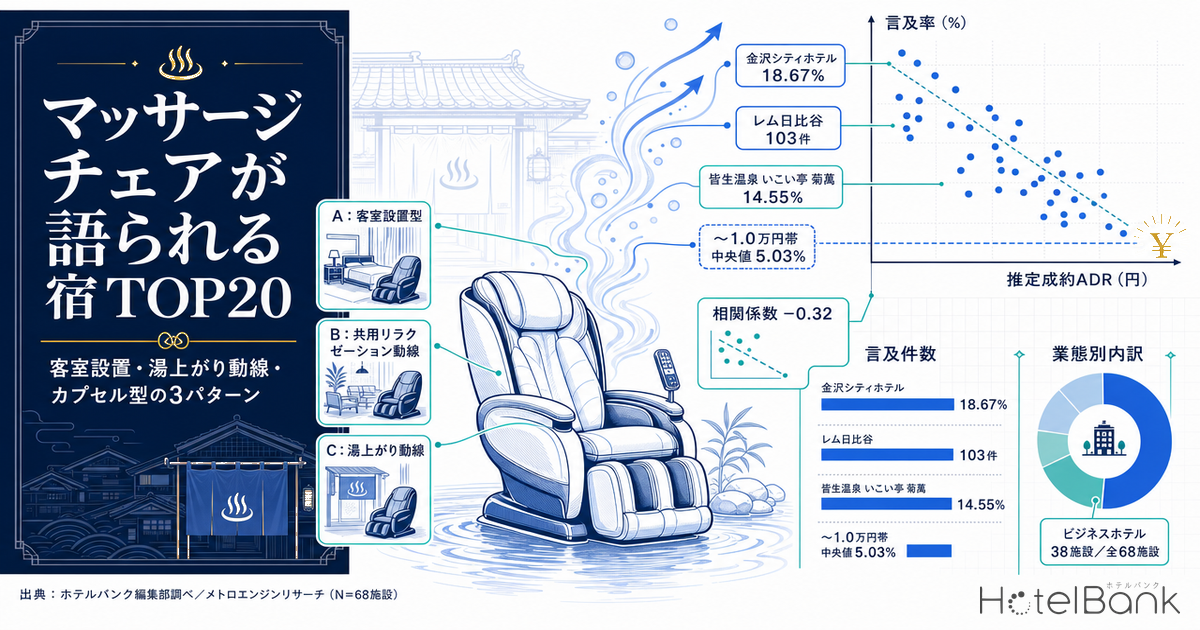
- — The highest mention count is remm Hibiya’s 103. The highest mention rate, however, belongs to Kanazawa City Hotel at 18.67% — the count leaders and the rate leaders are not the same properties.
- — About 56% of the 68 properties (38) are business hotels, followed by 12 ryokan, 7 resort hotels, and 6 city hotels.
- — There are three patterns that make it work: in-room installation, a shared relaxation zone, and the post-bath flow at ryokan. In-room installation drives high contact rates and makes double-digit mention rates achievable.
- — Estimated settled ADR and mention rate show a weak negative correlation, with a coefficient of -0.32. The highest mention rate sits in the under-¥10,000 band (5.03%, N=16 properties) — higher-priced properties are not the ones that get talked about.
- — A practical benchmark for shared-area installation is Nagoya B’s Hotel’s 11 chairs for 324 rooms (roughly one per 29 rooms). Rental arrangements starting in the ¥10,000-per-month range make low-upfront-investment deployment possible.
TOP 20 Hotels Where Massage Chairs Get Talked About
Let us start with the overall picture. The table below ranks properties by the number of positive review mentions of massage chairs across the past 24 months. The top mention count is remm Hibiya (Tokyo, 255 rooms) with 103, followed by Nagoya B’s Hotel (Aichi, 324 rooms) with 82.
| Rank | Property | Prefecture | Category | Rooms | Mentions | Mention rate | Estimated settled ADR band |
|---|---|---|---|---|---|---|---|
| 1 | remm Hibiya (レム日比谷) | Tokyo | Business hotel | 255 | 103 | 8.09% | ¥15,000–20,000 |
| 2 | Nagoya B’s Hotel (名古屋ビーズホテル) | Aichi | Business hotel | 324 | 82 | 7.91% | Under ¥10,000 |
| 3 | Anshin Oyado Premier Shimbashi Shiodome (豪華カプセルホテル 安心お宿プレミア 新橋汐留店) | Tokyo | Capsule hotel | 180 | 62 | 5.07% | Under ¥10,000 |
| 4 | remm Akihabara (レム秋葉原) | Tokyo | Business hotel | 259 | 60 | 3.08% | ¥20,000–30,000 |
| 5 | remm Shin-Osaka (レム新大阪) | Osaka | City hotel | 296 | 59 | 3.58% | ¥15,000–20,000 |
| 6 | Dormy Inn Higashi-Muroran with Natural Hot Spring (天然温泉 幸鐘の湯 ドーミーイン東室蘭) | Hokkaido | Business hotel | 196 | 52 | 5.49% | Under ¥10,000 |
| 7 | The Bridge Hotel Shinsaibashi (ザ ブリッジホテル心斎橋) | Osaka | Business hotel | 195 | 51 | 3.76% | ¥15,000–20,000 |
| 8 | Hotel Niwa Tokyo (庭のホテル東京) | Tokyo | City hotel | 229 | 51 | 2.44% | ¥30,000+ |
| 9 | Hotel Coco Grand Kitasenju (ホテル ココ・グラン北千住) | Tokyo | Business hotel | 99 | 50 | 6.87% | ¥10,000–15,000 |
| 10 | Ikoitei Kikuman, Kaike Onsen (皆生温泉 いこい亭 菊萬) | Tottori | Ryokan | 41 | 47 | 14.55% | ¥10,000–15,000 |
| 11 | Hotel Coco Grand Takasaki (ホテル ココ・グラン高崎) | Gunma | Business hotel | 119 | 47 | 11.96% | ¥10,000–15,000 |
| 12 | Kanazawa City Hotel (金沢シティホテル) | Ishikawa | Business hotel | 153 | 45 | 18.67% | Under ¥10,000 |
| 13 | remm Roppongi (レム六本木) | Tokyo | Business hotel | 400 | 43 | 2.81% | ¥15,000–20,000 |
| 14 | Hotel Kawaroku L-Stage Takamatsu (ホテル川六 エルステージ高松) | Kagawa | Business hotel | 449 | 42 | 3.22% | Under ¥10,000 |
| 15 | Hotel MyStays Maihama (ホテルマイステイズ舞浜) | Chiba | Business hotel | 90 | 41 | 3.66% | ¥20,000–30,000 |
| 16 | Richmond Hotel Yamagata Ekimae (リッチモンドホテル山形駅前) | Yamagata | Business hotel | 219 | 39 | 4.32% | ¥10,000–15,000 |
| 17 | Sakura Terrace The Gallery (サクラテラスザギャラリー) | Kyoto | Business hotel | 220 | 37 | 1.50% | ¥15,000–20,000 |
| 18 | Onyado Nono Nara (御宿 野乃 奈良) | Nara | Business hotel | 216 | 36 | 1.92% | ¥15,000–20,000 |
| 19 | Dotonbori Hotel (道頓堀ホテル) | Osaka | City hotel | 116 | 36 | 2.11% | ¥15,000–20,000 |
| 20 | Mitsui Garden Hotel Prana Tokyo Bay (三井ガーデンホテルプラナ東京ベイ) | Chiba | Resort hotel | 550 | 36 | 1.18% | ¥30,000+ |
Source: HotelBank Editorial Team research (guest reviews from the past 24 months, top 20 of N=68 properties) / estimated settled ADR from MetroEngines Research
Counts and rates do not necessarily line up. Large properties accumulate a lot of reviews, so a big denominator holds the mention rate to a few percent even when the raw count ranks near the top. Conversely, Kanazawa City Hotel (Ishikawa, 153 rooms) posted 45 mentions against 241 total reviews for 18.67%, and Ikoitei Kikuman at Kaike Onsen (Tottori, 41 rooms) recorded 47 mentions at 14.55% — both stand out on a rate basis. The chart below places the two measures side by side.
Source: HotelBank Editorial Team research (guest reviews from the past 24 months)
Three Patterns That Work — Where You Put It Changes How It Gets Talked About
Breaking the 68 properties down by category, business hotels account for the majority at 38, followed by 12 ryokan, 7 resort hotels, and 6 city hotels. At first glance this looks like a business-hotel story, but once you check how each property has installed its chairs, the structures that generate mentions divide into three broad types.
Source: HotelBank Editorial Team research (N=68 properties)
Pattern A: The urban business/city hotel “in-room” model
The configuration that accumulates the most mentions is placing a massage chair inside the guest room. The remm brand puts forward a concept on its official site of offering “not guest rooms but bedrooms,” and explicitly lists massage chair installation alongside its original mattresses and rain showers (excluding some twin rooms). Four of the top 20 properties are remm hotels — remm Hibiya (1st), remm Akihabara (4th), remm Shin-Osaka (5th), and remm Roppongi (13th) — which supports the idea that in-room placement puts every single guest in contact with the amenity.
Hotel Coco Grand Takasaki (Gunma, 119 rooms) also states on its official site that massage chairs are installed in every room, and it sits at a high 11.96% mention rate. Its group sibling Hotel Coco Grand Kitasenju (Tokyo, 99 rooms) installs them in all but a few room types and records 6.87%. Kanazawa City Hotel (Ishikawa, 153 rooms) equips a room type called the “Relaxation Single” with a full-size massage chair, and its reviews are lined with comments such as “having a massage chair in the room was especially good.” Because in-room installation pushes the contact rate close to 100%, it makes double-digit mention rates achievable.
Pattern B: The capsule/sauna “shared relaxation flow”
The second type places several units together in a shared area and folds them into the flow out of the bath or sauna. Nagoya B’s Hotel (Aichi, 324 rooms) operates an in-house facility called “B’s Salon,” which pairs its large public bath “Rakuda no Yu” with a sauna, a stone spa, and a fitness room; according to its official site the massage chair corner holds 11 units (installed May 2025), each chair partitioned into a semi-private booth and free for hotel guests to use. That density — 11 chairs for 324 rooms — serves as a useful reference point for the deployment guidance discussed below.
Anshin Oyado Premier Shimbashi Shiodome (Tokyo, 180 rooms) officially promotes a setup where massage chairs, along with an artificial hot spring and a mist sauna, can be used free of charge as many times as guests like during their stay. Hotel Kawaroku L-Stage Takamatsu (Kagawa, 449 rooms) likewise provides a separate “relaxation space” apart from the large public bath, with massage chairs reserved for women. What these share is a deliberate design decision about how guests should spend the several dozen minutes right after getting out of the bath. Guest reviews include comments like “there was a large public bath, and with a massage chair after the bath I was able to spend my time comfortably.”
Pattern C: The ryokan “post-bath flow” and all-room installation
The third type is the hot-spring ryokan. Twelve of the 68 properties are ryokan, and their median mention rate of 3.35% ranks near the top among categories. Ikoitei Kikuman at Kaike Onsen (Tottori, 41 rooms) advertises massage chairs in every room on its official site and recorded a 14.55% mention rate, the highest in the ryokan category. The fact that a property with only 41 rooms accumulated 47 mentions shows that room count and mention volume are not proportional.
Other hot-spring ryokan among the 68 include Zao Shiki-no-Hotel (Yamagata, 43 rooms, 4.79%), Yufuin Sansuikan (Oita, 85 rooms, 4.25%), Yamatoya Honten (Ehime, 91 rooms, 2.80%), and Hotel Sakurai (Gunma, 179 rooms, 2.16%). At ryokan the chairs are often placed in a rest area along the path from the large public bath back to the guest room, and they tend to be talked about as part of the cool-down experience after bathing.
Higher-Priced Properties Are Not the Ones That Get Talked About
This is the point to check the relationship with price band. Massage chairs are easy to picture as “an amenity at luxury properties,” but the data points the other way. Taking the 62 of the 68 properties for which six or more months of estimated settled ADR were available over the past 12 months, and computing the median mention rate by ADR band, the highest was the under-¥10,000 band (N=16 properties) at 5.03%. The correlation coefficient between ADR and mention rate is -0.32, a weak negative correlation.
Source: HotelBank Editorial Team research (review aggregation) / estimated settled ADR from MetroEngines Research (N=62 properties)
Looking at the individual scatter makes the structure clearer. The plot below puts estimated settled ADR on the horizontal axis, mention rate on the vertical axis, and mention count in the size of each circle. Properties reaching double-digit mention rates cluster in the ¥6,000 to ¥13,000 range of estimated settled ADR, while the above-¥30,000 band (N=4 properties) has a median mention rate of just 2.30%.
Source: HotelBank Editorial Team research (review aggregation) / estimated settled ADR from MetroEngines Research (N=62 properties)
This is not a story about high-priced properties having inferior equipment. At higher price points there is far more to talk about — spa treatments, lounges, views, dining — so review mentions spread across those instead. In fact, Hotel Niwa Tokyo (Tokyo, 229 rooms, estimated settled ADR in the ¥30,000s) ranks 8th on absolute mentions with 51, yet against 2,093 total reviews its mention rate stays at 2.44%. Put the other way round, for properties in the mid-price band and below, a massage chair works relatively well as a differentiator that actually shows up in reviews.
The same shape appears when you look at room count. Properties with fewer than 80 rooms (N=14) have a median mention rate of 5.47%, while those with 250 or more rooms (N=14) sit at 2.95% — smaller properties post the higher rate. On mention counts, though, the 250-plus-room group leads with a median of 34.0. Large properties make their presence felt in absolute numbers; small ones do it on rate.
Deployment Guidance — Unit Count, Placement, and Guest Flow
Let us translate the data so far into inputs for an actual deployment decision. The strength of the massage chair is that it requires far less capital than building a new public bath or adding a sauna, and it can make use of existing underutilized space.
1. Units per guest room
For shared-area installation, the 11 units per 324 rooms (roughly one per 29 rooms) publicly disclosed by Nagoya B’s Hotel is one practical benchmark. Given that day-use bathers are also in the mix there, a guest-only setup should be able to operate at the same density or with a little more headroom. Too few units, on the other hand, creates queues, and the experience itself then struggles to earn praise. The shared-area properties with high mention rates all share one trait: several units placed together.
In-room installation calls for different thinking. All-room deployments like Coco Grand Takasaki or Ikoitei Kikuman mean units equal rooms and a correspondingly larger investment, but the contact rate approaches 100% and the mention rate readily climbs into double digits. As a middle path, there is the approach Kanazawa City Hotel takes with its “Relaxation Single”: carving out massage-chair rooms as a distinct room type and selling them at a price differential. Because it can be run as a product that generates requested bookings without rolling out across every room, it suits a phased introduction.
2. Placement and guest flow
What the leading properties have in common is placement along the path from the bath back to the guest room. Checking the review profiles of the top 10 properties, seven have large-public-bath or spa-related mentions among their leading topics. At Nagoya B’s Hotel, mentions of the hot spring, the large public bath, and the sauna all rank near the top, and Hotel Coco Grand Kitasenju likewise has public-bath topics among its leading items. The reading is that a massage chair gets talked about as an experience when it is positioned as the closing act of the bathing experience, rather than as a standalone amenity.
Attention to privacy also matters. Nagoya B’s Hotel partitions each chair into a semi-private booth, and both Hotel Kawaroku L-Stage Takamatsu and Hotel Coco Grand Takasaki (which also has a women-only stone spa) provide women-only equipment and space. Putting a chair exposed in a corner of the lobby and putting it in a partitioned rest area produce different dwell times — and different reviews.
3. Investment structure — alternatives to outright purchase
Commercial massage chairs come with well-developed alternatives to purchase. Looking at rental operators’ published price ranges, leases run from roughly ¥10,000 to the high ¥20,000s per month, typically with delivery, installation, repair, and maintenance costs included in the monthly fee. For coin-operated deployments, some vendors offer arrangements with zero upfront cost, installing the units free and splitting coin revenue between the property and the vendor. Whether to open the chairs to guests free of charge or to charge by coin depends on the property’s positioning, but in either arrangement there is no need to line up a multi-million-yen capital outlay in advance — remarkably light as in-house facilities go.
It is also worth noting that about 56% of the 68 properties (38) are business hotels, which suggests this lever works best precisely at properties that do not command high room rates. For a property that already has a large public bath or a sauna, simply adding a relaxation space at the end of that flow may add one more element that shows up in reviews.
Conclusion
There is a clear structure behind the properties that attract massage chair mentions. First, in-room installation maximizes the contact rate and pushes the mention rate into double digits. Second, for shared-area installation, what matters is whether several units are grouped along the flow from the large public bath or sauna, and whether partitions and zoning make the space somewhere guests can actually relax. Third, the price band where this amenity gets talked about is not the high end but the mid-price band and below, around ¥10,000 in estimated settled ADR.
Mention rate is, in the end, a measure of how often something is talked about, not a measure of satisfaction itself. Even so, which elements get named over and over in reviews is a clue to what a property is remembered for. As a lever that adds one memorable element without a multi-million-yen capital program, the massage chair is an option worth considering.
Related Reading
References and Sources
■ Data sources
Built by matching, at the property level, an aggregation of amenity mentions from natural-language processing of guest reviews (past 24 months, HotelBank Editorial Team research) with estimated settled ADR (MetroEngines Research, monthly values from August 2025 to July 2026). Room counts and property categories are based on each property’s publicly available facility information.
■ Calculation assumptions
The population is the 68 properties with 20 or more total reviews and 15 or more positive massage chair mentions. Mention rate = mentions of the amenity ÷ that property’s total review count. Aggregations by ADR band, room-count band, and property category all use medians, and the 62 properties with six or more months of estimated settled ADR were used for the price analysis. Estimated settled ADR is the median of each property’s monthly values.
■ Limitations and caveats
Mention rate is a measure of how often something is talked about and is a different thing from a satisfaction score or star rating. Because guest contact frequency changes dramatically depending on whether the amenity is inside the room or in a shared area, mention rates are not suited to simple comparison across property categories or installation formats. Estimated settled ADR is an estimate derived by applying category-specific adjustment coefficients to the lowest published plan, and differs from each property’s actual transacted prices and accounting figures (cross-checked against disclosed results from listed hotel REITs, the median error is approximately 7.5%). Unit counts and installation formats are based on information published on each property’s official website; properties that do not disclose this are not included in this article’s classification of installation formats.
■ Data
- HotelBank Editorial Team research — guest reviews from the past 24 months analyzed with natural-language processing (20 or more total reviews, 15 or more mentions of the amenity, N=68 properties)
- MetroEngines Research — estimated settled ADR (median of monthly values from August 2025 to July 2026, N=62 properties)
■ Property official sites and facility information
- Nagoya B’s Hotel “B’s Salon” in-house facilities page (massage chair corner, 11 units, installed May 2025)
- Nagoya B’s Hotel large public bath “Rakuda no Yu”
- remm Hibiya “commitment to sleep” (in-room equipment)
- Hotel Coco Grand Takasaki guest rooms page (massage chairs in all rooms)
- Hotel Coco Grand Takasaki spa
- Hotel Coco Grand Kitasenju guest rooms page
- Ikoitei Kikuman, Kaike Onsen — rooms page (massage chairs in all 41 rooms)
- Anshin Oyado luxury capsule hotel official site
- Kanazawa City Hotel facility information (room type “Relaxation Single” / 153 rooms total)
- Hotel Kawaroku L-Stage Takamatsu “relaxation space”
■ Deployment options for commercial massage chairs