

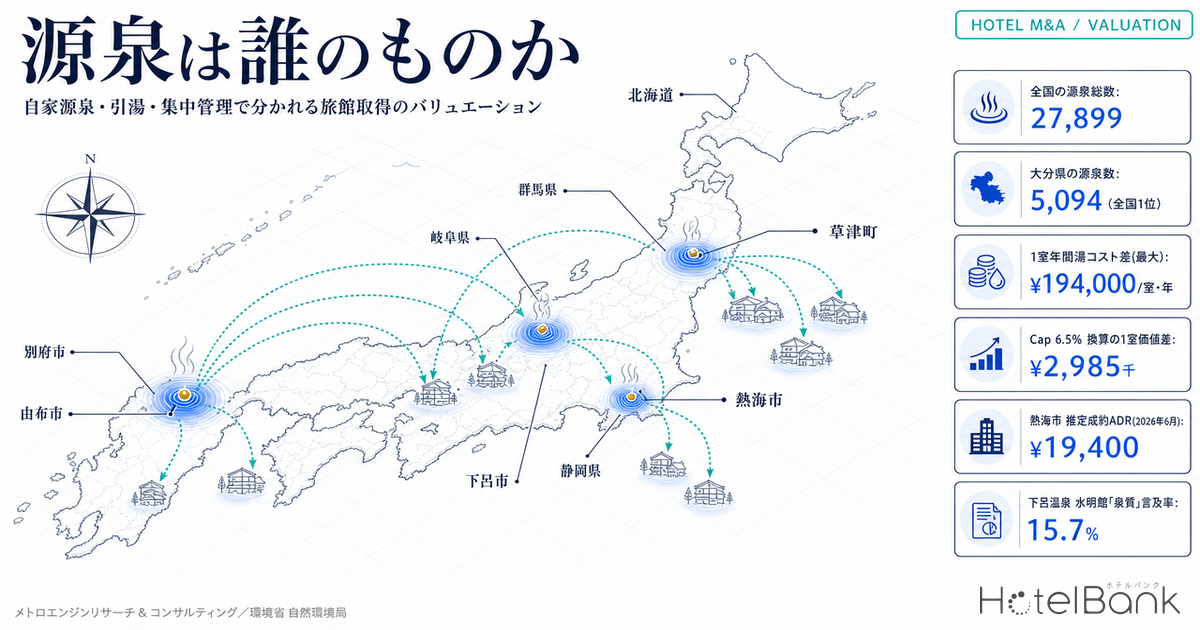
When a buyer acquires an onsen ryokan, what they ultimately hold is neither the building nor the land. It is the water. Yet the single phrase “we have hot spring water” conceals three legally distinct conditions: an owned source, where the operator holds its own drilling permit and controls the wellhead; a piped-water right (引湯権), under which water is apportioned from someone else’s source; and centralized management, where a cooperative or municipality pools sources and distributes the water. The three differ in how they appear on the balance sheet, in annual cash outflow, and in the certainty that the water can still be used after the acquisition closes. This article organizes the structure of these rights from two public frameworks — the Hot Springs Act (温泉法) and the National Tax Agency’s Basic Circular on Property Valuation (財産評価基本通達) — translates the difference in annual water-related cost into a per-room figure, and then capitalizes it into asset value at cap rates of 5.5%, 6.5% and 7.5%.
Metric Definitions Used in This Article
The cost estimates and asset-value conversions in this article are editorial estimates by the HotelBank Editorial Team based on the stated assumptions, and do not represent an appraised value for any individual transaction. Actual investment decisions require property-specific due diligence.
- — Annual water-related cost ranges from ¥31,000 to ¥225,000 per room — a roughly sevenfold spread. The lightest is centralized management; the heaviest is an owned source requiring pumped extraction plus reheating (40-room model, editorial estimate).
- — Capitalized at a 6.5% cap rate, that is a value gap of ¥2,985k per room, or roughly ¥119 million across 40 rooms. Factoring in a ±30% swing in fuel prices widens the range to roughly ¥96 million–¥143 million.
- — There are three forms of rights: owned source, piped-water right, and centralized management. Article 80 of the Basic Circular on Property Valuation values a piped-water right as “apportioned volume ÷ total discharge volume,” with a deduction of up to 30% depending on the terms of the arrangement.
- — The cost ranking and the value ranking do not coincide. Centralized management has the lightest cash outflow, but comes with constraints on operating freedom: a ceiling on permitted water volume, approval requirements for transfer of title, and forfeiture through suspension of use.
- — Estimated settled ADR for June 2026 was ¥19,400 in Atami (N=104 properties) and ¥19,200 in Yufu (N=141 properties). Beppu, which has more hot spring sources than any other city in Japan, came in at ¥12,100 (N=124 properties) — water volume is not the primary driver of ADR.
The Water Does Not Increase — 27,899 Sources and 2,839 Onsen Areas as a Finite Resource
According to the “Hot Spring Utilization Status” survey published by the Ministry of the Environment’s Nature Conservation Bureau, as of the end of March 2025 Japan had 2,839 onsen resort areas and 27,899 hot spring sources. The number of areas fell by 18 from the prior year, and the number of sources by 21. This contrasts with a recovering demand side — accommodation facility counts and total guest nights (125,414,300 in FY2024) — while the underlying resource base, and the number of onsen areas in particular, has declined for six consecutive years since FY2019, a cumulative loss of 132 areas.
This asymmetry is what elevates water rights to a primary variable in ryokan acquisitions. Demand is returning; the resource is not expanding. New drilling, moreover, requires prefectural governor approval under Article 3 of the Hot Springs Act, and permission is withheld where there is a risk of affecting the discharge volume, temperature or composition of existing sources, or of harming the public interest. Applications are customarily referred to the hot spring subcommittee of the prefectural environmental council, and in many municipalities that subcommittee convenes only about twice a year. In other words, the assumption that “you can simply drill for it” does not hold, at least not in the core of an established onsen area.
The resource is also highly concentrated geographically. By prefecture, Oita stands out with 5,094 sources, followed by Kagoshima with 2,735, Hokkaido with 2,249, Shizuoka with 2,185 and Kumamoto with 1,339. The top five prefectures account for roughly 48% of the national total.
A high source count does not, however, translate directly into “easy to own a source.” Within Oita, the distribution is extremely concentrated: Beppu has 2,831 sources with a discharge of 101,856 litres/minute, Yufu has 1,074 sources at 51,998 litres/minute, and Kokonoe has 435 sources at 85,736 litres/minute (Oita Prefecture disclosure, as of end of March 2025). In an area with high source density such as Beppu, holding an individual source can be a realistic option for a ryokan; in an onsen area with only a handful of sources, the only ways to obtain water are a piped-water right or centralized management from the outset. What the buyer can choose is not the form of the right, but rather the method the onsen area has already adopted.
Three Forms of Rights — Where the Hot Springs Act, Customary Law and Distribution Rules Overlap
Rights to hot spring water are not settled by any single statute. The Hot Springs Act (Act No. 125 of 1948) governs drilling, deepening, the installation of powered equipment, and the utilization permit required when water is supplied for public bathing or drinking. Who may use the water on an exclusive basis — the private-law question of ownership — falls outside the Act.
On that private-law question, the courts have taken a distinctive approach. The right to draw hot spring water directly from the mouth of a source and control it exclusively is known as a hot spring right (温泉権, also 湯口権 or 温泉専用権), and it is treated as an exception to the numerus clausus principle of real rights despite having no statutory basis. The Great Court of Cassation judgment of 18 September 1940 recognized an exclusive hot spring right as a real right under customary law, and the Yamagata District Court judgment of 25 November 1968 likewise recognized the existence of a usufructuary real right under customary law. As a general rule the right is contained within land ownership, but in onsen areas with long histories there are cases where it has come into being as a real right independent of land ownership. The land register alone, in other words, does not settle who owns the water.
In practice, the ways a ryokan obtains water can be organized into the following three forms.
| Form | Substance of the right | Principal legal basis | Items to verify at acquisition |
|---|---|---|---|
| 1. Owned source | A hot spring utilization right contained within land ownership, or a customary-law hot spring right independent of land ownership. Exclusive control of the wellhead. | Hot Springs Act Article 3 (drilling permit), Article 11 (powered equipment permit), Article 14-5 and related provisions (utilization permit); real rights under customary law | Holder and validity of the drilling, powered equipment and utilization permits; well depth, age and re-drilling history; replacement timing for extraction equipment; arrangements with adjacent sources regarding interference |
| 2. Piped-water right | The right to receive apportioned water from a party holding the spring land or the hot spring right. Defined in Article 79 of the Basic Circular on Property Valuation as “the right to pipe water.” May rest on contract as a claim, or take on the character of a customary real right. | Apportionment contract (between the parties), custom, Basic Circular on Property Valuation Articles 79 and 80 | Contract term and renewal provisions; ceiling on apportioned volume and reduction clauses; termination clauses triggered by transfer of management control or share transfer; provisions for revising the distribution fee; allocation of the source owner’s equipment renewal costs; ownership of the distribution pipe and consents for passage and burial across the land it crosses |
| 3. Centralized management | A cooperative or municipality pools multiple sources in a storage tank and distributes water to each property under rules or an ordinance. What the user holds is a position entitled to receive distributed water, not the source itself. | Municipal hot spring supply or usage ordinances, cooperative rules, membership agreements | Permitted water volume (apportionment ceiling); amount of the membership and contribution fees and whether they are re-levied on transfer; approval requirements and waiting period for change of title; forfeiture clauses triggered by suspension of use; levies for equipment renewal; the procedure by which tariffs are revised |
Of the three, the one hardest to read from the outside is centralized management. The ordinances and rules are public, but how many cubic metres of permitted water volume a given property actually holds, and what a change of title requires, are matters specific to that property. And it is precisely those property-specific circumstances that create room to negotiate on acquisition price.
Expressing “What You Are Buying” as a Formula — The Value Structure Set Out in the Basic Circular on Property Valuation
Japan already has a public formula for pricing rights to hot spring water: Section 9 of the National Tax Agency’s Basic Circular on Property Valuation, “Spring Land and Rights Existing Thereon.” Although it is a valuation standard for inheritance and gift tax, it is worth referencing in M&A valuation design because it sets out, at the level of the text itself, how the layers of rights stack.
| 69 (Valuation of spring land) | Valued by multiplying the fixed asset tax assessed value by the multiplier set by the Regional Taxation Bureau Commissioner. Where water temperature or discharge volume has changed abruptly, transaction comparables or expert opinion values are taken into account |
| 77 (Spring land subject to a hot spring right) | Value of the spring land − value of the hot spring right |
| 78 (Valuation of a hot spring right) | Transaction comparables, expert opinion values and the like are taken into account according to the terms on which it was established |
| 79 (Spring land or hot spring right subject to a piped-water right) | Value of the spring land or hot spring right − value of the piped-water right |
| 80 (Valuation of a piped-water right) | Value of the spring land or hot spring right × (apportioned volume ÷ discharge volume), less a deduction of up to 30% depending on the terms of the arrangement |
The value of a piped-water right is calculated as “the value of the source as a whole × your share (the apportioned-volume ratio).” What this reveals is a structure in which how the apportioned volume is defined in the contract or rules becomes, directly, the numerator of the right’s value. An arrangement that leaves quantity indeterminate — “the necessary volume will be supplied” — makes the very basis for measuring value ambiguous. Confirming that the apportioned volume is stated explicitly matters in due diligence not only for securing day-to-day water supply, but for measurability as an asset.
Article 80 provides for “a deduction of such amount as is deemed appropriate, within 30 per cent of that value, according to the terms of the piping arrangement.” Favourable terms mean a small deduction; restrictive terms mean a large one. Put the other way round, the contract terms themselves are publicly recognized as a variable that moves value across a range of up to 30%. This is territory where the buyer may have room to negotiate.
Translated into acquisition practice, each of the three forms demands a different question. For an owned source: will that wellhead continue to deliver the same volume and temperature, and will the permits transfer into the new name? For piped water: is the apportioned volume fixed as a number, and does the contract survive a transfer of management control? For centralized management: what is the permitted water volume, and whose approval is required for a change of title? None of these appear in the financial statements.
Distribution Systems Can Be Read from Public Sources — Actual Figures from Atami, Kusatsu and Gero
In onsen areas with centralized management or municipal distribution, the tariff structure and membership conditions are published as ordinances. This is information that can be secured free of charge and with certainty in the early stages of an acquisition review, and it is useful for getting a sense of the order of magnitude of the actual figures.
| Onsen area | Upfront payment on joining | Ongoing charges | Provisions on succession and forfeiture |
|---|---|---|---|
| Atami (municipal hot spring distribution) |
Supply membership fee: commercial Class A ¥990,000 up to 0.5m³ / ¥1,474,000 up to 1.0m³, plus ¥330,000 per additional m³. Class B is ¥1,287,000 / ¥1,793,000 / ¥473,000 (in force from 1 October 2019) | Base charge (as of 1 April 2024): commercial Class A ¥43,378/month up to 80m³; Class B ¥66,384/month up to 120m³. Excess charges per m³ are ¥693 for commercial Class A (80–560m³) and ¥712 for Class B (120–840m³), rising to ¥849–873 in the bands above. Hot spring maintenance fee ¥66,000 for standard supply; meter management fee ¥324 for standard supply | Applicants must be residents of, or building owners within, the supply area. Where the place of use is not owned by the applicant, the owner’s written consent is required. Piping work from the main to the bath must be carried out by a contractor designated by the city |
| Kusatsu (town hot spring usage ordinance) |
Hot water supply contribution: the permitted water volume multiplied by ¥300,000 for Class A or ¥900,000 for Class B (Article 28(2)). Transfer contributions are ¥100,000 for Class A→Class A, ¥500,000 for Class A→Class B, and so on (Article 28(4)) | Usage charges vary by source and supply method. For the Yubatake and Shirahata sources, the base charge is ¥30/m³ and the excess charge ¥40/m³; for the Bandai source, ¥45 base and ¥75 excess (appended table). Water meter usage fees are ¥1,000 per unit (Article 31), plus management fees (Article 32) | Usage permits are granted to lodging-business operators (five rooms or more) and similar parties (Article 4). Transfer of a piping permit accompanying a transfer of ownership of the permitted building is approved after five continuous years have elapsed (Article 9(2)(i)). Inheritance and succession must be notified within 30 days (Article 10). The permit may be revoked where piping has not commenced within two years of the day following the permit date, or where suspension of piping has continued for two years (Article 22(1)) |
| Gero (centralized management of Gero Onsen) |
Negotiated individually with the cooperative or managing body (not set out in a published ordinance) | As above. Water is distributed to each ryokan at 55°C | Centralized management has been in place since 1974 for the protection of the hot spring resource (Gero City disclosure). Because the detailed distribution rules are internal to the cooperative, a disclosure request via the seller is in practice the starting point when reviewing an acquisition |
Article 22(1) of the Kusatsu ordinance is instructive for anyone assessing a centrally managed right: continuing to draw the water can itself be a condition of retaining the right. In renovations involving a long closure, or in turnaround projects where the opening schedule slips, this kind of suspension clause enters the critical path of the business plan. Conversely, an onsen area whose procedures are set out explicitly in an ordinance is easier to assess, in the sense that the route to verification is clear.
Mapping the Onsen Areas Covered — Visibility of the Distribution System and the Distribution of Estimated Settled ADR
The onsen areas covered in this article are plotted on the map below. Circle size represents estimated settled ADR for June 2026; colour distinguishes whether the municipal or cooperative distribution system can be confirmed from published materials.
Ranking the estimated settled ADR levels, as of June 2026 Atami leads at ¥19,400 (N=104 properties) followed by Yufu at ¥19,200 (N=141 properties), then Ito at ¥15,900 (N=126), Minakami at ¥15,600 (N=49), Kusatsu at ¥14,600 (N=91), Kokonoe at ¥14,100 (N=46), Gero at ¥12,900 (N=48), Shibukawa at ¥12,600 (N=45) and Beppu at ¥12,100 (N=124). On the Hokkaido side, Noboribetsu is at ¥17,100 and Toyako at ¥14,300, but both cover only N=15 properties — smaller than the other areas — and are treated as reference values.
What deserves attention here is that a large number of sources does not correspond to a high ADR. Beppu holds 2,831 sources — the largest resource base in the country — yet its estimated settled ADR for June 2026 sits in the lower half of these 11 areas. Gero, where sources are centrally managed, is likewise at or below the middle. In other words, the volume of water itself is not the primary driver of pricing; other variables — the mix of property sizes, guest segments, and the level of capital investment — are doing the work. Water rights are not a device that lifts ADR directly; they are the foundation that determines the continuity and cost structure of the business generating that ADR.
Viewed as a year-over-year overlay, all four areas share the same seasonality: a peak in August with troughs in June and September. December is also a peak in Atami, Yufu and Kusatsu, though in Gero the highest month within 2025 was November (¥21,700). Yufu has been setting recent highs — ¥27,100 in December 2025 and ¥26,200 in January 2026 — with January 2026 up roughly 8% against the same month a year earlier (¥24,300 in January 2025). Atami likewise reached ¥27,200 in January 2026, up roughly 22% from ¥22,200 a year earlier. June 2026, by contrast, sits below the prior-year month in every area, which may reflect both demand adjustment during the rainy season and the fact that the number of properties observed rises seasonally in that month.
Translating the Cost of Water into an Annual Per-Room Figure — a 40-Room Model
Differences in the form of the right ultimately surface as differences in annual cash outflow. Below, with the assumptions stated explicitly, we assume a 40-room onsen ryokan and convert only those costs directly tied to obtaining and maintaining the water into an annual per-room amount. Bath cleaning, mains water, labour and building depreciation are excluded.
Assumptions (editorial estimate)
· Reheating: 10°C gap between source temperature and target temperature, heating value of Class A heavy fuel oil 39.1 MJ/L, boiler efficiency 85%, fuel price ¥110/L → annual consumption of approximately 33,100 L, roughly ¥3.64 million
· Pumping power: 11 kW submersible pump, 70% load factor, electricity at ¥22/kWh → approximately ¥1.48 million per year
· Well: ¥60 million of drilling work amortized over 30 years, ¥15 million of riser pipe and pump over 8 years → approximately ¥3.88 million per year
· Piped water (private apportionment): distribution fee of ¥150,000 per month, plus a ¥12 million membership payment amortized over 20 years
· Centralized management: based on the commercial Class A tariff table for Atami’s municipal hot spring system (as of 1 April 2024), assuming monthly consumption of 150m³. Base charge ¥43,378 plus 70m³ of excess at approximately ¥680/m³. Membership fee of ¥1,474,000 amortized over 20 years, hot spring maintenance fee of ¥66,000/year, and meter management fee of ¥324/month added
| Form of right (model) | Well and equipment, annualized | Pumping power | Distribution and usage charges | Reheating fuel | Membership fee, annualized, and other | Annual total per room |
|---|---|---|---|---|---|---|
| A. Owned source (free-flowing, high temperature) No reheating, no pumping | ¥50,000 | — | — | — | ¥8,000 | ¥58,000 |
| B. Owned source (pumped extraction) Pumped, 10°C of reheating required | ¥97,000 | ¥37,000 | — | ¥91,000 | — | ¥225,000 |
| C. Piped water (private apportionment) 10°C of reheating required | — | — | ¥45,000 | ¥91,000 | ¥15,000 | ¥151,000 |
| D. Centralized management (55°C distribution) No reheating | — | — | ¥27,300 | — | ¥3,500 | ¥31,000 |
Sensitivity to fuel and electricity prices — optimistic, central and pessimistic scenarios
The central case above assumes Class A heavy fuel oil at ¥110/L and electricity at ¥22/kWh. Reheating fuel, however, accounts for ¥91,000 of Case B’s ¥225,000 annual per-room cost — roughly 40% — making it the single largest variable, so a swing in unit prices moves the gap between the forms directly. Below we flex fuel and electricity prices by ±30% while holding every other assumption fixed (water volume, temperature gap, equipment cost, distribution fee and usage charges), giving three scenarios. Centralized management (D) requires no reheating because water arrives at 55°C, so it does not move in this analysis.
| Scenario (fuel / electricity price) | A. Free-flowing, high temp. | B. Pumped | C. Piped | D. Centralized | B−D gap | Capitalized at 6.5% (per room / 40 rooms) |
|---|---|---|---|---|---|---|
| Optimistic ¥77/L, ¥15.4/kWh | ¥58,000 | ¥187,000 | ¥124,000 | ¥31,000 | ¥156,000 | ¥2,400k / approx. ¥96 million |
| Central ¥110/L, ¥22/kWh (the base case in the text) | ¥58,000 | ¥225,000 | ¥151,000 | ¥31,000 | ¥194,000 | ¥2,985k / approx. ¥119 million |
| Pessimistic ¥143/L, ¥28.6/kWh | ¥58,000 | ¥263,000 | ¥178,000 | ¥31,000 | ¥232,000 | ¥3,569k / approx. ¥143 million |
Two things follow. First, the ranking of the forms themselves does not change when unit prices move. In every scenario the order from lightest to heaviest is D → A → C → B: centralized management is lightest, and an owned source with pumped extraction plus reheating is heaviest. Second, the size of the gap depends heavily on unit prices. The capitalized value gap between B and D ranges from roughly ¥96 million to roughly ¥143 million across 40 rooms — a spread of ¥47 million. The value of verifying source temperature and actual fuel consumption in due diligence is proportional to the size of that spread. Read the other way, a property with a heavy reheating load has correspondingly more room for its valuation to improve when fuel prices fall.
What this estimate shows is a counterintuitive ordering. The lightest cost belongs to centralized management (D, ¥31,000 per room per year), and the heaviest to the owned-source case requiring pumped extraction and reheating (B, ¥225,000). The gap is ¥194,000 per room per year, or ¥7.76 million a year across 40 rooms.
The reason is straightforward: under centralized management, the cooperative or municipality absorbs the equipment risk of drilling, maintaining and pumping the source, and where water is distributed at 55°C as at Gero Onsen, reheating fuel is unnecessary as well. An owned source, by contrast, means covering the entire temperature gap out of your own fuel budget whenever the discharge temperature falls short of bathing temperature. “Owning” a source can, in cost terms, be a burden. That said, there is also the option of treating that heat as a revenue source rather than a cost — monetizing it through heat supply or binary-cycle power generation, an approach with its own capex profile and site-suitability conditions.
But this is a discussion about cost, not about value. Centralized management has the smaller annual cash outflow, yet the permitted water volume is capped by the rules, a change of title requires the managing body’s approval, and the permit itself can lapse if suspension continues. An owned source carries the larger cash outflow, but so long as the operator controls the wellhead it can decide on its own initiative to add rooms, draw more water, or build a new bath. Valuation has to hold both sides in view at once.
Cap Rates of 5.5%, 6.5% and 7.5% — Converting the Cost Gap into Asset Value
The cost gap attached to hot spring water is a fixed expense that recurs every year and feeds directly into NOI. To bring it into a discussion of acquisition price, the practical approach is to capitalize it at a cap rate and restate it as a per-room value gap.
| Annual cost gap per room | Cap 5.5% | Cap 6.5% | Cap 7.5% |
|---|---|---|---|
| ¥30,000 | ¥545k/room | ¥462k/room | ¥400k/room |
| ¥50,000 | ¥909k/room | ¥769k/room | ¥667k/room |
| ¥100,000 | ¥1,818k/room | ¥1,538k/room | ¥1,333k/room |
| ¥194,000(the maximum B−D gap in this estimate) | ¥3,527k/room | ¥2,985k/room | ¥2,587k/room |
Restated at a 40-room scale, at a 6.5% cap rate the water cost structure alone produces a value gap of roughly ¥119 million for the property as a whole. Even a seemingly small difference of ¥50,000 per room per year becomes ¥769k per room when capitalized at 6.5%, or roughly ¥30.8 million across 40 rooms. Whether due diligence pins down source temperature and the actual distribution fee to a single digit determines whether you hold negotiating material on that scale.
Seen from the other direction, this also shows where the upside sits. A property with a heavy reheating fuel load has structural room to reduce cost — by replacing heat exchangers, insulating the storage tank, or shifting to a bath design suited to a low-temperature source. Being able to price in that post-acquisition improvement potential creates a negotiating shape that satisfies both the seller’s expectations and the buyer’s required return. In a centrally managed onsen area, the equivalent upside question is whether the permitted water volume secured on joining can be sized to a future room-expansion plan.
What Guest Reviews Say About the Water Itself — Mentions of Free-Flowing Springs and Water Quality
The form in which water rights are held is invisible to guests. But the experience of the water — “free-flowing from the source,” “water quality” — surfaces in reviews. Below we look at the distribution of mentions over the most recent 24 months, drawn from NLP analysis of guest reviews by MetroEngines Research & Consulting. Note that a mention rate is not a rating score; it is the frequency with which guests touched on that element.
| Shizuoka | Atami Club Geihinkan (熱海倶楽部 迎賓館) — 26 mentions, 6.9% / Izu-Ito Onsen Daitokan (伊豆・伊東温泉 大東館) — 24 mentions, 6.4% / Nishi-Izu Toi Onsen Musoan Biwa (西伊豆 土肥温泉 無雙庵 枇杷) — 21 mentions, 7.2% |
| Gunma | Hinoki no Yado Minakami Sanso (檜の宿 水上山荘) — 28 mentions, 8.1% / Ikaho Onsen Kokuya (伊香保温泉 古久家) — 15 mentions, 5.4% / Ishizaka Ryokan (石坂旅館) — 15 mentions, 10.6% |
| Gifu | Minorisou (みのり荘) — 12 mentions, 6.2% / Ryu Resort and Spa (龍リゾート アンド スパ) — 11 mentions, 8.0% |
| Oita | Hotel Arthur (ホテルアーサー) — 12 mentions, 3.3% / Beppu Station Hotel (別府ステーションホテル) — 11 mentions, 2.3% |
| Gifu | Gero Onsen Suimeikan (下呂温泉 水明館) — 436 mentions, 15.7% / Hotel Kusakabe Armeria (ホテルくさかべアルメリア) — 200 mentions, 13.0% / Gero Onsen Bosenkan (下呂温泉 望川館) — 83 mentions, 6.7% |
| Gunma | Hotel Sakurai (ホテル櫻井) — 163 mentions, 10.3% / Yamaguchikan (やまぐち館) — 101 mentions, 16.5% / Manza Onsen Nisshinkan (万座温泉 日進舘) — 95 mentions, 23.0% |
| Oita | Yufuin Yasuha (ゆふいん泰葉) — 67 mentions, 43.8% / Tsuetate Onsen Hizenya (つえたて温泉 ひぜんや) — 54 mentions, 10.4% / Beppu Onsen Suginoi Hotel (別府温泉 杉乃井ホテル) — 41 mentions, 1.3% |
| Hokkaido | Dai-ichi Takimotokan (第一滝本館) — 148 mentions, 6.3% / Fukui Hotel (ふく井ホテル) — 128 mentions, 15.3% / Hotel Mahoroba (ホテルまほろば) — 114 mentions, 8.0% |
The distribution in Gifu is worth noting. Gero Onsen has managed its sources centrally since 1974, distributing water at 55°C to each ryokan. Even so, Gero Onsen Suimeikan records 436 mentions of water quality (a 15.7% mention rate), an outlier nationally, and Hotel Kusakabe Armeria records 200 (13.0%). Guests’ own words indicate that centralized management does not, in itself, diminish the appeal of the water.
Mentions of “free-flowing from the source,” by contrast, come from a limited number of properties nationwide. Those meeting the threshold of 10 or more mentions judged positive within a prefecture number 13 in Shizuoka, 7 in Gunma, and only 2 in Hokkaido. Free-flowing water occupies a scarce position both as a resource and as a marketing term. How far that scarcity is being recovered as an ADR premium is a separate question from the form of the right, and one worth examining on its own terms.
An Acquisition Due Diligence Checklist — What to Ask, by Form of Right
The analysis above translates into verification items usable in a live transaction. None of them can be read from financial statements or the real estate register; each is settled only by enquiry to the seller, the managing body, or the competent municipality.
1. Owned source
Transferability of the permits: the holder of each permit under the Hot Springs Act — drilling, powered equipment, and utilization — and whether they transfer under a share transfer or a business transfer structure.
Remaining useful life of the well: year drilled, depth, most recent re-drilling and cleaning history, condition of the casing. Installation year and next replacement date for the riser pipe and pump.
Stability of discharge conditions: the historical record of discharge volume, temperature and composition. Article 69 of the Basic Circular on Property Valuation itself cites “an abrupt change having occurred in water temperature, discharge volume or the like” as grounds on which the standard valuation ceases to be appropriate, so the existence of time-series data is the foundation of the valuation.
Relations with neighbouring sources: distance to adjacent sources, any understandings regarding interference, and the competent municipality’s practice on whether new drilling permits are granted.
2. Piped-water right
Quantification of the apportioned volume: whether the contract states the apportioned volume as a number. Because Article 80 values a piped-water right by “the ratio of apportioned volume to discharge volume,” a contract that leaves the quantity indeterminate lacks a basis for measurement as an asset.
Term and termination clauses: the contract term, whether renewal is automatic, and whether termination can be triggered by a transfer of management control or a change of controlling shareholder.
Procedure for revising costs: how the distribution fee is revised, and the rules for allocating costs when the source owner renews the well or the pump.
Title to the distribution pipe: who owns the distribution pipe, the status of consents for passage over and burial in the land it crosses, and whether those consents transfer. Where a section runs through third-party land, obtaining that consent in writing becomes a verification item.
3. Centralized management
Permitted water volume: the current permitted volume (in cubic metres per minute or similar), whether an increase can be applied for, and whether there is a waiting list. Where a room-expansion plan exists, this is the ceiling.
Requirements for change of title: the approving body, required documents, and time needed. As in Kusatsu’s hot spring usage ordinance, some systems require a minimum elapsed period before a permit transfers with a change of ownership.
Forfeiture through suspension: the cap on the suspension period. Check the business plan against this clause for major refurbishments or delays to the reopening schedule.
Upfront payments and levies: whether membership fees and contributions are re-levied on succession, and whether levies arise when the storage tank or distribution pipes are renewed.
These checks are not simply an exercise in pushing the price down. If anything, a transaction in which the water rights are clearly documented is easier to explain in a lender’s credit review. Where the apportioned volume is fixed as a number and the succession procedure is set out explicitly in an ordinance or set of rules, both the collateral valuation and the future cash flow can be presented to third parties in a structured way. Conversely, a transaction in which the contours of the right rest on oral custom is both negotiating material on price and an opportunity to build value after acquisition by putting the arrangement in writing.
Conclusion — Water Rights Are Not a Cost. They Are the Price of Operating Freedom
What this analysis shows is that annual water-related cost can range across roughly a sevenfold spread depending on the form of the right — from ¥31,000 to ¥225,000 per room. Capitalized at a 6.5% cap rate, that is ¥2,985k per room, or roughly ¥119 million across 40 rooms. It is a variable that moves acquisition price at least as much as visible factors such as building grade or guest room size.
At the same time, the cost ranking and the value ranking do not coincide. The lightest form, centralized management, carries constraints on permitted water volume and succession procedure; the heaviest, an owned source with pumped extraction, buys with that burden the future freedom to add rooms, draw more water, and expand the bathing facilities. What the buyer should be pricing is not the water itself, but the operating freedom to do something with it.
As the Ministry of the Environment’s statistics show, the number of sources has fallen for six consecutive years and onsen areas are contracting. New drilling requires permission under Article 3 of the Hot Springs Act, and permission is withheld where an effect on existing sources is found. Under this structure, existing ryokan that have already secured water rights hold something scarce in the access right itself. Whether due diligence can read those water rights one level deeper is not merely a matter of avoiding risk; it is a question of whether that scarcity can be priced correctly.
And finally, it is worth restating what the Gero Onsen reviews showed. Even under centralized management, mentions of water quality ranked among the highest in the country. The form of the right determines operating freedom and economics, but what determines the value of the water as guests receive it lies on the operating side — in how that water is used. Due diligence on the rights is the entry point for measuring that operating latitude.
Related Reading
- Chosen for the Water: Japan’s Top 30 Onsen Inns by Review Mentions
- Corporate Retreat Conversions: 8.27% GOP Yield Across 5 Onsen Areas
- Gunma Hotel Market 2026: Four ADR Tiers and a ¥5,700 Upper-Mid Gap
- Listed vs Settled ADR Gap: Japan’s 46-Prefecture Upside Map 2026
References and Sources
■ Data sources
Estimated settled ADR and N (the number of properties covered by the estimate) are from MetroEngines Research & Consulting’s monthly municipality-level aggregation (July 2024 – June 2026; double occupancy, per-room rate basis; estimated settled rate after category-specific adjustment). Review mention counts and mention rates are from the same firm’s NLP analysis of guest reviews (most recent 24 months; properties with 5 or more mentions judged positive). Source counts, onsen area counts and total guest nights are from the Ministry of the Environment, Nature Conservation Bureau, “Hot Spring Utilization Status” (as of end of March 2025). Membership fees and tariffs for water distribution are from the published ordinances and tariff tables of Atami, Kusatsu and Gero. The structure of rights is from the Hot Springs Act and the National Tax Agency’s “Basic Circular on Property Valuation, Section 9.”
■ Assumptions used in the estimates
The model property has 40 guest rooms, 2 communal baths, water supply of 50 litres/minute, and operates year-round. Reheating assumes a 10°C gap between source and target temperature, a heating value of 39.1 MJ/L for Class A heavy fuel oil, boiler efficiency of 85%, and a fuel price of ¥110/L, giving annual consumption of approximately 33,100 litres. Pumping power assumes an 11 kW submersible pump at a 70% load factor with electricity at ¥22/kWh. The well amortizes ¥60 million of drilling work over 30 years and ¥15 million of riser pipe and pump over 8 years. Piped water assumes a distribution fee of ¥150,000 per month plus a ¥12 million membership payment amortized over 20 years. Centralized management is based on the commercial Class A tariff table for Atami’s municipal hot spring system (as of 1 April 2024), assuming monthly consumption of 150m³. The asset value conversion is a simple calculation of “annual cost gap ÷ cap rate (5.5%, 6.5%, 7.5%)” and does not account for tax effects, growth, vacancy or residual value. The sensitivity analysis flexes only fuel and electricity prices by ±30%, holding all other assumptions fixed.
■ Limitations and caveats
All water cost estimates and asset value conversions in this article are editorial estimates based on the stated assumptions, and do not represent an appraised value for any individual transaction. Actual amounts payable vary widely with source temperature, discharge volume, equipment specification and contract terms. Estimated settled ADR is an estimate; cross-checked against property-level disclosures from listed hotel REITs the median error is approximately 7%, and it differs from each property’s actual settled prices and accounting figures. Noboribetsu and Toyako cover only N=15 properties, smaller than the other areas, and are treated as reference values. In centrally managed onsen areas, the permitted water volume, actual amounts payable and internal operating practice for an individual property cannot be determined from public sources and can be confirmed only through disclosure via the seller and the managing body. Review mention rates are not rating scores but the frequency with which guests touched on that element, and do not indicate a quality ranking among properties.
■ Market data
- MetroEngines Research & Consulting — estimated settled ADR (July 2024 – June 2026, by municipality); NLP analysis of guest reviews
■ Government statistics and public data
- Ministry of the Environment, Nature Conservation Bureau, “Hot Spring Utilization Status” (as of end of March 2025)
- Ministry of the Environment, “Outline of the Hot Springs Act” (drilling permits, powered equipment permits, utilization permits)
- National Tax Agency, “Basic Circular on Property Valuation, Section 9: Spring Land and Rights Existing Thereon” (Articles 69, 75, 77, 78, 79, 80)
- Oita Prefecture, “Hot Spring Data” (source counts and discharge volumes as of end of March 2025)
■ Municipal water distribution systems (primary sources)
- Atami City, “Supply Membership Fees and Hot Spring Maintenance Fees” (in force from 1 October 2019)
- Atami City, “Hot Spring Tariffs” (as of 1 April 2024)
- Atami City, “Municipal Hot Springs”
- Kusatsu Town, “Kusatsu Town Hot Spring Usage Ordinance”
- Kusatsu Town, “Hot Spring and Hot Water Operations”
- Gero City, “Introduction to Gero Onsen” (centralized hot spring management since 1974, distribution at 55°C)
■ Case law and commentary
- Great Court of Cassation judgment of 18 September 1940 (recognizing an exclusive hot spring right as a real right under customary law)
- Yamagata District Court judgment of 25 November 1968 (recognizing the establishment of a usufructuary real right under customary law)
- Nihon Hogaku, Vol. 87 No. 3, “The Establishment of Hot Spring Rights in Drilled Springs” (December 2021)
■ Press coverage