

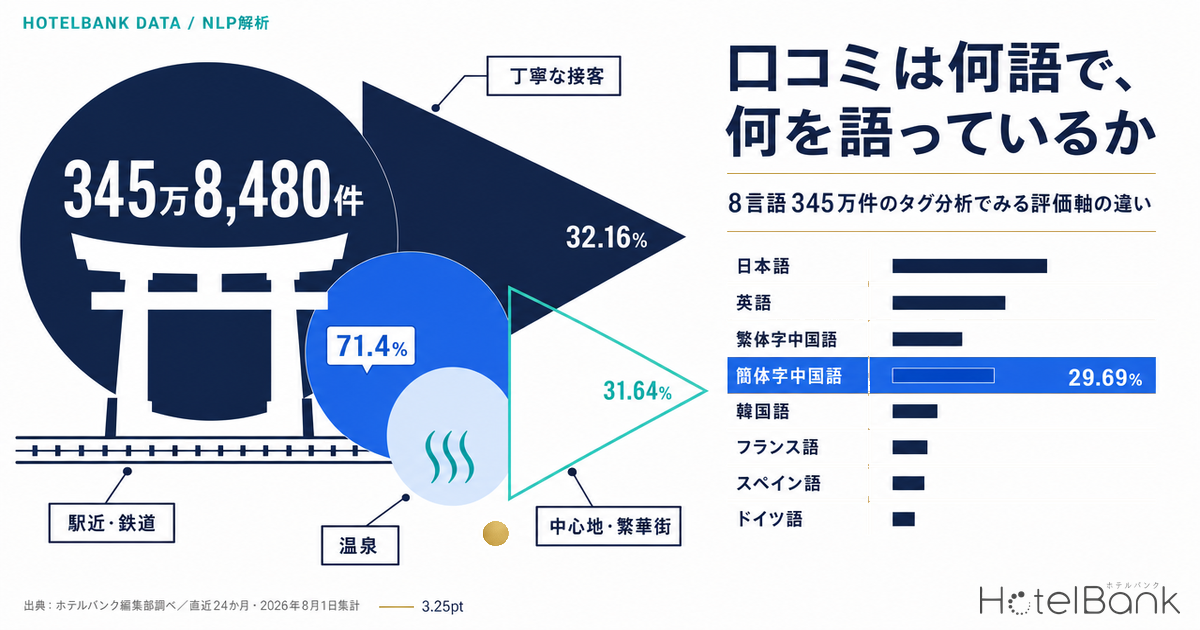
Guest reviews in Japan are no longer written only in Japanese. When the HotelBank Editorial Team classified domestic guest reviews using natural language processing, the eight-language total for the most recent 24 months came to 3,458,480 reviews — 71.4% of them in Japanese, with the remaining 28.6% written in English, Chinese, Korean, French, Spanish or German. And here is the interesting part: even among guests who stayed at the same property, what they choose to write about changes substantially with the language they write in. This article reads the measured figures across eight languages and their top tags to locate where the evaluation axes diverge, and where the headroom sits in product design and communication.
Metric Definitions Used in This Article
- Tag: a label assigned by classifying the body text of guest reviews with natural language processing across 186 perspectives such as Cleanliness, Station Access, and Onsen Bath. A single review can carry multiple tags.
- Mention rate: the share of a language’s total reviews that carry a given tag. Mention rate is not a satisfaction score — it measures how often something is talked about. A high value means the perspective comes up in conversation easily; it is a separate axis from whether the evaluation is favourable or unfavourable.
- Language of writing: the language the review text is written in. Language of writing is not nationality. People who write in English come from a wide range of places of residence and origin, so this article consistently uses the phrasing “reviews written in English” and draws no conclusions about nationality.
- Period and base: the most recent 24 months. Eight-language total N=3,458,480 (Japanese 2,469,803 / English 667,209 / Traditional Chinese 97,698 / Korean 64,818 / French 53,810 / Spanish 44,797 / Simplified Chinese 32,492 / German 27,853). Figures as of 1 August 2026.
- Data source: HotelBank Editorial Team research (NLP analysis of guest reviews)
- — Of 3,458,480 guest reviews (most recent 24 months, eight languages), 71.4% are in Japanese. The remaining 28.6% are written in English, Chinese, Korean, French, Spanish or German.
- — Nine items form the shared foundation — Cleanliness, Courteous Service, Station Access, Room Size, Value for Money, Onsen Bath, Sightseeing Base, View and Attentiveness rank highly in all eight languages.
- — Service and location diverge the most. Courteous Service spans a range of 17.13pt (German 31.64% ↔ Simplified Chinese 14.51%); Station Access spans 17.00pt (Traditional Chinese 32.16% ↔ Japanese 15.16%).
- — Food carries the largest translation headroom. Food Quality reaches 17.58% in Japanese against 10.02% in English, and falls outside the top 15 in four languages.
- — Onsen is the most uniform (range 3.25pt). In Oita and Gunma, the English-language onsen mention rate (27.07% / 29.31%) exceeds the Japanese-language rate (18.54% / 21.39%).
Top Tags in Eight Languages — the Nine Shared Items, and What Falls Outside Them
First, the top 10 tags by mention rate for each language of writing. In Japanese, Cleanliness leads at 19.08%, followed by Courteous Service (18.39%), Food Quality (17.58%) and Station Access (15.16%). In English, Station Access leads at 24.21%, with Central / Downtown second (21.64%) and Cleanliness third (21.40%). Central / Downtown, which never appears in the Japanese top 10, is the second most-discussed perspective in English — the first fork in the road.
| Rank | Japanese N=2,469,803 | English N=667,209 | Traditional Chinese N=97,698 | Simplified Chinese N=32,492 | Korean N=64,818 | French N=53,810 | Spanish N=44,797 | German N=27,853 |
|---|---|---|---|---|---|---|---|---|
| 1 | Cleanliness 19.08% | Station Access 24.21% | Station Access 32.16% | Station Access 24.11% | Station Access 23.83% | Courteous Service 26.47% | Central / Downtown 29.69% | Courteous Service 31.64% |
| 2 | Courteous Service 18.39% | Central / Downtown 21.64% | Cleanliness 20.79% | Central / Downtown 19.61% | Cleanliness 23.45% | Central / Downtown 24.27% | Station Access 26.18% | Central / Downtown 28.72% |
| 3 | Food Quality 17.58% | Cleanliness 21.40% | Central / Downtown 19.99% | Cleanliness 19.34% | Courteous Service 22.51% | Attentiveness 23.11% | Attentiveness 24.16% | Station Access 25.74% |
| 4 | Station Access 15.16% | Attentiveness 18.50% | Room Size 18.88% | Attentiveness 14.58% | Value for Money 16.05% | Station Access 22.51% | Courteous Service 22.09% | Cleanliness 21.13% |
| 5 | Attentiveness 13.82% | Value for Money 16.91% | Courteous Service 17.30% | Courteous Service 14.51% | General Location 13.16% | Cleanliness 18.32% | Room Size 18.93% | Room Size 19.95% |
| 6 | Value for Money 12.91% | Room Size 15.54% | Value for Money 15.65% | Value for Money 13.46% | Room Size 12.68% | Room Size 18.03% | Cleanliness 18.75% | Attentiveness 17.04% |
| 7 | Room Size 10.17% | Courteous Service 15.02% | Attentiveness 13.30% | Room Size 11.95% | Sightseeing Base 11.79% | Sightseeing Base 16.36% | Value for Money 16.58% | Sightseeing Base 16.01% |
| 8 | Onsen Bath 9.63% | Sightseeing Base 12.43% | Sightseeing Base 12.63% | Sightseeing Base 9.33% | Central / Downtown 11.13% | Value for Money 13.13% | Sightseeing Base 14.33% | Value for Money 12.08% |
| 9 | Sightseeing Base 9.41% | Food Quality 10.02% | Shopping 9.87% | Onsen Bath 8.53% | Onsen Bath 10.20% | Onsen Bath 10.58% | Bed Comfort 9.66% | Dated Facilities 10.96% |
| 10 | View 7.84% | View 7.61% | Onsen Bath 9.71% | View 7.79% | Food Quality 9.94% | Quietness 9.56% | Onsen Bath 8.12% | Onsen Bath 10.73% |
Source: HotelBank Editorial Team research (NLP analysis of guest reviews; most recent 24 months, eight-language total N=3,458,480; compiled 1 August 2026)
The shading by language is sharper still. Traditional Chinese puts Station Access at 32.16% — the highest of any language — placing rail access at the core of how the stay is judged. German records the highest Courteous Service figure of all at 31.64%, and French leads with the same tag at 26.47%: in the European languages, service manners themselves sit at the centre of the account. Spanish leads with Central / Downtown at 29.69%, foregrounding the value of staying inside the city. Korean puts Cleanliness (23.45%) and Courteous Service (22.51%) near the top, a composition relatively close to Japanese.
Mention rates for the four tags that appear in the top 15 of all eight languages (chart labels in Japanese)
Source: HotelBank Editorial Team research (NLP analysis of guest reviews; compiled 1 August 2026)
Nine items appeared in the top 15 tags of all eight languages: Cleanliness, Courteous Service, Station Access, Attentiveness, Value for Money, Room Size, Onsen Bath, Sightseeing Base and View. These nine can be called the shared evaluation axis, discussed regardless of language. The corollary is that every other tag appears or disappears depending on the language. Family Stays (5.72%) and Open-Air Bath (5.05%) appeared in Japanese alone; Dining District (6.92%) in Traditional Chinese alone; and Lounge (8.36% / 8.51%) in French and German only.
The Widest and Narrowest Gaps Between Languages
Next, for each of the nine shared items, we take the difference between the highest and lowest language (the range) and sort by dispersion. The higher a perspective sits, the more the way it is discussed changes with the language of writing.
| Tag (perspective discussed) | Highest language | Lowest language | Range |
|---|---|---|---|
| Courteous Service | German 31.64% | Simplified Chinese 14.51% | 17.13pt |
| Station Access | Traditional Chinese 32.16% | Japanese 15.16% | 17.00pt |
| Attentiveness | Spanish 24.16% | Korean 7.98% | 16.18pt |
| Room Size | German 19.95% | Japanese 10.17% | 9.78pt |
| Sightseeing Base | French 16.36% | Simplified Chinese 9.33% | 7.03pt |
| Cleanliness | Korean 23.45% | French 18.32% | 5.13pt |
| Value for Money | English 16.91% | German 12.08% | 4.83pt |
| View | German 10.24% | Spanish 5.48% | 4.76pt |
| Onsen Bath | German 10.73% | English 7.48% | 3.25pt |
Source: HotelBank Editorial Team research (the nine tags common to the top 15 of all eight languages; most recent 24 months)
Left end of each bar = mention rate of the lowest language; right end = mention rate of the highest language (chart labels in Japanese)
Source: HotelBank Editorial Team research (NLP analysis of guest reviews; compiled 1 August 2026)
The three widest are Courteous Service (17.13pt), Station Access (17.00pt) and Attentiveness (16.18pt) — all of them in the domains of service and access, which a property can control comparatively easily. At the other end, the narrowest is Onsen Bath, where the eight-language range fits inside just 3.25pt (German 10.73% to English 7.48%). Cleanliness (5.13pt), Value for Money (4.83pt) and View (4.76pt) follow.
From here we go deeper into the three tags that form the subject of this article.
Where no bar is drawn, the tag did not make that language’s top 15 (i.e. it falls below that language’s 15th-ranked mention rate). Chart labels in Japanese.
Source: HotelBank Editorial Team research (NLP analysis of guest reviews; compiled 1 August 2026)
1. Food Quality — third in Japanese, far lower elsewhere
Food Quality reaches 17.58% in Japanese (3rd), but only 10.02% in English (9th), 9.94% in Korean (10th) and 5.87% in Spanish (13th); in Traditional Chinese, Simplified Chinese, French and German it did not make the top 15 (falling below 6.86%, 4.44%, 6.90% and 8.30% respectively). The Japanese–English gap alone is 7.56pt, and the Japanese–Spanish gap is 11.71pt.
The point to be careful about here is that this does not mean the food is rated poorly. Mention rate is the frequency of being discussed, not satisfaction. What it does show is that food — the single greatest differentiator of the Japanese lodging product — has not yet become a subject of the multilingual account. Food Quality is a “worth writing about” experience for Japanese-language writers, while in other languages it cedes the frame to location and service. Read the other way round, if the composition of the menu, the provenance of the ingredients and the etiquette of eating can be conveyed in multiple languages, there is ample room for food to rise as a subject.
2. Onsen — the experience discussed most uniformly across languages
Onsen Bath registers 9.63% in Japanese, 10.73% in German, 10.58% in French, 10.20% in Korean, 9.71% in Traditional Chinese, 8.53% in Simplified Chinese, 8.12% in Spanish and 7.48% in English. In five of the eight languages it is discussed as often as, or more often than, in Japanese. Combined with the fact that it has the narrowest range among the nine shared items, onsen turns out to be one of the few experiences that already gets across without translation.
That is a strong tailwind for regional onsen destinations. As the next section shows, the share of non-Japanese reviews in regional onsen prefectures is still small, yet within the reviews that are written, the density of onsen mentions runs higher than in Japanese. In the sense that the evaluation axis is unlikely to wobble as the base grows, this is firm ground to build on.
3. Central / Downtown — the one perspective Japanese alone does not rank highly
Central / Downtown reaches 29.69% in Spanish (1st), 28.72% in German (2nd), 24.27% in French (2nd), 21.64% in English (2nd), 19.99% in Traditional Chinese (3rd), 19.61% in Simplified Chinese (2nd) and 11.13% in Korean (8th) — a top-10 perspective in seven languages. In Japanese, however, it did not make the top 15, remaining below 5.05%. The gap is at least 24.6pt, the widest of any tag covered in this article.
This asymmetry can be explained as a difference in how movement is conceived. In Japanese-language reviews, Station Access (15.16%) sits at the centre of the location perspective, and location is described in terms of “how many minutes from which station.” In many foreign-language reviews, the subject of location is instead “which area am I inside” — whether one is within walking distance of a downtown or central district. The same location calls for information at a different grain.
Cities and Regional Onsen Areas — the Language Mix Differs, and So Does More Than That
Next we compare the language mix and the way stays are described between cities with high inbound shares (Tokyo, Osaka, Kyoto) and prefectures with representative onsen destinations (Oita, Shizuoka, Gunma). The tally here is limited to the four main languages (Japanese, English, Traditional Chinese, Korean).
| Area | Type | Reviews counted (4 languages) | Share of non- Japanese reviews | Leading tag (Japanese) | Leading tag (English) |
|---|---|---|---|---|---|
| Tokyo | Urban | 457,130 | 51.6% | Station Access 25.90% | Station Access 30.28% |
| Osaka | Urban | 225,465 | 36.3% | Station Access 24.30% | Central / Downtown 26.41% |
| Kyoto | Urban | 155,627 | 55.0% | Station Access 22.65% | Station Access 24.65% |
| Oita | Onsen area | 52,279 | 22.2% | Food Quality 25.85% | Onsen Bath 27.07% |
| Shizuoka | Onsen area | 143,329 | 8.8% | Food Quality 25.85% | View 21.78% |
| Gunma | Onsen area | 53,858 | 6.5% | Food Quality 27.97% | Onsen Bath 29.31% |
Source: HotelBank Editorial Team research (four main languages, most recent 24 months. Tokyo N=457,130 / Osaka N=225,465 / Kyoto N=155,627 / Oita N=52,279 / Shizuoka N=143,329 / Gunma N=53,858)
The difference in language mix is unambiguous. In Kyoto, non-Japanese reviews exceed half at 55.0%, and Tokyo is close behind at 51.6%. Osaka stands at 36.3%. Against that, Oita is 22.2%, Shizuoka 8.8% and Gunma 6.5% — in the three prefectures with major onsen destinations, Japanese-language reviews dominate.
Bars = share of non-Japanese reviews; lines = onsen tag mention rate (the lines cover only the three onsen prefectures, since the onsen tag does not reach the top 10 in the three urban prefectures). Chart labels in Japanese.
Source: HotelBank Editorial Team research (NLP analysis of guest reviews; compiled 1 August 2026)
What is worth noting is that the low share and the density of the account point in opposite directions. In Oita, 27.07% of English-language reviews mention onsen, 8.53pt above the Japanese-language figure of 18.54%. Traditional Chinese reaches 31.64% and Korean 33.25%, both well above Japanese. Gunma shows the same pattern: English 29.31%, Korean 32.29% and Traditional Chinese 28.94% against 21.39% in Japanese. Non-Japanese reviews are fewer in number, but their content is more onsen-centred than the Japanese-language ones.
Korean-language reviews in Oita put Courteous Service at 35.25% — the highest mention rate anywhere in the data covered here. Together with onsen at 33.25%, the stay is described along two axes: the water and the hospitality. For more on which tags Korean-language reviews cluster around, see Korean Repeat-Visitor Tag Overindex Map.
Shizuoka raises a different axis again. The leading Japanese-language tag is Food Quality (25.85%), but in English the leader is View at 21.78%, and in Traditional Chinese View leads at 26.81%. The coastal scenery of Izu and Atami becomes a bigger subject than food in the multilingual account: a perspective ranked 5th in Japanese (16.11%) rises to 1st in English and Traditional Chinese.
The cities show the reverse asymmetry. In Tokyo, Station Access leads the Japanese-language tally at 25.90% while Central / Downtown sits 9th (6.58%); in English, Station Access reaches 30.28% and Central / Downtown enters 2nd at 26.76%. In Kyoto, English-language Central / Downtown stands at 23.91% (3rd) against 6.72% (10th) in Japanese. In Osaka the English leader is Central / Downtown (26.41%), ahead of Station Access (25.99%). In all three urban prefectures, the Japanese and English accounts of location swap places. For how far Japanese and foreign-language evaluations diverge at the individual property level, Tokyo Hotel Review Gap by Language examines major Tokyo hotels.
Alongside this, Room Size enters 6th (14.34%) in Tokyo’s English-language reviews, and the direction of the account was judged to lean negative. In Osaka’s Traditional Chinese reviews, Quietness sits 10th (10.48%) and is likewise judged to lean negative. Compact room design in city hotels is a rational market outcome in itself, but if dimensions, layout and soundproofing specifications can be stated in multiple languages before booking, there is still room to design expectations.
For context, total inbound demand in the first half of 2026 reached 21.08 million visitors (−2.0% year on year), with Korea +7.8%, Taiwan +14.6% and Hong Kong +28.5% growing while China fell 57.3% (source: Japan National Tourism Organization, “Foreign Visitors to Japan (June 2026 estimate),” published 15 July 2026). The more the individual markets rise and fall, the more the question of which language’s account thickens where remains in motion. That is the practical reason to keep the evaluation axes by language in view.
Product Design and Communication — Where the Headroom Is
Four practical areas of headroom follow from the data. None of them is about making up for something missing; each is about bridging assets that are already valued into languages they have not yet reached.
1. Describe location by “being inside the area,” not only by distance from the station
Central / Downtown ranks in the top 10 in seven languages and leads Spanish at 29.69%. Simply adding “what is within walking distance” to the Japanese-style “five minutes on foot from XX Station” matches the information multilingual readers are looking for. Maps, the number of venues within walking range, and what stays open at night become decision inputs before booking.
2. Food is the area with the largest translation headroom
Food Quality stands at 17.58% in Japanese against 10.02% in English, and falls outside the top 15 in four languages. An asset of the highest order in Japanese has not yet become a subject of the multilingual account. Preparing an explanation of the experience in several languages — the composition of the menu, the provenance of the ingredients, the seasonal rotation, the order and etiquette of eating — is an investment that extends an existing strength. Information travellers want to check in advance, such as food allergies, vegetarian and halal options, rides on the same current.
3. Onsen already gets across — next comes how to bathe and how to spend the time
The onsen mention-rate range across eight languages is just 3.25pt, and in Oita and Gunma the non-Japanese rates exceed the Japanese one. Since the numbers confirm this is the experience with the lowest translation barrier, what works next is not “explaining the water” but showing how the time is designed: the bathing sequence, private-bath and time-slot options, and how to spend the hour after the bath. Specific perspectives such as water quality and open-air baths are discussed heavily in Japanese, and there is still white space on the multilingual side.
4. Service ranks first in the European languages — worth stating explicitly as an asset
Courteous Service leads German at 31.64% and French at 26.47%, and Attentiveness ranks 3rd in Spanish at 24.16%. Service at Japanese properties is the element readers in these language markets most want to write about. That means everyday operations — how guests are guided on arrival, how luggage is handled, how the building is explained — sit at the centre of the evaluation, and showing concretely in photographs and text “what will be done for you” is itself a statement of why to choose the property.
What the four have in common is that none presumes new capital investment. Restating experiences that already exist in the terms each language’s readers are searching with — that is the highest-return move the current review data points to.
Conclusion
Read across 3,458,480 review tags in eight languages over the most recent 24 months, the evaluation axes are not entirely scattered: nine items — Cleanliness, Courteous Service, Station Access, Room Size, Value for Money, Onsen Bath, Sightseeing Base, View and Attentiveness — exist as a shared foundation. On top of that foundation, perspectives such as Courteous Service (range 17.13pt), Station Access (17.00pt) and Attentiveness (16.18pt) shade very differently by language, and Central / Downtown is the one perspective that Japanese alone does not rank highly.
Onsen, by contrast, is discussed most uniformly, with a range of 3.25pt, and in regional onsen prefectures the reversal holds: non-Japanese reviews are the more onsen-centred. Against urban language mixes of 55.0% in Kyoto and 51.6% in Tokyo, the shares in regional onsen prefectures — 6.5% in Gunma, 8.8% in Shizuoka — remain small. But judging by the density of the account, what sits there is headroom: assets that simply have not yet reached their audience.
One last point worth restating. The mention rates in this article measure how often something is discussed, not satisfaction. And the language of writing is not nationality; it indicates only the fact of which language was used. With those two caveats in place, laying out which languages your own property’s reviews arrive in, and which perspectives they gather around, is the simplest possible starting point for deciding the next move.
Frequently Asked Questions
Q. Is the “mention rate” in this article a satisfaction score?
A. No. Mention rate is “the share of a language’s total reviews that carry a given tag,” an indicator of how often something is discussed. A high value means the perspective comes up in conversation easily, which is a separate axis from whether the evaluation is favourable or unfavourable. Because a single review can carry multiple tags, the mention rates within a language sum to more than 100%.
Q. Can the reviewer’s nationality be inferred from the language of writing?
A. No. The language of writing indicates only the fact of which language the review text is written in. People who write in English, for example, come from a wide range of places of residence and origin, so this article consistently uses the phrasing “reviews written in English” and draws no conclusions about nationality.
Q. Are there perspectives discussed across all eight languages?
A. Yes. Nine items — Cleanliness, Courteous Service, Station Access, Room Size, Value for Money, Onsen Bath, Sightseeing Base, View and Attentiveness — rank highly in all eight languages and form a shared foundation. The evaluation axes are not entirely scattered; language-specific shading sits on top of a common core.
Q. Which perspective differs most between languages?
A. Courteous Service is the widest at 17.13pt (German 31.64% ↔ Simplified Chinese 14.51%), followed by Station Access at 17.00pt (Traditional Chinese 32.16% ↔ Japanese 15.16%) and Attentiveness at 16.18pt (Spanish 24.16% ↔ Korean 7.98%). The most uniform, conversely, is Onsen Bath, whose eight-language range stops at 3.25pt.
Q. Why is the mention rate for food lower in other languages?
A. The data in this article does not extend to reasons. What it shows is the distribution: Food Quality at 17.58% in Japanese against 10.02% in English, and outside the top 15 in four languages. Because a top-tier perspective in Japanese has not yet become a subject of the multilingual account, this is an area with considerable room to prepare explanations of the experience — menu composition, ingredient provenance, seasonal rotation — in several languages.
Q. Are non-Japanese reviews scarce in regional onsen areas?
A. Their share by count is smaller than in the cities: Gunma 6.5%, Shizuoka 8.8% and Oita 22.2% (against Kyoto 55.0% and Tokyo 51.6%). The density of the account is another matter, however: in Oita and Gunma the English-language onsen mention rate (27.07% / 29.31%) exceeds the Japanese-language rate (18.54% / 21.39%), which points to assets that simply have not yet reached their audience.
Further Reading
- Chosen for the Water: Japan’s Top 30 Onsen Inns by Review Mentions
- Japan’s Top 30 Hotels as Sightseeing Bases 2026 — Easy Access Wins
- Tokyo Hotel Review Gap by Language: How Japanese vs Inbound Guests Differ
- Korean Repeat-Visitor Tag Overindex Map — 951K Record Inbound
References and Sources
■ Data source
Guest reviews posted for lodging facilities in Japan were classified into 186 tagged perspectives using natural language processing and tallied by language of writing. The scope is the most recent 24 months, eight-language total N=3,458,480 (Japanese 2,469,803 / English 667,209 / Traditional Chinese 97,698 / Korean 64,818 / French 53,810 / Spanish 44,797 / Simplified Chinese 32,492 / German 27,853). Prefecture-level tallies cover the four main languages (Japanese, English, Traditional Chinese, Korean). Figures as of 1 August 2026.
■ Assumptions
Mention rate is “the share of a language’s total reviews that carry a given tag” and is not a satisfaction score. Because a single review can carry multiple tags, the mention rates within a language sum to more than 100%. Range is the difference (in pt) between the highest and lowest language values for the same tag. The language of writing is the language of the review text and does not indicate the reviewer’s nationality or place of residence.
■ Limitations and caveats
Tagging is automatic classification, and detection can be missed with spelling variation, very short texts, or machine-translated posts. The base sizes differ greatly between languages (largest 2,469,803, smallest 27,853), and the smaller the base, the wider the swing in the estimate. Tags outside the top 15 indicate “few mentions,” but this article does not identify their exact mention rates. Inbound visitor counts are an indicator independent of mention rates, and the two cannot be mapped directly onto each other.
■ Review analysis data
- HotelBank Editorial Team research — 186-tag classification of guest reviews by natural language processing. Most recent 24 months, eight-language total N=3,458,480 (compiled 1 August 2026)
- HotelBank Editorial Team research — tag tallies by prefecture for the four main languages (Tokyo N=457,130 / Osaka N=225,465 / Kyoto N=155,627 / Oita N=52,279 / Shizuoka N=143,329 / Gunma N=53,858)
■ Government statistics and public data