

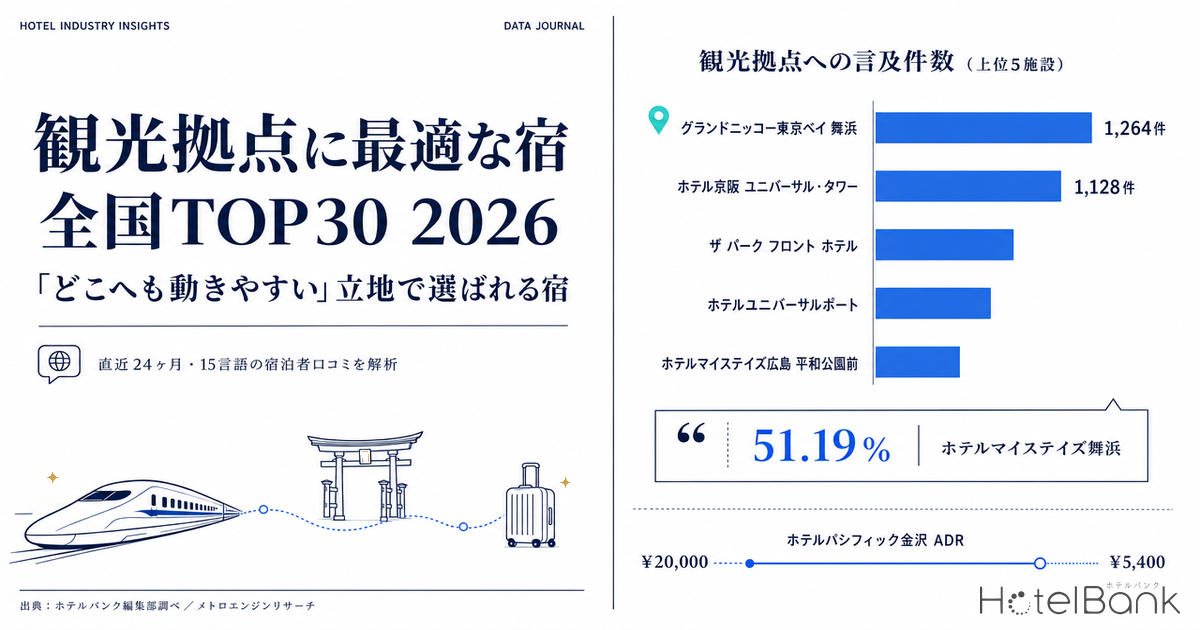
“Close to the station.” “Right by the food alley.” “Surrounded by nature.” There are many yardsticks for a good location. This article takes up one that is a little different from all of them: usability as a sightseeing base. Hotels that make it easy to reach multiple attractions by train or bus, and that leave guests on a day-trip-style itinerary — out in the morning, back at night — feeling “basing ourselves here was the right call.” We aggregated guest-review mentions pointing to exactly this value from across Japan and compiled them into a national Top 30.
Metric Definitions Used in This Article
- Sightseeing-base mentions: Positive mentions to the effect of “convenient as a sightseeing base” or “easy to move around from as a starting point for touring,” extracted by natural-language analysis of guest reviews. Coverage is the most recent 24 months across 15 languages.
- Mention count: The cumulative number of reviews in which such a mention was identified. Mention rate: That count as a share of the property’s total number of reviews.
- ADR (average daily rate): An estimated settled rate derived by applying a category-specific adjustment coefficient to each property’s lowest published plan level on OTAs (two guests per room, per room, tax included) — stated on a pre-tax-equivalent basis, based on June 2026 actuals. Cross-checked against property-level disclosures by listed hotel REITs (91 properties, most recent three months), the median error is approximately 7%. Figures shown in grey are listed prices (average of all plans, tax included), used for properties whose category places them outside the scope of ADR estimation.
- Data sources: Reviews = HotelBank Editorial Team research / ADR = MetroEngines Research
⚠ Mention rate is not a rating. This ranking shows how much sightseeing-base value was talked about in reviews (the volume and share of mentions); it is distinct from a property’s satisfaction score or quality rating. In addition, the languages analysed are the languages the reviews were written in, and do not indicate the nationality of the reviewer.
- — “Ideal as a sightseeing base” has two faces: the urban and theme-park type (Maihama, USJ, Huis Ten Bosch) and the touring type (Kyoto, Nara, Kanazawa, Matsumoto, Takayama). The former shows its strength in mention count, the latter in mention rate.
- — The national number one is Grand Nikko Tokyo Bay Maihama (グランドニッコー東京ベイ 舞浜), with 1,264 mentions. Among touring-type properties, several reach mention rates above 30%.
- — Touring bases skew toward the business-hotel category and lighter ADR bands, concentrated in the ¥8,000–¥18,000 range — a different price structure from urban flagships.
- — The aggregation covers guest reviews from the most recent 24 months across 15 languages. Note that mention rate reflects how often base value was talked about, not a satisfaction rating.
Methodology — How We Counted “Sightseeing-Base Mentions”
The basis is a single tag, drawn from a set of tags that semantically decompose guest reviews from a location standpoint, denoting “ideal as a sightseeing base / convenient as a starting point for touring.” Aggregating properties nationwide that met the population criteria — the most recent 24 months, at least 20 total reviews, and at least 50 relevant mentions (30 or more for parts of the national top-tier extraction) — produced more than 100 qualifying properties across Japan. This Top 30 ranks those properties in descending order of sightseeing-base mention count. We used count as the primary axis to avoid the small-sample distortion in which a handful of reviews sends the ratio alone soaring, and to make a nationwide comparison hold up on a reproducible population.
Location value expressed as “near the station,” “close to a food alley,” or “surrounded by nature” is captured by separate tags, and each produces a different set of leading properties. How proximity to a station is talked about in reviews, for example, is a distinct axis with its own leaderboard, while the view-from-the-room axis is examined in Hotels Where Room-View Ratings Are Rising: National TOP 30. Please note that this article narrows in on a single point: serving as a starting point for touring multiple destinations. Each property’s mention count (N) and mention rate are shown together in the tables.
National Top 30 — Hotels Named as Sightseeing Bases
First place goes to Grand Nikko Tokyo Bay Maihama (グランドニッコー東京ベイ 舞浜) in Chiba, with 707 rooms. Of its 6,164 total reviews, 1,264 touched on sightseeing-base value — an overwhelming mention count. Behind it come Hotel Keihan Universal Tower (ホテル京阪 ユニバーサル・タワー), The Park Front Hotel (ザ パーク フロント ホテル) and Hotel Universal Port (ホテルユニバーサルポート), all adjacent to Universal Studios Japan. The upper reaches are dominated by gateway properties serving large theme parks.
Source: HotelBank Editorial Team research (sightseeing-base mention counts, most recent 24 months)
| # | Property | Location | Category | Rooms | Mentions | Mention rate | ADR |
|---|---|---|---|---|---|---|---|
| 1 | Grand Nikko Tokyo Bay Maihama (グランドニッコー東京ベイ 舞浜) | Chiba | Resort | 707 | 1,264 | 20.51% | ¥20,000 |
| 2 | Hotel Keihan Universal Tower (ホテル京阪 ユニバーサル・タワー) | Osaka | City | 641 | 1,128 | 30.05% | ¥18,200 |
| 3 | The Park Front Hotel at Universal Studios Japan (ザ パーク フロント ホテル アット ユニバーサル・スタジオ・ジャパン) | Osaka | City | 598 | 1,066 | 34.07% | ¥20,000 |
| 4 | Hotel Universal Port (ホテルユニバーサルポート) | Osaka | City | 600 | 824 | 29.38% | ¥16,600 |
| 5 | Hotel MyStays Hiroshima Peace Park Front (ホテルマイステイズ広島 平和公園前) | Hiroshima | Business | 284 | 780 | 32.16% | ¥8,200 |
| 6 | Hotel Okura JR Huis Ten Bosch (ホテルオークラJRハウステンボス) | Nagasaki | Resort | 320 | 725 | 25.13% | ¥9,100 |
| 7 | Richmond Hotel Premier Asakusa (リッチモンドホテルプレミア浅草) | Tokyo | Business | 270 | 715 | 28.98% | ¥23,100 |
| 8 | Hotel Kintetsu Universal City (ホテル近鉄ユニバーサル・シティ) | Osaka | City | 456 | 710 | 33.4% | ¥17,800 |
| 9 | Hotel New Grand (ホテルニューグランド) | Kanagawa | City | 238 | 708 | 20.59% | ¥28,200 |
| 10 | Rihga Royal Hotel Hiroshima (リーガロイヤルホテル広島) | Hiroshima | City | 491 | 677 | 25.86% | ¥15,900 |
| 11 | The Singulari Hotel & Skyspa at Universal Studios Japan (ザ シンギュラリ ホテル & スカイスパ アット ユニバーサル・スタジオ・ジャパン) | Osaka | Business | 390 | 652 | 24.7% | ¥15,800 |
| 12 | Grand Prince Hotel Hiroshima (グランドプリンスホテル広島) | Hiroshima | City | 510 | 605 | 25.19% | ¥13,900 |
| 13 | Sheraton Grande Tokyo Bay Hotel (シェラトン・グランデ・トーキョーベイ・ホテル) | Chiba | Resort | 1016 | 590 | 18.51% | ¥24,500 |
| 14 | Hotel MyStays Maihama (ホテルマイステイズ舞浜) | Chiba | Business | 90 | 582 | 51.19% | ¥21,900 |
| 15 | Kobe Meriken Park Oriental Hotel (神戸メリケンパークオリエンタルホテル) | Hyogo | City | 323 | 561 | 12.99% | ¥23,400 |
| 16 | Oriental Hotel Tokyo Bay (オリエンタルホテル東京ベイ) | Chiba | Deluxe | 511 | 536 | 13.56% | ¥43,100 |
| 17 | Sakuraya (さくらや) | Hiroshima | Japanese-style inn | 22 | 517 | 35.1% | ¥17,600 |
| 18 | Tokyo Bay Maihama Hotel First Resort (東京ベイ舞浜ホテル ファーストリゾート) | Chiba | City | 696 | 498 | 21.12% | ¥23,000 |
| 19 | Kurashiki Ivy Square (倉敷アイビースクエア) | Okayama | City | 145 | 493 | 38.91% | ¥12,800 |
| 20 | Dai-ichi Takimotokan (第一滝本館) | Hokkaido | Ryokan | 395 | 467 | 19.89% | ¥17,100 |
| 21 | Rose Hotel Yokohama (ローズホテル横浜) | Kanagawa | City | 184 | 459 | 36.26% | ¥18,800 |
| 22 | APA Hotel & Resort Tokyo Bay Makuhari (アパホテル&リゾート〈東京ベイ幕張〉) | Chiba | City | 2007 | 458 | 9.47% | ¥10,800 |
| 23 | Hotel New Otani Osaka (ホテルニューオータニ大阪) | Osaka | Deluxe | 525 | 456 | 18.59% | ¥46,000 |
| 24 | Ark Hotel Kumamotojo Mae (アークホテル熊本城前) | Kumamoto | City | 222 | 448 | 31.22% | ¥6,700 |
| 25 | THE GATE HOTEL Kaminarimon by HULIC (THE GATE HOTEL 雷門 by HULIC) | Tokyo | Deluxe | 134 | 436 | 23.43% | ¥61,000 |
| 26 | Sotetsu Grand Fresa Osaka Namba (相鉄グランドフレッサ 大阪なんば) | Osaka | Business | 698 | 432 | 21.17% | ¥11,300 |
| 27 | APA Hotel Asakusa Tawaramachi Ekimae (アパホテル〈浅草 田原町駅前〉) | Tokyo | Business | 465 | 430 | 16.41% | ¥9,100 |
| 28 | Hakone Ashinoko Hanaori (箱根・芦ノ湖 はなをり) | Kanagawa | Resort | 154 | 428 | 21.44% | ¥27,200 |
| 29 | Hotel Emion Tokyo Bay (ホテルエミオン東京ベイ) | Chiba | City | 583 | 425 | 14.92% | ¥24,000 |
| 30 | Hotel Gracery Shinjuku (ホテルグレイスリー新宿) | Tokyo | Business | 970 | 419 | 7.41% | ¥27,600 |
Source: Reviews = HotelBank Editorial Team research / ADR = MetroEngines Research (June 2026 actuals, estimated settled ADR. Grey figures are listed prices.)
Mention Count and Mention Rate Are Different Things — Urban and Touring Types Invert
What deserves attention here is that a high count and a high share do not necessarily coincide. Hotels at large theme parks and in major cities have a large base of reviews to begin with, so mention counts pile up — but in mention-rate terms they settle at roughly 20–30%. Smaller touring-base properties, by contrast, may have modest mention counts while their mention rates soar, because a large share of their guests say the same thing: it was easy to get around for sightseeing.
Within the Top 30, the smaller and mid-sized properties show the highest shares: the 90-room Hotel MyStays Maihama at a 51.2% mention rate, the 22-room Sakuraya (さくらや, Miyajima in Hiroshima) at 35.1%, and Kurashiki Ivy Square (Okayama, 145 rooms) at 38.9%. The scatter plot below places mention rate on the horizontal axis and mention count on the vertical axis, with circle size representing the number of rooms. It is in the lower-right zone — “few mentions but a high mention rate” — that touring-type properties cluster.
Source: HotelBank Editorial Team research (circle size = number of rooms)
Distribution Map — The National Top 30 Skews Urban and Theme-Park
Plot the Top 30 on a map and the skew is obvious at a glance. Chiba (Maihama, Makuhari) and Osaka (USJ, Namba) have seven properties each; Tokyo and Hiroshima have four each. The list concentrates in the visitor-drawing hubs of the Greater Tokyo and Kansai regions and in sightseeing cities such as Hiroshima, Nagasaki (Huis Ten Bosch) and Kumamoto. By category, city hotels account for 14 properties — close to half. It becomes clear that the phrase “sightseeing base” is in fact most often used to mean proximity to a large visitor attraction.
Source: HotelBank Editorial Team research
Source: HotelBank Editorial Team research (prefecture distribution of the Top 30)
The Strength of Touring Areas — Kyoto, Nara, Kanazawa, Matsumoto, Takayama
So how do Kyoto, Nara, Kanazawa, Matsumoto and Takayama — the very archetypes of touring travel — perform? Properties in these cities sit around 50th to 90th nationally in mention count, but slice by area and look at mention rate and the base value specific to each place comes sharply into focus.
Jizokan Matsuya Ryokan (地蔵館 松屋旅館) in Nagano, in front of Zenkoji temple, stands out in particular with a 50.9% mention rate — the highest share of guests describing it as a touring base. Obana (尾花) in Naramachi follows at 47.1%, Hotel Pacific Kanazawa (ホテルパシフィック金沢) in front of Kanazawa Station at 37.2%, Nara Prefecture Sarusawa Inn (奈良県猿沢イン) at 35.1%, and Magome Chaya (馬籠茶屋) in the Nakasendo post town of Magome at 30.4%. At all of them, base value for touring — “just right as a starting point for exploring the streets,” “convenient for getting around to different places” — is repeatedly described as the central value of the stay.
Source: HotelBank Editorial Team research (sightseeing-base mention rates for leading properties in each area, 50 or more mentions)
| Area | Property | Category | Mentions | Mention rate | ADR |
|---|---|---|---|---|---|
| Kyoto | Hotel The Celestine Kyoto Gion (ホテル ザ セレスティン京都祇園) | Upscale city | 290 | 26.5% | ¥41,300 |
| Kyo-machiya Ryokan Sakura Urushi-tei (京町家旅館さくら うるし邸) | Machiya ryokan | 313 | 18.2% | ¥19,900 | |
| Miyako City Kintetsu Kyoto Station (都シティ 近鉄京都駅) | City | 314 | 8.7% | ¥14,500 | |
| Nara | Obana (尾花) | Ryokan | 180 | 47.1% | ¥8,100 |
| Nara Prefecture Sarusawa Inn (奈良県猿沢イン) | Japanese-style inn | 253 | 35.1% | — | |
| Nara Hotel (奈良ホテル) | Classic | 149 | 21.0% | ¥106,200 | |
| Onyado Nono Nara (御宿 野乃 奈良) | Japanese-style hotel | 232 | 12.4% | ¥9,300 | |
| Kanazawa | Hotel Pacific Kanazawa (ホテルパシフィック金沢) | Business | 326 | 37.2% | ¥5,400 |
| Hotel Resol Trinity Kanazawa (ホテルリソルトリニティ金沢) | Business | 269 | 28.7% | — | |
| Ann-an Kanazawa (雨庵 金沢) | Japanese-style hotel | 162 | 22.7% | ¥18,000 | |
| Matsumoto / Nagano | Jizokan Matsuya Ryokan (地蔵館 松屋旅館) | Ryokan (Zenkoji gate) | 295 | 50.9% | ¥11,900 |
| Matsumoto Hotel Kagetsu (松本ホテル花月) | Classic | 228 | 27.2% | ¥18,900 | |
| Richmond Hotel Matsumoto (リッチモンドホテル松本) | Business | 208 | 20.6% | — | |
| Takayama / Magome | Magome Chaya (馬籠茶屋) | Ryokan (Magome-juku) | 299 | 30.4% | ¥19,200 |
| Spa Hotel Alpina Hida Takayama (スパホテルアルピナ飛騨高山) | Business | 195 | 19.6% | ¥9,300 | |
| Gero Onsen Suimeikan (下呂温泉 水明館) | Onsen ryokan | 289 | 10.4% | — | |
| Takayama Green Hotel (高山グリーンホテル) | City | 166 | 10.2% | ¥22,000 |
Source: Reviews = HotelBank Editorial Team research / ADR = MetroEngines Research (June 2026 actuals. Grey figures are listed prices.)
Prevailing ADR Bands and Categories — Touring Bases Cluster in the Lighter Price Range
The difference between urban and touring types also shows up in prevailing price bands. Among the national Top 30, estimated settled ADR (June 2026) runs around ¥20,000–¥28,000 for the leading theme-park-adjacent and central-city properties, and some deluxe-category properties reach ¥43,000–¥61,000 on a listed-price basis. Base properties in touring areas, by contrast, are concentrated in a lighter ¥5,000–¥18,000 range: roughly ¥5,400 at Hotel Pacific Kanazawa, ¥9,300 at Onyado Nono Nara, ¥9,300 at Spa Hotel Alpina Hida Takayama and ¥11,900 at Jizokan Matsuya Ryokan.
This is consistent with the nature of touring travel. The property is, above all, a base, and much of the day is spent out in the town. That is precisely why such properties are chosen on access and value for money rather than luxury, and why that satisfaction translates into mentions of being “easy to move around from and convenient.” Classic hotels such as Nara Hotel (roughly ¥106,000 on a listed-price basis) also get named as bases, but this is an exceptional position in which the stay itself becomes the destination.
Conclusion — “Base Value” Has Two Faces
What this aggregation reveals is that the assessment “ideal as a sightseeing base” appears in two distinct forms. One is the urban and theme-park type, talked about in volume as proximity to a huge visitor attraction — Maihama, USJ, Huis Ten Bosch. The other is the touring type — Kyoto, Nara, Kanazawa, Matsumoto, Takayama — endorsed by a high share of guests as a starting point for exploring a whole town on foot. The former shows its strength in mention count, the latter in mention rate.
For travellers searching for somewhere to stay, reading “a high count = name recognition and scale” and “a high mention rate = satisfaction as a base for touring that particular place” should bring you closer to the property that fits your purpose. And keep in mind that mention rate is only a frequency of being talked about, not an overall rating of the property — reading through to the travel context behind the numbers is what makes an ordinary value like location look far more three-dimensional.
Related Reading
- Hotels Where Room-View Ratings Are Rising: National TOP 30 (Summer 2026 Fireworks)
- Parking-Review Ranking Across Car-Dependent Japan + EV Charging Edge
References and Sources
■ Data sources
Sightseeing-base mentions = HotelBank Editorial Team research (natural-language analysis of guest reviews, most recent 24 months, 15 languages). Estimated ADR = data compiled by MetroEngines Research & Consulting.
■ Estimation assumptions
ADR is an estimated settled rate derived by applying a category-specific adjustment coefficient to the lowest published plan level on OTAs (two guests per room, per room, tax included), stated on a pre-tax-equivalent basis and based on June 2026 actuals. Cross-checked against property-level disclosures by listed hotel REITs (91 properties, most recent three months), the median error is approximately 7%.
■ Limitations and caveats
Mention rate is the frequency with which base value was talked about in reviews, not a satisfaction or quality rating of the property. The languages analysed are the languages the reviews were written in and do not indicate reviewer nationality. Figures shown in grey are listed prices (average of all plans, tax included) for properties whose category places them outside the scope of ADR estimation.
- HotelBank Editorial Team research — natural-language analysis of guest reviews (sightseeing-base mentions, most recent 24 months, 15 languages, a national population of more than 100 properties)
- MetroEngines Research — estimated settled ADR and listed prices (June 2026 actuals, two guests per room, tax-included basis)
- Japan Tourism Agency (as general background on travel trends and accommodation statistics)
- Japan National Tourism Organization (JNTO)