

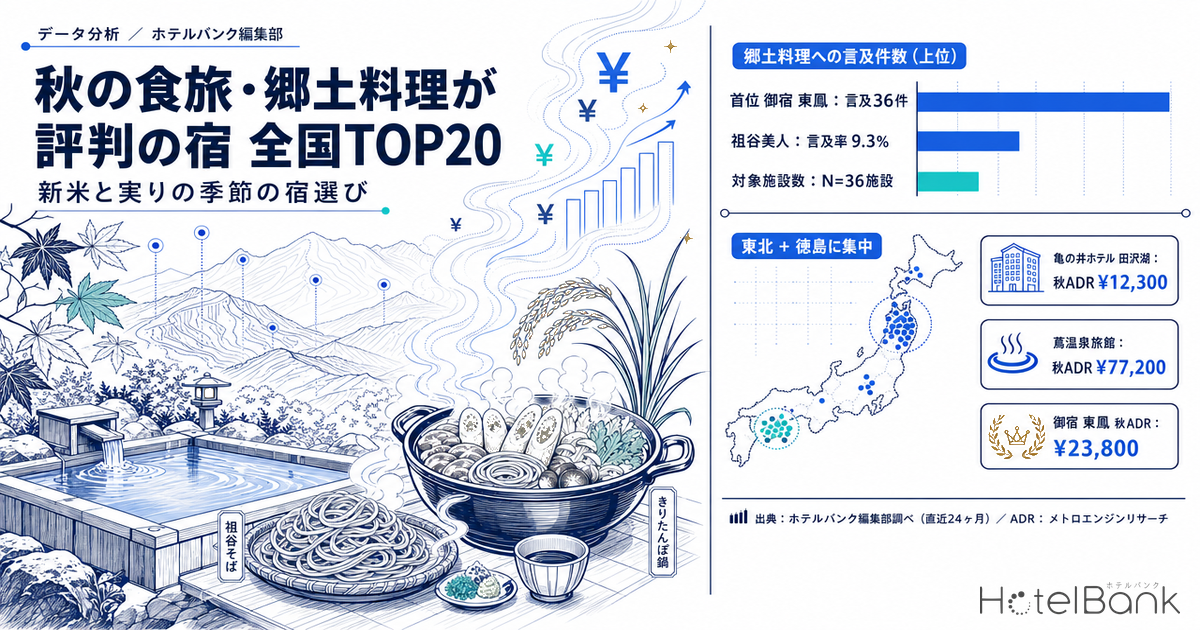
Autumn is Japan’s season of appetite. New-crop rice comes in, mushrooms, taro and river fish hit their peak, and a growing number of travelers now set the purpose of the trip itself on “a dish you can only eat in that place.” Branded wagyu, crab and premium seafood remain the classic draws, but what actually stays with guests after a ryokan dinner is often something else entirely: the regional cuisine and local specialties rooted in that particular area. This article extracts mentions of “regional cuisine at dinner” from guest reviews and reads which inns across Japan are winning the strongest praise.
Metric Definitions Used in This Article
- Regional-cuisine mentions: Guest reviews were analyzed with natural language processing to count posts referring to regional cuisine or local specialties at dinner (local free-range chicken, regional hot pots, local soba and the like). Mention rate = the share of that property’s total reviews accounted for by such mentions. It expresses “how often the topic comes up,” not a rating score in itself. Coverage: guest reviews from the most recent 24 months. Source: HotelBank Editorial Team research.
- ADR (average daily rate): An estimated settled rate (tax-exclusive equivalent) calculated by applying category-specific adjustment coefficients to each property’s lowest published plan level on OTAs (2 guests per room, per-room price, tax-inclusive basis). Cross-checked against property-level results disclosed by listed hotel REITs (91 properties, most recent 3 months), the median error is approximately 7%. These are estimates and differ from actual transacted prices. This article cites October 2025 levels (the autumn food season) as supplementary reference. Source: MetroEngines Research.
- — 36 properties nationwide drew a meaningful volume of mentions for regional cuisine at dinner, with negative mentions close to zero. Appreciation of regional food translates directly into overall satisfaction (guest reviews, most recent 24 months).
- — Tokushima (Iya and Naruto) with 7 properties and Fukushima (Aizu) with 6 form the leading pair. Praise concentrates in the mountain valleys and coastal hot-spring towns of Tohoku and Shikoku.
- — Autumn ADR spans a wide ¥12,300 to ¥77,200, and appreciation of regional food does not track room rate. It can serve as a differentiation axis for small and mid-sized inns that cannot compete on brand-name ingredients.
Regional Cuisine Is a Separate Axis from the Classic Gourmet Draws
When guests talk about a ryokan dinner, the attention has historically gone to ingredient brands and categories — wagyu kaiseki, crab, sashimi, local sake. In recent years, though, a distinct axis that does not overlap with any of those has come into view: regional cuisine and local specialties. Kozuyu in Aizu, kiritanpo in Akita, imoni in Yamagata, sobagome zosui in Iya — inns that put the local food culture itself on the table are moving the needle on trip satisfaction in a big way. Wagyu and branded beef remain a legitimate axis of their own, but it is a different one, anchored to specific cattle-producing regions rather than to a local culinary tradition.
From guest reviews compiled by the HotelBank Editorial Team (most recent 24 months), extracting posts that touched on regional cuisine at dinner yielded 36 properties nationwide that drew a meaningful volume of mentions. In every case negative mentions were close to zero, revealing a structure in which appreciation of regional cuisine feeds straight into overall satisfaction. Where this regional-cuisine axis still leaves white space across Japan is a separate question — one visible only from the demand side, and not addressed here. What follows introduces the leading inns in descending order of mention volume.
Japan’s Top 20 Inns Praised for Regional Cuisine
First, an overview of the upper ranks by mention volume. Onyado Toho in Aizu Higashiyama Onsen (Fukushima) takes the top spot with 36 mentions of regional cuisine. The distinguishing pattern is how praise clusters in mountain-valley and coastal hot-spring towns such as Lake Tazawa, Iya and Naruto.
Source: HotelBank Editorial Team research (count of regional-cuisine mentions in guest reviews, most recent 24 months / top 12 of N=36 properties)
| Rank | Property | Area | Signature regional dishes | Mention rate | Total reviews | Autumn ADR |
|---|---|---|---|---|---|---|
| 1 | Onyado Toho, Aizu Higashiyama Onsen (会津・東山温泉 御宿 東鳳) | Fukushima | Kozuyu, basashi (horse sashimi) | 2.4% | 1,508 | ¥23,800 |
| 2 | Kamenoi Hotel Tazawako (亀の井ホテル 田沢湖) | Akita | Kiritanpo hot pot | 3.9% | 686 | ¥12,300 |
| 3 | Kutsurogi-Jyuku Shintaki (くつろぎ宿 新滝) | Fukushima | Aizu regional cuisine | 4.2% | 501 | ¥20,400 |
| 4 | Iwakuni Kokusai Kanko Hotel (岩国国際観光ホテル) | Yamaguchi | Iwakuni-zushi, fugu (blowfish) | 4.5% | 376 | ¥17,500 |
| 5 | Yamanoha, Kurobe Unazuki Onsen (黒部・宇奈月温泉 やまのは) | Toyama | Masu-no-sushi (trout sushi), buri (yellowtail) | 1.2% | 1,250 | ¥38,400 |
| 6 | Wa-no-Yado Hotel Iya Onsen (和の宿 ホテル祖谷温泉) | Tokushima | Iya soba, dekomawashi | 3.4% | 410 | ¥35,000 |
| 7 | Taimaru Kaigetsu (鳴門海月別亭 鯛丸海月) | Tokushima | Naruto sea bream | 2.2% | 644 | ¥16,600 |
| 8 | Marumine, Aizu Ashinomaki Onsen (丸峰) | Fukushima | Aizu regional cuisine | 1.0% | 1,404 | — |
| 9 | Iya Bijin (祖谷美人) | Tokushima | Iya soba, dekomawashi | 9.3% | 140 | ¥28,400 |
| 10 | Naruto Grand Hotel Kaigetsu (鳴門グランドホテル海月) | Tokushima | Naruto sea bream | 1.4% | 930 | — |
| 11 | Lucent Takamiya, Zao (ルーセントタカミヤ) | Yamagata | Imoni, Yonezawa beef | 2.3% | 512 | ¥15,100 |
| 12 | Shosuke-no-Yado Takinoyu (庄助の宿 瀧の湯) | Fukushima | Aizu regional cuisine | 1.6% | 695 | ¥15,400 |
| 13 | Obokekyo Mannaka (大歩危峡まんなか) | Tokushima | Sobagome zosui, Iya soba | 3.7% | 296 | — |
| 14 | Kutsurogi-Jyuku Chiyotaki (くつろぎ宿 千代滝) | Fukushima | Aizu regional cuisine | 3.3% | 332 | ¥19,500 |
| 15 | Nihon-no-Yado Koyo, Kaminoyama Onsen (日本の宿 古窯) | Yamagata | Imoni, tama konnyaku | 0.9% | 1,166 | ¥27,800 |
| 16 | Tsuta Onsen Ryokan (蔦温泉旅館) | Aomori | Kaiyaki miso, senbei-jiru | 3.8% | 287 | ¥77,200 |
| 17 | Kamenoi Hotel Akita Yuze (亀の井ホテル 秋田湯瀬) | Akita | Kiritanpo hot pot | 4.0% | 273 | — |
| 18 | Bay Resort Hotel Naruto Kaigetsu (ベイリゾートホテル鳴門海月) | Tokushima | Naruto sea bream, local seafood | 1.4% | 721 | — |
| 19 | Yuze Hotel (湯瀬ホテル) | Akita | Kiritanpo hot pot | 2.3% | 437 | — |
| 20 | Hotel Shion, Tsunagi Onsen (ホテル紫苑) | Iwate | Nanbu senbei-jiru, hittsumi | 1.5% | 676 | ¥22,800 |
Source: HotelBank Editorial Team research (guest reviews, most recent 24 months / top 20 of N=36 properties) / ADR from MetroEngines Research (October 2025, estimated settled ADR; “—” indicates no reference value)
Looking at mention rate, Iya Bijin stands out at 9.3% despite a modest 140 total reviews. Regional cuisine accounts for an unusually high share of everything guests write about, suggesting that “Iya soba” and “dekomawashi” are etched deeply into visitors’ memories. At the other end, large properties with more than 1,000 reviews — Onyado Toho and Koyo among them — still hold a solid mention rate, indicating that the appeal of regional food is reaching a broad cross-section of guests.
Praise Concentrates in Tohoku and Iya
Broken out by prefecture, the 36 properties cluster sharply in the six Tohoku prefectures and in the Iya and Naruto areas of Tokushima in Shikoku. Tokushima (Iya and Naruto) with 7 properties and Fukushima (Aizu) with 6 form the leading pair. Both are hot-spring districts well away from the major cities, in mountain valleys and along the coast, and both are home to many inns that have kept local ingredients and food traditions alive.
Source: HotelBank Editorial Team research (prefectural distribution of properties ranking highly for regional-cuisine mentions, N=36 properties)
Autumn is also the season when this kind of regional food shines brightest. Akita’s kiritanpo, Yamagata’s imoni, Aizu’s kozuyu — these regional hot pots are all “harvest-season dishes” built on new-crop rice and seasonal root vegetables and mushrooms. From trips in search of summer coolness to trips that warm you with hot springs and a simmering pot: the motive behind choosing an inn switches over precisely in the season of appetite.
Signature Autumn Regional Dishes by Prefecture
Organized around the prefectures where the ranked inns are located, here are the signature regional dishes worth targeting on an autumn food trip — from the standards frequently served at ryokan dinners to the one plate unique to each place.
| Prefecture | Signature regional dishes | What to target in autumn |
|---|---|---|
| Fukushima (Aizu) | Kozuyu, basashi, wappa-meshi | Aizu autumn menus cooked with new-crop rice and mountain produce |
| Akita | Kiritanpo hot pot, Inaniwa udon, Hinai-jidori chicken | The season when kiritanpo made with new-crop rice tastes best |
| Yamagata | Imoni, Yonezawa beef, tama konnyaku | “Imoni-kai” season, as taro comes into its peak |
| Aomori | Kaiyaki miso, senbei-jiru, ichigo-ni | Autumn in Oirase, when mushrooms and seafood arrive together |
| Iwate | Nanbu senbei-jiru, hittsumi, wanko soba | The moment warm, root-vegetable-rich soups start to appeal |
| Tokushima (Iya) | Iya soba, dekomawashi, sobagome zosui | Valley autumn, with new-harvest soba and mountain-village bounty |
| Toyama | Masu-no-sushi, buri, shiro-ebi (white shrimp) | Late autumn, as the first winter yellowtail begins to run |
| Yamaguchi | Iwakuni-zushi, fugu, kawara soba | Peak food season, as the fugu fishery opens |
| Gifu (Hida) | Hoba miso, Hida beef, gohei-mochi | Autumn on the Hida road, scented with mushrooms and hoba miso |
| Kochi | Katsuo no tataki (seared bonito), sawachi ryori | Peak season for fat-rich returning bonito |
Source: Compiled by the HotelBank Editorial Team
A Wide Price Band: Regional Food Does Not Depend on a High Room Rate
As a supplementary read, estimated settled ADR for October 2025 (the autumn food season) across the ranked inns spreads widely — from Kamenoi Hotel Tazawako in the ¥12,000s to Tsuta Onsen Ryokan, known as a historic standalone inn, in the ¥77,000s. What deserves attention is that high praise for regional cuisine does not necessarily track a high room rate. Inns around the ¥15,000 mark — Kamenoi Hotel Tazawako, Lucent Takamiya in Zao, Shosuke-no-Yado Takinoyu — draw thick support for kiritanpo, imoni and Aizu regional cuisine all the same.
In other words, regional food functions as a differentiation axis distinct from the high-rate strategy of lining up luxury ingredients. The very posture of serving the local food culture with care is what stays in guests’ memories and converts into repeat stays and word of mouth. For small and mid-sized inns that struggle to compete on brand-name ingredients, this is a dependable lever for lifting autumn demand. For a related structure in which guests choose an inn for the people rather than the ingredients, see When the Chef Becomes the Brand: 50 Inns Where People, Not Menus, Drive Demand.
About the data in this article: Mention rates and mention counts are aggregates derived from natural language processing of guest reviews; they do not directly indicate the taste of the food or a rating score. Menus shown vary by season and by plan. ADR figures are estimates derived by applying adjustments to published prices at the time of the survey, and differ from actual transacted prices and accounting figures.
Conclusion
An autumn food trip does not have to star the classics of branded wagyu or crab. Kozuyu in Aizu, kiritanpo in Akita, imoni in Yamagata, sobagome zosui in Iya — in the season of new rice and harvest, tasting a region’s food culture at a ryokan dinner delivers a satisfaction that transcends price. As the ranking and the mention rates show, appreciation for regional cuisine runs thickest in Tohoku and the mountain villages of Tokushima in Shikoku, and in both the inns winning support are those that make the most of seasonal root vegetables, mushrooms and river fish. This autumn, why not pick the destination by working backward from the one dish you want to eat?
Related Reading
References and Sources
- HotelBank Editorial Team research — analysis of regional-cuisine mentions in guest reviews via natural language processing (most recent 24 months, top 36 properties)
- MetroEngines Research — estimated settled ADR (October 2025, by property)
- Ministry of Agriculture, Forestry and Fisheries, “Our Regional Cuisines: Cherished Flavors to Pass On to the Next Generation”
- Japan Tourism Agency
■ Data sources
Guest reviews were analyzed with natural language processing to extract and count posts referring to regional cuisine or local specialties at dinner (most recent 24 months; the 36 properties that drew a meaningful volume of mentions are covered). ADR is an estimated settled rate derived by applying category-specific adjustment coefficients to each property’s lowest published plan level on OTAs (October 2025, the autumn food season).
■ Calculation assumptions
Mention rate = number of reviews containing a relevant mention ÷ total reviews for that property. The ranking is ordered by descending mention count. ADR is converted to a tax-exclusive equivalent from a base of the per-room price for 2 guests per room (tax-inclusive). The signature regional dishes by prefecture were compiled by the editorial team around the prefectures where the ranked inns are located.
■ Limitations and caveats
Mention rate is a measure of “how often the topic comes up,” not of the taste of the food or a rating score in itself. The fewer total reviews a property has, the more volatile its mention rate (for example, Iya Bijin has 140 total reviews). ADR is an estimate and differs from actual transacted prices (cross-checked against property-level disclosures by listed hotel REITs: 91 properties, most recent 3 months, median error approximately 7%). Menus served vary by season and by plan.