

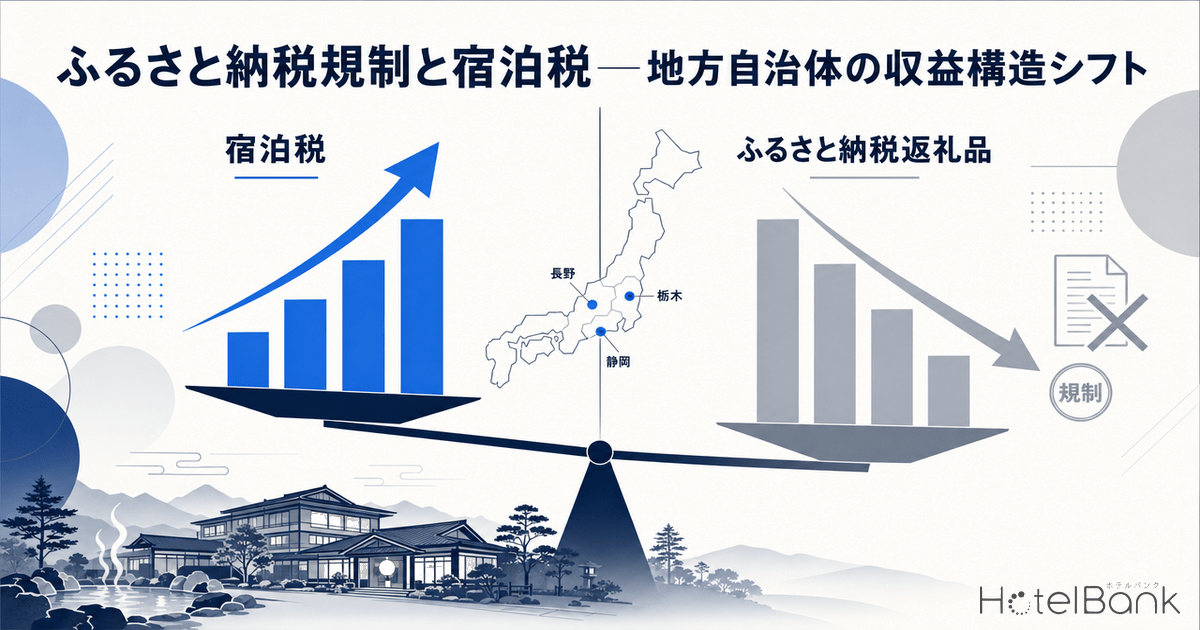
Two regulatory shifts are restructuring the lodging-related revenue base of Japan’s local governments. On one side, lodging tax rates are being expanded and raised in major cities including Kyoto and Tokyo through April 2026, lifting direct municipal revenue. On the other side, the October 2024 furusato nozei (hometown tax donation) reforms and the stricter local-product standards scheduled for October 2026 are squeezing the regional supply of accommodation-voucher-style donor gifts. This article contrasts these two opposing forces — rising direct revenue from lodging taxes versus shrinking voucher-driven indirect revenue — and uses public price data tracked by MetroEngines Research (メトロエンジンリサーチ) to examine ADR trends in regions with high voucher-gift exposure such as Nagano, Tochigi, Shizuoka, and Oita.
Metric Definitions Used in This Article
- ADR (Average Daily Rate): Average of publicly listed selling prices on OTAs and similar channels. This differs from actually transacted rates (cross-checked against REIT disclosures, public-price ADR tends to run roughly 25-30% above transacted ADR, because higher-priced unsold plans linger on OTAs and pull the public-price average upward). Per-room rate (tax included) for two adults in one room, averaged across all plan types from room-only through meal-inclusive.
- Property count by prefecture: Active properties tracked by MetroEngines Research. Ryokan, minshuku, and simple lodgings not listed on OTAs are excluded.
- Data sources: MetroEngines Research, Japan Tourism Agency, Ministry of Internal Affairs and Communications, Teikoku Databank, monthly REIT operational data.
Two Regulatory Shifts Reverse the Regional Revenue Mix
Local government lodging-related revenue has long been supported by accommodation-voucher gifts within the furusato nozei (hometown tax donation) program. Under that scheme, donations channel indirect demand to regional accommodation properties, and the local government keeps the donation amount net of expenses. However, the Ministry of Internal Affairs and Communications (MIC) has rolled out staged regulatory tightening from October 2024, forcing a rethink of regional dependence on the voucher model.
At the same time, lodging taxes are moving in the opposite direction. Kyoto City raised its top lodging tax bracket to ¥10,000 from March 2026, and Tokyo also has revisions planned from April 2026 onward. Direct municipal revenue is rising via the lodging tax while indirect revenue from donor gifts is shrinking under furusato nozei restrictions — these countervailing forces are starting to reshape both regional public finances and the management environment for regional ryokan operators.
| Effective Date | Reform Content | Direction of Impact |
|---|---|---|
| October 2024 | Furusato nozei: ban on accommodation vouchers exceeding ¥50,000 per person per night; ban on national-chain and shared-brand vouchers; tighter solicitation standards | Regional voucher revenue ↓ |
| March 2025 | Kyoto City: top lodging tax bracket raised to ¥10,000 (5-tier structure) | Direct municipal revenue ↑ |
| October 2025 | Furusato nozei: full ban on platform-specific bonus points on intermediary sites | Total donations and voucher use ↓ |
| April 2026 | Lodging tax introductions and rate hikes underway in multiple municipalities | Direct municipal revenue ↑ |
| October 2026 (planned) | Furusato nozei: stricter local-product standards (majority value-add within jurisdiction, country-of-origin certification, public disclosure of contractors paid more than ¥1 million) | Regional gift program redesign ↓ |
Source: Compiled by HotelBank Editorial Team from MIC and individual municipal disclosures.
Prefectures Most Exposed to Voucher-Type Furusato Nozei Gifts
The intensity of the regulatory impact varies sharply by the lodging composition of each prefecture. The backbone of furusato nozei accommodation vouchers consists of independent ryokan and resort hotels. Conversely, the business and city hotels concentrated in major metropolitan areas — typically national chains — were largely excluded from voucher programs in the first place. As a result, the regulatory hit concentrates structurally on regions with a high density of ryokan and resort hotels.
Tabulating the ryokan and resort-hotel mix among active properties tracked by MetroEngines Research by prefecture, the highest concentrations sit in Nagano (608 ryokan, 115 resort hotels), Shizuoka (524 ryokan, 106 resort hotels), Hokkaido, Oita, Gunma, and Hyogo. These regions are also the major suppliers of furusato nozei accommodation vouchers and are therefore the areas most exposed to the regulatory reforms.
Source: Compiled by HotelBank Editorial Team from MetroEngines Research.
In Nagano, of 1,891 tracked properties, 608 (32.2%) are ryokan and 115 (6.1%) are resort hotels — the two categories together account for 38.3% of the prefecture’s stock. That share is roughly nine times that of Osaka (55 ryokan and 4 resort hotels, combined 4.4%), making the gap in the ryokan and resort weighting of the regional economy unmistakable. Tochigi (210 ryokan, 26 resort hotels) and Oita (330 ryokan, 31 resort hotels) also have high ryokan concentrations, with voucher gift supply likewise clustered there.
ADR After the October 2024 Reform: Regional Markets Are Holding Up
So how have regional ADRs moved since the October 2024 rules took effect? Tracking MetroEngines Research monthly data from January 2024 through June 2026, ADR in Nagano, Tochigi, Shizuoka, and Oita has continued on a gradual upward trajectory year over year.
Source: Compiled by HotelBank Editorial Team from MetroEngines Research.
Nagano’s annual average ADR rose from ¥28,700 in 2024 to ¥30,400 in 2025, up 5.9% year over year. Shizuoka climbed from ¥30,900 to ¥33,900 (+9.6%), Oita from ¥28,100 to ¥29,100 (+3.7%), and Tochigi from ¥27,200 to ¥27,700 (+1.6%). For comparison, in metropolitan and tourism hub markets less affected by furusato nozei vouchers, ADR rose +8.3% in Tokyo, +5.8% in Kyoto, +8.1% in Osaka, +9.9% in Okinawa, and +6.9% in Fukuoka — all in positive territory year over year.
| Prefecture | 2024 Avg. ADR | 2025 Avg. ADR | YoY | Tracked Properties |
|---|---|---|---|---|
| Regions with high furusato nozei voucher exposure | ||||
| Nagano | ¥28,700 | ¥30,400 | +5.9% | 1,672 |
| Shizuoka | ¥30,900 | ¥33,900 | +9.6% | 1,592 |
| Oita | ¥28,100 | ¥29,100 | +3.7% | 684 |
| Tochigi | ¥27,200 | ¥27,700 | +1.6% | 671 |
| Gunma | ¥28,100 | ¥28,800 | +2.3% | 664 |
| Yamanashi | ¥31,100 | ¥32,000 | +2.9% | 822 |
| Gifu | ¥26,100 | ¥27,800 | +6.5% | 585 |
| Major cities and tourism hubs (reference) | ||||
| Tokyo | ¥30,400 | ¥32,900 | +8.3% | — |
| Kyoto | ¥36,500 | ¥38,700 | +5.8% | — |
| Okinawa | ¥24,200 | ¥26,600 | +9.9% | — |
N=15 prefectures, 30 months of monthly data. Source: Compiled by HotelBank Editorial Team from MetroEngines Research.
The data confirms that “regional ADR has not declined post-reform.” That said, regional growth rates lag those of metropolitan and tourism hubs such as Tokyo, Osaka, and Okinawa. Tochigi (+1.6%), Gunma (+2.3%), Yamanashi (+2.9%), and Oita (+3.7%) all sit below the national average. The ADR level is being held up by the geographic dispersion of inbound demand and by upmarket resort properties pulling rates higher, but the contraction in furusato nozei vouchers may already be showing up as a “growth-rate gap” weighing on lagging regions.
No Sharp Drop Right After the Reform: Pre/Post Monthly Comparison
To gauge the direct impact of the October 2024 reform, we look at ADR shifts between September 2024 (before) and November 2024 (after).
Source: Compiled by HotelBank Editorial Team from MetroEngines Research.
The categories that fall under the furusato nozei restrictions — national-chain ryokan and high-priced vouchers exceeding ¥50,000 per night — represented only a limited share of regional ADR averages to begin with. At independent resort hotels and ryokan that anchor the gift-supply base, vouchers are typically priced under ¥50,000 and fall outside the direct scope of the rules. As a result, the structure does not produce sharp swings at the average ADR level.
That said, some prefectures did show declines, including Nagano (-0.7%) and Shizuoka (-5.0%). Right after the reform, last-minute donor demand may have concentrated through September, with a temporary dip in voucher utilization from October. In addition, the impact of listings withdrawn for compliance reasons may have spilled over into OTA price setting in November 2024.
REIT Resort Assets Still Run Hot: Underlying Demand Stays Solid
One reason regional ADR has held up post-reform is the underlying strength of tourism demand itself. According to the February 2026 monthly operational data of Hoshino Resorts REIT (星野リゾート・リート投資法人, ticker 3287), portfolio-wide occupancy was 76.5%, ADR was ¥20,800, and RevPAR was ¥15,900 — registering ADR +8.6%, RevPAR +10.5%, and occupancy +1.9 percentage points year over year.
Among that REIT’s properties, those located in regions with high furusato nozei voucher exposure all show strong performance: Hoshinoya Karuizawa (星のや軽井沢, Nagano) at 86.7% occupancy and ¥76,700 ADR, KAI Hakone (界 箱根, Kanagawa) at 96.3% / ¥63,000, Risonare Atami (リゾナーレ熱海, Shizuoka) at 75.4% / ¥73,600, and KAI Beppu (界 別府, Oita) at 94.2% / ¥49,100. Real demand at regional resorts remains strong, and the regulatory impact is limited to the contraction of the furusato nozei voucher channel as one sales route — rather than to underlying demand itself.
Source: Compiled by HotelBank Editorial Team from Hoshino Resorts REIT February 2026 monthly operational data.
Connecting to Long-Established Ryokan Bankruptcies
That said, the management environment for regional ryokan is far from comfortable. Teikoku Databank reported 89 lodging-industry bankruptcies in calendar 2025, up 14.1% from 78 in 2024, marking a second straight year of increase. Including 178 voluntary closures and dissolutions, a total of 267 lodging operators exited the market over the year. Many of the bankruptcies are long-established regional ryokan struggling with aged facilities and difficulty financing renovation costs, including symbolic closures such as Kisenkaku (喜泉閣) in Toyama Prefecture, a property with nearly a century of history.
On a fiscal-year basis from April 2024 through March 2026, hotel and ryokan bankruptcies totaled 80 cases with combined liabilities of ¥34.546 billion — up 2.6% in case count and a sharp 65.4% in liabilities year over year. This wave of bankruptcies and voluntary closures, layered on top of channel contraction from the furusato nozei reforms, is a compounding pressure on independent small and mid-sized ryokan. Properties that had relied on donation income to fund renovation capex face the risk that shrinking voucher gifts will translate directly into delays in their facility-renewal cycles.
For related analysis, see our article on the Succession Crisis at Long-Established Ryokan.
The Next Battleground: October 2026 Tightening of Local-Product Standards
The October 2026 tightening of local-product standards does not directly target accommodation vouchers. Yet for the composite gift packages that lodging properties have offered alongside vouchers — bundled “stay plans with local cuisine” or “local-product-and-stay experiences” — operators will need to certify that the within-jurisdiction value-add of raw materials accounts for the majority, and to publicly disclose country-of-origin certifications. This raises the design cost of donor gifts, and the compliance burden for small-scale ryokan will be far from negligible.
Adding to that, as part of the push for transparency in donor-solicitation costs, municipalities will be required to publicly disclose the names and amounts of intermediaries and contractors paid more than ¥1 million (the first disclosure is scheduled for September 2026). For donor gifts routed via intermediary platforms, more transparency around platform fees is likely to trigger a renegotiation of the profit split among municipalities, lodging properties, and intermediaries.
On the lodging tax side, several municipalities beyond Kyoto and Tokyo are studying introductions or rate hikes from April 2026 onward. Mt. Fuji has surfaced as a case where a ¥4,000 climbing fee and a lodging tax may stack into a double-tax structure — a relationship between municipal revenue and tourism demand we explore further in Mt. Fuji 2026 Opening x Summer Peak Booking Pace. For ADR trends after Kyoto City’s lodging tax reform, see Kyoto’s New Lodging Tax: One Month In, Kyoto ADR +18.6% YoY and Examining the Impact of Kyoto City’s Lodging Tax Reform.
Summary: The Regions Have Entered a Channel-Transition Phase
The findings of this article distill into three points. First, the furusato nozei voucher restrictions (the ¥50,000-per-night ceiling, the ban on national chains, the ban on shared brands) took effect in stages from October 2024, but no immediate sharp drop in regional ADR has been observed — Nagano, Shizuoka, Oita, and Tochigi are all still in positive territory year over year. Second, regional growth rates trail those of metropolitan and tourism hubs, with sluggish prints such as Tochigi +1.6% and Gunma +2.3% potentially showing the “slow-acting impact of regulation and channel contraction.” Third, the October 2026 tightening of local-product standards forces a redesign not just of vouchers themselves but of “composite gift packages.”
For local governments, direct revenue is rising via the lodging tax while indirect revenue from furusato nozei is shrinking — the revenue mix is in the midst of a reversal. For regional ryokan, transitioning to a business model that does not depend on the furusato nozei sales channel is now imperative, running in parallel with the wave of bankruptcies and voluntary closures. The tailwinds of inbound demand dispersion to the regions and ADR upside in the upper-upscale and luxury segments are real, but the benefits accrue mainly to properties that can sustain capex and service-quality investment. Over the next one to two years, the litmus test for regional accommodation properties will be whether they can shift from a “municipal-subsidy-supported business model” to a “market-based revenue-management business model.”
Source data referenced in this article: Prefecture-level monthly ADRs reflect public prices of active properties tracked by MetroEngines Research (January 2024 through June 2026, N=15 prefectures, 30 months of monthly data). Property mix is from the same database’s active-property records. Bankruptcy statistics come from Teikoku Databank’s Lodging Industry Bankruptcy and Voluntary Closure Trends (2025). Regulatory content draws on the MIC’s review of furusato nozei designation criteria. REIT performance is based on the February 2026 monthly operational data of Hoshino Resorts REIT (星野リゾート・リート投資法人).
Related Reading
- Succession Crisis at Long-Established Ryokan: 89 Bankruptcies and 30% Without Successors
- Kyoto’s New Lodging Tax: One Month In, Kyoto ADR +18.6% YoY, Price Bands Shift Upmarket
- Examining the Impact of Kyoto City’s Lodging Tax Reform: Daily Tracking of Sub-¥10,000 Hotel ADR
- Mt. Fuji 2026 Opening x Summer Peak Booking Pace: The Double-Tax Structure of ¥4,000 Climbing Fee and Lodging Tax
- JNTO Cumulative 10M Milestone: Seven Markets Hit Single-Month Highs in March, How Far Did Regional ADR Ripple?
- JTA’s ¥138.3B FY2026 Budget: The Ideal of Regional Dispersion vs. the 2.5x ADR Reality Gap
- National Average ADR Hits Record ¥32,340 (May 2026): Decoding the +19% Three-Year Surge from Inflation and Labor-Cost Pass-Through
- The True Nature of Labor-Cost-Driven ADR Inflation: Decoding the 2026 Hotel Pricing Shift Through OCC × ADR Divergence
- Lodging Sector Labor Cost Pass-Through and Bankruptcy Risk: A Sustainability Inflection Point Read Through ADR Data
- Inflection Point in Kansai Luxury Hotel Supply and Demand: Reading 2026 Through DBJ Estimates and OTA Real-World Data