

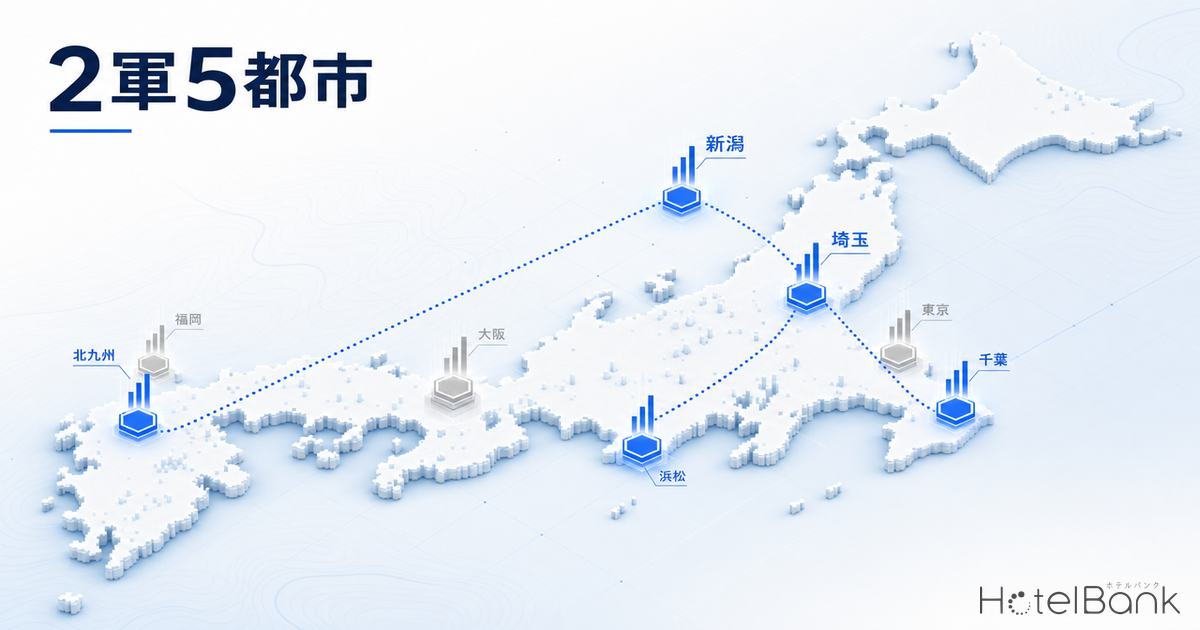
As hotel investment in Japan’s “first-tier” designated cities — Sapporo, Sendai, and Fukuoka — becomes increasingly competitive, investors are turning their attention to the next frontier. Five “second-tier” designated cities — Saitama, Chiba, Hamamatsu, Niigata, and Kitakyushu — offer an average 12% price discount compared to the first tier while possessing growth drivers such as MICE facilities, Shinkansen access, and redevelopment plans. Using data from MetroEngines Research, this article quantifies ADR levels, YoY changes, and grade-based supply structures across all five cities, evaluating from an investor perspective which city is most likely to support a luxury hotel segment next.
Metric Definitions Used in This Article
- ADR (Average Daily Rate): The average of published room rates on OTAs and other booking platforms. This differs from actual transaction prices (cross-referencing with REIT disclosure data shows published ADR tends to be +25-30% higher than transacted ADR, as unsold higher-priced plans remain listed on OTAs, structurally pushing the published average above the actual transaction price). Rates are per room for double occupancy (tax included), averaged across all plans (room-only through meal-inclusive).
- Second-Tier Discount Rate: The gap between each city’s ADR and the average ADR of the three “first-tier” cities (Sapporo, Sendai, Fukuoka). A larger value indicates greater room for price growth (upside potential).
- Data Source: MetroEngines Research (analysis covers approximately 27,000 properties with confirmed active operations tracked by MetroEngines Research)
ADR Levels Across 5 Cities vs. First Tier — Growth Potential Behind the 12% Discount
Comparing ADR as of May 2025, the five second-tier cities average ¥25,400 — a 12.2% discount to the first-tier average of ¥29,000. However, the gap varies significantly between cities: Hamamatsu (¥28,200) and Niigata (¥28,100) are nearly on par with the first-tier average, while Kitakyushu (¥21,900) lags by 24.4%. This disparity is the key factor differentiating investment decisions.
On a YoY basis, Hamamatsu posted the highest growth at +11.4%. This is likely driven by ADR increases in the upper-grade segment, exemplified by the Hamamatsu Marriott Hotel (a rebrand of the former Grand Hotel Hamamatsu), which opened in May 2026. Meanwhile, Chiba recorded -4.1%, the only YoY decline, though this is largely a structural effect of the pricing strategy at APA Hotel & Resort Tokyo Bay Makuhari (2,007 rooms), which drags down the market average in the Makuhari area.
Monthly ADR Trends — Reading Seasonality and Growth Trajectories
Looking at monthly ADR trends from April 2024 through September 2025, most months across all five cities exceeded their year-ago levels. Particularly noteworthy is Hamamatsu’s summer (August) performance, rising from ¥27,800 in 2024 to ¥30,300 in 2025 — an 8.7% increase. This is underpinned by leisure demand from Lake Hamana and Kanzanji Onsen, plus business travel demand from locally headquartered corporations such as Yamaha, Suzuki, and Hamamatsu Photonics.
Niigata also shows a strong seasonal peak at ¥31,500 in August, driven by fireworks festival demand (Nagaoka Festival), post-Fuji Rock accommodation needs, and a tourism boost from the Sado Gold Mine’s UNESCO World Heritage registration in 2024. In contrast, Saitama shows minimal seasonal variation, remaining within a narrow ¥21,000-¥25,000 range year-round. The GMO Arena Saitama (formerly Saitama Super Arena) has been closed for major renovations since January 2026, which may be suppressing event-driven ADR growth.
Supply Structure by Grade — Identifying Gaps in the Luxury Segment
The most critical question for hotel investors is “which price tier has room for new entrants?” Examining the ADR distribution by grade across the five cities reveals clear structural characteristics.
First, Hamamatsu has the strongest luxury segment, with 9 properties at an ADR of ¥58,900. Led by the Okura Act City Hotel Hamamatsu (322 rooms), the segment was further bolstered when the former Grand Hotel Hamamatsu (now Hamamatsu Marriott, 236 rooms) rebranded under an international flag, enriching supply at the upper-grade and above. Conversely, this means the best opportunity for new entrants lies in the midscale to upper-midscale tiers. The pattern of international hotel chains expanding into regional designated cities, including Marriott, is analyzed in our Marriott vs Hyatt Japan expansion strategy comparison.
Meanwhile, Saitama has no luxury segment at all. The highest-tier properties are high-grade hotels such as Hotel Metropolitan Saitama Shintoshin (157 rooms) and Candeo Hotels Omiya (321 rooms), capping out at an ADR of ¥23,200. With the Omiya GCS (Grand Central Station) development concept underway and the east exit large-scale redevelopment targeting spring 2027 commercial facility completion, there is first-mover advantage in positioning for the upper-grade tier.
Kitakyushu has Rihga Royal Hotel Kokura (295 rooms) as a luxury property, but its ADR of ¥43,100 is modest compared to the same grade in Fukuoka. BEB5 Mojiko by Hoshino Resorts (119 rooms) is set to open in July 2026 — the first Hoshino Resorts brand entry in Fukuoka Prefecture. By adding a new tourism anchor to the Mojiko Retro area, it is expected to lift ADR levels across all of Kitakyushu.
| City | Luxury | High-Grade | Upper | Economy | Budget |
|---|---|---|---|---|---|
| Saitama | — | ¥23,200 (2) | ¥25,500 (9) | ¥27,100 (4) | ¥18,600 (18) |
| Chiba | ¥48,500 (1) | ¥21,500 (4) | ¥32,900 (17) | ¥23,600 (6) | ¥15,900 (19) |
| Hamamatsu | ¥58,900 (9) | ¥33,700 (9) | ¥28,700 (13) | ¥22,300 (14) | ¥21,300 (22) |
| Niigata | ¥51,400 (7) | ¥51,900 (5) | ¥25,500 (13) | ¥21,200 (13) | ¥16,300 (32) |
| Kitakyushu | ¥43,100 (2) | ¥29,900 (5) | ¥31,500 (11) | ¥19,700 (7) | ¥14,100 (32) |
MICE Facilities, Transport Infrastructure & New Developments by City
Saitama is characterized by MICE and event demand centered on the GMO Arena Saitama (formerly Saitama Super Arena, approximately 2.87 million visitors annually), though it has been temporarily closed for major renovations from January 2026 through spring 2027. Rebound demand after the renovation is expected to be significant, and combined with the Omiya Station GCS concept (Sakuragi PPJ, spring 2027 completion target), medium-term demand growth is anticipated. Omiya Station is one of Japan’s premier terminals, served by six Shinkansen lines, offering strong access from Tohoku, Hokuriku, and Joetsu directions. Only three properties are set to open in 2026, including Hotel Global View Urawa (140 rooms), meaning supply pressure remains limited.
Chiba relies on MICE demand anchored by Makuhari Messe (72,000 sqm exhibition space, approximately 7 million visitors annually). The Kaihin-Makuhari area features large-scale properties such as APA Hotel & Resort Tokyo Bay Makuhari (2,007 rooms) and Hotel New Otani Makuhari (418 rooms), with ample hotel supply. Of note is the redevelopment around Chiba Station, where mid-scale city hotels are concentrating, including Candeo Hotels Chiba (270 rooms) and APA Hotel Chiba Ekimae (259 rooms). Royal Park Hotel Maihama Resort Tokyo Bay (750 rooms) is set to open in 2026, further expanding supply in the Disney Resort area.
Hamamatsu is undergoing the most dynamic transformation among the five cities. The Hamamatsu Marriott Hotel opening in May 2026 marks the city’s first international hotel brand — a 236-room full-service property that is acting as a catalyst for elevating ADR levels across the region. With global corporations such as Yamaha, Suzuki, and Hamamatsu Photonics headquartered or based here, the industrial MICE demand foundation is robust. In addition to the Shin-Tomei Expressway smart IC, the 2024 development around the Hamamatsu SA enhances its appeal as a mobility hub. Toyoko Inn Hamamatsu-Eki Minami-guchi (284 rooms) has also opened, reinforcing supply in the business hotel tier. The competitive set impact of three hotels opening in 2026, including the Hamamatsu Marriott, is also covered in our 2026 competitive set analysis for Imperial Hotel Kyoto, Hamamatsu Marriott, and Hilton Takayama Resort.
Niigata holds its own at ¥28,100, matching Hamamatsu’s ADR level. This is despite the large-scale supply from APA Hotel & Resort Niigata Ekimae Odori (1,001 rooms), as upper-grade properties like Hotel Okura Niigata (265 rooms) and Hotel Global View Niigata (308 rooms) support ADR levels. The Sado Gold Mine’s UNESCO World Heritage registration (July 2024) provides a medium- to long-term tailwind for inbound tourism demand. The Niigata Station Bandai-guchi redevelopment (pedestrian deck construction, operational from April 2026) is underway, with improved walkability around the station expected to stimulate lodging demand.
Kitakyushu has the lowest ADR among the five cities at ¥21,900, but its YoY growth rate of +8.5% is high. Large properties are concentrated around Kokura Station, including Rihga Royal Hotel Kokura (295 rooms) and Nishitetsu Inn Kokura (570 rooms), but the Mojiko Retro district had limited hotel supply relative to its tourism potential. BEB5 Mojiko by Hoshino Resorts (119 rooms, all rooms with Kanmon Strait views) is set to open here in July 2026, creating a new benchmark for tourism-oriented hotels. The pricing of ¥6,600+ per night per person targets younger travelers, so the direct ADR impact will be limited. However, the Hoshino Resorts brand’s visibility should contribute to raising awareness of the entire area.
Second-Tier Discount Rate vs. YoY Growth — Visualizing Price Growth Potential
For investment decisions, what matters is not just the current ADR level (stock) but the combination with growth velocity (flow). Here, we plot each city’s discount rate (x-axis) against YoY ADR growth rate (y-axis) and evaluate investment potential across four quadrants.
Cities in the upper-right quadrant (large discount x high growth rate) have “significant room for price increases, with prices actually rising” — the most attractive for investment. Saitama (19.6% discount, YoY +6.2%) falls in this quadrant. Meanwhile, Hamamatsu and Niigata have discount rates of just under 3%, nearly converging with first-tier levels, but maintain high growth rates — they are at the stage where “price convergence is already in progress.”
Kitakyushu has the largest discount at 24.4% combined with +8.5% growth, positioning it as “the city with the greatest upside potential.” Chiba is the only city with a YoY decline at -4.1%, but this reflects the structural pricing influence of mega-hotels in Makuhari — ADR in the Chiba Station area is actually trending upward.
New Opening Pipeline — Gauging Supply Pressure
Based on data tracked by MetroEngines Research, we summarize the 2025-2026 new hotel opening pipeline for the prefectures containing these five cities.
| City (Prefecture) | 2025 Openings | 2026 Openings | Notable Properties |
|---|---|---|---|
| Saitama (Saitama Pref.) | 15 properties | 3 properties | Hotel Global View Urawa (140 rooms), Toyoko Inn Tokorozawa (245 rooms) |
| Chiba (Chiba Pref.) | 50 properties | 17 properties | Royal Park Hotel Maihama Resort Tokyo Bay (750 rooms), Maihama View Hotel by HULIC (428 rooms) |
| Hamamatsu (Shizuoka Pref.) | 50 properties | 31 properties | Hamamatsu Marriott Hotel (236 rooms, rebrand), Toyoko Inn Hamamatsu-Eki Minami-guchi (284 rooms) |
| Niigata (Niigata Pref.) | 17 properties | 5 properties | Hotel Crown Hills Niigata No.2 (84 rooms), Trip7 Yuzawa Tenku Onsen (220 rooms) |
| Kitakyushu (Fukuoka Pref.) | 50 properties | 23 properties | BEB5 Mojiko by Hoshino Resorts (119 rooms), THE KNOT Fukuoka Tenjin (206 rooms) |
At the prefecture level, Chiba, Shizuoka, and Fukuoka have high opening counts, but the majority are vacation rentals and resorts in areas such as Minami-Boso, Izu Peninsula, and Dazaifu — supply pressure on the five cities’ central urban areas remains limited. Niigata Prefecture, meanwhile, has the fewest openings, making it the market with the lowest risk of supply overshoot.
City Hotel New-Build Simulation — Yield Comparison for a 200-Room, ¥15,000-ADR Property
Here we present a simplified pro forma for opening a 200-room city hotel in each market. Construction cost assumes the 2024 benchmark of ¥2 million per tsubo, with a gross floor area of 10,000 sqm (approximately 3,025 tsubo). ADR is set at ¥15,000 (estimated transaction basis), occupancy at 68%, and GOP margin at 30% — all held constant. Land prices reference the published land value (2026) for central commercial districts in each city.
| Item | Saitama | Chiba | Hamamatsu | Niigata | Kitakyushu Notable |
|---|---|---|---|---|---|
| Room Count | 200 rooms | 200 rooms | 200 rooms | 200 rooms | 200 rooms |
| Assumed ADR (transaction basis) | ¥15,000 | ¥15,000 | ¥15,000 | ¥15,000 | ¥15,000 |
| Occupancy Rate | 68% | 68% | 68% | 68% | 68% |
| Annual Revenue | ¥745M | ¥745M | ¥745M | ¥745M | ¥745M |
| GOP (30%) | ¥223M | ¥223M | ¥223M | ¥223M | ¥223M |
| Reference Land Price (¥/sqm) | ~¥1.4M | ~¥400K | ~¥150K | ~¥160K | ~¥250K |
| Land Acquisition Cost (1,000 sqm assumed) | ¥1.4B | ¥400M | ¥150M | ¥160M | ¥250M |
| Construction Cost (¥2M/tsubo) | ¥6.05B | ¥6.05B | ¥6.05B | ¥6.05B | ¥6.05B |
| Total Investment | ¥7.45B | ¥6.45B | ¥6.20B | ¥6.21B | ¥6.30B |
| GOP Yield | 3.0% | 3.5% | 3.6% | 3.6% | 3.5% |
By GOP yield, Hamamatsu and Niigata lead at 3.6%, followed by Chiba and Kitakyushu at 3.5%, with Saitama at 3.0% — the lowest. Saitama’s lower yield stems from the exceptionally high land price in the Omiya Station commercial district (~¥1.4M/sqm), which falls within the Greater Tokyo metropolitan commercial land price range. In contrast, Hamamatsu and Niigata benefit from low land prices of ¥150,000-160,000/sqm, keeping the land cost burden light relative to construction costs.
However, this simulation assumes identical ADR and occupancy. In reality, ADR potential differs by city. Referencing the Hamamatsu Marriott’s ADR range (upper-grade ¥28,700 to luxury ¥58,900), a developer targeting upper-grade or above in Hamamatsu could realistically aim for ADR ¥20,000-25,000 (transaction basis), potentially improving yields to 4.5-5.5%.
Ranking: Which City Can Next Support a Luxury Hotel Segment?
Synthesizing the above analysis, we rank the five cities by their likelihood of successfully supporting a new luxury-tier hotel (ADR ¥40,000+, transaction basis). The evaluation criteria are: (1) ADR growth trend, (2) existing luxury supply, (3) MICE and tourism demand base, (4) transport access, and (5) land price and yield. In 2026, even first-tier cities are seeing a wave of six luxury openings — including Imperial Hotel Kyoto, Capella Kyoto, and Conrad Nagoya. The broader supply impact is analyzed in our 2026 luxury hotel market impact analysis from an investor perspective.
#1 Hamamatsu
Overall: Most promising. The Hamamatsu Marriott opening has proven international brand viability. Strong industrial MICE base from Yamaha, Suzuki, and Hamamatsu Photonics. Shin-Tomei Expressway access. Established luxury-tier ADR of ¥58,900. Low land prices (¥150K/sqm) facilitate yield optimization. Highest YoY ADR growth at +11.4%.
#2 Saitama
Overall: Promising medium-term. Complete absence of luxury segment. Omiya GCS concept and Sakuragi PPJ (spring 2027) underway. Superior access via six Shinkansen lines. However, high land prices (¥1.4M/sqm) require ADR ¥25,000+ (transaction basis) for viable yields. Key trigger is post-renovation rebound at GMO Arena (spring 2027+).
#3 Kitakyushu
Overall: High potential, timing is key. Largest discount at 24.4% means greatest upside. Hoshino Resorts brand entry (BEB5 Mojiko) enhances tourism value. Rihga Royal Kokura provides luxury precedent. Population decline is a headwind — success depends on capturing inbound and cruise ship demand.
#4 Niigata
ADR levels are high (¥28,100), but the luxury segment already has 7 properties. Inbound growth from the Sado Gold Mine World Heritage designation continues. Low new supply keeps the market stable, but room for additional luxury entries is limited.
#5 Chiba
MICE demand from Makuhari Messe is stable, but APA Hotel & Resort Tokyo Bay (2,007 rooms) exerts significant pricing influence. Hotel New Otani Makuhari serves as the luxury benchmark. Competition with the TDR (Tokyo Disney Resort) market zone requires distinctive brand differentiation.
Conclusion — Can These 5 Second-Tier Cities Become the Next Frontier?
The hotel market across these five “second-tier” designated cities carries a 12.2% ADR discount relative to the first tier, yet four of the five cities are posting positive YoY growth — indicating genuine price growth potential. Hamamatsu stands out, with the Marriott brand’s proven entry and +11.4% ADR growth making it “the second-tier city where a luxury segment is most likely to succeed.”
Saitama occupies a rare position with a complete absence of luxury supply, but clearing the high land price hurdle requires the Omiya GCS redevelopment to progress and post-renovation event demand at GMO Arena to recover (spring 2027+). Kitakyushu has the largest discount rate (24.4%) and high tourism potential symbolized by the Hoshino Resorts entry, but carries the risk of headwinds from population decline.
Across all five cities, the path to success lies not in simply replicating “models that worked in first-tier cities,” but in differentiation strategies that leverage each city’s unique MICE facilities, industrial base, and tourism assets. For investors facing overheated competition and declining yields in first-tier markets, the “discount x growth rate” matrix across these five second-tier cities points toward the next frontier.
⚠ Note on Future-Date ADR: ADR data for dates from June 2025 onward reflects published rates on OTAs at the time of research and is subject to change as check-in dates approach. Please note that currently high-priced listings may be subject to last-minute discounting.
Related Articles
- Tokyu Stay x Mercure Hiroshima: Dual-Brand Strategy for Mid-Tier Cities
- Marriott vs Hyatt Japan Strategy: 122 vs 22 Hotels, Next Luxury Hotspots
- Six Luxury Hotels Opening in Japan in 2026: Investor Market Impact Analysis
- Osaka Expo’s Impact on Hotel ADR: REIT & OTA Data Analysis
References & Sources
- MetroEngines Research & Consulting — OTA published rate data (N=334 properties, 5 second-tier cities; N=834 properties, 3 first-tier cities)
- GMO Arena Saitama — Temporary Closure for Major Renovation (January 2026–)
- Saitama City — Omiya Station Grand Central Station Concept
- Hamamatsu Marriott Hotel — May 1, 2026 Opening Press Release (HMI)
- BEB5 Mojiko by Hoshino Resorts — July 24, 2026 Opening Press Release
- Tochidai Data — Published Land Values (2026)
- Makuhari Messe Official Site — Facility Overview & Usage Data
- Niigata Nippo — Niigata Station Area Redevelopment Progress
- Nikkei — Hoshino Resorts Opens Youth-Oriented Hotel in Kitakyushu Mojiko District
- AtHome — Omiya Station Area Redevelopment Summary 2025