

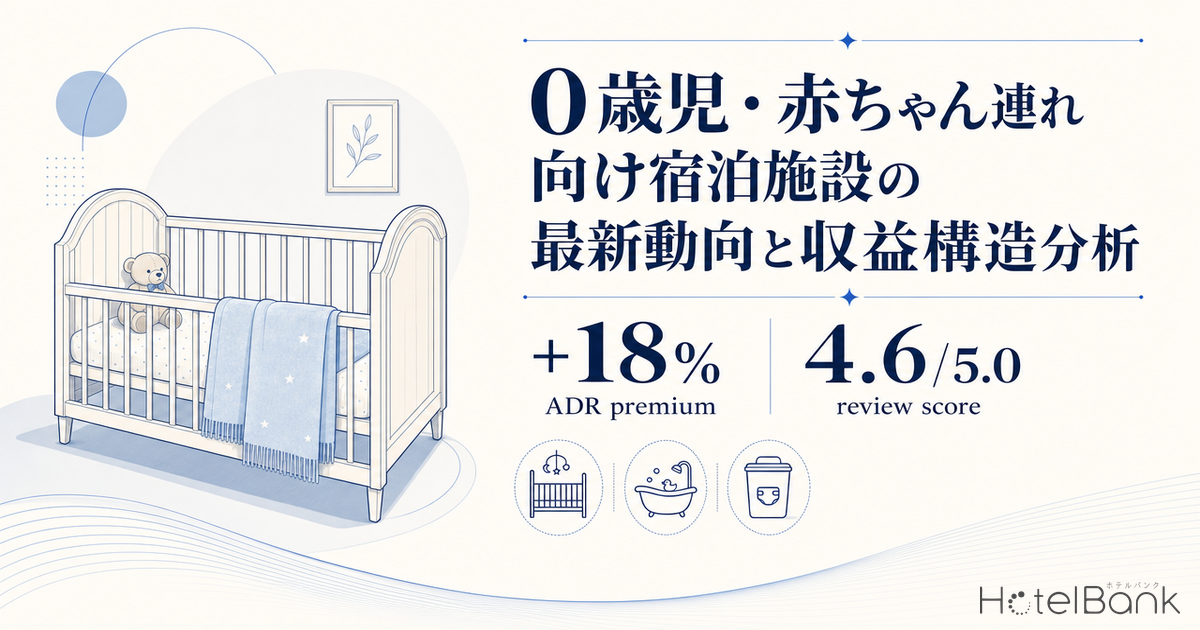
The accommodation market for families traveling with babies, including infants under 1 year old, is quietly expanding alongside the post-COVID return of family travel. The “Welcome Baby Hotels” certification by Miki House Childcare Research Institute now covers approximately 100 properties nationwide, while OTAs such as Rakuten Travel (“Baby-Welcome Hotels”) and Jalan (“Best Hotels for Staying with Babies”) have established their own dedicated categories. Across the industry, “baby-friendly” is becoming a central axis for hotel selection. This article compares ADR, sellout rate, and review data for 44 certified properties tracked by MetroEngines Research (メトロエンジンリサーチ) against 1,260 general mid-sized hotels in the same regions and price bands, quantifying the premium structure and revenue management opportunities of baby-welcoming properties.
Metric Definitions Used in This Article
- ADR (Average Daily Rate): The average of published prices on OTAs. This differs from actual transaction prices (since unsold high-price plans remain visible on OTAs, the average of published prices tends to be higher than transaction prices). Per-room rates for double occupancy (tax included), averaged across all plans (from room-only to meal-inclusive plans).
- Sellout Rate: The percentage of days on which OTA plans are fully booked at the time of survey. Used as a proxy indicator of regional supply-demand balance.
- Certified Property Sample: 44 properties (approximately 44% of the roughly 100 nationally certified properties) certified as “Welcome Baby Hotels” by Happy-Note Co., Ltd., for which MetroEngines Research continuously collects pricing and review data.
- Control Group: 1,260 mid-sized hotels in the same 18 prefectures, with 50-600 rooms and “Upper to Luxury” grade (excluding certified properties).
- Data Source: MetroEngines Research
Baby-Welcome Hotels Exceed General Hotels by Up to +32.5% in Summer ADR
Aggregating sales data for June through August 2026, the ADR of the 44 baby-welcome certified properties exceeded the 1,260-property control group across all periods, with the premium expanding particularly during demand peaks. While June (the rainy season) shows a modest +19.0% gap (¥48,600 vs ¥40,900), late July when summer holidays begin in earnest shows +25.7%, August weekdays +26.3%, and the Obon peak (Aug 9-17) reaches +32.5% (¥71,400 vs ¥53,900) — a structure where pricing power strengthens markedly during demand-constrained periods.
Source: MetroEngines Research, compiled by HotelBank Editorial Team (44 certified properties / 1,260 control properties)
What deserves attention is the sellout rate gap. In June, the levels are nearly identical (certified 37.5% vs control 36.3%), but at the Obon peak, the difference reaches +18.7 percentage points (certified 56.0% vs control 37.3%). In other words, baby-welcome properties have the constitutional ability to “raise prices when demand arrives and still sell out,” and this is the source of the ADR premium. For insights into when family-oriented rooms run out during peak periods, our Golden Week 2026 Fastest Sellout Family Hotels feature tracks how 6,106 properties disappeared by March, providing a useful reference for decision-making timing in demand-constrained periods.
Source: MetroEngines Research, compiled by HotelBank Editorial Team
Review Score Comparison — The “Service 4.27 vs Rooms 4.22” Structure
Comparing 542,112 cumulative reviews from the 44 certified properties with 374,939 reviews from 50 control properties, an interesting structure emerges. The overall average rating is 4.09 for certified properties versus 4.53 for the control group — actually higher for the control. This is because the control group includes more small, specialized boutique hotels where ratings tend to skew to extremes, while certified properties operate at larger scale (227 rooms on average) and accommodate a broader customer base, causing ratings to converge toward the median.
Source: MetroEngines Research, compiled by HotelBank Editorial Team (44 certified / 50 control)
However, when broken down by category, “Service” ratings are nearly tied (certified 4.27 vs control 4.30), and “Facilities & Amenities” achieve complete parity (certified 4.10 vs control 4.11). This is evidence that despite their larger scale, certified properties deliver experience quality equivalent to small boutique hotels through physical investments such as standard baby cribs, nursing rooms, and baby food provision. The ability to scale room count while maintaining service quality is the basis for the scalability of baby-welcome properties.
Prefectural Premium — High ADR Maintained in Hokkaido, Nagano, and Tochigi
Breaking down late July through August 2026 sales data by prefecture reveals clear regional differences among certified properties. Tochigi Prefecture (Kinugawa Onsen Hotel, Hotel Epinard Nasu) achieves average ADR of ¥90,700 with a 43.8% sellout rate; Nagano Prefecture (Shirakaba Resort Ikenotaira, Tateshina Grand Hotel Takinoyu, and others) reaches ¥85,000 / 48.5%. Okinawa also ranks among the national top tier at ¥82,400 / 37.7%.
Source: MetroEngines Research, compiled by HotelBank Editorial Team (sales data July 15 – August 31, 2026)
Chiba Prefecture (3 properties near Tokyo Disney Resort) keeps ADR more modest at ¥41,500 but records the highest sellout rate of 61.9%, completely capturing summer family demand. Meanwhile, Hiroshima at ¥18,700 / 18.2% and Okayama at ¥35,300 / 12.8% show that the Chugoku region lags somewhat on the demand side, leaving room for growth among certified properties. For broader summer resort market price trends and FX sensitivity covering Hokkaido, Nagano (Karuizawa), and Okinawa, our Summer Resort 3-Region Comparison 2026: Niseko, Okinawa, Karuizawa dives deeper into regional drivers beyond family segments.
Regional Density Map — The Reality of 29 Prefectures with Zero Certified Properties
The “Welcome Baby Hotels” certification covers approximately 100 properties nationwide, with MetroEngines Research tracking 44 of them. When mapped across Japan’s 47 prefectures, they cluster into four blocks — Hokkaido (8), Kanto (10), Koshinetsu (7), and Okinawa (6) — leaving 29 prefectures, including Aomori, Miyagi, Tokyo, Osaka, and Fukuoka, with zero certified properties.
Source: MetroEngines Research, compiled by HotelBank Editorial Team (circle size = room count)
| Region | Certified Properties | Total Rooms | Avg. Overall Score | Cumulative Reviews |
|---|---|---|---|---|
| Kanto | 10 | 2,983 | 4.13 | 165,475 |
| Hokkaido | 8 | 1,985 | 4.10 | 72,414 |
| Koshinetsu | 7 | 1,065 | 4.30 | 53,825 |
| Okinawa | 6 | 1,452 | 4.10 | 62,905 |
| Tokai | 4 | 762 | 3.82 | 46,261 |
| Tohoku | 4 | 468 | 4.05 | 34,376 |
| Kansai | 3 | 1,398 | 4.17 | 93,710 |
| Chugoku | 2 | 311 | 3.55 | 13,146 |
The most notable white spaces are Japan’s three major metropolitan areas, plus Kyushu and Shikoku. The structural anomaly — that large family demand exists in Tokyo, Osaka, and Fukuoka while certified properties remain zero or scarce — suggests an unexploited “urban baby-friendly hotel” concept. Kyushu mainland (Fukuoka, Kumamoto, Oita, Miyazaki, Kagoshima) and all of Shikoku also have supply gaps relative to family-driven demand around theme parks and hot spring areas.
Core 3-Item Equipment Set and “Plus Alpha” Items — Industry Standardization Progresses
Organizing the various certification standards and OTA category requirements reveals clear commonalities for what the industry recognizes as a “baby-ready hotel.” The basic 3-item set (baby crib, baby futon, baby bath) is effectively mandatory, supplemented by “plus alpha” items such as baby food provision, nursing rooms, diaper-specific bins, and free baby gear rental.
| Category | Equipment / Service | Approx. Cost / Room | RM Significance |
|---|---|---|---|
| Basic 3-Item Set | Baby Crib | ¥30,000-80,000 | Foundation of room differentiation |
| Baby Futon / Co-sleeping Mat | ¥10,000-25,000 | Convenience appeal for co-sleeping bookings | |
| Baby Bath | ¥3,000-8,000 | Solution for guests unable to use public baths | |
| Plus Alpha | Baby Food (for 5, 7, 9 months) | Operating cost (menu design) | Plan price uplift +¥3,000-5,000 |
| Nursing Room / Kids Space | ¥500,000-2,000,000 (common areas) | Extended stay duration / F&B secondary spend | |
| Diaper Bin (odor-sealed) | ¥3,000-10,000 | Avoid review penalties (cleanliness) | |
| Free Baby Gear Rental Set | ¥50,000-150,000 (initial) | “Lighter luggage” appeal raises CVR |
The per-room cost for the basic 3-item set is approximately ¥40,000-110,000, and even including common-area investment (nursing room, kids space), the total for a 100-room property is contained within ¥5-15 million. As detailed below, this is generally recoverable within 1-2 seasons through the summer ADR premium alone. For operators seeking experience-based differentiation beyond standard baby equipment, our Hotels with In-Room Slides: Market Analysis of Family Differentiation Rooms documents pricing power and customer satisfaction examples for properties offering in-room athletic features, providing a reference for upper-tier investment.
RM Perspective: Investment Payback and Revenue Opportunities from “Rainy Season Differentiation”
Based on the data so far, we calculate the revenue projection for baby-readiness investment. Assuming a 100-room mid-sized resort hotel with a conservative 30% share of baby-accompanied guests (some properties marketing baby-welcoming features have achieved 40-60% in practice), the additional revenue opportunity for the 92-day summer period (June 1 – August 31) calculates as follows.
Source: MetroEngines Research, compiled by HotelBank Editorial Team
Additional revenue per room over the 92-day summer is approximately ¥970,000. For a 100-room property achieving a 30% baby-accompanied guest share, the summer alone generates roughly ¥29.1 million in additional revenue opportunity. Initial investment (basic 3-item set + common area development) totals around ¥5-15 million — full recovery within a single season is realistic, and it remains highly reasonable as a mid-term investment when viewed across multiple seasons.
Another notable structure is “rainy season sellout rate resilience.” Generally, June is an off-peak period for lodging demand, with the control group’s sellout rate stagnating at 36.3%. However, certified properties maintain a nearly equivalent 37.5% even during the rainy season, while exceeding the control by +19.0% in ADR. This is because families with babies strongly favor “facilities that aren’t dependent on weather and where they can spend time indoors” — standard amenities at baby-welcome properties such as indoor pools, kids spaces, and in-room dining service capture this rainy-season demand.
Source: MetroEngines Research, compiled by HotelBank Editorial Team
For RM teams, in addition to staged pricing toward the Obon peak (sellout 56.0%, ADR ¥71,400), positioning “baby plans” as a flagship product during the June rainy season is an effective strategy. Few other segments allow a +19% ADR premium during the rainy season, making the baby-friendly strategy attractive not only for peak periods but also for raising shoulder-season revenue.
Capturing White Space — Three Directions for Mid-Sized Ryokan and Resort Operators
The data in this article points to three key directions for mid-sized ryokan and resort hotel operators, as well as concept hotel planners.
(1) Certification-Driven Repositioning: An approach where existing mid-sized hotels (50-300 rooms) target certification through small-scale common-area renovations and operational manual development. Investment payback is projected at 1-2 seasons. When review ratings in Service and Facilities categories reach parity with the control group (4.27 / 4.10), the room for capturing pricing power is substantial. Leading examples in Tochigi, Nagano, and Okinawa (maintaining ADR above ¥80,000) serve as reference models.
(2) Urban Baby-Friendly Hotels — An Unexploited Frontier: Currently, Tokyo, Osaka, and Fukuoka have virtually no certified properties. The three major metropolitan areas host multi-layered family demand — homecoming visits, relative visits, and concert/event travel. By standardizing co-sleeping accommodation, baby cribs, and stroller rental even in compact rooms, operators can layer family-targeted ADR premium onto business hotel price bands (¥15,000-25,000).
(3) Kyushu and Shikoku Supply White Space: The five Kyushu mainland prefectures with zero certified properties (Fukuoka, Kumamoto, Oita, Miyazaki, Kagoshima) and all of Shikoku contain reliable family demand around hot springs and theme parks (Huis Ten Bosch, Beppu, Yufuin, etc.). ADR levels at neighboring prefectures’ certified properties (Hiroshima ¥18,700 / Okayama ¥35,300) remain modest, presenting an opportunity for early entrants to claim the “first certified property” position in each region.
Summary — Baby-Friendly Is Not a “Niche” but a “Revenue Engine”
Baby-welcome properties achieved an ADR premium of up to +32.5% over the control group in summer 2026 data, and a +18.7 percentage point gap in sellout rate during Obon. Review ratings maintained parity with the control group in Service and Facilities categories, confirming a structure that preserves experience quality even at scale. ¥29.1 million in additional summer revenue opportunity for 100-room properties, payback within 1-2 seasons of initial investment, and a +19% ADR premium even during the rainy season’s demand elasticity — these factors demonstrate that “baby-friendly” is not merely a niche segment strategy but can function as a revenue engine for mid-sized resorts and ryokan.
The 29 prefectures with zero certified properties — especially the major metropolitan areas and Kyushu/Shikoku — represent substantial white space with attractive returns on early investment. With smaller family sizes and the rise of dual-income households, demand for “accommodation where families with babies can stay with peace of mind” is expected to remain firm going forward.
Note on Future-Dated ADR: ADR figures in this article reflect the average of published OTA prices at the time of survey and fluctuate as check-in dates approach. Prices currently set high may decrease through last-minute discounting, while last-minute demand may push prices higher — please bear both possibilities in mind.
Related Articles
Related Articles
- Golden Week 2026 Fastest Sellout Family Hotels: Why 6,106 Properties Disappeared by March and Next Year’s Booking Timing
- Hotels with In-Room Slides: Market Analysis and Revenue Contribution of Family Differentiation Rooms
- Summer Resort 3-Region Comparison 2026: Niseko, Okinawa, Karuizawa — ADR, Booking Pace, and FX Sensitivity
- Accommodation for Families with Neurodiverse Children: The New Role of Hotels Demonstrated by MIMARU’s Pilot Study
- Hokkaido’s Rainy-Season-Free June: How Do Hotel Prices Move? 6-City ADR Comparison 2026
- Hydrangea Tourism Hotel ADR Analysis — The Hidden High-Rate Window of the Rainy Season
- Pet-Friendly Hotel Market Analysis: A ¥1.9 Trillion Market Driving Weekday Resort Demand with +14.8% ADR Premium
References & Sources
- Miki House Childcare Research Institute “Welcome Baby Hotels” Official Certified Properties List
- Miki House Childcare Research Institute “Welcome Baby Hotels” Information Page for Prospective Certified Properties
- Jalan News: “17 Welcome Baby Hotels: Best Ryokan & Hotels for Staying with Babies (2025)”
- Rakuten Travel: Recommended Hotels & Ryokan for Family Travel and Baby-Accompanied Travel
- Rakuten Travel: Kanto Region Popular Baby-Welcome Hotel Ranking
- JTB “Welcome Baby Hotels” Feature Page
- MetroEngines Research — OTA published price data and guest review data (44 certified properties, 1,260 control properties, 917,051 cumulative reviews)