

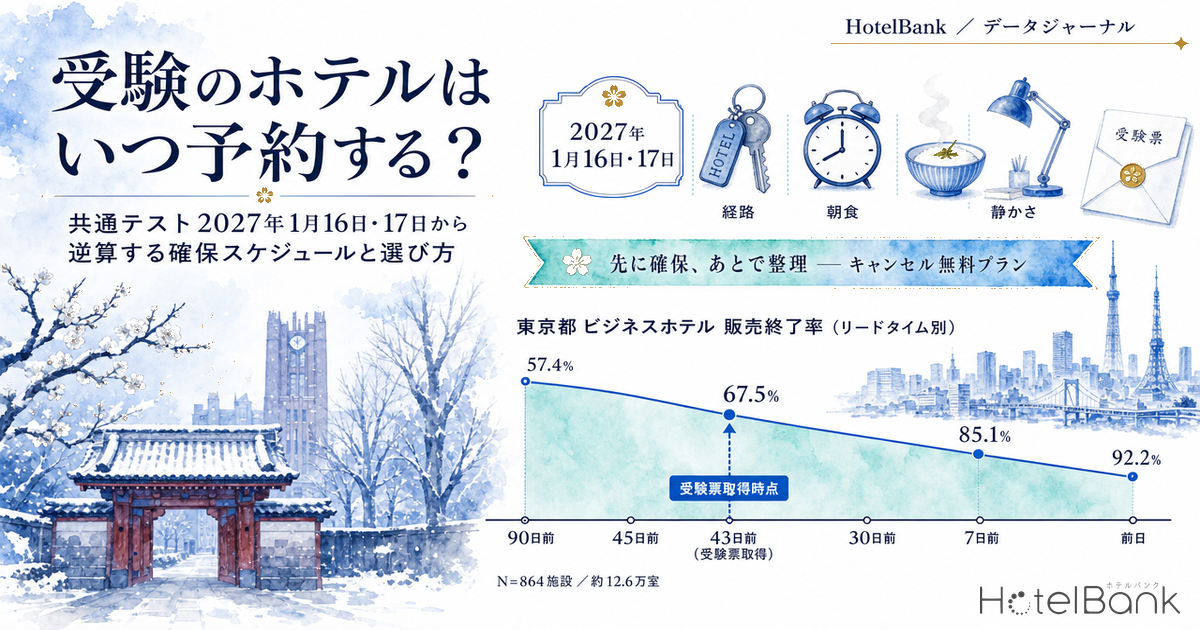
The conclusion on exam-night hotels is simple: now that the test dates are public, lock in rooms on free-cancellation plans. The National Center for University Entrance Examinations (大学入試センター) has already announced that the main sitting of the Common Test for University Admissions (大学入学共通テスト) for the 2027 academic year falls on Saturday 16 and Sunday 17 January 2027, with the supplementary sitting on Saturday 23 and Sunday 24 January (confirmed as of August 2026). Your test venue is not fixed until you receive your admission ticket, but rooms around the stations where candidate venues cluster fill up steadily from autumn onward. That is precisely why the basic strategy is not “wait for the admission ticket and then look,” but “secure rooms early on plans you can cancel for free, then tidy up once the venue is confirmed.” This article sets out a booking schedule counted backwards from those dates, plus a checklist for choosing a hotel that actually suits an exam trip.
- — The dates are already fixed — the main sitting of the Common Test for University Admissions for the 2027 academic year is Saturday 16 and Sunday 17 January 2027; the supplementary sitting is Saturday 23 and Sunday 24 January (announced by the National Center for University Entrance Examinations, confirmed August 2026).
- — Wait for the admission ticket and only a third is left — admission tickets become available at 10:00 on 4 December 2026, which is 43 days before the test. At that point an average of 67.5% of business-hotel rooms in Tokyo are already off sale (check-ins June–August 2026, N=864 properties / approx. 126,000 rooms).
- — It tightens further once venues are confirmed — the same dataset shows 72.4% at 30 days out, 85.1% at 7 days out and 92.2% the day before. Even 90 days out, 57.4% is already gone, so the earlier you move in autumn — before applications close — the better the rooms still on offer.
- — Secure first, tidy up later — hold one room per candidate exam city on a free-cancellation plan, then release what you no longer need once your choices firm up. Always note the free-cancellation deadline.
- — Judge on route, breakfast and quiet — the criteria differ from picking a hotel for sightseeing. Get those three of the seven items right and the rest can be covered with advance requests and a few things packed from home.
The Dates Are Already Set — 16 and 17 January 2027
Start by pinning down the dates everything else hangs on.
| Sitting | Dates |
|---|---|
| Common Test — main sitting | Saturday 16 and Sunday 17 January 2027 |
| Common Test — supplementary sitting | Saturday 23 and Sunday 24 January 2027 |
Source: test information for the 2027 academic year published by the National Center for University Entrance Examinations (as of August 2026)
Because the test runs over two days, anyone travelling from a distance should first decide between “arrive the day before and stay two nights” and “arrive the day before, stay one night, then commute from home on day two.” If the venue is more than an hour from home, stay the night before; if the subject line-up means an early start on day two, two consecutive nights is the safer choice. Private universities generally hold their general-entry exams from late January to mid-February, and national and public universities hold their second-stage exams after that, so rooms for February in your first-choice exam city deserve the same early treatment. How fast city business hotels actually fill can be measured. Aggregating Tokyo business hotels (check-ins June–August 2026, N=864 properties / approx. 126,000 rooms, estimated from OTA-listed inventory) by the number of days remaining before the stay date — the lead time — 57.4% were off sale at 90 days out, 66.8% at 45 days, 72.4% at 30 days, 85.1% at 7 days and 92.2% the day before. Admission tickets for the Common Test become available at 10:00 on 4 December 2026, which is 43 days before the test date. At the 43-day mark, the same dataset reads 67.5%. In other words, if you start looking only after your venue is confirmed, you are choosing from what is left after two-thirds has sold out. The pace differs by hotel category, too: as Figure 1 shows, city hotels start from a higher base but business hotels climb far more steeply over the final stretch.
Source: HotelBank Editorial Team analysis
The Reverse Schedule — Hold Rooms Without Waiting for Results
The classic way to get this wrong is to start searching once the venue is confirmed, only to find the area around the station almost fully booked. A schedule counted backwards from the test dates avoids that. Moving early pays on price as well. In our study of rate revisions across 12,821 properties in Japan, When Do Hotels Raise Rates?, upward revisions dominate 30 to 15 days before the stay date — so the closer to the date you book, the more likely you are to meet the post-increase price.
| When | What to do |
|---|---|
| Now to autumn (August–October) | Provisionally hold one room per candidate exam city on a free-cancellation plan. For every booking, note exactly how long you can cancel free of charge |
| Common Test applications (15 Sep–2 Oct) and choice of universities (October–November) | Release bookings in areas you will not sit exams in, and do it early — leaving them idle hurts the candidates coming after you |
| Admission ticket issued (from 10:00 on 4 December 2026, via your applicant account) | Once the venue is confirmed, check the route and journey time from hotel to venue. If it does not work, rebook — and tell the hotel any room requests, such as a quiet room |
| The final week | Confirm the route one last time, assuming the same train time as on the morning itself. January can bring snow delays, so the fewer the transfers — and the closer to walking distance — the more robust the plan |
The key point is to hold rooms by “the station a venue is likely to be near.” Common Test venues are assigned on the basis of the address given at application, and university exam venues are announced by campus, so if you hold something within walking distance of a major station you are unlikely to be badly wrong. For the Tokyo area, a useful reference is a comparison of hotels suited to the night before the exam across Hongo, Ochanomizu and Suidobashi, where test venues cluster: a HotelPicks comparison of hotels for the night before the Common Test (in Japanese). In that article’s survey, five hotels within the same walking radius listed rates ranging from ¥13,000 to ¥73,000 per room per night for two people (N=5 properties, publicly listed rates as of August 2026, tax included) — a spread of more than five times, and the earlier you move the wider your choice. It is tempting to think prices will fall if you wait until the last minute; our lead-time analysis of Obon 2026 rates concluded that prices do look cheaper close in, but what is cheap is what is left over. For the night before an exam, being stuck with rooms far from the venue or otherwise unsuitable is exactly what you want to avoid.
A Seven-Point Checklist for Choosing an Exam Hotel
Choosing a hotel for an exam has almost nothing in common with choosing one for sightseeing. Check these seven points before booking.
| Item | What to check |
|---|---|
| 1. Route to the venue | Prioritise having as few transfers as possible. Within walking distance, transport disruption cannot touch you. Judge by the real journey time at 8am, not by distance on a map |
| 2. Breakfast opening time | Count back from the reporting time: does it work? If breakfast starts at 7am or later and leaves you short, switch to buying food the night before and eating in the room |
| 3. Desk and lighting | Is the desk big enough, and the room bright enough, for a final review the night before? Check the room photos right down to whether there is a desk chair |
| 4. A quiet room | Say you would like a quiet room when you book. Requests to avoid rooms near the lift or the ice machine, or facing a main road, are often granted if made in advance |
| 5. Housekeeping on multi-night stays | If you are staying two nights, can you leave textbooks and luggage out while housekeeping comes through during the day? Some hotels let you decline servicing altogether |
| 6. Cancellation policy | Put the free-cancellation deadline in your calendar. In case of illness or a change of plan, the later that deadline falls relative to the test, the more comfortable you are |
| 7. Exam-candidate plans | Some hotels offer plans that bundle together the things exam candidates need: a humidifier in the room, late-night snacks or a breakfast bento, a later check-out |
Rather than hunting for a hotel that satisfies every item, make sure you get the top three right — route, breakfast and quiet. The rest can be covered by requests made after booking, or by what you bring with you (something for dry air, earplugs and so on).
Where to Look in More Detail
For hotel-by-hotel comparisons, these articles go into detail. Both are published in Japanese.
Common Test for University Admissions, 16–17 January 2027: Top 5 Hotels for Parent and Child the Night Before — Hongo, Ochanomizu and Suidobashi, chosen for quiet and for an easy early start within walking distance of the venue (HotelPicks, in Japanese)
Compares five hotels in Hongo, Ochanomizu and Suidobashi, where test venues cluster, on whether you can walk to the venue, how easy the morning is, and whether a parent and child can share a room. It covers Dormy Inn Korakuen (春日の湯 ドーミーイン後楽園), where breakfast opens at 6:30am; Richmond Hotel Tokyo Suidobashi (リッチモンドホテル東京水道橋), which has plenty of triple rooms; and Hotel Kizankan (ホテル機山館), about a four-minute walk from the University of Tokyo’s Akamon gate, which runs an exam-candidate plan every year.
Staying Near Haneda Airport Before an Early International Departure: 5 Hotels With 100+ Rooms in Kamata, Tenkubashi and Anamori-Inari — mapping airport-adjacent stays for late arrivals and early departures (innippon, in Japanese)
A comparison you can apply to nights either side of a flight, if you are flying to or from the city where you sit the exam. It maps five hotels by journey time to the airport and by room count, including Hotel Metropolitan Haneda (ホテルメトロポリタン羽田), directly connected to Tenkubashi Station and one stop — about two minutes — from Terminal 3, and Keikyu EX Inn Haneda (京急EXイン羽田), with 313 rooms and free breakfast.
Searching by University, Around the Campus
Second-stage and university-specific exams are held on campus, so it is quicker to search by the university’s name directly. Work outward from the campus: check what is within walking distance first, then widen to one or two stations along the line the campus sits on. When nothing is left near the campus itself — a common problem at large national universities on exam weekends — the workable fallback is a hotel on a direct line into the campus station, chosen for few transfers rather than for map distance, since that is what protects you against a delay on the morning itself.
Frequently Asked Questions
Q. When should I book a hotel for an exam?
A. The safe answer is now, while the test dates are public (as of August 2026), on a free-cancellation plan. Among business hotels in Tokyo, 57.4% are already off sale 90 days before the stay date, 66.8% at 45 days, and 67.5% as of 4 December — the day admission tickets are issued, 43 days before the test (check-ins June–August 2026, N=864 properties / approx. 126,000 rooms, estimated from OTA-listed inventory). From a booking point of view there is no reason to wait for applications or results.
Q. Is it safe to book before my venue is confirmed?
A. It is fine as long as the plan can be cancelled free of charge. Common Test venues are assigned on the basis of your application details and are not fixed until you receive your admission ticket on 4 December 2026, but if you hold a room within walking distance of a major station where candidate venues cluster, you are unlikely to be badly wrong. Once the ticket tells you the venue, check the route and rebook if it does not work. Tickets are issued 43 days before the test, at which point 67.5% of rooms are already off sale. Be sure to note the free-cancellation deadline for every booking.
Q. Won’t it get cheaper if I wait until the last minute?
A. It can look cheaper, but what is cheap is what is left over. In our analysis of price movements by lead time, rates do drift down closer to the date, while rate revisions tilt upward 30 to 15 days before the stay date. For the night before an exam, being left with only rooms far from the venue or otherwise unsuitable is not worth a saving of a few thousand yen.
Q. When is the 2027 Common Test, and when is the supplementary sitting?
A. The main sitting of the Common Test for University Admissions for the 2027 academic year is on Saturday 16 and Sunday 17 January 2027, and the supplementary sitting is on Saturday 23 and Sunday 24 January (announced by the National Center for University Entrance Examinations, as of August 2026). Private universities generally hold general-entry exams from late January to mid-February and national and public universities hold second-stage exams after that, so rooms for February in your first-choice exam city should be secured early on the same principle.
Q. What should I look at when choosing a hotel for an exam?
A. Give top priority to three things: the route to the venue, the time breakfast starts, and getting a quiet room. Judge the route by the real journey time at 8am and the number of transfers, not by distance on a map. For breakfast, count back from the reporting time; if it does not work, switch to buying food the night before. The rest — desk and lighting, housekeeping on multi-night stays, the cancellation policy and whether there is an exam-candidate plan — can be covered by requests after booking or by what you bring.
Q. Should I stay one night before, or two?
A. The test runs over two days, so as a rule of thumb: if the venue is more than an hour from home, arrive the day before and stay two nights; if the subject line-up means a later start on day two and you can commute from home, arrive the day before and stay one night. If you stay two nights, check before booking whether you can leave textbooks and luggage out while housekeeping comes through during the day, or decline servicing altogether — it makes the days themselves easier.
Related reading
References and Sources
■ Data sources
Test dates are the scheduled dates of the Common Test for University Admissions for the 2027 academic year as published by the National Center for University Entrance Examinations (confirmed 15 August 2026). The fill-rate figures are aggregated by lead time from our own daily snapshots of OTA-listed inventory, covering Tokyo check-ins from June to August 2026 (business hotels N=864 properties / approx. 126,000 rooms; city hotels N=100 properties / approx. 33,000 rooms, both three-month averages). The price range is drawn from publicly listed rates for five properties in Hongo, Ochanomizu and Suidobashi as of August 2026 (per room per night for two people, tax included, N=5 properties).
■ Basis of the estimates
The percentages in Figure 1 and in the body text represent the share of OTA-listed rooms that have gone off sale; they are not the occupancy rate actually achieved. Lead time is counted in days relative to the stay date, and the value at each lead time is averaged across every check-in date in the three months covered. “Admission tickets issued = 43 days before the test” is the number of days counted from 4 December 2026, when tickets become available through the Common Test applicant account, to 16 January 2027.
■ Limitations and caveats
The dataset covers check-ins from June to August 2026, not measurements of January itself, which is the exam season. Because mid-January overlaps with the New Year demand period, rooms may in practice fill faster than the figures here suggest. Common Test venues are assigned on the basis of application details and are not fixed until the admission ticket is issued. This article does not recommend any particular area around a venue or any particular hotel; always check the latest listed rates, free-cancellation deadlines and availability of exam-candidate plans on each hotel’s own booking page before you book.
■ Primary sources and related articles
- National Center for University Entrance Examinations, “Test Information for the Common Test for University Admissions, 2027 Academic Year” (in Japanese; confirmed 15 August 2026: main sitting 16–17 January 2027, supplementary sitting 23–24 January)
- HotelPicks, “Common Test for University Admissions, 16–17 January 2027: Top 5 Hotels for Parent and Child the Night Before” (in Japanese; comparison of five properties in Hongo, Ochanomizu and Suidobashi, publicly listed rates as of August 2026)
- innippon, “Staying Near Haneda Airport Before an Early International Departure: 5 Hotels With 100+ Rooms in Kamata, Tenkubashi and Anamori-Inari” (in Japanese; applicable to nights either side of a flight)
- When Do Hotels Raise Rates? 12,821 Hotels: Hikes Win Only LT30-15 (lead-time distribution of rate revisions across 12,821 properties)
- Tokyo booking curves by hotel category — verification of how fill rates differ between business, city and capsule hotels (HotelBank Editorial Team analysis, Japanese edition)