


On June 20, A Cabin Company, Inc. opened “Mori no Yado | ACAO FOREST” (森の宿|ACAO FOREST), a wooden trailer-house lodging limited to one group per day, inside the resort park ACAO FOREST in Atami, Shizuoka.
The site sits roughly 40 minutes from Shinagawa Station by Shinkansen — close to the city, yet surrounded by some 200,000 tsubo (about 66 hectares) of forest with views over Sagami Bay. The stay is designed to combine hotel-grade comfort with the openness of being in nature. Guest rooms use Tama-grown hinoki cypress and cedar, and the property runs on a self-sufficient energy setup built around solar generation, battery storage, and V2H (Vehicle-to-Home). Small-scale properties have kept opening across the Atami and Izu area through 2026; the full picture is laid out in Shizuoka’s 67 New 2026 Hotels: 1,089 Rooms, 64% One-Room Villas.
Why did the company choose Atami — and ACAO FOREST specifically — to propose a new form of nature-based lodging? We asked about the background to the opening and the kind of stay value the company sees ahead.
Official site: https://acabincompany.airhost.co/ja/houses/808646
—— “Mori no Yado | ACAO FOREST” is built around the idea of nature-based lodging close to the city. Why did you choose Atami, and ACAO FOREST in particular?
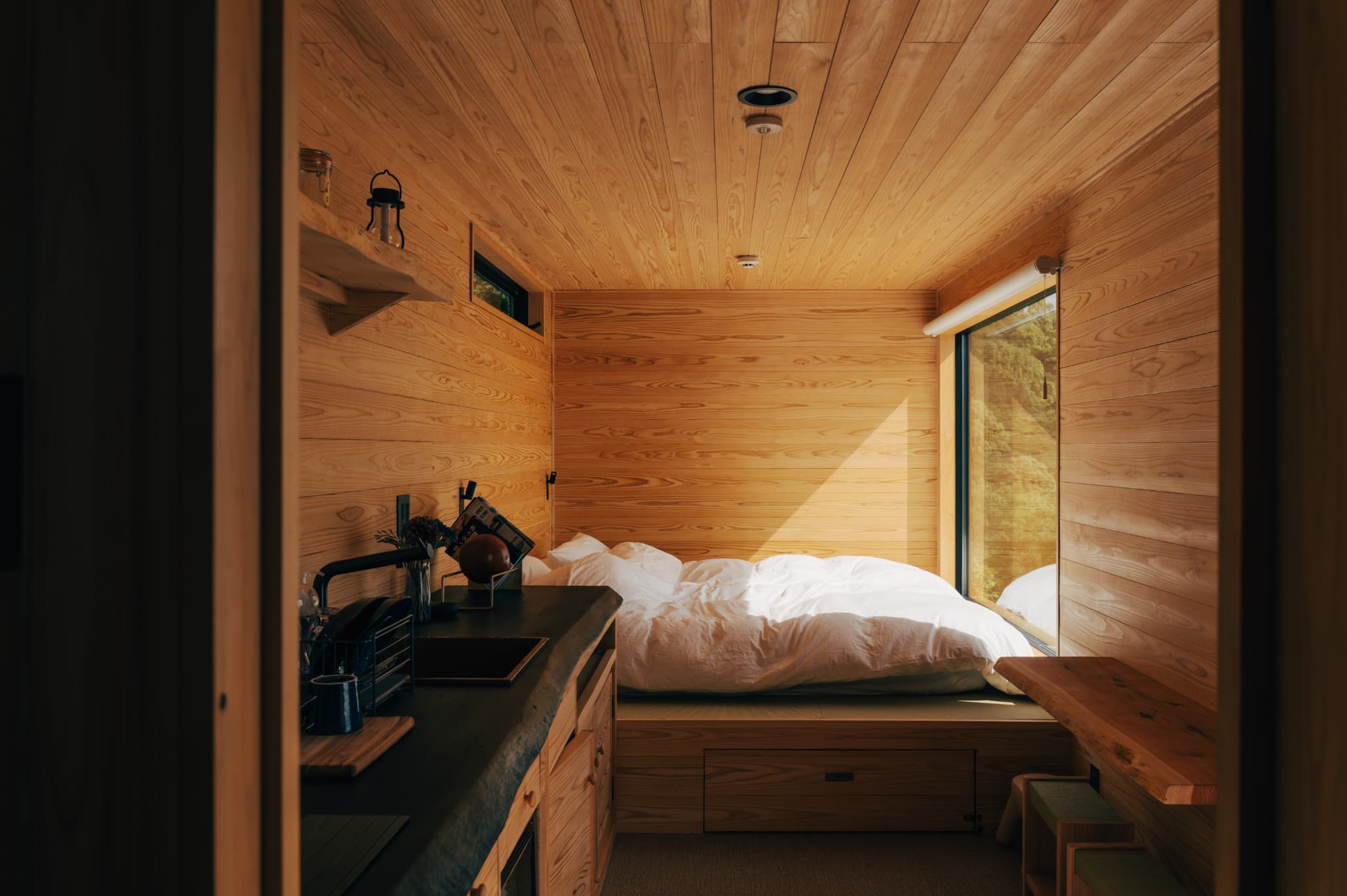
Atami has overwhelming accessibility — just 40 minutes from Tokyo by Shinkansen — while still being a place blessed with rich nature and views. We saw enormous potential in it as a stage for outdoor hospitality.
At the same time, Atami carries a strong image of hot springs and sightseeing, and there are almost no facilities offering an outdoor experience. We felt that gap was exactly where there was room for us.
When we choose a property, what we prioritize is, fundamentally, a place that is not a tourist destination. Atami is a tourist destination, but the ACAO FOREST area sits a little away from the center of town — quiet, up on a hillside, removed from the bustle of the hot-spring district and wrapped in stillness and nature.
The same applies to our trailer house in Isumi, Chiba: deliberately choosing places that are not “meccas of the outdoors” is directly connected to our thinking as a brand.
Our concept is “your own second home in nature, somewhere you can come back to casually, again and again.” If you put that in the middle of a tourist area, guests end up feeling they have to go sightseeing because they came all that way. We want it to be a place where simply being there feels like enough.
Somewhere you can drop in without any particular purpose and switch off in the middle of nature. Those are the places we look for.
—— Your concept of “outdoors close to the city, close to the station” — what needs or frustrations among urban residents did it come from?
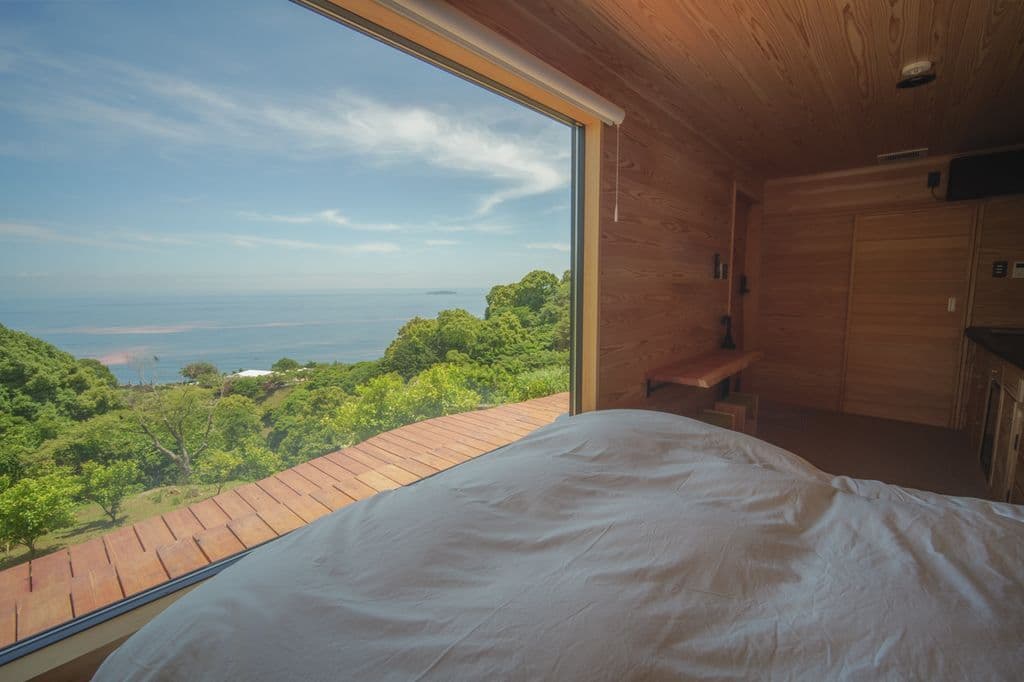
Japan has a characteristic that is rare anywhere in the world: you can reach nature without a car.
Zoom out a little and Tokyo is one of the world’s largest metropolitan areas, with a population of roughly 37 million. In megacities of similar scale — New York, London, Shanghai — getting to a quiet forest or coastline without a car means hours in traffic, or a complicated chain of transfers.
In Tokyo, though, you board the Tokaido Shinkansen and go from the concrete jungle around Tokyo Station to the volcanic coastline of Atami in a very short time. Look around the world and you rarely find that kind of environment.
The concept traces back to a formative experience of our CEO. While living in Kyoto as a student, he once traveled to the coast of Aichi to go surfing using only trains. Without a car, he could still catch waves on an empty beach. He says he never forgot that experience.
“In Japan the outdoors is this close at hand, and yet many people still haven’t noticed its value.” That intuition is the origin of the concept.
Glamping and luxury resorts are wonderful, but at four hours each way and ¥50,000 per person, they are hard to place in the extension of everyday life. We want to offer an experience at half the distance and half the budget, and twice the enjoyment.
Nature shouldn’t be reserved for special occasions; it can be an option much closer to daily life. We wanted to create a place where you don’t have to worry about the taxi fare or be tied to a schedule — where you can simply be there, with the same sense of adventure you had as a child.
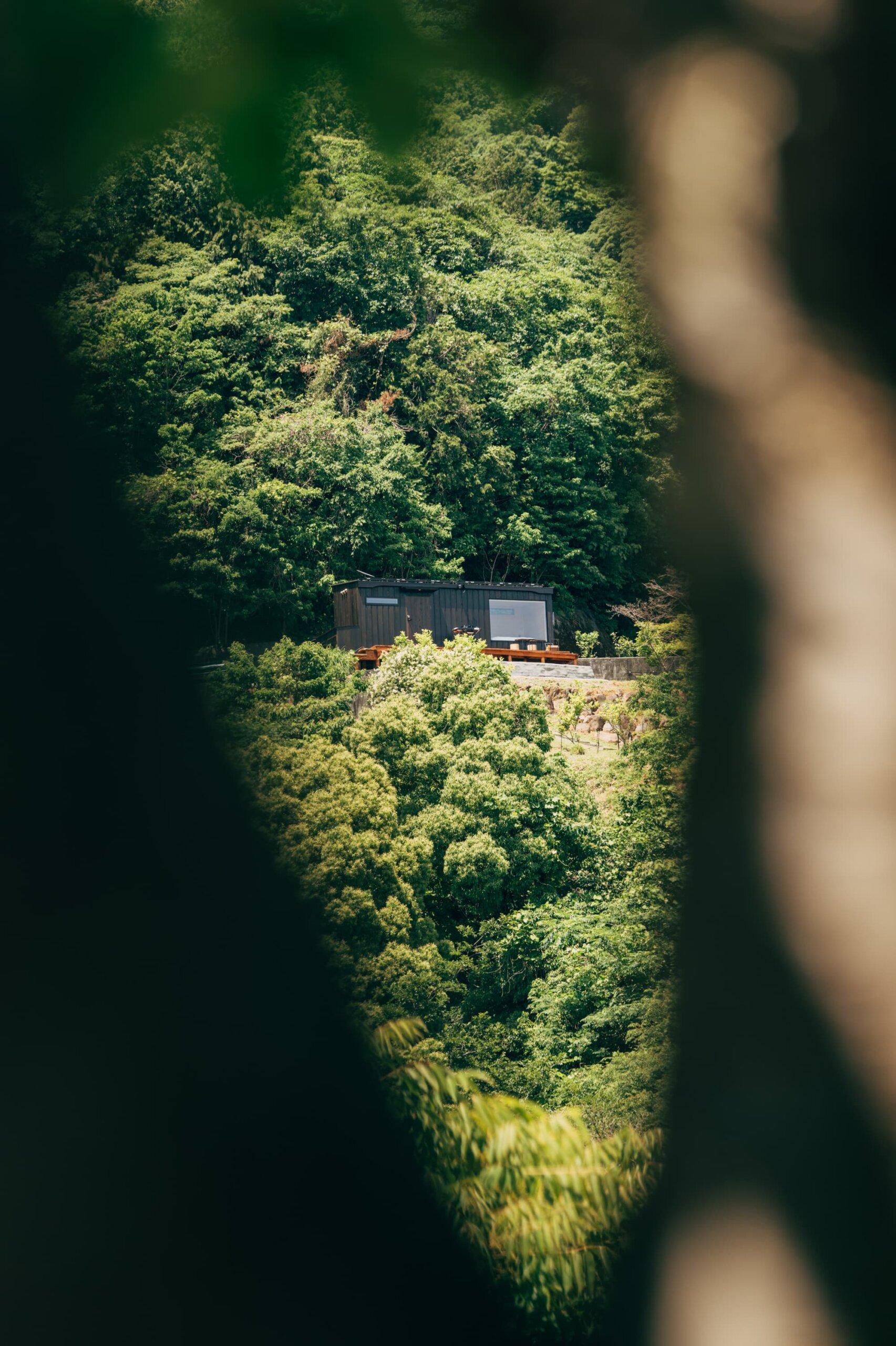
—— As a wooden trailer house limited to one group per day, what way of spending time do you most want guests to experience?
Broadly, I’d say it comes down to food and time.
We all cook at home every day, but a meal made together over a barbecue or a bonfire is an entirely different experience. In the dark, with only lantern light to go by, feeling the sound of the wind, the stars, the moon, the smells — you enjoy the act of eating with all five senses. That’s a moment you rarely get in ordinary life.
There is actually a scientific basis for this. When visual information is restricted in darkness, the brain is said to reallocate the spare neural processing resources to smell and taste — a phenomenon known as sensory compensation. As a result, smell and taste can feel sharper than usual.
On top of that, the organic compounds in bonfire smoke — guaiacol and syringol, for example — are aromas that bond easily with memory and emotion. I think that’s part of why eating around a fire stays with you so strongly.
*Bonfires are currently offered at the Isumi property. ACAO FOREST 01 opened on June 20, 2026, so its experience menu will be expanded in stages.
—— What was the aim behind the self-sufficient energy setup combining solar generation, battery storage, and V2H, and what does it mean for the guest experience?
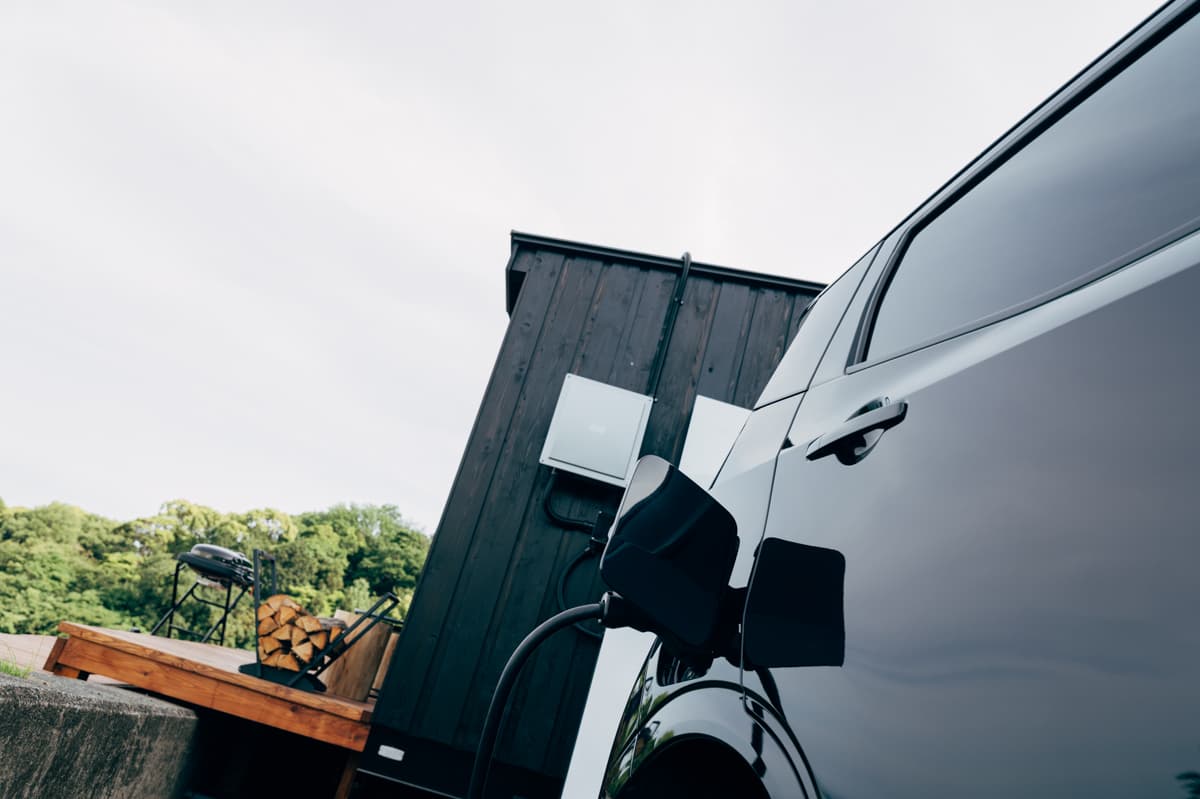
To be honest, we didn’t set out from the beginning with a plan to go off-grid.
On the ACAO FOREST site, bringing in electricity and sewerage was difficult. The reality is that we had little choice but to adopt a self-sufficient system combining solar generation, battery storage, and V2H.
As it turned out, though, nothing could have fit our brand thinking better.
We hold “Phase Free” certification, and our concept is that the property functions as a cabin hotel in normal times and as a disaster shelter in an emergency. Being able to operate even if the power grid goes down is the most concrete proof of that idea.
It was something you might call an inevitable accident, but off-grid operation is now at the core of the brand.
—— Through “Mori no Yado | ACAO FOREST,” what kind of nature-based stay does A Cabin Company, Inc. want to propose going forward?
Japan has wonderful nature resorts and glamping facilities, but I feel a “third option” that should sit between them has been missing all along.
Not as heavily outdoors-flavored as a tent or glamping. But not cut off from nature the way a resort hotel is, either. Think of a luxury hotel bedroom rebuilt in timber and natural materials and set down as it is in the middle of a forest. You barbecue, gather around a fire, and sleep at hotel quality while listening to the waves and the birds. I don’t think that experience has really existed in Japan until now.
Once we actually opened, most of the people who came turned out to be outdoor beginners. We’re seeing real signs that people with no background in camping or glamping are emerging as a new guest segment.
Our target was young Japanese travelers in their twenties and thirties living in the Kanto region. Hotel prices have risen with the surge in inbound demand, the weak yen has put overseas travel further out of reach, and prices keep climbing while wages don’t. Precisely because of that era, we want people to enjoy their own country’s nature more casually, and more often. We wanted to build a place for them.
Going forward, we plan to expand our locations mainly across the Kanto and Kansai regions, and eventually we have overseas markets such as South Korea in view.
Turning “staying in nature” from a special event into one of the ordinary options available to people — that’s what we’re aiming for.
■ Property Overview
Name: Mori no Yado | ACAO FOREST (森の宿|ACAO FOREST)
Operator: A Cabin Company, Inc.
Address: 1027-8 Kamitaga, Atami, Shizuoka (inside ACAO FOREST)
Capacity: 2 guests
Size: approx. 16 m²
Rate: from ¥15,000 per person per night (tax incl.; varies by season and day of week)
Check-in / Check-out: 16:00 / 12:00
Main specifications and amenities: queen-size bed, kitchen, toilet, shower, air conditioning, outdoor wood deck, Starlink Wi-Fi
Parking: free dedicated parking adjacent to the cabin
Official site: https://acabincompany.airhost.co/ja/houses/808646
Rates and Plans at Mori no Yado | ACAO FOREST (Atami)
Rates at Mori no Yado | ACAO FOREST start at ¥15,000 per person per night (tax incl.) and vary by season and day of the week. With a capacity of two guests, a two-person stay works out to roughly ¥30,000 and up for the whole cabin. Because the property takes only one group per day, there is never more than a single unit on sale. How far this format of whole-unit rentals and very small room counts has spread across Japan’s new supply is analyzed in detail in Vacation Rentals Take 45% of Japan’s 2026 New Hotel Openings (247 Villas).
| Indicative rate | From ¥15,000 per person per night (tax incl.; varies by season and day of week) |
|---|---|
| Meals | No meals served (room only). Barbecue available on the outdoor wood deck (full gas BBQ equipment included). Guest-only plans are offered at the restaurant and bar inside the park |
| Check-in / Check-out | 16:00 / 12:00 |
| Park admission | ACAO FOREST admission ticket included. Overnight guests may also spend time in the gardens before opening and after closing hours |
No meal-inclusive plans are offered. The standard pattern is to cook in the room’s kitchen (two IH burners with a full set of cookware), barbecue on the deck, or use the restaurants inside the park.
Booking and Access (Getting There from Atami Station)
Reservations are taken through the official booking page. With only one group per day, it is advisable to check availability early if you have a specific date in mind. Capacity is capped at two people in total, including day visitors.
| Address | 1027-8 Kamitaga, Atami, Shizuoka (inside ACAO FOREST, in the lemon-grove area overlooking Sagami Bay) |
|---|---|
| Train + bus | About 40 minutes from Shinagawa Station to Atami Station by Shinkansen. From JR Atami Station, take the local bus and get off at “Akao Forest” |
| Taxi | About 15 minutes from Atami Station |
| Car | Free dedicated parking adjacent to the cabin |
Room and Facilities (Wooden Trailer House Specifications)
The accommodation is a single wooden trailer house of approximately 16 m² for two guests. Tama-grown hinoki cypress and cedar are used throughout, from the structure to the interior, and the unit is fitted with one queen-size bed. Having hotel-grade bathroom facilities inside the room is the major difference from tent-style glamping properties. For background on the supply picture for glamping and cabin-type properties, and how depreciation is treated depending on structural classification, see Glamping Depreciation 4 vs 39 Years: 1.0-Year Payback Gap, 1,976 Sites.
- Bed: one queen-size bed
- Kitchen: two IH burners, full set of cookware
- Bathroom: separate flush toilet, shower room
- Climate and connectivity: air conditioning, Starlink Wi-Fi
- Outdoors: wood deck (chairs and table), full set of gas BBQ equipment
- Power: self-sufficient (off-grid) energy operation via solar panels, battery storage, and V2H
Because power does not depend on the grid, the property is built to a “Phase Free” design that works as a cabin hotel in normal times and as a disaster shelter in an emergency. The park also has restaurants, cafés, and workshop spaces available to guests during their stay.
Related Reading
- Shizuoka’s 67 New 2026 Hotels: 1,089 Rooms, 64% One-Room Villas
- [April 2026] Mid-Scale Properties Drive Sustainable Supply: Atami’s New Hotel Pipeline
- Vacation Rentals Take 45% of Japan’s 2026 New Hotel Openings (247 Villas)
- Glamping Depreciation 4 vs 39 Years: 1.0-Year Payback Gap, 1,976 Sites
- Shizuoka Ryokans: What “Full” Inns Name Differently (N=409)
- Eastern Shizuoka Hotel ADR: Numazu ¥7,290 vs Mishima ¥8,216
- Japan 2026: 1,242 Openings, 33,749 Rooms — 47% Villas, 42% Business