

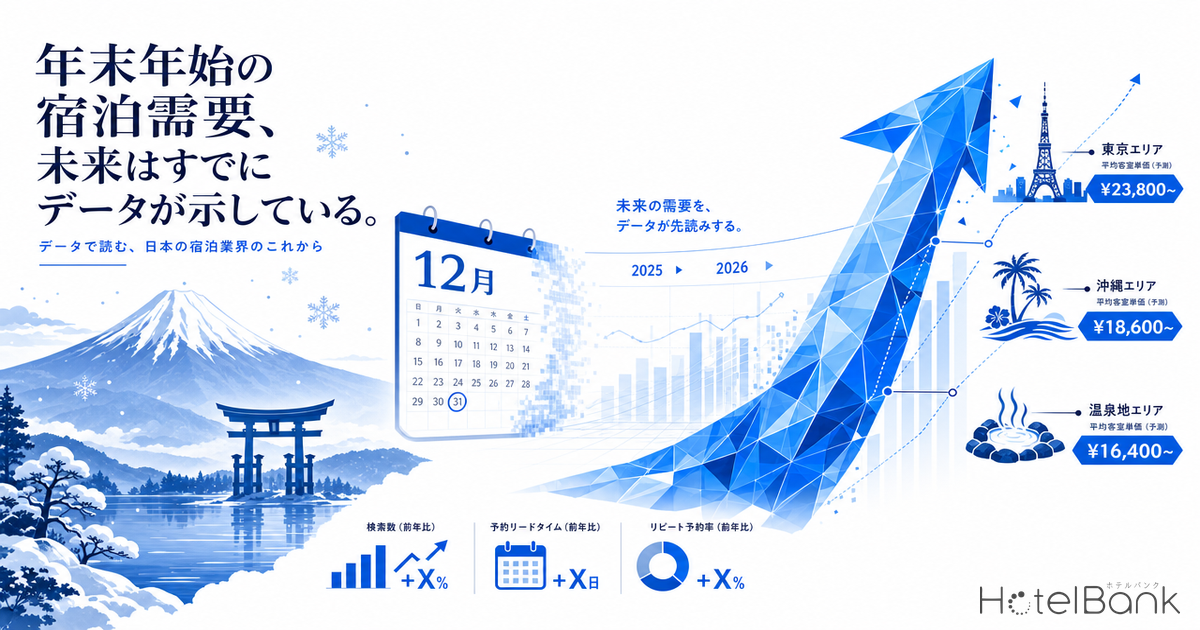
Year-end and New Year room rates are, in fact, already “visible” months in advance as the listed selling prices on OTAs. Even before the booking peak arrives, aggregating the level at which each property is releasing its December inventory reveals the broad direction of this season’s pricing. In this article, we use the estimated transaction ADR compiled by MetroEngines Research to examine the December 2026 forward ADR for major cities and resort areas, comparing it against the prior-year (December 2025) actuals.
Metric Definitions Used in This Article
- ADR (Average Daily Rate): The estimated transaction rate (tax-exclusive equivalent) calculated by applying a property-type correction coefficient to the lowest-plan level each property publishes on OTAs (for double occupancy, one room, per-room rate, tax-included). Against property-level actuals disclosed by listed hotel REITs (91 properties, most recent 3 months), the median error is approximately 7%. These are estimates and differ from each property’s actual transaction prices or accounting figures. Area-level ADR is the median of the target properties (the level of a standard property in that area).
- Forward ADR: For a future month whose check-in date has not yet arrived, the estimated transaction ADR calculated from the selling prices published on OTAs at the time of the survey. It fluctuates as bookings progress. The prior-year same month uses finalized actual values (history).
- YoY (vs Prior-Year Actual): December 2026 forward ADR (estimate) ÷ December 2025 actual ADR. This is a year-over-year same-month comparison, not a month-over-month one.
- Data Source: MetroEngines Research
- — Hokkaido +37.1% — the standout among the 10 areas. Resort-type areas post larger gains than urban ones.
- — Urban areas are also on an upward trend — Tokyo +12.4%, Aichi +26.8%, and Fukuoka +13.6%, with forward ADR exceeding prior-year actuals.
- — Kyoto plateaus at +0.7% — high-ADR areas see narrower gains as a reaction to last year’s steep rise.
- — Shizuoka −2.1% is the only area below prior year — an exceptional soft spot among the 10 areas.
- — Year-end pricing is visible months ahead — the forward estimated transaction ADR lets you read this season’s direction in advance.
December Forward ADR Across 10 Areas — The Big Picture
First, for 10 areas covering major cities and resorts, we lined up the December 2026 forward estimated transaction ADR against the prior-year same-month actuals. Overall, many areas are publishing prices above the prior year, confirming that year-end room rates remain on an upward trend this season as well. Hokkaido in particular stands out at +37.1% YoY, and a tendency for resort-type areas to post larger gains than urban ones is evident.
Source: MetroEngines Research; compiled by the HotelBank Editorial Team
On the other hand, some areas remain at levels where the rise has paused or is slightly below the prior year, such as Kyoto at +0.7% and Shizuoka at −2.1%. Kyoto rose sharply by +13.2% from two years ago (December 2024) to last year (December 2025), and as a reaction, its room for further price growth may be relatively small. In other words, not every area is rising uniformly; differences in this season’s pricing emerge according to the strength of demand and the degree of past increases.
| Area | Dec 2025 Actual | Dec 2026 Forward | YoY | N (Forward) |
|---|---|---|---|---|
| Hokkaido | ¥9,400 | ¥12,900 | +37.1% | 647 |
| Aichi | ¥9,100 | ¥11,500 | +26.8% | 361 |
| Fukuoka | ¥12,800 | ¥14,600 | +13.6% | 398 |
| Tokyo | ¥15,800 | ¥17,800 | +12.4% | 941 |
| Okinawa | ¥10,900 | ¥12,000 | +10.6% | 438 |
| Osaka | ¥11,100 | ¥11,800 | +5.9% | 545 |
| Kanagawa | ¥15,300 | ¥16,200 | +5.9% | 413 |
| Nagano * | ¥14,100 | ¥14,600 | +3.5% | 473 |
| Kyoto | ¥17,900 | ¥18,000 | +0.7% | 462 |
| Shizuoka | ¥15,500 | ¥15,200 | -2.1% | 578 |
* Nagano’s forward sample size (N=473) is only about 56% of the sample base for the prior-year actual, giving it thinner coverage than other areas. As this is a month still in the process of being listed, note that the level may fluctuate as coverage expands. Source: MetroEngines Research; compiled by the HotelBank Editorial Team
Urban vs. Resort — Which Drives the Gains?
When we broadly divide YoY into urban-type (Tokyo, Osaka, Kyoto, Fukuoka, Aichi, Kanagawa) and resort/tourism-type (Hokkaido, Okinawa, Nagano, Shizuoka), a structural difference in the distribution of gains comes into view. Hokkaido’s standout is largely driven by the ski resort areas discussed below. Okinawa also maintains double-digit growth at +10.6%, hinting at the strength of demand heading to southern resorts over the year-end and New Year period. The pricing structure of resort areas such as Niseko and Okinawa shares much in common across seasons; for a same-area comparison in summer, see our detailed analysis in Summer Resort 3-Region Comparison 2026: Niseko, Okinawa, Karuizawa.
Among urban types, Tokyo is solid at +12.4%, holding roughly the same pace of increase as last year (+12.0%). Aichi’s +26.8% is exceptionally large for an urban type. Because the December rise in the Nagoya area last year was relatively gentle (+8.7%), forward prices may be being pushed up this season in a catch-up fashion. Osaka, meanwhile, has settled down at +5.9%, decelerating from +10.0% the prior year.
Source: MetroEngines Research; compiled by the HotelBank Editorial Team
Hokkaido’s +37% — Ski Resorts Lead the Charge
Breaking down Hokkaido’s overall +37.1% to the municipal level makes it clear that the gains are concentrated in ski and snow resorts. In Kutchan Town, the core of the Niseko area, the December 2026 forward ADR is an estimated ¥48,800 — the highest level in the prefecture — up +35.2% YoY. Kamikawa Town, home to Sounkyo and Asahidake, is up +68.3%, and Furano City is up +9.9%, with inbound demand seeking snow strongly reflected in prices.
The winter season starting from the year-end and New Year period is when inbound visitors seeking powder snow concentrate. Niseko Village’s 2026-27 season is scheduled to operate from November 28, 2026 to April 4, 2027, and the structure whereby room rates jump sharply as the high season begins in late December remains unchanged this season as well. In addition, an accommodation tax was introduced in Niseko Town and Hokkaido in April 2026, and such incidental cost changes could also affect future price formation. For how Hokkaido’s winter demand, with Niseko at its apex, has built up, our GW2026 Hokkaido Hotel Price Analysis tracks the price movements in the first half of the season.
Source: MetroEngines Research; compiled by the HotelBank Editorial Team
The urban Sapporo (Chuo Ward) is up +12.5% and Chitose City up +23.4% — solid gains, though not to the degree of the resort areas. It can be read that Hokkaido’s year-end demand, while peaking at high-end ski resorts like Niseko and Sounkyo, is also spreading to the gateways of New Chitose and Sapporo.
Viewed Through Seasonality — Where Does December Sit in the Year?
To evaluate the level of forward ADR, it helps to grasp where December sits within the year’s seasonality. Below, for Tokyo, Hokkaido, and Okinawa, we show the monthly estimated transaction ADR overlaid by year. The X-axis runs from January to December, and the higher the line’s year, the more recent it is. Note that from October 2026 onward, the figures are forward estimates (based on the listing level at the time of the survey).
Source: MetroEngines Research; compiled by the HotelBank Editorial Team
Tokyo has two peaks — the spring cherry-blossom season (March–April) and the autumn foliage season (October–November) — with December sitting slightly below that autumn peak. Even so, in each year December’s level clearly exceeds the prior December, showing that year-end demand is not a seasonal trough but a firm demand period. Hokkaido, conversely, is a twin-peak type with peaks in summer (July–September) and winter (December onward), and its ramp-up from December is growing sharper year by year. Okinawa, with relatively small swings throughout the year, gradually steps up its level toward December.
What It Means That Prices Can Be Read
Year-end room rates come into focus, in terms of direction, by aggregating the selling prices published on OTAs even before the booking peak arrives. This examination confirmed forward ADR above prior-year actuals in many areas, and in particular a tendency for resort/tourism-type areas to post larger gains than urban ones surfaced. The picture is one where inbound demand seeking snow, led by Hokkaido’s ski resorts, strongly drives price formation. For the substance of the high-ADR inbound demand pushing up ADR in popular areas such as Kyoto, Hokkaido, and Okinawa, our piece on Singapore inbound visitors’ high-ADR condominium demand digs into the background.
That said, some areas such as Kyoto and Shizuoka have seen their rise pause, and this season’s outcome varies depending on the degree of past increases and the quality of demand. For accommodation operators, grasping early on where their own area’s forward level sits relative to surrounding markets can serve as one clue in year-end pricing. Forward ADR is ultimately an estimate at the time of the survey and fluctuates as bookings progress. On the premise that it is not a finalized value, it is best used as material for grasping the general direction of prices.
⚠ Note on Future-Dated ADR: The December 2026 forward ADR in this article is an estimated transaction ADR (an estimate) calculated from the selling prices published on OTAs at the time of the survey, and is not a finalized value. As the check-in date approaches, it fluctuates due to the addition of new plans and price adjustments. Prices set high at present could fall through last-minute discounting, or conversely rise as inventory is absorbed. The figures for the prior year (December 2025) are finalized actual values. Forward aggregation tends to have a thinner target sample size (N) than actual months, and this article appends a note for Nagano, whose sample fell below 60% of the prior-year actual base.
Related Reading
- Summer Resort 3-Region Comparison 2026: Niseko, Okinawa, Karuizawa — ADR, Booking Pace & FX Sensitivity
- Singapore Inbound 2026 Summer — High-ADR Condominium Demand Pushes Up Kyoto / Hokkaido / Okinawa ADR
- GW2026 Hokkaido Hotel Price Analysis — Niseko +29% and the Background of Surging Demand
- JTA 2025 Final Value 61.6% — Contrasting H1 2026 ADR Realities by Property Type
References & Sources
- MetroEngines Research — estimated transaction ADR based on OTA published price data; December 2024–2026 trends for 10 areas
- [2026] Accommodation Industry Trends — Current State and Outlook (Yadoken)
- Year-End & New Year Hotel/Ryokan Vacancy Calendar 2026-2027 (Nippon Travel Agency)
- Niseko Village Ski Resort 2026-27 Season Operating Information (Official)
- 2025 Review: Accommodation Industry Inbound Trends Report and 2026 Trends (IMJ)