

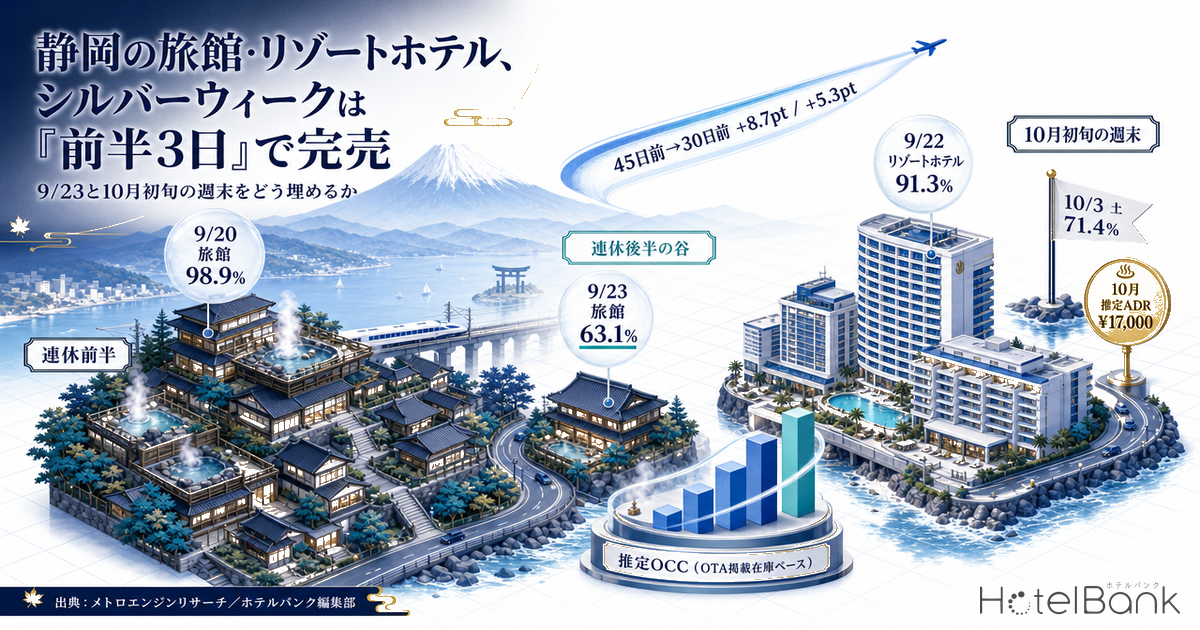
Japan’s five-day Silver Week runs from Saturday, September 19 to Wednesday, September 23, 2026 — the first such run in eleven years. Looking at estimated occupancy (OTA-listed-inventory basis) for ryokan and resort hotels in Shizuoka, those five days are anything but uniform. Sunday, September 20, the middle of the break, is effectively sold out at 98.9% for ryokan and 99.4% for resort hotels, while September 23 (Wednesday, Autumnal Equinox Day) — a public holiday inside the same run — sits at just 63.1% for ryokan and 74.0% for resort hotels. That is a 35.8-point gap for ryokan. Add Thursday, September 24 at 68.3%, Friday, September 25 at 65.6%, and the first Saturday of October, October 3, at 71.4% (all ryokan), and the remaining upside is concentrated not in the peak days but in the back half of the holiday and the first part of October. This article works through how to fill those troughs, using booking-progress data.
Scope: ryokan and resort hotels in Shizuoka Prefecture. Booking curve N=414 ryokan and 135 resort hotels; estimated settled ADR N=451 ryokan and 149 resort hotels. Price figures in this article are estimated settled ADR (the transaction-price level inferred from OTA and related sales data, tax-exclusive equivalent); occupancy figures are estimates on an OTA-listed-inventory basis. Full definitions appear at the end of the article. Data as of September 5, 2026.
- — The five-day break is really “three days plus two”: September 19-21 runs 90.3-98.9% for ryokan and 92.5-99.4% for resort hotels — effectively sold out. September 22 sits at 82.6% / 91.3% and September 23 at 63.1% / 74.0%, leaving them as a different kind of day.
- — Trough days also have a flatter slope: pickup from 45 days out to 30 days out was +8.7 points for September 20, versus +5.3 for September 23 and +4.3 for September 25. Waiting structurally delivers less on these dates.
- — Late demand has not stalled: ryokan on September 23 gained 4.0 points over the last seven days (about 0.6 points per day). Whether the remaining days get used is the deciding factor.
- — October is the rate peak: on current estimates, ryokan October at ¥17,000 exceeds September’s ¥16,300. Filling late September with discounts pulls October’s pricing down with it.
- — Mid-October is still undecided: Saturday, October 17 has moved from 69.1% at 45 days out to 69.7% most recently — essentially flat. It is too early to read the current level as weakness.
Silver Week is over after the first three days
Start with the shape of the holiday. Category splits follow our own property classification, and “ryokan” and “resort hotels” are tabulated separately (they are not combined).
Across Saturday September 19, Sunday September 20 and Monday September 21 (Respect for the Aged Day), ryokan run 90.3%, 98.9% and 98.2%, and resort hotels 92.5%, 99.4% and 99.1%. The sell-out rate (the estimated share of properties with no listed inventory on OTAs or similar channels) reaches 88.4% for ryokan and 87.4% for resort hotels on September 20. With 15 to 17 days to go before the stay, the market as a whole has essentially no inventory left on those three days.
The change starts on day four. Tuesday, September 22 is a “citizens’ holiday” wedged between Respect for the Aged Day and the Autumnal Equinox, and is a public holiday on the calendar — yet ryokan sit at 82.6% and resort hotels at 91.3%, down 15.6 points and 7.8 points respectively from September 21. Day five, Wednesday September 23 (Autumnal Equinox Day), comes in at 63.1% for ryokan and 74.0% for resort hotels. Despite being a holiday, it falls well below the weekend level immediately preceding it. The structure is visible directly in the numbers: the last day of a break is a travel-home day, and lodging demand behaves much as it does on a weekday. This back-half dip is not specific to Shizuoka — Silver Week 2026 Back Half at T-47 shows the same pattern at a 47-days-out fixed point, with September 23 stuck at the level of an ordinary Wednesday.
Worth noting is that the trough runs deeper for ryokan than for resort hotels. By September 22, ryokan have fallen to 82.6% while resort hotels hold 91.3%. Sell-out rates on September 22 are nearly level at 35.4% for ryokan and 37.0% for resort hotels, but the occupancy gap is 8.7 points. The reading: stay-type inventory built around multi-night stays carries demand into the back half of the holiday, whereas inventory weighted toward one-night stays is concentrated in the front half.
Source: MetroEngines Research; compiled by the HotelBank Editorial Team
After the holiday: Thursday September 24 at 68.3%, Friday September 25 at 65.6%, and Saturday September 26 at 75.5% (all ryokan). A final-week September Saturday at 75.5% is 23.4 points below September 20’s 98.9% — a level with room left to sell. For how the same Shizuoka market travelled into September, Shizuoka Post-Obon Inventory tracks the pickup over the final 15 days.
Booking progress, late September through mid-October
Progress by stay date is shown below at three cross-sections: 45 days out, 30 days out, and the latest observation. Booking curves are based on observations from 45 days before the stay date up to the present.
| Stay date | Day | Days left at latest obs. |
Ryokan T-45 |
Ryokan T-30 |
Ryokan latest |
Ryokan sell-out rate |
Resort T-45 |
Resort latest |
Resort sell-out rate |
|---|---|---|---|---|---|---|---|---|---|
| Sep 19 | Sat | 15 | 71.8% | 79.1% | 90.3% | 54.1% | 75.6% | 92.5% | 42.2% |
| Sep 20 | Sun | 16 | 82.5% | 91.2% | 98.9% | 88.4% | 87.3% | 99.4% | 87.4% |
| Sep 21 | Mon, Respect for the Aged Day | 17 | 79.2% | 89.8% | 98.2% | 85.2% | 84.2% | 99.1% | 83.7% |
| Sep 22 | Tue, Citizens’ Holiday | 18 | 64.9% | 70.8% | 82.6% | 35.4% | 73.5% | 91.3% | 37.0% |
| Sep 23 | Wed, Autumnal Equinox Day | 19 | 52.6% | 57.9% | 63.1% | 22.8% | 62.5% | 74.0% | 6.7% |
| Sep 24 | Thu | 20 | 59.0% | 63.5% | 68.3% | 33.3% | 66.8% | 77.1% | 12.6% |
| Sep 25 | Fri | 21 | 56.1% | 60.4% | 65.6% | 17.9% | 71.1% | 77.3% | 9.6% |
| Sep 26 | Sat | 22 | 64.7% | 71.6% | 75.5% | 21.5% | 75.1% | 83.0% | 20.0% |
| Oct 3 | Sat | 29 | 64.9% | 71.1% | 71.4% | 20.1% | 71.6% | 79.9% | 8.9% |
| Oct 10 | Sat | 36 | 73.8% | — | 77.6% | — | 78.4% | 82.2% | — |
| Oct 11 | Sun | 37 | 68.0% | — | 71.1% | — | 72.2% | 75.6% | — |
| Oct 12 | Mon, Sports Day | 38 | — | — | 60.1% | — | — | 71.3% | — |
| Oct 17 | Sat | 43 | 69.1% | — | 69.7% | — | 73.3% | 73.6% | — |
All figures are estimated OCC (OTA-listed-inventory basis). “Latest” is the most recent observation up to September 4, 2026. Sell-out rate is shown only for stay dates within 30 days. October 12 is not shown at 45 days out because the observed property count was too small to be more than a reference value.
Source: MetroEngines Research; compiled by the HotelBank Editorial Team
On trough days, the slope of pickup itself is flatter
This is the point that matters most in practice. Peak days and trough days differ clearly in how much they pick up as the stay date approaches. Looking at ryokan pickup over the 15 days from 45 days out to 30 days out, September 20 gained +8.7 points, against +5.3 points for September 23 and +4.3 points for September 25. Trough days are not only lower in absolute level — the speed at which demand accumulates is roughly half.
In other words, the expectation that “the trough days will fill up closer in as well” is not supported by the Shizuoka data for this period. Wait the same number of days and structurally less gets filled. Read the other way: on trough days, the more you act rather than wait, the more the difference shows.
Source: MetroEngines Research; compiled by the HotelBank Editorial Team
Isolate the last week alone, though, and the picture shifts somewhat. Ryokan on September 23 added 4.0 points over the last seven days (59.1% to 63.1%), and September 25 added 4.5 points (61.1% to 65.6%) — a pace of around 0.6 points per day. Over the same window October 3 added 2.8 points (68.6% to 71.4%) and October 10 added 3.2 points (74.4% to 77.6%). Demand has not stopped; late bookings are reliably coming in. From here, the deciding factor is whether the remaining days get used.
For October, Saturday the 10th at 77.6% is above Saturday the 3rd at 71.4%, a relatively strong start as the opening day of a three-day weekend. The final day of that break, Monday October 12 (Sports Day), sits at 60.1% for ryokan and 71.3% for resort hotels. The same final-day dip seen over the September holiday is already taking shape for October’s three-day weekend. Saturday, October 17 is at 69.7% for ryokan and 73.6% for resort hotels, barely moved from 69.1% and 73.3% at 45 days out — placing it just short of the point where bookings start to accumulate in earnest.
Setting a landing level from days remaining and pace
The figures so far describe where things stand today. What practice needs is where they will land, and that can be set with just two variables: days remaining x daily pickup pace. The table below starts from estimated OCC at the latest observation, runs the pace across four steps from 0.2 to 0.8 points per day, and multiplies by the days remaining to the stay date. The bolded cell in each row is the column closest to that date’s actual pace over the last seven days.
| Stay date | Category | Latest est. OCC |
Days left |
Actual pace, last 7 days (pt/day) |
0.2 pt/day | 0.4 pt/day | 0.6 pt/day | 0.8 pt/day |
|---|---|---|---|---|---|---|---|---|
| Sep 23 (Wed, Autumnal Equinox Day) | Ryokan | 63.1% | 19 | 0.57 | 66.9% | 70.7% | 74.5% | 78.3% |
| Sep 25 (Fri) | Ryokan | 65.6% | 21 | 0.64 | 69.8% | 74.0% | 78.2% | 82.4% |
| Oct 3 (Sat) | Ryokan | 71.4% | 29 | 0.40 | 77.2% | 83.0% | 88.8% | 94.6% |
| Oct 12 (Mon, Sports Day) | Ryokan | 60.1% | 38 | 0.37 | 67.7% | 75.3% | 82.9% | 90.5% |
| Oct 17 (Sat) | Ryokan | 69.7% | 43 | 0.46 | 78.3% | 86.9% | 95.5% | 100.0% (capped) |
| Sep 23 (Wed, Autumnal Equinox Day) | Resort hotel | 74.0% | 19 | 0.57 | 77.8% | 81.6% | 85.4% | 89.2% |
| Oct 3 (Sat) | Resort hotel | 79.9% | 29 | 0.67 | 85.7% | 91.5% | 97.3% | 100.0% (capped) |
| Oct 12 (Mon, Sports Day) | Resort hotel | 71.3% | 38 | 0.31 | 78.9% | 86.5% | 94.1% | 100.0% (capped) |
Note: this is simple linear extrapolation, not a market forecast. Actual pickup tends to accelerate as the stay date nears (ryokan on September 23 added 0.35 points per day from 45 to 30 days out, then 0.47 points per day to the latest observation), so for October 12 and October 17 — both more than 30 days out — the levels here run conservative. Use it as a yardstick for setting your own target and translating the gap from today into “how many points over how many remaining days.”
Source: MetroEngines Research; compiled by the HotelBank Editorial Team
Reading it is straightforward. Ryokan on September 23 stand at 63.1% with 19 days left; if the actual pace (0.57 points per day) holds, they land around 74%. That falls short of the 98%-plus of the first three days, but it is also not a level that “ends in the low 60s if nothing is done.” Apply the same view to October 12 — 60.1% with 38 days left — and the actual pace lands around 74% as well. With more days in hand, a pace of 0.6 points per day would reach 82.9%. Put simply, the late-September trough is a “not enough days left” problem and the mid-October trough is a “will the pace hold” problem, and the remedies differ in kind. The former means moving inventory and product conditions this week; the latter means building demand over the next three to five weeks.
Day-of-week structure and price level: is there room to fill without cutting rates?
To put the holiday trough in the context of weekday demand, consider actual day-of-week estimated OCC for the most recent completed months. In Shizuoka in July 2026, ryokan ran 92.5% on Saturdays against 75.0% on Thursdays (a 17.5-point gap), and resort hotels 94.0% on Saturdays against 78.8% on Wednesdays (15.2 points). August 2026 lifted everything as peak season, narrowing the ryokan gap to 6.0 points — 92.4% on Saturdays against 86.4% on Thursdays. From late September into October, the natural expectation is a return to the July type rather than the August type: a 15-17 point weekday trough. The current levels of 68.3% on September 24 (Thu) and 65.6% on September 25 (Fri) are exactly that weekday trough, compounded by the post-Silver Week pullback.
Now the price side. Overlaying years of monthly estimated settled ADR for Shizuoka, and comparing confirmed months against confirmed months: ryokan came in at ¥16,700 in July 2026 (N=457 properties) versus ¥17,500 a year earlier (N=449), down 4.4%; resort hotels at ¥16,300 in July 2026 (N=151) versus ¥17,900 (N=132), down 8.9%. June was similar, at -3.6% for ryokan and -7.2% for resort hotels, so the most recent confirmed months have landed slightly below the prior year.
Source: MetroEngines Research; compiled by the HotelBank Editorial Team
On estimates from current sales conditions, meanwhile, Shizuoka ryokan stand at ¥16,300 for September 2026 (N=451 properties) against ¥17,000 for October (N=426). Resort hotels are at ¥17,200 for September (N=149) and ¥17,200 for October (N=144). (Both are estimates based on current sales conditions and will move with future sales; a straight comparison against confirmed figures for past months has to wait for month-end confirmation.) Ryokan have October set above September — a market view that treats the autumn leisure season as the rate peak. With the occupancy trough in late September and the rate peak in October, filling late September through straight discounting risks carrying through into October’s pricing. Which month the autumn rate peak falls in varies by prefecture; Japan Autumn ADR 2026 sorts the patterns out.
For revenue managers running ryokan and resort hotels in Shizuoka: implications and an action plan
(1) Manage the break as “three days plus two,” not as five days. Market-wide, the three days from September 19 to 21 reach 90.3-98.9% for ryokan and 92.5-99.4% for resort hotels, leaving September 22 (82.6% / 91.3%) and September 23 (63.1% / 74.0%) as different days entirely. If your calendar treats all five days with the same inventory and the same rate structure, there is room to carve the final two out as an independent selling unit.
(2) Do not read trough days as “they will fill if we wait.” Pickup from 45 to 30 days out was +8.7 points on September 20, +5.3 on September 23 and +4.3 on September 25 — the deeper the trough, the smaller the organic gain. If your remaining rooms are tracking at or below the market’s trough-day level (estimated OCC in the 63-68% range) relative to the days left, relying on late organic pickup alone is worth reconsidering.
(3) How multi-night stays are captured is what separates ryokan from resort hotels. By September 22 the gap stands at 8.7 points — 82.6% for ryokan against 91.3% for resort hotels. Where selling is centred on one-night stays, rooms sold out in the front half may not be connecting through to the back half. Product design of two nights or more, including arrivals on September 21 and 22, is the lever that acts directly on the back-half trough.
(4) Separate filling September’s trough from October’s rate design. Current estimates put ryokan October at ¥17,000 against September’s ¥16,300, so the market has October as the rate peak. Filling the late-September trough with deep discounts can pull down October’s weekend pricing, which sits within the same rate structure. Moving September’s trough with inventory and product conditions rather than price is what protects October.
(5) October’s weekends have not settled into shape yet. Saturday, October 17 has moved from 69.1% at 45 days out to 69.7% most recently — essentially flat — and Monday, October 12 (Sports Day) sits low at 60.1%. Weekends from mid-October on are still in the window where demand accumulates, so judging them weak on today’s level alone is premature.
The action plan that follows from this, organised by time horizon:
| Horizon | Action | Decision trigger | Objective |
|---|---|---|---|
| Today to this week (Sep 22, Sep 23) | Carve the final two days of the break out as a separate selling unit, and set inventory release and product conditions apart from the front half | If your property’s September 23 booking progress is below the market at 63.1% for ryokan / 74.0% for resort hotels | Resolve the pattern where the back half is left behind by a sold-out front half, within the remaining three weeks |
| Today to this week (Sep 21-23) | Build multi-night products (two and three nights) arriving in the front half that carry into the back half, tied to front-half inventory | If your September 22 occupancy is more than 15 points below September 21 (the market ryokan drop is 15.6 points) | Close the gap to the 91.3% level resort hotels are holding, using length of stay |
| Within two weeks (Sep 24-26) | For the post-holiday weekdays (Thu, Fri), lock in product conditions aimed at weekday demand ahead of time | If your September 24 and 25 fall short of the market (ryokan 68.3% and 65.6%) and your seven-day pickup is also below the market’s roughly 0.6 points per day | Prepare ahead on the assumption of a return to the July-type structure, with a 15-17 point weekday trough |
| Within two weeks (Oct 3) | Revisit inventory allocation for the first Saturday of October, adjusting the release volume to what the remaining four weeks can absorb | If your October 3 is below the market at 71.4% for ryokan / 79.9% for resort hotels, and pickup since 45 days out falls short of the market’s +6.5 points | Secure the standalone weekend before demand is drawn to the October 10-12 three-day weekend |
| Looking to next month (Oct 10-12) | Design the three days of the October break with the same front-half / final-day split used for September | If your October 12 progress is at or below the market at 60.1% for ryokan / 71.3% for resort hotels | Price in the final-day dip observed in September and avoid it in October |
| Looking to next month (October overall) | Check on the rate-change calendar that late-September fill measures are separated from the October rate structure | If your October pricing is left below the market’s current estimates of ¥17,000 for ryokan / ¥17,200 for resort hotels | Avoid losing the opportunity to September-driven decisions while the market sets October as the rate peak |
Source: MetroEngines Research; compiled by the HotelBank Editorial Team
In summary: three yardsticks
For ryokan and resort hotels in Shizuoka, three yardsticks measure the September-October 2026 peak season.
First, look at inventory by “which day of the break it is,” not by “how many days the break runs.” Of the five days, the market has sold out the first three; days four and five are public holidays yet sit in a different world at 82.6% and 63.1% for ryokan. Operations that treat the break as a single block let that step change fall straight through.
Second, judge trough days by slope, not level. Pickup from 45 days out to 30 days out was +8.7 points on peak days against +4.3 to +5.3 points on trough days. The same days remaining fill different amounts, so reading level alone and concluding “there is still time” gets it wrong.
Third, do not discuss September’s trough and October’s peak within the same rate structure. Current estimates put ryokan October above September, and the market has October as the rate peak. Checking on the rate-change calendar that measures to fill the late-September trough are not dragging October’s pricing down is the condition for protecting revenue across the autumn as a whole.
About the data in this article
- Definition of estimated OCC (OTA-listed-inventory basis): OTA-listed-inventory occupancy = 100 – 100 x rooms still listed on OTAs / total rooms. It is an estimate based on how listed inventory is being absorbed, and is defined differently from actual room occupancy (it reads higher). This article covers ryokan and resort hotels in Shizuoka Prefecture, with stay dates from September 19 to October 17, 2026, plus July and August 2026 as completed months.
- Booking curve: based on observations from 45 days before the stay date up to the present.
- Sell-out rate: the estimated share of properties with no listed inventory on OTAs or similar channels. Shown only for stay dates within 30 days of the stay.
- Definition of estimated settled ADR: the transaction-price level (tax-exclusive equivalent) inferred from OTA and related sales data (lowest-plan level x segment coefficient, ensembled across multiple channels). Past months are confirmed values; the current and future months are estimates based on current sales conditions. Median error against published operating results is 6.6%.
- Breakdown of N: booking curves cover N=414 ryokan in Shizuoka (10,050 rooms) and N=135 resort hotels (7,925 rooms), both on a listing basis as of September 19, 2026. Estimated settled ADR covers N=451 ryokan and N=149 resort hotels in Shizuoka for September 2026; N=457 ryokan and N=151 resort hotels for July 2026 (confirmed); and N=449 ryokan and N=132 resort hotels for July 2025 (confirmed). Actual day-of-week estimated OCC covers N=334 ryokan and N=124 resort hotels for July 2026, and N=409 ryokan and N=136 resort hotels for August 2026.
- Category split: “ryokan” and “resort hotels” as classified in our property database. The two are tabulated separately and are not combined.
- Data as of: September 5, 2026. Sales conditions and inventory move daily, so the figures here are a snapshot at the time of retrieval.
References and sources
– Data sources
Booking curves, sell-out rates, estimated OCC and estimated settled ADR are aggregated by MetroEngines Research from public price and listed-inventory data in the accommodation booking market, at the level of ryokan in Shizuoka (N=414 properties, 10,050 rooms) and resort hotels (N=135 properties, 7,925 rooms). Public holiday and consecutive-holiday dates follow the Cabinet Office’s “National Holidays.”
– Calculation assumptions
The projected estimated OCC in “Setting a landing level from days remaining and pace” is a linear extrapolation: it starts from estimated OCC at the latest observation, sets daily pickup pace at four steps from 0.2 to 0.8 points, and simply multiplies by the days remaining to the stay date. Actual pace is the change in estimated OCC over the last seven days divided by seven. Calculated values above 100% are capped at 100%.
– Limitations and caveats
Projected estimated OCC is not a market forecast; it is an arithmetic yardstick for measuring the gap between your own target and where you stand today. Actual pickup tends to accelerate as the stay date nears, so for stay dates more than 30 days out these levels run conservative. Estimated OCC is an estimate on an OTA-listed-inventory basis and is defined differently from actual room occupancy. Estimated settled ADR for the current and future months will move with future sales. Data as of September 5, 2026.
- National Holidays | Cabinet Office (primary source for 2026 holiday and consecutive-holiday dates)
- When is Silver Week 2026? [The five-day break, Sep 19-23] | Holiday Calendar
- Silver Week returns: September 2026 brings the first long break in 11 years | Impress Watch
Related reading
- Silver Week 2026 Back Half at T-47: Sep 23 Matches a Normal Wednesday
- Shizuoka Post-Obon Inventory: Ryokan 55.5% at 45 Days Out on Sep 1
- Mie Silver Week: Sep 20 Ryokan 97.5% at T-31, Sep 23 Just 66.1%
- Japan Autumn ADR 2026: 20 Prefectures Peak in Nov, Kyoto +81.8%
- Shizuoka Ryokans: What “Full” Inns Name Differently (N=409)
- Shizuoka’s 67 New 2026 Hotels: 1,089 Rooms, 64% One-Room Villas