

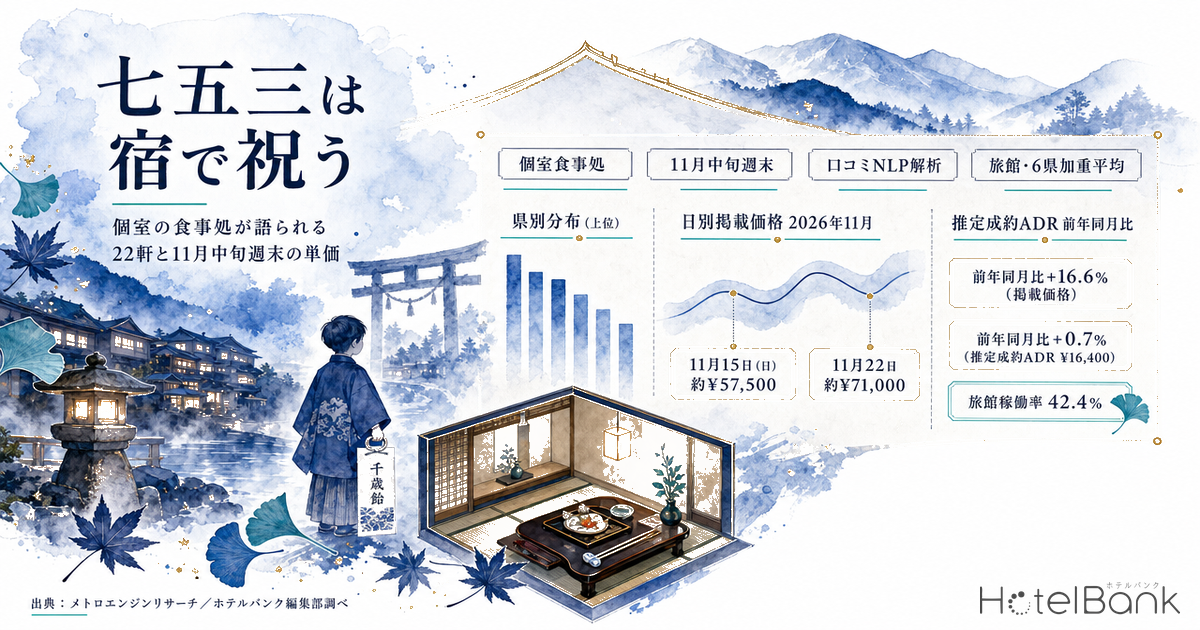
Shichi-Go-San — the traditional November rite marking the third, fifth and seventh birthdays of a child — is one of the few occasions that seats three generations of a family at a single table. Visit the shrine, share a meal with the grandparents, then stay the night: whether an inn can hold that pattern depends far less on the guest room than on what lies outside it, namely the design of the dining space. This article extracts, from guest reviews nationwide, the properties where private and semi-private dinner rooms are mentioned again and again, and then checks how nightly rates for the mid-November weekend of 2026 are currently shaping up.
Metric Definitions Used in This Article
- ADR (average daily rate): an estimated settled rate (tax-excluded equivalent) calculated by applying a property-type correction coefficient to the lowest-priced plan each property publishes on OTAs (double occupancy, per-room rate, tax included). Cross-checked against property-level results disclosed by listed hotel REITs (Invincible Investment Corporation, 184 property-months, April–May 2026), the median error is 7.5% (for the ryokan and resort segment alone, 34 property-months, 15.8%). These are estimates and differ from each property’s actual transacted prices and accounting figures. Area-level ADR is the median of the target properties (the level of a typical property in that area).
- Listed price (all-plan average): the average price across all plans, from room-only to two-meals-included. Per-room rate at double occupancy (tax included). Because the basis differs from ADR, please do not compare the two directly.
- Private-dining mention rate: the share of guest reviews over the trailing 24 months that refer positively to dinner in a private or semi-private room. A high mention count indicates how frequently an element is talked about — it is not a satisfaction score.
- Data source: MetroEngines Research / HotelBank Editorial Team
- — Inns whose private or semi-private dinner rooms are repeatedly mentioned in reviews number 22 nationwide (trailing 24 months, 10 or more positive mentions). Together they hold 1,484 rooms, with a median of 58.5 rooms per property — the center of gravity sits with mid-sized ryokan.
- — Locations skew heavily toward prefectures with dense clusters of onsen ryokan, led by Niigata with 4 and Nagano with 4. Central urban districts barely appear: private dining rooms are an asset built on top of a regional operating culture.
- — Shichi-Go-San in 2026 falls on Sunday, November 15. Listed prices for ryokan across the six prefectures on that date run about ¥57,500 — roughly 19% below the approximately ¥71,000 of the following weekend’s three-day holiday (an auspicious taian day at peak foliage), leaving it at an ordinary Sunday level.
- — On a six-prefecture weighted basis, listed prices are up 16.6% year on year while estimated settled ADR is up only 0.7%, essentially flat. That gap between bullish listings and actual market levels leaves room for product design over the mid-November weekend.
Twenty-two inns nationwide are talked about for their private dining rooms
We analyzed guest reviews with natural language processing and aggregated, by property, the posts that referred positively to “dinner in a private or semi-private room.” As of August 2, 2026, 22 properties nationwide met the threshold of 10 or more mentions over the trailing 24 months. The extraction cap was set at 100 properties, so the count of 22 is not a result of hitting a ceiling. Loosening the threshold to 7 or more mentions widens the field to 52 properties.
One point worth clarifying: 22 does not mean that only 22 inns in Japan have private dining rooms. Far more properties offer private dining in practice. These 22 are the inns where guests spontaneously write that “the private room made it” at high frequency — that is, where the private dining room functions strongly enough to stay in the memory of the stay. Only the inns that draw repeated phrasing along the lines of “without worrying about other diners…” or “we could eat at our own pace…” survive the filter.
Across the 22 properties, room counts total 1,484, with a median of 58.5 and a mean of 67.5 per property. The range runs from 13 rooms at the smallest to 118 at the largest, but the center of gravity sits with mid-sized ryokan of 50 to 110 rooms. Private dining rooms require a certain amount of floor area, workable service routes, and enough staff to serve in staggered seatings. Below a certain size, in-room dining is more practical; at large properties, a single synchronized banquet-hall operation is more efficient. The concentration of this asset in the mid-size band reads as a consequence of those operating conditions.
| # | Property | Location | Rooms | Total reviews | Private-room mentions | Mention rate |
|---|---|---|---|---|---|---|
| 1 | Nihon no Yado Koyo (日本の宿 古窯) | Yamagata | 118 | 1,184 | 30 | 2.53% |
| 2 | Senami Grand Hotel Haginoya (瀬波グランドホテルはぎのや) | Niigata | 37 | 402 | 19 | 4.73% |
| 3 | Tendo Hotel (天童ホテル) | Yamagata | 114 | 609 | 19 | 3.12% |
| 4 | Shiratama no Yu Senkei (白玉の湯 泉慶) | Niigata | 110 | 752 | 15 | 1.99% |
| 5 | Utsukushigahara Onsen Hotel Shoho (美ヶ原温泉 ホテル翔峰) | Nagano | 95 | 1,083 | 15 | 1.39% |
| 6 | Yunohara Hotel (湯の原ホテル) | Miyagi | 32 | 145 | 14 | 9.66% |
| 7 | Shima Tamura (四万たむら) | Gunma | 47 | 436 | 14 | 3.21% |
| 8 | Ikaho Onsen Hotel Kogure (伊香保温泉 ホテル木暮) | Gunma | 111 | 405 | 13 | 3.21% |
| 9 | Yurui no Yado Keizan (ユルイの宿 恵山) | Nagano | 47 | 636 | 13 | 2.04% |
| 10 | Atagawa Prince Hotel (熱川プリンスホテル) | Shizuoka | 58 | 350 | 13 | 3.71% |
| 11 | Asanoya (朝野家) | Hyogo | 66 | 539 | 13 | 2.41% |
| 12 | Tateshina Shinyu Onsen (蓼科 親湯温泉) | Nagano | 52 | 391 | 12 | 3.07% |
| 13 | Kamisuwa Onsen Kosenso (上諏訪温泉 湖泉荘) | Nagano | 17 | 233 | 12 | 5.15% |
| 14 | Shiratama no Yu Kaho (白玉の湯 華鳳) | Niigata | 110 | 437 | 12 | 2.75% |
| 15 | Ryoso Umi no Cho (旅荘 海の蝶) | Mie | 57 | 624 | 12 | 1.92% |
| 16 | Kutsurogi no Yado Seiunso (くつろぎの宿 静雲荘) | Niigata | 13 | 203 | 11 | 5.42% |
| 17 | SORA / Togetsuso Kinryu (宙SORA/渡月荘金龍) | Shizuoka | 29 | 259 | 11 | 4.25% |
| 18 | Hotel Sanrakuso (ホテル三楽荘) | Wakayama | 98 | 618 | 11 | 1.78% |
| 19 | Fushiokaku (不死王閣) | Osaka | 69 | 389 | 11 | 2.83% |
| 20 | Yumoto Kissho (湯元 吉祥) | Miyagi | 59 | 498 | 11 | 2.21% |
| 21 | Nikko Senhime Monogatari (日光 千姫物語) | Tochigi | 44 | 609 | 10 | 1.64% |
| 22 | Yumekaiyu Awajishima (夢海游 淡路島) | Hyogo | 101 | 897 | 10 | 1.11% |
* All 22 properties with 20 or more total reviews and 10 or more positive mentions of private-room dinner over the trailing 24 months. Mention rate = private-room mentions ÷ total reviews. The mention rate is not an evaluation score.
Source: HotelBank Editorial Team research (NLP analysis of guest reviews)
Yamagata, Niigata, Nagano — a clear tilt toward ryokan-dense prefectures
Looking at where the 22 properties are located, Niigata and Nagano lead with 4 each, followed by Yamagata, Gunma, Miyagi, Hyogo and Shizuoka with 2 each. Even in the 52-property set produced by loosening the threshold to 7 or more mentions, the top of the list barely changes: Niigata 6, Shizuoka 6, Yamagata 4, Nagano 4, Gunma 4 and Miyagi 4. Those 52 properties are spread across 23 prefectures, 11 of which contribute only a single property.
What they share is that each is a prefecture where mid-sized ryokan cluster across an onsen district. Zao and Tendo; Tsukioka and Senami; Kamisuwa and Tateshina; Ikaho and Shima; the Izu Peninsula — in all of them, two-meals-included stays built around kaiseki cuisine are the standard, and the design of the dining space itself has long been treated as part of the product. Private dining rooms are, in that sense, an asset that rests on a regional operating culture.
Source: HotelBank Editorial Team research (NLP analysis of guest reviews)
Conversely, the central districts of major metropolitan areas — Tokyo, Kyoto, Osaka — barely appear at all. The single Osaka property (Fushiokaku, in Ikeda City) sits in a suburban onsen district rather than the urban core. Dining at city hotels centers on à la carte restaurants or buffets, and self-contained dinner service in a private room is structurally rare. The tendency for family-occasion demand such as Shichi-Go-San to flow toward onsen ryokan is likely rooted not only in convenience of shrine access but in this difference in what the property can accommodate.
In November 2026, the Shichi-Go-San weekend still sits in ordinary-weekend territory
Next, how are nightly rates for the mid-November weekend shaping up? In 2026, November 15 falls on a Sunday, with November 14 the preceding Saturday. Shrine visits naturally cluster on that Saturday–Sunday pair.
For the ryokan category across the six prefectures where ryokan cluster (Yamagata, Niigata, Nagano, Gunma, Miyagi and Shizuoka), we aggregated daily listed prices for November 2026 (all-plan average, double occupancy, tax included). Saturday, November 14 comes in at roughly ¥67,000 and Sunday, November 15 at roughly ¥57,500. The following weekend, by contrast, runs to roughly ¥72,000 on Saturday, November 21 and roughly ¥71,000 on Sunday, November 22 — well above the Shichi-Go-San weekend.
Source: Compiled by HotelBank Editorial Team from MetroEngines Research
The reason for the gap is clear. Monday, November 23 is Labor Thanksgiving Day, making November 21–23 a three-day weekend; November 22 is additionally a taian day (the most auspicious day in the traditional Japanese calendar); and in eastern Japan’s onsen districts the same dates coincide with peak autumn foliage. With three conditions converging on one weekend, November 21–22 forms the monthly rate peak.
The level worth watching is Sunday, November 15. At roughly ¥57,500, it is the second-lowest Sunday of the month after November 29 (roughly ¥56,500) — the central day of Shichi-Go-San, yet priced no differently from an ordinary Sunday. The gap to the following Sunday (November 22) is about ¥13,500, or roughly 19%. The Saturday-to-Saturday gap (November 14 versus 21) is about ¥4,900.
That is where the operating opportunity lies. The structure that concentrates demand on the three-day weekend and peak foliage is not going to move, but the weekend one week earlier remains, as of now, gently priced. For an inn that holds an asset capable of absorbing anniversary demand — a private dining room — November 14–15 can be positioned as a weekend still available to win, hidden in the shadow of the holiday peak. Bundled into a product that combines a celebratory meal, commemorative photography and a changing space, there is ample room to build up from the ordinary Sunday rate.
Year on year, listed prices are up while estimated settled ADR is flat
For ryokan across the six prefectures, we compared actual results for November 2025 with current levels for November 2026. Listed prices (all-plan average) have risen from ¥35,200 to ¥41,000 on a six-prefecture weighted basis, up 16.6% year on year. Estimated settled ADR, meanwhile, has moved from ¥16,300 to ¥16,400 — up 0.7% year on year, essentially flat.
| Prefecture | Est. ADR Nov 2025 | Est. ADR Nov 2026 | YoY | Listed price Nov 2025 | Listed price Nov 2026 | YoY | Properties (est. ADR basis) |
|---|---|---|---|---|---|---|---|
| Yamagata | ¥13,778 | ¥14,672 | +6.5% | ¥33,193 | ¥39,746 | +19.7% | 175→142 |
| Niigata | ¥15,213 | ¥14,580 | -4.2% | ¥33,528 | ¥36,965 | +10.3% | 231→192 |
| Nagano | ¥14,256 | ¥14,863 | +4.3% | ¥31,410 | ¥35,081 | +11.7% | 485→400 |
| Gunma | ¥17,972 | ¥18,174 | +1.1% | ¥35,550 | ¥44,238 | +24.4% | 265→201 |
| Miyagi | ¥15,085 | ¥15,147 | +0.4% | ¥32,795 | ¥37,861 | +15.4% | 109→97 |
| Shizuoka | ¥19,650 | ¥19,293 | -1.8% | ¥41,523 | ¥49,428 | +19.0% | 423→354 |
| Six-prefecture weighted avg. | ¥16,326 | ¥16,436 | +0.7% | ¥35,173 | ¥41,019 | +16.6% | 1,688→1,386 |
* Ryokan category only. November 2026 figures are estimates based on listing status at the time of the survey; the property count will increase as further listings are added. Estimated ADR and listed prices rest on different bases and should not be compared directly.
Source: Compiled by HotelBank Editorial Team from MetroEngines Research
The two figures diverge because their bases differ. Listed price averages every plan, from room-only through two meals to special kaiseki menus, and in the early selling window that November still sits in, higher-priced plans tend to make up a larger share of the mix. Estimated settled ADR, by contrast, starts from the lowest-priced plan level and applies a property-type correction to arrive at an assumed transacted level — and for November it remains an estimate drawn from listings as of the survey date. The reading for now, then, is that listings have opened bullishly while the band that actually sells is still around last year’s level.
By prefecture, Gunma shows the strongest opening on listed prices at +24.4%, followed by Yamagata at +19.7% and Shizuoka at +19.0%. On estimated settled ADR, Yamagata (+6.5%) and Nagano (+4.3%) are positive, while Niigata (-4.2%) and Shizuoka (-1.8%) sit in negative territory. Differences in how November is being sold are beginning to emerge across prefectures.
Source: Compiled by HotelBank Editorial Team from MetroEngines Research
Tracked monthly, ryokan in these six prefectures show a two-peaked seasonality, rising in August and again from December into January. November sits between the two, at ¥16,300 in 2025 and ¥16,400 in 2026 — mid-to-upper range for the year. November is underpinned by foliage demand but never reaches the pronounced peaks of the New Year period or Obon. Precisely for that reason, it is also a month with room left to add demand along a different axis: family occasions.
The macro backdrop — ryokan occupancy in November 2025 was 42.4%
According to the Japan Tourism Agency’s Overnight Travel Statistics Survey, room occupancy in November 2025 was 42.4% for ryokan, 60.1% for resort hotels, 80.2% for business hotels and 77.7% for city hotels. Total guest nights for the month came to 55.99 million, down 3.7% year on year. Ryokan occupancy is the lowest of the hotel segments, more than 30 points below urban hotel types.
That figure is also the flip side of the ryokan business model: two meals included, concentrated on weekends. The gap between weekdays and weekends is wide and hard to level out. Put the other way round, family-occasion demand that reliably fills a weekend is a segment well suited to ryokan. Shichi-Go-San, school entrance and graduation, sixtieth and eighty-eighth birthday celebrations, meals following a memorial service — all are forms of demand that become easier to serve when a private dining room exists, and November’s Shichi-Go-San is the representative case.
A private dining room is one of the few in-house assets that lifts rate without adding guest rooms. With the same room count, simply being able to partition the dining experience widens the range of guests a property can accommodate. The phrasing that recurs across the 22 properties’ reviews — “without worrying about other diners…” — is evidence that the added value is being communicated properly. For inns that already hold this asset, explicitly productizing it for the mid-November window is the logical next move.
⚠ Note on prices for future dates: Prices in this article for October 2026 onward are estimates based on selling prices published on OTAs and elsewhere as of the survey date (August 2, 2026), and will fluctuate as the check-in date approaches. Because the property count also grows as additional plans are listed, current levels should be read as a work in progress. This article was also written more than 100 days before the stay dates in question, and makes no assessment of booking pace or sales progress.
For properties: plan-naming cues that work on this theme
Appeal elements most common in published plan names in the ryokan × Shichi-Go-San context (N=352) —
Kaiseki course 35%Anniversary 33%In-room dining 30%Two meals included 26%Open-air onsen bath 17%Families with children 12%
Examples of actual names (anonymized):
- 【お日にち限定】≪離れ客室・温泉付・個室食事≫創作会席◆2食付 — “Selected dates only ≪Detached room, private onsen bath, private dining≫ Creative kaiseki ◆ Two meals included”
- 【お得な10日間】≪離れ客室・温泉付・個室食≫地産朝食と創作会席◆スタンダード(2食付) — “Ten-day value window ≪Detached room, private onsen bath, private dining≫ Local-produce breakfast and creative kaiseki ◆ Standard (two meals included)”
* A descriptive tendency drawn from aggregated published plan names; it does not demonstrate that naming causes sales.
Summary
Inns whose private or semi-private dinner rooms are repeatedly talked about in guest reviews number 22 nationwide on a threshold of 10 or more mentions over the trailing 24 months. They skew toward prefectures where mid-sized ryokan cluster in onsen districts — Niigata, Nagano, Yamagata, Gunma, Miyagi and Shizuoka — with a center of gravity around the median of 58.5 rooms per property. A private dining room is an asset that only functions when floor area, service routing and staffing come together, and those operating conditions are what produce the geographic tilt.
Shichi-Go-San in 2026 centers on Sunday, November 15. Listed prices for that date average roughly ¥57,500 across ryokan in the six prefectures — no different from an ordinary Sunday. That stands in contrast to the following three-day weekend (November 21–23), which absorbs both a taian day and peak foliage to reach roughly ¥71,000–72,000. For inns holding an in-house asset capable of accommodating a three-generation anniversary, the mid-November weekend is a window where room for product design and pricing still remains.
Related reading
- Autumn Food Travel: Japan’s Top 20 Inns Praised for Regional Cuisine
- Chosen for the Water: Japan’s Top 30 Onsen Inns by Review Mentions
- Japan’s Earliest Foliage 2026: Aomori ADR Peaks at ¥15,300 in October
- Golf Town Hotels: ¥5,200–¥21,300 Autumn ADR Across 15 Municipalities
References and sources
■ Data sources
On the review side, a property-level aggregation of positive mentions of “dinner in a private or semi-private room” derived from natural language processing of guest reviews (trailing 24 months, 20 or more total reviews, data as of August 2, 2026). On the price side, monthly and daily aggregation of nightly rates for the ryokan category across six prefectures — Yamagata, Niigata, Nagano, Gunma, Miyagi and Shizuoka (double occupancy, per room, tax included). Occupancy figures are published values from the Japan Tourism Agency’s Overnight Travel Statistics Survey.
■ Estimation assumptions
Estimated settled ADR is an estimate (tax-excluded equivalent) produced by applying a property-type correction coefficient to each property’s lowest-priced plan level; area values are the median of the target properties. November 2025 uses confirmed history, while November 2026 is estimated from a snapshot of listings as of the survey date. Listed price is the average across all plans from room-only to two-meals-included, and rests on a different basis from estimated settled ADR. The six-prefecture weighted average is weighted by each prefecture’s property count.
■ Limitations and caveats
The mention rate is not a satisfaction score; it indicates how frequently an element is talked about. The extraction of 22 properties does not mean that only 22 inns are equipped with private dining rooms. Prices and property counts for November 2026 will change as further listings are added. This article was written more than 100 days before the stay dates in question and makes no assessment of booking pace or sales results. The plan-name aggregation is a description of tendencies and does not assert a causal link between naming and sales.
■ Market data and review analysis
- MetroEngines Research — nightly rate data (ryokan category, six prefectures). The listed-price aggregation covers 1,470 properties for November 2026 and 1,715 for November 2025; the estimated settled ADR aggregation covers 1,386 properties for November 2026 and 1,688 for November 2025. The property counts shown in the table in the body of this article are on the estimated settled ADR basis.
- HotelBank Editorial Team research — NLP analysis of guest reviews (trailing 24 months, data as of August 2, 2026, 22 properties matched)
■ Government statistics
- Japan Tourism Agency, “Overnight Travel Statistics Survey (November 2025 second preliminary figures; December 2025 first preliminary figures)”
- Japan Tourism Agency, “Overnight Travel Statistics Survey (2025 annual figures, preliminary)”
■ Calendar and event information