

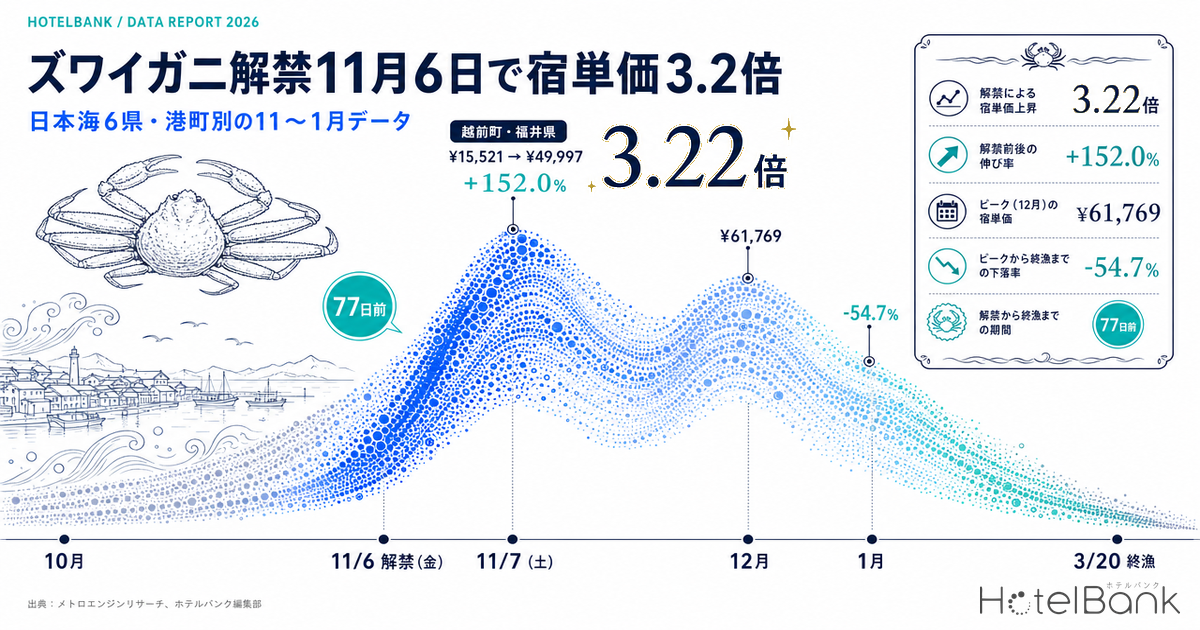
Snow crab fishing along the Sea of Japan opens on November 6 in 2026. That date falls on a Friday, which puts the first Saturday of the season on the very next day. Looking at room rates across the six Sea of Japan prefectures (Tottori, Hyogo, Kyoto, Fukui, Ishikawa and Shimane) at both prefecture and municipality level, the November increase at prefecture level is a modest +2.4% to +23.1% month over month (2026, forward basis) — while in the towns that host the crab landing ports, rates double or triple. In Echizen Town, Fukui, the settled ADR estimate went from ¥15,521 in October 2025 to ¥49,997 in November on a confirmed basis, a 3.22x jump (the same October-to-November step in 2024 was +152.0%).
This article takes an event with a fixed calendar date — the season opener — and examines at what unit the price step appears, when it appears, and how long it holds, using both monthly and daily data.
- — The season opens Friday, November 6, 2026. The male crab season runs to March 20 of the following year. Female season end dates vary by prefecture: December 29 in Ishikawa, December 31 in Fukui, January 20 in Tottori.
- — The price effect shows up at port level, not prefecture level. On confirmed 2024 figures, October to November was +152.0% in Echizen Town, Fukui — and +5.9% in Tsuruga City in the same prefecture.
- — Echizen Town has repeated the same shape three years running. In 2025 it went from ¥15,521 in October to ¥49,997 in November, a 3.22x step, then fell -54.7% to ¥20,146 the following April. It is the fishing season, not the calendar season, that sets the price band.
- — The rate peak lands in December-January, not November. Echizen Town hit ¥61,769 in December 2025, +23.5% above November; Kyotango City peaked at ¥43,577 in January 2026.
- — With 77 days to go, inventory has not started to move. Only 1 of 24 prefecture-date cells shows a remaining-inventory index below 95. There is still room to revise pricing and plan design.
Metric Definitions Used in This Article
- Settled ADR estimate: an estimated transacted rate (tax-excluded equivalent) calculated by applying a property-type correction factor to the lowest published plan rate each property lists on OTAs and similar channels (based on double occupancy, per room). Cross-checked against property-level results disclosed by listed hotel REITs (91 properties, most recent 3 months), the median error is approximately 7%. These are estimates and differ from each property’s actual transacted rates and accounting figures. At area level, the figure is the median across covered properties (the level of a typical property in that area).
- Published rate: the average rate across all plans listed on OTAs and similar channels (room-only through meal-inclusive, per room at double occupancy, tax included). Because this is measured on a different basis from the settled ADR estimate, this article always states which of the two is being used.
- Confirmed basis / forward basis: past months are on a confirmed basis derived from actual listing history; the current month onward is on a forward basis derived from listings at the time of the survey. This article does not make year-over-year comparisons across months measured on different bases. Month-over-month and two-month comparisons are always between months of the same year on the same basis.
- LT (lead time): days remaining until the check-in date. LT0 = same day.
- Data sources: MetroEngines Research (room rates and inventory), plus materials published by each prefecture and fisheries cooperative association (season opening dates and fishing periods)
The 2026 Opener Is Friday, November 6 — What Primary Sources Confirm
Snow crab fishing in the Sea of Japan is governed by Ministry of Agriculture, Forestry and Fisheries ordinances that set a closed season for each sea area. In the waters running from Shimane to Toyama (Sea Area A), the closed period is March 21 to November 5, which by definition makes the male crab season November 6 through March 20 of the following year. Kyoto Prefecture’s explainer page on snow crab fishing likewise states “approximately five months, from November 6 to March 20 of the following year,” so the calendar opening date is fixed at November 6 every year.
Female crab seasons (oyagani, seikogani, sekogani, kobakogani), by contrast, vary considerably according to prefectural and cooperative-level voluntary restrictions. Because this bears directly on how a property designs its products, we have compiled only what could be confirmed in primary sources. Where confirmation could not be obtained, that is stated as such.
| Prefecture | Regional brand name | Male season | Female season | Source confirmed |
|---|---|---|---|---|
| Tottori | Matsuba-gani | Nov 6 – Mar 20 | Nov 6 – Jan 20 (oyagani) | Tottori Prefecture, Dept. of Agriculture, Forestry and Fisheries press release |
| Hyogo | Matsuba-gani (Kasumi, Shibayama) | Nov 6 – Mar 20 | Through end of December (sekogani) | Tajima Fisheries Cooperative / Kami Town official site |
| Kyoto | Matsuba-gani (Taiza and others) | Nov 6 – Mar 20 | No separate shortening confirmed for this article | Kyoto Prefecture Oceanic Center explainer page |
| Fukui | Echizen-gani | Nov 6 – Mar 20 | Nov 6 – Dec 31 (seikogani) | Fukui Prefecture Tourism Federation (fuku-e.com) |
| Ishikawa | Kano-gani | Nov 6 – Mar 20 | Nov 6 – Dec 29 (kobakogani) | JF Ishikawa / JF Ishikawa Wajima Branch |
| Shimane | Matsuba-gani (Oki and others) | Nov 6 – Mar 20 (Sea Area A rule) | Not confirmed in prefectural or cooperative primary sources | JF Zengyoren Pride Fish (Oki Matsuba crab) |
Compiled by the HotelBank Editorial Team from materials published by each prefecture and fisheries cooperative association (as surveyed in August 2026)
The point worth holding onto here is that the female season ends between December 29 and January 20. Properties that build female crab into their year-end offerings need to design December and January plans separately, on the assumption that the January menu shifts to male crab. Put the other way round, the constraint itself — “kobakogani is only available through December 29” — is a reason for guests to book November and December earlier.
There is one more condition specific to 2026: November 6 falls on a Friday. It was a Wednesday in 2024 and a Thursday in 2025, but in 2026 the day after the opener is the first Saturday of the season (November 7). For a property that can put the first day’s catch on the next evening’s dinner table, this alignment makes the entire opening weekend sellable as a product.
Prefecture Averages Hide the Opener — +8.5% and +152% Coexist in One Prefecture
Start at prefecture level. On confirmed 2024 figures, the October-to-November change in settled ADR estimate was +8.5% in Tottori, +8.0% in Ishikawa, +21.0% in Shimane, +32.6% in Fukui, +44.5% in Kyoto and +14.5% in Hyogo. Kyoto’s large figure reflects autumn foliage demand in Kyoto City rather than crab in Tango, which is a good illustration of why prefecture-level aggregation is a poor instrument for measuring the effect of the opener.
Drop down to municipality level and the picture changes completely. The chart below plots the October-to-November change in settled ADR estimate for 2024 (confirmed basis), separating towns that host crab landing ports (blue) from cities within the same six prefectures that have no crab landing port (grey).
Source: MetroEngines Research; compiled by the HotelBank Editorial Team (October and November 2024 / confirmed basis / all property types)
Blue and grey separate cleanly. The port towns run from +12.4% (Misasa) to +152.0% (Echizen), while the control cities stay between -5.2% (Hamada) and +8.5% (Kanazawa). Within Tottori Prefecture, Tottori City is +8.2% and Misasa — while nowhere near Echizen — is +12.4%. Within Fukui Prefecture, Tsuruga City is +5.9% and Echizen Town is +152.0%. That is a wide enough separation to say plainly that the price effect of the opener occurs at port level, not prefecture level. This “prefecture averages flatten the layers” structure is not unique to crab; the five-layer rate structure within Hyogo, including the Tajima crab belt, is set out from the same angle in Hyogo’s Hotel Market in 5 Layers 2026.
| Municipality | Prefecture | 2024 (confirmed) | 2025 (confirmed) | 2026 (forward) | |||
|---|---|---|---|---|---|---|---|
| Oct→Nov | Properties | Oct→Nov | Properties | Oct→Nov | Properties | ||
| Echizen Town | Fukui | +152.0% | 19 / 19 | +222.1% | 19 / 17 | +168.3% | 18 / 15 |
| Kyotango City | Kyoto | +75.7% | 80 / 86 | +126.1% | 74 / 80 | +80.5% | 68 / 58 |
| Miyazu City | Kyoto | +49.3% | 28 / 28 | +78.6% | 30 / 30 | +11.0% | 27 / 23 |
| Shin-Onsen Town | Hyogo | +59.9% | 22 / 22 | — | — | +21.4% | 21 / 17 |
| Kami Town | Hyogo | +36.2% | 52 / 55 | — | — | +33.2% | 46 / 40 |
| Toyooka City | Hyogo | +37.2% | 102 / 105 | — | — | +23.1% | 88 / 77 |
| Misasa Town | Tottori | +12.4% | 20 / 20 | +24.2% | 19 / 18 | +30.6% | 18 / 15 |
| Matsue City | Shimane | +18.7% | 55 / 55 | +42.0% | 54 / 51 | +19.0% | 52 / 51 |
| Kaga City | Ishikawa | +12.6% | 45 / 45 | +29.5% | 45 / 44 | +13.5% | 45 / 44 |
| Nanao City | Ishikawa | -9.8% | 7 / 8 | +16.9% | 13 / 12 | +2.6% | 15 / 14 |
| Tottori City | Tottori | +8.2% | 37 / 36 | +17.1% | 33 / 31 | -6.1% | 29 / 24 |
| Yonago City | Tottori | +3.1% | 47 / 47 | +7.6% | 45 / 45 | +11.3% | 42 / 39 |
| Maizuru City | Kyoto | +0.2% | 16 / 16 | +4.4% | 17 / 17 | -7.6% | 16 / 12 |
| Tsuruga City | Fukui | +5.9% | 21 / 21 | +18.5% | 21 / 21 | +0.5% | 19 / 15 |
| Hamada City | Shimane | -5.2% | 15 / 15 | +7.6% | 15 / 14 | +0.1% | 14 / 14 |
| Kanazawa City | Ishikawa | +8.5% | 121 / 122 | +6.4% | 118 / 112 | +2.7% | 112 / 110 |
Source: MetroEngines Research; compiled by the HotelBank Editorial Team. Figures are the October-to-November change in settled ADR estimate. Property counts are the number of properties covered by the settled ADR estimate for “October / November”. Blue-shaded rows are municipalities hosting crab landing ports
Some cells in the table are blank. For November 2025, the number of properties covered by the settled ADR estimate in Hyogo Prefecture fell to 34 across the whole prefecture (roughly 540 in the adjacent months), and Kami Town, Toyooka City and Shin-Onsen Town were not calculated for that month either. Figures from thin-sample months diverge from actual market conditions, so they have been excluded from the aggregation. Iwami Town (Tottori) is likewise omitted from the table above, with only 3 to 4 properties covered. For reference, on a published-rate basis, Iwami Town went from ¥17,281 to ¥34,103 between October and November 2025 (8 to 9 properties covered) — close to a doubling.
Wajima City and Suzu City in Ishikawa are excluded from municipality-level aggregation because only 2 to 3 properties can be observed continuously for pricing on OTAs. Accommodation supply in Noto is still in recovery and has not reached a sample size that can be discussed statistically.
The Same Shape Three Years Running — Echizen’s Monthly Curve Shows the Season Sets the Price Band
To confirm this is not a single-year coincidence, the settled ADR estimate for Echizen Town (Fukui) — the municipality with the widest swing — is plotted year on year. The horizontal axis runs from January to December.
Source: MetroEngines Research; compiled by the HotelBank Editorial Team (Echizen Town, all property types, median settled ADR estimate. August 2026 onward is on a forward basis derived from listings at the time of the survey)
The three lines almost overlap. April through October sits flat in the ¥16,000-20,000 range; November jumps to the ¥40,000s; December through January peaks in the ¥50,000-60,000 range; February and March hold in the ¥40,000s; and then April drops back below ¥20,000. For 2026, ¥44,480 in March falls to ¥20,146 in April (-54.7% month over month). Rates fall not because spring arrives, but because the fishing season ends on March 20.
That this shape repeats across three years means Echizen Town’s room rates are governed by the fishing calendar rather than by seasonal demand. For a property, it is closer to reality to think of the fishing season as an external condition splitting the year into two price bands than to think of setting one’s own rate ceiling. Read the other way, the ¥16,000-20,000 range from April to October is precisely the stretch where the upside of building products that bring guests for reasons other than crab remains entirely unclaimed.
The Peak Lands in December-January, Not November — the Opener Is a Starting Gun, Not a Summit
Because news coverage clusters on the opening date, November can feel like the peak demand month — but the data says otherwise. Lining up the confirmed settled ADR estimate for November 2025, December 2025 and January 2026, the port towns peak somewhere between December and January.
Source: MetroEngines Research; compiled by the HotelBank Editorial Team (median settled ADR estimate, confirmed basis)
| Municipality | Nov 2025 | Dec 2025 | Jan 2026 | Peak month | Properties (Nov / Dec / Jan) |
|---|---|---|---|---|---|
| Echizen Town | ¥49,997 | ¥61,769 | ¥55,528 | December | 17 / 18 / 20 |
| Kyotango City | ¥40,132 | ¥42,182 | ¥43,577 | January | 80 / 80 / 79 |
| Kaga City | ¥22,792 | ¥24,640 | ¥22,025 | December | 44 / 44 / 44 |
| Misasa Town | ¥21,687 | ¥21,978 | ¥22,212 | January | 18 / 18 / 18 |
| Matsue City | ¥17,757 | ¥15,492 | ¥12,732 | November | 51 / 51 / 52 |
Source: MetroEngines Research; compiled by the HotelBank Editorial Team (median settled ADR estimate, confirmed basis)
Echizen Town is highest in December at ¥61,769, a further +23.5% on top of November. Kyotango City peaks in January at ¥43,577, +8.6% above November. Misasa Town also climbed gently, from ¥21,687 in November to ¥22,212 in January.
Matsue City is the exception: it peaks in November at ¥17,757 and declines through December and January. Matsue is a San’in regional city rather than a crab port town, and the composition of its accommodation demand is different. Which is another way of saying that within the same “crab prefecture,” a property located at a port and a property in the prefectural capital have entirely different winter curves.
This gap matters for the order in which products are designed. The first catch of the opener sells on novelty, but the rate peak arrives from December into the New Year period, when the meat fill is consistent. For a port-town property, November is the entrance for capturing year-end bookings — there is no need to sell out the inventory there. How far year-end rates are already visible is examined in Year-End 2026-27 Room Rates Are Already Visible, which checks December forward ADR against prior-year results.
Daily Data Puts the Step Not on Opening Day but on the Weekend After
Everything so far has been monthly. Raising the resolution, consider published rates day by day. The chart below plots published rates by check-in date for the ryokan category across the six prefectures, all observed at the same lead time — LT90, or 90 days before check-in. Because the observation point is held constant, only the difference in day-by-day pricing is visible.
Source: MetroEngines Research; compiled by the HotelBank Editorial Team (ryokan category, published rates as at LT90, November 6, 2026 opener)
There is a step on the opening day itself, Friday November 6, but the larger jump comes the following day, Saturday November 7. Lining the days up by day of week makes this structure clear.
Source: MetroEngines Research; compiled by the HotelBank Editorial Team (ryokan category, published rates as at LT90)
| Prefecture | Fri 10/30 | Fri 11/6 Opening day | Fri 11/13 | Sat 10/31 | Sat 11/7 | Sat 11/14 | Properties (11/7) |
|---|---|---|---|---|---|---|---|
| Tottori | ¥29,569 | ¥32,697 | ¥33,668 | ¥34,253 | ¥46,113 | ¥46,633 | 60 |
| Hyogo | ¥35,347 | ¥40,054 | ¥43,213 | ¥45,786 | ¥54,730 | ¥56,809 | 230 |
| Kyoto | ¥43,522 | ¥56,526 | ¥67,094 | ¥53,005 | ¥71,483 | ¥70,592 | 149 |
| Fukui | ¥28,148 | ¥29,356 | ¥41,105 | ¥37,730 | ¥45,511 | ¥51,670 | 112 |
| Ishikawa | ¥36,469 | ¥41,635 | ¥39,736 | ¥48,575 | ¥50,176 | ¥50,131 | 98 |
| Shimane | ¥33,148 | ¥33,924 | ¥34,794 | ¥41,323 | ¥41,970 | ¥42,818 | 90 |
Source: MetroEngines Research; compiled by the HotelBank Editorial Team (ryokan category, published rates as at LT90, per room for two guests / tax included)
Comparing the last Saturday before the opener (October 31) with the first Saturday after it (November 7): Kyoto +34.9%, Tottori +34.6%, Fukui +20.6%, Hyogo +19.5%. Just seven days apart, on the same day of the week, ryokan published rates move that much.
The Friday sequence is the interesting one. In Fukui, Friday rates are effectively flat from October 30 at ¥28,148 to November 6 at ¥29,356 (+4.3%), yet a week later on November 13 they jump to ¥41,105 (+46.0% against October 30). The second Friday of the season is priced higher than opening day itself. That reads naturally as pricing behaviour: because neither the volume nor the size of the first day’s catch can be predicted, high-rate plans are being concentrated on the weeks when crab can be served reliably. Kyoto shows the same shape, with ¥56,526 on November 6 against ¥67,094 on November 13.
Ishikawa (¥36,469 on Oct 30 → ¥41,635 on Nov 6 → ¥39,736 on Nov 13) and Shimane (¥33,148 → ¥33,924 → ¥34,794) show smaller steps around the opener than the other four prefectures. Their pricing smooths across the winter as a whole, which can equally be read as leaving the room to concentrate rates on the opening week still unused. Monthly figures for Kaga City and Matsue City show +13.5% and +19.0% growth in November (2026 forward), so the demand is there at port and hot-spring-resort level and is merely diluted at prefecture level.
Booking Pace 77 Days Out — Inventory Has Not Started Moving in Any of the Six Prefectures
Rates are moving. What about bookings? The survey date for this article (August 21, 2026) is 77 days before the opener. OTA inventory movement over this period is set out below as the change in remaining rooms across the five days from LT90 to LT86.
| Prefecture | Coverage (ryokan) | Sat 10/24 | Sat 10/31 | Sat 11/7 | Sat 11/14 |
|---|---|---|---|---|---|
| Tottori | 60 properties, 1,578 rooms | 100.7 | 96.5 | 98.8 | 102.0 |
| Hyogo | 230 properties, 4,624 rooms | 100.9 | 98.8 | 99.7 | 92.8 |
| Kyoto | 149 properties, 2,890 rooms | 98.1 | 98.4 | 97.3 | 100.1 |
| Fukui | 112 properties, 2,540 rooms | 99.5 | 96.3 | 99.1 | 96.9 |
| Ishikawa | 98 properties, 4,030 rooms | 98.9 | 99.0 | 97.6 | 101.3 |
| Shimane | 90 properties, 2,252 rooms | 95.0 | 96.9 | 97.2 | 101.5 |
Source: MetroEngines Research; compiled by the HotelBank Editorial Team. Figures are the remaining-inventory index at LT86 with remaining rooms at LT90 set to 100 (ryokan category; property and room counts as at November 7)
Of the 24 cells across six prefectures, only one fell below 95: Hyogo on Saturday November 14, at 92.8. In other words, across the five days from 90 to 86 days before check-in, OTA inventory has barely moved. Cells above 100 (Tottori at 102.0 for November 14, Shimane at 101.5) indicate that properties added rooms to OTAs during this period. This is still the stage of putting inventory on sale, not the stage of competing for it.
So at this point it is not possible to say “book early” or “it is already filling up.” What can be said is that the pricing design is already complete — published rates for the opening week are set +20% to +35% above the prior week in Kyoto, Tottori, Fukui and Hyogo — and that the booking response to it has yet to begin. Practically speaking, 77 days out is the position where a property still has the most room to revise plan composition and pricing.
Note that this remaining-inventory data is an estimate based on observations accumulated since March 10, 2026. It indicates how inventory offered for sale on OTAs is being taken up, and differs from a property’s actual overall occupancy rate.
Where Are the Properties Guests Talk About Crab At?
Price data alone cannot show which properties treat crab as a core product. Extracting crab-related mentions from guest review text and viewing, by prefecture, the properties where crab is discussed over the most recent 24 months, the result broadly overlaps with the areas where the price step was largest.
| Prefecture | Property | Total reviews | Crab mentions | Mention rate |
|---|---|---|---|---|
| Fukui | Umi no Hotel Hirose (海のホテルひろせ) | 478 | 43 | 9.0% |
| Fukui | Awara Onsen Seifuso (あわら温泉 清風荘) | 1,071 | 40 | 3.7% |
| Tottori | Kaike Grand Hotel Tensui (皆生グランドホテル 天水) | 681 | 36 | 5.3% |
| Tottori | Misasakan (三朝館) | 564 | 15 | 2.7% |
| Hyogo | Yanagiso (やなぎ荘) | 207 | 27 | 13.0% |
| Hyogo | Ryokufukaku (緑風閣) | 359 | 27 | 7.5% |
| Kyoto | Yuhigaura Onsen Ichibokan (夕日ヶ浦温泉 一望館) | 259 | 30 | 11.6% |
| Kyoto | Taiza Onsen Sumihei (間人温泉 炭平) | 420 | 20 | 4.8% |
| Ishikawa | Kagari Kisshotei (かがり吉祥亭) | 792 | 27 | 3.4% |
| Ishikawa | Ryotei Kaiseki Notoya (旅亭懐石 のとや) | 449 | 16 | 3.6% |
| Shimane | Matsunoyu (松乃湯) | 560 | 21 | 3.8% |
Source: HotelBank Editorial Team research (NLP analysis of guest review text, most recent 24 months; properties with 20 or more total reviews and 8 or more crab mentions)
Comments such as “all-you-can-eat crab,” “we were more than satisfied with the full crab course” and similar recur throughout. Mention rates reach double digits at Yanagiso in Hyogo (13.0%) and Yuhigaura Onsen Ichibokan in Kyoto (11.6%), meaning that just over one review in ten touches on crab. It is fair to say crab is recognised as the centre of the stay experience at these properties. Applying the same method nationwide shows that properties rated for crab are distributed beyond the Sea of Japan coast as well, and that there are 25 prefectures where mentions are almost entirely absent.
Only two properties in Shimane met the criteria. That composition — relatively few properties putting crab front and centre relative to the prefecture’s overall accommodation supply — can also be read as an area with considerable room to build a crab presence in reviews.
Designing Winter Backwards from the Season Calendar — Five Opportunities
From the data above, here are the revenue opportunities a Sea of Japan property can pursue in winter 2026. All are framed as upside on top of current pricing.
- Design the opening weekend (Fri 11/6 – Sun 11/8) as a three-day product. In 2026 the opener falls on a Friday and the next day is the first Saturday. A two-night Friday-Saturday stay, or Friday and Saturday nights packaged as separate products, is an alignment that did not exist in 2024 (Wednesday opener) or 2025 (Thursday opener).
- Put the centre of gravity for rates on the second week (Fri 11/13, Sat 11/14). Even at current published rates, Fukui has 11/13 above 11/6 (¥29,356 → ¥41,105), and Kyoto shows the same shape. Releasing high-rate plans once the meat fill is consistent is a pattern the market has already selected.
- Price December and January as the peak. On confirmed figures, Echizen Town, Kyotango City, Misasa Town and Kaga City all had their highest-rate month in either December or January. There is upside in an allocation that holds back year-end inventory rather than selling out in November.
- Use the female season end dates as a booking deadline. Kobakogani ends December 29, seikogani December 31, and Tottori’s oyagani January 20. “We can only serve this until that date” is one of the few materials available for pulling bookings forward without resorting to discounting.
- Do not leave the ¥40,000 range in February and March on the table. Echizen Town’s confirmed figures are ¥46,603 in February and ¥44,480 in March, holding at roughly the same level as November. The season runs to March 20, yet promotional energy tends to run out at year-end. Because the demand demonstrably exists, this is the highest-confidence upside of the five.
For every one of these measures, taking the externally fixed opening date as the starting point makes the backwards schedule fall out automatically. The present period, before the booking response begins, is the point at which there is the most room to lock down pricing and plan composition.
Summary
- The 2026 snow crab season opens Friday, November 6. The male season runs to March 20; female season end dates differ by prefecture — December 29 in Ishikawa, December 31 in Fukui, January 20 in Tottori.
- The price effect of the opener occurs at port level, not prefecture level. On confirmed 2024 figures, Echizen Town was +152.0% against +5.9% for Tsuruga City in the same prefecture.
- Echizen Town’s settled ADR estimate has traced the same shape three years running, dropping -54.7% in April. It is the fishing season, not the calendar season, that sets the price band.
- The rate peak is in December-January, not November. The opener is a starting gun, not a summit.
- With 77 days to go, inventory has not started moving in any of the six prefectures. There is still room to revise the pricing design.
Frequently Asked Questions
Q. When does the 2026 snow crab season open?
A. On the Sea of Japan side it is Friday, November 6, 2026. Ministry of Agriculture, Forestry and Fisheries ordinances set a closed season for each sea area; in Sea Area A, running from Shimane to Toyama, the closed period is March 21 to November 5, which by definition makes the male season November 6 to March 20 of the following year. Hokkaido and the Sea of Okhotsk operate under a different framework and are outside the scope of this article.
Q. Until when can female crab (seikogani, kobakogani, oyagani) be eaten?
A. It varies by prefecture. To the extent confirmed in primary sources for this article: kobakogani in Ishikawa runs November 6 to December 29, seikogani in Fukui November 6 to December 31, oyagani in Tottori November 6 to January 20, and sekogani in Hyogo through the end of December. For Kyoto and Shimane, no separate shortening of the female season could be confirmed in primary sources.
Q. How much do room rates rise after the opener?
A. It varies enormously by municipality. Comparing the October-to-November settled ADR estimate on confirmed 2024 figures: Echizen Town in Fukui +152.0%, Kyotango City in Kyoto +75.7%, Shin-Onsen Town in Hyogo +59.9%. By contrast, cities within the same six prefectures that have no crab landing port ranged only from -5.2% to +8.5%.
Q. Is November the most expensive month?
A. No. On confirmed figures, most port towns have their highest-rate month in December or January. Echizen Town’s ¥61,769 in December 2025 was +23.5% above November (¥49,997), and Kyotango City peaked at ¥43,577 in January 2026.
Q. When does the crab season end?
A. The male season ends on March 20. Echizen Town’s settled ADR estimate falls -54.7% from ¥44,480 in March 2026 to ¥20,146 in April, so the price band switches over as the fishing season closes.
Further Reading
- Tottori’s 3-Tier Hotel Market: Onsen ADR 2.16x the City Average
- Japan Hotel ADR Swings Up to 4.9x by Season: 633 Municipalities Ranked
- Fukui Ryokan Sat 90.9% vs Mon 76.3%: Business Hotels Dip on Sunday
- Why Hotels Feel Expensive in Obihiro, Fukui & Okayama: 393-City Check
- Toyama’s 14 Municipalities 2026: 3.3x ADR Gap, Four Price Tiers
- Hyogo’s Hotel Market in 5 Layers 2026: ADR from ¥10,700 to ¥29,600
- Year-End 2026-27 Room Rates Are Already Visible: December Forward ADR vs Prior-Year Results
- Fukui’s 3 Hotel Clusters: 2.5x ADR Gap and the Upper-Mid Whitespace
References and Sources
■ Data sources
Room rates and inventory are drawn from our continuously collected history of OTA published rates and published inventory (municipality-level monthly data from January 2024 to January 2027; daily published rates observed at a uniform lead time of 90 days; remaining-inventory movement from observations since March 10, 2026). Season opening dates and fishing periods come from primary sources published by each prefecture and fisheries cooperative association. Review data is from natural language processing of guest review text (most recent 24 months).
■ Calculation assumptions
The settled ADR estimate is the median across covered properties within an area (the level of a typical property in that area). Monthly month-over-month comparisons are made only between months of the same year on the same basis (confirmed to confirmed, or forward to forward); no year-over-year comparison is made across differing bases. Daily published rates are for the ryokan category, aligned at LT90, per room for two guests, tax included. The remaining-inventory index sets remaining rooms at LT90 to 100 and expresses LT86 relative to that.
■ Limitations and caveats
Months and areas with a thin covered-property count (Hyogo Prefecture in November 2025 = 34 properties prefecture-wide; Iwami Town 3-4 properties; Wajima City and Suzu City 2-3 properties) are excluded from the aggregation, so geographic coverage is not complete. Figures from August 2026 onward are forward-basis estimates and will move as check-in dates approach. The remaining-inventory index reflects take-up of inventory offered for sale on OTAs and differs from a property’s actual overall occupancy rate.
■ Season opening dates and fishing periods (primary sources)
- Tottori Prefecture, Department of Agriculture, Forestry and Fisheries, "On the Opening of Snow Crab (Matsuba-gani) Fishing" press release
- Kyoto Prefecture, "Snow Crab Fishing (Advanced)"
- Fukui Prefecture Tourism Federation (fuku-e.com), "Echizen-gani Fishing Opens Again This Year on November 6"
- JF Ishikawa Wajima Branch, "November 6: Kano-gani Season Opens"
- JF Ishikawa, "Kobakogani"
- Tajima Fisheries Cooperative, "Kasumi Matsuba-gani Festival" announcement
- National Federation of Fisheries Cooperative Associations, Pride Fish, "Oki Matsuba Crab (Shimane)"
- Japan Fisheries Research and Education Agency, "Stock Assessment of the Sea of Japan Snow Crab Stock, Sea Area A" (FY2024)
- Fisheries Agency of Japan
■ Room rate and inventory data
- MetroEngines Research — settled ADR estimate and published rates (municipality-level monthly, January 2024 to January 2027), OTA remaining-inventory movement (observations since March 10, 2026)
- HotelBank Editorial Team research — NLP analysis of guest reviews (most recent 24 months)
⚠ Note on rates for future dates: Figures in this article relating to months and dates from August 2026 onward are estimates based on rates published on OTAs and similar channels as at the survey date (August 21, 2026), and will move as check-in dates approach. Please note that they may rise or fall as new plans are added or prices adjusted. Figures for past months are on a confirmed basis, and this article makes no year-over-year comparisons across months measured on different bases.