

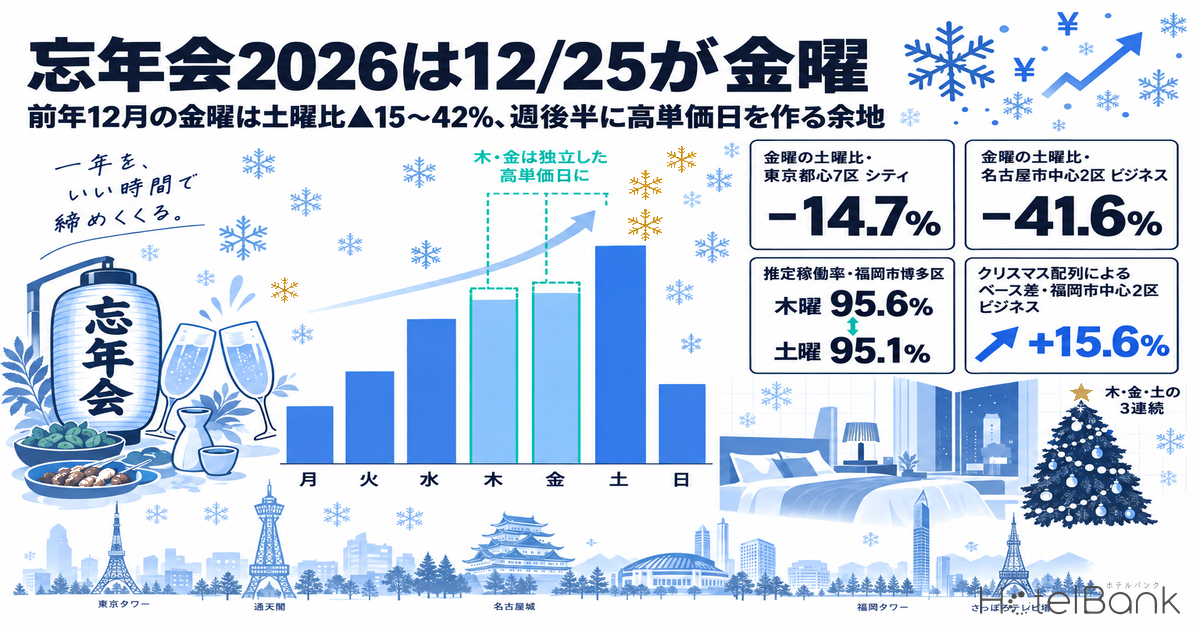
In December 2026, Christmas Eve falls on a Thursday, Christmas Day on a Friday, and the following day, the 26th, on a Saturday. The final working day for government offices is Monday 28 December, which means the weekdays available for year-end parties (bonenkai) run unbroken from Tuesday 1 December through Friday 25 December. How the late-week weekdays are priced will, on its own, determine December’s rate level.
This article uses day-by-day actuals from December of the prior year (2025) together with recent estimated occupancy to examine where room exists to “create a high-rate day outside the weekend” across the central districts of five cities: Tokyo, Osaka, Nagoya, Fukuoka and Sapporo.
Metric Definitions Used in This Article
- ADR (average daily rate): a settled-rate estimate (tax-exclusive equivalent) calculated by applying a property-type correction coefficient to the lowest published plan level each property lists on major reservation sites (double occupancy, per-room rate, tax-inclusive). Cross-checked against property-level results disclosed by listed hotel REITs (91 properties, trailing three months), the median error is approximately 7%. These are estimates and differ from each property’s actual transacted prices and accounting figures. Area-level ADR is the median of the properties covered (the level of a standard property in that area).
- Listed price: the average price of all plans posted on major reservation sites (double occupancy, per-room rate, tax-inclusive, spanning room-only through meal-inclusive plans). All day-by-day and day-of-week price analysis in this article is on this listed-price basis, which uses a different standard from the ADR above.
- OCC (occupancy): the share of sold rooms against total rooms in the area (an estimate based on OTA sales inventory). It is an estimate derived from how inventory offered on major reservation sites is being absorbed, and differs from each property’s actual overall occupancy.
- Data sources: MetroEngines Research / Japan Tourism Agency, “Accommodation Travel Statistics Survey”
- — Christmas Day 2026 falls on a Friday. The 24th (Thu), 25th (Fri) and 26th (Sat) run three days in a row, and the weekday business calendar lines up unbroken for four full weeks from Tuesday 1 December to Friday 25 December.
- — Not one pairing had Friday above Saturday. Across all 40 pairings in December of the prior year (5 cities × 2 property types × 4 Fridays), the Friday listed price ran 14.7% to 41.6% below Saturday.
- — On occupancy, Thursday pulls level with Saturday. On the June–July 2026 average, estimated occupancy put Thursday within one point of Saturday in four of five areas, and in Hakata Ward, Fukuoka, Friday at 95.3% came in above Saturday at 95.1%.
- — The late-week premium splits by property type. For early-to-mid December, the Thu–Fri average divided by the Mon–Tue average was higher for business hotels than for city hotels in all five cities — 24.3% against 17.2% in Fukuoka’s 2 central wards.
- — The calendar shift lifts the base by 3.1% to 15.6%. With Christmas moving from Wed–Thu to Thu–Fri, the largest gain is business hotels in Fukuoka’s 2 central wards (+15.6%).
The December 2026 calendar — Christmas lands on three consecutive late-week days
Start with the calendar. 1 December 2026 begins on a Tuesday, and 24 December (Thu), 25 December (Fri) and 26 December (Sat) run three days in a row. Because the Act on Holidays of Administrative Organs makes 29 December through 3 January holidays, the final government working day is Monday 28 December. In other words, the weekday business calendar runs continuously for four weeks from Tuesday 1 December to Friday 25 December, after which the weekend intervenes and Monday 28 December is the last working day.
The prior year, 2025, began 1 December on a Monday, with Christmas Eve on a Wednesday and Christmas Day on a Thursday. The final government working day was Friday 26 December. Both years have four Fridays in December, but the day Christmas lands on differs sharply: in 2025 it fell mid-week (Wed–Thu), and in 2026 it falls in the back half of the week (Thu–Fri).
| Item | December 2025 | December 2026 |
|---|---|---|
| First day of the month | Dec 1 (Mon) | Dec 1 (Tue) |
| Christmas Eve | Dec 24 (Wed) | Dec 24 (Thu) |
| Christmas Day | Dec 25 (Thu) | Dec 25 (Fri) |
| Day after Christmas | Dec 26 (Fri) | Dec 26 (Sat) |
| Fridays in December | 5, 12, 19, 26 (4 in total) | 4, 11, 18, 25 (4 in total) |
| Thursdays in December | 4, 11, 18, 25 (4 in total) | 3, 10, 17, 24, 31 (5 in total) |
| Final working day (government offices) | Dec 26 (Fri) | Dec 28 (Mon) |
| Weekday slots just before Christmas | Mid-week (Wed, Thu) | Late week (Thu, Fri) |
Source: compiled by the HotelBank Editorial Team from the calendar and the Act on Holidays of Administrative Organs
The scale of banquet demand itself is also worth noting. In a survey Tokyo Shoko Research conducted from 1 to 8 December 2025 covering 6,196 companies, the rate of companies holding year-end or new-year parties was 57.2%. That is down from 59.6% a year earlier — the first decline below the prior year since the end of the pandemic. Regional variation is wide, spanning 35.2 points from Okinawa at the top with 75.8% to Tokushima at the bottom with 40.6%. Not every company will hold one, but December still has to be planned on the assumption that more than half of companies will set up a year-end gathering.
Last December’s day-by-day curve — the rate peak was concentrated on a single Saturday
For Tokyo’s 7 central wards (Chiyoda, Chuo, Minato, Shinjuku, Shibuya, Taito and Toshima) in December 2025, we tracked day-by-day listed prices by property type. The sample covers 76 city hotels and 596 business hotels.
Source: compiled from MetroEngines Research by the HotelBank Editorial Team (Tokyo’s 7 central wards, 76 city / 596 business hotels, listed price)
The curve traces a clear sawtooth. Business hotels cut sharp peaks on Saturdays — ¥46,300 on 6 December (Sat), ¥46,600 on the 13th (Sat), ¥44,600 on the 20th (Sat) — then fall into troughs on Sunday and Monday. City hotels do the same, reaching the ¥80,000 range on Saturdays while dropping to around ¥60,000 on Sundays and Mondays. Effectively, only one day of the week sells at a high rate.
Averaging this shape by day of week makes the structure plain. Taking the three weeks of weekdays from 1 to 19 December — the core of the year-end party season — we indexed day-of-week listed prices across the five cities with Monday set to 100.
Source: compiled from MetroEngines Research by the HotelBank Editorial Team (1–19 December 2025, business hotels, listed price, Monday = 100)
The steepness of the within-week curve differs greatly by city. In Nagoya’s 2 central wards, Saturday sits at 227.6 against Monday — close to a 2.3-fold spread within the week. Fukuoka’s 2 central wards is also wide at 211.5. Tokyo’s 7 central wards, by contrast, stops at 151.3, the flattest of the five. Tokyo has a thick weekday business base, which leaves its concentration into Saturday relatively lower. How the weekend premium rate is distributed across individual properties is analysed in detail in Weekend Premium 2026: Tokyo Business 24% vs Hakone Ryokan 10%.
| Area | Type | Properties | Mon | Tue | Wed | Thu | Fri | Sat | Sun | Fri/Sat gap |
|---|---|---|---|---|---|---|---|---|---|---|
| Tokyo’s 7 central wards | City | 76 | ¥61,219 | ¥63,293 | ¥64,168 | ¥64,762 | ¥68,784 | ¥80,614 | ¥60,593 | -14.7% |
| Tokyo’s 7 central wards | Business | 596 | ¥30,698 | ¥32,276 | ¥33,188 | ¥34,798 | ¥37,424 | ¥46,435 | ¥29,990 | -19.4% |
| Osaka’s 6 central wards | City | 55 | ¥34,519 | ¥34,441 | ¥35,183 | ¥36,120 | ¥37,420 | ¥49,027 | ¥34,331 | -23.7% |
| Osaka’s 6 central wards | Business | 336 | ¥20,796 | ¥20,998 | ¥21,609 | ¥22,655 | ¥23,201 | ¥33,890 | ¥20,673 | -31.5% |
| Nagoya’s 2 central wards | City | 14 | ¥41,963 | ¥42,526 | ¥42,887 | ¥44,175 | ¥50,288 | ¥74,820 | ¥40,799 | -32.8% |
| Nagoya’s 2 central wards | Business | 139 | ¥17,359 | ¥18,350 | ¥19,545 | ¥20,664 | ¥23,094 | ¥39,515 | ¥17,918 | -41.6% |
| Fukuoka’s 2 central wards | City | 19 | ¥45,300 | ¥46,759 | ¥47,651 | ¥47,999 | ¥59,860 | ¥82,755 | ¥51,077 | -27.7% |
| Fukuoka’s 2 central wards | Business | 203 | ¥24,058 | ¥25,499 | ¥26,079 | ¥27,176 | ¥34,411 | ¥50,889 | ¥28,642 | -32.4% |
| Sapporo’s 3 central wards | City | 30 | ¥32,414 | ¥33,416 | ¥33,660 | ¥35,664 | ¥39,426 | ¥51,424 | ¥33,199 | -23.3% |
| Sapporo’s 3 central wards | Business | 119 | ¥20,051 | ¥21,302 | ¥21,675 | ¥22,710 | ¥26,210 | ¥33,386 | ¥20,058 | -21.5% |
Source: compiled from MetroEngines Research by the HotelBank Editorial Team (day-of-week averages for 1–19 December 2025, listed price, double occupancy, tax-incl.)
Here we checked the question this article set out with — whether any city or property type had Friday above Saturday last December — against the actuals. Across the 10 series (5 cities × 2 property types), we matched every Friday in December (the 5th, 12th, 19th and 26th) with the Saturday that followed it, for 40 pairings in total. The result: not a single pairing had the Friday listed price above the Saturday that followed. The narrowest gap was city hotels in Tokyo’s 7 central wards, where Friday sat 14.7% below Saturday; the widest was business hotels in Nagoya’s 2 central wards, at 41.6% below. In all five cities, the "weekend" in pricing terms was Saturday alone.
On occupancy, Thursday is level with Saturday
Prices are concentrated on a single Saturday — but how fast are rooms actually being absorbed? Our estimated occupancy series begins observation in March 2026 and cannot be traced back to December 2025. We therefore compiled day-of-week estimated occupancy for the same five city-centre areas across the most recent months with sufficient accumulated observation, June and July 2026.
Source: compiled from MetroEngines Research by the HotelBank Editorial Team (June–July 2026 average, business hotels, estimated occupancy)
The result differs markedly from the shape of prices. In Hakata Ward, Fukuoka (75 properties, 11,197 rooms), Thursday at 95.6% and Friday at 95.3% both came in above Saturday at 95.1%. Chuo Ward, Sapporo (63 properties, 9,665 rooms) had Thursday at 96.2%, 0.7 points above Saturday at 95.5%, and in Naka Ward, Nagoya (46 properties, 8,550 rooms) Thursday at 90.4% also exceeded Saturday at 89.9%. Tokyo’s 23 wards (535 properties, 77,948 rooms) were all but level, at 94.3% Thursday against 94.4% Saturday. In four of the five areas, Thursday occupancy stayed within one point of Saturday. Business hotels across Hokkaido as a whole also show Thursday and Saturday tied at the same peak, a day-of-week shape explored further in Hokkaido Business Hotels Aren’t Weekend-Led.
Chuo Ward, Osaka (101 properties, 16,345 rooms) is the one exception, retaining a 4.9-point gap between Thursday at 86.3% and Saturday at 91.2%. This is an area where Saturday leisure and sightseeing demand is relatively strong.
What this tells us. Late-week rooms are selling at almost the same speed as Saturday. Despite that, their prices sit 15% to 42% below the Saturday level. The gap is on the pricing side, not the demand side. If Thursday and Friday can be designed as independent high-rate days rather than as "the day before Saturday", demand that already exists can be carried straight through into rate.
Note: the price analysis (December 2025) and the occupancy analysis (June–July 2026) cover different periods. Because our estimated occupancy series began observation in March 2026, occupancy as of December 2025 was not observed. The most recent observable months are used here to show the relative absorption structure by day of week, and do not represent December occupancy levels themselves.
Early-to-mid December, where post-banquet stays land — city and business hotels rise differently
Year-end parties concentrate on weekdays in early-to-mid December, and above all on Thursday and Friday. Demand to stay on directly after the meal lands here. To measure this effect, we calculated how much higher the late week (Thu, Fri) runs against the early-week (Mon, Tue) average as a "late-week premium", and compared it across three periods: October, November, and early-to-mid December.
Source: compiled from MetroEngines Research by the HotelBank Editorial Team (October, November and 1–19 December 2025 / listed-price basis / late-week premium = Thu–Fri average ÷ Mon–Tue average − 1)
For early-to-mid December, the late-week premium was higher for business hotels than for city hotels in all five cities. In Tokyo’s 7 central wards it was 14.7% business against 7.3% city; in Osaka’s 6 central wards, 9.7% against 6.6%; in Nagoya’s 2 central wards, 22.5% against 11.8%; in Fukuoka’s 2 central wards, 24.3% against 17.2%; and in Sapporo’s 3 central wards, 18.3% against 14.1%. The structure is clear: business hotels tilt steeply toward the late week, while the within-week curve for city hotels is flatter.
The other thing worth noting is how this late-week premium has shifted against a normal week in October. Business hotels in Tokyo’s 7 central wards moved up 3.5 points, from 11.2% in October to 14.7% in December; Nagoya’s 2 central wards rose 6.9 points, from 15.6% to 22.5%; and Fukuoka’s 2 central wards rose 8.7 points, from 15.6% to 24.3%. In these three cities, an uplift beyond the normal-month level was in fact carried into the late week in December.
By contrast, business hotels in Osaka’s 6 central wards were all but unchanged at 9.8% in October and 9.7% in December, while Sapporo’s 3 central wards ran 29.3% in October against 18.3% in December — a gentler within-week tilt in December. In Sapporo the late week is already strong during the October foliage season, and in December year-end demand from Christmas onward lifts the whole week, so the relative late-week premium narrows.
On the city-hotel side, the late-week premium stays in single digits — 7.3% in Tokyo’s 7 central wards and 6.6% in Osaka’s 6 central wards. City hotels have banquet halls and are the property type actually hosting the year-end parties, yet their within-week curve for room rates remains flat. This is where room is left to design the guest rooms sold on a banquet night as an independent late-week high-rate day. Pricing the banquet and the stay as a single package is the most natural move available to a city hotel.
The effect of Christmas moving to the late week — entirely different by property type
In 2026, Christmas Eve falls on a Thursday and Christmas Day on a Friday. To gauge how much this calendar shift is worth, we compared the listed price on the prior year’s Christmas Eve (Wednesday 24 December) against the normal level for the same weekday in the same month (the average for 1–19 December).
Source: compiled from MetroEngines Research by the HotelBank Editorial Team (listed price for 24 December 2025 / against the normal level for the same weekday that month)
The Christmas Eve uplift was clearly skewed toward city hotels. On 24 December (Wed), city hotels ran 25.3% above a normal Wednesday in Nagoya’s 2 central wards, 13.7% above in Tokyo’s 7 central wards, 10.8% above in Osaka’s 6 central wards and 5.7% above in Fukuoka’s 2 central wards. Business hotels on the same day were 0.3% above in Tokyo’s 7 central wards and 3.1% above in Osaka’s 6 central wards, while Nagoya’s 2 central wards and Fukuoka’s 2 central wards both stayed in roughly the same range as a normal Wednesday (1.8% and 3.4% below it respectively).
Sapporo’s 3 central wards is the only area with a large uplift regardless of property type — 56.1% above a normal Wednesday for city hotels and 50.5% above for business hotels. In Sapporo the Christmas period overlaps the start of both the ski season and the illumination season, so the whole market is lifted irrespective of property type.
This result shows that December should be planned separately by property type. For city hotels, the December peak is Christmas; for business hotels, the peak is the late-week weekday rhythm. The main battleground for business hotels building rate in December is Thursday and Friday, not Christmas Day itself.
So how much lift does the 2026 calendar shift deliver? We estimated the difference from the base level of the days Christmas falls on moving from Wednesday+Thursday to Thursday+Friday, using the prior year’s day-of-week levels. Fukuoka’s 2 central wards is the largest at 15.6% for business hotels and 12.8% for city hotels, followed by Nagoya’s 2 central wards at 8.8% and 8.5% and Sapporo’s 3 central wards at 10.2% and 8.3%. Tokyo’s 7 central wards comes in at 6.2% and 3.6%, and Osaka’s 6 central wards at 3.6% and 3.1%. The steeper a city’s tilt toward the late week, the more it gains from Christmas landing on a Friday.
| Area | Type | Prior-year Wed+Thu base | 2026 Thu+Fri base | Base difference from the calendar |
|---|---|---|---|---|
| Tokyo’s 7 central wards | City | ¥128,930 | ¥133,546 | +3.6% |
| Tokyo’s 7 central wards | Business | ¥67,986 | ¥72,222 | +6.2% |
| Osaka’s 6 central wards | City | ¥71,303 | ¥73,540 | +3.1% |
| Osaka’s 6 central wards | Business | ¥44,264 | ¥45,856 | +3.6% |
| Nagoya’s 2 central wards | City | ¥87,062 | ¥94,463 | +8.5% |
| Nagoya’s 2 central wards | Business | ¥40,209 | ¥43,758 | +8.8% |
| Fukuoka’s 2 central wards | City | ¥95,650 | ¥107,859 | +12.8% |
| Fukuoka’s 2 central wards | Business | ¥53,255 | ¥61,587 | +15.6% |
| Sapporo’s 3 central wards | City | ¥69,324 | ¥75,090 | +8.3% |
| Sapporo’s 3 central wards | Business | ¥44,385 | ¥48,920 | +10.2% |
Source: compiled from MetroEngines Research by the HotelBank Editorial Team (estimated from day-of-week listed prices for 1–19 December 2025, two-day total)
The listed levels already published for December 2026 are starting to price this calendar in. City hotels in Tokyo’s 7 central wards show three consecutive high days — ¥83,500 on 24 December (Thu), ¥85,600 on the 25th (Fri) and ¥89,200 on the 26th (Sat) — while business hotels in Fukuoka’s 2 central wards step up progressively, at ¥31,400 on the 24th, ¥37,300 on the 25th and ¥57,100 on the 26th. That this calendar allows three consecutive days in the high-rate band is already legible in current listings. For a check of December’s overall forward level against prior-year actuals, see also Year-End 2026-27 Room Rates Are Already Visible.
December rate levels — from both year-on-year and the seasonal step
So far we have looked at the day-of-week structure of listed prices. Rate levels themselves are checked with the settled-ADR estimate. We avoid dividing months that use different bases directly, and compare months on the same basis instead.
Start with year-on-year. December 2024 and December 2025 are both calculated on a confirmed-actuals basis, so they can be compared as they stand. Settled-ADR estimates for the five city-centre areas moved as follows: Tokyo’s 7 central wards from ¥16,100 to ¥18,300, up 13.3% (N=681 properties); Fukuoka’s 2 central wards from ¥14,600 to ¥16,300, up 12.1% (N=221); Osaka’s 6 central wards from ¥11,400 to ¥12,400, up 8.4% (N=395); Nagoya’s 2 central wards from ¥9,400 to ¥10,100, up 8.2% (N=160); and Sapporo’s 3 central wards from ¥11,100 to ¥14,500, up 30.8% (N=153).
Source: compiled from MetroEngines Research by the HotelBank Editorial Team (both December 2024 and December 2025 are on a confirmed-actuals basis)
Government statistics point the same way. According to the Japan Tourism Agency’s "Accommodation Travel Statistics Survey" (December 2025, second preliminary release), the room occupancy rate for December 2025 was 59.7% overall, up 1.0 point against the same month a year earlier. By property type, business hotels were at 73.6% (up 0.5 points year on year) and city hotels at 73.0% (down 0.8 points). By prefecture, Tokyo ranked first nationally at 78.9% overall, and first for business hotels at 83.0%. Osaka was second at 73.0% overall, Fukuoka third at 72.3%, Aichi fifth at 68.4% and Hokkaido eleventh at 59.3%.
The same statistics report that in December 2025 room occupancy exceeded 80.0% in three prefectures for business hotels (five in the same month a year earlier) and in one prefecture for city hotels (also one a year earlier). December is not a month with a high absolute occupancy level over the year as a whole. That is precisely why whether rate can be secured on a limited number of high-demand days decides the month’s outcome.
Next, the seasonal step from November to December. Again, to avoid mixing bases, we calculated the step within a single basis in each case — November and December 2025 on the confirmed-actuals basis, and November and December 2026 on the current listed-price estimate basis — then compared those steps against one another.
| Area | Nov 2025 (confirmed actuals) | Dec 2025 (confirmed actuals) | Step | Nov 2026 (listed estimate) | Dec 2026 (listed estimate) | Step |
|---|---|---|---|---|---|---|
| Tokyo’s 7 central wards | ¥19,610 N=679 | ¥18,256 N=681 | -6.9% | ¥21,163 N=696 | ¥19,627 N=674 | -7.3% |
| Osaka’s 6 central wards | ¥13,216 N=392 | ¥12,391 N=395 | -6.2% | ¥12,490 N=401 | ¥11,422 N=393 | -8.6% |
| Nagoya’s 2 central wards | ¥11,456 N=160 | ¥10,133 N=160 | -11.5% | ¥13,086 N=145 | ¥12,482 N=143 | -4.6% |
| Fukuoka’s 2 central wards | ¥17,175 N=222 | ¥16,324 N=221 | -5.0% | ¥18,684 N=224 | ¥17,674 N=219 | -5.4% |
| Sapporo’s 3 central wards | ¥12,582 N=150 | ¥14,469 N=153 | +15.0% | ¥11,775 N=160 | ¥15,464 N=154 | +31.3% |
Source: compiled from MetroEngines Research by the HotelBank Editorial Team (steps calculated within a single basis. The two months of 2025 and the two months of 2026 use different bases, so no direct comparison of levels is made)
In the four cities other than Sapporo’s 3 central wards, the December settled-ADR estimate lands below November. November is a month where foliage-season leisure demand overlaps business demand from conferences and exhibitions, while December concentrates its peaks on Christmas and the year-end, leaving the monthly average smoother. The size of this step is broadly similar across the two years: Tokyo’s 7 central wards went from minus 6.9% to minus 7.3%, and Fukuoka’s 2 central wards from minus 5.0% to minus 5.4% — essentially the same shape. Nagoya’s 2 central wards narrowed from minus 11.5% to minus 4.6%, which may indicate that pricing for the late week in December has been designed more assertively than a year earlier.
Sapporo’s 3 central wards is alone in turning positive from November to December, and its step has widened — plus 15.0% last year against plus 31.3% this year. Both years confirm this as a market where the start of winter demand feeds directly into rate.
Where is the room to create a high-rate day outside the weekend?
Pulling the analysis together, the design points for December 2026 narrow to three.
1. Treat Thursday and Friday as days in their own right
Thursday estimated occupancy is within one point of Saturday in four of five areas. In Hakata Ward, Fukuoka, Friday at 95.3% came in above Saturday at 95.1%. The demand is already there. The 15% to 42% price gap against Saturday is, directly, the headroom in rate design.
2. Split the December peak by property type
City hotels carry an uplift on Christmas Eve (in Tokyo’s 7 central wards, 24 December runs 13.7% above the normal level for that weekday). The peak for business hotels is the late-week weekday rhythm. The same December, but different days to target.
3. Build 24–26 December as a single three-night product
With Thursday, Friday and Saturday consecutive in 2026, the Christmas base level lands on days that are 3.1% to 15.6% higher than the prior year. It is a calendar that lends itself to combining multi-night stays with event programming.
Three scenarios for moving Friday toward Saturday
So how much does "moving it" actually shift? Starting from last December’s day-of-week listed prices, we estimated the uplift across 5 cities × 2 property types if the Friday level were set at 85% (conservative), 90% (mid-case) or 95% (aggressive) of Saturday. The top line is the uplift per Friday night; the bottom line is the per-room increment across all four Fridays in December.
| Area | Type | Prior-year Friday | Prior-year Saturday | Fri/Sat ratio | Conservative 85% of Sat | Mid-case 90% of Sat | Aggressive 95% of Sat |
|---|---|---|---|---|---|---|---|
| Tokyo’s 7 central wards | City | ¥68,784 | ¥80,614 | 85.3% | 0.0% ¥0 | 5.5% ¥15,076 | 11.3% ¥31,196 |
| Tokyo’s 7 central wards | Business | ¥37,424 | ¥46,435 | 80.6% | 5.5% ¥8,184 | 11.7% ¥17,472 | 17.9% ¥26,756 |
| Osaka’s 6 central wards | City | ¥37,420 | ¥49,027 | 76.3% | 11.4% ¥17,012 | 17.9% ¥26,816 | 24.5% ¥36,624 |
| Osaka’s 6 central wards | Business | ¥23,201 | ¥33,890 | 68.5% | 24.2% ¥22,424 | 31.5% ¥29,200 | 38.8% ¥35,976 |
| Nagoya’s 2 central wards | City | ¥50,288 | ¥74,820 | 67.2% | 26.5% ¥53,236 | 33.9% ¥68,200 | 41.3% ¥83,164 |
| Nagoya’s 2 central wards | Business | ¥23,094 | ¥39,515 | 58.4% | 45.4% ¥41,976 | 54.0% ¥49,880 | 62.5% ¥57,780 |
| Fukuoka’s 2 central wards | City | ¥59,860 | ¥82,755 | 72.3% | 17.5% ¥41,928 | 24.4% ¥58,480 | 31.3% ¥75,028 |
| Fukuoka’s 2 central wards | Business | ¥34,411 | ¥50,889 | 67.6% | 25.7% ¥35,380 | 33.1% ¥45,556 | 40.5% ¥55,736 |
| Sapporo’s 3 central wards | City | ¥39,426 | ¥51,424 | 76.7% | 10.9% ¥17,136 | 17.4% ¥27,424 | 23.9% ¥37,708 |
| Sapporo’s 3 central wards | Business | ¥26,210 | ¥33,386 | 78.5% | 8.3% ¥8,672 | 14.6% ¥15,348 | 21.0% ¥22,028 |
Source: compiled from MetroEngines Research by the HotelBank Editorial Team (estimated on the basis of day-of-week listed prices for 1–19 December 2025. Where Friday already exceeds the level in question, the uplift is shown as 0%)
The width of the spread is itself the size of the opportunity. City hotels in Tokyo’s 7 central wards are already at 85.3% of Saturday, so even the mid-case scenario yields only a 5.5% uplift. Business hotels in Nagoya’s 2 central wards, by contrast, sit furthest away at 58.4% of Saturday: even the conservative scenario gives 45.4%, an increment of ¥41,976 per room across the four Fridays in December. Fukuoka’s 2 central wards retains a 24% to 33% range in the mid-case for both property types. The cities where the premise holds — Thursday and Friday estimated occupancy within one point of Saturday — are the ones where this range is realistically in reach.
Note: this estimate assumes current occupancy levels are maintained and does not factor in the drop in demand that accompanies a price increase (price elasticity). In practice, the design assumes raising the level in stages while watching the pace of inventory absorption on Thursday and Friday, and stopping short of the point where absorption slows.
In addition, connecting the banquet to the stay is the most natural move available to a city hotel. Companies holding year-end or new-year parties account for 57.2% of the 6,196 surveyed, and most of those cluster on Thursdays and Fridays in early-to-mid December. If the guest rooms for a banquet night can be designed within the same sales conversation, a peak can be added without strain to the within-week curve of city hotels, whose late-week premium is still stuck in single digits.
Business hotels, conversely, already have the late-week tilt working. In Tokyo’s 7 central wards the December late-week premium is 14.7%, 3.5 points above October’s 11.2%, and in Fukuoka’s 2 central wards it has built to 24.3%. The room to go further from here lies in the 15% to 42% step that remains between Friday and Saturday. Moving a late week that is selling at close to Saturday speed toward close to Saturday levels is the next move.
In December 2026, the weekday business calendar runs unbroken for four weeks from Tuesday 1 December to Friday 25 December, with Christmas landing on its final day. The late-week slots of Thursday and Friday line up five and four deep, followed by the three consecutive days of the 24th, 25th and 26th. For testing a revenue design that does not depend on a single weekend day, it is the best-configured calendar in several years.
A note on data for future dates: the figures for November and December 2026 in this article are estimates based on selling prices published as of the research date (September 2026), and will move as the check-in date approaches. December 2026 is roughly 80 to 110 days out from check-in, and levels will shift with future inventory additions and price adjustments. Please note both possibilities: prices set high at present may come down in last-minute adjustments, and they may equally rise if demand concentrates. Figures for December 2025 and earlier are on a confirmed-actuals basis.
Related reading
- Year-End 2026-27 Room Rates Are Already Visible: December Forward ADR vs Prior-Year Actuals
- Kyoto Day-of-Week OCC: Thursday 90.4% Edges Friday, May–Jul 2026
- Kumamoto Day-of-Week Occupancy Inverts by Type: Thu 88.3% vs Sat 89.9%
- Japan Liquor Tax Oct 2026: Draft Beer −¥9.1, Chu-hai +¥7.0 for Hotels
- Weekend Premium 2026: Tokyo Business 24% vs Hakone Ryokan 10%, N=659
- Hokkaido Business Hotels Aren’t Weekend-Led: Thu 95.4% Ties Sat 95.4%
References and Sources
■ Data sources
Listed price is the day-by-day average of all plans posted on major reservation sites (double occupancy, per-room rate, tax-inclusive). Property counts covered: Tokyo’s 7 central wards, 76 city / 596 business; Osaka’s 6 central wards, 55 / 336; Nagoya’s 2 central wards, 14 / 139; Fukuoka’s 2 central wards, 19 / 203; Sapporo’s 3 central wards, 30 / 119. The settled-ADR estimate is the median of the properties covered in each area; November and December 2025 are on a confirmed-actuals basis (Tokyo’s 7 central wards N=679 / 681; Osaka’s 6 central wards N=392 / 395; Nagoya’s 2 central wards N=160 / 160; Fukuoka’s 2 central wards N=222 / 221; Sapporo’s 3 central wards N=150 / 153), and November and December 2026 are on an estimate basis from listings as of September 2026 (same order, N=696 / 674; 401 / 393; 145 / 143; 224 / 219; 160 / 154). Estimated occupancy is the average of June and July 2026, covering Tokyo’s 23 wards at 535 properties and 77,948 rooms, Chuo Ward, Osaka at 101 properties and 16,345 rooms, Naka Ward, Nagoya at 46 properties and 8,550 rooms, Hakata Ward, Fukuoka at 75 properties and 11,197 rooms, and Chuo Ward, Sapporo at 63 properties and 9,665 rooms.
■ Estimation assumptions
Day-of-week averages cover the three weeks of weekdays from 1 to 19 December 2025. Late-week premium = Thu–Fri average ÷ Mon–Tue average − 1. Base difference from the calendar = (Thursday + Friday two-day total) ÷ (Wednesday + Thursday two-day total) − 1. The three scenarios in Table 5 are the uplift if the Friday listed price were set at 85%, 90% or 95% of Saturday, shown alongside the per-room increment totalled across the four Fridays in December (the 4th, 11th, 18th and 25th). All assume current occupancy levels are maintained and do not factor in the drop in demand accompanying a price increase (price elasticity).
■ Limitations and caveats
The price analysis (December 2025) and the occupancy analysis (June–July 2026) cover different periods. Because estimated occupancy began observation in March 2026, occupancy for December 2025 was not observed, and the most recent observable months are used to show the relative absorption structure by day of week. Figures for November and December 2026 are estimates based on listings as of September 2026 and use a different basis from the confirmed-actuals basis of 2025 and earlier, so no direct comparison of levels is made and steps were calculated only within a single basis. Cross-checked against property-level results disclosed by listed hotel REITs (91 properties, trailing three months), the settled-ADR estimate carries a median error of approximately 7% and differs from each property’s actual transacted prices and accounting figures.
■ Market data
- MetroEngines Research — settled-ADR estimates, listed prices (day-by-day and by day of week), estimated occupancy. Coverage: Tokyo’s 7 central wards (Chiyoda, Chuo, Minato, Shinjuku, Shibuya, Taito, Toshima), Osaka’s 6 central wards (Kita, Chuo, Naniwa, Nishi, Tennoji, Yodogawa), Nagoya’s 2 central wards (Naka, Nakamura), Fukuoka’s 2 central wards (Hakata, Chuo) and Sapporo’s 3 central wards (Chuo, Kita, Toyohira).
■ Government statistics
- Japan Tourism Agency, "Accommodation Travel Statistics Survey" (December 2025 second preliminary release; January 2026 first preliminary release)
- Japan Tourism Agency, "Accommodation Travel Statistics Survey" statistics portal
- Act on Holidays of Administrative Organs (holiday provisions for 29 December to 3 January)
■ Private-sector research