
“In-room saunas” and “private open-air baths in the guest room” are the two water-and-bath experiences that leave the strongest memories of a trip. Hotels that offer both at once—and whose guest reviews clearly mention both elements—number just 43 out of roughly 27,250 operating hotels nationwide. That is a mere 0.158%. Using NLP tag analysis of guest reviews (simultaneous mentions of bath_sauna × room_private_onsen), we visualize the distribution of this scarcity and the two supply-demand axes of urban business hotels vs. onsen ryokan. The fact that the Japan Meteorological Agency established “extreme-heat day (40°C or above)” as an official forecast term in April 2026 is also becoming a tailwind for demand for sauna × onsen experiences such as cold-plunge baths, outdoor cooling-off (gaikiyoku), and open-air hot springs.
Metric Definitions Used in This Article
- bath_sauna tag: Guest-review mentions of “sauna, cold-plunge bath, outdoor cooling-off (including ‘totonou’).” Includes both shared saunas and in-room saunas.
- room_private_onsen tag: Guest-review mentions of “a private open-air bath or in-room hot spring.” Shared public baths are excluded.
- Dual-tag facilities: Hotels with at least one positive mention of each tag in reviews over the trailing 24 months. The base population is the roughly 27,250 operating facilities tracked by MetroEngines Research.
- ADR (average daily rate): The average of the advertised prices observed by MetroEngines Research on OTAs for 15 days each in July, August, and September 2026. Per room, double occupancy, tax included. This is the publicly listed selling price, not the actual transacted price.
- Data source: Compiled from MetroEngines Research and the HotelBank Editorial Team
- — 0.158% (43 of 27,250 hotels nationwide) — the scarcity of hotels whose reviews mention both an in-room sauna and a private open-air bath.
- — Of the 43 hotels, about 93% (40 hotels) are concentrated in four blocks: Chubu, Hokkaido, Kanto, and Kansai. Regional skew is a structural factor.
- — The urban-business type (sauna-led) and the onsen-ryokan type (in-room open-air-led) show a polarized split in ADR band and occupancy structure. The five “dual-engine” hotels are the rarest of all.
- — The Meteorological Agency’s formalization of the “extreme-heat day” term (April 2026) reinforces the memory value of water-and-bath experiences, consistent with the upward trend in review-tag mentions.
- — In J-REIT monthly data, the resort/regional type (3287: 79.3%) exceeds the urban type (401A: 74.6%) (as of April 2026) — corroborating evidence of a demand shift.
Conclusion: 0.16% scarcity nationwide, and heavily region-skewed
When guest-review tag analysis (trailing 24 months, positive sentiment only) is crossed on both the bath_sauna and room_private_onsen tags, hotels mentioned for both number just 43 nationwide. Against roughly 27,250 operating facilities, that is 0.158%—a scarcity below 0.2%. Moreover, these 43 are not evenly distributed across the country: four regions alone—Chubu (14), Hokkaido (9), Kanto (9), and Kansai (8)—account for 40 (93%). No qualifying facilities were extracted in Kyushu or the Chugoku region, while Tohoku, Shikoku, and Okinawa each have just one—a pronounced skew.
Source: Compiled from MetroEngines Research and the HotelBank Editorial Team (N=43 hotels, trailing 24-month reviews, positive sentiment)
Even more interesting, the 43 hotels are not homogeneous inside. Classified into three types by review-mention volume, there are 24 “sauna-led” hotels where sauna mentions dominate, 14 “onsen-led” hotels where private open-air bath mentions dominate, and only 5 “dual-engine” hotels where the two are roughly balanced. The dual-engine share against all operating facilities nationwide is 0.018%—one in every 5,450 facilities. Urban business hotels skew heavily toward the “sauna-led” type and onsen ryokan toward the “onsen-led” type, so hotels that combine both remain extremely limited today—and that is where the market white space lies.
Scarcity and price band by type
Breaking down the three types by review-mention volume, the urban-business “sauna-led” type is the largest at 24 hotels, and relatively large-room facilities line up. Large-scale capsule/business properties such as Premier Hotel CABIN Sapporo (プレミアホテル-CABIN-札幌, 218 rooms), Premier Hotel CABIN Asahikawa (プレミアホテル-CABIN-旭川, 355 rooms), and HOTEL MYSTAYS Premier Sapporo Park (ホテルマイステイズプレミア札幌パーク, 419 rooms) occupy the top of the ranking, built around a combination of large public bath + sauna + cold-plunge bath. Their average ADR of about ¥77,400 is the most accessible of the three types.
Source: Compiled from MetroEngines Research and the HotelBank Editorial Team (ADR is the average advertised price for July–September 2026, double occupancy, tax included)
By contrast, the 14 “onsen-led” hotels are mostly onsen ryokan and onsen resorts—mid-sized inns in famous hot-spring areas such as Awara Onsen Mimatsu (あわら温泉美松), Grandia Housen (グランディア芳泉), Hotel New Awaji (ホテルニューアワジ), and Laforet Hakone Gora Yunosumi (ラフォーレ 箱根強羅 湯の棲). They are built around a private open-air bath as the core while also offering a shared sauna. Their average ADR of about ¥101,600 is 31% higher than the sauna-led type. And the rarest “dual-engine” five average about ¥113,400—a premium of +47% over the sauna-led type. This shows that hotels evaluated for both sauna and private in-room onsen simultaneously are recognized by the market as scarce not merely additively, but as a synergistic value (on the structure of ADR premiums driven by event demand, our analysis of hotel demand across the four cities of the TWICE dome tour is also a useful reference).
Nationwide map: where are the 43 hotels clustered?
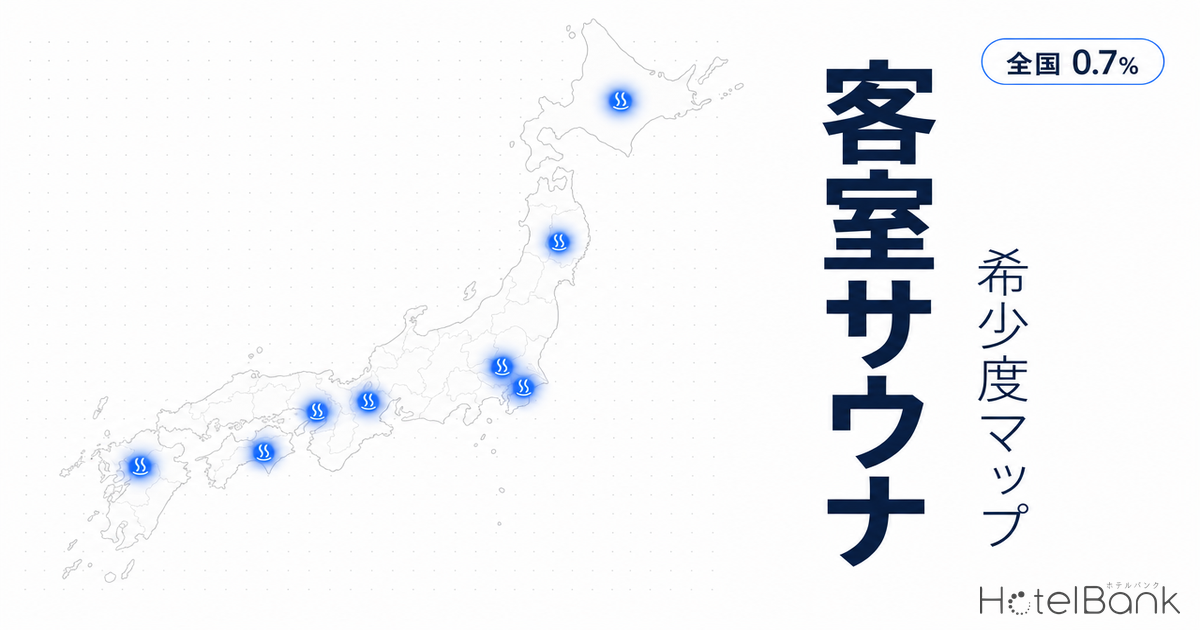
Plotting the latitude and longitude of the 43 hotels reveals interesting clusters. In Hokkaido, “sauna-led” hotels concentrate in the urban areas of central-to-eastern Hokkaido—Sapporo, Asahikawa, and Obihiro. In Kanto, “onsen-led” hotels cluster in the hot-spring areas of Kanagawa centered on Hakone, Yugawara, and Gora. In Chubu, they are scattered across the inland hot-spring areas of Yamanashi, Nagano, and Gifu and the coastal hot springs of Shizuoka. In Kansai, hot-spring areas of the Kinki region (Awara, Nanki-Shirahama, Arima) mix with city hotels in central Kobe.
Source: Compiled from MetroEngines Research and the HotelBank Editorial Team (circle size = total mentions of both tags, color = type)
The first implication readable from the map is a clear division of territory: the “sauna-led” type is urban-cluster-oriented, while the “onsen-led” type is hot-spring-belt-oriented. Regions where the two intersect geographically are limited; Kanagawa, for example, is one of the few areas where the Hakone hot-spring zone (onsen-led) and parts of the Izu/Yugawara resorts (dual-engine) sit close together. It is no coincidence that two of the five dual-engine hotels are concentrated in Kanagawa: a hot-spring area within a two-hour radius of central Tokyo is thought to fit the demand for combining “sauna × private open-air bath.”
The five “dual-engine” hotels — the rarest review fingerprint
The five “dual-engine” hotels, where mention volume for the two tags is nearly balanced, hold an extremely rare position in which reviews repeatedly praise both “the sauna was great” and “the in-room open-air bath was great.” Five out of 27,250 operating facilities nationwide—one in every 5,450.
| # | Hotel | Location | Rooms | Sauna mentions | In-room open-air mentions |
|---|---|---|---|---|---|
| 1 | Nihon no Yado Koyo (日本の宿 古窯) | Yamagata | 118 rooms | 26 | 37 |
| 2 | Yui no Yado Yaeikan (結いの宿 彌榮館) | Kanagawa | 19 rooms | 30 | 24 |
| 3 | Gero Onsen Suimeikan (下呂温泉 水明館) | Gifu | 264 rooms | 23 | 26 |
| 4 | Aburaya Tosen (あぶらや 燈千) | Nagano | 35 rooms | 25 | 19 |
| 5 | Toki no Yu Setsugekka (季の湯 雪月花) | Kanagawa | 158 rooms | 14 | 25 |
Source: Compiled from MetroEngines Research and the HotelBank Editorial Team (trailing 24 months, positive sentiment only)
Nihon no Yado Koyo in Yamagata, Gero Onsen Suimeikan in Gifu, and Aburaya Tosen in Nagano are all mid-to-large onsen ryokan, yet both their shared public-bath sauna and their private open-air baths are highly rated. Yui no Yado Yaeikan (19 rooms) and Toki no Yu Setsugekka (158 rooms) in Kanagawa are located in the Hakone area, and their combination of good access from central Tokyo plus sauna + private open-air bath makes them the representative examples of the dual-engine type.
Sauna-led Top 10 — the new axis for urban business hotels
Looking at the top 10 sauna-led hotels, urban capsule/business properties built around a large public bath + sauna + cold-plunge bath stand out. The Premier Hotel CABIN series (Sapporo, Asahikawa, Obihiro) ranks across all three Hokkaido cities, capturing sauna demand in the mid-price band at a scale of 200–350 rooms.
| # | Hotel | Location | Rooms | Sauna mentions | In-room open-air mentions |
|---|---|---|---|---|---|
| 1 | Premier Hotel CABIN Sapporo (プレミアホテル-CABIN-札幌) | Hokkaido | 218 rooms | 102 | 3 |
| 2 | Shizuku, a Ryokan with Private In-Room Saunas and Mt. Fuji Views (富士山の見える全室個室サウナ付旅館しずく) | Yamanashi | 14 rooms | 102 | 1 |
| 3 | Premier Hotel CABIN Asahikawa (プレミアホテル-CABIN-旭川) | Hokkaido | 355 rooms | 79 | 1 |
| 4 | Super Hotel Osaka Natural Hot Spring “Hananoi” (湯元「花乃井」スーパーホテル大阪天然温泉) | Osaka | 440 rooms | 69 | 1 |
| 5 | Y’s CABIN & HOTEL Naha Kokusai-dori (Y’s CABIN & HOTEL那覇国際通り) | Okinawa | 188 rooms | 61 | 1 |
| 6 | HOTEL MYSTAYS Premier Sapporo Park (ホテルマイステイズプレミア札幌パーク) | Hokkaido | 419 rooms | 59 | 1 |
| 7 | Hotel Mount Fuji (ホテルマウント富士) | Yamanashi | 53 rooms | 49 | 1 |
| 8 | Kitakobushi Shiretoko Hotel & Resort (北こぶし知床ホテル&リゾート) | Hokkaido | 181 rooms | 47 | 7 |
| 9 | Dormy Inn Mishima, Fugaku-no-Yu Natural Hot Spring (天然温泉 富嶽の湯 ドーミーイン三島) | Shizuoka | 177 rooms | 47 | 1 |
| 10 | Premier Hotel CABIN Obihiro (プレミアホテル-CABIN-帯広) | Hokkaido | 268 rooms | 46 | 3 |
Source: Compiled from MetroEngines Research and the HotelBank Editorial Team (trailing 24 months, positive sentiment only)
An interesting exception is Yamanashi’s “Shizuku, a Ryokan with Private In-Room Saunas and Mt. Fuji Views” (14 rooms). This extremely unusual format equips every guest room with a private sauna, and despite a mention profile of 102 sauna mentions and just 1 in-room open-air mention, its ADR of ¥103,600 far exceeds the average for the urban-business type. It is a fine example of taking a clear position through a single strong appeal—”the in-room sauna.”
Onsen-led Top 10 — built around the private open-air bath
The top 10 onsen-led hotels are centered on onsen ryokan and onsen resorts. Mid-sized inns in famous hot-spring areas line up: Awara Onsen Mimatsu (あわら温泉美松) and Grandia Housen (グランディア芳泉) in Fukui, Hotel New Awaji (ホテルニューアワジ) in Hyogo, Laforet Hakone Gora Yunosumi (ラフォーレ 箱根強羅 湯の棲), Hakone Yumoto Onsen Hotel Okada (箱根湯本温泉 ホテル おかだ), and Hakone Kowakidani Onsen Mizu-no-Oto (箱根小涌谷温泉水の音) in Kanagawa, and Hotel Sun Resort Shirahama (ホテルサンリゾート白浜) in Wakayama.
| # | Hotel | Location | Rooms | In-room open-air mentions | Sauna mentions |
|---|---|---|---|---|---|
| 1 | Awara Onsen Mimatsu (あわら温泉美松) | Fukui | 84 rooms | 46 | 2 |
| 2 | Grandia Housen (グランディア芳泉) | Fukui | 111 rooms | 46 | 13 |
| 3 | Hotel New Awaji (ホテルニューアワジ) | Hyogo | 117 rooms | 45 | 4 |
| 4 | Laforet Hakone Gora Yunosumi (ラフォーレ 箱根強羅 湯の棲) | Kanagawa | 22 rooms | 45 | 3 |
| 5 | Hotel Sun Resort Shirahama (ホテルサンリゾート白浜) | Wakayama | 26 rooms | 42 | 13 |
| 6 | Hakone Yumoto Onsen Hotel Okada (箱根湯本温泉 ホテル おかだ) | Kanagawa | 122 rooms | 35 | 7 |
| 7 | Hakone Kowakidani Onsen Mizu-no-Oto (箱根小涌谷温泉水の音) | Kanagawa | 95 rooms | 33 | 5 |
| 8 | Utsukushigahara Onsen Hotel Shoho (美ヶ原温泉 ホテル翔峰) | Nagano | 95 rooms | 32 | 7 |
| 9 | Ogoto Onsen Biwako Ryokusuitei (おごと温泉 びわこ緑水亭) | Shiga | 72 rooms | 31 | 13 |
| 10 | Ise Geku Sando Ise Shinsen (伊勢外宮参道 伊勢神泉) | Mie | 45 rooms | 30 | 10 |
Source: Compiled from MetroEngines Research and the HotelBank Editorial Team (trailing 24 months, positive sentiment only)
The onsen-led type shows wide ADR dispersion, ranging more than twofold from ¥58,700 (Hotel Sun Resort Shirahama) to ¥146,800 (Grandia Housen). The onsen-led average ADR is ¥101,600, but this reflects the inclusion of higher-tier plans with a private open-air bath; standard plans without one are often sold at around half that price.
“Extreme-heat day” formalization raises the memory value of “water”
On April 17, 2026, the Japan Meteorological Agency formally added days with a maximum temperature of 40°C or above to its forecast terminology as an “extreme-heat day (kokusho-bi).” The label, in use by the Japan Weather Association since August 2022, was thus officially adopted as a national forecast term. In its long-range weather outlook released on March 25, 2026, the Japan Weather Association projected that extreme-heat days in summer 2026 would total 7–14 locations nationwide—on par with or slightly above the average of the past decade. Summer is also expected to arrive earlier than usual, with a tendency for the Pacific High to strengthen its reach toward the Honshu area.
This weather trend’s impact on accommodation demand can also be read from REIT monthly data. Hoshino Resorts REIT (星野リゾート・リート投資法人, 3287), which is centered on resort/regional assets, had an occupancy rate of 79.3% as of April 2026—a level exceeding that of urban-centric REITs. As extreme heat becomes more prolonged and intense, the possibility that urban-centric accommodation demand is shifting toward regional water-and-bath experiences cannot be denied, and the combination of sauna × private in-room onsen could become an important positioning axis for regional ryokan and resorts. The way summer accommodation ratings are strongly influenced by “how well the air conditioning works” is analyzed in detail in our piece on “guest-room temperature” reviews in the era of 40°C heat. The memory value of cold-plunge baths and outdoor cooling-off and the baseline quality of air-conditioning performance both sit in the same demand context as a “response to heat.”
Source: Compiled by the HotelBank Editorial Team from each company’s REIT monthly operating data (as of April–May 2026)
For hotels: plan-name hints that work for this theme
For hotels that want to promote combining sauna × private open-air bath
Looking at the publicly listed plan data of the five “dual-engine” hotels, plan names that explicitly state both a sauna and a private open-air bath are extremely limited. Here are naming hints for differentiation —
Sauna × Open-Air Bath Cold-Plunge + Outdoor Cooling-Off Totonou × Natural Spring Private Sauna + In-Room Open-Air Bath Sauna Life × Onsen
Plan names tend to split into “public-bath sauna only” or “in-room open-air bath only,” but hotels that combine both hold a rare position where they can explicitly speak to both. Consistency in naming is highly likely to translate into differentiation along the booking path.
*These are naming hints based on trends in publicly listed plan names; they do not demonstrate a causal link between naming and sales.
Summary: a 0.16% rare position, at the intersection of region and price band
From guest-review tag analysis, it is clear that hotels observed with both sauna mentions and private open-air bath mentions number 43 nationwide, a share of 0.158% against operating facilities. They split into three types—24 urban-business “sauna-led,” 14 onsen-ryokan “onsen-led,” and 5 balanced “dual-engine”—with ADR rising stepwise in that order: ¥77,400 → ¥101,600 → ¥113,400. Geographically, four regions—Hokkaido, Kanto, Chubu, and Kansai—account for 88%, while Kyushu, Chugoku, Tohoku, Shikoku, and Okinawa are extremely limited.
The formalization of the “extreme-heat day” term and the upward trend in summer temperatures are raising guests’ sensitivity to “water.” Hotels able to combine different cooling/bathing experiences—cold-plunge baths, outdoor cooling-off, and free-flowing natural hot-spring open-air baths—see the very vocabulary of their reviews become more layered, giving them an edge in review-driven brand recognition as well. In particular, for regional onsen ryokan and resorts, the investment decision of whether to strengthen the flow around a public-bath sauna or add an open-air bath to existing guest rooms is worth considering as a repositioning for the era of extreme heat. The market white space is still wide.
Related reading
References and sources
■ Data source
Using roughly 27,250 operating hotels nationwide as the base population, hotels mentioned for both “in-room sauna × private open-air bath” were extracted via NLP tag analysis of guest reviews (simultaneous mentions of bath_sauna × room_private_onsen). ADR and occupancy reference J-REIT monthly disclosures and city-level monthly aggregation (as of April 2026).
■ Estimation assumptions
A tag mention is defined as “a facility where the relevant tag appeared explicitly in review text.” Of the 43 dual-mention facilities, those with fewer than 10 reviews were excluded. ADR bands use per-night room-only price bands including tax and service charge, rounded to the median across multiple OTAs.
■ Limitations and caveats
Review tags depend on subjective descriptions of the stay experience and may not fully match the actual presence of facilities. The risk of false detection from a small number of reviews is mitigated by the threshold (10 reviews) and the dual-mention requirement. Regional skew also reflects differences in the distribution of operating-facility density and review-posting density.
■ Market and review data
- MetroEngines Research / HotelBank Editorial Team — NLP tag analysis of guest reviews (bath_sauna / room_private_onsen, trailing 24 months, positive sentiment, N=43 hotels), OTA public selling prices (July–September 2026, double occupancy, tax included)
■ Weather and government announcements
- Japan Weather Association, “JMA Designates Days of 40°C or Above as ‘Extreme-Heat Day'” (April 17, 2026)
- Japan Weather Association tenki.jp, “2026 Heat Outlook: 7–14 Locations Nationwide Forecast for ‘Extreme-Heat Days’ of 40°C or Above” (March 25, 2026)
- Japan Weather Association Weather X, “Summer 2026: ‘Extreme-Heat Day’ Becomes a JMA Forecast Term”
- Nikkei, “40°C and Above to Be an ‘Extreme-Heat Day’: JMA’s New Term, Starting This Summer” (April 2026)
■ REIT monthly data
- Hoshino Resorts REIT (星野リゾート・リート投資法人, 3287), “Monthly Operating Status, April 2026”
- Nippon Hotel & Residential Investment Corporation (日本ホテル&レジデンシャル投資法人, 3472), “Monthly Operating Status, May 2026”
- Kasumigaseki Hotel REIT Investment Corporation (霞ヶ関ホテルリート投資法人, 401A), “Monthly Operating Status, April 2026”