

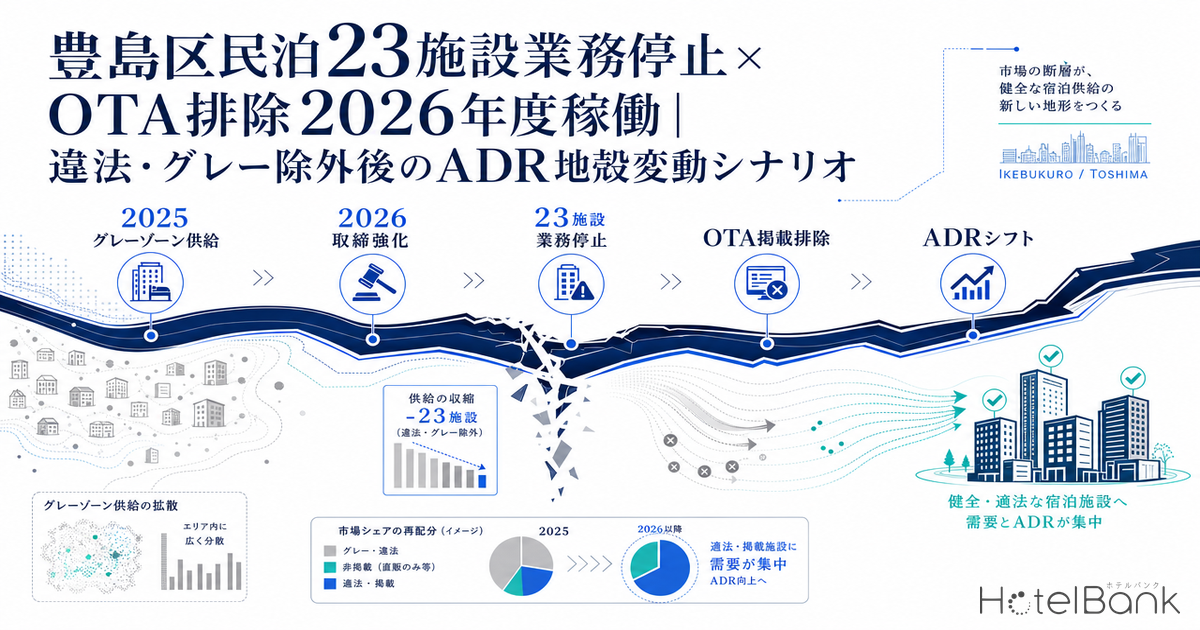
On April 24, 2026, Tokyo’s Toshima Ward announced its policy to issue a one-year business suspension order against 15 operators and 23 properties for violating the periodic reporting obligations under the Housing Accommodation Business Act (the Minpaku New Law). It is the first such measure by the ward and stands as a symbolic case positioned on the “eve” of the illegal-minpaku OTA purge system that the Japan Tourism Agency plans to launch in FY2026. This article combines public price data from MetroEngines Research with government statistics to quantitatively examine, across three scenarios, how hotel ADR in Tokyo’s 23 wards—including Toshima—may shift during the FY2026 regulatory tightening phase.
Metric Definitions Used in This Article
- ADR (Average Daily Rate): The average of selling prices publicly listed on OTAs and similar platforms. This differs from actual transacted prices. Per-room rate (tax included) for 2 guests in 1 room, averaged across all plans (room-only through meal-inclusive plans).
- Sold-out rate: The proportion of plans on OTAs whose reservations had been closed at the time of survey. This differs from the property-level occupancy rate.
- Data source: MetroEngines Research
The Significance of Toshima’s Order and the Scope of the Tourism Agency System Launch
Toshima’s grounds for the suspension order is the bi-monthly periodic reporting obligation prescribed in Article 14 of the Housing Accommodation Business Act. On April 3, 2026, the ward issued business improvement orders to 83 operators and 202 properties that had failed to file the December 2025 and February 2026 reports consecutively. However, for 15 operators and 23 properties that failed to resubmit by the deadline, the ward is expected to formally issue business suspension orders around June. The suspension period extends one year, effectively preventing the targeted operators from continuing to sell via OTAs and similar channels until summer 2027.
The impact of this measure extends beyond the 23 affected properties. Beginning in FY2026, the Japan Tourism Agency plans to launch a new system that centrally manages the three lodging categories—Housing Accommodation Business (Minpaku New Law), Special Zone Minpaku, and Simple Lodgings—and is building a mechanism that automatically removes unregistered or non-compliant properties by cross-referencing OTA listings with national and municipal registration records. In other words, Toshima’s suspension order should be read not as a one-off administrative disposition but as a leading indicator of the transition into the nationwide phase of purging illegal and gray-zone properties. We have separately quantified the upward ADR effect on the five major-city hotel markets from this system launch in Illegal Minpaku Purge System Launches in FY2026: Estimating ADR Uplift Across Five Major-City Hotel Markets.
It is worth confirming the market scale. According to the Japan Tourism Agency’s Minpaku Portal, as of September 2025 the number of registered Housing Accommodation Business properties reached 35,246 nationwide. Within Tokyo’s 23 wards, registrations are extremely concentrated in specific areas: Shinjuku 3,620, Sumida 1,989, Toshima 1,867, and Taito 1,341. If 10–20% of these dense-area listings are illegal or unregistered, the purge target could plausibly run into thousands of properties.
Correlation Between Minpaku Density and Hotel ADR Across the 23 Wards
To gauge the impact of regulatory tightening, we first need to visualize the present positioning of minpaku density and hotel price levels. The scatter plot below maps Tokyo’s 23 wards with the number of registered minpaku in each ward on the horizontal axis and ADR for business and city hotels as of April 2026 on the vertical axis.
Source: Compiled by HotelBank Editorial Team from MetroEngines Research (minpaku registrations as of January 2026 from publicly available kansyuku.com data; ADR for April 4, 2026 check-in, N=2,103 properties)
The structure read off the scatter plot is clear. Shinjuku tops the 23 wards with 3,620 registrations while still sitting at a high ADR of ¥68,100. Taito has 1,341 registrations against ADR ¥53,100; Sumida 1,989 at ¥52,200; Toshima 1,867 at ¥45,600. By contrast, Chiyoda, Minato, Shibuya, and Chuo—business-centric areas—have relatively few minpaku registrations and maintain elevated ADR levels of ¥62,000–¥90,600.
What stands out here is the singularity of Toshima. With 1,867 registrations, it is among the most concentrated of the 23 wards, yet its ADR of ¥45,600 is the lowest among the dense areas. This suggests that despite anchoring strong demand around Ikebukuro, room rates may be suppressed by price competition with minpaku. The ward’s sold-out rate (plan-based) tracks at a high 75.8%, yet ADR fails to follow—a structural state in which volumetric demand is not being passed through into pricing.
YoY Price Trends Across the Five Dense Wards
As regulatory tightening rolls in, how have ADRs in the dense areas already been moving? Comparing the same date in April 2025 and April 2026 (April 4 check-in), all the targeted wards posted year-over-year gains.
Source: Compiled by HotelBank Editorial Team from MetroEngines Research (April 4, 2025 vs. April 4, 2026 check-in, 2 guests/1 room, N=1,184 properties)
Shinjuku rose +18.5% YoY, Chiyoda +28.8%, Taito +12.3%, Toshima +14.4%, and Chuo +14.4%—all double-digit gains. The largest gain was Chiyoda’s +28.8%, likely the result of an office-district area capturing tourism demand including inbound. We dive deeper into the structural shift of foreign-guest ratios in Tokyo in Deep Dive into the Tourism Agency’s January 2026 Flash Report: Tokyo’s Entrenched 50%+ Foreign-Guest Ratio and the Tectonic Shift of Thinning Domestic Demand. On the other hand, it is worth noting that Toshima and Taito—dense-minpaku areas with high inbound exposure—posted relatively muted gains.
In other words, demand competition with minpaku may currently be acting as a drag on ADR growth in the dense areas. If the Tourism Agency system launch and OTA-side purges of illegal listings advance in tandem in the second half of FY2026, room emerges in these areas for “demand previously absorbed by minpaku” to flow back to hotels. In the next section we benchmark the magnitude of this effect against past regulatory cases.
Benchmarking the 2018 Minpaku New Law Enforcement
The most relevant historical analogue is the enforcement of the Housing Accommodation Business Act (Minpaku New Law) on June 15, 2018. Ahead of enforcement, the Tourism Agency stepped up enforcement against unregistered illegal minpaku, and the number of active Airbnb listings plunged from roughly 62,000 just before enforcement to about 13,800 within a few months after—a roughly 78% supply contraction on a property-count basis, an extremely large-scale shock.
The Nikkei reported on the market reaction at the time as “Minpaku Stalls Under New Law,” with lodging market share remaining at just 0.3%. On the hotel-industry side, business and city hotel ADR shifted into a gradual upward trend from H2 2018 through 2019, but inbound demand was in a phase of rapid growth at the time, making it difficult to isolate the pure “regulatory effect.”
| Phase | Event | Minpaku Supply | Hotel ADR Response |
|---|---|---|---|
| June 2018 | Minpaku New Law enforced | ~78% decline | Gradual upward trend |
| 2020–2022 | COVID-19 pandemic | Whole market suspended | Not comparable |
| 2023–2025 | Inbound recovery and minpaku rebound | Re-expansion to 35,246 | Double-digit growth across 23 wards |
| FY2026 onward | OTA-side illegal-listing purge system launches | Illegal/gray-zone removed | Estimated in this article |
Source: Compiled by HotelBank Editorial Team from Japan Tourism Agency “Status of the Housing Accommodation Business Act,” Nikkei, and MetroEngines Research
The benchmark from 2018 is that “rapid removal of illegal listings does not erase demand itself but redistributes it to compliant hotels.” That said, an important difference for scenario analysis is that 2018 had the tailwind of inbound growth, whereas FY2026 will see regulatory tightening with inbound already at elevated levels.
ADR Shift Estimates Under Three Scenarios
Below, we estimate ADR shifts from H2 FY2026 through FY2027 under three scenarios for the three dense-minpaku wards of Toshima, Shinjuku, and Taito. The estimates assume (a) the removal rate of illegal/unregistered properties, (b) the rate at which removed demand returns to hotels, and (c) seasonal factors held constant.
Source: Estimated by HotelBank Editorial Team based on MetroEngines Research data (scenarios constructed using April 2026 actual ADR as the base and elasticities inferred from past regulatory cases)
Scenario A “Gradual Removal” assumes that even after the Tourism Agency system launches, removal progresses slowly due to municipal capacity constraints. Setting the illegal/unregistered removal rate at 20% and the demand-return rate at 30%, the ADR uplift across the three dense wards lands in a +2–4% range. Toshima’s ADR would rise only modestly from ¥45,600 to roughly ¥46,900–¥47,400.
Scenario B “Standard Removal” assumes the system launch proceeds as planned and removal of illegal listings on major OTAs is broadly completed within the year. With a 35–40% removal rate and a 50% return rate, the ADR uplift is expected at +5–7% for Toshima, +4–6% for Shinjuku, and +5–7% for Taito. This is comparable to the market reaction observed at the 2018 New Law enforcement.
Scenario C “Forced Removal” assumes the Tourism Agency system works alongside independent municipal regulations (Toshima’s 120-day annual operating cap effective December 2026, weekend-only operation in Sumida and Katsushika), causing significant contraction in the supply of even legal minpaku. The effective minpaku supply contraction would exceed 50%, and ADR uplift in the three dense wards could theoretically reach +8–12%. However, if demand enters a phase of slowing inbound growth, ceiling resistance may also strengthen, so the upper bound of the range should be viewed as limited.
Note on data switching: This article combines OTA public-price data (selling-price basis) and REIT monthly operating data (transacted-price basis). Because the two have a structural level gap, please focus on YoY (year-over-year) rates of change rather than direct comparisons of absolute values.
REIT Monthly Data Pointing to Overall Market Direction
To corroborate the scenarios, we turn to the latest monthly operating results from listed hotel REITs. Japan Hotel REIT Investment Corporation (8985) posted March 2026 results showing ADR +5.0% YoY, occupancy +3.1 points, and RevPAR +9.0%—all positive. Invincible Investment Corporation (8963) likewise maintained 87.6% occupancy and ADR around ¥14,500 in March 2026.
Source: Compiled by HotelBank Editorial Team from each REIT’s monthly operating data (February–March 2026 actuals, total portfolio basis)
YoY readings across REITs remain firmly positive, suggesting that the overall market will sustain its upward price trajectory even as regulatory tightening sets in. That said, the structural question of whether 2026’s ADR rise is demand-driven or driven by labor-cost pass-through is examined in detail in The True Nature of Labor-Cost Pass-Through ADR Growth: Reading Japan’s 2026 Hotel Pricing Through the OCC×ADR Divergence. In particular, all seven listed hotel REITs—Ichigo Hotel REIT (3463), Invincible Investment Corporation (8963), Nippon Hotel & Residential Investment (3472), Japan Hotel REIT (8985), Hoshino Resorts REIT (3287), Mori Trust Hotel REIT (8961), and Kasumigaseki Hotel REIT (401A)—maintain occupancy above 70%.
In short, the FY2026 regulatory-tightening scenario is highly likely to act as a tailwind for the hotel industry as a whole. However, because the manifestation of the effect varies significantly by ward and property type, operators would do well to scrutinize area-level minpaku density and their own ADR positioning, then redesign pricing strategy accordingly.
Implications for Operators and Investors
Toshima’s business suspension order should be positioned as the prelude to the Tourism Agency’s nationwide illegal-minpaku purge system. As analyzed in this article, hotel ADRs in dense areas are already on a positive trajectory, and regulatory tightening is likely to act as an accelerant. That said, the magnitude of the effect depends on the removal rate and demand-return rate, with scenarios spanning a wide +2% to +12% range.
The initial actions operators should take can be organized into three points. First, identify the density of minpaku registrations within a 500m radius of one’s property and quantitatively estimate how much competitive pressure will ease during regulatory tightening. Second, in areas where minpaku and hotels have competed for demand—such as Toshima, Shinjuku, and Taito—continuously monitor weekly and monthly headroom for upward ADR revisions. Third, to avoid demand attrition from excessive price increases, raise prices gradually while monitoring sold-out rates and price elasticity in tandem.
The full launch timing of the Tourism Agency system, the enforcement schedules of municipal supplementary ordinances, and the implementation pace at each booking platform—these variables will move in parallel over the next 12–18 months. Building a data-driven monitoring framework will determine whether the ADR tectonic shift becomes an opportunity.
Note on future-dated ADR: The ADR figures in this article are averages of selling prices publicly listed on OTAs at the time of survey and will fluctuate as check-in dates approach. Prices currently set high may decline through last-minute reductions, so please keep this in mind.
Related Articles & References
- Japan Tourism Agency Minpaku Portal “minpaku”
- Toshima Ward: About the Housing Accommodation Business Act (for operators)
Related Reading
- Illegal Minpaku Purge System Launches in FY2026: Estimating ADR Uplift Across Five Major-City Hotel Markets
- The True Nature of Labor-Cost Pass-Through ADR Growth: Reading Japan’s 2026 Hotel Pricing Through the OCC×ADR Divergence
- Deep Dive into the Tourism Agency’s January 2026 Flash Report: Tokyo’s Entrenched 50%+ Foreign-Guest Ratio and the Tectonic Shift of Thinning Domestic Demand
- Weekday ADR Deep Dive Across Tokyo, Nagoya, Osaka, and Fukuoka: Visualizing the Recovery of Business Demand
- The Reality of Soaring Business Hotel Prices — National ADR Analysis and the Top 10 Most Cost-Effective Prefectures for Business Travel
- Osaka Expo 2025’s Impact on Hotel ADR: An Analysis Using REIT and OTA Data