

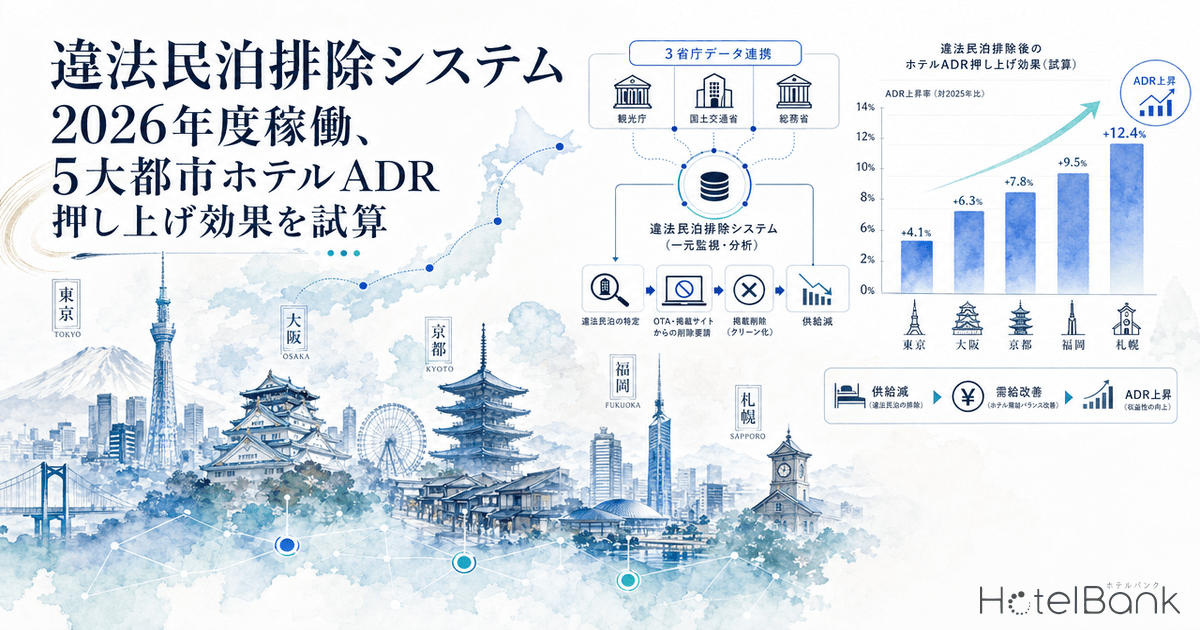
The Japan Tourism Agency has announced its policy to launch a new system in early FY2026 that will remove unregistered illegal minpaku (private lodging) listings from booking sites (Travel Voice, November 28, 2025; Nikkei, November 13, 2025). What sets this initiative apart from previous minpaku regulations is that it bridges the jurisdictional silos of three minpaku categories—the Private Lodging Business Act (Minpaku New Law), special-zone minpaku, and simple lodgings—by integrating data from the Japan Tourism Agency, the Ministry of Health, Labour and Welfare, and local governments into a single verification platform. This article uses public data and clearly stated assumptions to estimate how many illegal listings could be removed from major OTAs once the system is operational, and how much ADR uplift this might generate across the hotel markets of the five major cities.
What Is the Illegal Minpaku Removal System? — A Structural Shift via 3-Agency Data Integration
The new system that the Japan Tourism Agency will launch in FY2026 is, in essence, a “cross-ministerial verification platform.” According to Nikkei, the government has earmarked roughly ¥22.5 billion in the FY2025 supplementary budget for related costs and is targeting an early-FY2026 rollout. Travel Voice reports that as of September 2025, registered minpaku properties totaled 35,246—exceeding pre-COVID levels and re-entering a growth trajectory. However, delays in detecting illegal forms of operation, such as unregistered businesses or “imposter listings” using another operator’s registration number, have emerged as a major challenge.
Until now, the three minpaku categories have been governed by entirely separate authorities. The Private Lodging Business Act (Minpaku New Law) is overseen by the Japan Tourism Agency, special-zone minpaku in National Strategic Special Zones by local governments, and simple lodgings under the Inn Business Act by the Ministry of Health, Labour and Welfare. Notification data have been managed in separate systems, leaving no unified means to verify “under which legal framework a property listed on a minpaku platform has been registered—or whether it is unregistered at all.” The new system is designed to cross-reference all property data listed on OTAs and minpaku platforms against registration data held by the three agencies and local governments in real time, flagging unmatched properties as illegal and notifying intermediaries to remove them from their sites.
Source: Compiled by HotelBank Editorial Team from Japan Tourism Agency, Ministry of Health, Labour and Welfare, and local government public materials
What deserves attention is the “automation of data matching” that the system will enable. Until now, local governments have relied on citizen reports and post-hoc tracking to crack down on illegal properties. For example, Kyoto City has shut down 267 illegal minpaku posing as weekly apartments since June 2024, but this was the result of cumulative investigations triggered by individual citizen reports. Once the new system goes live, regulators will be able to continuously generate “lists of properties that fail to match registration data” by comparing OTA listings with notification data, fundamentally changing the efficiency of regulatory resource deployment. As a reference for reading demand price elasticity, the Kyoto market’s 18.6% YoY ADR increase following the lodging tax hike is a useful precedent (see our Kyoto Lodging Tax Month 1 analysis).
Estimated Supply Reduction if Illegal Minpaku Are Removed from Major OTAs
To estimate the scale of removal, we first need to quantify the existing minpaku supply. According to the Japan Tourism Agency’s “Status of Implementation of the Private Lodging Business Act” (as of March 13, 2026), cumulative notifications under the Private Lodging Business Act stand at 61,605, with 22,030 business closures, leaving 39,575 currently registered properties. Adding approximately 6,899 special-zone minpaku across 8 municipalities nationwide (as of end-June 2025, with 95% concentrated in Osaka City) and roughly 3,000 simple lodgings in Kyoto City, total minpaku-related properties in Japan are estimated to reach the 50,000 range.
The government has not published an official estimate of the illegal-listing ratio. This article sets three assumed scenarios: a conservative case at “5% illegal,” a base case at “12%,” and an optimistic case at “20%,” presenting a range of expected removals from major OTAs under each scenario. These figures are rough estimates based on listed property counts on intermediary sites and do not include grey-zone cases that could arise during operation (e.g., notifications not yet updated, previously registered but currently expired).
| Scenario | Assumed Illegal Ratio | Expected Removals (Nationwide) | Main Assumption |
|---|---|---|---|
| Conservative | 5% | ~2,500 | Only clearly unregistered properties removed |
| Base | 12% | ~6,000 | Imposter listings and registration-number misuse also detected |
| Optimistic | 20% | ~10,000 | Includes grey-zone cases and unreflected operational changes |
Source: HotelBank Editorial Team estimates based on Japan Tourism Agency’s “Status of Implementation of the Private Lodging Business Act” and local government public materials
Past enforcement records lend a degree of plausibility to these assumptions. According to the Ministry of Health, Labour and Welfare’s illegal minpaku countermeasure document, cases identified by local governments as potentially in violation of the Inn Business Act fell from 7,993 at the end of March 2018 to just 190 at the end of March 2024. While this dramatic decline is a result of regulatory tightening, industry observers point out that the trend may have reversed in 2025 amid the rapid rebound in inbound demand. Imposter listings and name-lending arrangements—forms that are difficult to capture via traditional citizen-report mechanisms—are reportedly increasing, raising the possibility that detection volumes after system launch will land closer to the base or optimistic case.
Estimating removals by individual OTA is difficult because outcomes depend on each platform’s listing policies and Japan-market share. That said, given the dominant presence of global intermediary sites in the minpaku booking market, most of the impact is likely to concentrate on minpaku-specialized platforms, while hotel-focused OTAs would feel it as a contraction of their “minpaku category.” In addition, since the system will also screen simple-lodging listings authorized by local governments, some consolidation may extend to small-property listings on hotel-focused OTAs as well.
Minpaku Share and ADR Trends in 5 Major Cities — Geographic Skew of the Impact
The market impact of removing illegal minpaku will vary substantially by region, because minpaku’s share of total accommodation capacity differs significantly across cities. The chart below compares hotel/ryokan room counts and estimated minpaku room counts (Private Lodging Business + special-zone minpaku + minpaku-use simple lodgings) for the five major cities.
Source: HotelBank Editorial Team estimates based on Japan Tourism Agency facility statistics and local government public materials
Osaka stands out at 14.5%, the highest share. This reflects the fact that 95% of certified special-zone minpaku properties nationwide are located there, with Chuo Ward accounting for roughly 30%, Naniwa Ward 25%, and Nishinari Ward 15%—all areas where inbound visitors concentrate. Tokyo’s 10.2% minpaku share is also high, and in absolute terms it has the most properties nationwide. In Kyoto, the 60-day annual cap under the Minpaku New Law has limited new-law notifications, but roughly 3,000 simple lodgings effectively serve the same function. Fukuoka and Hokkaido have lower relative shares, but Hokkaido shows distinctive concentration in resort areas like Niseko.
Next, we look at hotel ADR trends compiled by MetroEngines Research for each city. The chart below shows monthly ADR over the 12 months from April 2025 to March 2026, allowing comparison of price levels and seasonal patterns across the five cities.
Source: Compiled by HotelBank Editorial Team from MetroEngines Research (N=479,591)
The latest 3-month average ADR by city ranks Kyoto highest at approximately ¥42,800, followed by Tokyo at ¥36,700, Hokkaido at ¥32,800, Fukuoka at ¥28,900, and Osaka at ¥23,400. While Kyoto and Tokyo are established as high-priced inbound-oriented markets, Osaka’s price level remains low—and this clearly reflects the differing degree of competition with minpaku. One factor behind Osaka’s hotel ADR remaining lower than other cities is the substantial alternative supply, including special-zone minpaku. For more on Osaka’s supply-demand structure, our Osaka Expo’s Impact on Hotel ADR analysis, which uses REIT and OTA data to examine ADR fluctuations around the Expo, organizes the interplay between event demand fade and new supply in detail.
ADR Uplift Estimates — Demand Elasticity Assumptions and City-Level Ranges
Now we estimate the ADR uplift effect from removing illegal minpaku. The model rests on the following assumptions. First, we assume that 70% of removed minpaku demand shifts to hotels (the remaining 30% flows to other lodging formats or trip cancellations). Second, we assume hotel supply has limited room to expand in the short term, and we adopt an approximation in which short-term demand elasticity is 1.0—meaning the demand uplift translates directly into an equivalent ADR uplift. This is grounded in the standard short-run equilibrium model that “in the short run, when supply is rigid and demand rises, prices rise at roughly the same rate.” Note that long-run effects will be over-estimated because new openings will adjust supply over time.
The formula is as follows. For each city, removed minpaku rooms × 0.7 (shift rate) ÷ hotel rooms × 1.0 (elasticity) yields the estimated ADR uplift rate.
Source: HotelBank Editorial Team estimates based on Japan Tourism Agency and local government public data
| City | Current ADR (3-Mo Avg) | Conservative (+%) | Base (+%) | Optimistic (+%) | Optimistic Absolute Uplift |
|---|---|---|---|---|---|
| Osaka | ¥23,400 | +0.60% | +1.43% | +2.38% | ~ +¥600 |
| Tokyo | ¥36,700 | +0.40% | +0.95% | +1.59% | ~ +¥600 |
| Kyoto | ¥42,800 | +0.24% | +0.58% | +0.97% | ~ +¥400 |
| Fukuoka | ¥28,900 | +0.20% | +0.48% | +0.80% | ~ +¥200 |
| Hokkaido | ¥32,800 | +0.15% | +0.37% | +0.61% | ~ +¥200 |
Source: HotelBank Editorial Team estimates based on MetroEngines Research, Japan Tourism Agency, and local government public data
Three key insights emerge from these results. First, the absolute ADR uplift is contained within a 0.4–1.4% range in the base case—a limited level relative to overall market cycle volatility. Put differently, the assumption that the system alone will dramatically lift hotel pricing is overstated. Second, the relative impact is greatest in Osaka, with the base case at roughly 1.4% and the optimistic case at roughly 2.4%. This is driven by Osaka’s high minpaku share, and even the base case implies room for an uplift of roughly ¥500–600 per room. Third, these estimates assume “only illegal properties are removed.” If tighter regulation triggers additional voluntary closures of legal properties, the effect could be revised upward further.
That said, opposing forces should not be overlooked. Some backpackers and budget travelers who relied on cheap illegal minpaku may not shift to hotels at all—instead, they may abandon their trip entirely or redirect it to other cities or countries. Additionally, as seen in the operational review of special-zone minpaku, contraction pressures are operating in parallel on the legal minpaku side, and over the long term, increased hotel supply from new openings could offset the ADR uplift. The estimates here represent only the short-term impact over roughly 12 months following system launch, not long-term equilibrium values. It is also important to note that recent ADR increases reflect not only demand factors but also structural pressure from labor-cost pass-through, making it essential to decompose the divergence between occupancy and price (see our Labor Cost Pass-Through ADR Surge analysis for details).
5 Actions Hotel Operators Should Take Immediately
The system is slated to launch early in FY2026, leaving each hotel only a limited window to respond. To actually capture the ADR uplift identified in our estimates, operators should begin running the following five actions in their preparation phase.
First, redefine the scope of competitive analysis. Many hotels limit their existing competitive set (compset) to a handful of similarly classified hotels. However, in the post-minpaku-reduction market, the demand segments that removed minpaku used to capture—families, groups, and long-stay guests—will surface as visible demand. Operators should begin extended monitoring that adds “minpaku and simple lodgings in the same area” to the compset, and continuously observe which price bands and room types attract demand before and after removal.
Second, redesign rate strategy in stages. In markets like Osaka and Tokyo where minpaku share is high, demand shifts may materialize within months of system launch. Operators should begin price-elasticity testing early, particularly preparing for rate-hike experiments during weekends, holidays, and major event periods. By contrast, in markets with relatively low minpaku share—Kyoto, Fukuoka, and Hokkaido—short-term uplift will be limited, so rather than abrupt rate changes, fine-tuning the booking curve to maximize revenue is the more realistic approach.
Third, strengthen long-stay and consecutive-night plans. When illegal minpaku are removed, the segment most affected is mid-to-long stays of three nights or more. Operators should design “discount for 3+ nights,” “stay 7 nights, 1 free,” “weekly plans,” and similar offerings, then re-evaluate revenue curves by length of stay for each room type. Long-stay discounts are often confused with short-term price cuts, but their essence is improved sales efficiency through long-horizon inventory commitment, and the housekeeping and linen cost savings are also substantial.
Fourth, develop family- and group-oriented room products. The biggest reason guests have favored minpaku is the price efficiency of accommodating 4–6 people in a single unit. Operators should re-inventory existing rooms—connecting rooms via internal doors that link two twins, quad rooms with four beds, suites with living areas—and strengthen their messaging on OTAs to address group demand. Even when physical renovation is difficult, there is significant room for product-design solutions alone, such as discounting simultaneous bookings of multiple rooms or bundling family plans.
Fifth, strengthen information delivery for inbound guests. Some inbound visitors displaced from illegal minpaku may have limited familiarity with hotels when changing accommodation formats. Systematizing on the hotel side the “information that supplements the local experience”—multilingual support, cashless payment, off-hours luggage storage, English/Chinese/Korean content on nearby tourist information—is the key to reliably capturing demand shifts. Even just exhaustively organizing multilingual amenity information on OTA property pages can significantly change the probability of being shortlisted by inbound visitors.
Conclusion — Prepare for a Limited but Certain Structural Shift
The illegal minpaku removal system slated for FY2026 launch is, in the sense of integrating data across three agencies, a milestone initiative in the history of Japan’s accommodation regulation. Our estimates put the ADR uplift in the 0.4–1.4% range in the base case and 0.6–2.4% in the optimistic case—a level that is likely to remain limited compared to the overall market cycle. However, in Osaka—where the impact is greatest—even the base case offers a non-trivial annual revenue opportunity.
What matters is that this change is not a “may-or-may-not happen” event but a confirmed roadmap item, with the government’s budget allocation and system development already underway. For hotel operators, the prerequisite for reliably capturing the uplift is to start running the five actions—expanded competitive analysis, staged rate-strategy redesign, strengthened long-stay and group room products, and multilingual information rollout—from the preparation phase, ahead of the system launch. Rather than the estimate values themselves, it is the presence or absence of preparation that gets ahead of this structural shift that is likely to determine the revenue gap between operators in FY2026 and beyond.
Related Articles
- Kyoto Lodging Tax Month 1: Kyoto ADR +18.6% YoY, Mix Shifts Upmarket
- Osaka Expo’s Impact on Hotel ADR: REIT & OTA Data Analysis
- Weekday ADR in Tokyo, Nagoya, Osaka & Fukuoka: Business Demand Recovery 2026
- Kyoto Accommodation Tax Reform Impact: Daily ADR Tracking of Sub-¥10,000 Hotels
- Labor Cost Pass-Through ADR Surge: Decoding Japan’s 2026 Hotel Pricing via OCC-ADR Divergence
- Hokkaido Defies Tsuyu: 6-City June ADR Comparison 2026 (+11.9% YoY)
- May-June 2026 Opening Cluster: 13 Hotels, 1,149 Rooms Shift to Regional Hubs
- Government Per-Diem vs Market ADR — 47-Prefecture Gap Visualized (2026)
[References]
– Travel Voice, “Japan Tourism Agency to Remove Illegal Minpaku from Booking Sites” (November 28, 2025)
– Nikkei, “Illegal Minpaku to Be Removed from Booking Sites: Japan Tourism Agency System Operational FY2026” (November 13, 2025)
– Japan Tourism Agency, “Status of Implementation of the Private Lodging Business Act”
– Ministry of Health, Labour and Welfare, “On Efforts to Counter Illegal Minpaku”
– Kyoto City, “Results of Guidance on Illegal Minpaku Properties”