

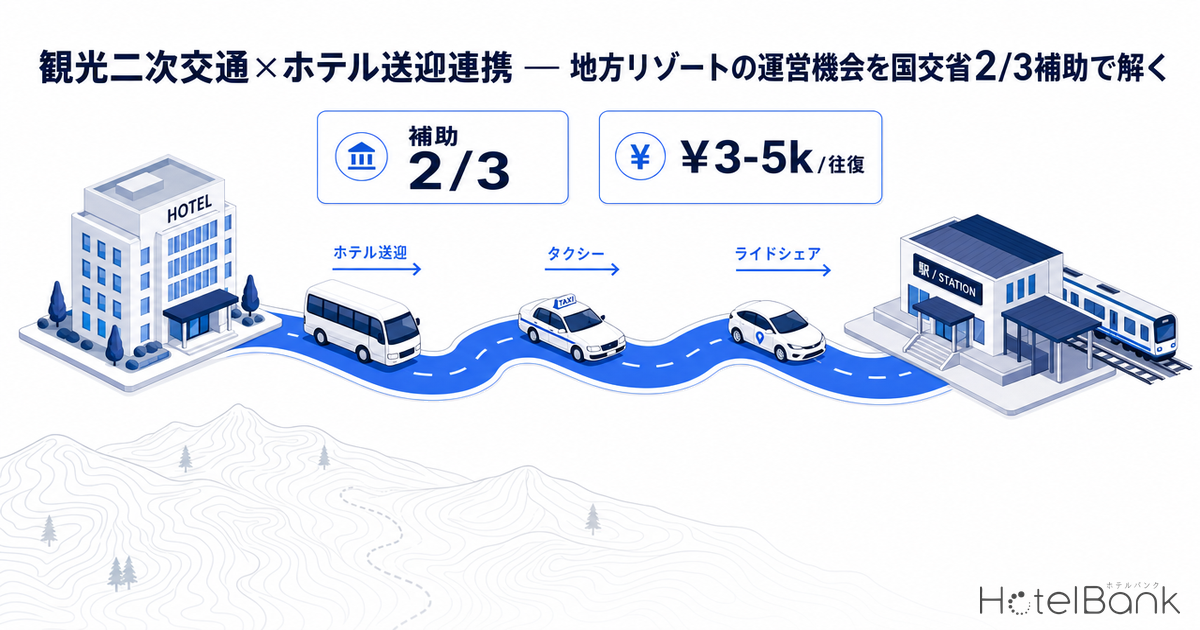
For hotel operators in regional resorts and hot-spring towns, the shuttle operation that handles guests’ “last one mile” has long been treated as a cost center. Running a single microbus back and forth to the station ties up a fixed driver’s wage, and once vehicle depreciation, insurance, and fuel are included, the real cost runs roughly ¥3,000–¥5,000 per round trip. Taking the Ministry of Land, Infrastructure, Transport and Tourism (MLIT) “Tourism Secondary-Transport Advancement Program” (2/3 subsidy rate, ¥5 million cap) and regional demonstration projects as a starting point, this article uses quantitative data to read out the operating opportunities that emerge when a hotel links its existing shuttle to local secondary transport.
Metric Definitions Used in This Article
- ADR (Average Daily Rate): the average of publicly listed selling prices on OTAs and similar channels. It differs from actual transacted prices. Per-room rate for double occupancy (tax included), averaged across all plans (from room-only to meal-inclusive plans).
- OCC (Occupancy Rate): the ratio of sold rooms to the total room supply in an area (estimated based on OTA sales inventory).
- Shuttle cost per round trip: an industry benchmark for the actual cost on a standard station⇔hotel route of 5–15 minutes one way, including driver wages, vehicle depreciation, fuel, and insurance.
- Data Source: MetroEngines Research & Consulting
- — By tapping MLIT’s “Tourism Secondary-Transport Advancement Program” (2/3 subsidy rate, ¥5 million cap per project), hotels can convert the fixed cost of their shuttle into shared regional operation.
- — An in-house microbus shuttle costing ¥3,000–5,000 per round trip is estimated to compress to ¥1,330–1,670 once the 2/3 subsidy is applied — an annual cash-flow improvement opportunity of ¥8.0–9.7 million.
- — ADR across eight regional-resort prefectures (N=6,544 properties) rose +7.4% to +18.0% year-on-year in May 2026, with Mie the largest at +18.0%. Areas with concentrated secondary-transport demonstrations overlap with this demand growth.
- — Five regional demonstrations — Shima, Sado, Dogo, Yufuin, and Kusatsu — are pioneering operating models that link hotel shuttles with Japan-style ride-share / public shuttle services.
- — The opportunity for hotels has three layers: ① cost compression, ② OCC +1–2 pt, and ③ ADR +3–5%. Forming a consortium led by local governments and DMOs is the precondition.
Executive Summary — Three Numbers Moved by Secondary-Transport Tie-ups
As of May 2026, publicly listed ADR across eight prefectures with a strong onsen/resort character ran +7.4% to +18.0% year-on-year, outpacing the national average. Meanwhile, regional secondary-transport networks still fail to fully bridge “the last few kilometers from the station to the inn,” leaving hotels with a structural cost burden as they keep filling the gap with their own shuttles. By tapping MLIT’s subsidy program and repositioning in-house shuttles into shared regional operation, an opportunity emerges to pursue cost reduction and an occupancy uplift at the same time.
Overview of MLIT’s “Tourism Secondary-Transport Advancement Program”
Administered through the regional transport bureaus (including the Kanto Transport Bureau), this program is a subsidy scheme that supports the introduction of Japan-style ride-share and public ride-share, aimed at improving inbound readiness and promoting regional dispersion in tourist destinations. The subsidy rate is 2/3, the cap is ¥5 million per project, and eligible recipients are transport operators, local governments, DMOs, NPOs, and similar implementing bodies. Cases where a hotel is the direct applicant are limited, but by contributing shuttle vehicles and operations to a consortium formed with local governments, DMOs, and transport operators, a hotel can be incorporated indirectly as part of a subsidy-eligible project.
| Item | Details |
|---|---|
| Official program name | Tourism Secondary-Transport Advancement Program (part of the Transport DX/GX Management Improvement Support Program) |
| Subsidy rate | 2/3 |
| Cap | ¥5 million per project |
| Eligible recipients | Transport operators, local governments, DMOs, NPOs, regional councils, etc. |
| Eligible activities | Introduction of Japan-style ride-share / public ride-share, building operation-management systems, dispatch-system deployment, multilingual support |
| Contact point | Each regional transport bureau (Kanto Transport Bureau, etc.) |
Source: MLIT “Tourism Secondary-Transport Advancement Program” call-for-applications guidelines and Kanto Transport Bureau public materials, compiled by MetroEngines Research & Consulting
Rising Room Rates Across Eight Resort Prefectures — A Tailwind for Secondary-Transport Improvement
Publicly listed ADR in the regional resorts and hot-spring towns where shuttle/transport improvements are under discussion held firm at +7.4% to +18.0% year-on-year as of May 2026. Mie Prefecture in particular (the Ise-Shima / Toba / Shima tourism zone) posted the largest gain at +18.0%, confirming a structure in which areas with concentrated secondary-transport demonstrations overlap with demand growth.
Source: MetroEngines Research & Consulting (N=8 prefectures, 6,544 properties, 2025-05 vs 2026-05 comparison)
| Prefecture | May 2025 ADR | May 2026 ADR | YoY | Properties |
|---|---|---|---|---|
| Mie (Ise-Shima / Shima) | ¥29,300 | ¥32,300 | +10.2% | 534 |
| Ehime (Dogo Onsen / Matsuyama) | ¥28,200 | ¥29,600 | +5.1% | 323 |
| Shizuoka (Atami / Izu) | ¥31,800 | ¥35,800 | +12.5% | 1,593 |
| Nagano (Karuizawa / Hakuba / Kamikochi) | ¥28,700 | ¥31,200 | +8.7% | 1,493 |
| Oita (Yufuin / Beppu) | ¥28,600 | ¥31,400 | +9.7% | 698 |
| Gunma (Kusatsu / Ikaho) | ¥29,000 | ¥33,500 | +15.6% | 645 |
| Tochigi (Kinugawa / Nasu / Nikko) | ¥28,000 | ¥29,700 | +6.3% | 701 |
| Niigata (Sado / Yuzawa) | ¥28,600 | ¥28,500 | -0.1% | 557 |
Source: MetroEngines Research & Consulting (per-room rate for double occupancy, averaged across all plans)
In a phase where demand-side ADR is rising, the management decision to reinvest part of the rate increase into secondary-transport services becomes easier to justify. If, for example, an ADR of ¥45,000 per night rises +12%, and ¥1,000–¥1,500 of the ¥5,400 increase can be allocated to upgrading shuttle/mobility operations, the structure offers a double return: an occupancy uplift and improved guest satisfaction.
Shima, Sado, Dogo, Yufuin, Kusatsu — Five Regional Case Studies
Secondary-transport improvement in regional resorts is advancing through cooperation among local governments, transport bureaus, transport operators, and accommodation operators. The table below summarizes the initiatives in five major regions, each presenting a different tie-up opportunity for accommodation operators.
| Region | Initiative | Operating body | Hotel tie-up opportunity |
|---|---|---|---|
| Shima (Mie) | Pearl Shuttle (Naiku ⇔ Shima direct), free shuttle from Kashikojima Station ⇔ hotels | Shima Kanko Hotel and others, Kanko Pro | Connect the existing station⇔hotel shuttle with direct services to tourist sites, expanding guests’ travel range |
| Sado (Niigata) | Sado ride-share (NearMe), 2025/4/26–11/30, operating 7:00–22:00 | Sado City, Niigata Kotsu Sado, Okesa Kanko Taxi | Complement access to the World Heritage Sado Gold Mine. Absorb peak-time shuttle shortfalls via shared operation |
| Dogo Onsen (Ehime) | Ooedo Onsen Monogatari: shuttle cooperation fee ¥30/one way; Dogo Prince Hotel: free shuttle at 10-minute intervals | Each hotel operates independently | Apportion the round-trip cost via shared operation; room to design cooperation-fee revenue |
| Yufuin (Oita) | Oita Airport ⇔ Yufuin express bus (55 min) + connection to inn shuttles | Each hotel operates independently | Opportunity to turn the last mile from Yufuin Station/airport to the inn into a shared shuttle |
| Kusatsu Onsen (Gunma) | Naganohara-Kusatsuguchi Station ⇔ Kusatsu Bus Terminal connection + inn shuttles; free shuttle to view the Yubatake | Kusatsu Now Resort, Ooruri Group and others | Turn the Yubatake ⇔ inn loop bus into shared regional operation, making it eligible for the secondary-transport subsidy |
Source: Sado City / Niigata Prefecture, Kanko Pro, each hotel’s official site, and WebSearch research, compiled by MetroEngines Research & Consulting
Common to all five regions is that the boundary between accommodation operators’ “in-house shuttles” and the region’s “public ride-share / shuttle” is blurred, leaving ample room to apportion the fixed cost of hotel shuttles across the region as a whole. When structured as a local-government-led demonstration project, as in Sado, it becomes eligible for the 2/3 subsidy, giving hotels a structure in which they can share shuttle capacity at an effective 1/3 of the cost. In Kusatsu, the density of shuttle demand around the Yubatake hot-spring field is itself a driver of area ADR — a structure we have mapped across the 20 hotels within a 5 km radius of the Yubatake.
The Cost Structure of Hotel Shuttles and a Reduction Simulation Under Ride-Share Tie-ups
When a hotel runs a single microbus in-house, the real cost per round trip converges to roughly ¥3,000–¥5,000. The breakdown is weighted toward fixed costs: driver wages (equivalent to ¥1,500–¥2,500/h), vehicle depreciation (¥500–¥800), fuel (¥400–¥700), and insurance/maintenance (¥200–¥400).
Source: microbus outsourcing market rates, Sotetsu Hotels public information, and various charter-bus fare materials, compiled by MetroEngines Research & Consulting (industry benchmark values)
Against this, the cost structure changes substantially when linked with regional ride-share / public shuttle services. The chart below compares the net burden per round trip between in-house microbus operation and a shared-operation model using the tourism secondary-transport subsidy (2/3).
Source: Tourism Secondary-Transport Advancement Program (2/3 subsidy rate, ¥5M cap) and public materials from each demonstration project, compiled by MetroEngines Research & Consulting
Opportunity summary: Against in-house microbus operation at ¥4,000/round trip, the net burden after shared operation plus the 2/3 subsidy is roughly ¥1,330–¥1,670/round trip. For a property running 10 round trips a day, this implies an annual cost-compression opportunity of ¥8.5–9.7 million. That is on par with accommodation revenue of ¥45,000 ADR × 20 rooms, and has the potential to be reallocated as funding to lift occupancy by 1–2 pt.
Shinkansen-Station / Airport Access and ADR Elasticity — The Demand Uplift from Secondary-Transport Improvement
The impact of secondary-transport improvement on accommodation demand can be observed in tandem with the convenience of station/airport access. Resort areas reachable by primary transport from a Shinkansen station or airport have a structure in which smoothing the onward last mile (station ⇔ inn) can be expected to extend length of stay and lift spend per guest.
Source: MetroEngines Research & Consulting (ADR-elasticity estimate based on N=8 prefectures, 6,544 properties, 2025-05 vs 2026-05 comparison data)
Behind Mie’s standout +18.0% lies a structure in which a massive tourism asset — Ise Jingu and the Shima tourism zone — runs alongside secondary-transport development between Kintetsu Kashikojima Station and the inns. Ehime (centered on Dogo Onsen, +13.1%), meanwhile, is positioned as an area with large room to strengthen secondary transport between Matsuyama Airport and Dogo. In the Hakuba area within Nagano (+12.0%), new ski-resort investments such as Cassia Hakuba and Indigo Nozawa are advancing in parallel. If shared operation using the secondary-transport subsidy takes root in each area, the structure supports earnings expansion on a RevPAR basis through occupancy uplift.
Three Operating Opportunities That Arise for the Hotel
The operational opportunities for hotels that tap this program can be organized into the following three layers.
| Opportunity layer | Specifics | Quantitative effect (estimate) |
|---|---|---|
| ① Cost compression | Turn the in-house microbus shuttle into shared regional operation; with the 2/3 subsidy applied, round-trip cost drops from ¥4,000 to ¥1,330–1,670 | Annual cost-reduction opportunity of ¥8.5–9.7 million |
| ② Occupancy uplift | Curb lost bookings caused by inconvenient shuttles; make station/airport-to-inn access visible | OCC +1–2 pt (trend value from regional demonstrations) |
| ③ Securing ADR elasticity | Expand in-stay mobility options to encourage touring and multi-night stays, lifting the value of a resort stay | ADR upside of +3–5% |
Source: Tourism Secondary-Transport Advancement Program and public materials from each demonstration project; MetroEngines Research & Consulting estimates
The three opportunities are not independent: the aim is a virtuous cycle in which funding freed up by cost compression is reinvested into upgrading mobility operations, ultimately lifting both occupancy and ADR. In particular, shared regional operation creates economies of scale that a hotel cannot achieve alone, and importantly only materializes through cooperation with local governments, DMOs, and transport operators.
The Practical Workflow for Applying and Forming a Consortium
The typical formation process when a hotel taps this program is as follows.
| Step | Lead | Details |
|---|---|---|
| 1. Form a regional council | Local government / DMO-led | Form a consortium of transport bureau, regional transport operators, and accommodation operators |
| 2. Draft the business plan | DMO / transport operator | Organize routes, operating hours, and vehicle-procurement plans; prepare demand forecasts |
| 3. Apply for the subsidy | Local government / DMO | Apply to the regional transport bureau (Kanto Transport Bureau, etc.); 2/3 subsidy rate, ¥5M cap |
| 4. Build the operation-management system | Transport operator | Appoint operation managers for Japan-style ride-share / public ride-share; deploy a dispatch system |
| 5. Move hotel shuttles to shared operation | Accommodation operator | Integrate existing shuttle timetables with regional operation; contribute or outsource vehicles and drivers |
| 6. Demonstration run and impact review | All parties | Monitor usage results and guest satisfaction monthly; decide on full-scale operation |
Source: MLIT “Tourism Secondary-Transport Advancement Program” call-for-applications guidelines and Kanto Transport Bureau public materials, compiled by MetroEngines Research & Consulting
Because the applicant is a local government or DMO rather than the hotel alone, the realistic position for a hotel operator is to participate as a member of a regional consortium, contributing vehicles, staff, and operating know-how. Hotels that already run their own shuttles have the potential to play a key role within the consortium, given that they hold operation-management know-how, driver resources, and demand-forecast data.
Implications from an Investor / Operator Perspective
When considering investment in or operation of regional resorts and hot-spring towns, the secondary-transport environment becomes an important parameter in location evaluation. Areas where access from a Shinkansen station or airport is complemented by secondary transport have a structure with a higher ceiling on accommodation demand and larger upside on both ADR and occupancy. For example, northern Tochigi — where an LRT opening and shuttered-ryokan redevelopment are in motion — can be framed as a “back garden of the metropolitan area” scenario.
Secondary-transport evaluation axes in investment decisions: ① primary-transport travel time from a Shinkansen station/airport, ② state of last-mile development between station and inn, ③ presence of shared regional operation, ④ track record of selection for MLIT subsidy programs, and ⑤ deployment of a multilingual dispatch system. Incorporating these five items into location scoring captures upside in accommodation demand that gross yield alone cannot reveal.
The three prefectures that recorded publicly listed ADR up more than +10% year-on-year as of May 2026 (Mie, Shizuoka, Gunma) all contain resort/onsen areas with remaining room for secondary-transport improvement. If, over the next three to five years, shared operation using this program becomes the regional standard, a clear divergence in earnings structure is likely to emerge between properties that keep carrying shuttles alone and those that compress costs through regional cooperation.
Conclusion — Repositioning the Shuttle from Cost to Opportunity
Hotel shuttles have long been treated as a cost center, but the combination of MLIT’s subsidy scheme and a shared regional-operation model has brought us to a phase where they can be repositioned as a “lever of opportunity.” Apportioning the ¥3,000–¥5,000 fixed cost per round trip across the region as a whole, and tapping the 2/3 subsidy, can compress the net burden to ¥1,330–¥1,670. That becomes an annual cash-flow improvement opportunity of more than ¥8 million; combined with the additional revenue from a 1–2 pt occupancy uplift, it is a powerful measure for improving the earnings structure of regional resorts.
Because this program presupposes a local-government / DMO-led consortium rather than a hotel-alone application, early communication with regional transport operators, transport bureaus, and local-government tourism divisions is the key. Hotels that already run their own shuttles are in a position to take a leading role within a regional consortium, given the intangible assets they hold — operation-management know-how and demand-forecast data. Now, with resort/onsen ADR holding firm, is the opportune moment to reinvest part of the increase into secondary-transport tie-ups and lift last-mile convenience across the region as a whole.
⚠ Note on the subsidy program: The subsidy rate and cap in this article are based on call-for-applications information as of June 2026. Because the application guidelines may change year to year, always confirm the latest guidelines from each regional transport bureau and the Japan Tourism Agency before any specific application.
References & Sources
■ Data sources
MetroEngines Research & Consulting (OTA publicly listed ADR data, N=8 prefectures, 6,544 properties, 2025-05 vs 2026-05 comparison); MLIT “Tourism Secondary-Transport Advancement Program” application materials; Kanto Transport Bureau public materials; public information on each demonstration project in Shima, Sado, Dogo, Yufuin, and Kusatsu; microbus outsourcing market rates and charter-bus fare materials (industry benchmark values).
■ Estimate assumptions
Shuttle cost per round trip assumes a standard station⇔hotel route of 5–15 minutes one way, including driver wages equivalent to ¥1,500–2,500/h, vehicle depreciation ¥500–800, fuel ¥400–700, and insurance/maintenance ¥200–400 as a real-cost benchmark (based on industry materials). The annual reduction estimate assumes 2 round trips per day over 365 operating days a year, with a net burden of ¥1,330–1,670 per round trip after the 2/3 subsidy. OCC/ADR elasticity is estimated from trend values across the five regional demonstration projects.
■ Limitations / caveats
The subsidy rate and scheme conditions in this article are based on the call-for-applications guidelines as of June 2026. Because the program presupposes a local-government / DMO-led consortium rather than a hotel-alone application, feasibility varies greatly with the presence or absence of a regional council. The estimates are standard-model assumptions and will move up or down with region, season, and operating timetable. Operation-management requirements for Japan-style ride-share / public ride-share differ by region.
■ Market data
- MetroEngines Research & Consulting — OTA publicly listed price data (N=6,544 properties, 8 prefectures, 2025-05 vs 2026-05 comparison), hotel shuttle cost estimate, secondary-transport tie-up simulation
■ Government statistics / public data
- MLIT “Tourism Secondary-Transport Advancement Program” (FY2025 Transport DX/GX Management Improvement Support Program subsidy)
- MLIT press release “Public call for executing bodies of the Tourism Secondary-Transport Advancement Program”
- Kanto Transport Bureau “Japan-style ride-share (private-vehicle utilization business)”
- Kanto Transport Bureau “On Japan-style ride-share, public ride-share, etc.”
- Niigata Prefecture “Demonstration study of the Sado ride-share”
■ Demonstration projects / regional cases
- NearMe “Sado ride-share”
- Niigata Prefecture Tourism Association “Getting around Sado made easy — convenient ride-share service for sightseeing launches”
- Kanko Pro “Pearl Shuttle (Naiku ⇔ Shima direct shuttle bus)”
- Shima Kanko Hotel “Free shuttle bus from Kashikojima Station”
- Dogo Prince Hotel “Access & shuttle guide”
- Kusatsu Now Resort Hotel “Shuttle service”
■ Industry / explainer materials
- Honichi Lab “MLIT opens second round of applications for a program supporting ride-share introduction and more”
- Jichitai Works “What is Japan-style ride-share? Local-government cases, differences from public ride-share, and the system explained”
- Sotetsu Hotels “Does calling a taxi to a hotel incur a shuttle fee? Payment methods and market rates explained”