

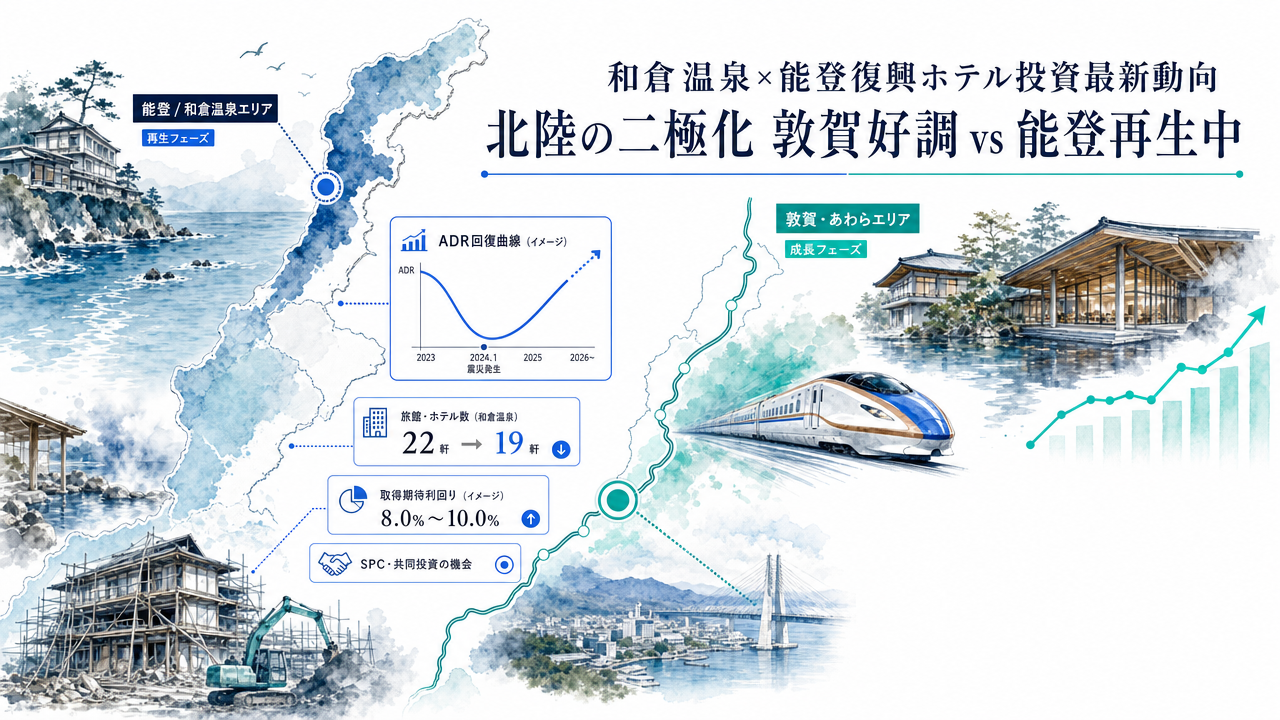
One year and four months after the January 1, 2024 Noto Peninsula earthquake, all 22 member properties of the Wakura Onsen Ryokan Cooperative were forced to suspend operations, eliminating 1,300 rooms and 6,600 guest capacity from the hot-spring resort area. As of May 2026, cooperative membership has shrunk from 20 to 19 properties (effective April 1, 2026), with some operators abandoning restart plans. Meanwhile, Kagaya (加賀屋) plans to open a new Kengo Kuma-designed flagship in winter 2026, TAOYA Wakura (TAOYA和倉) reopened in April 2025, and Notoraku (のと楽) resumed full operations in November 2024. Within the same Hokuriku region, a stark “polarization” has emerged: this contrasts sharply with Kaga Onsen-go (加賀温泉郷) and Awara Onsen (芦原温泉), which are benefiting from the tailwind of the Hokuriku Shinkansen Tsuruga extension (March 2024). This article integrates MetroEngines Research’s open price data, the Ministry of Land, Infrastructure, Transport and Tourism (MLIT) Real Estate Information Library, and national support measures to quantitatively analyze the opportunities and risks of Wakura Onsen investment for ryokan succession funds, regional revitalization REITs, and recovery investment SPCs.
Metric Definitions Used in This Article
- ADR (Average Daily Rate): Average of published prices on OTAs. Differs from actual transaction prices (unsold high-tier plans remain visible on OTAs, structurally biasing published-price averages upward versus actual booked prices). Per-room rate for double occupancy (tax-included), averaged across all plans (room-only through full meal plans).
- OCC (Occupancy): Sold rooms as a percentage of total rooms in the area (estimated from OTA inventory). In this article, OCC is used only at the prefecture or hot-spring district level, not for individual hotels.
- Cap Rate: Annual NOI / total investment. A simplified estimate; actual investment decisions require detailed feasibility studies.
- Data Sources: MetroEngines Research & Consulting, MLIT Real Estate Information Library, Japan Tourism Agency, and various official press releases.
16 Months After the Noto Quake — Wakura Onsen’s Current Position
Until the earthquake on January 1, 2024, the Wakura Onsen Ryokan Cooperative comprised 22 properties (1,300 rooms). The quake caused cracked exterior walls, ruptured hot-spring piping, and water-supply outages at every property, and the collapse of the Nanao Bay (七尾湾) seawall forced all ryokan into simultaneous suspension. As of December 2024, only a handful — including Tadaya (多田屋) and Kagaya’s sister property Aenokaze (あえの風) — had resumed operations, and in November 2024, Notoraku (Nihon no Yado Notoraku, 日本の宿のと楽) resumed full operations after a 10-month closure.
The pace of reopenings then accelerated. In April 2025, TAOYA Wakura (TAOYA和倉) — operated by the Ooedo Onsen Monogatari Group — reopened in a renovated form, and three additional properties (Kagaya, Niji to Umi, and Aenokaze) are scheduled to reopen within 2026. However, cooperative membership declined from 20 to 19 properties effective April 1, 2026. According to public materials from the Wakura Onsen Tourism Association and the Ryokan Cooperative, three cumulative withdrawals have been confirmed from the pre-quake 22-property baseline. This is an important signal that business succession and shutdown options are becoming concrete realities.
Symbolic of this shift is Kagaya’s decision. The 120-year-old property’s president Watanabe clarified the intent to “abandon lodging use” of the existing four buildings totaling 233 rooms, and committed to constructing a new Kengo Kuma-designed wing (five-story RC + S + wood hybrid structure, 8,610 sqm total floor area, approximately 50 rooms, all with sea views and open-air hot-spring baths). The construction site lies about 550 m west of the existing facility, using roughly one-quarter of a 30,000 sqm landholding. Dubbed the “Shin-RYOKAN Plan,” this is not mere restoration but a transformation toward downsizing and premiumization of the business structure itself — a potential template for Noto recovery investment. For the latest reservation trends and summer-demand recovery in Wakura Onsen and Wajima, see Noto Recovery Phase & 2026 Summer Booking Trends in Wakura Onsen and Wajima.
Recovery Curve in Published Price Data — A “U-Shaped” Monthly ADR Trajectory
Aggregating MetroEngines Research’s open price data for the Wakura Onsen area (within a 5 km radius, up to 28 properties), monthly ADR traces a clear U-shape. Immediately after the earthquake, in April 2024, ADR stood at ¥62,655 (21 properties operating). It then halved to the ¥29,000 range between December 2024 and March 2025, when reopened properties had returned to closure or only budget business-grade properties were selling. This is a structural artifact — averages were dragged down because only lower-priced inventory remained for sale — not a collapse in underlying demand.
From April 2025 onward, the cumulative effect of reopenings lifted ADR from ¥46,486 to ¥54,035 (April 2026). The number of observed selling properties rose from 5 in December 2024 to 14 in April 2026. Over the trailing year, Wakura Onsen’s ADR averaged ¥52,005 — roughly on par with adjacent Kaga Onsen-go neighbors Yamashiro Onsen (山代温泉) at ¥53,914 and Katayamazu Onsen (片山津温泉) at ¥49,952. With Awara Onsen at ¥62,050 sitting at the top, Wakura Onsen is at the stage of “catching up to peer competitors.”
Location Analysis — Land Use, Earthquake Risk, and Transit Access Along Nanao Bay
| Steep-Slope Collapse Hazard Zones | Designated (e.g., Kokubu-cho, Nanao) |
| Seawall Collapse (Nanao Bay) | Integrated tourism recovery plan in place |
| Land Use Designation | Onsen Tourism / Neighborhood Commercial |
| Building Standards Ordinance | Ishikawa Prefectural Ordinance No. 67 |
In March 2025, MLIT and the Japan Tourism Agency jointly formulated the “Regional Tourism Recovery Support Plan for Wakura Onsen, Integrated with Seawall Restoration.” This framework synchronizes the seawall-restoration progress led by MLIT’s Ports & Harbours Bureau with the Tourism Agency’s reopening updates and tourism revitalization measures — an important institutional mechanism that raises transparency for recovery investment decisions. Additionally, the “Wakura Onsen Creative Recovery Plan” (announced March 18, 2025; target year 2040) sets out eight zones — including Seaside Park, Wakura Port & Yumoto, and Yunotani — and advances six projects, such as “next-generation revenue capability of Wakura Onsen,” “hospitality city design,” “regional coordination through decarbonized energy,” and “whole-town BCP.”
Competitive Structure in the Recovery Phase — Scale & Grade Distribution of 19 Cooperative Members
The Wakura Onsen area (within a 5 km radius) currently contains over 50 lodging facilities, but narrowing to the 19 Ryokan Cooperative members reveals an extreme “pyramid” structure topped by Kagaya. The largest member, Kagaya (232 rooms), accounts for roughly 18% of the cooperative; next come Notoraku (171 rooms), Kagaya’s sister property Aenokaze (129 rooms), Wakura Onsen Kinpaso (113 rooms), and TAOYA Wakura (101 rooms) — all major properties with 100+ rooms. Meanwhile, small-scale ryokan with 20 rooms or fewer comprise roughly half of cooperative members.
Top Incumbents Luxury Ryokan Cluster
Kagaya, Aenokaze, Kinpaso, Kaibo, Biwanso. Approximately 100 rooms each, ADR ¥30k–¥50k. Formed the core of Noto tourism even before the quake.
Opportunity 1 Premium Small-Scale Boutique
The ~50 rooms / ADR ¥50k+ segment will be entered for the first time by the Kagaya new wing (winter 2026). With Kengo Kuma design, all-sea-view rooms, and open-air baths, it fills a market gap with premium value-add.
Opportunity 2 Mid-Scale Upper-Middle Revitalization
20–60 rooms / ADR ¥30k–¥50k mid-scale ryokan (Hamazuru, Noshu Iroha, etc.) are drawing attention as business succession targets.
Estimated OCC & Observed Selling Properties — Quantitative Indicators of Recovery Progress
Because OCC estimation is based on OTA inventory, its precision is limited in areas with few hotels, but in Wakura Onsen the active property count itself functions as a recovery KPI. While 21 properties were selling in April 2024, this only reflected residual sale plans immediately after the quake — many properties were in fact suspended in operation. On a substantive reopening basis, the number of selling properties has grown 2.8x, from a trough of 5 in December 2024 to 14 in April 2026.
Over the same window, ADR rose 58% from ¥34,115 to ¥54,035, reflecting the structural shift as luxury ryokan (Kagaya’s sister Aenokaze, Kaibo, Kinpaso, etc.) reopened in stages. The recovery in observed selling properties is expected to continue through FY2026, with the reopening of the Kagaya main facility (the 50-room new wing), Niji to Umi (42 rooms), and three existing buildings bringing actual operating properties among the 19 cooperative members to an estimated 15–17 by year-end 2026.
Luxury Ryokan Simplified GOP & Yield Model — Benchmarked Against the Kagaya New Wing
Taking the Kagaya new wing (50 rooms, Kengo Kuma design, all sea-view rooms with open-air hot-spring baths) as a template, we model the economics of new development investment. The ADR of ¥50,000 sits above the FY2025 top of Wakura Onsen’s luxury ryokan band confirmed in the positioning analysis (Yadomoriya Juen ¥48,968, Kaibo ¥47,270), but is achievable given the new-build, all-open-air-bath, Kengo Kuma-brand value-add. The 75% OCC assumption is higher than pre-quake Ishikawa ryokan/resort hotel OCC (Japan Tourism Agency Lodging Statistics: 46–49% in 2014), but is set assuming peak post-recovery occupancy.
Construction cost is set at ¥120 million per room (five-story RC + S + wood hybrid). This corresponds to 8,610 sqm / 50 rooms ≈ 172 sqm/room, with a unit cost of about ¥2.3 million per tsubo. According to MLIT’s Construction Starts Statistics, the 2024 average hotel construction cost across all structures was ¥1.95 million per tsubo — up 41% from ¥1.38 million in 2022. Given the Kagaya new wing’s high-spec configuration (all rooms with open-air hot-spring baths, wood hybrid structure), ¥2.3 million per tsubo (above the average) is a reasonable level. GOP margin is set at 30%. As an upper-bound reference, Invincible Investment Corporation’s disclosed 91 MHM-operated properties achieved 38.9% GOP (FY ending December 2024), so 30% is set conservatively for the first year of new operations.
| Item | A. Pure Private | B. Tourism Recovery Support Recommended | C. Maximum Recovery Fund |
|---|---|---|---|
| Rooms | 50 | 50 | 50 |
| ADR Assumption | ¥50,000 | ¥50,000 | ¥50,000 |
| OCC Assumption | 75% | 75% | 75% |
| Annual Room Revenue | ¥684M | ¥684M | ¥684M |
| GOP Margin | 30% | 30% | 30% |
| Annual GOP | ¥205M | ¥205M | ¥205M |
| Construction (50 rooms × ¥120M) | ¥6,000M | ¥6,000M | ¥6,000M |
| Subsidy | ¥0 | ¥250M (Tourism Recovery: ¥5M × 50 cap) | ¥1,000M (Recovery Fund max) |
| Net Investment | ¥6,000M | ¥5,750M | ¥5,000M |
| Cap Rate (NOI / Investment) | 3.4% | 3.6% | 4.1% |
The pure-private scenario yields only a 3.4% cap rate, while combining the Japan Tourism Agency’s “Tourism Recovery Support Project for Noto Peninsula Earthquake Recovery” (¥5M cap per property) with maximum use of the recovery fund (Scenario C) improves this to 4.1%. Compared with Japanese luxury resort / ryokan REIT acquisition cap rate ranges (3.5–5.0%), Scenario B sits at roughly the lower bound and Scenario C in the mid-range. Critically, in recovery regions, publicly-funded seawall restoration (regenerating the value of the tourism destination itself) proceeds in parallel, providing significant invisible upside for equity investors.
Hokuriku Polarization — Tsuruga Extension Tailwind vs Noto Recovery in Progress
One year and two months after the Hokuriku Shinkansen Tsuruga extension (March 16, 2024), the newly-opened Kaga Onsen, Awara Onsen, and Echizen-Takefu stations have driven the Kaga Onsen-go district (Yamashiro, Katayamazu, Yamanaka) and Awara Onsen into a sustained ADR uptrend. Awara Onsen’s monthly ADR rose 16.4% from ¥59,251 in April 2024 to ¥68,951 in March 2026, and on a full-year basis remains at ¥62,050 (FY2025) — the highest level in the region. Wakura Onsen, while rebounding rapidly from its post-quake trough, still trails Awara Onsen by roughly ¥10,000 in absolute terms.
This gap cannot be explained by Shinkansen access alone. In the Awara Onsen area, an extended wave of renovations and new openings — anticipating the Tsuruga extension — has continued since 2022, with the tourism association, local government, and private sector advancing a unified “Shinkansen town development.” Wakura Onsen has begun a similar framework (the Creative Recovery Plan 2040), but the timeline is in the 10–15 year range. The difference in investment horizons creates the “Tsuruga boom vs Noto recovery in progress” structure. For a structural review of post-Tsuruga ADR trends in Fukui Prefecture (a four-city comparison of Tsuruga, Komatsu, Kanazawa, and Fukui), see Hokuriku Shinkansen Tsuruga Extension Year 3: 4-City ADR Comparison of Fukui, Tsuruga, Komatsu, and Kanazawa.
Two-Pronged Investment Strategy — Four Action Scenarios
Hokuriku hotel investment can be organized into four quadrants by area × time horizon.
| Strategy | Target Area | Investment Horizon | Primary Exit | Suitable Player |
|---|---|---|---|---|
| 1. Tsuruga Extension Ride | Awara / Kaga Onsen-go | 3–5 years | REIT inclusion / sale | Regional revitalization REITs, hotel funds |
| 2. Wakura Premium Redevelopment | Wakura Onsen (~50 rooms) | 5–7 years | Operator-managed hold | Recovery investment SPCs, Kengo Kuma-style development |
| 3. Wakura Business Succession | Mid-scale Wakura ryokan (20–60 rooms) | 7–10 years | Brand rebuilding post-succession | Succession funds, tourism association co-investment SPCs |
| 4. Inner Noto Expansion | Wajima / Suzu / Noto-cho | 10+ years | Regional DMO formation | Recovery fund / tourism association-led |
For business succession funds, the mid-scale upper-middle layer (20–60 rooms) among Wakura Onsen’s 19 properties is the most worth-watching target. Heritage ryokan with over 100 years of history (Tadaya 1885, Biwanso 1872, Kaibo 1890) have seen succession issues come to the surface due to the earthquake, and the succession value of their brands, hot-spring sources, and locations is exceptionally high. However, since the buildings themselves require seismic and equipment upgrades, post-succession renovation investment (¥20–30 million per room) and an operational overhaul are required as a set. For a deep dive into the nationwide structure of succession crises at heritage ryokan (89 bankruptcies, 30% lack a successor), see Heritage Ryokan Succession Crisis: 89 Bankruptcies, 30% No Successor — Structure and Survival Conditions.
For regional revitalization REITs, Scenario 1 — the Tsuruga extension ride — is the orthodox play. In the Wakura Onsen area, a realistic option is to monitor as senior lenders to facilities reopening from 2026 onward (Kagaya new wing, Niji to Umi, Aenokaze, etc.) or as future REIT inclusion candidates. Recovery investment SPCs may reasonably target Opportunity 1 — premium small-scale, ADR ¥50k+ — following the Kagaya new wing model, maximizing subsidies and fund support for investment efficiency.
Investment Decision Summary — “Noto Recovery” Is a Proof-of-Concept for the Next-Generation Model
Wakura Onsen’s recovery is not merely disaster restoration, but a proof-of-concept that simultaneously advances three structural transformations: “downsizing + premiumization,” “public-private support packaging,” and “creative recovery targeting 2040.” The Kagaya new wing (from 233 existing rooms to 50 new rooms — a 78% room count reduction with substantial unit-price uplift) is its symbol. If the new wing stabilizes its operations in 2027–2028, it could become a “shrink and reinvest” template for aging luxury ryokan nationwide (Kusatsu, Kinugawa, Ito, etc.).
For business succession funds, the 20–60 room mid-scale ryokan layer (Hamazuru, Noshu Iroha, Mizuki, Hosenkaku, etc.) is the most noteworthy pipeline, with early coordination with tourism associations and ryokan cooperatives being the key to deal access. Regional revitalization REITs should realistically focus on the Tsuruga-ride Kaga Onsen-go and Awara Onsen as their core axis, while monitoring the leasing status of Wakura Onsen recovery properties. Recovery investment SPCs have room to follow the Kagaya new wing model — deploying premium 50-room developments with star-designer engagement (à la Kengo Kuma) plus public funds — in the Wakura Onsen Opportunity 1 segment.
The Hokuriku polarization carries an important implication for investors: “within the same prefecture, completely different strategic approaches are required.” The wave of Wakura Onsen reopenings in FY2026–FY2027, the operational performance of the Kagaya new wing, and the FY2025 / FY2026 awards under the tourism recovery support program will be the critical milestones that determine the trajectory of Noto recovery investment.
References & Sources
■ Market Data
- MetroEngines Research & Consulting — Wakura Onsen 5 km-radius OTA published price data (FY2025: N=15 properties; monthly ADR trend Apr 2024 – Apr 2026)
■ Government Statistics & Public Data
- Japan Tourism Agency / MLIT Ports & Harbours Bureau “Regional Tourism Recovery Support Plan for Wakura Onsen, Integrated with Seawall Restoration” (March 2025)
- MLIT “Regional Tourism Recovery Support Plan for Wakura Onsen, Integrated with Seawall Restoration” PDF
- Japan Tourism Agency “Tourism Recovery Support Project for Noto Peninsula Earthquake Recovery (FY2025)”
- Japan Tourism Agency “FY2026 Tourism Recovery Support Project for Noto Peninsula Earthquake Recovery”
- MLIT Real Estate Information Library — Station Boardings & Disaster Risk Zones
- e-Stat “Japan Tourism Agency Lodging Statistics — Occupancy” (Statistic ID: 0003313904, Ishikawa, ryokan, resort hotels)
- e-Stat “Construction Starts Statistics” (Statistic ID: 0003114490)
■ Recovery Plans & Advisory Councils
- Wakura Onsen Creative Recovery Town Development Council — Official Website
- “Wakura Onsen” Creative Recovery Vision (Target Year 2040, 8 Zones)
- Wakura Onsen Tourism Association & Ryokan Cooperative Official Brochure
■ Industry Reports & Benchmarks
- MLIT Construction Starts Statistics — 2024 hotel construction cost, all-structure average ¥1.95M/tsubo (vs ¥1.38M in 2022, +41%)
- Invincible Investment Corporation (8963) IR Materials — MHM-operated 91 properties, GOP 38.9% (FY ending Dec 2024)
■ News & Press Releases
- Hokkoku Shimbun “Kagaya New Wing in Winter 2026: 5-Story 50-Room Property Along Nanao Bay” (2025)
- Kankokeizai Shimbun “Kagaya to Open New Wing in Winter 2026; Three Existing Buildings to Reopen Same Year”
- Nikkei xTech “Earthquake-Damaged Heritage Ryokan Kagaya to Build New Ryokan; Kengo Kuma Design, Opens Winter 2026”
- Hokuriku Kogyo Shimbun “Kagaya New Ryokan Construction / 5-Story, 8,610 sqm / Opens Winter 2026 / Wakura Onsen / Designed by Kengo Kuma”
- Travel Voice “Wakura Onsen Nihon no Yado Notoraku to Resume Operations in November” (September 2024)
- PR TIMES “Nihon no Yado Notoraku Resumes Operations — Notoraku Co., Ltd. Press Release”
- Travel Voice “MLIT Formulates Wakura Onsen Regional Tourism Recovery Support Plan” (April 2025)
- Travel Voice “Wakura Onsen Announces Recovery Master Plan: 8 Zones Set for 2040”
- READYFOR “Please Help Wakura Onsen” Crowdfunding (Tourism Association Official)
- Wakura Onsen Kagaya Official: “Reopening Schedule for Suspended Kagaya Group Properties”
- Travel Voice “One Year After Noto Peninsula Earthquake, MLIT Releases Recovery Outlook”
Related Reading
- Noto Recovery Phase & 2026 Summer Booking Trends in Wakura Onsen and Wajima
- Hokuriku Shinkansen Tsuruga Extension Year 3: 4-City ADR Comparison of Fukui, Tsuruga, Komatsu, and Kanazawa
- Heritage Ryokan Succession Crisis: 89 Bankruptcies, 30% No Successor — Structure and Survival Conditions
- 2026 Luxury Hotel Openings: Investor-Perspective Market Impact Analysis of 6 Properties
- Hotel Investment in the 80%-Nankai-Trough Era: Disaster Risk × ADR × Risk-Adjusted Yield Across 10 Pacific-Coast Destinations