

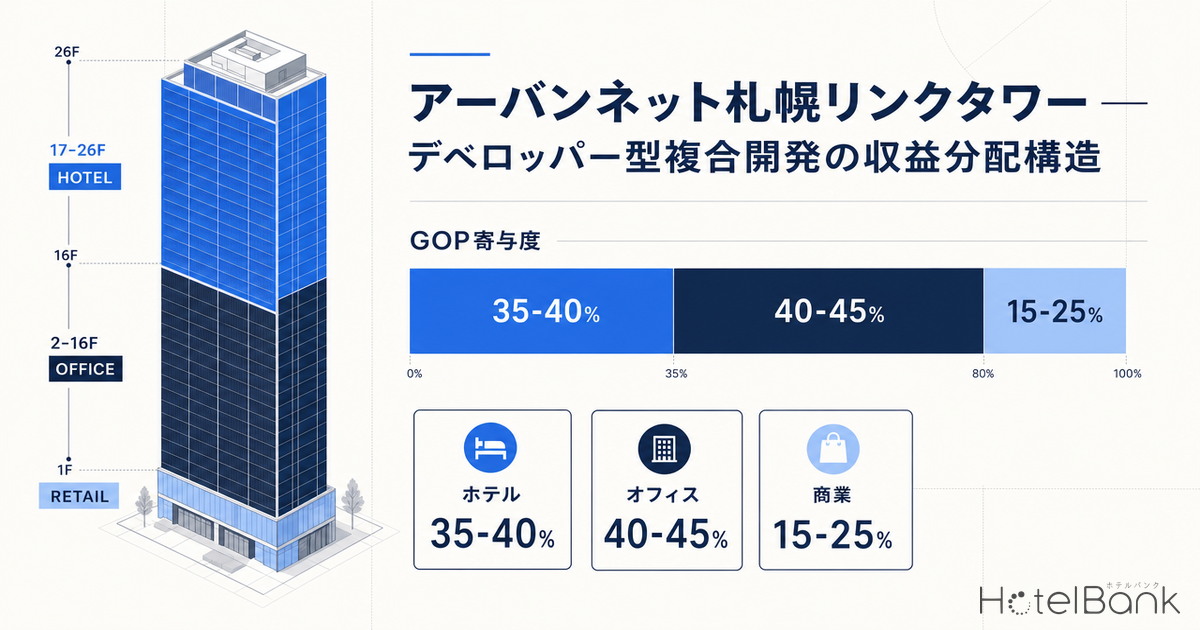
Slated for completion in June 2026 on the former HBC headquarters site in front of Sapporo Station, “Urbannet Sapporo Link Tower” is a 26-story, approximately 60,000㎡ super-high-rise mixed-use building. NTT Urban Development is the project developer, Taisei Corporation is the contractor, and Kume Sekkei is the architect. Floors 17–26 will house “Hyatt Centric Sapporo” (216 rooms), marking the foreign lifestyle brand’s first entry into Sapporo. With retail on B1–2F (11 units), offices on 3–16F, and the hotel on the upper floors, this is a classic developer-led mixed-use stack. Rather than treating the hotel as a standalone asset, “how the hotel contributes to the overall GOP (gross operating profit) of the mixed-use building, and how it interacts with land and tenant revenue” is the key to reading the feasibility of regional ordinance-designated city mixed-use development.
Metric Definitions Used in This Article
- ADR (Average Daily Rate): Average of publicly listed prices on OTAs. Differs from actual transaction prices (tends to run +25–30% higher than the transaction ADR disclosed by REITs). Per-room rate (tax included) at double occupancy, averaged across all plans (room-only to plans with meals).
- GOP (Gross Operating Profit): Profit attributable to real estate, calculated as revenue less operating costs (labor, utilities, SG&A). In this article, we separately discuss rental revenue or operating profit for the hotel, office, and retail portions of the mixed-use building.
- Data Sources: MetroEngines Research & Consulting (OTA public prices, N=75 properties, within 1km radius of Sapporo Station), MLIT Real Estate Information Library, various public statistics
Executive Summary — 75 Properties Within 1km of Sapporo Station; Hotel GOP Contribution 35–40% of Total
Bottom line up front: Urbannet Sapporo Link Tower is a textbook case of “the hotel boosting land utilization efficiency (FAR consumption) and stabilizing occupancy, making high-density development viable where office or retail alone would not succeed” in front-of-station regional ordinance-designated city mixed-use development. Based on NTT Urban Development disclosures and various benchmarks, we estimate the hotel segment will contribute roughly 35–40% of total GOP, with offices at 40–45% and retail at 15–25%. Sapporo’s office rent level is markedly lower than Tokyo or Osaka (Sapporo central ward average ~¥15,481/tsubo vs. central Tokyo at ~¥30,000+/tsubo), making standalone offices insufficient to recoup the investment in a large high-rise. Placing a foreign lifestyle hotel brand on the upper floors is a clear strategy to secure the feasibility of the mixed-use model.
Project Fundamentals — Hotel Stack on Floors 17–26 and the Story of Construction Delays
| Item | Specification |
|---|---|
| Location | Kita 1-jo Nishi 5-chome, Chuo-ku, Sapporo (former HBC headquarters site) |
| Developer | NTT Urban Development |
| Architect | Kume Sekkei |
| Contractor | Taisei Corporation |
| Scale | 26F above ground / 2F below ground / ~110.9m height |
| Total Floor Area | ~60,908㎡ (~18,456 tsubo) |
| Site Area | ~4,611㎡ (~1,395 tsubo) |
| Structure | Steel / RC, seismic damping |
| Use Composition | B1–2F: retail / 3–16F: office / 17–26F: hotel |
| Hotel Rooms | 216 (incl. 9 suites) / Hyatt Centric |
| Office Typical Floor | ~1,675㎡ (~506 tsubo) / 2,800mm ceiling height |
| Retail | B1F–2F, 11 units (food & beverage focused) |
| Original Completion | February 2024 |
| Revised Completion | June 2026 (28-month delay) |
| Hotel Opening | Autumn 2026 |
| Environmental Spec | 3rd “Zero Carbon Promotion Building” certification in Sapporo |
In March 2023, structural steel defects were discovered after erection had reached the 15th floor. Steel columns and beams were misaligned in 70 places by an average of 4mm (max 21mm), and concrete floors were thinner than spec in 245 locations by an average of 6mm (max 14mm). The root cause was attributed to false reporting of precision measurements by Taisei’s quality-control staff. All steelwork erected up to the 15th floor was dismantled and redone, pushing the completion schedule out approximately 28 months. In addition to construction cost overruns, the Hyatt Centric opening was pushed from spring 2024 to autumn 2026.
About 10 minutes on foot from JR Sapporo Station (direct underground passage connection). Near the former Hokkaido Government Building, Odori Park, and Odori Station. Designated commercial zone with FAR allowance enabling high-density development. The average commercial land price in Sapporo Chuo-ku is ~¥1.81 million/㎡ (2025 reference), among the highest land price levels in northern Japan.
86,042 passengers (FY2024, JR Hokkaido). Combined boardings and alightings reach approximately 150,000. The most-used station in Hokkaido. Surrounding redevelopment is progressing in parallel with the Hokkaido Shinkansen extension to Sapporo (now pushed back to end of FY2038).
Site Analysis — Zoning, Land Prices, and Mixed-Use Pipeline Around Sapporo Station
The project site (Kita 1-jo Nishi 5-chome) is designated as a commercial zone with FAR and lot coverage parameters that comfortably accommodate large-scale mixed-use development. The 2025 benchmark commercial land price in Sapporo Chuo-ku is ~¥1.81 million/㎡ (~¥6 million/tsubo), with the average including residential land at ~¥1.17 million/㎡. While this is an order of magnitude below central Tokyo commercial sites (tens of millions per ㎡), it is the highest tier among Japan’s regional ordinance-designated cities, unmatched elsewhere in northern Japan.
| Project | Completion | Scale | Main Uses | Developer |
|---|---|---|---|---|
| Urbannet Sapporo Link Tower | June 2026 | 26F, ~61,000㎡ | Retail / Office / Hotel 216 rooms | NTT Urban Development |
| Sapporo Station Exchange Hub Kita 5 Nishi 1 / Nishi 2 District | FY2028 | 43F, ~245m | Observation / International-grade hotel ~200 rooms / Limited-service hotel ~300 rooms / Office / Retail | JR Hokkaido Group |
| Kita 4 Nishi 3 Redevelopment (Yodobashi) | July 2028 | 33F / 9F, ~203,000㎡ total | Retail / Office / Lodging | Yodobashi Holdings et al. |
| Odori Nishi 4 Minami District Redevelopment | FY2028 | 36F, ~185m | Business / Retail / Lodging / District heating & cooling | Sapporo Daibiru et al. |
The notable point is that around Sapporo Station between 2026 and 2028, at least four projects representing roughly 1,000 new hotel rooms are advancing in parallel. Rather than assessing Urbannet Sapporo Link Tower in isolation, competitive pressure must be priced in across the entire area pipeline. On the other hand, the Hokkaido Shinkansen extension to Sapporo has slipped significantly from FY2030 end to FY2038 end or later, which is a downward catalyst for the area’s medium- to long-term demand growth curve. With the 2030 Sapporo Winter Olympics bid also uncertain, demand creation will likely hinge on foreign brand introductions and lifting existing inbound momentum. For broader context on the Hyatt Centric brand’s Hokkaido rollout and the market impact of the upper-midscale foreign lifestyle tier, see our analysis at Hyatt Centric Sapporo Opening — Reading Foreign Brand Expansion and ADR Trends in Hokkaido.
Competitive Landscape Around Sapporo Station — 75 Properties and Over 8,100 Rooms Within 1km
Within a 1km radius of Sapporo Station, MetroEngines Research tracks 75 properties. The top 26 alone account for over 8,100 rooms: ~1,700 rooms in the luxury tier (ADR ¥45,000+), ~1,500 in the upper-midscale tier, ~3,700 in the midscale tier, and ~1,200 in the economy tier — a structure clearly weighted toward midscale supply. The largest properties include Sapporo Hotel by Granbell (605 rooms), Sapporo Grand Hotel (504 rooms), and Keio Plaza Hotel Sapporo (483 rooms) — all major 500-room-class properties. Hyatt Centric’s 216 rooms place Urbannet Sapporo Link Tower in the mid-tier by room count, but in the foreign lifestyle / upper-upper-midscale band it overlaps with JR Tower Hotel Nikko Sapporo and ANA Crowne Plaza in positioning.
The whitespace visible from the positioning map is the “200–250 room scale × ADR ¥40,000–¥55,000 upper-upper-midscale” band. Existing players in this band around Sapporo Station are limited to long-established large hotels in the 300–400 room class such as JR Tower Hotel Nikko Sapporo (342 rooms, ¥50,400) and ANA Crowne Plaza Hotel Sapporo (412 rooms, ¥43,100). At 216 rooms, Hyatt Centric Sapporo is mid-sized, differentiated through lifestyle and stylish design, and is positioned to inject a new entrant into this niche. By contrast, the midscale band (ADR ¥18,000–¥28,000) already has 14 properties and ~3,700 rooms — an oversupplied space where new entry would be difficult.
Mixed-Use Revenue Distribution — Hotel 35–40%, Office 40–45%, Retail 15–25%
The defining feature of developer-led mixed-use development is that “high-density development that would not pencil out on a single use is made viable by combining revenues from multiple uses.” For Urbannet Sapporo Link Tower, with ~61,000㎡ of total floor area distributed across B2F through 26F, filling every floor with offices alone would be difficult given Sapporo’s office demand scale. Conversely, retail plus hotel alone could not fill the mid-floor volume. The investment recovery of the super-high-rise mixed-use building hinges on the three uses complementing each other.
The floor area share and GOP contribution share diverge by use. By floor area, office is the largest (across 14 floors from 3F–16F, estimated 35,000㎡+, ~58% of total floor area), but the Sapporo Chuo-ku average office rent is ~¥15,481/tsubo/month, which annualizes to ~¥186,000/tsubo/year. Hotel, despite occupying ~30% of total floor area, has a higher cash-flow efficiency from ADR × occupancy × 365 days; assuming Hyatt Centric’s 216 rooms at an ADR of ¥45,000 and OCC of 75%, annual room revenue would reach ~¥2.7 billion, and adding F&B and MICE revenue brings the total above ¥3 billion. The retail portion (11 units, just over 10% of floor area) commands rents (estimated ¥30,000–¥40,000/tsubo) backed by front-of-station pedestrian traffic, giving the highest per-area efficiency. The result: GOP contribution settles into Hotel 35–40%, Office 40–45%, Retail 15–25%.
Hokkaido ADR exhibits clear seasonality. In winter (December–February), ski resort demand at Niseko and Tomamu pushes the all-Hokkaido average ADR to ¥31,000–¥36,000; in summer (July–August), the tourism peak brings ADR to ¥30,000–¥34,000. April, the off-peak month, is the lowest at ¥27,000–¥30,000. The April 2026 Hokkaido average ADR is ¥29,700, up +10.2% YoY from ¥27,000. The weighted average ADR of the 26 competitive properties around Sapporo Station is ¥32,800 — above the Hokkaido average — confirming the premium that comes with the front-of-station location.
Comparable Case Study — Revenue Structure vs. Tokyo Midtown Yaesu and Grand Green Osaka
To benchmark the feasibility of the “regional ordinance-designated city mixed-use × foreign luxury hotel” model, we compare to similar urban mixed-use developments.
| Item | Tokyo Midtown Yaesu | Grand Green Osaka (South Tower) | Urbannet Sapporo Link Tower |
|---|---|---|---|
| Developer | Mitsui Fudosan et al. | Mitsubishi Estate, Orix Real Estate, and 9 others | NTT Urban Development |
| Completion | March 2023 | September 2024 (South Tower first phase) | June 2026 (planned) |
| Scale | 45F / ~287,000㎡ | South Tower 41F (Park Tower) | 26F / ~61,000㎡ |
| Hotel | Bulgari Hotel Tokyo (98 rooms, 39–45F) | Waldorf Astoria Osaka (252 rooms, 28–38F) / Canopy by Hilton | Hyatt Centric Sapporo (216 rooms, 17–26F) |
| Hotel Brand Tier | World-class luxury | Hilton flagship / Premium lifestyle | Upper-midscale lifestyle |
| Office Typical Floor | ~4,000㎡ | ~4,140㎡ (Park Tower, among the largest) | ~1,675㎡ |
| Estimated Hotel GOP Share | 20–30% | 25–35% | 35–40% |
| Estimated Office Share | 50–60% | 40–50% | 40–45% |
| Site Characteristics | Direct Tokyo Station connection, highest land price | Direct Osaka Station connection, Expo area | 10 min walk from Sapporo Station, underground passage |
Three structural takeaways emerge from comparing the three projects. First, the more central the location, the heavier the office weighting; the more regional, the heavier the hotel weighting. Of Tokyo Midtown Yaesu’s 287,000㎡, the office portion (7F–38F) dominates and Bulgari Hotel’s 98 rooms account for less than 10% of floor area. Office commands the majority of GOP. By contrast, Urbannet Sapporo Link Tower at 61,000㎡ is less than one-fifth the scale, and Hyatt Centric’s 216 rooms carry 35–40% of GOP. Given Sapporo’s office rent (under half of Tokyo’s), standalone office investment recovery is difficult — and the hotel’s high room rates lift overall mixed-use profitability.
Second, brand positioning selection criteria. Tokyo and Osaka can support world-class luxury (Bulgari, Waldorf Astoria), but Sapporo still lacks sufficient inbound ultra-luxury demand to fill rooms priced over ¥150,000/night. Selecting Hyatt Centric — the “upper-midscale lifestyle” tier — with an envisioned ADR range of ¥40,000–¥55,000 represents a rational fit, precisely capturing the whitespace around Sapporo Station. Third, asymmetric construction delay risk. A standalone regional development like Sapporo’s is more exposed to construction management and procurement risks, and the 28-month delay illustrates the risk premium specific to regional ordinance-designated city mixed-use development. For perspective on super-high-rise luxury developments around Tokyo Station, Shinagawa, and Nagoya — and the tri-polar structure emerging in Japan’s metropolitan core — see Luxury Hotel Development Around Tokyo Station and Japan’s Tri-Polar Metropolitan Core (Tokyo, Shinagawa, Nagoya).
Investment Scenarios — Hotel Cash Flow Sensitivity by ADR × OCC
We present a revenue simulation for Hyatt Centric Sapporo’s 216 rooms across three scenarios. Assumptions: F&B and MICE revenue at 25–30% of room revenue; GOP margin of 30–35% for lifestyle brands (conservatively applying the high-30s GOP margins observed in Invincible Investment Corp.’s lifestyle-branded operations).
| Item | A. Base Case | B. Bull Case Hypothesis | C. Bear Case |
|---|---|---|---|
| Assumed ADR | ¥40,000 | ¥48,000 | ¥32,000 |
| Assumed OCC | 75% | 80% | 68% |
| Annual Room Revenue | ¥2.37B | ¥3.03B | ¥1.72B |
| F&B / MICE Revenue | ¥0.60B | ¥0.81B | ¥0.43B |
| Total Revenue | ¥2.97B | ¥3.84B | ¥2.15B |
| GOP (assumed 30%) | ¥0.89B | ¥1.15B | ¥0.65B |
| RevPAR | ¥30,000 | ¥38,400 | ¥21,760 |
The base case (ADR ¥40,000, OCC 75%) projects GOP of ~¥0.89 billion; the bull case (ADR ¥48,000, OCC 80%) projects ~¥1.15 billion; and even the bear case yields ~¥0.65 billion. Compared with leading competitor ADRs around Sapporo Station (JR Tower Nikko ¥50,400, ANA Crowne Plaza ¥43,100), the bull case looks like a realistic target for Hyatt Centric. If the building-wide GOP is assumed to run ¥2.5–3.0 billion annually, the hotel’s ¥0.89–1.15 billion GOP equates to ~30–40% of total — consistent with the headline estimate at the start of this article.
That said, these are hypothetical figures, and actual performance will depend heavily on Shinkansen extension progress, the viability of the 2030 Sapporo Winter Olympics bid, and structural shifts in inbound demand. With another ~500 new hotel rooms entering Sapporo Station’s south side in 2028 (the Kita 4 Nishi 3 Yodobashi project and the Kita 5 Nishi 1 / Nishi 2 JR Hokkaido project), it is essential to factor in an intensified-competition scenario for the 2–3 years after Hyatt Centric opens. A similar ADR × OCC scenario-based investment evaluation approach is applied in Kubota HQ Site Arena × Hotel Investment Scenario — 8–10% Yield Estimates for a Namba 4-Star 600-Room Project, providing useful comparable material for urban mixed-use cash flow design.
Whitespace and Strategic Implications — Future Mixed-Use Investment Opportunities Around Sapporo Station
Opportunity 1
Foreign Lifestyle Tier
The Sapporo Station area is heavy on luxury and midscale, with an upper-midscale / lifestyle whitespace (ADR ¥40,000–¥60,000, 150–250 rooms). Following Hyatt Centric, there is room for entrants such as Marriott Autograph, IHG Kimpton, and Accor MGallery.
Opportunity 2
Concentration on Sapporo Station North Exit
The Yodobashi and JR Hokkaido mixed-use buildings due in 2028 are concentrated on the south exit of Sapporo Station. Link Tower sits at Kita 1 Nishi 5, closer to the south exit and near Odori Park. The next wave of mixed-use development has greater room on the north exit, likely to be paired with post-Shinkansen-extension redevelopment.
Opportunity 3
2030 Winter Olympics × Shinkansen
The Hokkaido Shinkansen Sapporo extension (end of FY2038 or later) is a medium-term certainty. Depending on the Winter Olympics bid trajectory, discussions of foreign luxury brand entries (Four Seasons, Ritz-Carlton, Conrad, etc.) into Sapporo may rekindle. Urbannet Sapporo Link Tower can be viewed as the prelude.
Summary — What the Sapporo Model Means for Developer-Led Mixed-Use Development
Urbannet Sapporo Link Tower is the latest example of the “hotel + office + retail” mixed-use model in front-of-station regional ordinance-designated city development, with the hotel segment carrying 35–40% of total GOP. At Sapporo’s office rent levels (under half of Tokyo’s per tsubo), standalone super-high-rise office investment recovery is difficult; only by placing a foreign hotel brand on the upper floors does the structure achieve both FAR consumption and profitability.
The “Hyatt Centric — upper-midscale lifestyle” tier chosen for this project precisely targets the whitespace visible on the Sapporo Station area positioning map (200–250 room scale × ADR ¥40,000–¥55,000), making it a rational brand positioning strategy. Considering medium- to long-term demand drivers — additional large-scale redevelopment due in 2028 on Sapporo Station’s south side, plus the post-2030s Shinkansen extension and potential Olympics bid — the probability is high that foreign luxury brand (Four Seasons, Ritz-Carlton, etc.) entry discussions for Sapporo will reignite within the next 5–10 years. Urbannet Sapporo Link Tower is positioned as the prelude to that coming wave.
On the other hand, the 28-month construction delay caused by defective workmanship illustrated the asymmetric construction management risk in regional ordinance-designated city mixed-use development. In making an investment decision, applying the same risk premium used for Tokyo and Osaka is insufficient; an additional layer for regional-specific construction management and demand variability risks must be priced in.
⚠ Note on Forward-Date ADR and Revenue Estimates: The ADR figures in this article reflect the average of OTA-listed prices at the time of research and will fluctuate as the check-in date approaches. The revenue simulation for Hyatt Centric Sapporo is a simplified estimate based on benchmarks available before opening (competitor ADRs around Sapporo Station, REIT-disclosed GOP margins, general occupancy track records for lifestyle brands); an actual investment decision requires a detailed feasibility study.
Related Articles
- Hyatt Centric Sapporo Opening — Reading Foreign Brand Expansion and ADR Trends in Hokkaido
- Luxury Hotel Development Around Tokyo Station and Japan’s Tri-Polar Metropolitan Core (Tokyo, Shinagawa, Nagoya)
- Nagoya Hotel Investment 2026 — Conrad Opening × Luxury Whitespace × Linear Shinkansen Delay
- Kubota HQ Site 12,500-Seat Arena × Hotel Investment Scenario — 8–10% Yield Estimates for a Namba 4-Star 600-Room Project
- YOSAKOI Soran Festival Period Sapporo Hotel ADR Analysis: Peak Day ¥52,600, +17.6% YoY Structure
- GIC / Singapore SWF Japan Hotel Investment Strategy — Reading the Edge of Long-Term Money from the ¥150B Prince 31-Property Acquisition
- Six Luxury Hotels Opening in 2026: Market Impact Analysis from an Investor’s Perspective
References & Sources
■ Market Data
- MetroEngines Research & Consulting — OTA public price data (N=75 properties, within 1km radius of Sapporo Station), Hokkaido monthly ADR trend
■ Project Information (Official / Construction Industry)
- Urbannet Sapporo Link Tower | NTT Urban Development (Office)
- Urbannet Sapporo Link Tower | NTT Urban Development (Retail)
- Hyatt Centric Sapporo General Manager Appointment, Autumn 2026 Opening | NTT Urban Development
- Urbannet Sapporo Link Tower Name Decision & Zero Carbon Promotion Building Certification | NTT Urban Solutions
- Urbannet Sapporo Link Tower / Office, Retail, Hotel Mixed-Use to Be Completed in June 2026 | Ryutsuu News
- Former HBC HQ Mixed-Use Building Dismantled and Rebuilt Due to Construction Defects | Real Economy
- Urbannet Sapporo Link Tower | City of Sapporo
■ Sapporo Station Area Redevelopment / Pipeline
- Sapporo Station Area Redevelopment Future Plans (March 2025) | JR Hokkaido
- Redevelopment at JR Sapporo Station South Exit — Two Mixed-Use Buildings (Retail, Business, Lodging) Coming in 2028 | Kenbiya
- Yodobashi-Led Sapporo Station South Exit Redevelopment Construction Started — 33-Story Mixed-Use Complex | Impress Watch
- Sapporo Odori Station Front / ~185m Retail Mixed-Use Building to Complete in FY2028 | Ryutsuu News
■ Office Rent / Land Price / Statistics
- Sapporo Office Rent and Vacancy Rate | Sanko Estate
- Reiwa 7 Land Price Survey Summary (Sapporo Land Price Trends) | City of Sapporo
- JR Hokkaido Station-by-Station Boardings
■ Comparable Cases (Tokyo & Osaka Mixed-Use)
- Tokyo Midtown Yaesu | Wikipedia
- Grand Green Osaka (Umekita Phase 2) Official | Hotel Information
- Umekita Phase 2 District Development “Grand Green Osaka” | Sanko Estate
■ Shinkansen Extension / Tourism Demand