

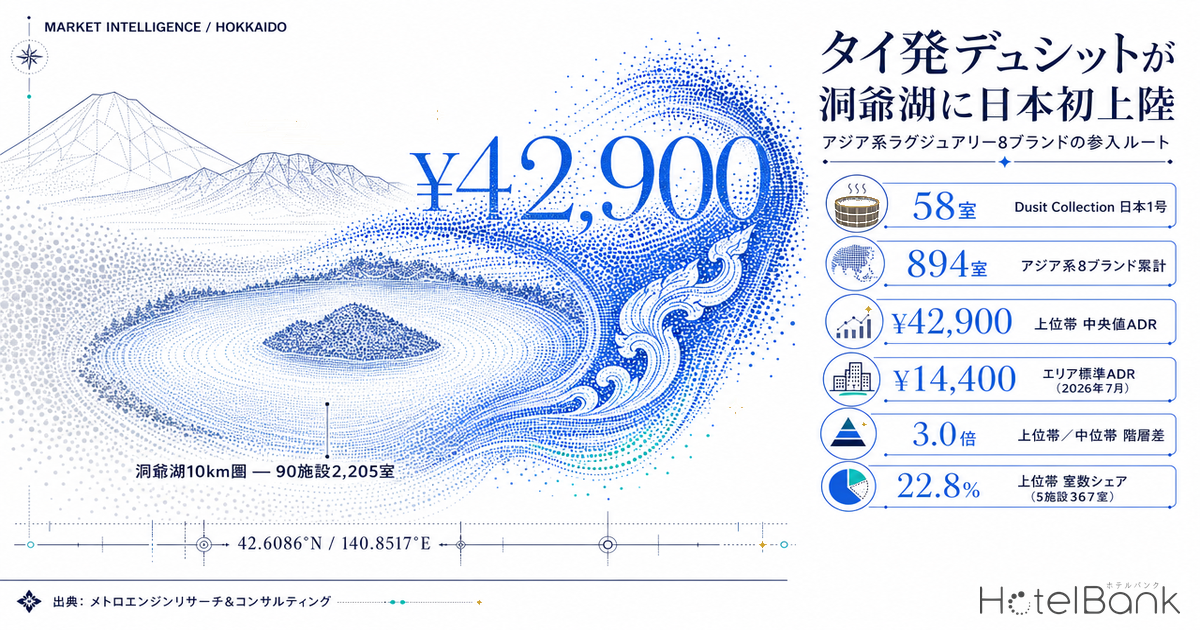
On 1 July 2026, the “WE Hotel Toya” in Toyako Town, Abuta District, Hokkaido reopened as “WE Hotel Toya – Dusit Collection.” It is the first Japanese property for “Dusit Collection,” the luxury brand operated by Thailand’s Dusit International, and the company’s third property in Japan following two in Kyoto. What deserves attention is the form of the entry. Japanese debuts by Asian luxury brands have almost without exception been new-build projects; this time the operator simply changed the sign on an existing property whose design was supervised by Kengo Kuma. This article takes a room-by-room inventory of supply within a 10km radius of Lake Toya, cross-references it against the entry track record of eight Asian brands, and reads quantitatively what this “rebrand route” means for the market.
Metric Definitions Used in This Article
- ADR (average daily rate): An estimated settled rate (tax-exclusive equivalent) derived by applying category-specific adjustment coefficients to the lowest published plan rate each property lists on OTAs and other channels (double occupancy, per-room rate, tax-inclusive). Cross-checked against property-level actuals disclosed by listed hotel REITs (91 properties, most recent 3 months), the median error is approximately 7%. It is an estimate and differs from each property’s actual transacted rates and accounting figures. Area-level ADR is the median across the covered properties (the level of a typical property in the area).
- Listed price (all-plan average): The average published rate across all plans, from room-only to meal-inclusive (double occupancy, per-room rate, tax-inclusive). The basis differs from the settled ADR estimate.
- OCC (occupancy): The share of sold rooms against total rooms in the area (an estimate based on OTA sales inventory; consistency checks against monthly REIT disclosures confirm accuracy within roughly a few percentage points). Used only as a macro indicator at the prefecture and municipality level.
- Data source: MetroEngines Research & Consulting
- — Japan No.1 is a 58-room rebrand — the only non-new-build case among the eight Asian luxury brand debuts in Japan verifiable from primary sources.
- — The 10km radius around Lake Toya holds 90 properties and 2,205 rooms. Of the 22 properties and 1,611 rooms for which a settled ADR estimate could be calculated, the ¥35,000-plus upper tier is a thin 5 properties and 367 rooms (22.8%).
- — A 3.0x tier gap: ¥42,900 in the upper tier against ¥14,100 in the mid tier. The 60-150 room class in the upper tier is essentially vacant, leaving headroom to lift existing stock.
- — Toyako Town’s settled ADR estimate was ¥14,400 in July 2026 (N=15 properties), up 2.1% year on year. A stable profile without the ski-driven seasonality seen in towns like Kutchan.
- — All six Asian entries since 2023 are around 100 rooms or fewer and outside Tokyo. Entry routes other than large new-builds in major cities have reached a practically workable stage.
The Japan Debut Was a Sign Change, Not a New Build — Establishing the Facts
Start with the primary sources. Cross-referencing the 1 July 2026 report by Travel Voice with the description on Dusit’s official site, the outline of the property is as follows. Of the 58 rooms, 55 are lake-view rooms (37 square metres), each with a hinoki open-air bath on the balcony. The remaining three are villa-type units of 186.2 square metres, designed for group stays. The property houses the signature restaurant “EZO Cuisine,” the casual dining venue “La Saison,” and “TARU Bar,” with La Saison serving Thai dishes such as tom yum noodles and khao soi. The address is 293-1 Toya-cho, Toyako-cho, Abuta-gun, Hokkaido, and the property has hot-spring facilities (indoor and open-air) overlooking Lake Toya.
The building itself is not new. Its predecessor, “WE Hotel Toya,” was developed by Greenwood Capital Group Co., Ltd., soft-opened in September 2018 and held its grand opening on 18 November of the same year, with design supervision by Kengo Kuma & Associates. It is characterised by a wooden-louvre facade and a fabric-rich lobby, and opened with 55 rooms. In other words, this Japanese debut is not a ground-up project but a Thai-capital brand placed onto an existing asset roughly seven and a half years after it opened. For Dusit, it is the group’s third property in Japan, following “ASAI Kyoto Shijo” (114 rooms, opened June 2023) and “Dusit Thani Kyoto” (147 rooms, opened September 2023).
| Item | Detail | Source |
|---|---|---|
| Property name | WE Hotel Toya – Dusit Collection | Dusit official site |
| Rebrand opening date | 1 July 2026 | Travel Voice (1 July 2026) |
| Total rooms | 58 | Dusit official site / Travel Voice |
| Lake-view rooms | 55 (37 sqm, balcony with hinoki open-air bath) | Travel Voice |
| Villas | 3 (186.2 sqm) | Travel Voice |
| Design supervision | Kengo Kuma & Associates | Greenwood Capital Group press release |
| Predecessor opening | Grand opening 18 November 2018 (55 rooms) | Greenwood Capital Group press release |
| Location | 293-1 Toya-cho, Toyako-cho, Abuta-gun, Hokkaido | Dusit official site |
| Operating brand | Dusit Collection (Dusit International, Thailand) | Dusit official site |
| Group’s other properties in Japan | ASAI Kyoto Shijo (114 rooms, June 2023), Dusit Thani Kyoto (147 rooms, September 2023) | Company press releases |
Taking Inventory of the 10km Radius — 5 Properties and 367 Rooms in the Upper Tier out of 90 Properties and 2,205 Rooms
Next, count the target market room by room. Extracting a 10km radius from the property’s coordinates yields 90 properties and 2,205 rooms within the coverage tracked by MetroEngines Research & Consulting. Of these, prices were observable over the most recent 12 months (August 2025 to July 2026) for 58 properties and 2,003 rooms, and after category-specific adjustment a settled ADR estimate could be calculated for 22 properties and 1,611 rooms. Because the market structure is dominated by small whole-house rentals, the share by property count and the share by room count diverge sharply — a point worth keeping in mind.
Split into price tiers, the shape of the market becomes clear. The upper tier, with a settled ADR estimate of ¥35,000 or more, contains only 5 properties and 367 rooms — just 22.8% of the 1,611 rooms for which a settled ADR estimate could be calculated. By contrast, the mid tier of ¥12,000 to under ¥20,000 concentrates 6 properties and 827 rooms, a majority of the market on a room basis. Large hot-spring ryokan and resort hotels stack up thickly in that band, with a thin upper tier resting on top — a two-layer structure.
| Price tier (settled ADR estimate) | Properties | Rooms | Room share | Tier median | Typical composition |
|---|---|---|---|---|---|
| Upper tier ¥35,000+ | 5 | 367 | 22.8% | ¥42,900 | High-value lakeside resorts and small luxury properties |
| Upper-mid tier ¥20,000 to under ¥35,000 | 2 | 247 | 15.3% | ¥22,800 | One large hot-spring hotel accounts for most of it |
| Mid tier ¥12,000 to under ¥20,000 | 6 | 827 | 51.3% | ¥14,100 | Large ryokan and resorts in the Toyako Onsen district |
| Economy tier under ¥12,000 | 9 | 170 | 10.6% | ¥7,200 | Small and mid-sized ryokan, pensions, hostels |
Plotted as a scatter chart, the scale skew within the upper tier is visible. Of the five properties at ¥35,000 or more, only one exceeds 100 rooms; the remaining four range from 18 to 80 rooms. The 58 rooms rebranded here fit neatly into that small-to-mid-scale upper tier, and do not represent large new supply colliding head-on with the existing market structure. If anything, the “60-150 rooms in the upper tier” band remains thin — a segment where the area still has room to grow.
How Area Rates Have Moved — Three Years in Toyako Town
The settled ADR estimate for Toyako Town as a whole has hovered broadly in the low ¥10,000s from 2024 through 2026. July 2026 came in at ¥14,400 (N=15 properties), up 2.1% from ¥14,100 in the same month a year earlier. Within Hokkaido, Kutchan Town shows ski-season swings that lift it to ¥63,500 in February 2026 (N=21 properties); Toyako Town’s annual range is far narrower, a stable profile with a gentle summer peak.
Against an area standard level in the ¥14,000s, the upper-tier median is ¥42,900 — a 3.0x step. That step is exactly the headroom foreign brands target when entering regional resorts, and equally the reason brands are expected to act as “devices that lift the area average.” Note that figures from August 2026 onward are estimates based on listed levels at the time of research and will shift with future selling patterns.
Demand-side conditions are worth checking too. Hokkaido-wide occupancy for July 2026 (estimated on an OTA listed-inventory basis) was 92.3% (N=1,293 properties, 92,099 rooms), and by category: deluxe 94.0%, resort 88.4%, ryokan 87.6% — the higher the category, the further inventory has sold through. That demand is following the high-rate band makes this a favourable moment to enter.
Japan Entry Routes of Eight Asian Luxury Brands
Widen the lens to the whole country. Listing the Japanese debut projects of Asia-headquartered luxury hotel brands for which the opening date and room count can be corroborated from primary sources, in chronological order, gives the following eight. The composition is three Hong Kong-based, two Singapore-based, and three Thai-based (three Dusit brands).
| Brand | Home base | Location in Japan | Opened | Rooms | Entry format |
|---|---|---|---|---|---|
| Mandarin Oriental | Hong Kong | Nihonbashi, Tokyo | December 2005 | 179 | New build upper floors of a mixed-use tower |
| Shangri-La | Hong Kong | Marunouchi, Tokyo | March 2009 | 200 | New build upper floors of a mixed-use tower |
| ASAI (Dusit) | Thailand | Shijo Karasuma, Kyoto | June 2023 | 114 | New build |
| Dusit Thani | Thailand | Shimogyo Ward, Kyoto | September 2023 | 147 | New build former primary school site redevelopment |
| Banyan Tree | Singapore | Higashiyama, Kyoto | August 2024 | 52 | New build |
| Rosewood | Hong Kong | Miyakojima, Okinawa | March 2025 | 55 | New build villa format |
| Capella | Singapore | Miyagawacho, Kyoto | March 2026 | 89 | New build former primary school site redevelopment |
| Dusit Collection | Thailand | Lake Toya, Hokkaido | July 2026 | 58 | Rebrand existing property |
Three things stand out from this sequence. First, after the two Hong Kong entries in 2005 and 2009 there is a gap of more than 13 years, then six projects cluster from 2023 onward. Second, whereas the first two took 200-room formats on the upper floors of mixed-use towers in Tokyo, all six since 2023 are small-to-mid scale at around 100 rooms or fewer, scattered across non-Tokyo destinations such as Kyoto, Miyakojima and Lake Toya. Third, seven of the eight are new builds; the rebrand format appears exactly once, at Lake Toya.
In addition, Banyan Group has announced multiple further openings in Japan after Kyoto, including a property inside the Hokkaido Ballpark F Village scheduled for March 2027. It is reasonable to read Asian brands’ expansion into Japan as still at the entry stage.
New Build vs Rebrand — Reading Asset-Value Headroom Through ADR Tiers
The difference in entry format changes the entire structure of the investment. A new build involves land acquisition and construction, so the time and capital committed are large. Based on the Ministry of Land, Infrastructure, Transport and Tourism’s construction starts statistics, 2025 hotel construction costs averaged ¥1.952 million per tsubo (3.31 sqm) across all structures, ¥2.405 million per tsubo for steel-frame and ¥2.026 million per tsubo for reinforced concrete — a historically high level sustained since ¥1.38 million in 2022. Hypothetically, building a 58-room luxury property with 60 square metres of gross floor area per room would mean roughly 3,480 square metres (about 1,053 tsubo), putting construction cost alone in the ¥2.0-2.5 billion range (simplified calculation). The choice between new build and rebrand within the same luxury band is a genuine fork in investment structure, with different capital, timeline and risk profiles on each path.
A rebrand, by contrast, makes use of the existing structure and interiors, so the bulk of capital shifts to renovation costs and brand-related expenses. Given that Toyako Town’s published land price averages ¥10,183/sqm and is down 2.43% year on year — in clear contrast to Niseko Town’s +13.26% on a benchmark land price basis — this area meets the condition of “cheap land, heavy construction cost.” Where a building already carries asset quality such as design supervision by Kengo Kuma, taking it as the starting point is a rational judgement. Placing a brand onto existing stock in less time and with less capital than a new build is a structurally distinct route to brand positioning.
New build (7 of 8)
Land acquisition plus construction. On 2025 actuals, construction cost averaged ¥1.952 million per tsubo across all structures and ¥2.405 million for steel-frame. Because it adds net supply, it raises the area’s room count itself. Easiest to execute in urban markets such as Kyoto where redevelopment sites become available.
Rebrand (1 of 8)
A sign change on an existing asset. New supply is zero, so the 2,205 rooms within 10km of Lake Toya do not change. Renovation cost and brand-related expenses dominate, and ramp-up is faster. Chosen where high-quality existing stock already exists in a regional resort.
The headroom the market creates
The area’s tier gap is 3.0x: ¥42,900 in the upper tier against ¥14,100 in the mid tier. The 60-150 room class in the upper tier is currently near-vacant, leaving headroom to lift existing stock by leveraging its quality.
So what does moving up one tier do to revenue? Here we apply a uniform 70% occupancy (a common full-year basis, used for comparison) to each tier’s median ADR and line up annual room revenue per room. This is simple arithmetic on aligned assumptions; in practice renovation capital, F&B revenue, and occupancy changes accompanying a tier move all come into play, and that should be emphasised.
| Price tier | Median ADR | Annual room revenue per room (70% occupancy, full-year basis) | Gap to the tier above |
|---|---|---|---|
| Upper tier | ¥42,900 | ¥10,961,000 | — |
| Upper-mid tier | ¥22,800 | ¥5,825,000 | +¥5,136,000 |
| Mid tier | ¥14,100 | ¥3,602,000 | +¥2,223,000 |
| Economy tier | ¥7,200 | ¥1,840,000 | +¥1,762,000 |
Moving just one tier, from mid to upper-mid, works out to a difference of ¥2.22 million per room per year. At a 60-room scale that is on the order of ¥130 million a year. Of course this figure guarantees nothing about attainability; it is only a yardstick for the distance between tiers. Even so, it conveys the range that brand introduction on existing stock can carry for the asset value of a regional resort.
One caveat: whether the Lake Toya case is an example of “lifting” is not so simple. The predecessor WE Hotel Toya had a median settled ADR estimate of ¥45,100 over the most recent 12 months, placing it in the area’s upper tier before the rebrand. This is therefore not a move from a lower tier to a higher one, but more accurately a case of connecting an asset already in the upper tier to an international brand’s distribution network and loyalty membership base. Only about six weeks have passed since the rebrand, so it is too early to speak numerically about the brand’s impact on rates. Verifying the effect requires at least a year of accumulated results.
Dividing the Tier Move by Occupancy — Scenarios and a Two-Axis Sensitivity Grid
Every number to this point is an observed value presented in the body of this article. Feeding them back into the identity “annual room revenue per room = settled ADR estimate x occupancy x 365 days” shows the distance between tiers as a range. To be clear in advance, what follows is not a new empirical claim but arithmetic multiplying two figures already presented.
| Scenario | Settled ADR estimate | Source of the ADR | Occupancy | Source of the occupancy | Annual room revenue per room | At 58 rooms |
|---|---|---|---|---|---|---|
| Conservative | ¥42,900 | Upper-tier median | 70.0% | Common full-year assumption in this article | ¥10,961,000 | approx. ¥636m |
| Central | ¥45,100 | Predecessor property’s median settled ADR estimate, most recent 12 months | 87.6% | Estimated occupancy for the ryokan category, July 2026 | ¥14,420,000 | approx. ¥836m |
| Optimistic | ¥45,100 | Same as above | 94.0% | Estimated occupancy for the deluxe category, July 2026 | ¥15,474,000 | approx. ¥897m |
The spread between conservative and optimistic is roughly ¥4.5 million per room per year, or about ¥260 million at 58 rooms. Note that most of that spread comes from occupancy, not ADR: the upper-tier ADR moves only 5.1%, from ¥42,900 to ¥45,100, while occupancy moves 24.0 points, from 70.0% to 94.0%. In the luxury band of a regional resort, how much inventory can be sold through across the full year matters as much as, or more than, how high a rate can be captured.
| Settled ADR estimate \ Occupancy | 70.0% | 87.6% | 88.4% | 92.3% | 94.0% |
|---|---|---|---|---|---|
| ¥14,100 | ¥3.60M | ¥4.51M | ¥4.55M | ¥4.75M | ¥4.84M |
| ¥22,800 | ¥5.83M | ¥7.29M | ¥7.36M | ¥7.68M | ¥7.82M |
| ¥35,000 | ¥8.94M | ¥11.19M | ¥11.29M | ¥11.79M | ¥12.01M |
| ¥42,900 | ¥10.96M | ¥13.72M | ¥13.84M | ¥14.45M | ¥14.72M |
| ¥45,100 | ¥11.52M | ¥14.42M | ¥14.55M | ¥15.19M | ¥15.47M |
Looking across the grid, the mid tier (¥14,100) reaches only ¥4.84 million per room per year even at 94.0% occupancy — short of the ¥10.96 million the upper tier (¥42,900) earns at 70.0% occupancy on a full-year basis. Occupancy gains alone cannot cross the tier wall. Put the other way, a move that lifts the ADR tier by one step using the quality of existing stock works on an axis independent of occupancy improvement. That independence of the two axes is precisely why the Lake Toya case draws attention as a rebrand.
Thailand as a Demand Base — The Background to the Brand Choice
That Dusit is Thai capital is more than a matter of origin. According to Honichi Lab’s tabulation, 1,233,103 Thai visitors came to Japan in 2025, up 7% year on year, and their travel spending reached a record ¥252.7 billion. JNTO likewise positions Thailand as a market with a high repeat-visitor ratio and strong interest in experience-led content. Hokkaido is a signature snow-and-nature destination for Southeast Asian markets, so a Thai-origin brand choosing a Hokkaido lakeside resort for its Japanese debut is consistent from a source-market perspective.
High-rate supply in Hokkaido is also thickening. Alongside expansion by domestic operators such as Hoshino Resorts, Singapore-based Banyan Group plans a March 2027 opening inside the Hokkaido Ballpark F Village, and the number of players in the prefecture’s upper tier looks set to keep growing. In areas such as Lake Toya where existing stock is of high quality, the ability to place a brand without waiting for a new build translates into a speed advantage. Hokkaido has other precedents of existing ryokan converted to a new brand positioning, and the pattern is becoming familiar in the region.
Conclusion — The Menu of Entry Routes Has Widened
To summarise. First, Dusit Collection’s Japanese debut is a 58-room rebrand, and the only non-new-build case among the eight Asian luxury brand debuts in Japan verifiable from primary sources. Second, the target market within 10km of Lake Toya holds 90 properties and 2,205 rooms, and the upper tier with a settled ADR estimate of ¥35,000 or more is a thin 5 properties and 367 rooms (22.8% on a calculable-ADR basis), leaving whitespace in the 60-150 room upper-tier class. Third, the area’s tier gap is 3.0x — ¥42,900 in the upper tier against ¥14,100 in the mid tier — so brand introduction that leverages existing stock carries a clear range for the asset value of a regional resort.
Given that all six Asian brand entries since 2023 have been small-to-mid scale at around 100 rooms or fewer and located outside Tokyo, Japan’s hotel market has reached a stage where entry routes other than large new builds in major cities work in practice. Cheap land, high-quality existing stock, a thin upper tier — Lake Toya is not the only area that meets these conditions. For operators and owners alike, one more option on the menu is no small thing.
⚠ Note on ADR for future dates: ADR figures in this article for August 2026 onward are estimates based on selling prices published on OTAs at the time of research, and will move as the check-in date approaches. Please note that rates set high at present may fall through last-minute adjustments.
Related Reading
- 1,291 Hotels, 31,024 Rooms Above ¥100,000: Japan’s Luxury Map
- Fukui’s 3 Hotel Clusters: 2.5x ADR Gap and the Upper-Mid Whitespace
- Hakone’s 126-Room Luxury Supply: Listed +30.9%, Settled ADR +5.7%
- Chitose & Tomakomai Worker Lodging — 7 New Hotels, 738 Rooms in 2026
- New Hotel ADR Ramp-Up: 91 Japan Openings Split Into 4 Pricing Types
References & Sources
■ Data sources
Settled ADR estimates, occupancy and the property master come from aggregated data by MetroEngines Research & Consulting (90 properties / 2,205 rooms within 10km of Lake Toya, of which 58 properties / 2,003 rooms had observable prices and 22 properties / 1,611 rooms had a calculable settled ADR estimate; area monthly figures are based on monthly medians for August 2025 to July 2026, and occupancy is an OTA listed-inventory-based estimate for July 2026). Opening dates and room counts for properties and brands come from primary sources — company official sites, press releases and news reports. Construction costs are from the Ministry of Land, Infrastructure, Transport and Tourism’s Construction Starts Statistics Survey; land prices from published and benchmark land price data; Thai inbound statistics from JNTO and Honichi Lab.
■ Calculation assumptions
Annual room revenue per room = settled ADR estimate x occupancy x 365 days. The 70% occupancy is a common full-year assumption for comparing tiers, not the actual result of any specific property. All inputs to the scenario table and the two-axis sensitivity grid (settled ADR estimate ¥14,100-¥45,100, occupancy 70.0-94.0%) are observed values presented in the body, and cells are calculated by multiplication alone. The simplified new-build construction estimate multiplies 58 rooms x 60 sqm gross floor area per room = approx. 3,480 sqm (about 1,053 tsubo) by the 2025 hotel construction cost per tsubo, and excludes land acquisition, design and supervision fees, FF&E and pre-opening costs.
■ Limitations and caveats
The settled ADR estimate applies category-specific adjustments to OTA published prices and differs from each property’s actual transacted rates and accounting figures. Occupancy is an estimate based on OTA sales inventory and is used only as a macro indicator. Figures from August 2026 onward are estimates based on listed levels at the time of research and will move with future selling patterns. Price-tier aggregation uses a proprietary extraction within a 10km radius, so the population differs from published municipality-level tabulations. Because only about six weeks have passed since the rebrand, the brand’s impact on rates is outside the scope of this article’s verification. The scenario table and sensitivity grid are yardsticks for the distance between tiers, not forecasts of attainability.
■ Market data
- MetroEngines Research & Consulting — settled ADR estimates (90 properties / 2,205 rooms within 10km of Lake Toya; 22 properties / 1,611 rooms with a calculable settled ADR estimate), occupancy (OTA listed-inventory-based estimate), property master
■ Property and brand primary sources
- WE Hotel Toya – Dusit Collection official site
- Thai luxury hotel brand Dusit makes its Japan debut, opening at Lake Toya, Hokkaido (Travel Voice, 1 July 2026)
- [WE Hotel Toya] Hotel with design supervision by Kengo Kuma holds grand opening on 18 November 2018 (Greenwood Capital Group)
- ASAI Kyoto Shijo opens reservations (Dusit International)
- Dusit Thani Kyoto to open on 1 September (Monthly Hoteres)
- Banyan Tree opens flagship hotel in Higashiyama, Kyoto (Travel Voice)
- Rosewood Miyakojima to open on 1 March 2025 (Rosewood Hotels & Resorts)
- Capella Debuts in Kyoto, Japan (Hospitality Net)
- Capella Kyoto, the brand’s Japan debut, opens reservations (NTT Urban Development)
- Shangri-La Hotel, Tokyo (opened March 2009, 200 rooms)
- Mandarin Oriental, Tokyo (opened December 2005, 179 rooms)
- Banyan Group’s hotel opening plans in Japan (Travel Watch)
■ Government statistics and public data
- Ministry of Land, Infrastructure, Transport and Tourism, “Construction Starts Statistics Survey” (hotel construction cost per tsubo)
- Land price levels and published land prices for Toyako Town (Tochidai)
- [Published Land Prices 2026] Hokkaido up 1.3% (Nikkei)
- JNTO, “Inbound Travel Promotion Handbook 2025 (7 Southeast and South Asian markets)”
- 1.233 million Thai visitors to Japan in 2025, spending ¥252.7 billion (Honichi Lab)