

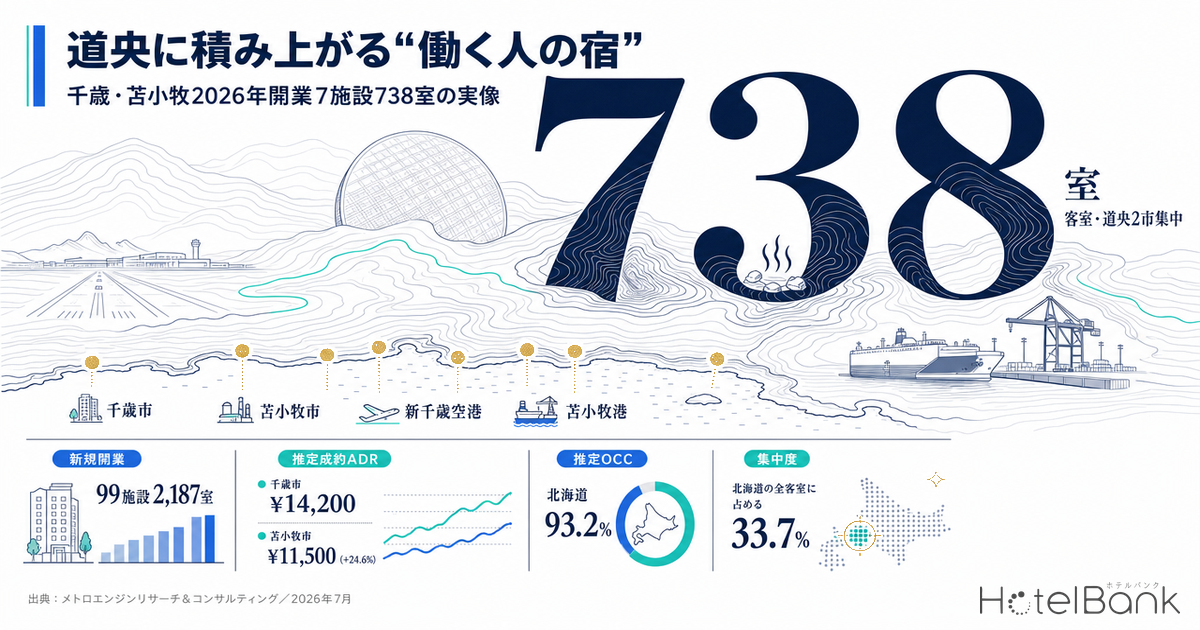
In 2026, Hokkaido saw 99 new lodging properties — roughly 2,200 rooms — come online. Break that number open and the picture splits in two: by property count, 59 of the 99 are rental villas, close to 60% of the total; by room count, a full third of all new rooms sit in just seven properties in the cities of Chitose and Tomakomai. Central Hokkaido’s “lodging for working people” has begun to accumulate as real, built stock.
This article reads central Hokkaido’s business demand from the supply side — from the properties that actually opened in 2026. The demand-side story of semiconductor clusters and port logistics has been told in many places, but there has been little quantitative work on where that room stock is actually being built, at what scale, and at what price point. By layering city-level settled-ADR estimates, measured inventory depletion, published land prices, and the forward supply pipeline, we test how far the dormitory-style, economy business-lodging asset class can stand on its own.
Metric Definitions Used in This Article
- ADR (average daily rate): An estimated settled rate (tax-exclusive equivalent) calculated by applying category-specific adjustment coefficients to the lowest publicly listed plan level each property posts on OTAs and elsewhere (double occupancy, per-room rate, tax included). Cross-checked against property-level results disclosed by listed hotel REITs (91 properties, most recent three months), the median error is approximately 7%. These are estimates and differ from each property’s actual transacted rates or accounting figures. Area-level ADR is the median of the properties covered (the level of a typical property in that area).
- OCC (occupancy rate): The share of sold rooms against total rooms in the area (an estimate based on OTA sales inventory; consistency checks against monthly REIT disclosures confirm accuracy to within roughly a few percentage points). Used only at the prefectural level; never calculated for individual properties.
- LT (lead time): Days remaining until the check-in date. LT0 = same day. Early sellout LT = the lead time at which remaining rooms first reached zero (a larger value means an earlier sellout).
- New-opening data: Based on confirmed OTA listings (within the scope MetroEngines Research tracks; not a complete census). The supply pipeline is based on building-confirmation applications from the Ministry of Land, Infrastructure, Transport and Tourism (MLIT) “Building Dynamics Statistics Survey.”
- — Of 99 properties and 2,187 rooms, 33.7% of the rooms are concentrated in seven properties (738 rooms) in Chitose and Tomakomai. Sixty percent of the property count is rental villas — a two-layer structure in which volume and count point in different directions.
- — Chitose received three national-chain properties of 100+ rooms each, all near the station and with natural hot springs; Tomakomai received three dormitory-style properties of 50-64 rooms. Within the same central Hokkaido region, the character of supply divides sharply.
- — Estimated settled ADR in June 2026 was ¥14,200 in Chitose (+2.3% YoY) and ¥11,500 in Tomakomai (+24.6% YoY). Both exceed the all-Hokkaido average of ¥10,300.
- — On weekday inventory, smaller extended-stay and dormitory-style properties reached zero remaining rooms at LT14-25. The larger the property, the longer it can hold inventory toward the check-in date.
- — A simplified model of a 60-room dormitory-style property shows a 7.9% yield (mid case) on ¥886 million of total investment. A 5×5 sensitivity grid on ADR × occupancy gives a range of 5.8-9.3%.
Inside the 99 Properties and 2,187 Rooms — Villas Are 60% of the Count, but Nine 100+ Room Properties Hold 70% of the Rooms
Within the scope MetroEngines Research tracks, 99 newly opened properties totaling 2,187 rooms had confirmed OTA listings in Hokkaido between January and September 2026. The point to watch is that counting properties and counting rooms paint entirely different pictures.
By property count, rental villas dominate at 59 properties, some 60% of the total — the result of one-room, whole-building rentals accumulating in fine grain across resort areas such as Kutchan, Niseko, Furano and Biei. Look at room count, however, and just nine properties of 100 rooms or more account for 1,515 rooms, or 69.3% of the total. Hokkaido’s 2026 supply is therefore a two-layer structure: dispersed resort supply by count, large-scale business supply by volume. What kind of stay demand those whole-building rentals answer is examined in more depth, from the angle of self-catering and multi-night suitability, in Vacation Rentals Lead Japan’s 2026 Hotel Supply.
By month, June brought 23 properties and 670 rooms, and July 5 properties and 591 rooms — large projects clustered in early summer. The thinning of counts from August onward does not mean supply stops. Because OTA listings appear several months before opening, months after the survey date will inevitably fill in with later listings. Of hotels that opened in 2024-2025, only 19% had a confirmed OTA listing before opening, while 31% were first observed on OTAs more than 91 days after opening (MetroEngines Research & Consulting, analysis of OTA listing timing for properties opened in 2024-2025). The figures of one property in August and two in September represent “what could be observed at this point,” not final counts.
| Size band | Properties | Share | Rooms | Room share | Main formats |
|---|---|---|---|---|---|
| 100 rooms or more | 9 | 9.1% | 1,515 | 69.3% | Business / city hotels |
| 50-99 rooms | 4 | 4.0% | 227 | 10.4% | Dormitory-style, capsule |
| 20-49 rooms | 7 | 7.1% | 241 | 11.0% | Hostels, extended-stay |
| 5-19 rooms | 18 | 18.2% | 136 | 6.2% | Ryokan, minshuku, cottages |
| 1-4 rooms | 61 | 61.6% | 68 | 3.1% | Rental villas (whole-building) |
| Total | 99 | 100% | 2,187 | 100% | — |
Seven Properties, 738 Rooms — One Third of All Hokkaido Rooms Landed in Chitose and Tomakomai
Of the 99 properties, four with 576 rooms are in Chitose and three with 162 rooms are in Tomakomai. These seven, just 7.1% of the property count, account for 33.7% of all new rooms in Hokkaido. While whole-building rentals in resort areas drive the property count, the quantitative supply impact concentrated in central Hokkaido’s business-demand cities.
| Property | Location | Rooms | Opening date | Type | Verification |
|---|---|---|---|---|---|
| Super Hotel Premier Chitose Natural Hot Spring (スーパーホテルPremier千歳天然温泉) | Chitose | 212 | 2026-08-07 | Business (natural hot spring, breakfast included) | Verified vs official release |
| Dormy Inn Chitose, Tsurumai-no-Yu Natural Hot Spring (天然温泉 鶴舞の湯 ドーミーイン千歳) | Chitose | 198 | 2026-06-24 | Business (natural hot spring, sauna) | Verified vs official release |
| Comfort Hotel Chitose (コンフォートホテル千歳) | Chitose | 142 | 2026-06-15 | Business (free breakfast, fully non-smoking) | Verified vs official release |
| Piece Chitose S2 (ピエス千歳 S2) | Chitose | 24 | 2026-04-01 | Extended-stay residential | Internally tracked figure |
| Workman House Tomakomai Funami (ワークマンハウス苫小牧船見) | Tomakomai | 64 | 2026-09-28 | Dormitory-style (large communal bath, canteen, shared bath) | Verified vs official release |
| Workman House Premium Tomakomai Hokuei (ワークマンハウスプレミアム苫小牧北栄) | Tomakomai | 50 | 2026-09-30 | Dormitory-style (unit bath in every room) | Verified vs official release |
| Work Stay Tomakomai (ワークステイ苫小牧) | Tomakomai | 48 | 2026-06-01 | Extended-stay | Internally tracked figure |
| Total, 7 properties | — | 738 | — | — | — |
All three of the Chitose properties are 100+ room openings by national chains: a 212-room premium format with a natural hot spring; a 198-room hot-spring business hotel that is the brand’s 13th property in Hokkaido; and a 142-room property with which Choice Hotels Japan (チョイスホテルズジャパン) marked its 100th hotel in Japan. All three chose the same locational conditions — a 6-8 minute walk from JR Chitose Station and a 10-15 minute drive from New Chitose Airport. Three operators moved at once to capture a catchment that works for both the station and the airport.
The three Tomakomai properties are different in character. They are dormitory-style products aimed squarely at long-stay business travelers: the 64-room Funami property has all single rooms with shared bath and toilet, plus a large communal bath and a canteen, priced from ¥6,900 room-only; the 50-room Hokuei property has a unit bath in every room and starts at ¥7,900. Operator Red Horse Trust (レッドホーストラスト) already runs several properties under the same brand within Tomakomai and opened these two simultaneously at the end of September 2026. Where Chitose targets “broad-area business plus tourism at the station front,” Tomakomai targets “long stays close to the worksite.” Within the same region, the character of supply divides clearly.
| Chitose, existing | 65 properties / 3,527 rooms |
| Opened in 2026 | +4 properties / 576 rooms (+16.3%) |
| Tomakomai, existing | 45 properties / 2,086 rooms |
| Opened in 2026 | +3 properties / 162 rooms (+7.8%) |
| Two cities combined | 110 properties / 5,613 rooms → 6,351 rooms |
| Chitose | 19 properties / 2,797 rooms → 22 properties / 3,349 rooms |
| Tomakomai | 11 properties / 1,433 rooms → 13 properties / 1,547 rooms |
In the 50+ room band that absorbs corporate contracts and group bookings, Chitose gains roughly 20% more depth and Tomakomai about 8%.
Tomakomai’s City-Level ADR Is Up 24.6% Year on Year — Two Central Hokkaido Cities Above the Regional Average
Where supply is rising, price is moving too. According to MetroEngines Research data, estimated settled ADR in June 2026 was approximately ¥14,200 in Chitose and ¥11,500 in Tomakomai. Against the all-Hokkaido level for the same month (approximately ¥10,300), Chitose stands +37.2% and Tomakomai +11.3%.
Year-on-year, the difference is sharper still. Chitose is a settled +2.3%, while Tomakomai is +24.6%. On a January-June half-year average, Chitose is +8.6% and Tomakomai +9.6% — both at or above the all-Hokkaido average (+8.6%). Chitose, carrying combined airport and tourism demand, is starting from an already high level; Tomakomai is catching up rapidly from a low one.
Note that from July onward the Tomakomai sample thins to 12-13 properties, against 15-19 in the actual months. The level of those estimates should be treated as indicative only; the sensible use is directional.
Demand-side indicators are tight as well. Hokkaido’s estimated OCC for June 2026 was 93.2% (1,316 properties, 92,700 rooms), with business hotels at 94.5% and city hotels at 94.1%. In May, every format had risen to 97.0%. These are estimates based on the depletion of inventory sold on OTAs and differ from true property-wide occupancy, but they indicate that business-oriented inventory across Hokkaido remains thin.
| Format (Hokkaido) | Properties | Rooms | Est. OCC Apr 2026 | May 2026 | Jun 2026 |
|---|---|---|---|---|---|
| All properties | 1,316 | 92,700 | 80.3% | 97.0% | 93.2% |
| Business hotels | 387 | 43,659 | 83.5% | 97.0% | 94.5% |
| City hotels | 74 | 15,884 | 82.3% | 96.8% | 94.1% |
| Resort hotels | 130 | 15,259 | 73.1% | 96.9% | 90.2% |
| Ryokan | 257 | 11,437 | 75.2% | 97.4% | 90.3% |
Measured Inventory Depletion — Extended-Stay and Dormitory-Style Properties Fill by LT14 on a Weekday Wednesday
Market-wide occupancy alone does not reveal the quality of business demand. We therefore tracked property-level remaining-room movements on a room basis for a weekday check-in with limited tourism influence — Wednesday, 17 June 2026. Only properties whose OTA-published allocation is at least 30% of total rooms are included.
| Property | Location | Total rooms | Rooms left at LT30 | LT14 | LT7 | Early sellout LT | Days observed sold out |
|---|---|---|---|---|---|---|---|
| Smile Hotel Tomakomai (スマイルホテル苫小牧) | Tomakomai | 97 | 19 | 27 | 0 | LT56 | 12 days |
| Piece Chitose S1 (extended-stay) | Chitose | 26 | 9 | 4 | 3 | LT29 | 10 days |
| Hotel Stay Village | Tomakomai | 27 | 4 | 0 | 0 | LT25 | 25 days |
| Minn Chitose (Minn千歳) | Chitose | 51 | 14 | 0 | 0 | LT15 | 16 days |
| Dormy Inn Tomakomai, Tarumae-no-Yu Natural Hot Spring (天然温泉 樽前の湯 ドーミーイン苫小牧) | Tomakomai | 163 | 44 | 15 | 8 | — | — |
| Hotel Grand Terrace Chitose (ホテルグランテラス千歳) | Chitose | 255 | 58 | 46 | 52 | — | — |
What emerges is a tendency for smaller extended-stay and dormitory-style properties to fill earliest. The 27-room Hotel Stay Village hit zero remaining rooms at LT25 and was observed sold out on 25 separate days; the 51-room Minn Chitose reached 0 of 51 rooms remaining by LT14. The 26-room Piece Chitose S1 moved from 9 rooms left at LT30 to 4 at LT14 and 3 at LT7. By contrast, the 255-room Hotel Grand Terrace Chitose still had 52 rooms left at LT7 — larger properties can hold inventory until close to arrival.
The 97-room Smile Hotel Tomakomai reached zero remaining rooms once at LT56, then saw inventory return — 19 rooms left at LT30 and 27 at LT14 — before selling out again at LT7. A return of inventory of five or more rooms sustained over three or more days is inferred to be a release of held inventory by the hotel, and this movement most likely reflects an additional release from adjusting group and corporate allocations. Put the other way, mid-sized business hotels in Tomakomai are drawing enough weekday demand to sell out once a full two months ahead.
The Depth of Demand — Tomakomai Needs Beds for 10,800 at Peak Against 2,086 Rooms of Stock
Central Hokkaido’s business demand is built from three layers of different character. The first is Chitose’s semiconductor cluster. Rapidus began operating a 2nm-generation pilot line at its next-generation semiconductor manufacturing base in Chitose on 1 April 2025, targeting the start of mass production in 2027. Construction workers at the plant have been reported at more than 4,000 at peak, and once mass production begins a resident population in the low thousands is expected. Comparable semiconductor investment is reshaping the lodging markets around Kumamoto and Hiroshima as well, each with its own demand structure.
The second is Tomakomai’s next-generation energy and port-related activity. In February 2025 the Ministry of Economy, Trade and Industry designated part of the offshore area of Tomakomai as a specified zone under the CCS Business Act. Tomakomai hosts Japan’s first large-scale CCS demonstration project, with commercial operation planned from 2030. Facing a run of large energy-related projects, the city and Hokkaido Prefecture have proposed regulatory easing for temporary worker accommodation through a National Strategic Special Zone designation in fiscal 2026, arguing that more than 10,800 worker beds will be needed at peak.
The third is port logistics itself. Cargo handled at the Port of Tomakomai in 2025 rose 1.7% year on year to 101.71 million tonnes — above 100 million tonnes for the 13th consecutive year. Its domestic-trade cargo volume has ranked first nationally for 16 straight years. More than 90% of Hokkaido’s logistics depends on maritime transport through its ports, and more than half of that passes through Tomakomai. Ferry and RORO crews, cargo handling, maintenance and renewal works generate a constant layer of business demand on top of the rest.
The contrast makes one fact plain. Even adding 2026’s 162 new rooms to Tomakomai’s existing 2,086 gives 2,248 rooms — roughly 20% coverage of the 10,800-person accommodation requirement expected at peak. This is not a volume the hotel format alone can absorb, which is precisely why the city and prefecture are seeking regulatory relief for temporary accommodation. Conversely, the portion a lodging business can capture is limited to the layer that arises steadily before and after the peak — and that requires a deliberate design decision.
Chitose is a different case. Its existing 3,527 rooms plus 576 new ones reach 4,103, against a construction peak of roughly 4,000 workers. The numbers look close, but Chitose’s rooms also compete with connecting demand at New Chitose Airport and tourism demand around Lake Shikotsu. Business demand cannot monopolize that inventory. That is exactly why three operators converged on the same specification in Chitose: 100+ rooms, a station-front location, and a natural hot spring — a product that can take both corporate and leisure demand.
| Use | Chitose | Tomakomai |
|---|---|---|
| Average | ¥68,915/m² +11.85% | ¥19,743/m² +3.53% |
| Commercial land | ¥146,000/m² +29.67% | ¥28,231/m² +1.21% |
| Residential land | ¥54,105/m² +6.78% | ¥19,368/m² +3.99% |
| Industrial land | ¥16,900/m² +15.56% | ¥10,765/m² +4.69% |
Chitose’s commercial land is up 29.67% year on year and its overall average +11.85% — the 23rd-highest rate of increase in Japan. From a site-acquisition standpoint, station-front commercial land is already competitively priced. Tomakomai, by contrast, remains at ¥28,231/m² for commercial land (+1.21%) and ¥10,765/m² for industrial land (+4.69%), leaving room to acquire sites for dormitory-style projects.
The Forward Pipeline — No New Central Hokkaido Projects Yet on a Building-Confirmation Basis
What comes after 2026’s supply? Checking Hokkaido hotel projects on a building-confirmation-application basis in MLIT’s “Building Dynamics Statistics Survey,” we could identify 32 cases, of which room counts are known for five.
| Location | Rooms | Gross floor area | Floors | Scheduled completion | Main use |
|---|---|---|---|---|---|
| Shimogoryo, Furano | 200 | 13,000 m² | 10 | December 2027 | Hotel |
| Kita 1-jo Nishi 5-chome, Chuo-ku, Sapporo | 216 | 15,122 m² | 26 | December 2026 | Offices, hotel, retail, parking |
| Hanazono, Kutchan, Abuta District | 500 | 120,000 m² | 3 | December 2025 | Hotel, hotel condominiums, detached villas |
| Kita 3-jo Nishi 3-chome, Chuo-ku, Sapporo | 172 | 33,546 m² | 20 | December 2025 | Mixed use (hotel, offices, retail and others) |
| Sakaemachi 1-chome, Kitahiroshima | 158 | 17,881 m² | 14 | March 2025 | Hotel, retail |
All five sit in Sapporo, Kutchan, Furano and Kitahiroshima, and the 27 cases without disclosed room counts are all within Sapporo. No projects in Chitose or Tomakomai can be confirmed at this point. That does not mean central Hokkaido has no future plans: building-confirmation applications are typically filed one to two years before opening, so counts for future years are structurally undercounted. The five cases shown here are strictly a lower bound on the currently confirmed pipeline.
Even so, what is suggestive for investors and operators is that 2026’s central Hokkaido supply surge is likely to run its course, at least for a while. Nationally, rising construction costs continue to suppress new supply. Based on 2025 construction-starts statistics, per-tsubo construction costs are ¥2.405 million for steel-frame and ¥2.026 million for reinforced concrete — well above 2022 levels. How far this cost factor will cut national new supply in 2027-2029 is set out by year and area in Construction +41% and Labor Crunch Erase Japan’s 2027-2029 Hotel Supply. On top of that, Tomakomai’s response to peak demand is heading down a separate route — temporary accommodation via a special zone — making a scenario of sharply rising permanent hotel supply hard to draw. The 738 rooms built in 2026 will operate for some time in an environment with little new competition.
What It Takes for Dormitory-Style, Economy Business Lodging to Work as an Asset Class
Taken together, the data show two asset classes working in central Hokkaido. One is the Chitose type — “100+ rooms, station front, hot-spring business hotel.” The other is the Tomakomai type — “50-64 rooms, close to the worksite, dormitory-style.” The latter has rarely featured in Japanese hotel-investment discussion, but its success conditions are relatively clear.
Condition 1 Set the absolute price at about 60% of the market
Workman House Tomakomai Funami publishes rates of ¥6,900 room-only and ¥8,900 with two meals (both single occupancy; +¥2,000 in summer, July-September; +¥500 for heating and snow removal in winter, November-April). Against Tomakomai’s estimated settled ADR of roughly ¥11,500, the room-only rate sits at about 60% — comfortably inside corporate travel policies and subcontractor reimbursement limits. The design is to build earnings not by chasing rate but by leveling occupancy across the year.
Condition 2 Make the stay self-contained with a communal bath, canteen and laundry
Funami has all single rooms with shared bath and toilet plus a large communal bath and canteen; Hokuei has a unit bath in every room. Both have washer-dryers on site. On long stays, the friction of eating and doing laundry off-site drives retention, so investment in shared facilities pays off more than room rate does. Trimming guest rooms to fund communal space is the design philosophy of this format.
Condition 3 Exploit low land costs on industrial and quasi-industrial sites
Tomakomai’s industrial land is ¥10,765/m² (+4.69% year on year) and even its commercial land is ¥28,231/m² — a fivefold gap against Chitose’s ¥146,000/m² commercial land. Because the locational requirement of being close to the worksite coincides with cheap land, investment per room is easy to contain. Compress total investment and the yield holds up even at a low rate.
We turned these three conditions into numbers with a simplified model: a 60-room dormitory-style property (15 m² rooms, 70% guest-room ratio, giving roughly 1,286 m² / 389 tsubo of gross floor area) newly built on industrial land in Tomakomai. Construction cost starts from the ¥2.026 million per tsubo reinforced-concrete rate in the 2025 construction-starts statistics and is presented in two steps to incorporate inflation during the construction period.
| Item | A. Room-only led | B. Mixed with two meals Recommended |
|---|---|---|
| Rooms | 60 | 60 |
| Gross floor area | 1,286 m² (389 tsubo) | 1,286 m² (389 tsubo) |
| Construction cost (2025 actual rate, RC ¥2.026m/tsubo) | ¥788m | ¥788m |
| Construction cost (assumed 2028 opening, ~+10.6% period inflation) | ¥872m | ¥872m |
| Land (assumed 1,300 m² of industrial land) | ¥14m | ¥14m |
| Total investment (post-inflation) | ¥886m | ¥886m |
| Assumed rate (single occupancy, full-year average) | ¥7,400 | ¥9,400 |
| Assumed occupancy | 85% | 85% |
| Annual revenue | ¥138m | ¥175m |
| Assumed GOP margin (GOP = gross operating profit, revenue less operating costs) | 45% | 40% |
| GOP | ¥61.99m | ¥69.99m |
| Yield on total investment | 7.0% | 7.9% |
| If occupancy falls to 75% (assumed, full-year average) | 6.2% | 7.0% |
| Assumed ADR \ Occupancy | 70% | 75% | 80% | 85% | 90% |
|---|---|---|---|---|---|
| ¥8,400 | 5.8% | 6.2% | 6.6% | 7.1% | 7.5% |
| ¥8,900 | 6.2% | 6.6% | 7.0% | 7.5% | 7.9% |
| ¥9,400 | 6.5% | 7.0% | 7.4% | 7.9% | 8.4% |
| ¥9,900 | 6.9% | 7.3% | 7.8% | 8.3% | 8.8% |
| ¥10,400 | 7.2% | 7.7% | 8.2% | 8.7% | 9.3% |
Note that the ¥6,900-8,900 used as the basis for the assumed rates is disclosed by the operators as a single-occupancy tariff, a different basis from this article’s estimated settled ADR (an indicator premised on the per-room rate at double occupancy). Because dormitory-style properties are all single rooms and assume single occupancy, comparison with market ADR should be treated only as a rough sense of level.
The implication of the model is that the yield holds around 7% even if occupancy comes in 10 points lower. Because the rate is low, total investment is also small, which makes the return less sensitive to occupancy. In addition, the Hokkaido lodging tax introduced in April 2026 levies ¥100 per person per night on lodging charges under ¥20,000. At dormitory-style price points the tax burden stays at roughly 1.3-1.5% of the rate, so the impact on price levels is limited. This too indicates that low-rate, extended-stay formats are relatively robust to regulatory change.
There are caveats. Dormitory-style properties depend heavily on corporate contracts and monthly-basis use, which ties revenue closely to project progress. Tomakomai’s energy-related work runs on a timeline pointing to the start of CCS operations in 2030, and Chitose’s semiconductor milestone is the 2027 start of mass production. How much design headroom is preserved to redirect toward leisure or general business demand when a project phase changes will determine long-term earnings stability. A specification that includes a communal bath and canteen is reasonable in that light too, as a way of preserving that conversion headroom.
Conclusion — How to Read a Two-Layer Structure of “Volume in Central Hokkaido, Count in the Resorts”
Break down Hokkaido’s 99 new properties and 2,187 rooms in 2026 and 60% of the property count is rental villas, while 70% of the rooms sit in nine properties of 100+ rooms. Within that, four properties with 576 rooms in Chitose and three with 162 rooms in Tomakomai — 738 rooms in total — account for 33.7% of all new rooms in Hokkaido. The concentration in central Hokkaido is no accident: it is the supply side answering three layers of business demand — semiconductor clusters, next-generation energy, and port logistics.
City-level estimated settled ADR in June 2026 was approximately ¥14,200 in Chitose (+2.3% YoY) and ¥11,500 in Tomakomai (+24.6% YoY), both above the all-Hokkaido average. Looking at weekday inventory depletion on a room basis, smaller extended-stay and dormitory-style properties reached zero remaining rooms as early as LT14-25, confirming the pull of business demand in measured data. In published land prices, Chitose’s commercial land surged 29.67% year on year while Tomakomai’s industrial land stayed at ¥10,765/m², leaving room to acquire sites for dormitory-style projects.
The building-confirmation pipeline shows no Chitose or Tomakomai projects at this point, so the 738 rooms built in 2026 should operate for some time with little new competition. Against Tomakomai’s 10,800-person peak requirement, room stock stands at 2,248 — meaning what a lodging business can capture is the layer that arises steadily before and after the peak. Do not chase rate; make the stay self-contained through shared facilities; keep total investment down with cheap land. As long as that design holds, dormitory-style economy business lodging is an asset class with real room to grow in central Hokkaido.
⚠ Note on ADR for future dates: ADR figures for July 2026 onward in this article are estimates calculated from prices published on OTAs at the survey date and will move as check-in dates approach. In particular, the Tomakomai sample from July onward covers 12-13 properties, fewer than the 15-19 of the actual months, so treat those levels as reference values. Also, because OTA listings for newly opened properties appear progressively from several months before opening, the count of openings from August 2026 onward may rise as further listings are confirmed.
Related Reading
- Construction +41% and Labor Crunch Erase Japan’s 2027-2029 Hotel Supply
- Supply Absorption Capacity in 8 Regional Core Cities — GW2026 Sellout Rates and New Openings
- Vacation Rentals Lead Japan’s 2026 Hotel Supply — 48.2% of 758 New Openings
References and Sources
■ Data sources
Newly opened properties are our own tally based on confirmed OTA listings (Hokkaido, N=99 properties / 2,187 rooms, January-September 2026). City-level estimated settled ADR comes from monthly area aggregates (Chitose N=24-25 properties; Tomakomai N=15-19 properties in actual months, N=12-13 in estimated months); estimated OCC covers Hokkaido N=1,316 properties / 92,700 rooms (as of June 2026). Property-level remaining-room movements are room-based observations for check-in on Wednesday, 17 June 2026. Published land prices, per-tsubo construction costs and construction plans come from MLIT published statistics; demand-side headcounts come from municipal proposals and press reports. Room counts for major properties have been cross-checked against operators’ official releases.
■ Model assumptions
The feasibility model is an illustrative case of a 60-room dormitory-style property (15 m² rooms, 70% guest-room ratio, gross floor area 1,286 m² = 389 tsubo) newly built on industrial land in Tomakomai. Construction cost starts from ¥2.026 million per tsubo for reinforced concrete (2025 actual) with approximately +10.6% construction-period inflation (+5.3% in 2026, +5.0% in 2027); land is calculated at 1,300 m² of industrial land at ¥10,765/m², giving total investment of ¥886 million. Revenue is rooms × assumed ADR × 365 days × occupancy, and the yield is GOP divided by total investment. Plan A is room-only led (ADR ¥7,400, 45% GOP margin), Plan B is mixed with two meals (ADR ¥9,400, 40% GOP margin), occupancy is 85% in the mid case, and the sensitivity analysis presents a range of ADR ¥8,400-10,400 × occupancy 70-90%.
■ Limitations and caveats
New-opening data is not a complete census, and because OTA listings appear progressively from several months before opening, the most recent months are understated. Estimated settled ADR applies category-specific adjustments to the lowest published plan and differs from actual transacted rates or accounting figures. Estimated OCC is based on the depletion of OTA-listed inventory and therefore runs higher than true occupancy. The Tomakomai sample from July 2026 onward is thin at 12-13 properties, so use it for direction rather than level. The supply pipeline is on a building-confirmation basis, so future years are structurally undercounted and the counts shown are a lower bound. Published tariffs for dormitory-style properties are on a single-occupancy basis, a different standard from the estimated settled ADR, which assumes double occupancy. The feasibility model is illustrative; an investment decision requires a detailed feasibility study.
■ Market data
- MetroEngines Research & Consulting — newly opened properties (confirmed OTA listings, N=99), city-level estimated settled ADR (Chitose N=24-25; Tomakomai N=12-19), estimated OCC (Hokkaido N=1,316), property-level inventory movements (check-in 17 June 2026)
■ Government statistics and public data
- MLIT “Building Dynamics Statistics Survey” — hotel construction plans in Hokkaido (building-confirmation basis, N=5)
- MLIT “Construction Starts Statistics” (2025) — per-tsubo construction cost by structure
- MLIT “Published Land Prices” 2026 — Chitose / Tomakomai
- METI, “Designation of part of the offshore area of Tomakomai, Hokkaido as a specified zone under the CCS Business Act” (21 February 2025)
- Hokkaido Prefecture, “Hokkaido Lodging Tax” (introduced 1 April 2026)
- City of Tomakomai, “Large-Scale CCS Demonstration Project in Tomakomai”
■ Operator releases and property information
- Super Hotel, “Premier Chitose Natural Hot Spring Kanto Kohaku-no-Yu” official site (grand opening 7 August 2026)
- Choice Hotels Japan, “Comfort Hotel Chitose opens 15 June 2026” (142 rooms, 100th hotel in Japan)
- Kyoritsu Maintenance, “Dormy Inn Chitose pre-opening 24 June” (198 rooms)
- Workman House Tomakomai Funami property information (64 rooms, opening 28 September 2026)
- Workman House Premium Tomakomai Hokuei property information (50 rooms, opening 30 September 2026)
- Red Horse Trust, “Two ‘Workman House’ long-stay properties for business travelers to open simultaneously in September 2026”
- Asset Planning, “Piece Chitose S1, an extended-stay residential hotel, opens in Chitose, Hokkaido”
■ News and press coverage
- Hokkaido Shimbun, “City and prefecture propose special zone to ease Tomakomai lodging shortage — 10,800 beds needed as large projects pile up; deregulation sought for temporary construction” (31 March 2026)
- Hokkaido Shimbun, “Port of Tomakomai cargo above 100 million tonnes for 13th straight year — preliminary 2025 figures”
- Nikkei, “Tomakomai and others propose using a special zone to secure accommodation for CCS construction workers”
- Nikkei, “Rapidus is changing Chitose: 4,000 workers gather, a ‘town’ on the hill” (5 August 2024; peak plant-construction workforce above 4,000)
- Rakumachi, “What does the ‘Rapidus boom’ look like now? Development around Chitose Station”
- Toyo Keizai Online, “[2026 edition] Residential land price growth ranking in Hokkaido”
- EY Japan, “A hydrogen and ammonia hub concept: the Port of Tomakomai’s strategy for transition to a next-generation energy port”