

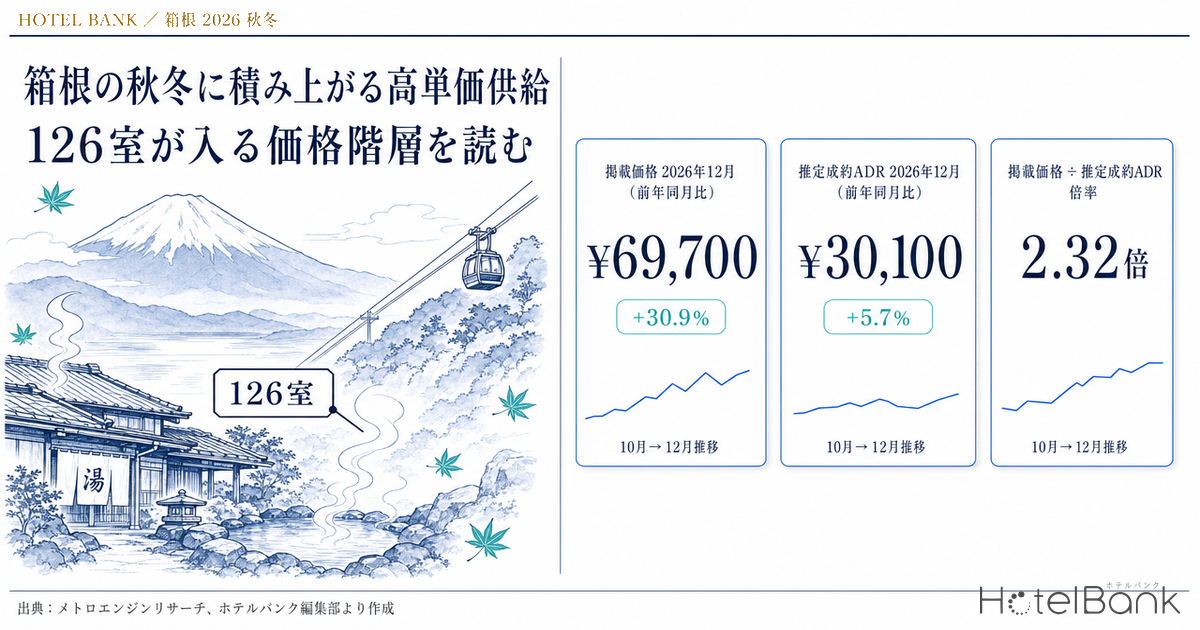
In Hakone Town, Ashigarashimo District, Kanagawa Prefecture, a 126-room luxury hotel with hot-spring baths in every guest room will open on December 15, 2026. Announced by Mitsui Fudosan in a news release dated July 13, 2026, it is called HOTEL THE MITSUI HAKONE. Tracking Hakone Town’s autumn-winter (October–December) price levels in MetroEngines Research data, listed prices are pushed up by as much as +30.9% year on year, while the estimated settled ADR rises only +5.7%. Where exactly do these two layers diverge at a moment when supply in the upper price tiers is thickening? We read the answer through a comparison with Yugawara Town, Atami City and Izu City, a price-band histogram, and the room-count depth of the upper tiers.
Metric Definitions Used in This Article
- ADR (Average Daily Rate): An estimated settled rate (tax-exclusive equivalent) calculated by applying property-type correction coefficients to the lowest publicly listed plan level each property publishes on OTAs and similar channels (double occupancy, per-room rate, tax-inclusive). Cross-checked against property-level results disclosed by listed hotel REITs (91 properties, most recent 3 months), the median error is approximately 7%. These are estimates and differ from each property’s actual transacted prices and accounting figures. Area-level ADR is the median of the target properties (the level of a typical property in that area). Estimated settled ADR is calculated only for verified property types (business / city / resort / ryokan / capsule); unverified types such as pensions, minshuku and rental villas are excluded.
- Listed price (all-plan average): The average price of all plans publicly listed on OTAs and similar channels. Expressed as the per-room rate at double occupancy (tax-inclusive), covering everything from room-only to meal-inclusive plans. Because it uses a different basis from the estimated settled ADR, this article always treats it as a separate metric.
- Basis difference between past and future months: Figures for July 2026 onward in this article are forward-month snapshots estimated from listings publicly available on OTAs and similar channels as of the survey date. They differ in nature from the confirmed basis used for months already completed (June 2026 and earlier) and will move as the check-in date approaches.
- Data source: MetroEngines Research
- — HOTEL THE MITSUI HAKONE, with 126 rooms and a hot-spring bath in every room, opens December 15, 2026 in Kowakudani, Hakone Town. It is the second property under Mitsui Fudosan’s top-tier brand.
- — Through autumn and winter, listed prices in Hakone Town stack up +15.9% to +30.9% year on year, while the estimated settled ADR gains only +5.7% to +15.6%.
- — Among the four neighboring areas, Hakone Town is the only one with a positive estimated settled ADR in all three autumn-winter months. In December, Yugawara Town is -9.1%, Atami City -4.7% and Izu City -15.3%.
- — Hakone Town’s ¥100,000-and-above band holds 78 properties and 1,796 rooms, yet averages just 23.0 rooms per property — a cluster of small boxes. Adding 126 rooms lifts that band’s room count by roughly 7.0% on its own.
- — In Yugawara Town, the ¥70,000–100,000 band is thin at 8.5%. The thicker Hakone’s upper tier becomes, the more room opens up in that mid-to-upper band to absorb spillover demand.
December 15: 126 rooms, all with hot-spring baths, arrive in Kowakudani
In a news release dated July 13, 2026, Mitsui Fudosan announced that HOTEL THE MITSUI HAKONE will open on December 15, 2026 in Kowakudani, Hakone Town. It is the second property under the company’s top-tier HOTEL THE MITSUI brand; the first is located in Kyoto. The published headline specifications are as follows.
| Item | Details |
|---|---|
| Opening date | December 15, 2026 |
| Location | Kowakudani, Hakone Town, Ashigarashimo District, Kanagawa Prefecture (within Fuji-Hakone-Izu National Park) |
| Guest rooms | 126 rooms (every room with an indoor natural hot-spring bath and a balcony or terrace) |
| Site area | Approx. 135,500 m² (land associated with the former Mitsui family villa) |
| Design and construction | Takenaka Corporation (project management: Nikken Sekkei) |
| Principal facilities | Thermal Spring (a spa with indoor and outdoor baths), three dining outlets (Japanese cuisine, all-day dining and a bar), the detached tea house Shikian, and a fitness gym |
| Brand affiliation | Affiliated with Marriott International’s Luxury Collection (release dated November 7, 2024) |
Source: Compiled by the HotelBank Editorial Team from Mitsui Fudosan’s HOTEL THE MITSUI HAKONE news releases (July 13, 2026 and November 7, 2024)
The project is corroborated on the construction-planning side as well. Planning data based on the Ministry of Land, Infrastructure, Transport and Tourism’s Building Construction Statistics Survey records a new-build hotel project at 450 Kowakudani, Hakone Town, with 126 rooms, 23,600 m² of total floor area, three above-ground floors, construction started in July 2024 and scheduled completion on December 15, 2026 — consistent with the release. The same planning data also includes a 71-room, 6,590 m², five-story project in Gora, Hakone Town (scheduled completion April 2026). That said, building confirmation applications are typically filed one to two years before opening, so counts for future years will grow as further applications are added. The currently registered count should be read as a lower bound on the confirmed pipeline.
Looking further ahead, upper-tier plans do not stop at 2026. The domestic pipeline published by Hyatt Japan lists “Atona Hakone (tentative name)” in Hakone with an opening scheduled for 2028 or later. Atona is a new brand the company is launching in Japan, and its room count has not been determined. Hakone already has the 80-room Hyatt Regency Hakone Resort & Spa, which opened in December 2006, so multiple upper-tier brands will be layering into the same area. How price tiers separate when upper-tier development concentrates in a single area is organized within the same framework in our Yokohama Minatomirai luxury development pipeline investment analysis.
Listed prices +30.9%, estimated settled ADR +5.7% — an autumn and winter split in two layers
Following Hakone Town’s monthly trend in MetroEngines Research data, listed prices and the estimated settled ADR diverge clearly in autumn and winter. December 2026 listed prices run about ¥69,700, up 30.9% year on year; November is about ¥66,400 (+21.8%) and October about ¥60,400 (+15.9%) — the highest levels of the year. The estimated settled ADR, by contrast, is about ¥30,100 in December (+5.7%), about ¥31,000 in November (+7.3%) and about ¥29,500 in October (+15.6%), with every gain falling short of the listed-price increase.
Source: MetroEngines Research; compiled by the HotelBank Editorial Team (Hakone Town, December 2026, N=285 properties, of which 135 are covered by the estimated settled ADR calculation)
Taking the ratio between the two makes this two-layer structure clearer. Listed price ÷ estimated settled ADR stood at 1.89× in November 2025 and 1.87× in December 2025, but widens to 2.14× in November 2026 and 2.32× in December 2026. Because the listed-price average covers all plans, it is easily pulled upward when inventory in the upper price tiers thickens. In other words, the +30.9% increase in listed prices does not mean “the typical Hakone property became 30% more expensive.” To a large extent, upper-tier inventory is creating an upward tail in the distribution of listings and lifting the average.
Source: MetroEngines Research; compiled by the HotelBank Editorial Team
Note that figures for July 2026 onward are forward-month snapshots estimated from listings as of the survey date, and differ in nature from confirmed past months. December in particular has only 135 properties in the estimated settled ADR calculation, below the 170–187 range of the trailing 12 months. It should be read as a snapshot taken at a stage where upper-tier listings have gone live first and mid-tier listings have not yet fully appeared.
Hakone is the only area growing its estimated settled ADR in all three autumn-winter months
The jump in listed prices is not unique to Hakone. Lining up neighboring hot-spring destinations on the same forward-month snapshot basis, December listed prices are up 29.4% year on year in Atami City and 14.7% in Izu City — double-digit gains in both. So what about the estimated settled ADR? This is where the four areas part ways.
Source: MetroEngines Research; compiled by the HotelBank Editorial Team
| Area | Month | Listed price | YoY | Estimated settled ADR | YoY | Properties covered |
|---|---|---|---|---|---|---|
| Hakone Town | October | ¥60,378 | +15.9% | ¥29,467 | +15.6% | 165 |
| Hakone Town | November | ¥66,440 | +21.8% | ¥31,045 | +7.3% | 148 |
| Hakone Town | December | ¥69,718 | +30.9% | ¥30,078 | +5.7% | 135 |
| Yugawara Town | October | ¥43,876 | +5.5% | ¥21,528 | +9.6% | 46 |
| Yugawara Town | November | ¥45,686 | +1.7% | ¥21,668 | +0.3% | 44 |
| Yugawara Town | December | ¥48,438 | -2.9% | ¥22,231 | -9.1% | 41 |
| Atami City | November | ¥59,722 | +20.4% | ¥26,417 | +1.5% | 91 |
| Atami City | December | ¥66,323 | +29.4% | ¥28,813 | -4.7% | 84 |
| Izu City | November | ¥47,753 | +18.0% | ¥22,463 | -2.4% | 54 |
| Izu City | December | ¥49,199 | +14.7% | ¥22,500 | -15.3% | 46 |
Source: MetroEngines Research; compiled by the HotelBank Editorial Team (“Properties covered” is the number of properties included in the estimated settled ADR calculation. Hakone Town and Yugawara Town are in Kanagawa Prefecture; Atami City and Izu City are in Shizuoka Prefecture.)
Of the four areas, Hakone Town is the only one whose estimated settled ADR exceeds the prior year in all three autumn-winter months. Yugawara Town moves from +9.6% in October to -9.1% in December, Atami City from +1.5% in November to -4.7% in December, and Izu City is negative in all three months, reaching -15.3% in December. Listed prices are rising in every area; the difference lies in whether the estimated transaction level follows. In Hakone Town, it is not only that more upper-tier listings have appeared — the level at which bookings are expected to settle is itself higher than a year ago.
Hakone has nothing below ¥10,000; Yugawara is thin above ¥70,000
So what difference in price distribution produces this gap? The histogram below allocates properties across price bands, based on per-property average prices calculated from listed prices for October to December 2026. Coverage is 331 properties in Hakone Town and 71 in Yugawara Town, limited to properties with confirmed listings on 15 or more days during the period.
Source: MetroEngines Research; compiled by the HotelBank Editorial Team (Hakone Town N=331 properties, Yugawara Town N=71 properties; listed prices, all-plan average, October–December 2026)
Hakone Town has not a single property in the sub-¥10,000 band. Its thinnest band is ¥10,000–30,000 with 13 properties (3.9%), and the center of gravity sits in the ¥30,000–50,000 band (86 properties, 26.0%). Moving upward, the ¥50,000–70,000 band holds 65 properties (19.6%), ¥70,000–100,000 holds 59 (17.8%) and ¥100,000-and-above holds 80 (24.2%) — property counts do not fall away even at the high end. Bands of ¥50,000 and above alone account for 204 properties, or 61.6%.
Yugawara Town’s distribution has a different shape. It shares the concentration in the ¥30,000–50,000 band, with 24 properties (33.8%), but thins out above that: 11 properties (15.5%) in ¥50,000–70,000 and 6 (8.5%) in ¥70,000–100,000, before recovering to 14 (19.7%) at ¥100,000 and above. The mid-to-upper ¥70,000–100,000 band is the thinnest of all. Conversely, the sub-¥30,000 range holds 16 properties, or 22.5%, far above Hakone Town’s 12.4%. Yugawara Town has depth in the affordable bands, with a small number of high-rate properties sitting above it like an enclave.
This difference in shape shows where each area’s headroom lies. In Hakone Town, the ¥100,000-and-above band already accounts for 24.2%, so there is an existing tier that can naturally absorb new high-rate supply. In Yugawara Town, the gap in the ¥70,000–100,000 band leaves room to receive demand spilling over from the equivalent band in Hakone. Yugawara’s own restructuring potential — the case for acquiring and rebranding its ryokan stock — is a separate question that turns on asset-level economics rather than on the price distribution shown here.
The upper tier is a cluster of small boxes — 126 rooms join an average of 23.0
Digging one level deeper reveals the character of Hakone Town’s high price bands. Using listed prices from mid-November 2026 (November 6–20), we tallied property counts and room counts by price band. Coverage is 292 properties and 6,357 rooms in total.
| Listed price band | Properties | Total rooms | Average rooms | Largest property |
|---|---|---|---|---|
| Under ¥20,000 | 10 | 101 | 10.1 | 22 |
| ¥20,000–30,000 | 17 | 158 | 9.3 | 26 |
| ¥30,000–50,000 | 76 | 1,378 | 18.1 | 123 |
| ¥50,000–70,000 | 54 | 1,133 | 21.0 | 198 |
| ¥70,000–100,000 | 57 | 1,791 | 31.4 | 151 |
| ¥100,000 and above | 78 | 1,796 | 23.0 | 154 |
Source: MetroEngines Research; compiled by the HotelBank Editorial Team (Hakone Town, N=292 properties and 6,357 rooms, November 6–20, 2026)
Source: MetroEngines Research; compiled by the HotelBank Editorial Team
The ¥100,000-and-above band accounts for 78 properties, or 26.7% of the total, yet averages only 23.0 rooms — smaller than the 31.4 rooms of the ¥70,000–100,000 band. Hakone’s top tier is sustained by sheer numbers of “small boxes”: rental villas and small ryokan with a dozen or so rooms. Its 1,796 total rooms are shared among 78 properties.
Adding a 126-room property with hot-spring baths in every room lifts the top tier’s room count by roughly 7.0% on its own. At about 5.5 times the 23.0-room average, it is a step-change addition in terms of room-count depth within that band. An area where upper-tier bookings have rested on the scarcity of small boxes gains a single sizeable block of capacity.
The picture from the new-openings side is consistent. Within the scope MetroEngines Research tracks, 2026 openings whose property names include a place name inside Hakone Town numbered 10 properties and 35 rooms in total as of July 2026, with the largest at just 8 rooms. Almost all were small rental-villa-type projects of one to eight rooms. In 2025 there were 20 properties and 200 rooms in total (largest 77 rooms), including one larger project. The 126 rooms arriving in December amount to 3.6 times the total room count of all Hakone Town openings confirmed so far in 2026 (35 rooms) — delivered by a single property.
* Opening data is based on confirmed listings on OTAs and similar channels. Because listings typically appear several months before opening, counts for recent and future months and years will increase as further listings appear. Openings from August 2026 onward may not yet be reflected in this tally.
Where high-rate supply clusters
Mapping the locations of Hakone Town’s higher-priced properties reveals three clusters: the slopes along the mountain railway and cable car linking Gora, Miyanoshita and Kowakudani; Sengokuhara; and the shore of Lake Ashi. Kowakudani, where the new hotel will open, sits at the southern end of the densest of these — the Gora–Miyanoshita axis. Circle size represents room count, making it visually clear that large circles are scarce in the upper tier.
Source: MetroEngines Research; compiled by the HotelBank Editorial Team (properties with listed prices of ¥130,000 or more and 10 or more rooms, November 2026). The planned site is an approximate location within the Kowakudani area. Map labels are shown in Japanese.
The stretch from Gora to Miyanoshita includes properties with November 2026 listed prices above ¥200,000, along with ryokan and hotels in the 40–70 room range. The Lake Ashi shore has properties of 30–50 rooms, while Sengokuhara’s high-rate properties run 10–20 rooms. Each cluster carries a different range of property sizes, showing that combinations of price and scale are differentiated within the area.
Conclusion — where the headroom lies this autumn and winter
In autumn and winter 2026, Hakone Town’s listed prices stack up 15.9% to 30.9% year on year, and the estimated settled ADR also exceeds the prior year by 5.7% to 15.6%. Among the four neighboring areas, Hakone Town alone posts a positive estimated settled ADR in all three autumn-winter months, indicating that transaction levels are being supported even as supply in the upper price tiers thickens.
The price tier absorbing that supply — ¥100,000 and above — carries real weight at 26.7% of properties and 1,796 rooms, yet averages just 23.0 rooms per property and is therefore composed of small operators. The 126 rooms arriving in December lift that band’s room count by roughly 7.0% on their own: an addition that changes the character of “volume” in the upper tier.
Headroom in the surrounding areas shows up in the differing shapes of these tiers. In Yugawara Town, the ¥70,000–100,000 band is thin at 8.5%, while the sub-¥30,000 range accounts for 22.5%. The thicker Hakone’s upper tier becomes, the more room opens up in that mid-to-upper band to absorb spillover demand. Atami City and Izu City are also seeing double-digit increases in listed prices, so their headroom lies less in raising listing levels than in designing plan mixes and price tiers that allow the estimated settled ADR to follow.
In addition, Hakone’s upper-tier pipeline does not end in 2026. A new brand has published plans for an opening in 2028 or later, and the projects registered in construction-planning data remain a lower bound at this point. The question of which price tier should absorb high-rate autumn and winter demand will be a live design issue for several years to come.
⚠ Note on ADR for future dates: Figures for July 2026 onward in this article are estimates based on listings publicly available on OTAs and similar channels as of the survey date, and will move as the check-in date approaches. Because the estimated settled ADR for future months uses listing snapshots as its basis, it differs in nature from the levels of confirmed past months. Note in particular that December 2026 has fewer properties in the calculation than the trailing 12-month level, and that the level may change as further listings appear.
Related Reading
References and Sources
■ Primary sources (press releases)
- Mitsui Fudosan, HOTEL THE MITSUI HAKONE news release (July 13, 2026) — opening date, 126 rooms, site area, design and construction, in-house facilities
- Mitsui Fudosan, “HOTEL THE MITSUI HAKONE to open in 2026” news release (November 7, 2024) — brand affiliation, location
- Hyatt Japan K.K., “Press Materials, April 2026” — list of hotels operated in Japan and new-opening pipeline
- Hyatt Hotels and Resorts, Atona brand announcement release (May 27, 2024) — overview of the onsen ryokan brand, rollout areas (including Hakone), and assumed scale per property
■ Government statistics and public data
- Ministry of Land, Infrastructure, Transport and Tourism, Building Construction Statistics Survey — new-build hotel construction plans within Hakone Town (location, room count, total floor area, scheduled completion)
- Ministry of the Environment, Fuji-Hakone-Izu National Park — national park zoning covering the planned site
■ Market data
- MetroEngines Research — monthly listed prices and estimated settled ADR for Hakone Town, Yugawara Town, Atami City and Izu City (July 2025–December 2026), property and room count distribution by price band, and property-level listed prices
- MetroEngines Research & Consulting (based on confirmed OTA listings) — list of new property openings in 2025 and 2026
■ Media coverage
- Travel Voice, “Mitsui Fudosan to open a luxury hotel in Hakone” (November 7, 2024)
- Mynavi News, “A new resort is born in Hakone: HOTEL THE MITSUI HAKONE confirmed to open in December 2026” (July 22, 2026)
Source: Hyatt Japan K.K., “Press Materials, April 2026”