


Appi Kogen, a mountain resort in Hachimantai City, Iwate Prefecture, has been reshaped step by step since 2016, when Asia Gate Group (20% stake) and an overseas investor in Asian resorts (80%) acquired all shares of the operator, Iwate Hotel and Resort (岩手ホテルアンドリゾート). Three IHG brands followed in 2021–22 and a British-style boarding school opened in 2022. On August 10, 2026, the operator announced on its official website a plan to replace the Appi Gondola, installed about 40 years ago, and positioned the resort as an “all-season resort for the next 50 years.” This article overlays the room stock within a 2km radius tracked by MetroEngines Research (786 → 837 rooms over nine years), Hachimantai City’s estimated settled ADR (¥16,500 in January 2026, +38.5% YoY), Iwate Prefecture’s ski visitor statistics, and land price and city planning data from the Ministry of Land, Infrastructure, Transport and Tourism (MLIT). From the perspective of investors weighing an acquisition or development and of regional lenders, it examines how a lift renewal and added rooms could reinforce each other, and where the room to revive the cluster of pensions lies.
• ADR (average daily rate) = estimated settled rate (tax-excluded equivalent), calculated by applying segment-specific adjustment factors to the lowest plan price each property publishes on OTAs (per room, 2 guests, tax included). Checked against property-level results disclosed by listed hotel REITs (91 properties, most recent 3 months), the median error is about 7%. These are estimates and differ from each property’s actual settled prices and accounting figures.
• ADR for an area (prefecture or municipality) is the median of the estimated settled rates of the properties covered (the level of a typical property in the area).
• Where listed prices are mentioned, they are per-room rates for 2 guests (tax included).
• OCC (occupancy) = rooms sold as a share of total rooms in the area (an estimate based on OTA sales inventory).
• Source: MetroEngines Research (continuously tracks OTA published prices for about 168,000 properties in Japan, of which about 27,000 are confirmed operating)
Room stock in this article covers lodging facilities with 10 or more rooms (excluding leisure hotels) within a 2,000m radius of ANA Crowne Plaza Resort Appi Kogen. “Operating” means a property whose selling price was confirmed on major booking sites in the most recent 3 months (September–November 2026) (as of November 10, 2026, compiled by MetroEngines Research).
Note: September–November is the off-season at Appi Kogen. Properties that open only in winter, or that resume sales ahead of winter, are not counted as “operating,” so the operating property and room counts are at the low end for the year. Room counts by property are the rooms registered for sale on major booking sites and may not match the total room counts published by operators or brands (published figures are given alongside in the text). ADR changes are consistently year-over-year for the same month.
- — 837 rooms Room stock within a 2km radius rose from 786 to 837 rooms in 2022 and has been flat for the four years since. Three IHG hotels (618 rooms) account for 69.2% of the 893 listed rooms.
- — +38.5% Hachimantai City’s estimated settled ADR for January 2026 was ¥16,529 (N=12 properties). The level is 1/3.7 of Kutchan’s, but the YoY growth was the highest of the six major ski areas compared.
- — ¥40,000–¥70,000 × 40–80 rooms No property sits in the upper-midscale, mid-sized band between Mori no Hotel (¥29,000 in winter) and the Crowne Plaza (¥66,000 in winter).
- — 6.0% GOP yield Base case for a 60-room model (winter ADR ¥55,000, construction cost ¥2.76bn including inflation). 6.5% with 55% green-season occupancy; 5.4% if a 10% drop in winter ADR coincides with a 5pt drop in occupancy.
- — The new gondola’s specs are the turning point The replacement plan announced in August 2026 has no published schedule or project cost. Whether it runs in summer will drive green-season occupancy and the development decision.
Executive Summary — Fastest Winter Rate Growth of Six Major Ski Areas, Rooms Unchanged for Four Years
The conclusion first: Appi Kogen is in a phase where “rates move first and rooms catch up later.” Room stock within a 2km radius centered on ANA Crowne Plaza Resort Appi Kogen (ANAクラウンプラザリゾート安比高原) rose from 786 to 837 rooms in 2022 with the opening of ANA InterContinental Appi Kogen Resort (ANAインターコンチネンタル安比高原リゾート, 38 rooms) and a glamping facility (13 rooms), and has not moved at all in the four years since. Meanwhile, Hachimantai City’s estimated settled ADR reached ¥16,500 in January 2026, up 38.5% from ¥11,900 a year earlier, a faster rise than Kutchan (+28.4%) or Hakuba Village (+30.0%) in the same month. The level itself is only 1/3.7 of Kutchan’s ¥61,600 and 0.77 times Hakuba’s ¥21,500, so there is headroom in the absolute rate, and the upward momentum is the strongest among the six major ski areas compared.
The demand base is also visible. Iwate Prefecture statistics show 289,273 skier visits to Appi Kogen Ski Resort in the 2025-26 season, up 0.5% from the previous season. While the total for the prefecture’s 20 ski areas fell (704,255 visits, −3.1%), Appi held on to the previous season’s scale and accounted for 41.1% of the prefecture on its own. Its 153 operating days were the longest in the prefecture, and the long season from early December to the May holidays underpins the seasonal rate curve. On top of this comes the new gondola plan announced in August 2026. The operator has not published the schedule, project cost or capacity, but the phrase “all-season resort” can be read as a statement of intent to convert lift renewal investment into green-season stay demand. Unlike typical ski areas, where lifts and lodging are run on separate books, at Appi Kogen the same group owns the lifts, hotels, golf course and school land. For investors, the questions come down to two: how far this integrated ownership allows lodging ADR and occupancy to underwrite the payback on the lift renewal, and whether there is room for third-party capital to revive the largely dormant pensions.
Market Trends — Hachimantai’s Estimated Settled ADR Grows in Winter, Flat in Summer
First, the annual rate curve. Overlaying Hachimantai City’s estimated settled ADR (12–14 properties, based on major booking site listings) for 2024, 2025 and 2026, January rose 38.5% from ¥11,900 in 2025 to ¥16,500 in 2026, February rose 25.0% from ¥11,600 to ¥14,500, and December 2025 was up 10.2% YoY at ¥14,500, so all three winter months posted double-digit growth. By contrast, summer to autumn stayed flat to slightly below the prior year, at ¥12,600 in August 2026 (−6.4% YoY) and ¥11,800 in October (−6.7%). Across the year, the shape is “the winter peak gets higher while the summer trough stays the same.” January 2026 is also 10.5% above January 2024 (¥15,000), so a rebound from the 2025 dip alone does not explain it.
This winter-weighted curve matches skier visits. According to the Iwate Prefecture Department of Commerce, Industry, Labor and Tourism report “Ski Visitor Trends (2026 Season),” monthly visits to Appi Kogen were 48,765 in December, 84,657 in January, 86,619 in February, 57,118 in March, 11,350 in April and 764 in May, with January and February together accounting for 59% of the year. Compared with the previous season, both ends of the season grew (December +4.5%, March +9.7%, April +3.4%), while January and February dipped slightly (−3.4% and −3.3%). Rates rising sharply while peak-month visits edged down shows the resort has entered a phase of building winter revenue through spend per guest rather than guest numbers, a favorable position at a time when many Japanese ski areas face falling visits.
Winter Rates vs Major Ski Areas — Level 1/1.3 to 1/3.7, Growth Rate in First Place
From an investment standpoint, both the absolute level and the growth rate matter. Lining up municipal estimated settled ADR for January 2026 gives Kutchan ¥61,600, Niseko Town ¥42,300, Yuzawa Town ¥23,200, Hakuba Village ¥21,500, Hachimantai City ¥16,500 and Myoko City ¥13,200. Hachimantai sits at 1/3.7 of Kutchan, 0.77 times Hakuba and 1.26 times Myoko. Yet on YoY growth, Hachimantai’s +38.5% was the highest of the six, followed by Hakuba +30.0%, Kutchan +28.4%, Myoko +22.6%, Niseko +16.4% and Yuzawa +11.6%. In February, Hachimantai kept growing at +25.0%, second only to Myoko (+27.4%). Precisely because the gap to the rate band Niseko and Hakuba have reached is so wide, the high growth rate can be read as remaining headroom for rates. For a full picture of municipal rates on the Hokkaido side, including Kutchan, see our Hokkaido Hotel Investment Map 2026.
| Municipality | Jan 2025 | Jan 2026 | YoY | Feb 2026 | Feb YoY | Properties (Jan) |
|---|---|---|---|---|---|---|
| Kutchan Town (Hokkaido) | ¥47,951 | ¥61,574 | +28.4% | ¥63,522 | +19.1% | 20 |
| Niseko Town (Hokkaido) | ¥36,348 | ¥42,306 | +16.4% | ¥39,369 | +17.5% | 10 |
| Yuzawa Town (Niigata) | ¥20,760 | ¥23,164 | +11.6% | ¥21,700 | +13.4% | 47 |
| Hakuba Village (Nagano) | ¥16,536 | ¥21,490 | +30.0% | ¥19,547 | +15.4% | 44 |
| Hachimantai City (Iwate) | ¥11,938 | ¥16,529 | +38.5% | ¥14,466 | +25.0% | 12 |
| Myoko City (Niigata) | ¥10,737 | ¥13,162 | +22.6% | ¥13,166 | +27.4% | 36 |
The macro environment is also a tailwind. The Japan National Tourism Organization (JNTO) estimates that international visitor arrivals reached a record 42.68 million in 2025 (+15.8% YoY). Appi Kogen is about an hour by car from Morioka Station and about an hour and a half from Hanamaki Airport, a position that can capture both shinkansen travelers from the Tokyo area and inbound visitors. Harrow International School Appi Japan, which opened in August 2022 (a boarding school for ages 11–18), brings year-round, non-ski demand to the area in the form of parent visits and school events, which cannot be ignored when thinking about green-season occupancy.
Location and Development Constraints — A Plateau Outside the City Planning Area, Land at ¥15,000–¥23,000 per sqm in Town
Any development case needs a check on regulation and land prices. Overlaying city planning data from the MLIT Real Estate Information Library on the Appi Kogen hotel cluster (a radius of about 2km centered on ANA Crowne Plaza Resort Appi Kogen) shows no zoning district or city planning area designation. The city planning area covered by Iwate Prefecture’s “Hachimantai City Planning Area Master Plan” (about 4,052ha, non-delineated) is set on the town side, around Obuke and Tate, and Appi Kogen lies outside it. While no zoning caps on building coverage or floor area ratio apply, building confirmation and development permits are judged case by case depending on the site’s position relative to Iwate Prefecture ordinances, the Forest Act (private forests under the regional forest plan) and Natural Parks Act areas. As the operator itself says of the new gondola, it is “proceeding with close consultation and coordination with the relevant authorities on the various permits required under the relevant laws, starting with the ropeway business permit.” For both lifts and lodging, the permitting process should be assumed to drive the investment schedule.
Hachimantai City Land Prices — All 16 Official Sites Flat to −4.0%
On land prices, a defining feature of Appi Kogen is that land is a small share of development cost. In the official land prices as of January 1, 2026, a commercial site in Obuke was ¥22,600/sqm (−0.4% YoY) and a residential site in Tate was ¥15,200/sqm (0.0%). The prefectural land price survey as of July 1, 2025 shows a commercial site in Tate at ¥14,600/sqm (−2.0%), a residential site in Obuke at ¥12,400/sqm (−0.8%), Matsuo-Yoriki at ¥4,380/sqm (−2.0%) and Kashiwadai at ¥5,020/sqm (−1.4%). All 16 sites in the city (3 official land price, 13 prefectural survey; the table shows 9 key sites) fall between flat and −4.0%, with the largest declines in northern villages such as Tayama and Araya-Shinmachi. Forest land in Noda is ¥45,100/10a (0.0%). Compared with Kutchan and Niseko, where rising land prices have pushed up land costs for lodging businesses, Appi Kogen combines “rising rates with land that has not moved,” so the total investment for adding rooms is determined almost entirely by construction cost.
| Benchmark site (Hachimantai City) | Use | Area classification | Price | YoY | Reference date |
|---|---|---|---|---|---|
| Obuke 21 Chiwari | Commercial | Non-delineated city planning area | ¥22,600/sqm | −0.4% | Jan 1, 2026 (official land price) |
| Tate 10 Chiwari | Residential | Non-delineated city planning area | ¥15,200/sqm | 0.0% | Jan 1, 2026 (official land price) |
| Tate 26 Chiwari | Commercial | Non-delineated city planning area | ¥14,600/sqm | −2.0% | Jul 1, 2025 (prefectural survey) |
| Obuke 24 Chiwari | Residential | Non-delineated city planning area | ¥12,400/sqm | −0.8% | Jul 1, 2025 (prefectural survey) |
| Tate 25 Chiwari | Residential | Non-delineated city planning area | ¥10,200/sqm | 0.0% | Jul 1, 2025 (prefectural survey) |
| Noda 20 Chiwari | Residential | Non-delineated city planning area | ¥6,400/sqm | −1.5% | Jul 1, 2025 (prefectural survey) |
| Kashiwadai 2-chome | Residential | Outside city planning area | ¥5,020/sqm | −1.4% | Jul 1, 2025 (prefectural survey) |
| Matsuo-Yoriki 28 Chiwari | Residential | Outside city planning area | ¥4,380/sqm | −2.0% | Jul 1, 2025 (prefectural survey) |
| Noda 27 Chiwari | Forest land | Outside city planning area | ¥45,100/10a | 0.0% | Jul 1, 2025 (prefectural survey) |
Room Stock and Competitive Structure — 786 → 837 Rooms in Nine Years, Three IHG Hotels Hold 70% of Listed Rooms
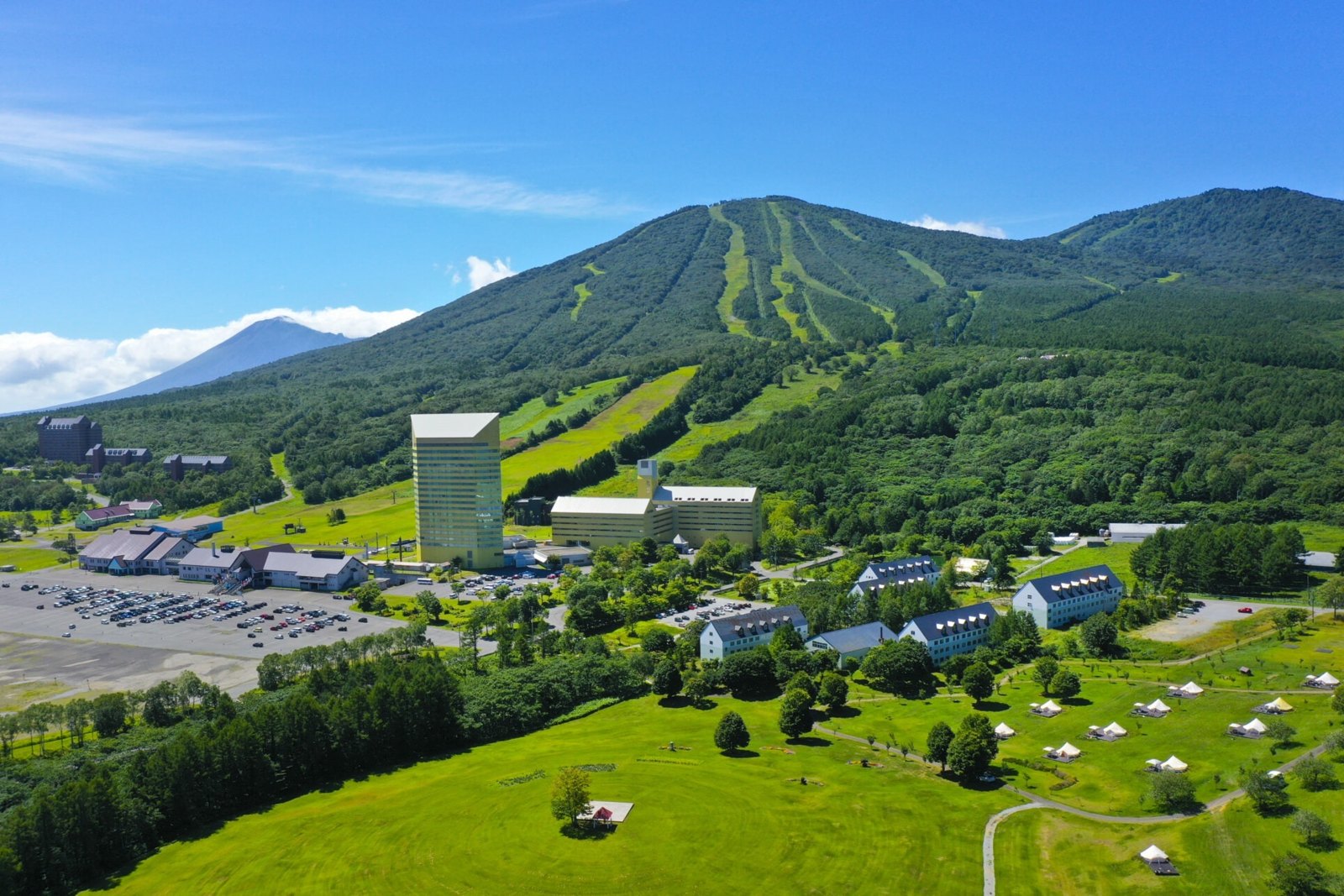
Tracking supply year by year, room stock within a 2km radius fell from 814 rooms in 2017 to 786 in 2018, stayed flat through 2021, and reached 837 in 2022 with the addition of ANA InterContinental Appi Kogen Resort (38 rooms, opened February 25, 2022) and Appi no Mori Glamping (13 rooms). There have been no new openings since 2023, and the stock was still 837 rooms as of November 2026. By opening decade, 7 properties with 484 rooms opened in the 1980s, 13 with 330 rooms in the 1990s, and 3 with 79 rooms in the 2020s, so more than 80% of rooms are in buildings over 30 years old. In other words, apart from the two resort hotels fully renovated when the IHG brands were introduced, most of the stock is approaching its next renewal cycle, which makes it a deep pool for reinvestment.
| Type | Listed properties | Listed rooms | Operating properties | Operating rooms | Share of listed rooms |
|---|---|---|---|---|---|
| Resort hotels (3 IHG hotels) | 3 | 618 | 2 | 439 | 69.2% |
| Pensions | 12 | 140 | 6 | 69 | 15.7% |
| Ryokan | 3 | 74 | 1 | 28 | 8.3% |
| Minshuku (guesthouses) | 2 | 28 | 0 | 0 | 3.1% |
| Glamping | 1 | 13 | 1 | 13 | 1.5% |
| Youth hostels and lodges | 2 | 20 | 0 | 0 | 2.2% |
| Total | 23 | 893 | 10 | 549 | 100% |
By composition, the three IHG resort hotels hold 618 (69.2%) of the 893 listed rooms, followed by 12 pensions with 140 rooms, 3 ryokan with 74 rooms and 2 minshuku with 28 rooms. In the September–November 2026 off-season, sales were confirmed at 10 properties with 549 rooms: 2 resort hotels with 439 rooms, 6 pensions with 69 rooms and 1 ryokan with 28 rooms. Widening the radius to 5km adds guesthouses in surrounding villages for 34 listed properties and 1,064 rooms, but ski-in lodging is almost entirely concentrated in the 23 properties within 2km. Note that IHG’s April 2021 announcement of the three-brand introduction cited “more than 1,000 rooms in total,” “18 restaurants and bars” and “2,000 sqm of hot spring facilities,” and a 2020 operator document also describes the whole resort as “8 hotels, 1,009 rooms, capacity of 4,000 guests.” IHG’s property pages list ANA Holiday Inn Resort Appi Kogen (ANAホリデイ・インリゾート安比高原) at 588 rooms (combining two predecessor buildings) and ANA Crowne Plaza Resort Appi Kogen in the 400s, so total room counts are larger than the rooms registered for sale on major booking sites (618 in this article). It is reasonable to understand total capacity, including group and school travel, direct sales and seasonal wings, as being on the order of 1,000 rooms.
| Property (top 10 by rooms) | Type | Listed rooms | Opened | Distance from center |
|---|---|---|---|---|
| ANA Crowne Plaza Resort Appi Kogen | Resort hotel | 401 | 1985 | 1m |
| ANA Holiday Inn Resort Appi Kogen | Resort hotel | 179 | 1996 | 1m |
| ANA InterContinental Appi Kogen Resort | Resort hotel | 38 | 2022 | 939m |
| Appi Kogen Mori no Hotel | Ryokan | 28 | 2020 | 115m |
| Molden no Yu La Vista Appi Kogen | Ryokan | 28 | 1987 | 185m |
| Kogen no Yado Ashiro Ringyo Center | Ryokan | 18 | 1990 | 1,472m |
| Minshuku Ageha | Minshuku | 18 | 1990 | 1,872m |
| Pension Apricot | Pension | 14 | 1990 | 274m |
| Earth Color | Pension | 14 | 1988 | 310m |
| Ski House Alpen | Pension | 14 | 1990 | 1,771m |
| 13 others (pensions with 10–13 rooms, glamping, etc.) | — | 141 | 1985–2022 | 41–1,708m |
The supply pipeline is quiet. Hotel projects in Iwate Prefecture identifiable from building confirmation applications in MLIT’s “Building Activity Statistics Survey” were limited to one in Rikuzentakata City (134 rooms, scheduled for completion in February 2027) as of November 2026, with none in Hachimantai City (based on confirmation applications at the time of research; the count is expected to rise as applications are added, so treat this as the floor of the confirmed pipeline). Within the city, a Livemax Resort revival project (229 rooms) is under way on the Hachimantai Onsen side for a 2026 opening, but it is a separate hot spring area about 15km from Appi Kogen and does not join the ski-in market (for the predecessor property and the economics of the revival, see Livemax Resort’s four onsen sites opening in 2026). With new supply stalled within 2km and only winter rates rising, this is both a phase in which the earning power of existing stock is increasing and one in which the room to absorb additional rooms is widening.
Positioning — 3.9x Winter-Summer Rate Gap, the Upper-Midscale Band Is Empty
Property-level rate curves show Appi Kogen’s resort hotels pulling strongly in winter. ANA Crowne Plaza Resort Appi Kogen’s estimated settled ADR was ¥66,000 in January 2026 (¥46,700 a year earlier, +41.4%) against ¥16,900 in August 2026, a winter-to-summer ratio of 3.9x. ANA InterContinental Appi Kogen Resort was ¥151,100 in January 2026 (¥139,100 a year earlier, +8.7%), ¥165,400 in February and ¥57,700 in August, a ratio of 2.6x. Appi Kogen Mori no Hotel (安比高原 森のホテル, 28 rooms, opened 2020) was ¥28,900 in January (¥21,700 a year earlier, +33.0%) and ¥14,700 in August, a ratio of 2.0x. Compared with Hachimantai City’s overall median of ¥16,500 in January and ¥12,600 in August (1.3x), the closer a resort hotel is to the slopes, the more it builds up its rate in winter. For the InterContinental, of 147 guest reviews (last 24 months, compiled by MetroEngines Research & Consulting), 21.8% mention “afternoon tea” and 10.9% mention “room size,” all favorably, confirming that the value of a stay in the luxury band is firmly established in guest assessments.
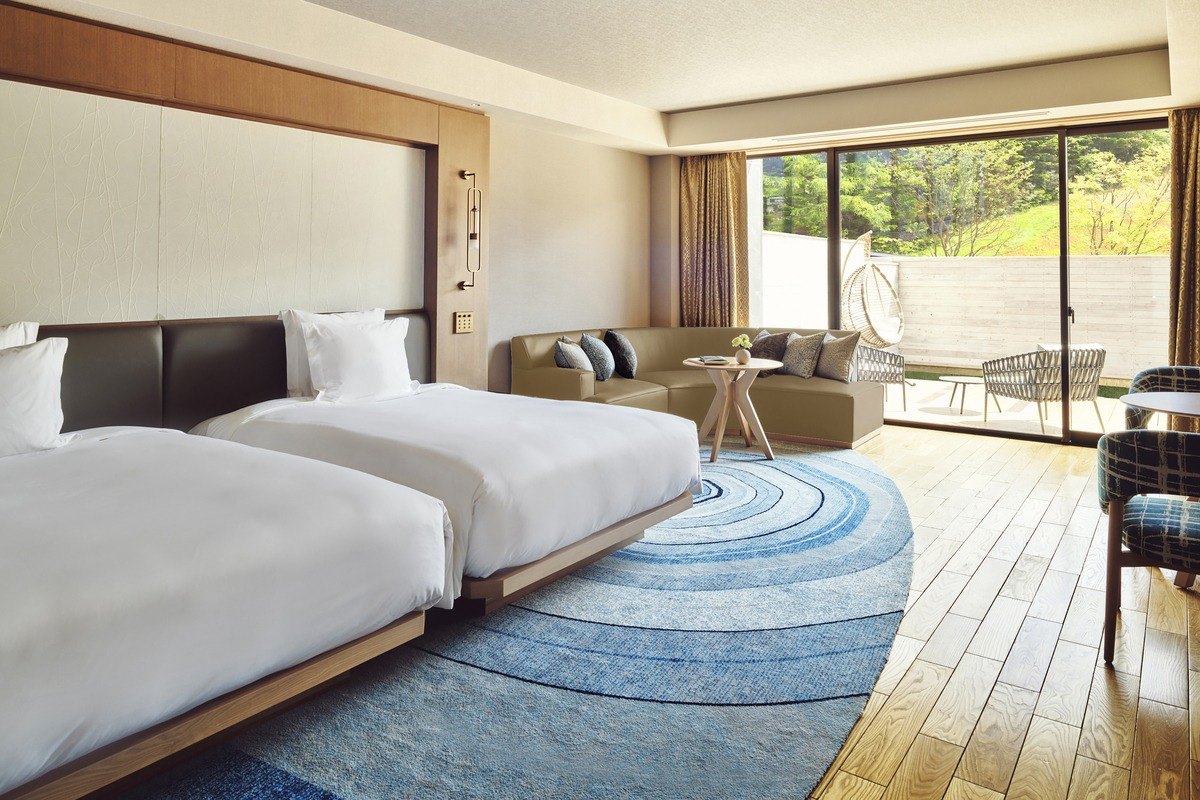
Laying out the price tiers makes the gap clear. At the top is the InterContinental (38 rooms, ¥150,000+ in winter), below it the Crowne Plaza (401 rooms, ¥66,000 in winter) and Mori no Hotel (28 rooms, ¥29,000 in winter), and below that the pensions. Of the 12 pensions, the 5 with confirmed January 2026 listed prices (average of all plans, tax included) range from ¥16,000 to ¥32,600 with a median of ¥23,600; for a band that includes room-only to two-meal stays for 2 guests, that is less than half Mori no Hotel’s listed price (¥53,700 in January). In short, there is not a single “upper-midscale, mid-sized hotel” with a winter estimated settled ADR of ¥40,000–¥70,000 and 40–80 rooms. The band where condominiums and mid-sized boutique hotels have stacked up in Niseko and Hakuba is still empty at Appi Kogen.
Crowded Occupied segment
Listed ¥16,000–¥33,000 × 10–14 rooms
12 pensions with 140 rooms, opened 1988–90. A small-scale band from room-only to two meals, making up more than half of the properties within 2km.
WS1 Upper-midscale, mid-sized
Winter ADR ¥40,000–¥70,000 × 40–80 rooms
No property sits between Mori no Hotel (¥29,000, 28 rooms) and the Crowne Plaza (¥66,000, 401 rooms). A candidate is a mid-sized hotel with ski-in/ski-out access and a hot spring on a site near the gondola base station.
WS2 Pension revival, small lots
10–14 rooms per building × renovate to listed ¥50,000s
Mori no Hotel, opened in 2020 with 28 rooms, is a real example of reaching a ¥29,000 settled rate in winter. Small-lot investment that acquires and renovates buildings from around 1990 one at a time fits the scale of regional banks and regional funds.
Development Scenario — How Lift Renewal and Added Rooms Reinforce Each Other
This is the core of the article. Ski lifts are generally held on separate books from lodging, and replacing a single gondola costs around ¥3bn in published cases (Nozawa Onsen’s Nagasaka Gondola, about ¥3bn, completed 2020; Hakuba Happo-one’s new gondola, ¥3.2bn total investment, scheduled to open December 2027), while Niseko is seeing more than ¥10bn of lift and slope investment over several years. At most ski areas, the reality is a two-tier structure: lift investment is recovered mainly through lift ticket revenue, while lodging benefits only indirectly through higher rates (we estimate the share of lift investment passed through to lodging rates in Ski Lift Renewal Costs ¥3bn; Hotels’ Share Is ¥348 per Room-Night — The Two-Tier Structure of Lift Investment). Appi Kogen differs in that the same operator group owns the lifts, golf course, hotels and school land, so it can recover the gain in drawing power from a gondola renewal directly through its own lodging revenue. Assuming this integrated ownership, our estimate tests what yield “an upper-midscale 60-room hotel opening around the same time as the new gondola” could produce. The operator has not published the new gondola’s schedule, project cost or capacity and has not announced any additional hotel, so what follows is strictly a hypothetical scenario based on public data.
Assumptions — 120 Winter Nights × ¥55,000 ADR, 245 Green-Season Nights × ¥22,000 ADR
Rate assumptions come from the positioning in the previous section. For winter (December–March, 120 nights), the estimated settled ADR is ¥55,000, midway between Mori no Hotel’s ¥29,000 and the Crowne Plaza’s ¥66,000, with 75% occupancy given how Hachimantai’s skier visits concentrate in peak months. For the green season (April–November, 245 nights), the base case is ¥22,000 with 45% occupancy, above the Crowne Plaza’s ¥16,900 and Mori no Hotel’s ¥14,700 in August; the range runs from 55%, if summer gondola operations (summit art projects, hiking access) lift stay demand, to 35%, if weather or a slow demand ramp-up hold it back. Ancillary revenue from F&B, hot springs and spa is set at 25% of room revenue, and the GOP margin at 30%. A 30% GOP margin is more conservative than the 38.9% actual for 91 operating properties disclosed by Invincible Investment Corporation (インヴィンシブル投資法人) (fiscal period ended December 2024).
Construction cost is viewed in two stages. Stage one is 2025 actuals: based on MLIT’s construction starts statistics, 2025 hotel construction costs averaged ¥1.952M per tsubo across all structures and ¥2.405M per tsubo for steel frame; we adopt ¥2.5M per tsubo as a benchmark for an upper-midscale hotel with a hot spring and spa. 60 rooms × 55 sqm of floor area per room = 3,300 sqm (about 998 tsubo), or about ¥2.50bn. Stage two builds in inflation during construction: applying Turner & Townsend’s forecasts (+5.3% in 2026, +5.0% in 2027) compounded to the midpoint of construction raises the cost to about ¥2.76bn (+10.6%). As noted in the previous section, the city’s benchmark land sites are ¥4,380–¥22,600 per sqm, and land is only a few percent of total investment, so yields here are calculated on construction cost alone.
| Item | A. Green OCC 35% | B. Green OCC 45% Base | C. Green OCC 55% (new gondola summer effect) |
|---|---|---|---|
| Rooms | 60 rooms | 60 rooms | 60 rooms |
| Winter (120 nights) ADR × OCC | ¥55,000 × 75% | ¥55,000 × 75% | ¥55,000 × 75% |
| Green season (245 nights) ADR × OCC | ¥22,000 × 35% | ¥22,000 × 45% | ¥22,000 × 55% |
| Room revenue | ¥410M | ¥443M | ¥475M |
| Of which winter share | 72.4% | 67.1% | 62.5% |
| Total revenue (incl. 25% ancillary) | ¥513M | ¥553M | ¥594M |
| GOP (30%) | ¥154M | ¥166M | ¥178M |
| Construction cost (2025 actuals, ¥2.5M/tsubo) | ¥2.50bn | ¥2.50bn | ¥2.50bn |
| GOP yield (2025 actuals basis) | 6.2% | 6.6% | 7.1% |
| Construction cost (with inflation, 2028 opening assumed) | ¥2.76bn | ¥2.76bn | ¥2.76bn |
| GOP yield (after inflation) | 5.6% | 6.0% | 6.5% |
| Simple payback (after inflation) | 17.9 yrs | 16.6 yrs | 15.5 yrs |
Reading the results: because 120 winter nights earn 62–72% of room revenue, the yield level is set almost entirely by winter ADR and occupancy, while every 10pt move in green-season occupancy shifts the yield by 0.4–0.5pt. If summer operation of the new gondola lifts green-season occupancy from 45% to 55%, the post-inflation yield rises from 6.0% to 6.5% and payback shortens from 16.6 to 15.5 years. That is what “lift renewal and added rooms reinforcing each other” means in practice. Whether a design works in which lodging-side green-season occupancy absorbs year-round investment that the gondola alone cannot recover decides development at an integrated-ownership resort. Conversely, if lifts and lodging are owned by separate capital, the same investment would give the lodging side only an indirect lift in winter rates, and this linkage would not occur.
Sensitivity Analysis — Winter ADR −10% and Occupancy −5pt Give a 5.4% Yield
| Base case (green OCC 45%) | Base | Winter ADR −10% | Winter OCC −5pt | Both |
|---|---|---|---|---|
| Total revenue | ¥553M | ¥516M | ¥528M | ¥494M |
| GOP (30%) | ¥166M | ¥155M | ¥159M | ¥148M |
| Yield (2025 actuals basis) | 6.6% | 6.2% | 6.3% | 5.9% |
| Yield (with inflation) | 6.0% | 5.6% | 5.7% | 5.4% |
The sensitivity results bring out what it means that Hachimantai’s winter ADR has just risen 38.5% in January 2026. Even if rates give back 10% next winter, the yield holds at 5.6%, and a 5pt shortfall in occupancy still leaves 5.7%. The 5.4% when both happen together is a level that warrants caution for a regional resort development, but if green-season occupancy then rises to 55%, the yield recovers to 5.8% (6.4% on a 2025 actuals basis). In other words, the earnings turning point for development at this location is not “how far to trust winter rates” but “how far year-round lift operation can fill summer,” and only when the new gondola’s specifications (whether it runs in summer, whether there are summit facilities) are published can the lodging business plan be finalized.
Two-Factor Sensitivity — Winter ADR × Green-Season Occupancy
The table above moves one factor at a time. Moving winter ADR and green-season occupancy together spreads the post-inflation GOP yield from 4.8% to 7.3% (winter occupancy fixed at 75%, construction cost ¥2.76bn). 14 of the 25 combinations reach 6% or more, and even with winter ADR −10% (¥49,500), 55% green-season occupancy gives 6.1%, above the base (6.0%). 10pt of green-season occupancy is equivalent to about 11% of winter ADR; the key reading of the table is how far summer occupancy can make up for erosion in winter rates.
| Winter ADR / Green OCC | 35% | 40% | 45% | 50% | 55% |
|---|---|---|---|---|---|
| ¥44,000 (−20%) | 4.8% | 5.0% | 5.2% | 5.4% | 5.6% |
| ¥49,500 (−10%) | 5.2% | 5.4% | 5.6% | 5.8% | 6.1% |
| ¥55,000 (base) | 5.6% | 5.8% | 6.0% | 6.2% | 6.5% |
| ¥60,500 (+10%) | 6.0% | 6.2% | 6.4% | 6.6% | 6.9% |
| ¥66,000 (+20%) | 6.4% | 6.6% | 6.8% | 7.0% | 7.3% |
Pension Revival — Small Lots of 10–14 Rooms per Building, a Band Regional Finance Can Join
The other development opportunity is reviving the 12 pensions with 140 rooms that opened in 1988–90. Sales were confirmed at 6 of them (69 rooms) in September–November 2026; the remaining 6 (71 rooms) appear to operate only in winter or to be closed. Appi Kogen Mori no Hotel, which opened in 2020 with 28 rooms, reached an estimated settled rate of ¥28,900 in January 2026 (+33.0% YoY), a real example showing that acquiring a building from around 1990 as a whole and raising the standard of its hot spring, food and rooms can move it into the listed ¥50,000s band (average of all plans, tax included). Small-lot investment, with acquisition and renovation of a few hundred million yen per building, is a scale that Tohoku regional banks and regional funds can readily lead, and building out a middle tier of “12–28 rooms × 6–8 buildings” beneath the large IHG properties can also be expected to raise the resort’s overall median ADR. A location lined up within 300–400m of the gondola base station is a strong enough precondition to support the product after renovation.
Investment Summary — Recommended Scenario and Risks
Putting this together, investment opportunities at Appi Kogen fall into three layers. The first is a mid-sized upper-midscale hotel (WS1, about 60 rooms) linked to the lift renewal led by the operator group, with a GOP yield of 6.6% on a 2025 actuals basis, 6.0% after inflation, and 6.5% at 55% green-season occupancy. The second is pension revival (WS2), which third-party capital can enter more easily; a portfolio approach bundling several small lots of a few hundred million yen each is realistic. The third is improving the earnings of the existing three IHG hotels themselves, whose earnings grow without additional investment while winter rates keep rising. This article recommends combining the first and second layers, and in particular advises waiting for the new gondola’s specifications to be published, then reflecting whether it runs in summer in the green-season occupancy assumption before making a development decision.
| Risk factor | Rating | Details and response |
|---|---|---|
| Market (winter rate pullback) | Medium | Comes right after +38.5% in January 2026. In the sensitivity analysis, the yield holds at 5.6% even at −10%. The rate gap with Niseko and Hakuba (1.3–3.7x) supports the upside |
| Demand (green season) | Medium | 60–70% of room revenue is concentrated in 120 winter nights. Summer gondola operation, boarding school events and the golf course (36 holes) fill the 35–55% occupancy range |
| Regulation (permits) | Medium | No use restrictions outside the city planning area, but Forest Act, Natural Parks Act and ropeway business permit procedures drive the schedule. The operator is also consulting and coordinating permits with the relevant authorities |
| Construction (rising costs) | Medium | Steel frame at ¥2.405M/tsubo in 2025, with increases of around 5% a year forecast. On the other hand, high construction costs restrain new supply, an upside that softens competition for existing stock |
| Disaster (landslides, liquefaction) | Low | No landslide warning zone designated in the hotel cluster block; mountain / volcanic terrain unlikely to liquefy. Snow handling costs built into the plan |
| Supply (more competition) | Low | No hotel projects in Hachimantai City based on confirmation applications (as of November 2026, floor value). Flat at 837 rooms within 2km since 2022 |
Timeline and Next Steps
As a rough schedule, starting from permits and publication of specifications for the new gondola plan (from fiscal 2026), and allowing one year for the master plan and site and permit studies and two years for design and construction, the realistic earliest opening for the hotel is the ski season of late 2028 to 2029. The inflation-adjusted construction cost in this article assumes this schedule. As next steps: first, confirm the lift renewal specifications (summer operation, capacity, schedule) through dialogue with the operator group; second, settle the Forest Act and Natural Parks Act zones and development permit procedures through preliminary consultation with Hachimantai City and Iwate Prefecture; and third, survey owner intentions and building condition individually for the buildings from around 1990 that are candidates for pension revival. None of these can be settled from public data alone, and the figures in this article should be treated as a starting point for decision-making.
Frequently Asked Questions
Q. How do Appi Kogen’s lodging rates compare with Niseko and Hakuba?
A. The January 2026 estimated settled ADR (municipal median) was ¥16,500 in Hachimantai City, 1/3.7 of Kutchan’s ¥61,600 and 0.77 times Hakuba Village’s ¥21,500. On the other hand, its YoY growth of +38.5% was the highest of the six major ski areas.
Q. Are there plans to add rooms at Appi Kogen?
A. As of November 2026, no hotel projects in Hachimantai City can be identified from building confirmation applications in MLIT’s “Building Activity Statistics Survey.” The new gondola plan announced by the operator also makes no mention of additional hotels, and room stock within a 2km radius has stayed at 837 rooms since 2022.
Q. When will the new gondola start operating?
A. The operator announced the construction plan on August 10, 2026, but has not published the schedule, project cost or start of operation, and says permits such as the ropeway business permit are under discussion with the relevant authorities. The estimates in this article assume a 2028 opening and are not confirmed information.
⚠ Note on ADR for future dates: The estimated settled ADR in this article uses values for finalized past months (through October 2026). Figures for December 2026 onward are only estimates based on selling prices published on OTAs and elsewhere at the time of research, and they change as new plans are added and prices adjusted closer to the check-in date, so they are not included in the YoY comparisons in the text. ADR, occupancy and construction cost in the development scenario are assumptions, and an actual investment decision requires a detailed feasibility study.
Related Articles
- Ski Lift Renewal Costs ¥3bn; Hotels’ Share Is ¥348 per Room-Night
- Livemax Resort’s 4 Onsen Revivals: 229 & 136 Rooms, 4.5–15yr Payback
- Iwate Hotel Market 2026: 2.2x ADR Gap, Morioka ¥200 Lodging Tax
- Hokkaido Hotel Investment Map 2026: Kutchan ¥62K in Jan, Hakodate ¥10K
- Spring Ski: How Far March ADR Falls vs Feb — Kutchan −54%, Nozawa −3%
- Six Senses Myoko: 57 Rooms + 21 Residences vs a 2,487-Room 5km Market
- Ski Resort Opening Dates 2026-27 & Hotel ADR: Hakuba +60%, Kutchan 2x
- Snow Removal Costs ¥79,100 per Room a Year — 4-9% of Winter Sales
References and Sources
■ Data Sources
Room stock, estimated settled ADR and guest reviews are compiled by MetroEngines Research & Consulting (continuous tracking of OTA published prices; room stock as of November 10, 2026, ADR finalized through October 2026). Skier visits are from the Iwate Prefecture Department of Commerce, Industry, Labor and Tourism; land prices, city planning and disaster risk from the MLIT Real Estate Information Library; and hotel construction costs from MLIT construction starts statistics.
■ Estimate Assumptions
60 rooms, 55 sqm of floor area per room (about 998 tsubo), construction cost of ¥2.5M per tsubo for ¥2.50bn, rising to ¥2.76bn with inflation of +5.3% in 2026 and +5.0% in 2027. 120 winter nights at ¥55,000 ADR and 75% occupancy; 245 green-season nights at ¥22,000 ADR and 35% / 45% / 55% occupancy. Ancillary revenue 25% of room revenue, GOP margin 30%. Land cost not included.
■ Limitations
Estimated settled ADR is an estimate that applies segment-specific adjustments to the lowest plan and differs from each property’s actual settled price. Room counts are the rooms registered for sale on major booking sites and are smaller than the published total room counts. The “operating” classification is a floor value based on confirmed sales in the off-season (September–November 2026). The new gondola’s schedule, project cost and specifications have not been published, so the development scenario is a hypothetical estimate based on public data.
■ Market Data
- MetroEngines Research & Consulting — Room stock within 2,000m / 5,000m radii (23 listed properties with 893 rooms, 34 properties with 1,064 rooms, as of November 10, 2026); estimated settled ADR for Hachimantai City, Kutchan Town, Niseko Town, Hakuba Village, Yuzawa Town and Myoko City (municipal median, finalized January 2024–October 2026); property-level estimated settled ADR; guest review analysis (compiled by MetroEngines Research & Consulting, N=147)
■ Government Statistics and Public Data
- Iwate Prefecture Department of Commerce, Industry, Labor and Tourism, “Iwate Tourism Statistics: Ski Visitor Trends (2026 Season)” (June 2026)
- MLIT Real Estate Information Library — official land prices (January 1, 2026), prefectural land price survey (July 1, 2025), city planning areas, zoning, landslide warning zones, liquefaction tendency maps
- Iwate Prefecture, “Hachimantai City Planning Area Master Plan” (city planning area about 4,052ha)
- MLIT, “Building Activity Statistics Survey” (hotel projects compiled from building confirmation applications)
- MLIT, “Construction Starts Statistics” / archi-book 2025 edition (cost per tsubo by structure)
- Japan National Tourism Organization (JNTO): 42.68 million international visitors in 2025 (Travel Voice, January 21, 2026)
■ Operator and Brand Publications
- Iwate Hotel and Resort Co., Ltd., “New Gondola at Appi Kogen Ski Resort” (official website, announced August 10, 2026)
- APPI ALL SEASON RESORT Appi Kogen Ski Resort official website
- Iwate Hotel and Resort Co., Ltd., “Appi Kogen Resort Valley Concept Project Launches in Earnest — Financing Agreement with SMBC for School Construction” (November 25, 2020)
- Iwate Hotel and Resort, opening of “ANA InterContinental Appi Kogen Resort” (Nikkei press release, February 2022)
- ANA Travel & Life, “ANA InterContinental Appi Kogen Resort” (38 rooms, opened February 25, 2022)
- Invincible Investment Corporation, hotel operating results (GOP margin) / Relo Hotel Solutions, “GOP Margin Benchmarks by Segment”
■ News and Press Releases
- Travel Voice, “Asia Gate Group Acquires Iwate Hotel and Resort, Operator of APPI Kogen Ski Resort” (June 23, 2016)
- Travel Watch, “Hotel Resort at Appi Kogen, Iwate: ANA InterContinental Resort, ANA Crowne Plaza Resort and ANA Holiday Inn Resort to Open in December” (April 15, 2021)
- Opening of Harrow International School Appi Japan (PR TIMES, August 2022)
- Shinano Mainichi Shimbun, “¥3.2bn Total Investment for New Gondola at Happo-one Ski Resort, Hakuba Village” (November 28, 2024) / Nikkei, “Nozawa Onsen Ski Resort Completes New Gondola Lift” (December 2020)