

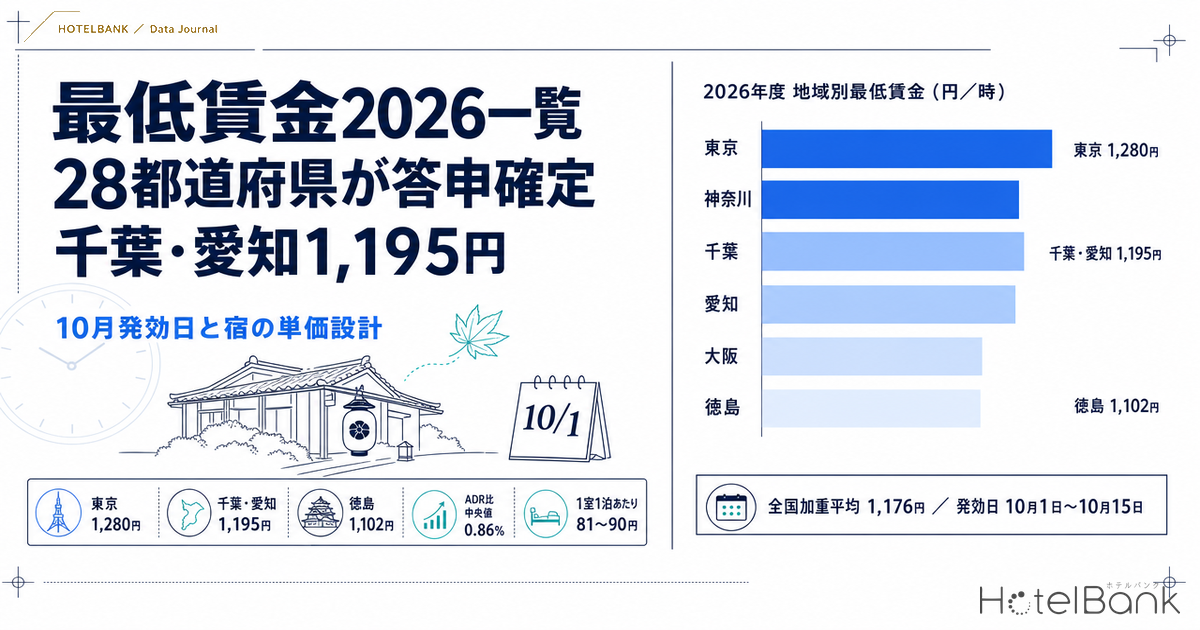
Three regulatory changes land on Japan’s lodging industry in October 2026. The central one is the revision of regional minimum wages: on July 28, 2026 the Central Minimum Wages Council issued guideline increases of ¥54 for Rank A and ¥56 for Ranks B and C, putting the national weighted average at ¥1,176 (up ¥55, or 4.9%, year on year). Working from that guideline, prefectural councils have been issuing their own recommendations, and as of August 17, 2026, 28 prefectures have reported. Chiba and Aichi both land at ¥1,195 (+¥55), Tokyo at ¥1,280 (+¥54), and the largest increases are the +¥60 in Miyagi and Tottori.
This article is not a forecast. It is an operational calendar built on confirmed recommended rates and effective dates. We cover all 47 prefectures (28 confirmed plus 19 on a guideline basis), the seven distinct effective dates running from October 1 to October 15, and the wider October package including the new lodging taxes and the revised furusato nozei (hometown tax donation) standards. We then use MetroEngines Research estimated settled ADR to calculate, prefecture by prefecture, what share of the room rate the labour-cost revision actually represents. The headline finding: for a limited-service hotel (assuming 1.5 labour hours per occupied room-night), the required rate adjustment is a median of 0.86% of ADR, or ¥81–90 per room-night. That is comfortably inside the range normal rate design can absorb — which makes the question how the remaining weeks before October are used.
Metric Definitions Used in This Article
- ADR (average daily rate): an estimated settled rate (tax-exclusive equivalent), derived by applying a category-specific adjustment factor to the lowest publicly listed plan rate each property posts on OTAs (double occupancy, per room, tax-inclusive). Cross-checked against property-level disclosures from listed hotel REITs, the median error is roughly 7%. These are estimates and differ from any individual property’s actual transacted rates or accounting figures. Area-level ADR is the median across the properties covered (the level of a typical property in that area); this article uses the 12-month average for August 2025 through July 2026.
- Labour-cost revision as a share of room rate: the minimum wage increase (¥ per hour) x assumed labour hours per occupied room-night, divided by estimated settled ADR. The assumed labour hours are a modelling assumption set by our editorial team; actual labour input varies widely by property.
- Data sources: minimum wage figures are published values from the Ministry of Health, Labour and Welfare and the prefectural Labour Bureaus. Room rates are from MetroEngines Research.
- — National weighted average of ¥1,176 (+¥55, +4.9%). As of August 17, 2026, 28 prefectures have confirmed recommendations; 16 came in above the guideline and none came in below.
- — Chiba and Aichi at ¥1,195; Tokyo at ¥1,280, all effective October 1. The largest increases are the +¥60 in Miyagi and Tottori.
- — Effective dates fall into seven patterns between October 1 and October 15. October 1 covers 15 prefectures, the most of any date; Shizuoka, the latest, sits a full two weeks behind.
- — The labour-cost revision equals a median 0.86% of the room rate, or ¥81–90 per room-night (limited-service, 1.5 labour hours assumed). Even at the full-service assumption of 4.0 hours it is 2.3%, or ¥224.
- — October also brings new lodging taxes (Nasu Town and Morioka City) and tighter furusato nozei designation standards. Booking-system tax settings and rate design are worth locking down during September.
FY2026 Minimum Wages — ¥1,176 National Weighted Average, 28 Prefectures Confirmed
On July 28, 2026, the 75th session of the Central Minimum Wages Council issued its guideline for the FY2026 revision of regional minimum wages. The rank-based guidelines were ¥54 for Rank A and ¥56 for both Rank B and Rank C, giving a national weighted average of ¥1,176 — an increase of ¥55, or 4.9%. That is a moderation from the prior year (+¥66, +6.3%).
Rank A covers six prefectures: Saitama, Chiba, Tokyo, Kanagawa, Aichi and Osaka. Rank B covers 28: Hokkaido, Miyagi, Fukushima, Ibaraki, Tochigi, Gunma, Niigata, Toyama, Ishikawa, Fukui, Yamanashi, Nagano, Gifu, Shizuoka, Mie, Shiga, Kyoto, Hyogo, Nara, Wakayama, Shimane, Okayama, Hiroshima, Yamaguchi, Tokushima, Kagawa, Ehime and Fukuoka. Rank C covers 13: Aomori, Iwate, Akita, Yamagata, Tottori, Kochi, Saga, Nagasaki, Kumamoto, Oita, Miyazaki, Kagoshima and Okinawa. The distinguishing feature of this year’s guideline is that Ranks B and C were set at the same amount (¥56), a design that reads as deliberately aimed at narrowing regional gaps.
Prefectural minimum wage councils have been issuing their recommendations in response, with 28 prefectures published as of August 17, 2026. The remaining 19 are expected to report between late August and September. The chart below places the confirmed figures for the 28 alongside guideline-based projections for the 19 still pending.
Source: compiled by the HotelBank Editorial Team from the Ministry of Health, Labour and Welfare, “Guideline for the FY2026 Revision of Regional Minimum Wages,” and figures published by the prefectural Labour Bureaus (28 prefectures confirmed; 19 on a guideline basis; as of August 17, 2026)
All 47 Prefectures — Recommended Rate, Increase, Effective Date and Share of Room Rate
The table below covers all 47 prefectures. The “recommended rate” is the figure put forward by each prefectural minimum wage council; it then passes through an objection period, is confirmed by the head of the prefectural Labour Bureau, is published in the Official Gazette, and finally takes effect. For the 19 prefectures still awaiting a recommendation, we show in grey a projected figure obtained by adding the guideline increase for that rank (¥56 for both Rank B and Rank C) to the current rate. The two right-hand columns show each prefecture’s estimated settled ADR (12-month average) and, for a limited-service hotel, what percentage of the room rate the wage revision represents.
| Prefecture | Rank | FY2025 rate | FY2026 recommended | Increase | Effective date | Est. settled ADR | Revision / ADR (1.5 hrs assumed) | Status |
|---|---|---|---|---|---|---|---|---|
| Tokyo | A | 1,226 | 1,280 | +54 | Oct 1 | ¥14,631 | 0.55% | Confirmed |
| Kanagawa | A | 1,225 | 1,279 | +54 | Oct 1 | ¥14,199 | 0.57% | Confirmed |
| Osaka | A | 1,177 | 1,231 | +54 | Oct 1 | ¥10,724 | 0.76% | Confirmed |
| Saitama | A | 1,141 | 1,196 | +55 ▲Guideline +1 | Oct 1 | ¥8,037 | 1.03% | Confirmed |
| Chiba | A | 1,140 | 1,195 | +55 ▲Guideline +1 | Oct 1 | ¥10,186 | 0.81% | Confirmed |
| Aichi | A | 1,140 | 1,195 | +55 ▲Guideline +1 | Oct 1 | ¥8,818 | 0.94% | Confirmed |
| Kyoto | B | 1,122 | 1,178(guideline) | +56 | — | ¥16,570 | 0.51% | Pending |
| Hyogo | B | 1,116 | 1,172 | +56 | Oct 1 | ¥13,690 | 0.61% | Confirmed |
| Shizuoka | B | 1,097 | 1,154 | +57 ▲Guideline +1 | Oct 15 | ¥13,558 | 0.63% | Confirmed |
| Mie | B | 1,087 | 1,143 | +56 | Oct 1 | ¥11,712 | 0.72% | Confirmed |
| Hiroshima | B | 1,085 | 1,141(guideline) | +56 | — | ¥8,655 | 0.97% | Pending |
| Shiga | B | 1,080 | 1,136 | +56 | Oct 3 | ¥8,280 | 1.01% | Confirmed |
| Hokkaido | B | 1,075 | 1,131 | +56 | Oct 1 | ¥10,137 | 0.83% | Confirmed |
| Ibaraki | B | 1,074 | 1,130(guideline) | +56 | — | ¥6,965 | 1.21% | Pending |
| Tochigi | B | 1,068 | 1,125 | +57 ▲Guideline +1 | Oct 1 | ¥10,594 | 0.81% | Confirmed |
| Gifu | B | 1,065 | 1,121 | +56 | Oct 1 | ¥11,304 | 0.74% | Confirmed |
| Gunma | B | 1,063 | 1,120 | +57 ▲Guideline +1 | Oct 3 | ¥12,064 | 0.71% | Confirmed |
| Toyama | B | 1,062 | 1,119 | +57 ▲Guideline +1 | Oct 1 | ¥7,569 | 1.13% | Confirmed |
| Nagano | B | 1,061 | 1,117 | +56 | Oct 2 | ¥12,082 | 0.70% | Confirmed |
| Fukuoka | B | 1,057 | 1,114 | +57 ▲Guideline +1 | Oct 4 | ¥11,781 | 0.73% | Confirmed |
| Ishikawa | B | 1,054 | 1,113 | +59 ▲Guideline +3 | Oct 3 | ¥11,232 | 0.79% | Confirmed |
| Fukui | B | 1,053 | 1,112 | +59 ▲Guideline +3 | Oct 4 | ¥11,546 | 0.77% | Confirmed |
| Niigata | B | 1,050 | 1,108 | +58 ▲Guideline +2 | Oct 1 | ¥9,729 | 0.89% | Confirmed |
| Yamanashi | B | 1,052 | 1,108(guideline) | +56 | — | ¥11,774 | 0.71% | Pending |
| Nara | B | 1,051 | 1,107 | +56 | Oct 4 | ¥13,277 | 0.63% | Confirmed |
| Okayama | B | 1,047 | 1,104 | +57 ▲Guideline +1 | Oct 2 | ¥8,319 | 1.03% | Confirmed |
| Tokushima | B | 1,046 | 1,102(guideline) | +56 | — | ¥6,456 | 1.30% | Pending |
| Wakayama | B | 1,045 | 1,101 | +56 | Oct 3 | ¥9,720 | 0.86% | Confirmed |
| Yamaguchi | B | 1,043 | 1,101 | +58 ▲Guideline +2 | Oct 8 | ¥7,559 | 1.15% | Confirmed |
| Miyagi | B | 1,038 | 1,098 | +60 ▲Guideline +4 | Oct 1 | ¥9,249 | 0.97% | Confirmed |
| Shimane | B | 1,033 | 1,092 | +59 ▲Guideline +3 | Oct 10 | ¥10,419 | 0.85% | Confirmed |
| Kagawa | B | 1,036 | 1,092 | +56 | Oct 1 | ¥8,140 | 1.03% | Confirmed |
| Oita | C | 1,035 | 1,091(guideline) | +56 | — | ¥14,909 | 0.56% | Pending |
| Tottori | C | 1,030 | 1,090 | +60 ▲Guideline +4 | Oct 3 | ¥8,622 | 1.04% | Confirmed |
| Kumamoto | C | 1,034 | 1,090(guideline) | +56 | — | ¥10,579 | 0.79% | Pending |
| Fukushima | B | 1,033 | 1,089(guideline) | +56 | — | ¥7,513 | 1.12% | Pending |
| Ehime | B | 1,033 | 1,089(guideline) | +56 | — | ¥6,961 | 1.21% | Pending |
| Yamagata | C | 1,032 | 1,088(guideline) | +56 | — | ¥9,687 | 0.87% | Pending |
| Iwate | C | 1,031 | 1,087(guideline) | +56 | — | ¥7,204 | 1.17% | Pending |
| Akita | C | 1,031 | 1,087(guideline) | +56 | — | ¥8,002 | 1.05% | Pending |
| Nagasaki | C | 1,031 | 1,087(guideline) | +56 | — | ¥7,835 | 1.07% | Pending |
| Saga | C | 1,030 | 1,086(guideline) | +56 | — | ¥12,164 | 0.69% | Pending |
| Aomori | C | 1,029 | 1,085(guideline) | +56 | — | ¥7,838 | 1.07% | Pending |
| Kagoshima | C | 1,026 | 1,082(guideline) | +56 | — | ¥6,848 | 1.23% | Pending |
| Kochi | C | 1,023 | 1,079(guideline) | +56 | — | ¥7,912 | 1.06% | Pending |
| Miyazaki | C | 1,023 | 1,079(guideline) | +56 | — | ¥6,913 | 1.22% | Pending |
| Okinawa | C | 1,023 | 1,079(guideline) | +56 | — | ¥11,793 | 0.71% | Pending |
Source: minimum wage figures published by the Ministry of Health, Labour and Welfare and the prefectural Labour Bureaus (as of August 17, 2026). ADR from MetroEngines Research (estimated settled ADR, 12-month average for August 2025–July 2026). “▲Guideline +N” indicates the amount by which the recommendation exceeded the Central Minimum Wages Council guideline. Compiled by the HotelBank Editorial Team
Taking the three prefectures most often asked about, Chiba goes from ¥1,140 to ¥1,195 (+¥55, +4.82%), effective October 1。Aichi likewise goes from ¥1,140 to ¥1,195 (+¥55), effective October 1. Both came in ¥1 above the Rank A guideline of ¥54.Tokyo goes from ¥1,226 to ¥1,280 (+¥54, +4.40%), effective October 1, exactly in line with the guideline. Recommendations for all three are already settled, so staffing plans from October onward can be built on these figures.
16 Prefectures Exceeded the Guideline — Distribution of Increases
Of the 28 prefectures with confirmed recommendations, 16 came in above the Central Minimum Wages Council guideline. Twelve matched the guideline exactly, and none fell below it. The largest add-ons were in Miyagi and Tottori, both ¥4 above guideline for a ¥60 increase. In Miyagi’s case, press reports note this is the second consecutive year of exceeding the guideline, and that the ¥60 increase (5.78%) is the second largest since the current framework was adopted in 2002.
Source: compiled by the HotelBank Editorial Team from figures published by the prefectural Labour Bureaus (28 prefectures with confirmed recommendations, as of August 17, 2026)
The prefectures posting the largest add-ons — Ishikawa, Fukui and Shimane (+¥59 each), Niigata and Yamaguchi (+¥58 each), and Tochigi, Gunma, Toyama, Shizuoka, Okayama and Fukuoka (+¥57 each) — are Rank B prefectures whose current rates sit in the ¥1,030–1,100 range. Measured as growth rates, Tottori (+5.83%) and Miyagi (+5.78%) lead, a 1.4-point spread over Tokyo’s +4.40%. Urban prefectures remain far higher in absolute terms, but the regions continue to grow faster. Because lodging is an industry whose employment is dispersed across regional Japan, that difference in growth rates matters for workforce planning.
Seven Effective-Date Patterns from October 1 to October 15 — Building the Operational Calendar
In practice, the effective date matters nearly as much as the rate itself. Minimum wages do not switch over nationwide on a single day; each prefecture has its own effective date. Among the 28 confirmed prefectures, October 1 is the most common with 15, followed by October 3 with five (Gunma, Ishikawa, Shiga, Wakayama, Tottori), October 4 with three (Fukui, Nara, Fukuoka), and October 2 with two (Nagano, Okayama). Yamaguchi takes effect on October 8, Shimane on October 10, and Shizuoka last of all on October 15.
Source: compiled by the HotelBank Editorial Team from figures published by the prefectural Labour Bureaus (28 prefectures with confirmed recommendations, as of August 17, 2026)
For chains operating across several prefectures, or operators who move staff across prefectural lines, that two-week spread becomes a payroll fork in the road. In prefectures where the effective date falls across the October payroll cut-off, a single wage ledger will contain both an old-rate period and a new-rate period, so it is safer to configure the hourly-rate switchover in the time and attendance system property by property, keyed to each effective date.
The other item worth checking is the hourly conversion for staff on daily or monthly salaries. Because the minimum wage is defined as an hourly amount, monthly-salaried staff still need to be tested: divide by contractual working hours and confirm the result is not below the new regional minimum. The longer a workplace’s contractual hours, the lower the converted figure — so a rate that looks comfortable on paper can sit much closer to the revised floor than expected.
How Large Is the Labour-Cost Revision Against the Room Rate? — Estimates for All 47 Prefectures
This is the core of the article. Translated into room-rate terms, what does the minimum wage increase (¥ per hour) actually amount to? The framework is simple: increase (¥ per hour) x assumed labour hours per occupied room-night, divided by estimated settled ADR.
■ Modelling assumptions
- The increase used is each prefecture’s recommended amount (for the 19 still pending, the rank-based guideline amount), i.e. ¥54–60.
- Assumed labour hours per occupied room-night are set at 1.5 for limited-service hotels and 4.0 for full-service hotels and two-meal ryokan. These are assumptions set by our editorial team; actual labour input varies widely by category, scale and the share of work outsourced.
- The denominator is estimated settled ADR (12-month average for August 2025–July 2026, tax-exclusive equivalent).
- This estimate covers only labour paid at or near the minimum wage. It does not include knock-on effects across the wider wage curve.
The scatter plot below shows the result. The horizontal axis is estimated settled ADR; the vertical axis is the rate adjustment required under the limited-service assumption of 1.5 hours. The higher a prefecture’s ADR, the smaller the ratio — a clear inverse relationship.
Source: minimum wages from the Ministry of Health, Labour and Welfare and the prefectural Labour Bureaus; ADR from MetroEngines Research (N=47 prefectures; estimated settled ADR is the 12-month average for August 2025–July 2026). Compiled by the HotelBank Editorial Team
The median ratio is 0.86%. In yen, all 47 prefectures fall within a band of ¥81–90 per room-night. Because the increases themselves span only ¥54–60, there is almost no variation between prefectures in absolute terms; the spread in ratios is driven almost entirely by the denominator, ADR.
The smallest ratio is Kyoto at 0.51% (estimated settled ADR ¥16,600, N=588 properties), followed by Tokyo at 0.55% (¥14,600, N=1,125), Oita at 0.56% (¥14,900, N=459) and Kanagawa at 0.57% (¥14,200, N=572). At the other end are Tokushima at 1.30% (¥6,500, N=141), Kagoshima at 1.23% (¥6,800, N=317), Miyazaki at 1.22% (¥6,900, N=163) and Ibaraki at 1.21% (¥7,000, N=310). The spread from top to bottom is 2.5x.
There is a second, more intuitive way to read the same data: how many hours of the revised minimum wage does one room-night of estimated settled ADR represent? Kyoto comes to 14.1 hours, Oita 13.7, Nara 12.0, Shizuoka 11.7 and Tokyo 11.4. Against that, Tokushima is 5.9 hours, Ibaraki 6.2 and Kagoshima 6.3. The national median is 8.8 hours. Selling one room for one night generates roughly nine hours of revenue at the revised minimum wage — and the lower that number in a given area, the more room there is, relatively speaking, to lift the rate level itself.
Sensitivity by Category — What Happens When Labour Hours Change
The 1.5-hour assumption reflects a limited-service hotel and naturally shifts by category. Holding the increase at the national median of ¥56 and ADR at the national median of ¥9,729, and varying only labour hours, produces the following.
| Assumed labour hours per room-night | Typical category | Required rate adjustment | Share of ADR |
|---|---|---|---|
| 0.5 hours | Unstaffed or low-headcount models: housekeeping outsourced, front desk minimised | +¥28 | 0.29% |
| 1.0 hours | Limited-service (housekeeping in-house, minimal front desk) | +¥56 | 0.58% |
| 1.5 hours | Limited-service (housekeeping in-house, breakfast served) | +¥84 | 0.86% |
| 2.5 hours | Mid-size city hotel / hotel with restaurant | +¥140 | 1.44% |
| 4.0 hours | Full-service hotel / two-meal ryokan | +¥224 | 2.30% |
Source: calculated using an increase of ¥56 (national median) and estimated settled ADR of ¥9,729 (national median, MetroEngines Research). Labour hours are assumptions set by our editorial team. Compiled by the HotelBank Editorial Team
Because both labour hours and ADR level differ property by property, the grid below moves the two together. The increase is held at the national median of ¥56, with labour hours per occupied room-night down the side and estimated settled ADR across the top. Reading the cell closest to your own measured figures gives a working estimate of the rate adjustment required.
| Labour hours per room-night | Revision (¥ per room-night) | ¥7,000 | ¥9,729 | ¥12,000 | ¥15,000 | ¥20,000 |
|---|---|---|---|---|---|---|
| 1.0 hours | ¥56 | 0.80% | 0.58% | 0.47% | 0.37% | 0.28% |
| 1.5 hours | ¥84 | 1.20% | 0.86% | 0.70% | 0.56% | 0.42% |
| 2.5 hours | ¥140 | 2.00% | 1.44% | 1.17% | 0.93% | 0.70% |
| 4.0 hours | ¥224 | 3.20% | 2.30% | 1.87% | 1.49% | 1.12% |
Source: calculated holding the increase at ¥56 (national median), with representative levels of estimated settled ADR (MetroEngines Research, 12-month average for August 2025–July 2026) across the top. Labour hours are assumptions set by our editorial team. Compiled by the HotelBank Editorial Team
Even at the 4.0-hour assumption for full-service hotels and two-meal ryokan, the required adjustment stays at 2.3% of ADR, or ¥224. Ryokan-heavy prefectures tend to carry higher absolute ADR, so the real ratio is often smaller: Nagano (estimated settled ADR ¥12,100), Gunma (¥12,100) and Oita (¥14,900) all land in the 1.5–1.9% range even under the 4.0-hour assumption.
What this shows is that the labour-cost revision itself sits within the range that rate design can absorb. Eighty to ninety yen per room-night is far smaller than the gap between room-only and breakfast-included plans, or between weekday and weekend pricing. Paired analysis comparing room-only and breakfast-included plans within the same property puts the breakfast differential in the range of several hundred to several thousand yen. At the granularity rate design already operates on, the revision is well within reach.
The real question is where to place that adjustment. Spread evenly across every plan? Concentrated on strong days of the week and strong seasons? Loaded onto breakfast and ancillary pricing? The best answer changes with each property’s demand curve. Where a property can identify the dates whose daily remaining-inventory curve starts moving early, there is scope to capture rate upside well in excess of the revision itself.
Two More Rules Taking Effect in October — Lodging Tax and Furusato Nozei
October 2026 brings regulatory changes beyond the minimum wage that bear directly on lodging operations. It is worth laying them out as an operational calendar.
| Effective date | Rule | Detail | Applies to |
|---|---|---|---|
| October 1 | Minimum wage revision | Takes effect October 1 in 15 prefectures, then in stages through October 15 | All workplaces |
| October 1 | Nasu Town lodging tax | First in Tochigi Prefecture. Six tiers based on the room rate (¥100–3,000) | Lodging properties in Nasu Town |
| October 1 | Morioka City lodging tax | First in Iwate Prefecture. Flat ¥200 per person per night | Lodging properties in Morioka City |
| October 1 | Revised furusato nozei designation standards | From the designation period beginning October 2026: tighter local-product standards (value-added test), stricter pricing discipline on gift procurement, and clarified publicity-purpose criteria | Properties offering thank-you gifts |
| October 1 | Narrowing of invoice-system transitional relief | Input tax credit on taxable purchases from tax-exempt suppliers falls from 80% to 70% | Properties that outsource work |
Source: compiled by the HotelBank Editorial Team from published materials of the Ministry of Health, Labour and Welfare, the prefectural Labour Bureaus, Nasu Town, Morioka City and the Ministry of Internal Affairs and Communications
Lodging Tax — Nasu Town and Morioka City Start October 1
Nasu Town introduces Tochigi Prefecture’s first lodging tax on October 1, 2026. The tax has six tiers keyed to the room rate: ¥100 below ¥10,000; ¥300 for ¥10,000 to under ¥20,000; ¥500 for ¥20,000 to under ¥30,000; ¥800 for ¥30,000 to under ¥50,000; ¥1,500 for ¥50,000 to under ¥100,000; and ¥3,000 at ¥100,000 and above. Guests under 12, along with participants and chaperones on school trips and school events for schools defined under Article 1 of the School Education Act (universities excluded), are exempt. Special collection agents are operators licensed under the Hotel Business Act and operators registered under the Private Lodging Business Act.
Nasu Town’s estimated settled ADR is ¥20,200 (12-month average for August 2025–July 2026, N=50 properties), against ¥33,900 on a listed-price basis. Converted to a per-person figure assuming double occupancy, most stays fall into the ¥100 or ¥300 tier. That said, Nasu Town is heavy on highland resort properties and spans a wide price range, so some properties will see a meaningful share of bookings in the upper tiers. It is worth working through both the display along the booking path and the collection process at check-in, tier by tier.
Morioka City introduces Iwate Prefecture’s first lodging tax as a flat ¥200 per person per night, applying to stays from October 1. It is uniform regardless of age or room rate, with no exemption provisions. Morioka’s estimated settled ADR is ¥7,300 (N=42 properties), a level consistent with predominantly business demand, and the flat structure collects the same amount across every price band. The ordinance builds in a review roughly three years after the tax starts, followed by reassessment every five years.
Both taxes are amounts held on behalf of the authority under special collection; neither lands directly on a property’s revenue or costs. They do, however, need to be handled as “tax and service charge excluded” in OTA display, so it is practical to lock down booking-system settings during September, including how existing reservations spanning October 1 are treated. We have separately estimated how the split between Nasu Town’s tiered structure and Morioka’s flat rate lands on actual room rates in Nasu vs Morioka Lodging Tax from October 1: Tiered Rates vs a Flat ¥200. Lodging taxes have now spread to some 30 municipalities nationwide.
Furusato Nozei — Tighter Standards from the Designation Period Starting October 2026
For furusato nozei — Japan’s hometown tax donation scheme — the revision of designation standards under the Ministry of Internal Affairs and Communications notification promulgated on June 24, 2025 (MIC Notification No. 220 of 2025) applies from the designation period beginning October 1, 2026. A designation period runs, as a rule, from October 1 of one year to September 30 of the next, so the new standards bite at that changeover.
There are three main changes. First, the local-product standard is tightened: for gifts manufactured or processed within the municipality, it is now explicit that the majority of value added must arise from processes within the municipality, calculated and evidenced on a price basis. Second, gift procurement pricing must be disciplined — municipalities are not to procure above normal retail prices without reasonable cause. Third, the publicity-purpose criteria have been clarified.
The second point is the one that bites directly for lodging operators. Accommodation vouchers and travel coupons offered as gifts are built under the constraint that they stay “within the room rate per night at that property,” which means that as actual room rates rise, so does the face value that can be set on the voucher. Rate design and gift design move together.
Separately, the restriction on accommodation vouchers exceeding ¥50,000 per person per night is a different standard, in force since October 1, 2024. It applies where an operating company runs multiple properties across prefectural lines under a shared brand name.
What Can Be Prepared Before October — Five Checkpoints
Translating the above into actions that can be started during September. None of these are merely defensive compliance; they are preparation for capturing upside in rate and productivity.
| Item | Detail |
|---|---|
| 1. Switch hourly rates on the effective date | Confirm your prefecture’s effective date and configure the hourly-rate switchover in the time-and-attendance and payroll systems to that date. For multi-prefecture operators, set this property by property. Where the October payroll cut-off straddles the effective date, verify the pro-rating logic between the old-rate and new-rate periods in advance. |
| 2. Test the hourly conversion for salaried staff | For monthly- and daily-paid staff, check that the hourly figure obtained by dividing by contractual working hours exceeds the revised regional minimum wage. Note that the longer a workplace’s contractual hours, the lower the converted figure. |
| 3. Design where the rate adjustment goes | Decide where to place an adjustment of ¥80–90 per room-night (limited-service, 1.5 hours assumed). Weighting it toward strong days of the week and strong dates produces more total upside than spreading it evenly. |
| 4. Measure actual labour hours | Replace this article’s assumptions (1.5 and 4.0 hours) with your own measured figures. Once you know the hours per occupied room-night for housekeeping, front desk and food and beverage separately, the yen impact of the revision can be estimated precisely. It also becomes the baseline for evaluating productivity initiatives. |
| 5. Review available support schemes | Check the eligibility requirements of schemes that pair wage increases with capital investment, starting with the Business Improvement Subsidy. Timing labour-saving equipment installations to coincide with the effective date makes the payback picture easier to build. |
Source: compiled by the HotelBank Editorial Team
The fourth item, measuring actual labour hours, matters for more than swapping this article’s assumptions for your own numbers. The Japan Tourism Agency treats lodging-sector productivity as a standing policy theme, and the Fifth Basic Plan for Promoting a Tourism-Oriented Country (approved by Cabinet on March 27, 2026) sets a target of ¥6.8 trillion in value added created by the lodging industry in FY2030. Labour hours per occupied room-night is the most direct indicator of where a given property stands against that target — and the minimum wage revision is a reasonable prompt to start measuring it.
Room for Revisiting the Rate Level Itself — The Gap Between Listed and Settled Prices
On these estimates, the labour-cost revision comes to 0.5–1.3% of ADR for limited-service properties and stays in the 2% range even for full-service. Rate design can absorb that. But the larger upside sits somewhere else.
Setting estimated settled ADR against listed prices (all-plan average, tax-inclusive) across the 47 prefectures, the distance between them varies widely. Chiba, for instance, shows an estimated settled ADR of ¥10,200 against an all-plan listed average of ¥31,600; Hyogo ¥13,700 against ¥35,900. Tokyo (¥14,600 against ¥25,600) and Osaka (¥10,700 against ¥18,700) are relatively close. Because listed prices structurally retain unsold high-rate plans, that gap does not translate directly into headroom for rate increases — but it does indicate room to revisit price-band design and plan mix.
The ¥80–90 of the labour-cost revision, versus the distance between listed and settled prices: these are different orders of magnitude. Whether October’s regulatory changes get used as an occasion to examine rate design itself is what will separate the next twelve months of revenue.
Frequently Asked Questions
Q. When do the FY2026 minimum wages take effect?
It varies by prefecture. Of the 28 prefectures with confirmed recommendations, 15 take effect on October 1, with the remainder following on October 2, 3, 4, 8, 10 and 15. The latest is Shizuoka on October 15. Check the announcement from the Labour Bureau of the prefecture where your workplace is located.
Q. What are the FY2026 minimum wages in Chiba and Aichi?
Both are ¥1,195. Chiba rises ¥55 from ¥1,140 and Aichi rises ¥55 from ¥1,140, both scheduled to take effect on October 1, 2026. Both recommendations came in ¥1 above the Rank A guideline of ¥54.
Q. How should we treat prefectures that have not yet issued a recommendation?
As of August 17, 2026, 19 prefectures are still pending. The guideline for their rank (¥56 for both Rank B and Rank C) serves as a floor, but 16 of the 28 confirmed prefectures came in above the guideline and none came in below. Planning on the assumption of at least the guideline amount is the realistic approach.
Q. How much of the labour-cost revision should be reflected in room rates?
For a limited-service property (assuming 1.5 labour hours per occupied room-night), the working figure is ¥81–90 per room-night, a median of 0.86% of ADR. For full-service hotels and two-meal ryokan (4.0 hours assumed) it is about ¥224, or 2.3% of ADR. Note that this covers only labour paid at or near the minimum wage and excludes knock-on effects across the wider wage curve. We recommend measuring your own labour hours per occupied room-night and substituting them.
Conclusion
Three sets of rules take effect in October 2026: the minimum wage revision, new lodging taxes in Nasu Town and Morioka City, and the revised furusato nozei designation standards. On the wage side, 28 prefectures had confirmed recommendations as of August 17 — Chiba and Aichi at ¥1,195, Tokyo at ¥1,280, with the largest increase the ¥60 in Miyagi and Tottori. Sixteen prefectures exceeded the guideline and none fell below it. Effective dates split into seven patterns between October 1 and October 15, so multi-prefecture operators need property-level rate switchover settings.
As a share of the room rate, the labour-cost revision is a median 0.86% under the limited-service assumption, or ¥81–90 per room-night. Even for full-service it stops at 2.3%, or ¥224. The 2.5x spread from Kyoto’s 0.51% to Tokushima’s 1.30% is explained almost entirely by differences in ADR level. One room-night of estimated settled ADR equals a median 8.8 hours of the revised minimum wage, ranging from 14.1 hours in Kyoto to 5.9 hours in Tokushima.
That range is comfortably within reach of rate design. What is really being tested is the precision with which the adjustment is placed — on which dates and which plans — and beyond that lies the gap between listed and settled prices, an order of magnitude larger. The six weeks before October are best spent measuring labour hours per occupied room-night and re-examining rate design.
Related Reading
- Japan Ends the ¥1.06M Wage Threshold in October 2026 — Rethinking Hotel Shift Design
- Japan’s Invoice Relief Falls 80% to 70% on October 1 — Room to Revisit Outsourcing Costs
- Iwate Hotel Market 2026: a 2.2x ADR Gap Across 29 Municipalities and Morioka’s October Lodging Tax
- Nasu vs Morioka Lodging Tax from October 1: Tiered Rates vs a Flat ¥200
- Hotel Labor Cost Pass-Through vs Bankruptcy Risk: Reading the Tipping Point in ADR Data
- Listed vs Settled ADR: Japan’s 47-Prefecture Upside Map 2026
References and Sources
■ Data sources
Recommended minimum wage rates, increases and effective dates are published values from the Ministry of Health, Labour and Welfare and the prefectural Labour Bureaus (as of August 17, 2026; the 28 prefectures with recommendations are confirmed figures, the 19 pending are projections obtained by adding the rank guideline to the current rate). Room rates are MetroEngines Research estimated settled ADR (47 prefectures, 12-month average for August 2025–July 2026, double occupancy, per room, tax-exclusive equivalent, area median). Lodging tax and furusato nozei details are from published materials of Nasu Town, Morioka City and the Ministry of Internal Affairs and Communications.
■ Limitations and caveats
(1) Recommended rates become final only after the decision of the Labour Bureau head and publication in the Official Gazette, so figures outside the 28 prefectures covered here may change. The figures for the 19 pending prefectures are guideline-based projections, not confirmed amounts. (2) Labour hours per occupied room-night (1.5 for limited-service, 4.0 for full-service) are assumptions set by our editorial team; actual labour input varies widely by category, scale and share of work outsourced. (3) This estimate covers only labour paid at or near the minimum wage; it excludes knock-on effects across the wider wage curve and any increase in the employer’s social insurance contributions. (4) The ADR denominator is an estimate; cross-checked against property-level disclosures from listed hotel REITs, the median error is roughly 7%. It differs from any individual property’s actual transacted rates or accounting figures. (5) Area-level ADR is the median across covered properties and does not represent the results of any specific property.
■ Minimum wage
- Ministry of Health, Labour and Welfare, “Guideline for the FY2026 Revision of Regional Minimum Wages” (Central Minimum Wages Council recommendation, July 28, 2026)
- Ministry of Health, Labour and Welfare, “National List of Regional Minimum Wages”
- Nikkei, “Miyagi Minimum Wage Up ¥60 to ¥1,098; Second Straight Year Above the Guideline” (August 2026)
- FY2026 regional minimum wage revision recommendations published by the prefectural Labour Bureaus (28 prefectures, as of August 17, 2026)
■ Lodging tax
- Nasu Town, “Introduction of the Nasu Town Lodging Tax”
- Morioka City, “The Morioka City Lodging Tax Ordinance”
- Iwate Nippo, “Morioka Introduces Iwate’s First Lodging Tax at ¥200 per Night” (December 23, 2025)
■ Furusato nozei
- Ministry of Internal Affairs and Communications, “Revision of Furusato Nozei Designation Standards” (MIC Notification No. 220 of 2025, promulgated June 24, 2025)
- Impact of the October 2026 Rule Changes on Thank-You Gifts (furusato nozei portal explainer)
■ Productivity and policy
■ Room rate data
- MetroEngines Research — estimated settled ADR (47 prefectures, 12-month average for August 2025–July 2026) and municipality-level estimated settled ADR for Nasu Town (N=50 properties) and Morioka City (N=42 properties)