

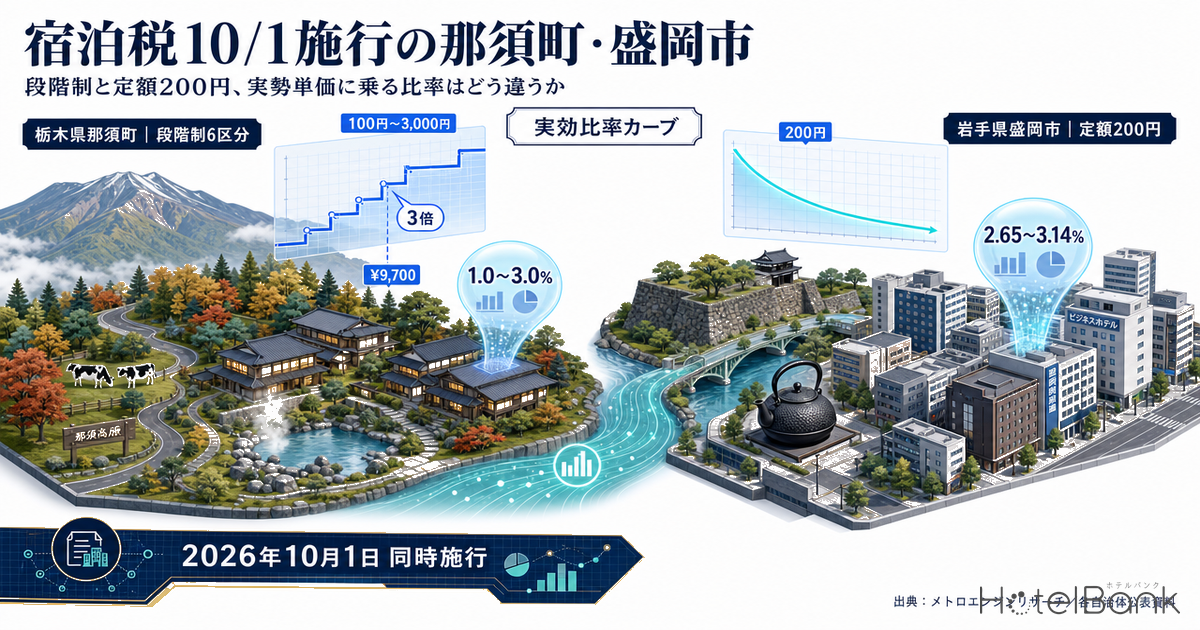
On October 1, 2026, lodging tax collection begins simultaneously in Nasu Town (那須町), Tochigi, and Morioka City (盛岡市), Iwate. Both are the first lodging taxes ever introduced within their respective prefectures, yet their approaches to setting the tax amount are diametrically opposed. Nasu Town uses a six-tier structure keyed to the room rate (¥100 to ¥3,000), while Morioka City applies a flat ¥200 per person per night regardless of age or price. We overlaid these two systems — launching on the very same day — onto MetroEngines Research estimated settled ADR to quantify, by month and by property, exactly what percentage of the prevailing rate the tax actually represents.
- — Nasu Town’s six-tier structure (¥100–¥3,000) and Morioka City’s flat ¥200 per person per night both take effect on October 1, 2026. Neither sets a tax-free threshold; only Nasu Town grants exemptions (children under 12, school trips, etc.).
- — Overlaid onto estimated settled ADR, the effective ratio is 1.0–3.0% for Nasu Town and 2.65–3.14% for Morioka City (single-occupancy basis). The tiered design is pro-cyclical, rising in peak season; the flat design is counter-cyclical, rising in the low season.
- — Nasu Town’s double-occupancy per-person rate sits at roughly ¥9,700, just below the first tier boundary of ¥10,000. Only the autumn foliage season and year-end cross that line, where the tax jumps threefold from ¥100 to ¥300.
- — Mechanically applying five different tax designs shows that Nasu Town’s tiered structure produces an average tax of ¥242, almost identical to Okinawa’s 2% ad valorem rate (¥237). It is effectively a 2%-equivalent calibration tuned to the local rate distribution.
- — The tax is smaller than the price range the market moves through routinely. Against Nasu Town’s ADR swing of roughly ¥4,700, the per-room tax amounts to just 4–13% of that band. The real operational difference comes from receipt presentation, use of grants, and pricing design.
Metric Definitions Used in This Article
- ADR (Average Daily Rate): An estimated settled rate (net of tax equivalent) calculated by applying category-specific adjustment coefficients to the lowest publicly listed plan level each property posts on OTAs (double occupancy, per-room rate, tax included). The median error against property-level actuals disclosed by listed hotel REITs is 6.6% (verified categories: business, city, resort, ryokan, capsule). These are estimates and differ from each property’s actual transaction prices and accounting figures. Area-level ADR is the median of the properties covered (the level of a typical property in that area). Where listed prices are referenced, figures are per-room rates for double occupancy (tax included).
- Per-person, per-night rate (this article’s conversion): The per-room estimated settled ADR above, divided by the number of guests occupying the room. Because the lodging tax base is defined as “the accommodation charge per person per night,” this conversion was performed independently for this article in order to compute ratios. The conversion process is stated explicitly in the text.
- Data sources: MetroEngines Research; institutional details from published materials of Nasu Town, Morioka City, the Ministry of Internal Affairs and Communications, Kyoto City, the Tokyo Metropolitan Government, and Okinawa Prefecture.
Two Designs as Written in the Statutes — Six Tiers vs. a Flat ¥200
Start with the primary sources. Article 5 of the Nasu Town Lodging Tax Ordinance (Ordinance No. 22, June 12, 2025) sets the rate “per guest per night” across the following six tiers: ¥100 under ¥10,000; ¥300 for ¥10,000 to under ¥20,000; ¥500 for ¥20,000 to under ¥30,000; ¥800 for ¥30,000 to under ¥50,000; ¥1,500 for ¥50,000 to under ¥100,000; and ¥3,000 for ¥100,000 and above. Article 4 grants exemptions to “persons under 12 years of age” and to “children, students and accompanying supervisors of schools defined in Article 1 of the School Education Act (excluding universities) who are participating in school excursions or other school events prescribed by regulation,” plus “persons the mayor deems necessary.” No tax-free threshold (a floor below which no tax applies) is set, so even ¥1 of accommodation charge triggers the minimum ¥100 tier.
What matters here is the definition of the tax base. The town’s published materials state explicitly that “the accommodation charge for lodging tax purposes refers to the room-only charge and associated service charges, and does not include meal charges or consumption tax.” At ryokan where one night with two meals is the standard product, the tier is determined on the amount remaining after the meal component is subtracted from the sale price.
Morioka City, by contrast, states in its publicly released “Guide to Special Collection Procedures for the Lodging Tax” (1st edition, January 13, 2026) that “the lodging tax rate is a uniform ¥200 per guest per night.” The same guide also specifies that “regardless of the guest’s age, the stay is taxable whenever an accommodation charge arises,” providing no reduction for children under 12 and no exemption for school trips. The press release issued by the Ministry of Internal Affairs and Communications on March 27, 2026, granting consent likewise records “none” in the “tax exemptions” field for the Morioka City lodging tax. The only exemption the guide lists is accommodation incident to the official duties of foreign ambassadors and similar persons, on reciprocity grounds under the Vienna Convention on Diplomatic Relations. As in Nasu Town, meal charges, entertainment expenses, consumption tax, local consumption tax, bathing tax, and booking-site administrative fees are all excluded from the tax base.
The table below sets out the main parameters of both systems, anchored on the Ministry of Internal Affairs and Communications press releases issued at the time of consent (Nasu Town: September 30, 2025; Morioka City: March 27, 2026).
| Item | Nasu Town, Tochigi | Morioka City, Iwate |
|---|---|---|
| Start of taxation | October 1, 2026 | October 1, 2026 |
| Tax amount | Six tiers ¥100 / ¥300 / ¥500 / ¥800 / ¥1,500 / ¥3,000 | Flat Uniform ¥200 |
| Tax base | Number of stays (tier determined by the room-only charge per person per night) | Number of stays |
| Tax-free threshold | None (minimum tier ¥100) | None (stays with no accommodation charge are outside the scope) |
| Exemptions | Under 12s / children, students and supervisors on school excursions etc. / persons the mayor deems necessary | “None” per the press release. The guide lists only stays incident to the official duties of foreign ambassadors and similar persons |
| Projected revenue (full year) | Approx. ¥300 million | Approx. ¥260 million |
| Projected collection cost (full year) | Approx. ¥20 million | Approx. ¥15 million |
| Review provision | Reviewed as necessary after the ordinance takes effect | Around three years after entry into force, then every five years |
| Ordinance passed / MIC consent | June 12, 2025 / September 30, 2025 | December 22, 2025 / March 27, 2026 |
Source: Compiled by the HotelBank Editorial Team from MIC press releases “Establishment of a Lodging Tax in Nasu Town, Tochigi Prefecture” and “Establishment of a Lodging Tax in Morioka City, Iwate Prefecture,” the Nasu Town Lodging Tax Ordinance, and Morioka City’s “Guide to Special Collection Procedures for the Lodging Tax”
That a town of roughly 23,000 residents projects full-year revenue of ¥300 million — more than Morioka City, the prefectural capital with about 280,000 residents (both figures approximate resident registry populations published by the respective municipalities) — speaks directly to the depth of Nasu Town’s accommodation demand. Collection cost as a share of revenue is about 6.7% for Nasu Town versus about 5.8% for Morioka City, the tiered design running slightly higher because it entails tier determination work. Earlier in 2026, Kumamoto City and Miyazaki City also began taxing on the same day in July, and the market response when multiple municipalities launch simultaneously is a pattern worth watching: in both cases the tax was introduced at the start of a peak demand month, so the first months of collection coincided with the strongest rate levels of the year.
Sawtooth vs. Downward Slope — The Effective Ratio Curves
Tiered and flat designs differ structurally in how the tax burden ratio moves as the rate rises. Plotting the accommodation charge per person per night on the horizontal axis and tax divided by that charge on the vertical axis makes the difference immediately visible.
Source: Compiled by the HotelBank Editorial Team from the Nasu Town Lodging Tax Ordinance, Morioka City’s “Guide to Special Collection Procedures for the Lodging Tax,” Kyoto City’s “Formal Decision on the Lodging Tax Revision Effective March 1, 2026,” and the Tokyo Metropolitan Bureau of Taxation’s “Review of the Lodging Tax”
Within each tier of Nasu Town’s structure, the ratio falls as the rate rises (regressive within band), then jumps at each tier boundary — a sawtooth shape. At the top of each band the ratio runs 1.00–1.67%; at the bottom, 2.50–3.00%. The whole curve stays within a 1.00%–3.00% range. The town’s FAQ describes the tax as “roughly 1–3% of the accommodation charge,” which matches this design ceiling and floor exactly. Laid out by boundary, the picture is as follows.
| Charge per person per night | Nasu Town tax | Nasu Town effective ratio | Morioka City (flat ¥200) |
|---|---|---|---|
| ¥5,000 | ¥100 | 2.00% | 4.00% |
| ¥9,999 | ¥100 | 1.00% | 2.00% |
| ¥10,000 | ¥300 | 3.00% | 2.00% |
| ¥19,999 | ¥300 | 1.50% | 1.00% |
| ¥30,000 | ¥800 | 2.67% | 0.67% |
| ¥50,000 | ¥1,500 | 3.00% | 0.40% |
| ¥100,000 | ¥3,000 | 3.00% | 0.20% |
| ¥150,000 | ¥3,000 | 2.00% | 0.13% |
Source: Compiled by the HotelBank Editorial Team from Article 5 of the Nasu Town Lodging Tax Ordinance and Morioka City’s “Guide to Special Collection Procedures for the Lodging Tax”
Morioka City’s flat ¥200, by contrast, traces a monotonic downward slope: the higher the rate, the lower the ratio, without interruption. It is 4.00% at ¥5,000, 2.00% at ¥10,000, 1.00% at ¥20,000, and 0.40% at ¥50,000 — structurally heavier at the low end. In a tiered system the ratio is determined by tier position, so it stays within 1–3% regardless of rate level; in a flat system the rate itself determines the ratio. That difference is what comes to the fore when the curves are overlaid on actual market rates in the next section.
Converting to Market Rates — From Double Occupancy to Per Person, Per Night
The lodging tax base is “the accommodation charge per person per night,” but market data observes rates on a per-room basis. To connect the two, this article used the following procedure.
Conversion procedure
- Obtain MetroEngines Research estimated settled ADR (per room, net-of-tax equivalent) on a monthly basis.
- Divide by the number of guests in the room to convert to a per-person, per-night rate. Because resorts and ryokan dominate the Nasu Town population, double occupancy is used as the basis there; because business hotels dominate Morioka City, both single occupancy and double occupancy are shown.
- Map the converted amount onto each municipality’s tax tiers and compute the effective ratio as tax divided by the per-person, per-night rate.
Note that the tax base in both municipalities is the room-only equivalent, excluding meal charges. At ryokan where one night with two meals is the norm, the actual amount used for tier determination can be lower still than these converted figures, so this analysis should be read as an upper-bound guide for ryokan-dominated areas.
Nasu Town’s estimated settled ADR over the nine months from October 2025 to June 2026 had a per-room median of roughly ¥19,500 (N=50 properties; the listed-price population ranged from 195 to 251 properties). Divided for double occupancy, that is about ¥9,700 per person per night — sitting almost exactly on the ¥10,000 first tier boundary. This is the single most telling point in the analysis.
Source: MetroEngines Research; compiled by the HotelBank Editorial Team (Nasu Town, double-occupancy conversion, N=49–54 properties)
Month by month, the autumn foliage season of October–November and year-end December run ¥10,700–¥11,000 per person per night, clearing the ¥10,000 line and landing in the ¥300 tier. January through June 2026, by contrast, runs ¥8,700–¥9,800, all below ¥10,000 and therefore in the ¥100 tier. The effective ratio takes two values — 1.02–1.15% and 2.72–2.79% — a gap of roughly 2.7 times. Because a rate movement of just ¥1,000–¥2,000 triples the tax, the tiered design is pro-cyclical: the ratio climbs in peak season.
It is also worth checking the outlook at the October 2026 start of taxation. Estimated from prices listed on OTAs as of the survey date, Nasu Town’s estimated settled ADR for October 2026 is roughly ¥22,300 per room (about ¥11,200 on a double-occupancy basis), and November roughly ¥20,300 (about ¥10,100). Both are estimates on a listed-snapshot basis, with populations of N=47 properties in October and N=41 in November. Both sit above ¥10,000, making it likely that the ¥300 tier applies from the very first month of collection, with effective ratios of 2.69% and 2.96% respectively. On the same listed-snapshot basis, however, August 2026 comes in at about ¥23,800, September about ¥19,500, and December about ¥20,000 — the estimates for the most recent five months swing across a band of roughly ¥19,500 to ¥23,800. The October and November levels should therefore be read as one point within that band rather than as point estimates.
Morioka City paints an entirely different picture. Its estimated settled ADR over the same nine months had a per-room median of roughly ¥6,900 (N=41–44 properties; listed-price population 45–49 properties), reflecting a structure in which business hotels account for 24 properties at the core of the population. Category medians of estimated settled ADR are roughly ¥6,400 for business, ¥7,800 for city, and ¥9,700 for ryokan.
Source: MetroEngines Research; compiled by the HotelBank Editorial Team (Morioka City, N=41–44 properties)
On a single-occupancy basis, the per-person, per-night rate runs about ¥6,400–¥7,500, putting the effective ratio of the flat ¥200 at 2.65–3.14%. The ratio peaks in March (3.14%), when demand slackens, and bottoms out in October–November (2.65–2.67%). This is the mirror image of tiered Nasu Town: a counter-cyclical pattern in which the ratio rises in the low season. Converted for double occupancy, the per-person figure falls to ¥3,200–¥3,800 and the ratio climbs to 5.30–6.28%.
| Month | Nasu Town ADR per room |
Double occupancy |
Tax | Effective ratio | Morioka City ADR per room |
Single occupancy |
Tax | Effective ratio |
|---|---|---|---|---|---|---|---|---|
| 2025/10 | ¥21,515 | ¥10,758 | ¥300 | 2.79% | ¥7,544 | ¥7,544 | ¥200 | 2.65% |
| 2025/11 | ¥21,546 | ¥10,773 | ¥300 | 2.78% | ¥7,494 | ¥7,494 | ¥200 | 2.67% |
| 2025/12 | ¥22,086 | ¥11,043 | ¥300 | 2.72% | ¥6,915 | ¥6,915 | ¥200 | 2.89% |
| 2026/01 | ¥19,649 | ¥9,824 | ¥100 | 1.02% | ¥7,023 | ¥7,023 | ¥200 | 2.85% |
| 2026/02 | ¥17,562 | ¥8,781 | ¥100 | 1.14% | ¥6,542 | ¥6,542 | ¥200 | 3.06% |
| 2026/03 | ¥18,183 | ¥9,092 | ¥100 | 1.10% | ¥6,366 | ¥6,366 | ¥200 | 3.14% |
| 2026/04 | ¥18,019 | ¥9,010 | ¥100 | 1.11% | ¥6,845 | ¥6,845 | ¥200 | 2.92% |
| 2026/05 | ¥19,468 | ¥9,734 | ¥100 | 1.03% | ¥7,386 | ¥7,386 | ¥200 | 2.71% |
| 2026/06 | ¥17,356 | ¥8,678 | ¥100 | 1.15% | ¥6,927 | ¥6,927 | ¥200 | 2.89% |
Source: MetroEngines Research; compiled by the HotelBank Editorial Team (Nasu Town N=49–54 properties, double-occupancy conversion; Morioka City N=41–44 properties, single-occupancy conversion)
Tier Distribution by Property — 52% of Nasu Town Sits in the Lowest Tier
Area medians alone do not reveal how much spread a tiered system actually spans. So for each property in Nasu Town and Morioka City with data for at least six of the nine months from October 2025 to June 2026, we took the median estimated settled ADR, converted it for double occupancy, and mapped it onto the tiers.
Source: MetroEngines Research; compiled by the HotelBank Editorial Team (Nasu Town N=50 properties, double-occupancy conversion, Nasu Town tax tiers applied)
Of Nasu Town’s 50 properties, 26 (52.0%) fall into the minimum ¥100 tier, 17 (34.0%) into ¥300, four (8.0%) into ¥500, and three (6.0%) into ¥800. The simple property average tax is ¥242 per person per night, with a median effective ratio of 2.05% (minimum 1.08%, maximum 3.80%). The interquartile range of per-room rates runs from about ¥12,300 at the first quartile to about ¥33,300 at the third — a 2.7-fold spread — and it is precisely this dispersion that makes the market structurally well suited to a tiered design.
Morioka City’s 43 properties show an interquartile range of per-room rates from about ¥5,100 to about ¥10,300, a 2.0-fold spread that is distinctly narrower than Nasu Town’s. The single-occupancy median is about ¥6,700, giving the flat ¥200 a median effective ratio of 2.98% (minimum 0.47%, maximum 6.91%). In a market with low dispersion, a flat rate is the administratively simplest design that works — and that is the choice legible in the data.
Swapping the Designs — What a Cross-Simulation Reveals About Each System’s Intent
The interesting exercise is applying each municipality’s design to the other’s market. We mechanically applied Nasu Town’s tiered structure, Morioka City’s flat ¥200, and representative designs already in force or scheduled elsewhere to the same property sets, then calculated the average tax per person per night.
| Design applied | Nasu Town property set (N=50, double-occupancy conversion) |
Morioka City property set (N=43, single-occupancy conversion) |
|---|---|---|
| Nasu Town: six tiers (¥100–¥3,000) | ¥242 | ¥167 |
| Morioka City: flat ¥200 | ¥200 | ¥200 |
| Kyoto City: five tiers (¥200–¥10,000, from March 2026) | ¥436 | ¥335 |
| Okinawa: 2% ad valorem, capped at ¥2,000 (from February 2027) | ¥237 | ¥172 |
| Tokyo: 3% ad valorem, exempt below ¥13,000 (from April 2027) | ¥197 | ¥71 |
Source: Estimated by the HotelBank Editorial Team by mechanically applying each municipality’s published tax rates to MetroEngines Research estimated settled ADR. Actual tax revenue will vary with guest mix, occupancy per room, and meal-charge deductions
The ¥242 average that Nasu Town’s tiered design generates in its own market is almost identical to the ¥237 produced by applying Okinawa’s 2% ad valorem rate to the same property set. In other words, Nasu Town’s six tiers are calibrated so that, given the local rate distribution, they are effectively equivalent to an ad valorem tax of about 2%. That is consistent with the town’s FAQ description of “roughly 1–3%.”
On the Morioka City side, applying Nasu Town’s tiered structure yields an average of only ¥167 — below the flat ¥200 the city actually adopted. In a market with a thick low-rate segment, the tiered system’s minimum band (¥100) applies broadly, so a flat rate secures revenue more reliably. Conversely, in Nasu Town the tiered system captures the high-rate tail (a third quartile of roughly ¥33,300 per room, or about ¥16,600 on a double-occupancy basis), producing a higher average tax than a flat ¥200. Both municipalities, in short, chose the design better matched to their own rate distribution.
Because the 3% ad valorem rate Tokyo introduces in April 2027 exempts stays below ¥13,000, applying it to the Morioka City property set drops the average sharply to ¥71. That figure shows how much a tax-free threshold matters in the business-demand band of a regional city, and it highlights how the designs adopted by Nasu Town and Morioka City — neither of which sets a threshold — spread the burden broadly and thinly across lower-rate segments as well.
Relative Scale Against Neighboring Untaxed Areas
What influences guest choice is not the absolute amount but the relative difference against the area next door. Below we line up per-room estimated settled ADR levels for nearby municipalities within the same prefecture that have not introduced a lodging tax.
Source: MetroEngines Research; compiled by the HotelBank Editorial Team (median estimated settled ADR, October 2025 – June 2026)
On the Tochigi side, against Nasu Town’s per-room median of roughly ¥19,500, Nikko City runs about ¥18,400 (N=112–123 properties) and Nasushiobara City about ¥13,800 (N=63–70 properties). The gap between Nasu Town and Nikko City is only about ¥1,000, so the two effectively overlap as price bands. For a double-occupancy stay, the lodging tax comes to ¥200 per room (the ¥100 tier) or ¥600 (the ¥300 tier) — 19% to 58% of that ¥1,000 gap.
That said, Nasu Town’s own estimated settled ADR moved across a range of roughly ¥17,400 to ¥22,100 over the nine months, a swing of about ¥4,700. The per-room lodging tax equates to just 4–13% of that swing. The amplitude of the price adjustments the market already makes routinely is far larger than the tax itself. That is where accommodation operators retain room to exercise pricing discretion. As for the investment environment of the northern Tochigi area encompassing Nasu and Nikko, supply-side activity there has been building through LRT infrastructure, resort-operator entries, and the redevelopment of vacant ryokan.
On the Iwate side, against Morioka City’s roughly ¥6,900, Kitakami City runs about ¥5,900 (N=21–22 properties) — again a gap of about ¥1,000. Hanamaki City, centered on hot spring ryokan, is higher than Morioka City at roughly ¥13,600 (N=30–32 properties) and serves a fundamentally different demand segment. Morioka City’s ¥200 tax on a single-occupancy stay accounts for about 19% of the ¥1,000 gap with Kitakami City. What stands out is how narrow Morioka City’s own annual swing is: roughly ¥1,200. The flat ¥200 therefore represents about 17% of the price range this market moves through over a full year. In markets driven by business demand, where seasonal price variation is small, a design that presents the tax as an explicit line item rather than absorbing it into the rate fits operational reality better.
A Design Map of Municipalities Already Taxing — Where the October Pair Sits
Lodging tax designs sort broadly into four types: tiered flat amounts, uniform flat amounts, ad valorem rates, and capped ad valorem rates. Arranging the major municipalities from their published materials makes clear where the two October entrants stand.
| Municipality | Type | Amount / rate | Tax-free threshold | Effective date |
|---|---|---|---|---|
| Nasu Town, Tochigi | Tiered flat (6 tiers) | ¥100–¥3,000 | None | October 1, 2026 |
| Morioka City, Iwate | Uniform flat | ¥200 | None | October 1, 2026 |
| Kyoto City | Tiered flat (5 tiers) | ¥200–¥10,000 | None | March 1, 2026 (revision) |
| Tokyo (current) | Tiered flat (2 tiers) | ¥100 / ¥200 | Below ¥10,000 | Through March 31, 2027 |
| Tokyo (post-revision) | Ad valorem | 3% (no cap) | Below ¥13,000 | April 1, 2027 |
| Okinawa | Capped ad valorem | 2%, capped at ¥2,000 | — | February 1, 2027 |
Source: Compiled by the HotelBank Editorial Team from each municipality’s published materials (Nasu Town Lodging Tax Ordinance, Morioka City Guide to Special Collection Procedures for the Lodging Tax, Kyoto City press release, Tokyo Metropolitan Bureau of Taxation, Okinawa Prefecture)
From March 1, 2026, Kyoto City raised its top tier to ¥10,000 for stays of ¥100,000 and above, shifting toward a design weighted to the high-rate band: 8.00% at ¥50,000 per person per night and 10.00% at ¥100,000. Tokyo moves to a uniform 3% ad valorem system in April 2027 and raises its tax-free threshold to below ¥13,000. Okinawa sets a 2% ad valorem rate with a ¥2,000 cap, so the ratio declines for accommodation charges above ¥100,000. Kyoto’s March increase is a useful reference point for how a mid-band property base absorbs a rate change, as it applied a materially higher tier precisely to the ¥10,000-band hotels that make up the bulk of the city’s inventory.
Within these four types, Nasu Town’s six tiers occupy the middle ground — approximating an effective 2% in steps — while Morioka City’s flat ¥200 spreads a fixed amount thinly across a low-rate band. Neither adopts Kyoto City’s tilt toward the high-rate band nor Tokyo’s tax-free threshold. Against the demand structures of a regional tourist destination and a prefectural capital respectively, both read as designs that prioritize administrative simplicity and revenue stability.
Operational Implications — Room to Build the Tax Into Display and Pricing
Building on the figures above, here are the issues worth settling before October that can be turned into opportunity.
Receipt presentation feeds directly into consumption tax treatment
Morioka City’s guide asks operators to “display the name and amount of the lodging tax on receipts and similar documents,” specifying “宿泊税” in Japanese and “Accommodation Tax” in English. It further states explicitly that “if the name and amount of the lodging tax are not clearly displayed, the lodging tax amount may also become subject to consumption tax.” The guide provides display examples for both “pricing that excludes the lodging tax from the room charge” and “pricing that includes it,” and choosing between them is a design decision about the rate structure. In the excluding case, the format is “In addition to the above, ¥200 of lodging tax was collected,” or the tax appears as a line in the total breakdown; in the including case, “The above amount includes ¥1,000 of consumption tax and ¥200 of lodging tax.” At properties with a high inbound share, standardizing the English wording translates directly into fewer disputes at the point of explanation.
The special collection grant increases with electronic filing
Morioka City pays special collection agents who file and remit within the deadline a grant equal to 2.5% of the amount remitted. For the first five years after taxation begins the rate is 3.0%, rising to 3.5% where electronic filing (eLTAX) is used during that period. For a property remitting, say, ¥2 million of lodging tax a year, the difference between 2.5% and 3.5% is ¥20,000 annually. The practical case for choosing eLTAX from year one is clear. The city requires submission of an “Application for Account Registration for the Lodging Tax Special Collection Grant,” and states that submitting it in the first year removes the need to resubmit annually.
Nasu Town offers a subsidy and a first-year special measure
The Nasu Town subsidy for lodging tax POS system modifications covers one-half of eligible costs, up to ¥1 million. Applications are accepted from January 13 to October 30, 2026, and it is important to note that costs incurred before the grant decision are not eligible. In addition, a “special measure on first-year filing and remittance deadlines” eases the initial administrative burden: operators who apply may file and remit the months from October 2026 through January 2027 together with February, effectively five months’ worth in a single filing due by March 31, 2027. Operators running multiple properties within the town may also file on a consolidated basis with prior approval.
Excluding meal charges from the tax base is a useful explanatory point for plan design
In both municipalities the tax base is the room-only equivalent and does not include meal charges. At Nasu Town ryokan where one night with two meals is standard, the lodging tax as a share of the sale price is lower still than this article’s estimates. For example, on a ¥25,000 per-person plan with two meals where the meal component is ¥7,000, the assessed amount is ¥18,000, placing it in the ¥300 tier (1.2% of the sale price). The fact that “no lodging tax applies to the meal portion” is useful material for building guest acceptance of the price.
The ¥10,000 boundary can serve as a value-design milestone
In Nasu Town, once the room-only equivalent per person per night exceeds ¥10,000, the tax rises from ¥100 to ¥300. When raising rates in peak season, that step becomes visible to guests. The effective response is to present the step not as a simple surcharge but paired with an upgrade in what is delivered. Combining elements such as an enhanced breakfast built on local ingredients, bundled shuttle or activity access, or complimentary late checkout makes the higher total more readily received as a richer experience. Because Nasu Town explicitly designates secondary transport enhancement and tourism infrastructure development among the uses of its lodging tax revenue, the message that “the tax is returned to mobility in this area” is also available as explanatory material.
In Morioka City, building higher-tier plans dilutes the ratio
Under a flat ¥200, the ratio falls as the rate rises. Against the current estimated settled ADR of about ¥6,900 on a single-occupancy basis and a ratio of 2.89%, a ¥12,000 plan brings it down to 1.67% and a ¥20,000 plan to 1.00%. Morioka City’s estimated settled ADR has been stable, swinging only about ¥1,200 over nine months, which leaves headroom in the upper price band. Building out higher-tier plans differentiated by breakfast and facilities for extended-stay and multi-night business travel demand points in the same direction on both the lodging tax ratio and the revenue axis.
Fine-grained assessment rules are worth sharing early
Morioka City’s guide offers a rich set of practical assessment examples. A taxable “stay” is defined as use “of six hours or more that spans a calendar day,” or use treated as a stay under contract. Day-use is outside the scope because it does not span a day, but is taxable where it is contractually treated as an accommodation charge. Free co-sleeping arrangements with no additional bedding and no accommodation charge are not taxed. Cancellations are outside the scope because no stay occurs; where payment including the lodging tax has already been settled, the property or the booking-site operator refunds it. Where a multi-night discount makes one night effectively free, the lodging tax still applies for the number of nights stayed. Multi-night stays beginning on or before September 30, 2026 are taxed from the night of October 1, and bookings made before October 1 are also taxable. Aligning staff on these lines across both reservations and front desk operations makes for smoother rollout.
Nasu Town’s exemptions cover under-12s and school excursion participants. At properties with a strong family and educational travel base, organizing the scope of exemptions and the verification method in advance reduces rework at the point of guest communication. Morioka City has no age-based exemption, so where a child rate arises, the tax applies per head. This difference is the single biggest factor splitting front desk operating design between two systems that start on the very same day of October 1.
Conclusion
The lodging taxes launching together on October 1, 2026 in Nasu Town and Morioka City reflect contrasting design philosophies. Nasu Town’s six tiers are calibrated to be equivalent to an ad valorem tax of roughly 2% given the local rate distribution, with the effective ratio contained within 1.0–3.0%. But because the estimated settled rate per person per night (double-occupancy basis) straddles the ¥10,000 first boundary, the ratio runs 2.7–2.8% in the foliage season and at year-end versus 1.0–1.2% in other months — a seasonal swing of roughly 2.7 times. That is a pro-cyclical profile in which the ratio rises in peak season.
Morioka City’s flat ¥200 works out to 2.65–3.14% on a single-occupancy basis. The ratio peaks in March, when demand slackens — a counter-cyclical pattern that rises in the low season. In a market with a thick low-rate band and low price dispersion, a flat amount is more stable than a tiered structure and simpler to administer. Indeed, applying Nasu Town’s tiered design to the Morioka City property set yields an average of ¥167, below the ¥200 the city adopted.
Under either system, the tax itself is smaller than the price range the market moves through routinely. Nasu Town’s per-room estimated settled ADR moved across a band of roughly ¥4,700 over nine months, and the per-room lodging tax amounts to only 4–13% of that. What actually generates operational differences is the design of receipt presentation, the use of grants and subsidies, and how value is assembled — including meal-charge exclusion and late checkout. How the remaining two months before October 1 are used will determine whether compliance becomes a cost or an upgrade in pricing narrative.
⚠ Note on forward-dated ADR: Estimated settled ADR figures referenced for August 2026 onward are estimates based on sale prices publicly listed on OTAs as of the survey date, and will shift as new plans are added and prices are adjusted closer to the check-in date. Current levels will not necessarily be realized as shown. Figures treated as actuals cover the nine months from October 2025 to June 2026.
Related Reading
- Nagano Prefecture Lodging Tax Takes Effect June 1 — The Second Prefecture-Level Tax and Its ADR Pass-Through Scenarios
- One Month Into Kyoto’s New Lodging Tax: Kyoto ADR +18.6% YoY, Price Band Shifting Upmarket
- Mt. Fuji 2026 Opening x Summer Peak Booking Pace: The Double Tax Structure of the ¥4,000 Climbing Fee and the Lodging Tax
References and Sources
■ Data sources
Institutional details come from the ordinances and published materials of Nasu Town and Morioka City, and from the Ministry of Internal Affairs and Communications press releases granting consent to non-statutory special-purpose taxes (Nasu Town: September 30, 2025; Morioka City: March 27, 2026). Comparison municipalities are drawn from published materials of Kyoto City, the Tokyo Metropolitan Bureau of Taxation, and Okinawa Prefecture. Market data is MetroEngines Research estimated settled ADR (nine months from October 2025 to June 2026 on a confirmed-history basis; August 2026 onward on a listed-snapshot basis). Populations: Nasu Town N=49–54 properties, Morioka City N=41–44, Nikko City N=112–123, Nasushiobara City N=63–70, Hanamaki City N=30–32, Kitakami City N=21–22.
■ Estimation assumptions
(1) Per-room estimated settled ADR is divided by the number of occupants to convert to a per-person, per-night rate (Nasu Town: double occupancy; Morioka City: single occupancy as the basis, with double occupancy shown alongside). (2) Converted values are mapped onto each municipality’s tax tiers, and the effective ratio is computed as tax divided by the per-person, per-night rate. (3) Area figures are medians of the properties covered; property-level analysis is limited to properties with data for at least six of the nine months (Nasu Town 50 properties, Morioka City 43 properties). (4) The cross-simulation is a simple average from mechanically applying each municipality’s published tax rates to the same property set.
■ Limitations and caveats
Estimated settled ADR carries a median error of 6.6% against actuals disclosed by listed hotel REITs and differs from each property’s actual transaction prices and accounting figures. Because the tax base in both municipalities is the room-only equivalent excluding meal charges, actual assessed amounts at Nasu Town ryokan — where one night with two meals is the norm — can be lower than these estimates (this analysis is an upper-bound guide). Converting from per-room rates by headcount does not reflect actual guest mix. Figures from August 2026 onward are estimates on a listed-snapshot basis and will shift closer to the check-in date. Revenue-equivalent figures in the cross-simulation do not incorporate guest counts, exemptions, or meal-charge deductions.
■ Nasu Town (primary sources)
- Nasu Town, “Introduction of the Nasu Town Lodging Tax” (six tiers, exemptions, effective date)
- Nasu Town Lodging Tax Ordinance (Ordinance No. 22, June 12, 2025), PDF
- Nasu Town, “Lodging Tax Flyer,” PDF (tax table, exemptions, use of revenue)
- Nasu Town, “Frequently Asked Questions on the Nasu Town Lodging Tax”
■ Morioka City (primary sources)
- Morioka City, “Lodging Tax”
- Morioka City, “Guide to Special Collection Procedures for the Lodging Tax,” 1st edition (January 13, 2026), PDF
- Morioka City, “About the Morioka City Lodging Tax Ordinance”
■ Ministry of Internal Affairs and Communications (consent to non-statutory special-purpose taxes)
- MIC press release, “Establishment of a Lodging Tax in Nasu Town, Tochigi Prefecture” (September 30, 2025), PDF
- MIC press release, “Establishment of a Lodging Tax in Morioka City, Iwate Prefecture” (March 27, 2026), PDF
■ Other municipalities used for comparison
- Kyoto City, “Formal Decision on the Lodging Tax Revision Effective March 1, 2026” (October 3, 2025)
- Tokyo Metropolitan Bureau of Taxation, “Review of the Lodging Tax” (3% ad valorem from April 1, 2027)
- Okinawa Prefecture, “Okinawa Prefecture Lodging Tax” (effective February 1, 2027; 2% ad valorem capped at ¥2,000)
■ News coverage
- Shimotsuke Shimbun, “Nasu Town’s Lodging Tax Projected to Raise ¥114 Million in Its First Year”
- Iwate Nippo, “Morioka City Introduces Iwate’s First Lodging Tax at ¥200 per Night” (December 23, 2025)
■ Market data
- MetroEngines Research — Estimated settled ADR (Nasu Town N=49–54 properties, Morioka City N=41–44, Nasushiobara City N=63–70, Nikko City N=112–123, Hanamaki City N=30–32, Kitakami City N=21–22; October 2025 – June 2026)