

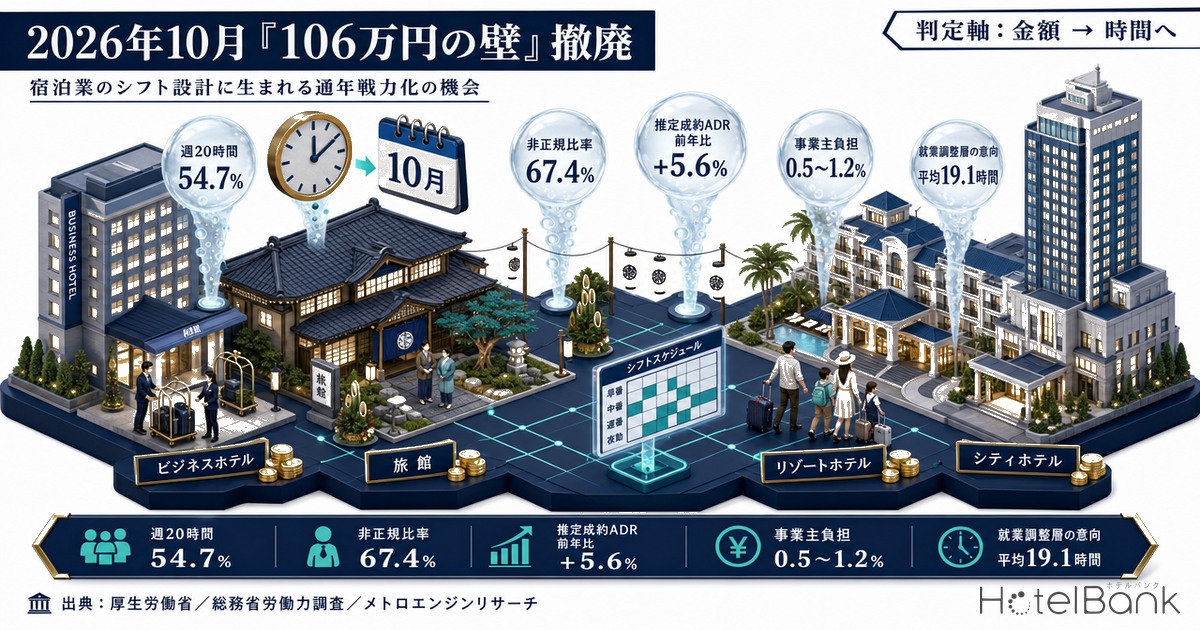
In October 2026, the monetary criterion of “scheduled monthly wages of ¥88,000 or more” is expected to be removed from the test that determines whether short-hours workers must enrol in Japan’s social insurance system. With the test narrowing from a wage measure to a working-hours measure alone, the accommodation industry loses a long-standing constraint — that raising hourly pay pushes staff to cut their own hours — and gains room to staff up during peak season. This article confirms the substance of the reform from primary sources, then reads three things quantitatively using public statistics and our estimated settled ADR: how dependent the accommodation industry is on part-time labour, where the 20-hour-per-week line actually sits, and how much of the added labour cost room rates can absorb.
Metric Definitions Used in This Article
- Estimated settled ADR (average daily rate): An estimated transacted rate (tax-exclusive equivalent) calculated by applying property-type adjustment coefficients to the lowest publicly listed plan level each property offers on OTAs (double occupancy, per-room rate, tax-inclusive). Cross-checked against property-level actuals disclosed by listed hotel REITs, the median error is approximately 6.6%. These are estimates and differ from each property’s actual transacted prices and accounting figures. Area-level values are calculated from the median of the properties covered (the level of a typical property in that area).
- Listed price: The average of all plans listed on OTAs (double occupancy, per-room rate, tax-inclusive). Because its level differs from estimated settled ADR, the two are stated separately throughout this article.
- Data sources: MetroEngines Research / Ministry of Internal Affairs and Communications, “Labour Force Survey” / Ministry of Internal Affairs and Communications, “Consumer Price Index” / published materials from the Ministry of Health, Labour and Welfare and the Japan Pension Service
- — The wage criterion disappears; the test narrows to 20 hours per week. In October 2026, “scheduled monthly wages of ¥88,000 or more” is expected to be dropped from the enrolment test. Three criteria remain: 20 or more hours per week, expected employment exceeding two months, and not being a student.
- — 54.7% of accommodation-industry employees are non-regular; part-timers average 19.1 hours per week. The enrolment line runs straight through the largest cohort (15–29 hours per week, 40.1%). The reform therefore bites structurally harder here than in other industries.
- — 67.4% of those limiting their hours say they would work more if the threshold were removed. Because raising hourly pay no longer moves the enrolment test, better pay can be tied directly to recruiting power.
- — The employer contribution for newly enrolled staff equals 0.5–1.2% of the room rate. Even doubling the assumed number of new enrolees, the figure is 1.22% for business hotels and 2.47% for ryokan. Estimated settled ADR over the past 12 months moved +5.1% to +7.1% by property type.
- — But rate growth is entering a slowdown. The year-on-year change in the accommodation CPI fell from +7.1% in H2 2025 to +3.1% in June 2026. The centre of gravity shifts from relying on rate growth to building the capacity to capture the year-end/New Year, Obon and long-weekend peaks in full.
From a Wage Test to an Hours Test — What Changes in October 2026
The legal basis is the “Act to Partially Amend the National Pension Act and Related Acts to Strengthen the Functions of the Pension System in Light of Socioeconomic Change,” enacted on 13 June 2025 and promulgated on 20 June of the same year. The Ministry of Health, Labour and Welfare explains that the wage criterion of scheduled monthly wages of ¥88,000 or more will be “abolished within three years from June of Reiwa 7 (2025), taking into account the state of the minimum wage,” with the effective date to be set by cabinet order. In its guidance for employers, the Japan Pension Service states explicitly that this wage criterion is “scheduled for abolition in October of Reiwa 8 (2026).”
Three criteria remain after the change: scheduled working hours of 20 or more per week, an expectation of employment exceeding two months, and not being a student. In addition, the company-size criterion (51 or more insured persons under Employees’ Pension Insurance) remains for the time being and will be lowered in stages from October 2027 onward. In short, what happens in October 2026 is that the monetary yardstick disappears from the enrolment test, leaving a single yardstick of time: 20 hours per week.
Table 1: Coverage Criteria for Short-Hours Workers and the Schedule Ahead
| Criterion | Through September 2026 | From October 2026 (planned) |
|---|---|---|
| Scheduled working hours | 20 or more hours per week | 20 or more hours per week (retained) |
| Wages | Scheduled monthly wages of ¥88,000 or more | Abolished |
| Employment period | Expected employment exceeding two months | Retained |
| Student status | Must not be a student | Retained |
| Company size | 51 or more insured persons | From Oct 2027: 36 or more / From Oct 2029: 21 or more / From Oct 2032: 11 or more / From Oct 2035: all establishments |
Source: Compiled by the HotelBank Editorial Team from the Japan Pension Service, “Expansion of Health Insurance and Employees’ Pension Insurance Coverage for Short-Hours Workers”; Ministry of Health, Labour and Welfare, “Response to the ‘Income Threshold’ Issue”; and the Ministry of Health, Labour and Welfare’s dedicated site on social insurance coverage expansion
On the number of people affected, materials presented by the MHLW Pension Bureau to the Pension Subcommittee of the Social Security Council estimate that abolishing the company-size criterion and eliminating non-covered industries at individually owned establishments with five or more employees would cover roughly 900,000 people, with a further expansion of about 2 million where “the wage criterion for short-hours workers is abolished or an equivalent effect is obtained through minimum wage increases.” The condition attached to that estimate — “or through minimum wage increases” — should not be overlooked.
Twenty hours a week works out to roughly 86.7 hours a month, which puts the hourly-wage breakpoint for reaching ¥88,000 a month at about ¥1,016. Regional minimum wages for fiscal 2025 have already risen to a national weighted average of ¥1,121, so the wage criterion has in practice largely ceased to bind. Put differently, the October 2026 abolition is less an event where costs suddenly appear than the system formally acknowledging a change that minimum wage increases had already set in motion. That is precisely why the question for the accommodation industry is not “how do we brace for this?” but “how do we redesign shifts in an environment governed by a single yardstick of time?”
The Base: More Than Half of Accommodation-Industry Employees Are Non-Regular
How hard a rule change bites depends on how much an industry rests on short-hours workers. According to the 2025 annual average of the Ministry of Internal Affairs and Communications’ “Labour Force Survey (Basic Tabulation),” the accommodation industry (the sub-category excluding food services) had 530,000 employees excluding executives, of whom 290,000 were non-regular staff and 250,000 were part-time and casual workers. That puts the non-regular share at 54.7% and the part-time/casual share at 47.2% — 18.2 percentage points above the all-industry non-regular share of 36.5%.
Looking at the broader category “accommodation and food services,” 2.73 million of the 3.58 million employees excluding executives are non-regular (76.3%), and 2.58 million are part-time or casual (72.1%). Set against all industries or against healthcare and welfare, it becomes clear how thoroughly this industry’s staffing is built around short-hours workers. It also means the pool of people affected when the enrolment test changes is structurally larger here than elsewhere.
Source: Compiled by the HotelBank Editorial Team from the Ministry of Internal Affairs and Communications, “Labour Force Survey (Basic Tabulation),” 2025 annual average (shares of employees excluding executives)
One more point worth noting: this base is not shrinking. Employees excluding executives in the accommodation industry bottomed at 460,000 in 2021 and recovered to 540,000 in 2023 and 530,000 in 2025, while the part-time/casual share actually rose from 43.5% in 2021 to 47.2% in 2025. Absorbing the recovery in demand by adding short-hours workers is the real picture of the past few years.
The 20-Hour Line Runs Right Through the Industry’s Largest Cohort
So how many hours do those short-hours workers actually work? The 2025 annual average of the “Labour Force Survey (Detailed Tabulation)” shows that among the 2.62 million part-time and casual workers in “accommodation and food services,” 970,000 (37.0%) work 1–14 hours per week, 1.05 million (40.1%) work 15–29 hours, 170,000 (6.5%) work 30–34 hours, and 310,000 (11.8%) work 35 hours or more. The average weekly working time is 19.1 hours.
Where that 19.1-hour figure sits is what matters. The all-industry average for part-time and casual workers is 22.5 hours, so accommodation and food services runs 3.4 hours shorter. In other words, the industry’s typical working pattern clings to just below the 20-hour enrolment line. The 1–14 hour cohort is heavy at 37.0% versus 25.7% across all industries, while the 35-hours-or-more cohort is thin at 11.8% versus 19.1%. A structure deeply dependent on short, dispersed shifts shows up directly in the numbers.
Source: Compiled by the HotelBank Editorial Team from the Ministry of Internal Affairs and Communications, “Labour Force Survey (Detailed Tabulation),” 2025 annual average, composition of part-time and casual workers by hours worked in the last week of the month
The 20-hour line runs inside the 15–29 hour band, the largest cohort of all. This is where the operational constraint has sat until now. Raising hourly pay pushes the same hours past ¥88,000 a month, so workers who do not want to enrol cut their own hours. Better pay triggered reduced hours — a force pulling in the opposite direction.
The scale of that behaviour is visible in private-sector surveys as well. In a survey conducted by Nomura Research Institute in November 2025 (3,090 married women working part-time), 56.7% reported adjusting their working hours or days out of awareness of the “income threshold.” In a further survey the firm conducted in January–February 2025 (3,090 married women working part-time), 67.4% of those limiting their hours said they “would like to work more hours and earn more if the threshold were raised or removed,” and 48.1% said they would consider “changing to a job with higher hourly pay.”
From October 2026, once the wage criterion is gone, no amount of hourly pay increase will move the enrolment test itself. With better pay decoupled from hours adjustment, wage increases can be tied directly to stronger recruiting. For the accommodation industry, this is an environment in which money spent on pay rises finally works as intended.
Year-End, Obon and Long Weekends — Room Opens Up in Peak-Season Shifts
Demand in the accommodation industry is not level across the year. Whether staff can be concentrated into the year-end/New Year period, Obon, Golden Week and three-day weekends drives both occupancy and rate. Yet for people working on the premise of keeping annual income below a set level, taking many shifts in December means compressing their hours later in the year — creating a situation where peak season is precisely when extra help is hardest to ask for. An annual income ceiling was constraining monthly shift flexibility.
Once the monetary criterion is removed, the need for that annual management fades. For workers who become covered, there is no longer a reason to watch how many tens of thousands of yen they earn in any given month, making a heavy-in-peak, light-in-trough allocation easier to accept. The finding cited above — that two in three of those limiting their hours would work more if the threshold disappeared — shows that this opening points in the same direction as what staff themselves want.
Meanwhile, workers on fewer than 20 hours a week (37.0% of part-time and casual workers in accommodation and food services) remain outside coverage. This group works primarily with an eye on the criteria for dependent-spouse status, and their role as spot capacity for peak periods is unchanged. Shift design from October 2026 onward therefore works best when it clearly separates “year-round capacity” at 20 or more hours per week from “peak-response capacity” below 20 hours — an arrangement that is workable for both sides.
What Percentage of the Room Rate Does the Added Labour Cost Represent?
Next, the size of the employer burden created by more staff enrolling. For fiscal 2026 (Reiwa 8), the Employees’ Pension Insurance rate is 18.30% (split equally, so 9.15% for the employer), the Japan Health Insurance Association’s health insurance rate averages 9.90% nationally (4.95% for the employer), and a child allowance contribution of 0.36% (borne entirely by the employer) is added on top. That puts the employer contribution rate at roughly 14.5%, rising to about 15.3% where the worker is 40 or older and qualifies as a Category 2 long-term care insurance subscriber, adding the employer half of the 1.62% long-term care insurance rate.
Table 2: Employer Contribution Per Person (calculated at an employer contribution rate of 14.46%)
| Working pattern | Scheduled monthly wages | Employer contribution (monthly) | Employer contribution (annual) |
|---|---|---|---|
| 20 hrs/week × ¥1,121/hr | approx. ¥97,200 | approx. ¥14,000 | approx. ¥168,600 |
| 22 hrs/week × ¥1,200/hr | approx. ¥114,400 | approx. ¥16,500 | approx. ¥198,500 |
| 24 hrs/week × ¥1,200/hr | approx. ¥124,800 | approx. ¥18,000 | approx. ¥216,600 |
| 25 hrs/week × ¥1,300/hr | approx. ¥140,800 | approx. ¥20,400 | approx. ¥244,400 |
Source: Calculated by the HotelBank Editorial Team based on an Employees’ Pension Insurance rate of 18.30%, the Japan Health Insurance Association’s fiscal 2026 prefecture-level rates (national average 9.90%), and a child allowance contribution of 0.36%. Scheduled monthly wages are converted as weekly scheduled hours × 52 ÷ 12. Rounding arising from the application of standard monthly remuneration brackets is not taken into account
That is roughly ¥170,000 to ¥240,000 per person per year. Aggregating this to the property level and dividing it back across the rooms sold shows how much the rate can absorb. The following models representative scales by property type.
Table 3: Model Calculation by Property Type — What Share of the Room Rate Is the Added Labour Cost?
| Property-type model | Rooms | Occupancy (assumed) | New enrolees | Annual labour cost increase | Per room sold | vs estimated settled ADR |
|---|---|---|---|---|---|---|
| Business hotel | 120 rooms | 80% | 10 | ¥1.90M | ¥54 | 0.61% |
| City hotel | 250 rooms | 78% | 25 | ¥4.75M | ¥67 | 0.48% |
| Resort hotel | 150 rooms | 68% | 20 | ¥3.80M | ¥102 | 0.60% |
| Ryokan | 40 rooms | 55% | 8 | ¥1.52M | ¥189 | 1.24% |
Source: Annual employer contribution of ¥190,000 per person; room counts, occupancy rates and numbers of new enrolees are assumed values for the calculation. Estimated settled ADR uses national figures by property type (12-month average from July 2025 to June 2026, weighted by property count). Compiled from MetroEngines Research by the HotelBank Editorial Team
The required pass-through is smaller the larger the property. Business hotels, city hotels and resort hotels land at roughly 0.5–0.6%, while the ryokan model — with fewer rooms and lower occupancy — comes to 1.24%. Even doubling the assumed number of new enrolees keeps the range at around 1.2% for business hotels and 2.5% for ryokan.
Table 6: Sensitivity Analysis — New Enrolees × Property-Type Model (required pass-through as a share of estimated settled ADR)
| New enrolees | Business hotel 120 rooms · 80% occ. | City hotel 250 rooms · 78% occ. | Resort hotel 150 rooms · 68% occ. | Ryokan 40 rooms · 55% occ. |
|---|---|---|---|---|
| 0.5× | 0.30% | 0.24% | 0.30% | 0.62% |
| Base case (Table 3) | 0.61% | 0.48% | 0.60% | 1.24% |
| 1.5× | 0.91% | 0.72% | 0.91% | 1.86% |
| 2.0× | 1.22% | 0.96% | 1.21% | 2.47% |
Source: Calculated by the HotelBank Editorial Team on the same assumptions as Table 3 (annual employer contribution of ¥190,000 per person; national estimated settled ADR by property type, 12-month average from July 2025 to June 2026). All conditions other than the number of enrolees are held fixed. Moving occupancy by ±10 percentage points puts the required pass-through at 0.54–0.70% for business hotels, 0.43–0.55% for city hotels, 0.53–0.71% for resort hotels and 1.05–1.51% for ryokan (all at the base-case number of enrolees)
Whether the number of enrolees is halved or doubled, the three hotel types stay below 1.3%. The widest range belongs to the ryokan model at 0.62–2.47%, but that reflects the small denominator of 40 rooms at 55% occupancy: a 10-point rise in occupancy alone brings the required pass-through down from 1.24% to 1.05%. Put another way, the cost of this reform has more room to be absorbed through occupancy than through rate.
Pass-Through in Practice — Estimated Settled ADR and the Accommodation CPI Over the Past 12 Months
So how large is that 0.5–1.2% band relative to actual price movements? Using MetroEngines Research data, we aggregated estimated settled ADR by property type (national, weighted by property count) for the most recent 12 months (July 2025 to June 2026). Business hotels averaged ¥8,900 over the 12 months, up 5.6% year on year (N=7,362 properties); city hotels ¥13,900, up 7.1% (N=1,094); resort hotels ¥16,900, up 6.4% (N=1,543); and ryokan ¥15,300, up 5.1% (N=6,659).
Every property type delivered growth above 5% on an annual basis, so the 0.5–1.2% band the model requires sits comfortably inside price movements already under way. Track the series monthly, however, and the pace of that growth has clearly shifted.
Source: Compiled from MetroEngines Research by the HotelBank Editorial Team (national, weighted by property count, N=1,094–7,362 properties by type)
Business hotels went from an average of +9.1% in H2 2025 to +2.3% in H1 2026, and city hotels from +12.2% to +2.2%. Resort hotels, by contrast, moved from +6.1% to +6.5% and ryokan from +5.6% to +4.3%, holding relatively steady. The more urban and lodging-focused the property, the higher the prior-year base it is now measured against, and the more its growth rate has levelled off.
Public statistics show the same movement. In the Ministry of Internal Affairs and Communications’ “Consumer Price Index,” the accommodation component averaged +7.1% year on year in H2 2025 against +4.9% in H1 2026, narrowing to +3.1% in the most recent reading for June 2026. The index level itself keeps rising, but the momentum behind that rise is easing.
Source: Compiled by the HotelBank Editorial Team from the Ministry of Internal Affairs and Communications, “Consumer Price Index,” accommodation component (national, 2020 = 100)
The reading here is that a design leaning entirely on rate growth is gradually losing its effectiveness. The required pass-through itself is small. But in a phase where headroom for price increases flattens out, “increasing the number of days you capture in full” carries relatively more weight than rate as a means to the same revenue. The value of being able to staff peak season is exactly what pays off here. How staffing constraints shape the ceiling on occupancy is treated quantitatively in Only Hotels That Capture Demand Survive: 2026’s Occupancy Ceiling.
By region, too, the foundation for pass-through is broadly shared. Aggregating 12-month average estimated settled ADR across all 47 prefectures, 44 posted a year-on-year gain, with a median of +5.6%. By level, Kyoto (¥16,700), Oita (¥15,000) and Tokyo (¥14,700) lead; by growth rate, Okinawa (+14.7%), Fukuoka (+11.5%) and Hokkaido (+10.4%) stand out. The 0.6% figure the model required translates to about ¥100 in high-rate Kyoto and ¥88 in Tokyo.
Table 4: Estimated Settled ADR by Prefecture (12-month average, July 2025 – June 2026, top 20)
| Prefecture | Estimated settled ADR | YoY | Properties (N) | 0.6% pass-through equivalent |
|---|---|---|---|---|
| Kyoto | ¥16,719 | +5.6% | 589 | ¥100 |
| Oita | ¥15,018 | +4.3% | 456 | ¥90 |
| Tokyo | ¥14,684 | +8.4% | 1,117 | ¥88 |
| Kanagawa | ¥14,291 | +8.7% | 568 | ¥86 |
| Shizuoka | ¥13,589 | +5.2% | 830 | ¥82 |
| Nara | ¥13,410 | +6.0% | 134 | ¥80 |
| Hyogo | ¥13,367 | +6.6% | 548 | ¥80 |
| Saga | ¥12,230 | -10.5% | 151 | ¥73 |
| Gunma | ¥12,097 | +5.2% | 427 | ¥73 |
| Nagano | ¥12,079 | +8.9% | 811 | ¥72 |
| Yamanashi | ¥11,835 | +7.4% | 291 | ¥71 |
| Fukuoka | ¥11,781 | +11.5% | 466 | ¥71 |
| Mie | ¥11,726 | +2.9% | 355 | ¥70 |
| Okinawa | ¥11,717 | +14.7% | 492 | ¥70 |
| Fukui | ¥11,593 | +1.5% | 210 | ¥70 |
| Gifu | ¥11,345 | +7.1% | 369 | ¥68 |
| Ishikawa | ¥11,259 | +3.6% | 237 | ¥68 |
| Osaka | ¥11,048 | +6.2% | 642 | ¥66 |
| Kumamoto | ¥10,665 | -0.4% | 385 | ¥64 |
| Tochigi | ¥10,650 | -1.6% | 398 | ¥64 |
Source: Compiled from MetroEngines Research by the HotelBank Editorial Team. Aggregated across all 47 prefectures; months in which the number of covered properties fell below 60% of the period median were excluded (this applied only to Hyogo in November 2025, so that prefecture is an 11-month average)
The higher an area’s rate level, the easier the same percentage pass-through is to absorb in yen terms. Conversely, areas with relatively low rates and smaller properties face a higher required percentage. But the gap spans only a few tens of yen to around two hundred yen — a level reachable by revisiting breakfast and plan design, or by sharpening pricing precision on low-demand dates by one notch.
Practical Points to Settle Before the Rule Takes Effect
In the time remaining before the change, five points repay the effort of getting straight. None of them is defensive; all are about designing how to grow the pool of staff who can serve as year-round capacity.
Table 5: Practical Checklist for October 2026
| Issue | Points to verify and design |
|---|---|
| Drawing the 20-hour line | The test is applied in principle to “scheduled working hours” as set out in the employment contract and work rules. Where hours are set monthly, divide the monthly scheduled hours by 52/12 to convert to a weekly figure. Take stock of contract wording and align it with actual practice, including how to treat cases where actual hours routinely exceed the scheduled amount. |
| Identifying who is affected | Identify staff currently outside coverage because they work 20 or more hours per week but earn under ¥88,000 a month. In some cases minimum wage increases mean few such people remain, and knowing the actual count makes it easier to judge how urgent preparation is. Because the company-size criterion steps down from October 2027 onward, check projections for the 36-or-more and 21-or-more insured-person thresholds at the same time. |
| Explaining to labour and management | Set out, in concrete yen amounts alongside the change in take-home pay, that enrolment increases future pension entitlements and opens access to health insurance benefits such as injury and sickness allowance and maternity allowance. The Ministry of Health, Labour and Welfare publishes a social insurance premium calculator for employers and a take-home pay calculator for employees, both usable as materials in one-on-one discussions. |
| Designing peak-season staffing | Rebuild the staffing plan around two roles: year-round capacity at 20 or more hours per week, and peak-response capacity below 20 hours. Set the headcount needed for the year-end/New Year period, Obon and long weekends first, then work backwards to fix the number of year-round staff and their scheduled hours — leaving less room for adjustments driven by an annual income ceiling. |
| Designing pay improvements | Because hourly pay increases no longer affect the enrolment test, wage rises can be linked directly to stronger recruiting. The model puts the labour cost of new enrolees at 0.5–1.2% of the room rate — a level comfortably justified by capturing even a handful of additional days in peak season. |
Source: Compiled by the HotelBank Editorial Team from material published by the Japan Pension Service and the Ministry of Health, Labour and Welfare’s dedicated site on social insurance coverage expansion
Conclusion — From Managing Money to Designing Time
The abolition of the wage criterion planned for October 2026 is, for the accommodation industry, primarily a change that raises the degrees of freedom in shift design. With the minimum wage now at a national weighted average of ¥1,121, the ¥88,000-a-month criterion has already largely ceased to bind, and the reform formally acknowledges that reality by narrowing the test to a single measure of 20 hours per week.
In the accommodation industry, 54.7% of employees excluding executives are non-regular, and part-time and casual workers average 19.1 hours a week — clustered just short of the 20-hour line. Because of that structure, a change in the enrolment test affects shifts more here than in other industries. And since 67.4% of those limiting their hours say they would work more if the threshold disappeared, this change points in the same direction as what properties themselves want during peak season.
On cost, the employer contribution for newly enrolled staff amounts to roughly 0.5–1.2% of the room rate, and with estimated settled ADR up +5.1% to +7.1% by property type over the past 12 months, the room to pass it through demonstrably exists. That said, growth rates narrowed entering H1 2026, and the year-on-year accommodation CPI has settled to +3.1% in the most recent reading. The shift is from a design entrusted solely to rate growth toward building the capacity to capture the year-end/New Year period, Obon and long weekends in full. October 2026 is a useful marker for pushing that reorganisation forward.
Further Reading
References and Sources
■ Primary sources on the rule change
- Japan Pension Service, “Expansion of Health Insurance and Employees’ Pension Insurance Coverage for Short-Hours Workers”
- Ministry of Health, Labour and Welfare, “Response to the ‘Income Threshold’ Issue”
- Ministry of Health, Labour and Welfare, “Special Site on Social Insurance Coverage Expansion” / Coverage Expansion Q&A
- Ministry of Health, Labour and Welfare, “The Pension System Reform Act Has Been Enacted” (enacted 13 June 2025, promulgated 20 June 2025)
- Ministry of Health, Labour and Welfare, Pension Bureau, “On the Response to the So-Called ‘Income Threshold’ with a View to Employee Insurance Coverage Expansion and the Category 3 Insured Person System (2)” (material for the Pension Subcommittee, Social Security Council)
■ Government statistics
- Ministry of Internal Affairs and Communications, “Labour Force Survey (Basic Tabulation),” number of employees by industry and employment type (e-Stat table ID: 0003078085, 2025 annual average)
- Ministry of Internal Affairs and Communications, “Labour Force Survey (Detailed Tabulation),” employees excluding executives by industry, employment contract period, employment type and hours worked in the last week of the month (e-Stat table ID: 0003226188, 2025 annual average)
- Ministry of Internal Affairs and Communications, “Consumer Price Index,” accommodation component (e-Stat table ID: 0003427113, national, 2020 = 100)
- Ministry of Health, Labour and Welfare, “National List of Regional Minimum Wages” (fiscal 2025, national weighted average ¥1,121)
■ Insurance rates
- Japan Health Insurance Association (Kyokai Kenpo), “Fiscal 2026 Prefecture-Level Insurance Rates” (national average 9.90%, long-term care insurance rate 1.62%)
- Employees’ Pension Insurance rate of 18.30% (split equally between employer and employee); child allowance contribution of 0.36% (borne entirely by the employer)
■ Private-sector surveys
- Nomura Research Institute, “Although the ‘Income Threshold’ Was Raised from 2025, Roughly 60% of Married Women Working Part-Time Still Limit Their Hours” (9 December 2025; 3,090 married women working part-time, surveyed November 2025)
- Nomura Research Institute, “67.4% of Married Women Working Part-Time Who Limit Their Hours Say They Would Work More and Earn More If the ‘Income Threshold’ Were Removed” (3 March 2025; 3,090 married women working part-time, surveyed January–February 2025)
■ Market data
- MetroEngines Research — estimated settled ADR (by prefecture N=120–1,117 properties; by property type N=1,094–7,362 properties; July 2025 – June 2026)