

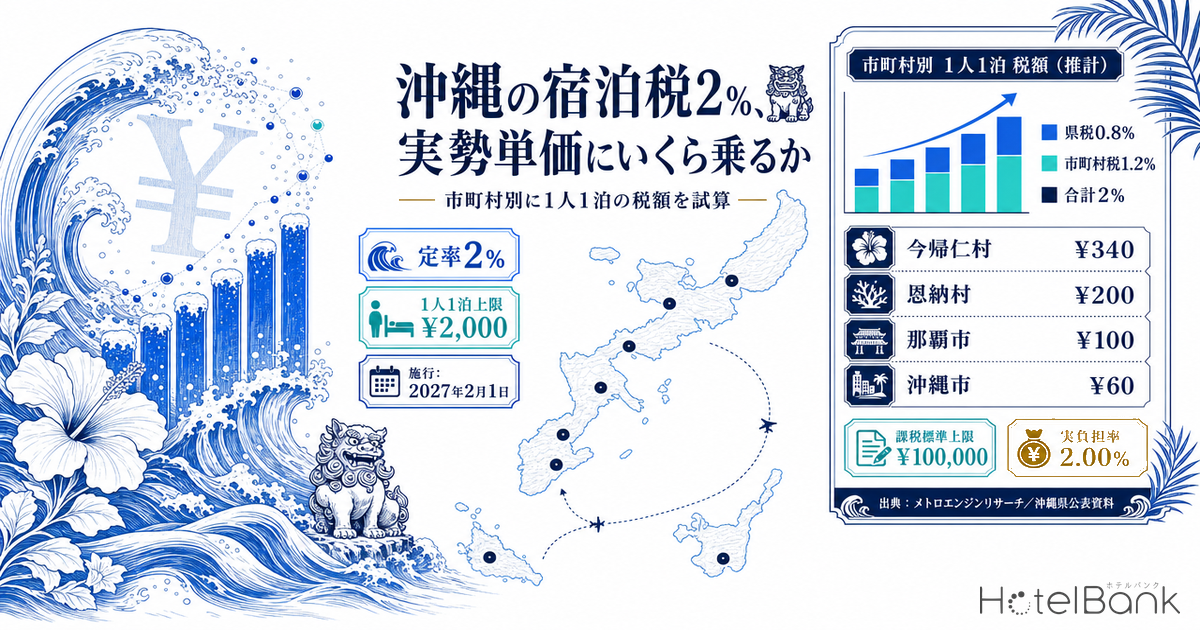
On February 1, 2027, Okinawa Prefecture begins collecting its lodging tax. The design — an ad valorem 2% rate capped at ¥2,000 per person per night — is the first percentage-based lodging tax adopted at the prefectural level in Japan. Six municipalities (Motobu, Onna, Chatan, Miyakojima, Ishigaki and Nago) will levy their own municipal tax alongside it, producing a split of 0.8% prefectural plus 1.2% municipal. So how much does that 2% actually add to Okinawa’s prevailing room rates? We converted MetroEngines Research estimated settled ADR to a per-person, per-night basis and calculated the tax amount and effective burden rate for each municipality.
Metric Definitions Used in This Article
- ADR (average daily rate): An estimated settled rate (tax-exclusive equivalent) calculated by applying category-specific adjustment coefficients to the lowest-plan rate each property publishes on OTAs and similar channels (double occupancy, per-room, tax-inclusive). Cross-checked against property-level actuals disclosed by a listed hotel REIT (Invincible Investment Corporation), the median error was approximately 7.5% across 184 property-months (= the aggregate count of property × month observations, for April–May 2026). These are estimates and differ from each property’s actual transacted rates and accounting figures. Area-level ADR is the median across covered properties (the level of a typical property in that area) and covers verified categories (business, city, resort, ryokan, capsule).
- Listed price (average across all plans, tax-inclusive): The average price across all plans published on OTAs and similar channels (double occupancy, per-room). Because the property universe differs from that of estimated settled ADR, we do not take a ratio between the two.
- Per-person, per-night conversion: This article assumes double occupancy and divides estimated settled ADR (per room) by two to derive a per-person, per-night level. For single occupancy, the room rate is the per-person rate, so the tax calculation works differently (discussed below).
- Data sources: MetroEngines Research; tax scheme details from published materials of Okinawa Prefecture and the respective municipalities
- — Effective February 1, 2027, an ad valorem 2% rate capped at ¥2,000 per person per night. It is the first percentage-based lodging tax at the prefectural level, and the tax base is the room-only rate excluding consumption tax.
- — Two rounding rules apply — amounts under ¥1,000 are truncated, and the tax base is capped at ¥100,000. The effective burden rate holds flat at 2.00% up to ¥100,000, then tapers to 1.33% at ¥150,000 and 1.00% at ¥200,000.
- — The tax actually added runs ¥60–¥340 per person per night (converted from the 12-month average estimated settled ADR for July 2025–June 2026, assuming double occupancy). Okinawa City ¥60, Naha ¥100, Onna ¥200, Nakijin ¥340.
- — Even in the six municipalities with a dual levy, the guest pays a uniform 2% prefecture-wide. The prefectural rate steps down from 2% to 0.8%, and combined with the 1.2% municipal rate the total is preserved. What changes is where the revenue lands and where the filing goes.
- — Rate movement is the larger variable. Estimated settled ADR over the past year ran +11.7% to +31.0% YoY, and June’s roughly ¥778 YoY gain in the per-person nightly rate is several times that month’s tax amount (around ¥100–200).
The Structure — A Room-Only, Tax-Exclusive Base, Truncated Below ¥1,000
Start with the outline of the scheme. The Okinawa Prefecture lodging tax ordinance passed the prefectural assembly on September 18, 2025, and on February 13, 2026 the prefecture obtained the Minister for Internal Affairs and Communications’ consent to establish the new non-statutory earmarked tax. The ordinance was promulgated on February 25 of the same year, with the effective date set at February 1, 2027 (Reiwa 9). Coverage extends beyond hotels, ryokan and simple lodging houses licensed under the Hotel Business Act to include notified private lodgings under the Private Lodging Business Act and special-zone minpaku under the National Strategic Special Zones Act.
In practice the most important element is the definition of the tax base. Okinawa Prefecture’s published materials specify “the lodging charge per person per night (room-only charge),” with the calculation given as “amount paid − charges other than lodging (breakfast, activities, consumption tax, etc.).” In other words, the base is the room-only equivalent excluding consumption tax. Two rounding rules then apply: amounts under ¥1,000 are truncated, and the tax base itself is capped at ¥100,000. In the prefecture’s worked example, a room-only charge of ¥8,500 before tax gives a tax base of ¥8,000, and 2% yields ¥160 of prefectural tax (in dual-levy areas, ¥64 prefectural plus ¥96 municipal).
| Item | Detail |
|---|---|
| Effective date | February 1, 2027 (Reiwa 9) |
| Rate (prefecture-only areas) | Ad valorem 2% (tax capped at ¥2,000) |
| Rate (prefecture + municipality dual-levy areas) | Prefectural 0.8% (cap ¥800) + municipal 1.2% (cap ¥1,200) = 2% total |
| Tax base | Lodging charge per person per night (room-only charge). Amounts under ¥1,000 truncated; capped at ¥100,000 |
| Tax base calculation | Amount paid − charges other than lodging (breakfast, activities, consumption tax, etc.) |
| Covered facilities | Hotels, ryokan and simple lodging houses (Hotel Business Act); special-zone minpaku; private lodgings (Private Lodging Business Act) |
| Exemptions | Stays as part of the educational activities of schools defined in Article 1 of the School Education Act (excluding universities); stays to participate in tournaments hosted by the Nippon Junior High School Physical Culture Association and other bodies designated by regulation (both require submission of a certificate) |
| Collection method | Special collection (lodging operators collect and remit). A special provision is planned to change filing and remittance from monthly to once every three months |
| Scheme review | A review is to be considered three years after introduction (FY Reiwa 11) |
Source: Compiled by the HotelBank Editorial Team from Okinawa Prefecture, “Okinawa Prefecture Lodging Tax” (updated July 28, 2026)
The fact that exemptions are limited to school educational activities and junior high athletic federation tournaments is not a trivial detail in Okinawa’s lodging market. At properties in the southern and central areas that take heavy school-trip group business, administering exemption certificates will become part of routine operations. Discounts for prefectural residents and consideration for remote-island residents are handled not through exemptions but on the spending side, through the programs the revenue funds.
Tax Amount and Effective Burden by Price Band — Flat 2% to ¥100,000, Tapering Above
Because the tax is ad valorem, the amount scales directly with price. But since the tax base is capped at ¥100,000, the burden rate declines in bands above ¥100,000 per person per night. This is easy to misread: the taper begins only above ¥100,000; at exactly ¥100,000 the rate is still 2.00% (¥2,000 of tax).
| Room-only charge per person per night (excl. tax) | Tax base | Prefectural 0.8% | Municipal 1.2% | Total tax | Effective burden rate |
|---|---|---|---|---|---|
| ¥5,000 | ¥5,000 | ¥40 | ¥60 | ¥100 | 2.00% |
| ¥10,000 | ¥10,000 | ¥80 | ¥120 | ¥200 | 2.00% |
| ¥20,000 | ¥20,000 | ¥160 | ¥240 | ¥400 | 2.00% |
| ¥30,000 | ¥30,000 | ¥240 | ¥360 | ¥600 | 2.00% |
| ¥50,000 | ¥50,000 | ¥400 | ¥600 | ¥1,000 | 2.00% |
| ¥100,000 | ¥100,000 | ¥800 | ¥1,200 | ¥2,000 | 2.00% |
| ¥150,000 | ¥100,000 (cap) | ¥800 | ¥1,200 | ¥2,000 | 1.33% |
| ¥200,000 | ¥100,000 (cap) | ¥800 | ¥1,200 | ¥2,000 | 1.00% |
Source: HotelBank Editorial Team calculation based on the rate and tax base in Okinawa Prefecture, “Okinawa Prefecture Lodging Tax”
Source: HotelBank Editorial Team calculation based on the rate and tax base in Okinawa Prefecture, “Okinawa Prefecture Lodging Tax”
The other rule that bites harder at real-world prices is the truncation of amounts under ¥1,000. Even at a nominal 2%, truncating the remainder pulls the effective burden slightly below 2%. At ¥4,900 per person per night, for instance, the tax base becomes ¥4,000, the tax ¥80, and the effective rate falls to 1.63%. At ¥7,900 the base is ¥7,000, the tax ¥140, and the rate 1.77%. Structurally, the lower the rate band, the larger the relative effect of truncation.
| Room-only charge per person per night (excl. tax) | Tax base (truncated below ¥1,000) | Total tax | Effective burden rate |
|---|---|---|---|
| ¥4,900 | ¥4,000 | ¥80 | 1.63% |
| ¥6,800 | ¥6,000 | ¥120 | 1.76% |
| ¥8,500 (prefecture’s example) | ¥8,000 | ¥160 | 1.88% |
| ¥9,900 | ¥9,000 | ¥180 | 1.82% |
Source: HotelBank Editorial Team calculation based on the rate and tax base in Okinawa Prefecture, “Okinawa Prefecture Lodging Tax”
Viewed per room, the truncation rule produces different results depending on headcount. A room at ¥13,000 (excl. tax, room only) occupied by one guest gives a tax base of ¥13,000 and ¥260 of tax. The same room with two guests gives ¥6,500 each → a ¥6,000 base → ¥120 each, or ¥240 for the room — ¥20 less. Since the calculation is per person per night, these rounding differences are unavoidable in practice.
For the same room rate, then, the per-room tax changes with the number of guests. Because amounts under ¥1,000 are truncated per person per night, a larger party makes it more likely that each guest’s tax base carries a truncated remainder. The table below lays out total per-room tax on two axes: room rate and occupancy.
| Room-only rate per room (excl. tax) | 1 guest | 2 guests | 3 guests | 4 guests |
|---|---|---|---|---|
| ¥8,000 | ¥160 ¥160 per person | ¥160 ¥80 per person | ¥120 ¥40 per person | ¥160 ¥40 per person |
| ¥13,000 | ¥260 ¥260 per person | ¥240 ¥120 per person | ¥240 ¥80 per person | ¥240 ¥60 per person |
| ¥20,000 | ¥400 ¥400 per person | ¥400 ¥200 per person | ¥360 ¥120 per person | ¥400 ¥100 per person |
| ¥30,000 | ¥600 ¥600 per person | ¥600 ¥300 per person | ¥600 ¥200 per person | ¥560 ¥140 per person |
| ¥50,000 | ¥1,000 ¥1,000 per person | ¥1,000 ¥500 per person | ¥960 ¥320 per person | ¥960 ¥240 per person |
Source: HotelBank Editorial Team calculation based on the rate and tax base in Okinawa Prefecture, “Okinawa Prefecture Lodging Tax” (sub-¥1,000 truncation, ¥100,000 tax base cap)
Split ¥8,000 across three guests and each pays ¥2,666 → a ¥2,000 base, for a room total of ¥120 — 25% below the ¥160 that applies at one, two or four guests. At ¥30,000, four guests means ¥7,500 each → ¥7,000, for a room total of ¥560, below the ¥600 that applies at one to three guests. Even at a flat 2%, the effective per-room burden moves by several percent up to 25% depending on the occupancy step. The heavier a property’s mix of group business, the more its collection forecast improves by modeling party composition explicitly.
Applying It to Okinawa’s Prevailing Rates — Tax per Guest Night by Municipality
This is the core of the exercise. We averaged MetroEngines Research estimated settled ADR over the most recent 12 months (July 2025–June 2026, all completed past months), converted it to a per-person, per-night basis assuming double occupancy, and then applied the rules above (sub-¥1,000 truncation, ¥100,000 cap). Because estimated settled ADR is calculated at a tax-exclusive-equivalent level, its basis aligns with the definition of the tax base (the room-only equivalent excluding consumption tax).
| Municipality | Levy type | Estimated settled ADR (double occupancy, tax-excl. equiv.) |
Per person per night | Tax base | Tax (per person per night) |
Monthly tax range | N |
|---|---|---|---|---|---|---|---|
| Nakijin Village (今帰仁村) | Prefectural only | ¥34,372 | ¥17,186 | ¥17,000 | ¥340 | ¥280–460 | 19 |
| Onna Village (恩納村) | Prefectural + municipal | ¥20,501 | ¥10,250 | ¥10,000 | ¥200 | ¥160–280 | 39 |
| Chatan Town (北谷町) | Prefectural + municipal | ¥15,756 | ¥7,878 | ¥7,000 | ¥140 | ¥120–180 | 24 |
| Motobu Town (本部町) | Prefectural + municipal | ¥14,723 | ¥7,362 | ¥7,000 | ¥140 | ¥120–180 | 20 |
| Miyakojima City (宮古島市) | Prefectural + municipal | ¥12,768 | ¥6,384 | ¥6,000 | ¥120 | ¥100–160 | 72 |
| Taketomi Town (竹富町) | Prefectural only | ¥13,059 | ¥6,530 | ¥6,000 | ¥120 | ¥100–160 | 20 |
| Ishigaki City (石垣市) | Prefectural + municipal | ¥11,009 | ¥5,504 | ¥5,000 | ¥100 | ¥80–140 | 59 |
| Nago City (名護市) | Prefectural + municipal | ¥10,802 | ¥5,401 | ¥5,000 | ¥100 | ¥80–140 | 22 |
| Naha City (那覇市) | Prefectural only | ¥10,224 | ¥5,112 | ¥5,000 | ¥100 | ¥80–140 | 139 |
| Okinawa City (沖縄市) | Prefectural only | ¥7,406 | ¥3,703 | ¥3,000 | ¥60 | ¥60–100 | 17 |
Source: Compiled by the HotelBank Editorial Team from MetroEngines Research (estimated settled ADR is the 12-month average for July 2025–June 2026; N is the median number of properties covered in the monthly estimated settled ADR calculation)
Source: Compiled by the HotelBank Editorial Team from MetroEngines Research
Lined up side by side, the tax per person per night at the level of a typical property falls in a ¥60–¥340 range. At double occupancy that is ¥120–¥680 per room. Nakijin Village tops the list at ¥340, reflecting a cluster of large resort properties and an estimated settled ADR of ¥34,372 that stands well clear of the rest. Onna Village follows at ¥200, then Chatan and Motobu at ¥140 each, while Naha, Ishigaki and Nago settle around ¥100.
It is worth setting this against the prefecture’s own estimate. In materials presented to its review committee, the prefecture put the average tax at ¥237 per person per night for FY Reiwa 8. Our municipality-level figures (¥60–340) straddle that average. The gap is natural: the prefecture’s ¥237 is weighted by total guest nights, whereas our figures are medians for a typical property in each area. Because guest nights concentrate heavily at large resorts, a guest-night-weighted average sits above the property-level median.
Source: Compiled by the HotelBank Editorial Team from MetroEngines Research
Prefecture-Only vs. Dual-Levy Areas — Same Guest Burden, Different Destination for the Revenue
This is the part of the scheme most often misread. Motobu, Onna, Chatan, Miyakojima, Ishigaki and Nago levy a municipal tax on top of the prefectural tax, but that does not add to what the guest pays. In dual-levy areas the prefectural rate steps down from 2% to 0.8%, and together with the 1.2% municipal rate the total lands at 2%. The effective burden rate seen by the guest is therefore identical everywhere in Okinawa; what differs is whose coffers the collected tax enters.
| Classification | Coverage | Guest burden | Prefectural tax | Municipal tax | Filing and remittance |
|---|---|---|---|---|---|
| Prefecture + municipality (dual levy) | Motobu, Onna, Chatan, Miyakojima, Ishigaki, Nago (6 municipalities) | 2% (cap ¥2,000) | 0.8% (cap ¥800) | 1.2% (cap ¥1,200) | The prefectural portion is also filed and remitted through the municipality. Procedures and exemption handling follow the method the municipality prescribes |
| Prefectural only | Naha, Nakijin, Taketomi, Okinawa City and others (all except the six above) | 2% (cap ¥2,000) | 2% (cap ¥2,000) | — | Filed and remitted to the prefecture. The prefecture lists “distribution to municipalities that do not introduce their own tax” as one use of the revenue |
Source: Compiled by the HotelBank Editorial Team from Okinawa Prefecture, “Okinawa Prefecture Lodging Tax”
For lodging operators, however, the difference is real. Properties in dual-levy areas will file and remit through the municipality where they are located — including the prefectural portion — and the procedures for special collection agents and the handling of exemption certificates follow the method each municipality prescribes. An operator running properties in both Naha and Onna under one chain needs to design its back-office process around split remittance destinations and forms. The prefecture is providing subsidies for system modifications and a lodging tax calculation tool for smaller operators.
The scale of the revenue is also worth noting. The prefecture is reported to project lodging tax receipts of ¥6.18 billion in the first year and ¥7.73 billion from FY2028 onward. In an allocation estimate the prefecture presented to its review committee in November of Reiwa 6 (a ¥7.7 billion revenue case, based on the five municipalities before Nago decided to introduce its own tax), collections in the adopting municipalities came to ¥3.18 billion — ¥1.908 billion of municipal tax and ¥1.272 billion of prefectural tax, a ratio of exactly 3:2, matching the rate split (municipal 1.2% : prefectural 0.8%). The remaining 35 municipalities, where the prefecture collects directly, accounted for ¥4.52 billion.
| Classification | Amount | Breakdown |
|---|---|---|
| Collected in adopting municipalities | ¥3.18bn | Municipal tax ¥1.908bn + prefectural tax ¥1.272bn |
| Of which, municipal tax breakdown | ¥1.908bn | Onna ¥564m / Ishigaki ¥420m / Miyakojima ¥420m / Motobu ¥264m / Chatan ¥240m |
| Collected directly by the prefecture | ¥4.52bn | Prefectural tax from properties in the other 35 municipalities |
Source: Compiled by the HotelBank Editorial Team from Okinawa Prefecture, “Explanatory Materials on the Tourism Purpose Tax (Lodging Tax)” (November, Reiwa 6). This is an allocation estimate for the ¥7.7 billion revenue case, based on the five municipalities prior to Nago’s decision to adopt
Municipal estimates have been published too. In its scheme design materials, Nago City projects roughly ¥360 million of city tax and ¥240 million of prefectural tax, for total receipts of about ¥600 million. According to the same materials, of the 3,003 guest rooms in the city, only 7% fall in the under-¥10,000 band (by the city’s own classification), while the ¥30,000-and-above band accounts for 47%. The rate structure of the northern resort market translates directly into the depth of the tax take. The expansion of that northern resort market following the opening of Junglia Okinawa is framed as part of the upside for this revenue stream.
How Much Does the Tax Move Seasonally? Rates Move, and the Tax Follows Proportionally
With an ad valorem design, the tax tracks seasonal rate swings one for one. Looking at monthly estimated settled ADR for Okinawa Prefecture as a whole, the recent high was ¥14,272 in August 2025 and the low ¥9,213 in January 2025. Converted to a per-person nightly basis, those are ¥7,136 and ¥4,607, giving tax bases of ¥7,000 and ¥4,000 and tax amounts of ¥140 and ¥80. Within the same area, in other words, the tax moves by a factor of 1.5 to 1.8 between peak and trough.
Source: Compiled by the HotelBank Editorial Team from MetroEngines Research (estimated settled ADR; all months are completed past months)
February, the month collection begins, is worth a note of its own. Prefecture-wide estimated settled ADR reached ¥13,596 in February 2026, the second-highest level of the past year after August 2025. Collection does not, therefore, start in a soft demand period — a useful point for planning the operational rollout. By municipality as well, February was the month at the top of the tax range for Chatan, Nago, Naha and Okinawa City.
And rate movement itself has run far wider than the tax. Prefecture-wide estimated settled ADR rose year over year by 19.9% in January 2026, 31.0% in February, 16.5% in March, 11.7% in April, 12.5% in May and 15.8% in June — double-digit gains throughout. On the June figure, the per-person nightly rate ran roughly ¥778 above the year-earlier month, several times that month’s tax (around ¥100–200). A 2% rate sits comfortably inside the price range the market moves through in a single year.
The Base Is Room-Only — The More Meals Are Separated Out, the Lighter the Tax Base
Okinawa’s tax base is the room-only charge, with breakfast, activities and consumption tax excluded. That matters operationally for resort and ryokan formats where meal-inclusive plans carry heavy weight. A paired comparison limited to properties selling both room-only and meal-inclusive plans within the same property (June 2026) shows how large the meal component is.
Source: Compiled by the HotelBank Editorial Team from MetroEngines Research (paired comparison limited to properties selling both plan types within the same property, June 2026, double occupancy, per room)
At Okinawa resort hotels, two-meal plans run ¥13,011 higher per room than room-only plans on average (+26.9%, 66 properties). Across all categories, two-meal plans are ¥11,731 higher (+25.8%, 87 properties) and dinner-inclusive plans ¥8,077 higher (+22.3%, 16 properties). The breakfast-inclusive premium averages ¥2,262 across all categories (+7.1%, 180 properties), ¥1,989 at business hotels (+12.1%, 74 properties) and ¥5,634 at city hotels (+24.4%, 8 properties).
That gap flows straight through to the tax base. Take a resort hotel’s two-meal plan: from a per-room selling price of ¥61,456, stripping out the meal component leaves a room-only equivalent of ¥48,445. Converted to a per-person nightly basis that is ¥24,223, so the tax base is ¥24,000 and the tax ¥480 (¥192 prefectural, ¥288 municipal). Calculated on the gross selling price without separating meals, it would be ¥30,728 per person → a ¥30,000 base → ¥600 of tax, a difference of ¥120 per person per night, or ¥240 per room at double occupancy. Plan design and the itemization of charges feed directly into the accuracy of the amount collected.
This is not, however, a matter of “engineering the tax down.” It is a matter of internal itemization — calculating the room-only equivalent correctly, as the ordinance’s tax base requires. How to apportion a package rate between the lodging portion and the meal and activity portions is something to sort out in line with the practical rules of the lodging tax.
Room for Rate Design — Where Does 2% Sit Within the Price Range?
Pulling the numbers together: at a typical Okinawa property, the tax actually added runs ¥60–¥340 per person per night, or ¥120–¥680 per room at double occupancy. The ¥2,000 cap is reached only in bands above ¥100,000 per person per night, and on our data only a limited set of high-value properties reaches that level routinely.
That order of magnitude carries two implications for rate design. First, because the tax moves in ¥1,000 tax-base steps, a price set just below a threshold — ¥9,900, say — drops the tax base to ¥9,000 through truncation. Raising the rate to ¥10,000 adds only ¥20 of tax. The granularity of pricing and the granularity of the tax are two orders of magnitude apart.
Second, in a market where estimated settled ADR has posted double-digit YoY gains for the past year, a flat 2% is not of a scale that governs pricing decisions. The more consequential question is what the tax funds. The prefecture lists as intended uses: tourism crisis management and marine safety, strengthening receiving capacity, environmental and landscape conservation and destination brand-building, promotion of culture, arts and sports, and distribution to municipalities that do not introduce their own tax. Beach and coastal safety measures, congestion relief and secondary transport are precisely the foundations that support sustained increases in room rates. In areas with their own tax, such as Onna Village and Ishigaki City, the revenue lands locally, making the link between programs and rates easier to see. We examine how lodging tax revenue is coming to sit within local government revenue structures in Furusato Tax Curbs vs. Lodging Tax: Local Government Revenue Shift Hits Regional Hotels.
Conditions in regions that have already introduced a lodging tax offer a useful reference. In Kyoto’s market one month after its lodging tax revision, and again three months in, shifts in supply-demand balance and price-band mix — not the tax add-on — were the primary drivers of rate movement. The same pattern has been observed in Nagano Prefecture’s rollout as the second prefecture to adopt one, and in the simultaneous introductions in Kumamoto and Miyazaki cities. In Okinawa too, what shapes the medium-term rate level will be less the start of collection in February 2027 than how the revenue thickens the destination’s receiving capacity.
Summary
Okinawa Prefecture’s lodging tax takes effect on February 1, 2027, at an ad valorem 2% capped at ¥2,000 per person per night. The tax base is the room-only charge excluding consumption tax, subject to two rounding rules: truncation below ¥1,000 and a ¥100,000 cap. Up to ¥100,000 the effective burden is a flat 2.00%; above that it tapers, to 1.33% at ¥150,000 and 1.00% at ¥200,000. In lower price bands, truncation pulls the effective rate slightly below 2% — 1.63% at ¥4,900, for example.
Converting MetroEngines Research estimated settled ADR (12-month average, July 2025–June 2026) to a per-person nightly basis at double occupancy, the tax actually added is ¥340 in Nakijin Village, ¥200 in Onna Village, ¥140 in Chatan and Motobu, ¥120 in Miyakojima and Taketomi, ¥100 in Ishigaki, Nago and Naha, and ¥60 in Okinawa City. That range straddles the prefecture’s guest-night-weighted average projection of ¥237 per person per night.
And the key point is this: even where the six municipalities of Motobu, Onna, Chatan, Miyakojima, Ishigaki and Nago add a municipal tax, the guest’s burden rate remains a uniform 2% prefecture-wide. The prefectural rate steps down from 2% to 0.8% so the total is preserved; what changes is where the revenue lands and the mechanics of filing and remittance. For lodging operators, the preparation work centers on itemizing charges and sorting out remittance destinations.
Related Reading
- Okinawa Memorial Day 2026: Hotel Demand & School Trip Trends in 3 Southern Cities
- Shuri Castle Revival Lifts Naha Hotel Demand — Supply & ADR Upside
- Mt. Fuji 2026: ¥4,000 Climbing Fee + Lodging Tax Double-Tax Structure
- Furusato Tax Curbs vs. Lodging Tax: Local Government Revenue Shift Hits Regional Hotels
References and Sources
■ Tax scheme (government publications)
- Okinawa Prefecture, “Okinawa Prefecture Lodging Tax” (Tax Affairs Division, General Affairs Department; updated July 28, 2026)
- Okinawa Prefecture, “Explanatory Materials on the Tourism Purpose Tax (Lodging Tax)” (Tourism Policy Division, Culture, Tourism and Sports Department; Tax Affairs Division, General Affairs Department; November, Reiwa 6)
- Nago City, “Public Comment Materials on the Introduction of the Nago City Lodging Tax” (Tourism Division, Regional Economy Department; December, Reiwa 7)
- Motobu Town, “Lodging Tax”
- Ishigaki City, “Ishigaki City Lodging Tax”
■ Press coverage
- Okinawa Times, “Debating the use of ¥7.7bn in lodging tax revenue: first meeting of the Prefectural Tourism Promotion Strategy Council; ¥6.1bn projected in the first year”
- Nikkei, “Okinawa’s lodging tax ordinance to take effect February 2027; Governor Tamaki: ‘We have the internal affairs minister’s consent'”
- Travel Watch, “Okinawa Prefecture and others establish a lodging tax: up to ¥2,000 per person per night”
- Okinawa Times, “Onna Village lodging tax ordinance passes village assembly; introduction targeted for around January 2027”
■ Data sources
MetroEngines Research — estimated settled ADR for Okinawa Prefecture and its municipalities (monthly, July 2025–June 2026; prefecture-wide July 2024–June 2026), and paired price comparison by meal plan type (June 2026). Scheme and revenue figures are from published materials of Okinawa Prefecture and the respective municipalities, and from press coverage.
■ Calculation assumptions
Municipality-level tax amounts were derived by averaging monthly estimated settled ADR (double occupancy, tax-exclusive equivalent) over the most recent 12 months, dividing by two to convert to a per-person nightly basis on a double-occupancy assumption, applying sub-¥1,000 truncation and the ¥100,000 tax base cap, and then applying the 2% rate (in dual-levy areas, 0.8% prefectural + 1.2% municipal). The monthly tax range is the minimum to maximum of the individual monthly values over those 12 months. The price-band and occupancy calculations are mechanical, based solely on the statutory rate and rounding rules, and use no market data.
■ Limitations and caveats
Estimated settled ADR is an estimate (median error of approximately 7.5% when cross-checked against property-level actuals disclosed by a listed hotel REIT) and differs from each property’s actual transacted rates and accounting figures. Area figures are medians across covered properties, so they rest on a different basis from the prefecture’s guest-night-weighted average projection (¥237 per person per night) and will not match it. Single occupancy, parties of three or more, and the apportionment between lodging and meal components in meal-inclusive plans can all cause the actual tax base to diverge from this calculation. Scheme details are based on published materials as of July 28, 2026; operational specifics may change as regulations are finalized ahead of the effective date.
■ Market data
- MetroEngines Research — estimated settled ADR (by Okinawa municipality, monthly, July 2025–June 2026), paired price comparison by meal plan type (June 2026)