

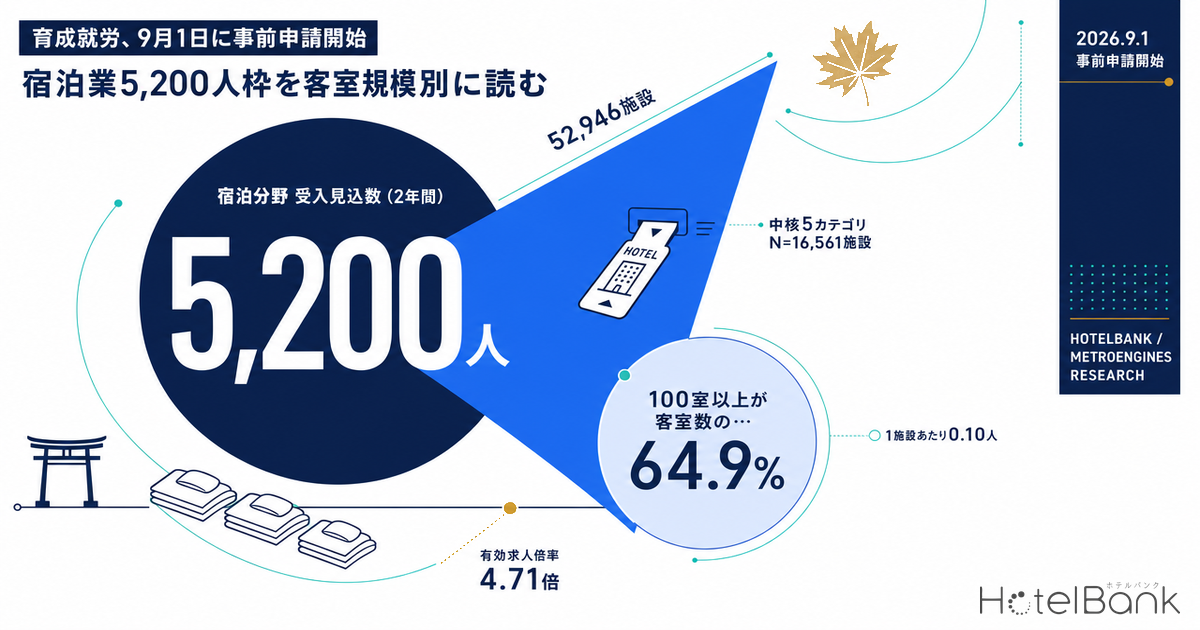
On September 1, 2026, Japan’s immigration authorities begin accepting pre-enforcement applications for certification of “Employment for Skill Development plans” (育成就労計画) under the new Employment for Skill Development program. The program itself does not take effect until April 1, 2027, but advance filing at the regional offices and branches of the Organization for Technical Intern Training starts on this date, with certification results mailed out in sequence from April 1, 2027 onward. For lodging operators that want to bring in foreign staff from FY2027, autumn 2026 is effectively the preparation deadline.
This article treats the sector-specific operational policy for the lodging field published by the Immigration Services Agency (Cabinet decision of January 23, 2026) as the primary source for the program requirements, then cross-references the property master tracked by MetroEngines Research with the Japan Tourism Agency’s “Overnight Travel Statistics Survey” to read — quantitatively, by room-count band and by property type — where the capacity to host workers actually sits, and where year-round employment design will require extra work.
Metric Definitions Used in This Article
- Room occupancy rate (Japan Tourism Agency): The official room occupancy rate published in the Japan Tourism Agency’s “Overnight Travel Statistics Survey.” Figures by property type and by month use the confirmed 2025 (Reiwa 7) values released on July 6, 2026.
- Inventory sell-through rate (estimated): The share of sold rooms against total rooms in the area (an estimate based on OTA-listed inventory). The formula is (total rooms − remaining rooms) ÷ total rooms. It is an estimate based on the depletion of inventory offered on OTAs and differs from a property’s actual overall occupancy rate.
- LT (lead time): Days remaining until the check-in date. LT0 = same day.
- Property and room counts: Of the roughly 168,000 domestic properties tracked by MetroEngines Research, the population consists of the approximately 27,000 properties and 1.26 million rooms whose operation can be confirmed on OTAs; of these, the five core categories corresponding to ryokan/hotel businesses under the Hotel Business Act (business hotels, city hotels, resort hotels, ryokan, deluxe hotels) are aggregated here. Ryokan, minshuku and simple lodging houses not listed on OTAs are excluded.
- Data sources: Immigration Services Agency, Japan Tourism Agency, Ministry of Health, Labour and Welfare, MetroEngines Research
- — On September 1, 2026, pre-enforcement filing opens for certification of Employment for Skill Development plans. The program takes effect on April 1, 2027 and certification notices are mailed only after that, so the practical deadline for properties aiming to host workers in FY2027 falls in autumn 2026.
- — The projected intake for the lodging field is 5,200 people over the two years of FY2027–FY2028. Against the 52,946 licensed ryokan/hotel businesses that qualify, that is 0.10 people per property — this is not a quota designed to spread thinly across every operator.
- — Among the 16,561 properties in the five core categories, the 3,743 with 100 rooms or more account for 64.9% of all rooms. Allocated pro rata by room share, that works out to 1.42 people per property at 200+ rooms versus 0.09 at under 50 rooms — a gap of more than 15 times.
- — The relative swing in room occupancy is 18.1% for city hotels and 19.7% for business hotels, against 29.7% for resort hotels and 33.2% for ryokan. How well a property fits three years of year-round employment splits clearly by type.
- — The restriction period on employer transfers initiated by the worker is set at the floor of one year for the lodging field alone (eight fields including nursing care and construction were set at two years). Retention is tested from the first year of employment — but properties with well-built intake systems also gain an opening to attract transfers.
What Actually Starts on September 1 — The Program Timeline Seen from the Lodging Industry
The Employment for Skill Development program takes effect on April 1, 2027 as a new residence status replacing the Technical Intern Training program. The framework of occupations and tasks eligible for transition under technical intern training has been reorganized to align with the industrial fields of the Specified Skilled Worker system, leaving Employment for Skill Development covering 17 fields and Specified Skilled Worker covering 19. The lodging field is included in both.
Entry into the program comes in two stages. First, applications for licensing of supervising and support organizations opened on April 15, 2026 and are already under way. The point worth noting here is that a corporation currently operating as a supervising organization under the technical intern training program does not automatically carry over into a supervising and support organization. It must obtain a new licence from scratch. From the receiving property’s point of view, whether the organization it has worked with will actually be licensed and operating as of April 2027 is a precondition worth confirming.
On top of that, from September 1, 2026, receiving properties can begin filing in advance for certification of their “Employment for Skill Development plan.” Applications go to the regional offices and branches of the Organization for Technical Intern Training. Because certification results are mailed in sequence from April 1, 2027 onward, a September filing will not produce a certification notice for more than six months. Put the other way round: the earlier in FY2027 a property wants to start hosting workers, the more firmly its plan needs to be settled during autumn 2026.
| Date | Event | How lodging operators are involved |
|---|---|---|
| April 15, 2026 | Licence applications open for supervising and support organizations | Confirm the licensing status of candidate partners |
| September 1, 2026 | Pre-enforcement filing opens for certification of Employment for Skill Development plans (regional offices and branches of the Organization for Technical Intern Training) | The receiving property files as the applicant |
| April 1, 2027 | Employment for Skill Development program takes effect / certification results mailed in sequence | Bring housing and training systems into operation ahead of intake |
| FY2027–FY2028 | Projected intake of Employment for Skill Development workers in the lodging field: 5,200 (two-year cap) | Design the intake plan within the quota |
Source: Compiled by the HotelBank Editorial Team from the Immigration Services Agency’s “Basic Policy and Sector-Specific Operational Policies on the Operation of the Employment for Skill Development Program” (Cabinet decision, January 23, 2026)
The Quota Set Aside for Lodging: “5,200 People Over Two Years”
Appendix 9, “Lodging,” of the sector-specific operational policy states the projected intake plainly. Across the lodging field as a whole, the figure is 20,000 people over the five years from FY2024 to FY2028. Within that, 14,800 are Specified Skilled Worker (i) foreign nationals over five years and 5,200 are Employment for Skill Development workers over the two years from FY2027 — both operated as intake ceilings through the end of FY2028.
Behind that 20,000 figure lies a supply-demand projection for the lodging field. According to the same policy, FY2028 will require roughly 641,000 workers, with a labor shortfall of about 81,000. Even after filling roughly 34,000 through a productivity gain of about 5.3% from capital investment such as smart check-in and cleaning robots, and roughly 27,000 through additional domestic hiring driven by wage increases and better working conditions, an estimated shortfall of about 20,000 remains. The job-openings-to-applicants ratio in the lodging field was 4.71 in FY2024. The foreign-worker intake quota is designed as a complement to that residual gap.
There is a clearly positive signal as well. The share of lodging businesses reporting a shortage of full-time employees fell from 77.8% in January 2023 to 60.2% in January 2025. Average wages (contractual cash earnings) also rose from ¥270,500 per month in 2022 to ¥291,800 per month in 2024. Better pay and labor-saving investment have advanced together, and the government’s own projections already embed that productivity gain. How much room this easing of the labor shortage leaves for occupancy to rise is a separate question, but the direction of travel is visible in the same data: supply constraints are loosening at the same time as the intake framework is being built.
Working Back from the Denominator — Just How “Thick” Is 5,200?
To get a feel for the size of the quota, it has to be set against the number of properties eligible to host workers. What matters here is the lodging field’s eligibility requirement. The sector-specific operational policy explicitly requires that an employer under the program “hold a licence for ryokan/hotel business under Article 3, Paragraph 1 of the Hotel Business Act.” In other words, properties operating under a simple lodging house (kan’i shukusho) licence fall outside the program.
According to the Ministry of Health, Labour and Welfare’s “Report on Public Health Administration and Services, FY2024,” Japan has 52,946 licensed ryokan/hotel businesses (+3.7% year on year), 44,901 simple lodging houses (+7.1%), and 491 boarding houses, for 98,338 lodging businesses in total. Recent growth in property counts has been driven largely by the simple-lodging side, but the pool eligible to receive Employment for Skill Development workers is the former: 52,946 properties. Dividing the 5,200 quota by that denominator gives 0.10 people per property — roughly one worker for every ten eligible properties nationwide.
In practice, though, the properties that can actually build an intake structure are limited to those able to design jobs along the defined task categories — front desk, guest service, restaurant service — provide housing, and fit Japanese-language study time into work rosters. So we broke down the 16,561 properties and 1,123,767 rooms in the five core categories tracked by MetroEngines Research that correspond to ryokan/hotel businesses under the Hotel Business Act (business hotels, city hotels, resort hotels, ryokan, deluxe hotels) by room-count band.
Source: Compiled by the HotelBank Editorial Team from MetroEngines Research (N=16,561 properties, 1,123,767 rooms)
The distribution is extremely skewed. By property count, the under-50-room band holds 10,050 properties, or 60.7% of the total, yet accounts for only 17.5% of rooms. Conversely, the 200+ room band is just 1,223 properties (7.4%) but holds 375,674 rooms (33.4%). Combining the two bands of 100 rooms and above gives 3,743 properties and 728,955 rooms — 22.6% of properties but 64.9% of rooms.
Against that structure, if the 5,200 quota were allocated in proportion to room share, the number of workers per property would differ by more than 15 times across bands.
| Room-count band | Properties | Rooms | Avg. per property | Room share | Pro-rata estimate (people / property) |
|---|---|---|---|---|---|
| Up to 49 rooms | 10,050 | 196,654 | 19.6 rooms | 17.5% | 0.09 |
| 50–99 rooms | 2,768 | 198,158 | 71.6 rooms | 17.6% | 0.33 |
| 100–199 rooms | 2,520 | 353,281 | 140.2 rooms | 31.4% | 0.65 |
| 200+ rooms | 1,223 | 375,674 | 307.2 rooms | 33.4% | 1.42 |
| Total | 16,561 | 1,123,767 | 67.9 rooms | 100% | 0.31 |
Source: Compiled by the HotelBank Editorial Team from MetroEngines Research. The pro-rata estimate is a reference figure that mechanically distributes the lodging field’s projected intake of 5,200 Employment for Skill Development workers by room share; it does not represent the actual allocation method.
What this shows is that the 5,200-person quota is not the kind of allocation that spreads thinly across every lodging property in the country. Below 100 rooms the pro-rata value does not even reach one person; only at 200 rooms and above does it reach 1.42. In other words, this is not a quota where “every property takes one” — it will concentrate at properties that put their intake design in place first. Which is precisely why the September 1, 2026 opening of advance filing carries practical weight.
Property Types That Can Staff Year-Round, and Those That Need Seasonal Design
Employment for Skill Development presumes three years of direct employment. The sector-specific operational policy limits employment in the lodging field to “direct employment only” — dispatch and indirect employment are not permitted. Because the three-year plan must impart the core skills of the job, receiving properties are tested on their ability to keep meaningful work available year-round.
The reference point here is the Japan Tourism Agency’s “Overnight Travel Statistics Survey,” specifically the confirmed 2025 (Reiwa 7) room occupancy rates by property type and month. On an annual basis, the figures are 61.6% overall, 75.3% for business hotels, 74.1% for city hotels, 56.9% for resort hotels, 38.2% for ryokan and 29.6% for simple lodging houses. All improved from the previous year, with resort hotels up 2.8 points and ryokan up 2.1 points — the leisure segment’s recovery stands out.
Source: Compiled by the HotelBank Editorial Team from the Japan Tourism Agency’s “Overnight Travel Statistics Survey,” 2025 (Reiwa 7) annual confirmed values (released July 6, 2026)
Laid out month by month, the difference in seasonal shape between property types is clear. Business hotels bottom at 66.6% in January and peak at 81.4% in October, holding around the 70s throughout the year. City hotels trace almost the same curve, from 66.9% in January to 80.3% in October. Ryokan, by contrast, run from 33.0% in January to 45.7% in August, and resort hotels from 50.6% in June to 67.5% in August — a summer-concentrated peak.
What deserves attention is not the absolute swing but its ratio to the annual level. Business hotels swing 14.8 points over the year, smaller than resort hotels’ 16.9 points, but the difference is not large. Divide by the annual occupancy rate, however, and business hotels come out at 19.7%, resort hotels at 29.7%, ryokan at 33.2% and simple lodging houses at 49.3% — a 2.5-fold spread between property types.
Source: Compiled by the HotelBank Editorial Team from the Japan Tourism Agency’s “Overnight Travel Statistics Survey,” 2025 (Reiwa 7) confirmed values. Relative swing = (highest month − lowest month) ÷ annual value.
| Property type | 2025 annual | Lowest month | Highest month | Swing | Relative swing |
|---|---|---|---|---|---|
| City hotels | 74.1% | 66.9% (Jan) | 80.3% (Oct) | 13.4pt | 18.1% |
| Business hotels | 75.3% | 66.6% (Jan) | 81.4% (Oct) | 14.8pt | 19.7% |
| All types | 61.6% | 54.6% (Jan) | 66.6% (Oct) | 12.0pt | 19.5% |
| Resort hotels | 56.9% | 50.6% (Jun) | 67.5% (Aug) | 16.9pt | 29.7% |
| Ryokan | 38.2% | 33.0% (Jan) | 45.7% (Aug) | 12.7pt | 33.2% |
| Simple lodging houses (outside the program) | 29.6% | 24.5% (Dec) | 39.1% (Aug) | 14.6pt | 49.3% |
Source: Compiled by the HotelBank Editorial Team from the Japan Tourism Agency’s “Overnight Travel Statistics Survey,” 2025 (Reiwa 7) confirmed values
Translated into workforce planning, these numbers sort out as follows. Business hotels and city hotels, with relative swings below 20%, show a comparatively small gap between peak and trough months relative to their annual level, making them the best fit for the three years of year-round employment the program presumes. Resort hotels and ryokan, with relative swings around 30%, risk running short of meaningful work in the off-season if staffing is built around the peak. Here, designs such as concentrating Japanese-language study and skills training in the quiet months, or rotating placements across multiple properties within the same operating company, start to matter. On how staffing constraints set a ceiling on occupancy itself, see also Only Hotels That Capture Demand Survive: 2026’s Occupancy Ceiling.
If anything, being able to write into the plan from the outset how the off-season will be used suits the character of this program. The sector-specific operational policy requires workers to reach the lodging field’s Employment for Skill Development evaluation test (elementary level) and Japanese equivalent to A1 within one year of starting, and the lodging field’s Specified Skilled Worker (i) evaluation test and Japanese equivalent to A2.2 by completion. Resort and ryokan operations, which have clearly identifiable months where study time can be secured, arguably hold a distinct advantage in delivering those skill and language targets on schedule.
When Peak-Day Demand Firms Up Also Differs by Property Type
On top of the annual pattern, when demand for a peak day itself becomes visible also affects staffing. Taking Saturday, August 15, 2026 — the Obon peak day — we tracked how OTA-listed inventory was drawn down by lead time, by property type, within Tokyo.
Source: Compiled by the HotelBank Editorial Team from MetroEngines Research. Tokyo; check-in August 15, 2026. Business hotels N=870 properties / 126,136 rooms; city hotels N=100 properties / 32,712 rooms; ryokan N=46 properties / 1,058 rooms; resort hotels N=14 properties / 1,045 rooms.
By LT90 (mid-May), city hotels had already sold through 73.7% of inventory and ryokan 76.2%, with only 8.0 and 8.4 points added respectively by LT21. In other words, three months out, a substantial share of peak-day demand is already visible.
Business hotels, by contrast, run 63.2% at LT90, 69.0% at LT60, 76.3% at LT30 and 79.6% at LT21 — a steady build toward the date. The gain from LT90 to LT21 is 16.4 points, more than double that of city hotels. The industry’s felt sense that business demand skews toward last-minute booking is confirmed here in the sell-through trajectory.
This feeds directly into how predictable staffing is. Ryokan and city hotels can gauge required headcount three months out and settle rosters and training schedules early. Business hotels can staff a thicker base given their consistently high year-round occupancy, but the peak-day upside firms up only shortly before. Because an Employment for Skill Development worker is a full-time resource for three years, one reading is that such staff are relatively easy to build into the baseline that absorbs this late-breaking demand.
Note that this sell-through rate is an estimate based on the depletion of inventory offered on OTAs and differs from a property’s actual overall occupancy rate. It is used to read relative comparisons between property types and movement over time, and the levels themselves should not be interpreted as occupancy rates. Ryokan and resort hotels have small populations within Tokyo (46 and 14 properties respectively) and are treated as reference figures.
Translating the Lodging Field’s Requirements into Intake Design
Here are the lodging-field requirements set out in the sector-specific operational policy, organized as the practical points a receiving property needs to cover.
Scope of work. There is a single task category, “lodging,” covering work related to the provision of lodging services at a lodging facility — front desk, planning and public relations, guest service, restaurant service and the like. In addition, the policy explicitly states that incidental engagement in the related duties normally performed by Japanese employees in those roles — it cites room cleaning, bed making and in-house sales as examples — is permissible. This is the point that governs how much freedom there is in job design: the core of drafting the plan lies in placing the principal duties in front-desk and guest-service work while deciding how related duties are combined around them.
Eligibility to receive workers. A licence for ryokan/hotel business under Article 3, Paragraph 1 of the Hotel Business Act is mandatory. Additional conditions apply: not assigning work at facilities defined in Article 2, Paragraph 6, Item 4 of the Businesses Affecting Public Morals Regulation Act; not having workers perform “entertainment services” as defined in Article 2, Paragraph 3 of the same Act; providing necessary cooperation to the Employment for Skill Development council; and cooperating with surveys and guidance by the Ministry of Land, Infrastructure, Transport and Tourism or its designees.
The language and skills ladder. Before starting work, a worker must reach the equivalent of A1 on the “Reference Framework for Japanese Language Education,” or complete Japanese-language instruction at a comparable level at a certified Japanese-language institution. Within one year of starting Employment for Skill Development, the lodging field’s evaluation test (elementary level) and A1-equivalent Japanese are required; by completion, the lodging field’s Specified Skilled Worker (i) evaluation test and A2.2-equivalent Japanese. The three-year development period is itself designed as a staged programme for raising both language and skills.
Employer transfers. The restriction period on transfers initiated by the worker is set by field within a statutory range of one to two years, and the lodging field is set at one year. While eight fields including nursing care, construction and food service were set at two years, lodging adopted the one-year floor. A transfer requires passing the lodging field’s Employment for Skill Development evaluation test (elementary level) and Japanese at A2.1-equivalent or above. For a receiving property, that means retention is tested once a worker is one year into employment. Read the other way, properties with housing and training already in place also open a channel to receive transfers from other fields and other properties.
What comes next. A worker who completes Employment for Skill Development and reaches the lodging field’s Specified Skilled Worker (i) evaluation test and A2.2-equivalent Japanese can move to Specified Skilled Worker (i). Specified Skilled Worker (ii) further requires the lodging field’s SSW (ii) evaluation test plus “practical experience providing lodging services while supervising multiple employees” and Japanese at B1-equivalent or above. The path from three years of Employment for Skill Development to SSW (i) and on to SSW (ii) is designed as a long-term career track for growing frontline leaders in-house. The policy also states that the Ministry of Land, Infrastructure, Transport and Tourism will work with the relevant industry bodies to formulate a “development and career formation programme” covering qualifications, Japanese-language ability and management experience.
Intake Design Priorities by Room-Count Band
Overlaying the program requirements with the occupancy data, the centre of gravity for preparation shifts by size band.
| Band | Character of intake capacity | Design priority | To start before September |
|---|---|---|---|
| Up to 49 rooms 10,050 properties |
Even one worker per property is a large share of the staffing mix. Many are ryokan, carrying a 33.2% relative seasonal swing | Multi-skilled job design in which one person spans front desk, guest service and restaurant service. Concentrate Japanese-language study and skills training in the off-season | Explore joint intake across multiple properties, or a shared scheme with a local supervising and support organization |
| 50–99 rooms 2,768 properties |
Business hotels are the majority at 1,580 properties. Year-round occupancy is stable, making one or two permanent placements realistic | Build the role into the rotation for continuous single-person front-desk coverage. State the split against related duties explicitly in the plan | Secure housing (company housing or leased units) and design commuting logistics. Select the provider for Japanese-language instruction |
| 100–199 rooms 2,520 properties |
The core band, at 31.4% of rooms. At 0.65 people per property on the pro-rata estimate, it stands at the threshold of multi-person intake | Split development plans by department (front desk / restaurant). Design job scope to widen in stages across years one, two and three | Draft the Employment for Skill Development plan with three-year skill and language targets broken down by department |
| 200+ rooms 1,223 properties |
1.42 people per property on the pro-rata estimate. Includes 287 city hotels, with an 18.1% relative swing — the most year-round of all | A supervision structure premised on receiving several workers at once. Scope extends to designing the “experience supervising multiple employees” needed for SSW (ii) | Memoranda with supervising and support organizations, assignment of in-house training leads, securing multiple housing units |
Source: Compiled by the HotelBank Editorial Team from MetroEngines Research, the Japan Tourism Agency’s “Overnight Travel Statistics Survey,” and the Immigration Services Agency’s “sector-specific operational policy”
New supply trends reinforce this picture. Within the scope tracked by MetroEngines Research, new openings in the five core categories ran to 468 properties and 38,759 rooms in 2023, 428 properties and 33,361 rooms in 2024, and 475 properties and 35,912 rooms in 2025. For 2026, 252 properties and 23,822 rooms have been confirmed as of the survey date, of which 45 properties and 11,673 rooms are in the 200+ room band — already above the 42 properties and 11,571 rooms recorded for the whole of 2025. Large-format supply continues, and the number of properties that must build year-round staffing from the day they open keeps rising.
Source: Compiled by the HotelBank Editorial Team from MetroEngines Research (based on confirmed OTA listings). Note: because OTA listings appear several months before opening, figures for the most recent months onward may rise with subsequent listing confirmations.
Three Things to Have in Place by September 1
1. Selecting a supervising and support organization. The receiving property is the applicant for certification of the Employment for Skill Development plan, but in practice the process presumes coordination with a supervising and support organization. As noted, supervising organizations under technical intern training cannot carry over automatically and must obtain a new licence, so it is worth checking, candidate by candidate, how their applications have progressed since filing opened on April 15, 2026. Knowledge of the lodging field, channels into sending countries, and how much of the Japanese-language instruction they can deliver are the axes of selection.
2. Securing housing. Employment for Skill Development is three years of direct employment, and arranging the basics of daily life is central to intake design. In resort areas and regional onsen districts in particular, the housing stock within commuting range is itself limited, so acquiring or leasing company housing takes time. The sector-specific operational policy likewise cites “encouraging fuller living support by lodging facilities in each region” as a measure to avoid excessive concentration in major metropolitan areas — housing provision is treated as important on the policy side too. The more predictable a band’s occupancy, the easier the payback case is to make.
3. Arranging Japanese-language support. A worker must reach A1-equivalent or above before starting work, or complete comparable instruction at a certified Japanese-language institution. Because the targets are staged — A1 in year one, A2.2 at completion — the plan needs to spell out how study time is built into work rosters. This is where the seasonal patterns by property type come back into play. Ryokan and resort hotels, with relative swings above 30%, can block out concentrated study time in quiet months. For business hotels and city hotels, with stable year-round occupancy, a continuing weekly fixed study slot is likely more realistic. Matching the study design to the seasonal curve is, in itself, what makes the plan persuasive.
Conclusion
The advance filing for Employment for Skill Development plans that begins on September 1, 2026 is the first practical milestone for lodging properties that want to bring in foreign staff during FY2027. The quota set aside for the lodging field is 5,200 people over two years. Against a denominator of 52,946 licensed ryokan/hotel businesses, that is a density of 0.10 people per property. This is not a quota that spreads thinly and evenly — it will gather at properties that get their intake design in place first.
Looking at the distribution across the 16,561 properties and 1,123,767 rooms in the five core categories tracked by MetroEngines Research, the 3,743 properties with 100 rooms or more account for 64.9% of all rooms. Allocated by room share, that gives 1.42 people at 200+ rooms and 0.65 at 100–199 rooms — the larger the property, the more realistic a multi-person intake design becomes. At the same time, for the 10,050 properties under 50 rooms, a single hire still lands a large impact on the staffing mix. There is room for approaches scaled to size, such as joint schemes across multiple properties.
By property type, city hotels and business hotels, with relative swings of 18–20%, fit well with three years of year-round employment, while resort hotels and ryokan, at around 30%, can put the off-season to work on Japanese-language study and skills training. Both have a workable way to structure intake around their own seasonal curve. Setting the transfer restriction period at one year for the lodging field raises the importance of retention measures while also opening an opportunity for well-prepared properties to attract talent.
The program starts moving in April 2027, but the work of settling plans begins in autumn 2026. The starting point is to sketch what intake design is feasible from three pieces of data already at hand: your own room count, property type, and the shape of your occupancy curve.
Related Reading
References and Sources
■ Data sources
Program requirements draw on the Immigration Services Agency’s “Basic Policy and Sector-Specific Operational Policies on the Operation of the Employment for Skill Development Program” (Cabinet decision, January 23, 2026) and its Appendix 9, “Lodging,” as primary sources. Lodging business counts come from the Ministry of Health, Labour and Welfare’s “Overview of the Report on Public Health Administration and Services, FY2024”; room occupancy rates by property type and month come from the Japan Tourism Agency’s “Overnight Travel Statistics Survey,” 2025 (Reiwa 7) confirmed values (released July 6, 2026). Property and room counts by room-count band, new openings, and inventory sell-through by lead time are aggregated by MetroEngines Research.
■ Estimation assumptions
The “pro-rata estimate (people / property)” is a reference figure that mechanically distributes the lodging field’s projected intake of 5,200 Employment for Skill Development workers by room share across the 16,561 properties and 1,123,767 rooms in the five core categories, then divides by the number of properties in each band. It does not represent the actual allocation method, screening criteria or order of priority. Relative swing is calculated as (highest month’s room occupancy − lowest month’s room occupancy) ÷ annual value. The figure of 0.10 people per property is 5,200 divided by the 52,946 licensed ryokan/hotel businesses.
■ Limitations and caveats
The aggregation population is limited to properties whose operation can be confirmed on OTAs; ryokan, minshuku and simple lodging houses not listed on OTAs are excluded. The inventory sell-through rate is an estimate based on OTA-listed inventory and differs from a property’s actual overall occupancy rate. In the Obon peak-day analysis, ryokan (N=46 properties) and resort hotels (N=14 properties) in Tokyo have small populations and are treated as reference figures. New openings are based on confirmed OTA listings, so figures for the most recent months onward may rise with subsequent listing confirmations. Detailed operational guidelines for the program may change through future public notices and circulars, so please check the latest primary sources when filing.
■ Program and legislation (primary sources)
- Immigration Services Agency, “Basic Policy and Sector-Specific Operational Policies on the Operation of the Employment for Skill Development Program” (Cabinet decision, January 23, 2026)
- Appendix 9, “Policy on the Operation of the Specified Skilled Worker Residence Status and the Employment for Skill Development System in the Lodging Field” (Minister of Justice, Minister of Health, Labour and Welfare, National Public Safety Commission, Minister for Foreign Affairs, Minister of Land, Infrastructure, Transport and Tourism)
- Immigration Services Agency, “Employment for Skill Development Program” (overview, related legislation, operational guidelines, pre-enforcement filing)
- Immigration Services Agency, “On Restrictions on Worker-Initiated Employer Transfers under the Employment for Skill Development Program (Draft)”
■ Government statistics
- Japan Tourism Agency, “Overnight Travel Statistics Survey,” 2025 (Reiwa 7) annual confirmed values (released July 6, 2026)
- Ministry of Health, Labour and Welfare, “Overview of the Report on Public Health Administration and Services, FY2024” (lodging business counts)
■ Market data
- MetroEngines Research — property master (properties and rooms by room-count band, N=16,561 properties, 1,123,767 rooms), new opening data (based on confirmed OTA listings), inventory sell-through by lead time