

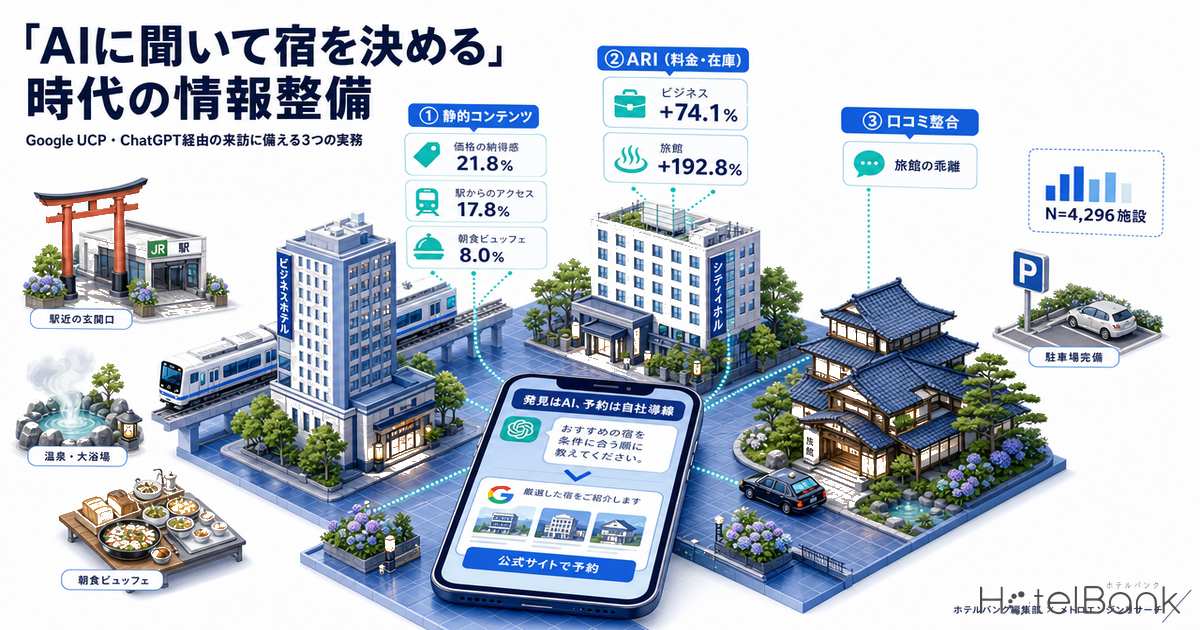
The entry point for finding a place to stay is quietly shifting from the search box to a conversation with an AI. Since the start of 2026, Google has signalled that it will extend its common standard for agentic commerce into the travel category, while OpenAI has stepped back from booking directly inside ChatGPT and moved instead toward sending users out to brands’ own websites and apps. At the end of July, a global chain went live with real-time availability and rates displayed inside ChatGPT. This article translates that shift into the data work a lodging property can start on today, drawing on the primary reporting and on our own review and pricing data.
Metric Definitions Used in This Article
- ADR (average daily rate): An estimated settled rate (tax-exclusive equivalent), calculated by applying a category-specific adjustment coefficient to the lowest published plan level each property lists on OTAs and other booking sites (two guests per room, price per room, tax-inclusive). Cross-checked against property-level results disclosed by listed hotel REITs (91 properties, most recent three months), the median error is approximately 7%. These are estimates and differ from each property’s actual transacted prices and accounting figures. Area-level ADR is the median of the properties covered (the level of a typical property in that area).
- Published price (average across all plans): The average price of all plans listed on booking sites (two guests per room, price per room, tax-inclusive, spanning room-only through meal-inclusive plans). Because it is measured on a different basis from ADR, the two are never compared as if they were the same metric.
- Mention rate: The share of guest reviews that touch on a given theme (NLP analysis by the HotelBank Editorial Team). It indicates how frequently a topic is put into words, not a rating score.
- Data source: MetroEngines Research / HotelBank Editorial Team analysis (NLP)
- — What moved is “discovery,” not “booking.” The four major 2026 news items all point the same way: AI takes on searching and comparing, and hands the final booking back to each company’s own path to purchase.
- — Application to the Japanese market is undecided. Google positioned hotels as its next target but gave no start date, and OpenAI scaled back its plans to integrate direct booking.
- — “Rate” can nearly double depending on the conditions attached. On a property-count-weighted basis across six prefectures in June 2026, published prices exceed estimated settled ADR by 74.1% for business hotels and 192.8% for ryokan (combined N=4,296 properties). Reliability rests on stating the conditions, not just the number.
- — Your strengths are already put into words in your reviews. Across N=466,230 nationwide reviews from the most recent three months, what guests actually talk about are concrete items that translate into conditions — value for money at 21.8%, breakfast buffet selection at 8.0%, and so on.
- — Start in three stages: static content → ARI → alignment with reviews. None of these is a new investment; each is a matter of standardising how existing information is written and published, and none requires waiting for the standards to be finalised.
Three Facts Established in 2026 — Discovery Moved Before Booking
The first thing to grasp is the order in which the 2026 reporting arrived. A world in which AI books your room did not suddenly materialise. What moved was not payment, but the layer in front of it: discovery.
| Date | Party | Substance |
|---|---|---|
| 22 January 2026 | Wire coverage sets out the travel-specific obstacles facing UCP (Universal Commerce Protocol), the common standard for agentic commerce: inventory that changes by the second, missing travel-specific fields such as room type, and unresolved questions of liability | |
| 6 March 2026 | OpenAI | Scales back plans to integrate direct booking inside ChatGPT. Users browse travel products in the chat but do not proceed to checkout, so the emphasis shifts to completing the transaction inside connected third-party apps. Shares in the major OTAs rose on the news (as of 5 March) |
| 20 May 2026 | On 19 May, positions hotels as the next domain for UCP and presents AP2, a payments standard allowing AI agents to transact on a user’s behalf. The start date is described only as “soon,” with no specific date given | |
| 28 July 2026 | Radisson Hotel Group / Accenture | Launch an app that lets users search for accommodation conversationally inside ChatGPT. It shows real-time availability and rates for more than 1,000 properties across over 100 countries, along with maps and facility information, but the booking itself is completed on the group’s own site |
Source: Travel Voice (22 January, 6 March and 20 May 2026) and Accenture Newsroom (28 July 2026), compiled by the HotelBank Editorial Team
Line the four up and the direction converges on a single shape: AI takes on the “search and compare” work, and hands the final booking back to each company’s own reservation path. The Radisson case is emblematic — live inventory and rates appear on the ChatGPT screen, but confirmation happens on the group’s own site. None of the reporting confirms availability in the Japanese market or application to domestic chains. Reading this as “automated booking has arrived in Japan” is therefore premature. Even so, the fact that the discovery layer moves first makes the order of priorities for properties much clearer. Travellers are already bringing AI into their trip planning: survey work has found that more than 90% of Chinese visitors to Japan use it when planning a trip.
Why Travel Is Last in Line — the Structure of “Inventory That Disappears in Seconds”
UCP was designed around retail goods to begin with. In retail, price and stock barely move during the few minutes between adding to cart and paying. In travel, by contrast, it is not unusual for the price or the availability an AI has just presented to vanish seconds later. Wire coverage also notes that lodging-specific fields — room type, check-in procedure, digital key handover — are missing from the standard. On top of that, if an AI gives incorrect guidance, the seller of record remains the lodging operator. Confirmation steps and real-time updates are exactly the sort of friction agentic commerce wants to remove, yet in travel they have long functioned as safeguards against sudden price changes and failed transactions.
In other words, for agent-driven automated booking to take hold in travel, both an extension of the standard and a supply of data from operators are required. And the part operators can start on first does not need to wait for the standard to be finished. The wire coverage likewise recommends keeping data feeds to existing Google services accurate, and broadening API coverage beyond search to ancillary products and booking confirmation, rather than waiting for UCP to spread. That is where this article begins.
Practice 1: The “Strengths” AI Summarises Are Already Articulated in Your Reviews
When an AI recommends a property, the raw material is the description on the official website plus the accumulated words of past guests. Domestic survey work has already mapped how far generative AI actually reaches into each stage of trip planning among Japanese users. So what are guests actually saying? We ran NLP analysis on 466,230 reviews posted over the most recent three months and tallied mention rates by theme.
Source: HotelBank Editorial Team analysis (NLP; reviews from the most recent three months, N=466,230)
At the top sit room cleanliness (22.3%), value for money (21.8%), access from the station (17.8%) and room size (16.5%). What matters is that none of these is an abstract “it was good” — each is a concrete item that can be restated as a condition. When an AI processes a request such as “a quiet hotel near the station with a solid breakfast,” this is the level of granularity it can draw on. Put the other way round: if the official website says only “we offer a comfortable stay,” there is almost no condition to extract from it.
Look at individual properties and the density of that articulation separates sharply. The table below lists Tokyo properties with heavy mention of station access, ranked by mention count over the most recent 24 months.
| Property | Total reviews | Station-access mentions | Mention rate |
|---|---|---|---|
| Hotel Sunroute Plaza Shinjuku (ホテルサンルートプラザ新宿) | 4,960 | 2,070 | 41.7% |
| Karaksa Hotel Tokyo Station (からくさホテル東京ステーション) | 2,563 | 1,348 | 52.6% |
| Ours Inn Hankyu (アワーズイン阪急) | 2,955 | 1,273 | 43.1% |
| APA Hotel Shinagawa Sengakuji-Ekimae (アパホテル〈品川 泉岳寺駅前〉) | 2,745 | 1,153 | 42.0% |
| Hotel Monterey Hanzomon (ホテルモントレ半蔵門) | 2,307 | 1,099 | 47.6% |
Source: HotelBank Editorial Team analysis (NLP; Tokyo, most recent 24 months, positive mentions; properties with at least 20 reviews and at least 10 such mentions, giving a population of N=1,889 properties; top five by mention count)
At these properties, between 40% and 50% of reviews touch on station access. Guests are describing the same strength in the same words, over and over — which makes it very easy material for an AI to assemble a summary from. What the property can do here is clear: match the wording on your own site to the strength guests are already crediting you with. If reviews say “walking distance from Shinjuku Station,” then the access section of your official page should spell out the station name, the exit and the walking time in minutes. The same holds for the other nationwide themes — onsen (7.6%), large communal baths (5.2%), breakfast buffet selection (8.0%) and lounges (4.7%). If guests are talking about it, there is a fact there worth making machine-readable.
Source: HotelBank Editorial Team analysis (NLP; most recent three months, nationwide, N=466,230). The nationwide mention rates in this paragraph come from the same tabulation cited above.
Practice 2: “Rate” Nearly Doubles Depending on Which Conditions It Refers To
Next, price. When an AI is told “with a budget of ¥20,000,” which number it should refer to is not self-evident. So consider two levels for the same set of properties. One is the published price, the average across all plans on booking sites (tax-inclusive, two guests per room); the other is the estimated settled ADR derived from the lowest plan level (tax-exclusive equivalent). The chart below shows Tokyo by property category for June 2026.
Source: Compiled by MetroEngines Research and the HotelBank Editorial Team (June 2026, Tokyo; business N=915 / city N=108 / resort N=20 / ryokan N=55 / capsule N=39 properties)
For business hotels, a published price of ¥20,000 sits against an estimated settled ADR of ¥11,900; for city hotels, ¥39,900 against ¥22,200. For ryokan the gap is wider still: ¥25,400 against ¥10,300. To be clear, this difference is not an error. The published price is a tax-inclusive average across all plans, including meal-inclusive and higher-grade rooms, while the estimated settled ADR is a tax-exclusive-equivalent estimate benchmarked to the lowest plan level. The two are defined differently in the first place.
Which is precisely why it matters. The fact is that the “rate” of the same property can look nearly twice as high or low depending on how the conditions are set. Weighting that gap by property count across six prefectures (Tokyo, Osaka, Kyoto, Hokkaido, Okinawa and Fukuoka), by category, gives the following.
Source: Compiled by MetroEngines Research and the HotelBank Editorial Team (June 2026; six prefectures, combined N=4,296 properties)
| Category | Amount by which published price exceeds estimated settled ADR (property-count weighted) | Properties covered |
|---|---|---|
| Business hotel | +74.1% | 2,698 |
| City hotel | +88.8% | 389 |
| Capsule hotel | +157.3% | 67 |
| Resort hotel | +160.0% | 474 |
| Ryokan | +192.8% | 668 |
Source: Compiled by MetroEngines Research and the HotelBank Editorial Team (June 2026; category-level figures for Tokyo, Osaka, Kyoto, Hokkaido, Okinawa and Fukuoka, weighted by property count)
What is interesting is the ordering: business hotels and city hotels show the smallest gaps, while resort hotels and ryokan open up sharply. The wider a category’s price range from room-only through half-board, the wider the territory the single word “rate” has to cover. The ryokan figure of +192.8% is best read not as an operational problem but as evidence that the product mix itself is genuinely multi-layered.
And that is where the opportunity lies. When an AI presents a rate, reliability turns less on the amount itself than on whether it is explicit about what the price includes. Number of guests, whether meals are included, how tax and service charges are treated, cancellation terms — supply the rate with those conditions attached and an AI can quote it correctly, conditions and all. Let the amount alone circulate, and the guest’s expectation diverges from the final bill. When Accenture explains that the Radisson project began with a mechanism to “structure and validate content, inventory, rates and booking signals,” it is this layer it is describing.
Practice 3: Think in Three Stages — Static Content, ARI, Review Alignment
Here is the whole picture reduced to three stages, in the order you should tackle them. None is really a new investment; each is a matter of standardising how information you already hold is written and published.
| Stage | Scope | What to do specifically | Difficulty |
|---|---|---|---|
| Stage 1 | Static content (facilities, house rules, access) | State the station name, exit and walking time in minutes, the opening hours of the communal bath, the number of parking spaces and the fee, the earliest check-in time, and whether children and pets are accepted — each described one way and one way only across the official site. Audit whether the same item is written differently on different pages | Entirely in-house. The first thing you can start on |
| Stage 2 | ARI (availability, rates, inventory restrictions) | Supply rates and availability in real time, with “two guests per room,” “breakfast included or not,” “tax and service charge included or not,” minimum length of stay and the cancellation deadline attached as conditions. At minimum, keep feeds to existing search and mapping services accurate | Involves configuration on the channel manager and PMS side |
| Stage 3 | Alignment with the strengths your reviews credit you for | Extract the themes guests raise repeatedly (cleanliness, station proximity, breakfast, onsen and so on) and use the same words in your own copy. Rather than emphasising items no one credits you for, put into words the strengths you are already credited for | Requires reading through reviews, but no investment |
Source: Compiled by the HotelBank Editorial Team
Do not underestimate Stage 1. The classic way an AI ends up giving wrong guidance is when the official site contradicts itself. The facilities page says “parking for 30 cars,” while the FAQ says only “advance reservation required, limited spaces.” A human reader fills in the gap from context; a machine does not. The audit itself costs nothing, and it works just as well on your existing booking path.
Stage 2 is about how much of your rate and inventory you can push outward in machine-readable form. This one does not stay in-house. Even so, simply knowing “which channels currently receive our rates, and at what level of detail” puts you in a clearly better position than scrambling once the standard is settled. When agentic booking is implemented, the properties that can supply accurate, condition-qualified rates will be the ones handled first.
Stage 3 is in fact the most cost-effective. As shown above, reviews already hold concrete strengths, articulated and accumulated. Guests nationwide talk most about cleanliness and value for money, then about location and room size. That ordering does not change for AI any more than it does for human decision-making. Simply counting the words that recur in your own reviews and placing those words in the headings and body copy of your official site raises both machine readability and persuasiveness. Separately, an analysis of some 20,000 reviews has broken down what the properties guests describe as “worth more than the price” have in common.
Conclusion — There Is No Need to Wait for the Standard to Be Finished
What the sequence of moves in 2026 showed is a structure in which AI has begun to handle travel “discovery,” while “confirming the booking” has been handed back to each company’s own path to purchase. OpenAI stepped back from direct booking; Google positioned hotels as its next target but named no start date. The Radisson case, too, is designed so that the display happens in ChatGPT and the booking on the group’s own site. Application to the Japanese market is not confirmed in any of the reporting.
Which is exactly why now is a good time to prepare. Consistent descriptions in static content, condition-qualified supply of rates and inventory, and alignment with the strengths your reviews credit you for — all three pay off in your direct booking conversion and in how you appear on existing channels, whatever pace AI agents spread at. The property that waits until the standard is settled and the property that starts ordering its information now will be standing in very different places the moment implementation arrives. The opportunity is still comfortably ahead of us.
Related Reading
- Hotels Chosen for Value for Money: National TOP 30 (21.6% of Reviews)
- Chosen for the Water: Japan’s Top 30 Onsen Inns by Review Mentions
- All-Inclusive Japan 2026: Free Drinks, Lounges & the +40.7% Meal Lift
- Japan Intra-Prefecture ADR Gaps Reach 5.2x: 368 Municipalities Ranked
References and Sources
- Google launches automated hotel booking in earnest: extending the AI agent purchasing infrastructure into travel, and what lodging businesses must prepare next [wire report] (Travel Voice, 20 May 2026)
- Will Google’s new common AI agent standard “UCP” redraw the travel industry map? The reality and the obstacles it faces [wire report] (Travel Voice, 22 January 2026)
- ChatGPT’s travel booking function: OpenAI to scale back direct booking integration as users fail to reach checkout; major OTA shares surge (Travel Voice, 6 March 2026)
- Radisson Hotel Group and Accenture Redefine Travel Discovery on ChatGPT (Accenture Newsroom, 28 July 2026)
- About Google’s Universal Commerce Protocol (UCP) and UCP-enabled checkout (Google Merchant Center Help)
- MetroEngines Research — published prices and estimated settled ADR (June 2026; by category for Tokyo, Osaka, Kyoto, Hokkaido, Okinawa and Fukuoka, combined N=4,296 properties)
- HotelBank Editorial Team analysis (NLP) — mention rates by theme in guest reviews (most recent three months, N=466,230) and station-access mentions in Tokyo (most recent 24 months)