


Drop the bags and explore the city light — a growing network now uses hotels’ spare space to serve this traveler need. The luggage-storage sharing service ecbo cloak passed 2,500 locations and more than 1 million cumulative users at its ninth anniversary in January 2026. After rolling out to 7-Eleven stores and Daiichikosho karaoke outlets, it expanded to 3,500+ locations across all 47 prefectures by summer 2026. For the host business, registration, onboarding and maintenance are all free, and the only on-site task is photographing the luggage.
Hotels already have what luggage storage requires: a staffed front desk and space to hold bags. In a survey of lodging operators by the Kinki District Transport Bureau (Kansai, n=164), 38% of properties said luggage storage was a burdensome front-desk task, yet only 1% had partnered with an outside luggage-storage provider. There is ample room to lighten luggage handling with a system and turn it into revenue and new foot traffic. This article covers how ecbo cloak works and what it costs, its expanding network, four benefits for hotels, and how to get started.
• The mechanics, pricing and location counts of ecbo cloak are based on ecbo Inc.’s official website, partner recruitment page and press releases (all as of November 4, 2026). Location counts are the figures published at each point in time and are all lower bounds (“or more”). Screenshots are taken from the company’s official website.
• Figures on luggage-handling burden at hotels come from the Kinki District Transport Bureau’s “Domestic Quantitative Survey Report for the Demonstration Project Toward Building a Japanese-Style In-Town Check-in (Hands-Free Tourism) from Kansai” (published October 17, 2025; web survey conducted June 13 – July 14, 2025; lodging operators n=164). The survey covers the Kansai region. Subgroup figures are cited only for segments with n≥30, which the report itself analyzed.
• Figures marked “company data” are published by ecbo Inc.; passages marked “HotelBank estimate” or “likely” are calculations or estimates by the HotelBank Editorial Team.
- — ¥0 to join; the only task is a photo: Registration, onboarding and maintenance are all free. ecbo cloak handles booking, payment and insurance; the hotel simply photographs and holds the bags.
- — A network of 3,500+ locations nationwide: Present in all 47 prefectures with over 1 million cumulative users. Travelers find hosts via the map and app.
- — 1% outside partnership = big headroom: 38% of properties find luggage storage burdensome and 42% find luggage delivery burdensome, yet only 1% partner with a luggage-storage provider (Kinki District Transport Bureau survey).
- — Spare space becomes ancillary revenue and foot traffic: 10 suitcases a day generates ¥240,000 a month in user fees (before commission; HotelBank estimate). About 30% of users dine or shop while dropping off bags (company data).
- — Hands-free travel for hotel guests too: Same-day delivery is expanding at Haneda Airport and in Kansai, with Keikyu EX Inn and Tobu Group hotels taking part as drop-off and partner points.
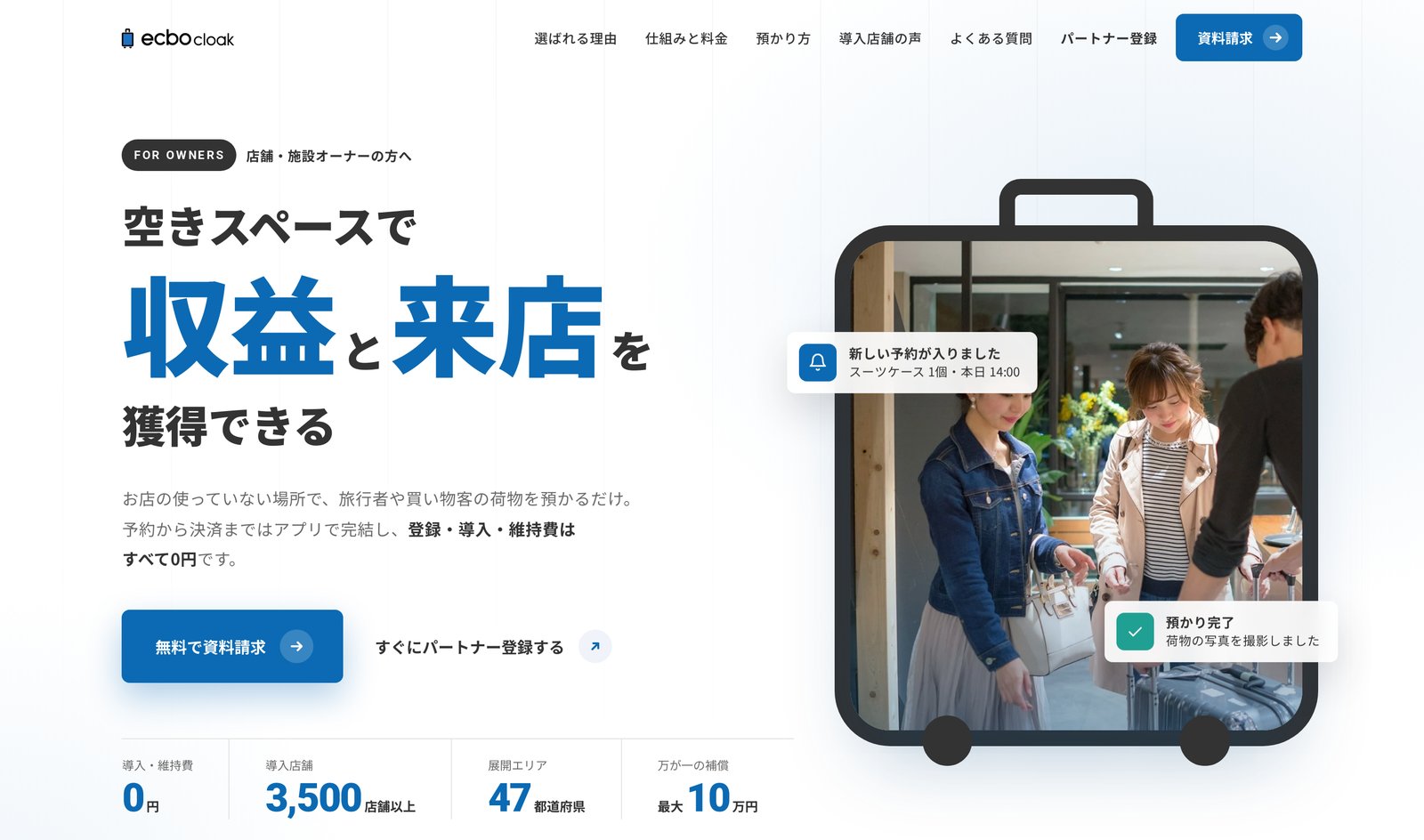
Source: ecbo cloak partner recruitment page (accessed November 4, 2026)
¥0 to Join, Just Take a Photo — How ecbo cloak Works and What It Costs
ecbo cloak is a sharing service that turns spare space in cafés, shops, tourist information centers, lodging facilities and similar venues into temporary luggage-storage points. Its operator, ecbo Inc., was founded in June 2015 (President and CEO Shinichi Kudo; Shibuya, Tokyo) and lists JR East, JR West, Japan Post, Amazon Japan and Keikyu Corporation among its main business partners. When the service launched in January 2017 at more than 100 cafés and shops in Tokyo, it was reported to be targeting “tourists who want to drop their bags before hotel check-in” — compatibility with hotels was built in from the start. Since August 2023 it has also operated in Taiwan.
Travelers use the app or website to choose an area, date/time and number of bags, find a host location, and complete the booking and card payment in advance. At the location they show the booking screen, staff photograph the luggage, and drop-off is done; at pickup the bags are matched against the photo in the app. Because no paper claim tickets are used, the common problem of lost claim tickets does not arise. There is no size limit — anything one person can carry, up to 20 kg, including strollers, musical instruments and sports equipment, can be stored. Cancellation is free until 23:59 the day before; same-day changes and cancellations are not accepted.
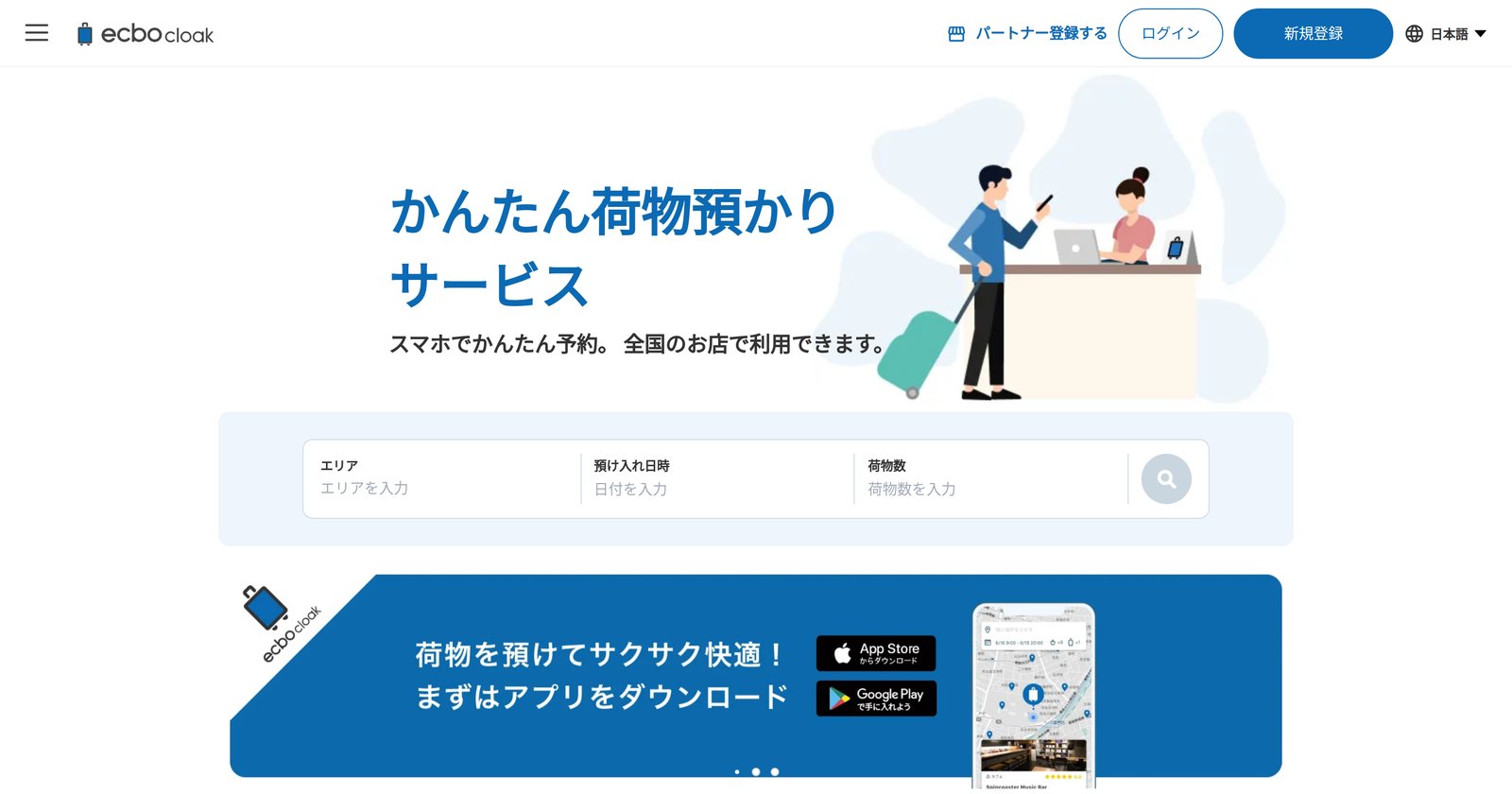
Source: ecbo cloak official website (accessed November 4, 2026)
The process on the hotel side is equally simple. After registering as an owner online and passing a review of whether the premises can manage luggage, the hotel registers its business hours and a cap on the number of bags it will accept; listing typically starts in about two weeks. ecbo cloak handles booking, payment and insurance, and the hotel only performs four steps on a smartphone: “check the booking → receive the bags → take a photo → hand the bags back.” Bookings beyond the cap are not accepted, so even a hotel with little space can start at its own pace. User fees minus commission are paid out at the end of the following month, with month-end closing (the commission rate is provided in the partner materials).
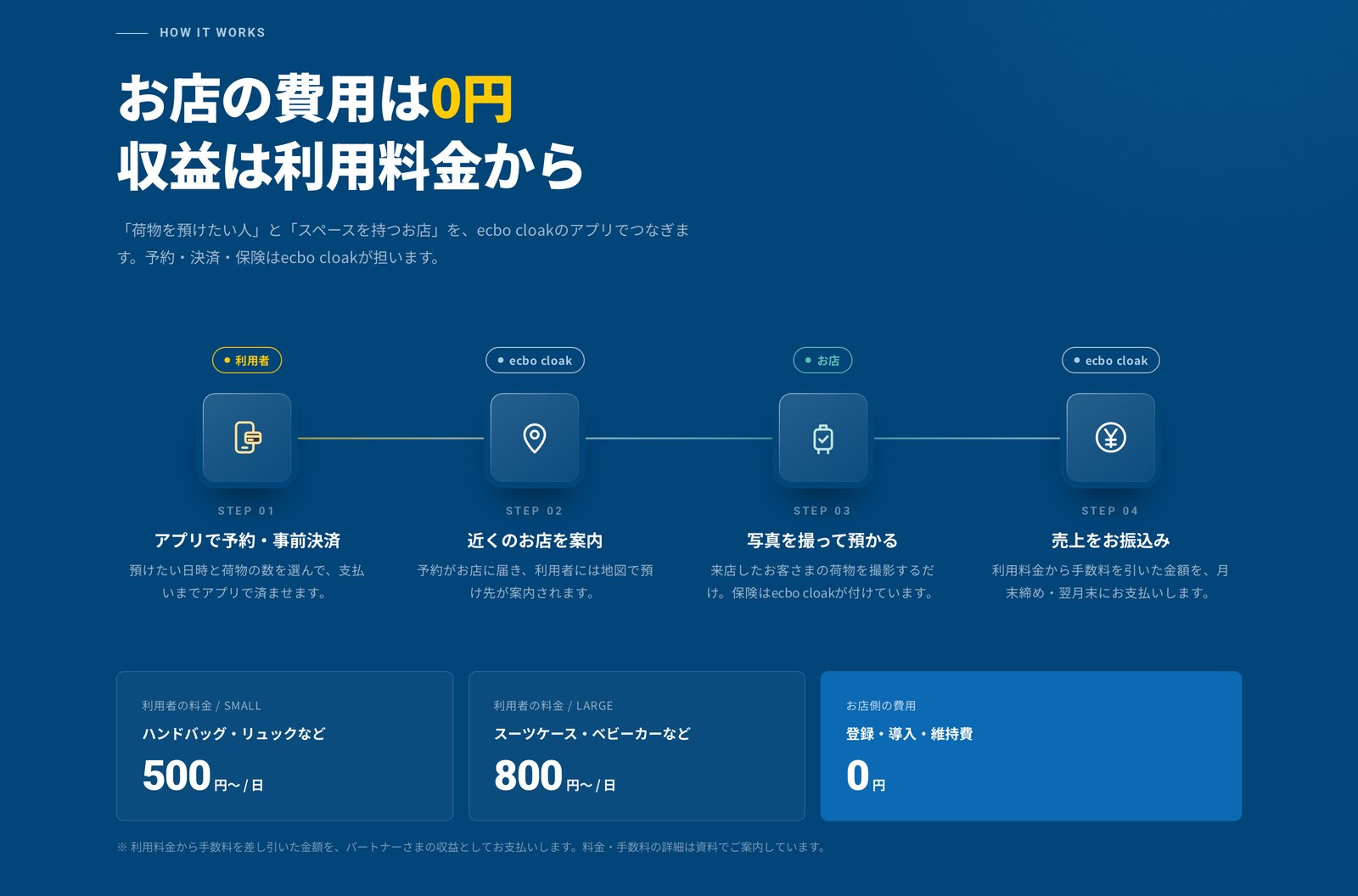
Source: ecbo cloak partner recruitment page (accessed November 4, 2026)
Safeguards are in place as well. A proprietary insurance policy arranged with Tokio Marine & Nichido covers loss, damage and theft of luggage up to ¥100,000 (subject to review; used items are valued at market value). Matching against the photo at handover prevents mix-ups, and according to company data there have been zero cases of loss or theft to date. Because the only on-site task is taking a photo, it is easy to serve overseas travelers even without a shared language. Point-of-sale materials such as posters and banners are also provided.
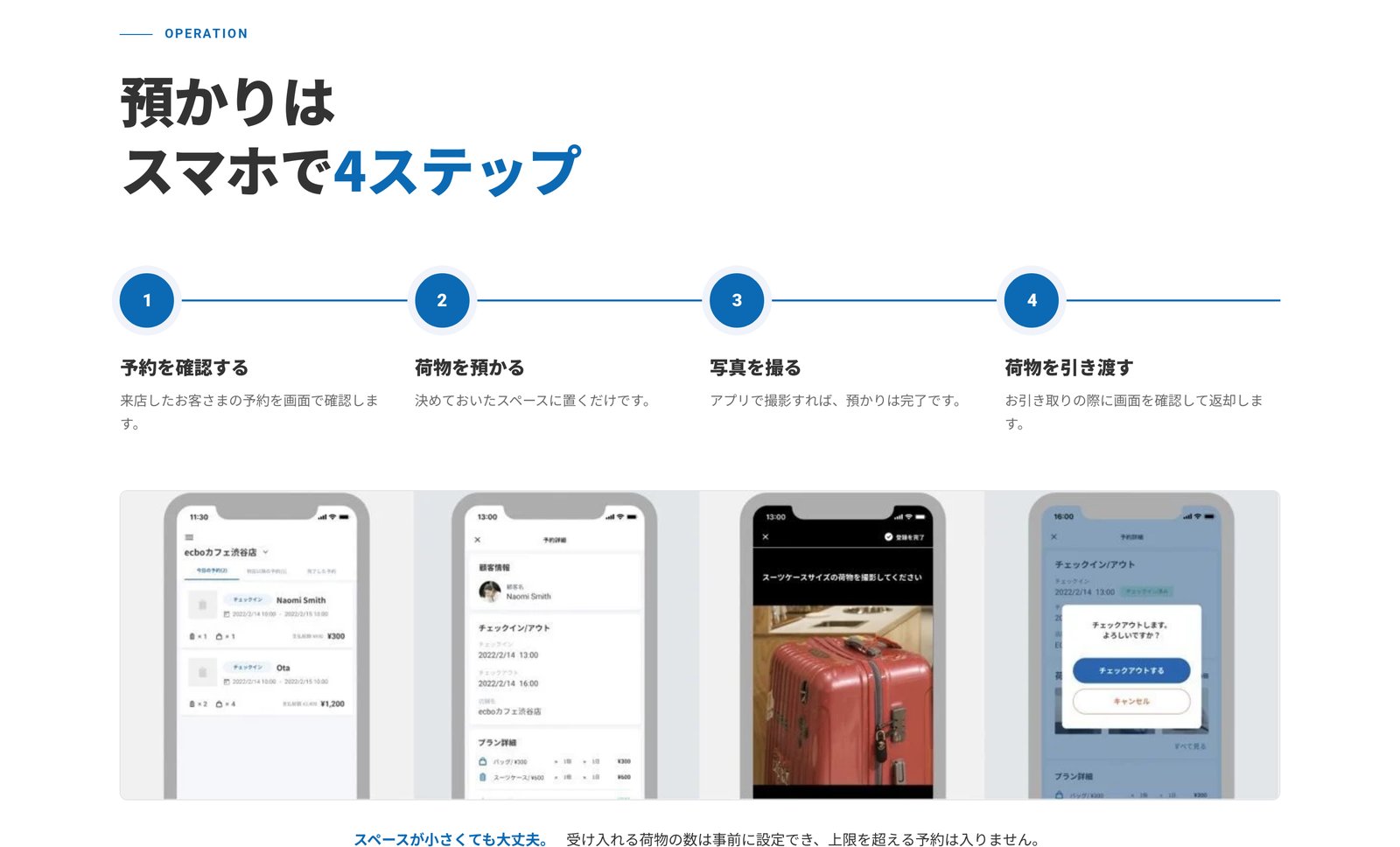
Source: ecbo cloak partner recruitment page (accessed November 4, 2026)
| Service | Category | Price (tax incl.) |
|---|---|---|
| Temporary storage (standard) | Bag (longest side under 45 cm) | From ¥500/day |
| Temporary storage (standard) | Suitcase (longest side 45 cm or more) | From ¥800/day |
| Temporary storage (exception) | Temporary counter at Tokaido Shinkansen Shinagawa Station (pilot, March 18 – June 17, 2026) | ¥1,400/item |
| Temporary storage (exception) | Daiichikosho karaoke outlets | ¥800/item/day (flat) |
| Same-day delivery (Tokyo) | Tokyo locations / lodging ⇄ Haneda Airport, 23 wards and Urayasu | 3 sides ≤120 cm ¥1,600 / ≤160 cm ¥2,100 / over 160 cm ¥3,700 |
| Same-day delivery (Kansai) | Official storage points → hotels in Osaka City/Amagasaki / Itami Airport area / central Kyoto | ¥1,500 / ¥2,000 / ¥2,500 (per item) |
Source: Compiled by the HotelBank Editorial Team from the ecbo cloak official website, partner recruitment page and press releases (as of November 4, 2026)
Same-day delivery is offered in Tokyo and Kansai. In Kansai, if the name on the request matches the name on the hotel reservation, luggage is delivered the same day from official storage points to hotels in Osaka City, the Itami Airport area and central Kyoto (private vacation rentals and unstaffed hotels are excluded). Guests can sightsee hands-free and find their bags waiting when they arrive at the hotel — an experience the hotel can offer without any additional investment.
Toward 3,500 Locations — A Network Spanning Railways, Convenience Stores and Airport Delivery
Tracking the published location counts, the network grew from 100+ stores in January 2017 to 1,000+ in November 2022, more than 2,500 locations in January 2026, and 3,500+ stores across 47 prefectures by July–August 2026. Much of the 2026 increase likely came from 7-Eleven: a rollout that began in December 2025 at 378 stores in 26 prefectures had reached 1,261 stores in 42 prefectures as of July 15, 2026. The closer storage points are to travelers, the more the habit of “dropping bags and moving light” spreads. Within that, hotels have an edge in areas that are hard for convenience-store large-item slots (suitcases only) to handle: strollers, musical instruments, golf bags, large volumes of group luggage, multi-day storage, and early-morning or late-night drop-offs.
Source: Compiled by the HotelBank Editorial Team from ecbo Inc. publications and media reports (figures as published at each point in time; all are lower bounds)
Laying out the 2026 developments chronologically shows two axes advancing at once: geographic expansion of storage points, and same-day delivery between airports and lodging facilities. Directly relevant to hotels are the pilot launched on March 9 with Keikyu Corporation and Vision for same-day delivery from drop-off points such as lodging facilities to Haneda Airport Terminal 3 (Keikyu EX Inn Tokyo-Nihombashi was cited as an example drop-off point; hotel guests only, until 11:00 on the day), and the Haneda Airport area “hands-free network” pilot that began on September 30 after being selected for a Japan Tourism Agency program. The latter brings together Keikyu Corporation, Ota City, Odakyu Electric Railway, Tobu Hotel Management and Yokohama City Air Terminal, with Tobu Group hotels in Tokyo (Kinshicho, Ginza, Shibuya, Shinagawa, etc.) and Keikyu EX Hotel Minatomirai Yokohama listed as partner points. As background, the company notes that Haneda Airport’s international passenger count hit a record 25.04 million in 2025 (+41% vs. 2019).
| 2026 | Development | Relevance to hotels |
|---|---|---|
| Jan 21 | Ninth anniversary: more than 2,500 locations and over 1 million cumulative users. In 2025 it was the official luggage storage and delivery provider for Expo 2025 Osaka, Kansai, connected with JR East Smart Logistics’ “Multi Ecube” multifunction lockers, and won an Excellence Award at the Japan Service Awards | Larger pool of travelers who can discover hosts |
| Jan 30 | Rolled out to 166 Daiichikosho karaoke outlets (Big Echo, etc.) in 32 prefectures. Station-front locations are “among the facilities used by the most users” | Shows the scale of storage demand at station-front sites |
| Feb 13 | Raised funds led by the Cool Japan Fund, which committed up to ¥1 billion. Daisey Holdings, DE-SIGN Capital and others also participated. Proceeds go to expanding in domestic regions where locations lag demand, developing logistics services, and overseas expansion | Opens the door wider for regional lodging facilities |
| Mar 9 | Launched a pilot with Keikyu Corporation and Vision for same-day delivery from drop-off points such as lodging facilities to Haneda Airport Terminal 3. Airport counter hours extended to 20:00. Same-day delivery from Haneda to lodging began as a pilot in August 2024 and went into full operation in March 2025 | Hotels become delivery drop-off points |
| Mar 18 | Storage and delivery pilot at Tokaido Shinkansen Shinagawa Station (through June 17). Delivery to lodging in the 23 wards and Urayasu (including private rentals) by around 20:00 on the day of drop-off | Shinkansen arrivals’ luggage goes straight to the hotel |
| Apr 1 | Began operating the “shibuya-san” tourist information center in Shibuya Fukuras (about 20,000 visitors a month) under contract from Tokyu Land. Same-day delivery to Haneda Airport and lodging also planned | Tourist information centers become delivery origins |
| Jun 26 | Announced rollout to the “TRDS” counter at Namba Marui (started June 29). Storage and nationwide shipping in one place | “Store + ship” combined |
| Jul 15 | 7-Eleven rollout reached 1,261 stores in 42 prefectures, including a start in Okinawa. Targets drop-off demand right after arrival, before check-in and after check-out | Confirms drop-off demand around check-in/check-out |
| Aug 17 | Opened a directly operated counter at Don Quijote Shinjuku Kabukicho. Storage 9:00–22:00; same-day delivery to the 23 wards, Urayasu and Haneda | Delivery network to Tokyo hotels expands |
| Sep 30 | Selected for the Japan Tourism Agency’s FY2026 program to promote area-wide visitor-reception environments, including preventing and curbing overtourism; launched the Haneda Airport area “hands-free network” pilot (through February 21, 2027) | Tobu Group hotels and Keikyu EX Hotel serve as partner points |
Source: Compiled by the HotelBank Editorial Team from ecbo Inc. press releases (January–September 2026) and LOGISTICS TODAY
Same-day delivery at Haneda goes back to the capital and business alliance between Keikyu Corporation and ecbo and the launch of their pilot. In Kansai, a luggage-delivery pilot based at Kansai International Airport (a Japanese-style in-town check-in) is also under way, and the creation of “hands-free” routes linking airports, stations and hotels is gaining real momentum in both Tokyo and Kansai.
Hotels Still Handle Luggage In-House — 1% Outside Partnership Leaves Headroom
Data on conditions at hotels come from the “Domestic Quantitative Survey Report for the Demonstration Project Toward Building a Japanese-Style In-Town Check-in (Hands-Free Tourism) from Kansai,” published by the Kinki District Transport Bureau on October 17, 2025. In a web survey of 164 lodging operators (June 13 – July 14, 2025) asking which front-desk tasks were most burdensome (multiple answers), 65% cited handling inquiries, 43% check-in, 42% luggage delivery, and 38% luggage storage. Luggage-related tasks are seen at the front desk as a burden on par with check-in.
The tendency is especially strong among properties with 150–299 rooms (delivery 61%, storage 46%) and those where foreign guests make up 70% or more (delivery 64%, storage 50%). 43% of all properties store “21 or more” bags a day, rising to 67% among 150–299-room properties; the share of guests who drop luggage before check-in was “10% to under 30%” at 32% of properties and “30% to under 50%” at 29%. At 66% of properties, check-in queues form every day. If luggage handover can be lightened with a system, the front desk can focus correspondingly more on check-in and guest service.
Source: Compiled by the HotelBank Editorial Team from the Kinki District Transport Bureau’s “Domestic Quantitative Survey Report for the Demonstration Project Toward Building a Japanese-Style In-Town Check-in (Hands-Free Tourism) from Kansai” (October 2025) (lodging operators n=164, multiple answers; subgroups limited to segments with n≥30)
Adoption of outside services, meanwhile, has barely begun. While 57% of properties partner with a delivery company, only 1% partner with a luggage-storage provider. On fees, only 3% already charge for luggage storage, while 29% would like to start charging (“strongly agree” plus “somewhat agree”); among properties with 70%+ foreign guests, “strongly agree” reaches 17%, above the overall 10%. At many properties storage is still run free of charge, in-house, with paper claim tickets — which means the room to bring in an outside system is correspondingly large.
Source: Compiled by the HotelBank Editorial Team from the Kinki District Transport Bureau’s “Domestic Quantitative Survey Report for the Demonstration Project Toward Building a Japanese-Style In-Town Check-in (Hands-Free Tourism) from Kansai” (October 2025) (lodging operators n=164)
The most common storage problems are lost claim tickets (35%) and damaged luggage (31%; 48% among properties with 70%+ foreign guests). Benefits expected if delivery use grows include higher guest satisfaction (46%) and freed-up space as fewer bags are stored (38%), and 81% of properties cited at least one benefit. The most common concern was added front-desk workload (71%). In other words, frontline staff understand the value of hands-free travel; what they want is “a system that delivers it without adding front-desk hands.” ecbo cloak, which outsources booking, payment, language support and compensation, is one option that fits this requirement. For options that reduce front-desk work itself with equipment, and their payback periods, see our analysis Japan Labor-Saving Subsidy: Hotel 3-Year Payback Line 68 to 34 Rooms.
Four Benefits for Hotels
Using ecbo cloak benefits hotels on four fronts: revenue, customer acquisition, guest experience and operational efficiency.
Benefit 1: Unused space becomes ancillary revenue
Cloakrooms and back-of-house areas that sit empty during the day can be opened as paid capacity for non-guests’ luggage. Registration, onboarding and maintenance cost nothing, and the hotel sets its own cap on bags, so it can start small and scale with demand.
Benefit 2: People dropping off bags become on-site customers
Through the map and app, travelers and shoppers who had no prior contact with the hotel come through its doors. According to company data, about 30% dine or shop while dropping off their bags, driving visits to ground-floor cafés, restaurants and shops. Displaying a store coupon banner on the booking-confirmation screen can also be discussed. Getting the hotel’s name and location known can also prompt future stay bookings.
Benefit 3: Guests can sightsee and travel hands-free
By pointing guests to same-day delivery in Tokyo (Haneda Airport ⇄ 23 wards and Urayasu) and Kansai (official storage points → Osaka City, the Itami Airport area and central Kyoto), hotels let guests sightsee without luggage after check-out or on arrival day. In the survey, higher guest satisfaction (46%) was the most frequently cited benefit of delivery use.
Benefit 4: A system lightens front-desk luggage handling
By partnering with ecbo as a delivery drop-off point, as Keikyu EX Inn Tokyo-Nihombashi and Tobu Group hotels have, the hotel leaves online booking, prepayment and multilingual reception to ecbo and only handles the handover. On days when the cloakroom is full, simply directing guests to a nearby ecbo cloak location can solve their problem.
| Pain point (Kinki District Transport Bureau survey) | ecbo cloak mechanism |
|---|---|
| Lost claim tickets (35%) | Bags are matched by photo; no paper claim tickets |
| Damaged luggage (31%; 48% at properties with 70%+ foreign guests) | Proprietary insurance with Tokio Marine & Nichido covers up to ¥100,000 (subject to review; used items at market value) |
| Handling luggage delivery (42%) | ecbo handles online booking, prepayment and multilingual reception; the hotel only does the handover |
| Foreign-language support | The store’s only task is taking a photo; users complete booking and payment in a multilingual app |
| Paid storage hasn’t caught on (only 3% charge) | Guests keep free storage as before, while non-guests can be served as paid storage via the app |
Source: Compiled by the HotelBank Editorial Team from the Kinki District Transport Bureau domestic quantitative survey report (October 2025) and the ecbo cloak official website and partner recruitment page
Drawing the pricing line is particularly straightforward. For storage booked through ecbo cloak, users agree to the fee in the app and prepay, so the front desk never has to handle cash or explain charges. An operating rule of “guests free as before, non-guests paid via the app” is easy to understand for both staff and users.
Ancillary Revenue at Zero Cost — ¥240,000 a Month at 10 Bags a Day
The HotelBank Editorial Team estimated indicative ancillary revenue from the published prices. Multiplying daily bag count by the ¥800 suitcase rate and summing over 30 days, total user fees come to ¥72,000 a month at 3 bags a day, ¥120,000 at 5, ¥240,000 at 10, and ¥480,000 at 20. The hotel receives this amount minus commission; the commission rate is provided in the partner materials. Since there are no onboarding or maintenance costs, every booking adds directly to income.
Source: HotelBank estimate based on ecbo cloak’s published price (suitcase ¥800/day). Totals before commission
The value goes beyond storage fees. According to company data, about 30% of users dine or shop while dropping off bags, so for hotels with a ground-floor café, restaurant or retail, storage becomes a gateway to on-site spending. Simply appearing on travelers’ maps and apps is itself a free touchpoint that raises the hotel’s visibility. Combined with promoting same-day delivery to guests, it can be positioned as a measure that lifts ancillary revenue, on-site spending and guest satisfaction at the same time.
Best-Fit Hotels — Near Stations, Tourist Sites and Event Venues
The features the company cites for “locations that attract bookings” are wide reception hours, same-day and multi-day booking, ample storage space, English support, ground-floor access or an elevator, and well-stocked photos and reviews. Hotels with a 24-hour front desk that are used to handling large luggage meet many of these conditions from day one. In the Daiichikosho case, station-front locations were described as “among the facilities used by the most users,” and guesthouses are already a major listing category.
| Hotel characteristics | Why it fits |
|---|---|
| Limited-service / business hotels, hostels and guesthouses near major stations, airport-access stations or tourist sites | Station-front sites are among the most used locations, and guesthouses are a major listing category |
| 24-hour front desk, ground floor or elevator, cloakroom empty during the day | Wide reception hours and easy access make bookings more likely |
| Ground-floor café, restaurant or retail | About 30% dine or shop while dropping off bags (company data) |
| Near arenas, domes or convention facilities | About 80% of users are domestic (HotelBank calculation from company data), so there is demand from concert and event attendees |
| Full-service hotels | Easy to start by partnering as a delivery drop-off point or by referring guests to nearby locations when full |
| Hotels with congested check-in/check-out hours | Setting reception hours and bag caps outside peak times keeps operations manageable |
Source: Compiled by the HotelBank Editorial Team from the ecbo cloak partner recruitment page, ecbonist (articles for owners) and ecbo Inc. press releases
Overseas users account for about 20% (company data); the remaining roughly 80% are domestic travelers, business travelers and shoppers. Opportunities therefore exist not only in inbound-heavy areas but also for hotels in locations that draw domestic event and business-travel demand. Note that having staff on site who can manage luggage is a condition of registration.
Tips for a Smooth Start
Keeping the following points in mind makes it easier to get operations up and running.
| Item | Tip |
|---|---|
| Bag cap and reception hours | Set the cap to fit your space and schedule reception hours outside check-in/check-out peaks to balance it with guest service |
| A complete listing page | Photos of the exterior, reception and signage (stickers, banners) plus on-site perks make bookings more likely |
| Share compensation and usage rules | Compensation is up to ¥100,000 (subject to review) and excludes valuables. Make sure staff know rules such as no same-day cancellations and a maximum of 5 days for unclaimed bags |
| Check contract terms | Confirm the commission rate, pricing, and — under management or lease agreements — who receives the ancillary revenue, using the partner materials and contracts |
Source: Compiled by the HotelBank Editorial Team from the ecbo cloak official website, partner recruitment page and ecbonist (articles for owners)
Demand is also a tailwind. JNTO estimates that visitor arrivals to Japan exceeded 42 million in 2025, and Haneda Airport’s international passenger count set a new record. In 2026 the mix of source markets has shifted (January–September arrivals were 30,730,200, down 2.9% year on year, with China declining while Korea rose 25.6% and Taiwan 13% in September). Together with demand from domestic leisure and business travelers — about 80% of ecbo cloak users — the desire to drop luggage and move light is spreading across a wide range of travelers.
How to Start — Listed About Two Weeks After Applying
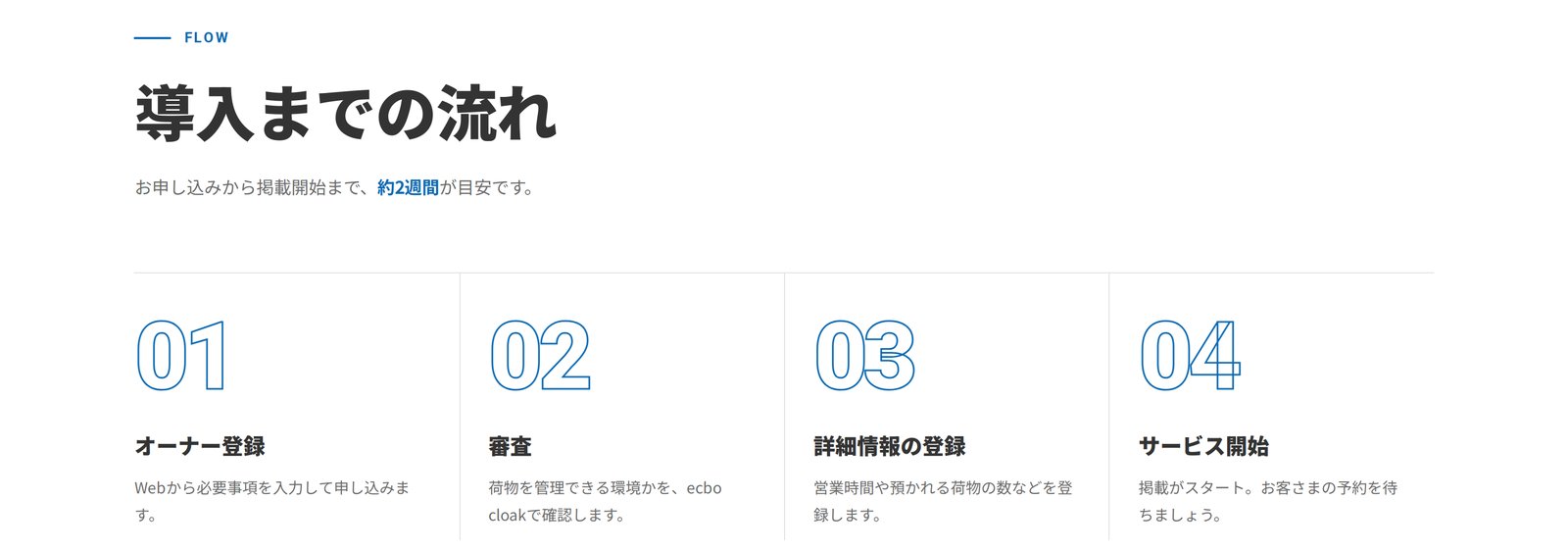
Onboarding has four stages: owner registration online, review by ecbo, registration of details such as business hours and the number of bags accepted, and service launch. Listing typically begins about two weeks after applying. A 21-page partner brochure covering the mechanism, costs, compensation and onboarding flow can be requested free of charge from the official page and used as-is for internal review.
Source: ecbo cloak partner recruitment page (accessed November 4, 2026)
A practical approach is to start with one or two properties — for example, limited-service hotels in front of stations — capping bags at 5–10 and running for about three months. Watching daily bookings, storage revenue, spillover into on-site dining and retail, and front-desk time spent, the hotel can then decide whether to expand storage as a listed location or to focus on partnering as a delivery drop-off point. Properties in Tokyo or Kansai can start promoting same-day delivery to guests at the same time. With the Japan Tourism Agency backing hands-free tourism pilots through its budget for area-wide visitor-reception environments, now is a good time for hotels to take on new luggage services.
ecbo cloak partner registration and brochure request
Registration, onboarding and maintenance are free. The 21-page partner brochure covering the mechanism, costs, compensation and onboarding flow can be requested free of charge from the official page.
Summary — Turning Hotels’ Spare Space into Travelers’ Freedom and Revenue
With zero onboarding cost and a photo as the only task, ecbo cloak turns hotels’ spare space into luggage-storage points. Its network has grown to 3,500+ locations nationwide and more than 1 million cumulative users, and in 2026 it extended into convenience stores, karaoke outlets and airport delivery. For hotels it offers four benefits: monetizing spare space, on-site spending by people dropping off bags, hands-free travel for guests, and more efficient front-desk operations. The fact that properties find luggage handling burdensome yet only 1% partner externally means, conversely, that hotels moving early have the most room to be chosen by travelers. Hotels near stations, tourist sites or event venues should start with a small listing and test the impact alongside promoting same-day delivery to guests.
Frequently Asked Questions
Q. Does becoming an ecbo cloak host cost the hotel anything?
Registration, onboarding and maintenance are all free. User fees minus commission are paid to the hotel at the end of the following month, with month-end closing. The commission rate is provided in the partner materials.
Q. Can a hotel with little space get started?
Yes. The number of bags accepted can be set in advance (e.g., “up to 3”), and bookings beyond the cap are not taken, so storage can be matched to the available space.
Q. We are not confident handling foreign languages. Is that a problem?
The only on-site task is photographing the luggage, and users complete booking and payment in a multilingual app, so it works even without a shared language. Enabling the English-support setting makes the location more likely to be chosen by overseas travelers.
Q. How much revenue can be expected?
By HotelBank’s estimate, storing 10 bags a day at the ¥800 suitcase rate yields total user fees of ¥240,000 a month (before commission). In addition, company data show about 30% of users dine or shop while dropping off bags, so spillover into on-site spending can also be expected.
Q. What compensation applies if luggage is lost or damaged?
A proprietary insurance policy arranged with Tokio Marine & Nichido covers loss, damage and theft up to ¥100,000. Claims are subject to review, and used items are valued at market value. Valuables and cash cannot be stored.
Methodology and Sources
Statements about ecbo cloak in this article are based on the company’s user website, partner recruitment page, company profile and press releases as reviewed on November 4, 2026. Screenshots were taken from the company’s official website (user home page and partner recruitment page) on November 4, 2026. Location counts use the lower-bound figures (“or more,” “over”) published by the company at each point in time; the four points in the trend chart are the published figures for January 2017, November 2022, January 2026 and July–August 2026. Figures on luggage-handling burden at hotels are tabulations of the lodging-operator sample (n=164) in the domestic quantitative survey report published by the Kinki District Transport Bureau on October 17, 2025, with subgroups limited to segments with n≥30 that the report analyzed. The revenue estimate is the pre-commission total obtained by multiplying the company’s published suitcase rate of ¥800/day by daily bag count and 30 days.
Related Articles
- 1,592 Openings in 2026, Half Single-Room: Japan’s No-Front-Desk Shift
- Japan Labor-Saving Subsidy: Hotel 3-Year Payback Line 68 to 34 Rooms
References and Sources
■ ecbo Inc. (official)
- ecbo cloak user website (pricing, FAQ, same-day delivery)
- ecbo cloak partner recruitment (for store and facility owners)
- ecbo Inc. company profile
- Press release: “Fundraising” (February 13, 2026)
- Press release: “7-Eleven passes 1,000 stores” (July 15, 2026)
- Press release: “Directly operated counter at Don Quijote Shinjuku Kabukicho” (August 17, 2026)
- Press release: “Haneda Airport area hands-free network pilot” (September 30, 2026)
- Press release: “Same-day delivery to Haneda Airport with Keikyu and Vision” (March 9, 2026)
- Press release: “Pilot at Tokaido Shinkansen Shinagawa Station” (March 18, 2026)
- Press release: “Operation of shibuya-san begins” (April 1, 2026)
- Press release: “Rolled out to 166 Daiichikosho outlets” (January 30, 2026)
- Press release: “Namba Marui TRDS” (June 26, 2026)
- ecbonist: “[For owners] What makes a location attract bookings?” (November 7, 2018)
■ Government statistics and public sources
- Kinki District Transport Bureau, “Domestic Quantitative Survey Report for the Demonstration Project Toward Building a Japanese-Style In-Town Check-in (Hands-Free Tourism) from Kansai” (October 17, 2025)
- JNTO, “Visitor Arrivals to Japan (December 2025 estimates)” (January 21, 2026)
■ News and industry media
- LOGISTICS TODAY, “ecbo cloak marks ninth anniversary” (January 22, 2026)
- THE BRIDGE, “ecbo cloak launches at 100+ cafés and other stores in Tokyo” (January 2017)
- GOLD ONLINE, “Growing revenue and traffic with zero ad spend: a luggage-storage service” (November 28, 2022)
- Travel Voice, “Foreign visitors to Japan down 5% to 3.1 million in September 2026” (October 21, 2026; JNTO preliminary figures)
- HotelBank estimate — total storage fees estimated from ecbo cloak’s published prices (before commission)