

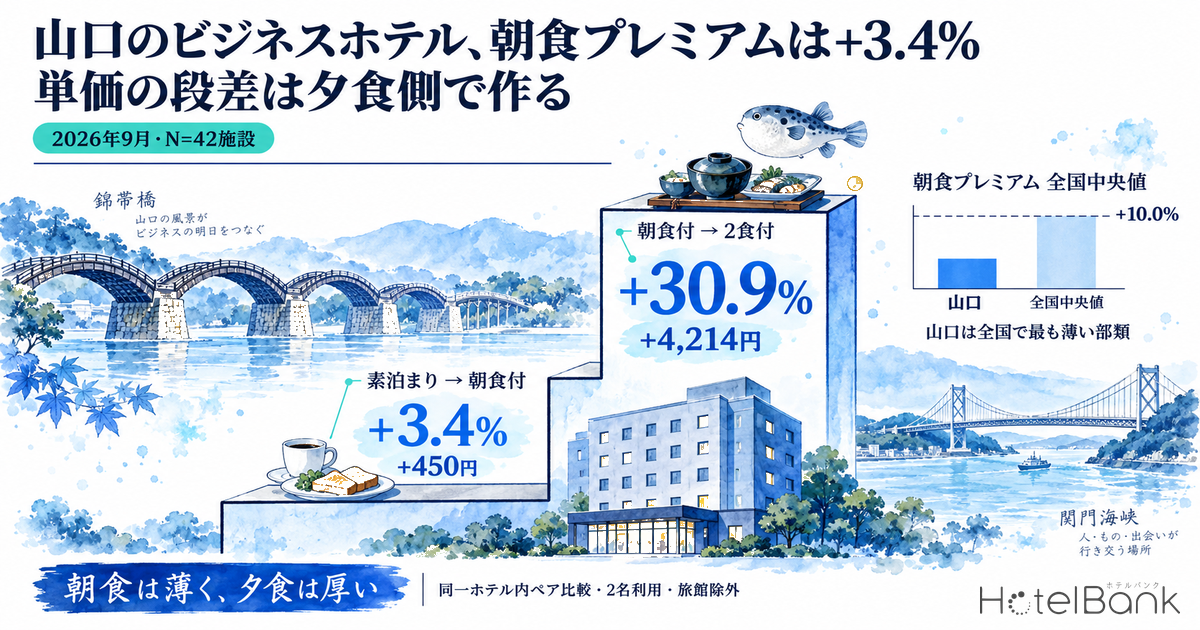
At business hotels in Yamaguchi Prefecture, adding breakfast lifts the rate by just +3.4% (+¥450; N=42 properties). Against a 47-prefecture median of +10.0% for the same month, September 2026, Yamaguchi’s breakfast premium is among the thinnest in Japan. In the same market, however, half board (dinner and breakfast) carries +30.9% over breakfast-included (+¥4,214; N=23 properties), and +32.8% over room-only (+¥4,704; N=17 properties). Even in a market where breakfast barely moves the rate, the dinner side still offers a clear step up the price ladder—and that is the starting point for product design at Yamaguchi’s business hotels.
Scope: business hotels in Yamaguchi Prefecture. Meal premiums use a within-hotel paired comparison, N=42 properties (breakfast-included vs room-only, September 2026); estimated settled ADR uses N=96–100 properties. Price metrics in this article are estimated settled ADR (the settled-price level estimated from OTA and other sales data, tax-exclusive equivalent); occupancy, where mentioned, is an estimate based on OTA-listed inventory. Definitions are given at the end of the article. Data as of September 21, 2026.
- — The breakfast premium is +3.4% (+¥450; N=42 properties)—about one-third of the 47-prefecture median of +10.0%, and the second-thinnest in Japan (September 2026).
- — Half board, by contrast, carries +30.9% over breakfast-included (+¥4,214; N=23 properties) and +32.8% over room-only (+¥4,704; N=17 properties). In yen terms that is about 9.4x the breakfast premium.
- — The asymmetry is not temporary. Over the five months from May to September 2026, breakfast stayed in single digits at +3.4% to +6.6%, while half board held steady at +30.3% to +31.2%; the two ranges never overlap.
- — The prefecture splits internally. Ube +11.3% (N=8) and Yamaguchi City +6.1% (N=10) contrast with Shunan −3.2% (N=5) and Shimonoseki −4.0% (N=9), where the data include days on which breakfast-included sells below room-only.
- — The underlying estimated settled ADR (finalized values) runs ¥6,005–¥6,987 (N=96–100 properties). Seven of the eight months from January to August 2026 were up year over year, so the rate base itself is edging higher.
Reading Meal Premiums — A Within-Hotel Paired Comparison
Comparing meal-plan premiums as simple averages across the whole market mixes in a selection bias: properties that sell meal plans may simply sit in a higher price tier to begin with. This article therefore uses a paired comparison: only properties that sell both a room-only plan and a meal-inclusive plan are extracted, the price difference is taken within each property, and those differences are then aggregated. Because property-specific conditions such as location, building age and room grade are shared by both sides of the pair, the remaining gap comes close to “the uplift from adding the meal.”
The basis is double occupancy, and ryokan are excluded (for ryokan, half board is the standard product, so pairs with room-only rarely form). Every figure is shown with N, the number of properties for which that pair could be formed. Pairs with small N are treated as reference values, and pairs with N below 5 are not cited.
For business hotels in Yamaguchi Prefecture in September 2026, the pairs that could be formed are listed below.
| Pair compared (within the same hotel) | Difference | Premium | N (properties with the pair) |
|---|---|---|---|
| Breakfast-included vs room-only | +¥450 | +3.4% | 42 |
| Half board vs breakfast-included | +¥4,214 | +30.9% | 23 |
| Half board vs room-only | +¥4,704 | +32.8% | 17 |
| Dinner-only vs room-only (reference value) | +¥5,841 | +40.5% | 6 |
September 2026, Yamaguchi Prefecture, business hotels, double occupancy, ryokan excluded. Source: compiled by HotelBank Editorial Team from MetroEngines Research data.
Read the four rows top to bottom and the price ladder is strikingly lopsided. The first step, from room-only to breakfast-included, is a shallow +¥450; the second, from breakfast-included to half board, is +¥4,214—about 9.4x larger in yen terms. The dinner-only pair (no breakfast) has a thin N=6 and is treated as a reference value, but at +40.5% over room-only it points in the same direction.
For reference, city hotels in the same prefecture achieve a thicker breakfast uplift than business hotels: +11.9% (+¥1,986; N=5 properties) for breakfast-included vs room-only. With only N=5, however, that figure is not precise enough to be set alongside the business-hotel N=42.
Breakfast Premium in Single Digits for Five Straight Months; Dinner Side Steady at ~30%
To check whether this structure was a September fluke, the same method was applied to each of the five months from May to September 2026. The result is clear: the breakfast premium stayed in single digits throughout (+3.4% to +6.6%), while the half-board premium over breakfast-included barely moved, within a +30.3% to +31.2% range.
Yamaguchi Prefecture, business hotels, within-hotel paired comparison, double occupancy, ryokan excluded. Source: compiled by HotelBank Editorial Team from MetroEngines Research data.
The number of properties forming each pair was nearly constant month to month: 42–45 for the breakfast pair and 22–23 for the half-board pair. So the pattern is not an artefact of a changing sample; the same set of hotels held the same shape for five months. In yen terms, too, the breakfast premium ran +¥450 to +¥859 and the half-board premium +¥3,996 to +¥4,214, with no overlap between the ranges.
Next, break the prefecture down one level further. As of September 2026, four municipalities had at least five properties forming the pair, and their breakfast premiums diverge as follows.
| Municipality | Breakfast-included vs room-only: difference | Premium | N |
|---|---|---|---|
| Ube | +¥1,285 | +11.3% | 8 |
| Yamaguchi City | +¥838 | +6.1% | 10 |
| Shunan | −¥469 | −3.2% | 5 |
| Shimonoseki | −¥600 | −4.0% | 9 |
September 2026, business hotels, within-hotel paired comparison, double occupancy. Source: compiled by HotelBank Editorial Team from MetroEngines Research data.
Between Ube’s +11.3% and Shimonoseki’s −4.0%, breakfast works as a completely different product within the same prefecture. The negative figures for Shimonoseki and Shunan mean that in these markets breakfast-included is “cheaper than room-only on some days.” Because the comparison is within the same hotel, this reflects not a difference in property mix but days on which a property’s own breakfast-included and room-only plans are priced the other way round. Across May–September, Shimonoseki flips sign from month to month (−4.0% in September, +4.1% in August, −0.0% in July), and Shunan moves within a narrow −3.2% to −0.2% band. These are best understood as markets where the breakfast uplift is structurally thin.
Neighbouring Prefectures — Where Yamaguchi Sits: “Thin on Breakfast, Thick on Dinner”
Running the same breakfast paired comparison for business hotels across all 47 prefectures gives a September 2026 median of +10.0% (47 prefectures; N=14–358 properties per prefecture). Yamaguchi’s +3.4% ranks second from the bottom. The other Chugoku-region prefectures are all in double digits: Hiroshima +10.0% (N=65), Shimane +10.8% (N=25), Okayama +12.5% (N=39) and Tottori +13.5% (N=22). Across the strait in Kyushu, Fukuoka also beats Yamaguchi at +8.0% (N=145).
Shift the lens to the half-board premium over breakfast-included, however, and the order reverses.
September 2026, business hotels, within-hotel paired comparison, double occupancy, ryokan excluded. N (breakfast pair / half-board pair): Yamaguchi 42/23, Hiroshima 65/21, Shimane 25/7, Okayama 39/10, Tottori 22/13, Fukuoka 145/49. Source: compiled by HotelBank Editorial Team from MetroEngines Research data.
Yamaguchi’s half board vs breakfast-included premium of +30.9% (N=23) exceeds Hiroshima +26.8% (N=21), Fukuoka +27.3% (N=49), Okayama +27.0% (N=10) and Tottori +28.5% (N=13). Shimane is higher still at +39.6%, but with N=7 it remains a reference value. In other words, Yamaguchi’s business-hotel market has a clear asymmetry: breakfast is harder to monetise here than in any neighbouring prefecture, while products that include dinner earn as much as or more than their neighbours.
This asymmetry indicates where the centre of gravity of a rate strategy should sit. A breakfast premium of +3.4% (+¥450) means that, once the food and labour cost of serving breakfast is considered, a breakfast-included plan functions less as a product that lifts the rate and more as a same-price-band option to avoid losing guests who would otherwise book room-only. Structurally, the job of building steps in the price ladder falls to the dinner side.
The Price Base — Estimated Settled ADR for Yamaguchi Business Hotels
It is also worth checking the base on which the meal premiums sit. The estimated settled ADR (finalized values) for Yamaguchi business hotels ranged from ¥6,005 to ¥6,987 between January and August 2026 (N=96–100 properties), and seven of the eight months were up year over year.
Yamaguchi Prefecture, business hotels, estimated settled ADR (finalized values, tax-exclusive equivalent). N=96–100 properties. Source: compiled by HotelBank Editorial Team from MetroEngines Research data.
Year-over-year changes between finalized months: January 2026 +9.9% (¥6,253 vs ¥5,690), February +3.1%, March +1.7%, April +0.9%, May +3.0%, June +1.9%, August +4.7% (¥6,987 vs ¥6,674). Only July fell, by −10.0% (¥6,046 vs ¥6,721). Across the year, the pattern of a peak in May followed by a dip in June has held for two years running, and the summer high for the year came in July–August in 2025 and in August in 2026. For a by-segment look at the first half, including city hotels in Yamaguchi, see our detailed analysis Yamaguchi Settled ADR H1 2026: Business +3.4%, City Hotels −6.4%.
Estimated settled ADR from October onward is a provisional estimate based on current sales (October ¥9,121, N=95 properties; November ¥9,024, N=96; December ¥8,635, N=93) and is on a different basis from the finalized values. A like-for-like comparison has to wait for those months to be finalized, so they are not included in the chart.
For winter demand context, Yamaguchi Prefecture has a tourism season built around winter delicacies, led by fugu (pufferfish) (Yamaguchi Prefecture Tourism Federation, “Fugu is best in its home, Yamaguchi: from full-course meals to casual lunches” (in Japanese)). In a market where the dinner-side premium holds steady at around 30%, local ingredient seasons offer an easy angle for designing dinner products.
For Revenue Managers at Yamaguchi Business Hotels — Implications and Action Plan
1. Reset the breakfast-premium target to the market level. Line up your own breakfast-included and room-only plans for the same dates and the same room type and check the difference. The market level for Yamaguchi business hotels is +3.4% (+¥450; N=42 properties), and it stayed in single digits across all five months. Setting the national median of +10.0% as the target keeps the discussion running on an unachievable premise. First establish where your own difference sits relative to the market’s +¥450, then make an explicit decision: is breakfast there to “earn”, or purely to prevent lost bookings?
2. The room to build price steps is on the dinner side. In the same market, half board vs breakfast-included is +30.9% (+¥4,214; N=23 properties) and half board vs room-only is +32.8% (+¥4,704; N=17 properties). The drop in paired properties from 42 to 23 means that relatively few properties sell a product that includes dinner. For hotels without a dinner product, there is room to stack one more step on top of the existing breakfast-included plan.
3. Take location-driven differences in breakfast value as a given. Even within the prefecture, breakfast plays a different role in Ube (+11.3%, N=8) and Shimonoseki (−4.0%, N=9). Which type of market your hotel is in changes the decision of whether to polish breakfast as a rate-building product or to redirect investment to dinner and in-house food and beverage. In areas where the market premium runs negative, simply having an operating rule that never lets breakfast-included drop below room-only leaves room for improvement.
4. The price base is rising gradually. On a finalized-month basis, estimated settled ADR was up year over year in seven of eight months (e.g. January +9.9%, August +4.7%; N=96–100 properties). When the base is moving, adding meal products both lifts the rate and creates inventory in price bands that room-only alone cannot reach. The two-year pattern of a peak in May, a dip in June and the year’s high in summer (July–August) is a useful guide when building a rate-revision calendar.
The concrete actions that follow are organised by time horizon below.
| Horizon | Action | Decision trigger | Aim |
|---|---|---|---|
| Today to this week | List the difference between your breakfast-included and room-only plans for every date, on the same date and the same room type | If the difference is negative on even one day | Eliminate price inversions. Even at the market’s thin +¥450 level, the premise is that the two are never inverted |
| Today to this week | Align the team on a single definition of breakfast-included: a “rate-building product” or an “option to prevent lost bookings” | If your breakfast difference is below the market level of +3.4% / +¥450 | Avoid discussions stalling on an unachievable target |
| Within 2 weeks | Inventory whether you have a product line that includes dinner; if not, list the formats you could offer (in-house, partner restaurants, meal vouchers, etc.) | If your current plans stop at two steps: room-only and breakfast-included | Stop leaving no product in the tier where the market shows a +30.9% step |
| Within 2 weeks | Compare your own difference with the breakfast premium of your municipality (Ube +11.3% / Yamaguchi City +6.1% / Shunan −3.2% / Shimonoseki −4.0%) | If your difference deviates widely from your area’s level | Re-anchor on the actual level in your area rather than the prefectural average |
| Toward next month | Fix the allotment and service dates for dinner-inclusive products around the winter ingredient season first, then work back to the on-sale date | If you currently hold not a single dinner-inclusive allotment for December or January | Avoid entering the demand season with the upper price tier left empty |
| Toward next month | Build next year’s rate-revision timing into a calendar, based on the two-year pattern of a May peak, a June dip and a summer high | If your rates remain below the latest finalized month (August 2026, estimated settled ADR ¥6,987) | Build the seasonal shape in ahead of time rather than chasing it |
Source: compiled by HotelBank Editorial Team from MetroEngines Research data.
None of these actions comes with a guaranteed effect; whether they work depends on each hotel’s cost structure, operating set-up and location. Dinner products in particular are heavily constrained by kitchen capacity and service hours, so designing one in a hurry purely because of the price step tends to put the load on operations.
Summary — Three Yardsticks
When reading the Yamaguchi business-hotel market through meal premiums, three yardsticks can be used again and again.
Yardstick 1: the breakfast uplift is +3.4% (+¥450) in practice. It held in single digits across the five months from May to September (N=42–45 properties) and is on a clearly different level from the 47-prefecture median of +10.0%. Benchmark against your own prefecture’s actual level, not the national average.
Yardstick 2: the price step is on the dinner side. Half board vs breakfast-included is +30.9% (+¥4,214; N=23 properties), about 9.4x the breakfast premium in yen. It stayed within a +30.3% to +31.2% range for five months and is higher than in neighbouring prefectures (Hiroshima +26.8%, Fukuoka +27.3%, Okayama +27.0%, Tottori +28.5%).
Yardstick 3: the underlying ADR is edging up. On a finalized-month basis, seven of eight months were up year over year, within a ¥6,005–¥6,987 range (N=96–100 properties). The annual shape: a peak in May, a dip in June, and the year’s high in summer (July–August).
A thin breakfast premium does not mean rates cannot be raised in this market. The numbers simply show a market in which the place to build the price step is not breakfast but dinner.
Frequently Asked Questions
Q. How much does adding breakfast raise the rate at business hotels in Yamaguchi Prefecture?
A. As of September 2026, +3.4% (+¥450). The figure comes from a paired comparison of 42 properties that sell both room-only and breakfast-included plans (double occupancy, ryokan excluded), and it is far below the 47-prefecture median of +10.0%. Across the five months from May to September 2026 it stayed in single digits at +3.4% to +6.6%, so it is not a one-month fluke.
Q. Does a thin breakfast premium mean rates cannot be raised in Yamaguchi?
A. No. In the same market, half board (dinner and breakfast) reaches +30.9% over breakfast-included (+¥4,214; N=23 properties) and +32.8% over room-only (+¥4,704; N=17 properties). In yen terms that is about 9.4x the breakfast premium, and it is higher than in neighbouring prefectures: Hiroshima +26.8% (N=21), Fukuoka +27.3% (N=49), Okayama +27.0% (N=10) and Tottori +28.5% (N=13). It reads as a market in which the place to build the price step is dinner, not breakfast.
Q. Does the treatment of breakfast differ by area within the prefecture?
A. Yes. Among the four cities with at least five pairs in September 2026, Ube +11.3% (N=8 properties) and Yamaguchi City +6.1% (N=10) are positive, while Shunan −3.2% (N=5) and Shimonoseki −4.0% (N=9) are negative, meaning that within the same property there are days when the breakfast-included plan is cheaper than the room-only plan. Which type of area your hotel is in changes the decision of whether to polish breakfast as a rate-building product or to redirect investment to dinner and in-house food and beverage.
About the Data
- How meal premiums are calculated: a “within-hotel paired comparison” that extracts only properties selling both room-only and meal-inclusive plans, takes the difference within each property, and then aggregates. Ryokan are excluded. Double-occupancy basis. N for each figure is the number of properties for which the pair could be formed; pairs with N below 5 are not cited in this article.
- Definition of estimated settled ADR: the settled-price level (tax-exclusive equivalent) estimated from OTA and other sales data (lowest-plan level × segment-specific coefficient, ensembled across multiple channels). Past months are finalized values; current and future months are provisional estimates based on current sales. Median error against published operating results: 6.6%.
- Definition of estimated OCC (OTA-listed inventory basis): OTA-listed-inventory occupancy = 100 − 100 × OTA-listed rooms remaining ÷ total rooms. Covers a fixed cohort of properties that list at least 30% of their total rooms on OTAs (the same set of properties for every stay date). It is an estimate based on how OTA-sold inventory is absorbed and differs in definition from actual room occupancy (rooms not listed are counted as sold, so it reads higher). No occupancy metric is used in this article.
- Booking curves: based on observations from 45 days before the stay date up to the most recent date. Not used in this article.
- Differences in basis: meal premiums are the difference between a property’s meal-inclusive and room-only plans (total for two guests), while estimated settled ADR is a per-room, tax-exclusive-equivalent estimate. Because the bases differ, the two are never added to or subtracted from each other.
- Breakdown of N: meal premiums = Yamaguchi business hotels, breakfast-included vs room-only N=42 properties, half board vs breakfast-included N=23, half board vs room-only N=17, dinner-only vs room-only N=6 (all September 2026). By municipality: Yamaguchi City N=10, Shimonoseki N=9, Ube N=8, Shunan N=5. Prefectural comparison: 47 prefectures, N=14–358 properties per prefecture. Estimated settled ADR = Yamaguchi business hotels, N=96–100 properties (finalized months), N=93–96 (provisionally estimated months).
- Data as of September 21, 2026. Sales and inventory change daily, so the figures in this article are a snapshot at the time of collection.
References and Sources
■ Data sources
Meal premiums use a within-hotel paired comparison (only properties selling both room-only and meal-inclusive plans are extracted; the within-property difference is taken and then aggregated; double occupancy, ryokan excluded, September 2026). Estimated settled ADR uses finalized values for Yamaguchi business hotels, N=96–100 properties (tax-exclusive equivalent, January–August 2026). All figures aggregated by MetroEngines Research and compiled by HotelBank Editorial Team. Data as of September 21, 2026.
■ Calculation assumptions
Premiums are aggregated after calculating, for each property, the difference between the total price of its meal-inclusive plan and that of its room-only plan. N is the number of properties for which the pair could be formed; pairs with N below 5 are not cited even as reference values. The prefectural median is the median across 47 prefectures (N=14–358 properties per prefecture). The municipal breakdown lists only cities with at least five pairs.
■ Limitations and caveats
Figures in this article are estimates based on observed OTA-listed prices and do not reflect actual settled rates or each property’s cost structure and operating load. Markets with a negative breakfast premium include days on which a property’s breakfast-included and room-only plans are priced the other way round. Finalized and provisionally estimated settled ADR are on different bases and are not compared directly. Meal premiums (total for two guests) and estimated settled ADR (per room, tax-exclusive equivalent) are also on different bases and are never added to or subtracted from each other.