

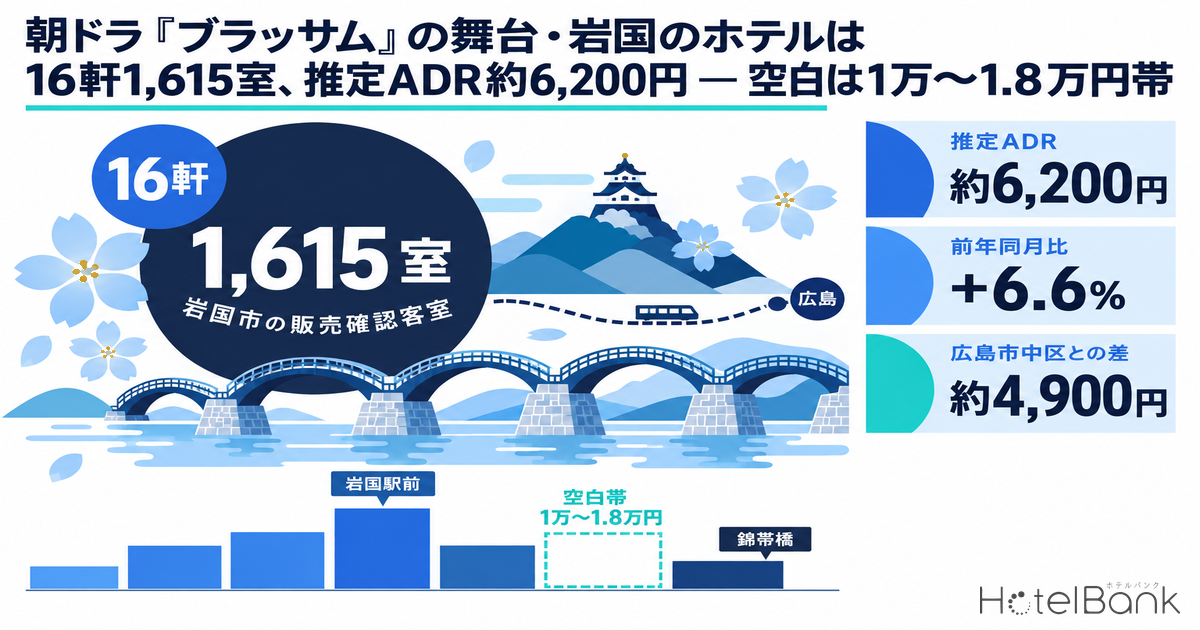
NHK’s morning drama serial (asadora) “Blossom” (ブラッサム), starring Shizuka Ishibashi and modeled on the novelist Chiyo Uno, began airing on NHK General TV on September 28, 2026, according to program listings. In Iwakuni, Yamaguchi — the city where the story begins — MetroEngines Research confirmed 16 lodging properties with 1,615 rooms on sale as of the survey date (October 6, 2026), and the city’s estimated ADR for September 2026 was approx. ¥6,200 (N=16 properties, +6.6% YoY). This article examines where that lodging stock sits relative to Kintaikyo Bridge and Iwakuni Station, how overnight demand could flow out to Hiroshima, Miyajima, Shunan and Yanai, and which price band remains unfilled in Iwakuni.
Metric Definitions Used in This Article
ADR (average daily rate) = an estimated settled rate (tax-exclusive equivalent) calculated by applying a property-type adjustment factor to the lowest-priced plan level each property publishes on OTAs (two guests per room, rate per room, tax included). When checked against property-level results disclosed by listed hotel REITs (91 properties, latest three months), the median error is approx. 7%. These are estimates and differ from each property’s actual settled rates and accounting figures. Area-level ADR is the median of the properties covered (the level of a typical property in the area). Where listed prices are mentioned, they are rates per room for two guests per room (tax included). Property and room counts cover the properties tracked by MetroEngines Research that were confirmed on sale as of the survey date; they are not a complete census. Data source: MetroEngines Research.
- — 16 properties, 1,615 rooms: the lodging stock confirmed on sale in Iwakuni as of the survey date (October 6, 2026). 89.3% of rooms sit within 2km of Iwakuni Station, while the 1km radius around Kintaikyo Bridge holds only 5 properties and 106 rooms (6.6%).
- — Estimated ADR of approx. ¥6,200 (September 2026, N=16 properties) is up 6.6% YoY. This is the baseline before the broadcast began on September 28.
- — Two tiers: the station front and the foot of the bridge: 9 business hotels with 1,482 rooms, mainly in front of the station, cluster in the ¥5,000 to under ¥8,000 band, while the top three ryokan around Kintaikyo Bridge sit at approx. ¥19,200–28,700.
- — The gap with Hiroshima’s Naka Ward is approx. ¥4,900 per room. Hatsukaichi (Miyajima) is 3.7 times Iwakuni’s level, while Shunan and Yanai to the west are at nearly the same level as Iwakuni.
- — Zero properties at ¥10,000 to under ¥18,000. This is the band where the median for Hiroshima’s Naka Ward (approx. ¥11,100) sits, leaving room for premium products at existing properties and for new small-scale lodgings.
Iwakuni’s Lodging Stock Is 16 Properties and 1,615 Rooms — Nearly 90% of Rooms Within 2km of Iwakuni Station
We start with where the lodging stock is located. For stay dates in the week starting October 6, 2026, 16 properties with 1,615 rooms were confirmed on sale within Iwakuni. They comprise 9 business hotels, 6 ryokan and 1 resort hotel, with business hotels accounting for more than 90% of rooms.
Split by location, two cores of different character emerge. Within a 1km straight-line radius of Iwakuni Station there are 7 properties with 898 rooms, and in the 1–2km ring another 2 properties with 545 rooms; the 2km radius around the station alone holds 1,443 rooms, or 89.3% of the total. By contrast, the 1km radius around Kintaikyo Bridge — the place drama viewers are likely to picture first — has only 5 properties and 106 rooms, a small vessel at 6.6% of the total. Iwakuni Kintaikyo Airport lies roughly 3km in a straight line from the station-front cluster, so the airport and the station front can be regarded as essentially the same lodging catchment.
Source: MetroEngines Research, compiled by HotelBank Editorial Team (N=16 properties; circle size = room count; as of October 6, 2026)
| Distance band (straight line) | Properties | Rooms | Room share | Main property type |
|---|---|---|---|---|
| Within 1km of Kintaikyo Bridge | 5 | 106 | 6.6% | Ryokan |
| Within 1km of Iwakuni Station | 7 | 898 | 55.6% | Business hotels |
| 1–2km from Iwakuni Station (incl. airport side) | 2 | 545 | 33.7% | Business hotels |
| Outskirts (Kuga / Shuto area) | 2 | 66 | 4.1% | Business hotel / resort |
| Iwakuni total | 16 | 1,615 | 100% | — |
Source: MetroEngines Research, compiled by HotelBank Editorial Team (N=16 properties; properties confirmed on sale for stays of October 6–12, 2026)
Looking at individual properties, small and highly rated inns line the foot of Kintaikyo Bridge. Shiratame Ryokan (白為旅館, 6 rooms) has earned strong support, with an overall score of 4.78 (out of 5; HotelBank Editorial Team research, cumulative as of October 2026) across 275 cumulative guest reviews. On the station side, Iwakuni City View Hotel (岩国シティビューホテル, 144 rooms) scores 4.39 across 2,485 reviews, and HOTEL R9 The Yard Iwakuni (HOTEL R9 The Yard 岩国, 31 rooms), nearer the airport, scores 4.68 across 132 reviews — properties of different types each winning approval from their own guest segments. The total stock is not large, but having lodgings that can already be discussed in terms of quality is a strength.
Estimated ADR Is Approx. ¥6,200 — Up 6.6% YoY in September, Before the Broadcast Began
Next, the rate level. Iwakuni’s estimated ADR for September 2026 was approx. ¥6,200 (N=16 properties), up 6.6% from approx. ¥5,800 (N=15 properties) in the same month a year earlier. In 2026, ADR exceeded the same month of the previous year in seven of the nine months from January to September; apart from July (−0.8%) and August (−4.0%), a gentle upward trend has continued. Because the broadcast began on September 28, this figure contains almost none of the drama’s effect. In other words, this is the pre-broadcast baseline.
Source: MetroEngines Research, compiled by HotelBank Editorial Team (Iwakuni, estimated ADR; N=14–17 properties per month)
However, the median of approx. ¥6,200 merely reflects the level of the business hotel cluster in front of the station. By property type, business hotels (N=9 properties) are stable at approx. ¥5,900, up 3.6% YoY. In contrast, the top three ryokan around Kintaikyo Bridge have estimated ADRs in the range of approx. ¥19,200–28,700, selling at three to five times the station-front rate. Iwakuni can be read as a market made up of two widely separated tiers: “around ¥6,000 in front of the station” and “the ¥20,000s at the foot of the bridge.”
How to Size the Drama Effect — The Distance Between 2.55 Million Annual Visitors and 1,615 Rooms
How far, then, does an asadora broadcast reach into lodging demand? A useful reference is the article we published in August, “2027 Taiga Drama Sites: 939 Rooms in Yokosuka vs 10 Near Tozenji.” Citing recent cases in which locations associated with NHK’s Taiga historical dramas posted double-digit YoY growth in the month the broadcast began, followed by months that fell below the previous year, that article concluded that continuously observing actual conditions in one’s own area is more practical than assuming a general rule that “broadcast = more overnight stays.”
Applied to Iwakuni, this caution carries even more weight. According to Yamaguchi Prefecture’s Tourist Movement Survey, Iwakuni received 2,548,705 tourists in 2024 (Reiwa 6; 102.2% of the previous year). In the Japan Tourism Agency’s Overnight Travel Statistics Survey, cited in the same document, total guest nights for Yamaguchi Prefecture as a whole were 3,785,580 (104.6% of the previous year). Meanwhile, even assuming that the 1,615 rooms confirmed on sale in the city were filled with two guests every night for a full year, total guest nights would come to only approx. 1.18 million (a simple calculation of 1,615 rooms × 365 days × 2 guests). The vessel for overnight stays is small relative to the scale of visitation, suggesting that tourism in Iwakuni has long been built mainly around day trips.
For comparison, in the earlier article’s inventory, Yokosuka had 12 properties and 939 rooms within 5km of Verny Park (estimated ADR approx. ¥11,500, N=17 properties, July 2026), and Takasaki had 30 properties and 2,850 rooms within 3km of the station (approx. ¥7,400, N=31 properties). Iwakuni’s 1,615 rooms and approx. ¥6,200 place it between the two cities in room count and close to Takasaki in rate. In other words, Iwakuni has a structure in which the share of visitors converting to overnight stays tends to come out low even when visitation rises, yet it is also of a scale where a slight move in the conversion rate produces a visible change in station-front rooms. As a drama for the second half of fiscal 2026, it is expected to air for six months, and how that exposure is linked to overnight stays is now the question.
Sensitivity of the Broadcast Effect — If Visitation Rises 10% and 10% of That Stays Overnight, About 35 Rooms per Day
Because the size of the drama effect cannot be pinned down to a single number, we estimate here the range of additional demand reaching Iwakuni’s rooms by varying two factors: how much visitation increases, and what share of the additional visitors stay overnight in the city. The base is the 2024 (Reiwa 6) tourist count of 2,548,705, and we assume the additional visitors stay one night at two guests per room. The table below shows annual additional room nights averaged over 365 days, alongside their ratio to the city’s 1,615 rooms.
| Increase in visitation (vs. 2024) | Overnight conversion 5% | Overnight conversion 10% | Overnight conversion 20% |
|---|---|---|---|
| Visitation +5% (approx. 127,000) | approx. 9 rooms (0.5%) | approx. 17 rooms (1.1%) | approx. 35 rooms (2.2%) |
| Visitation +10% (approx. 255,000) | approx. 17 rooms (1.1%) | approx. 35 rooms (2.2%) | approx. 70 rooms (4.3%) |
| Visitation +20% (approx. 510,000) | approx. 35 rooms (2.2%) | approx. 70 rooms (4.3%) | approx. 140 rooms (8.6%) |
Source: HotelBank Editorial Team estimate based on Iwakuni’s tourist count in Yamaguchi Prefecture’s “Tourist Movement Survey (2024)” and the number of rooms confirmed on sale by MetroEngines Research (1,615 rooms). The overnight conversion rate is the share of additional visitors who stay one night in the city; calculated at two guests per room, one night, leveled across the year. This is an illustrative estimate for discussion, not a forecast.
Even in the mid case — visitation +10% and an overnight conversion rate of 10% — additional demand averages only about 35 rooms per day, or 2.2% of the city’s rooms. The figures confirm that in a city dominated by day trips, growth in visitation does not translate directly into growth in overnight stays. Still, those 35 rooms are equivalent to one-third of the 106 rooms within 1km of Kintaikyo Bridge, and the roughly 140 rooms in the upside case (visitation +20%, conversion 20%) exceed the room count at the foot of the bridge. Given that additional demand tends to concentrate on weekends and holiday periods, a sense of shortage on peak days should appear sooner than the average suggests. The point to take from this estimate is that even at a scale the station-front rooms can absorb in total, there may be times when the vessel falls short for demand that specifically wants to stay near Kintaikyo Bridge.
Rate Gaps with Hiroshima, Miyajima, Shunan and Yanai — Iwakuni Is About ¥4,900 per Room Below Hiroshima’s Naka Ward
In a city with a small lodging stock, overnight demand flows to the surrounding area. For Iwakuni, the candidates are Miyajimaguchi and Hiroshima to the east and Yanai and Tokuyama (Shunan) to the west, all linked by the JR Sanyo Main Line. Straight-line distances from Iwakuni Station are approx. 17km to Miyajimaguchi Station, approx. 34km to Hiroshima Station, approx. 26km to Yanai Station and approx. 41km to Tokuyama Station — all close enough to fall within day-trip range.
Source: MetroEngines Research, compiled by HotelBank Editorial Team (September 2026, estimated ADR; N = Iwakuni 16 / Hiroshima Naka Ward 64 / Hatsukaichi 35 / Shunan 18 / Yanai 3 properties)
| Area | Straight-line distance from Iwakuni Station | Estimated ADR (Sep 2026) | YoY | N (properties) | Gap vs. Iwakuni |
|---|---|---|---|---|---|
| Iwakuni | — | ¥6,190 | +6.6% | 16 | — |
| Hatsukaichi (Miyajima / Miyajimaguchi) | approx. 17km (Miyajimaguchi Station) | ¥23,161 | +14.1% | 35 | +¥16,971 |
| Hiroshima Naka Ward | approx. 34km (Hiroshima Station) | ¥11,084 | +6.1% | 64 | +¥4,894 |
| Shunan (Tokuyama) | approx. 41km (Tokuyama Station) | ¥6,932 | +2.6% | 18 | +¥742 |
| Yanai | approx. 26km (Yanai Station) | ¥5,136 | +5.6% | 3 | −¥1,054 |
Source: MetroEngines Research, compiled by HotelBank Editorial Team (N for the same month a year earlier: Iwakuni 15 / Hatsukaichi 34 / Hiroshima Naka Ward 61 / Shunan 17 / Yanai 4 properties. Yanai is a reference value because N is small. Distances are approximate straight-line distances between stations)
Set side by side, the figures show that the outflow destinations differ in character between east and west. Hatsukaichi to the east is at approx. ¥23,200, 3.7 times Iwakuni’s level, and its YoY growth is also large at +14.1%. Miyajima is established as a destination where travelers “want to stay even if it is expensive,” and it is natural to assume that among travelers visiting both Iwakuni and Miyajima in one trip, the higher-spending segment stays on the Miyajima side. Hiroshima’s Naka Ward is at approx. ¥11,100, a gap of approx. ¥4,900 per room with Iwakuni. With 64 properties it also offers ample choice, so travelers who prioritize an evening meal or the next day’s itinerary are likely to return to Hiroshima.
To the west, by contrast, Shunan at approx. ¥6,900 and Yanai at approx. ¥5,100 sit in almost the same price band as Iwakuni. With rates no different, there is little incentive to head west on price alone. To sum up so far, what Iwakuni faces is “the experiential value of Miyajima” and “the convenience of Hiroshima,” and against Hiroshima, the rate gap of approx. ¥4,900 can itself be a reason to stay in Iwakuni. For two nights at two guests per room, the gap widens to nearly ¥10,000, with added time to enjoy Kintaikyo Bridge in the morning and evening and to stroll at leisure through places associated with Chiyo Uno. The key is whether this combination can be put into words and delivered to travelers.
The Open Band Is ¥10,000–18,000 — No Properties Between the Station Front and the Foot of the Bridge
Finally, we look at Iwakuni’s room distribution by price band. Ranking the 16 properties by estimated ADR for September 2026, 9 properties with 1,482 rooms cluster in the ¥5,000 to under ¥8,000 band, accounting for 91.8% of all rooms. The ¥8,000 to under ¥10,000 band has 1 property with 15 rooms, and ¥18,000 and above has 3 ryokan with 85 rooms around Kintaikyo Bridge; in between, at ¥10,000 to under ¥18,000, there is not a single property.
Source: MetroEngines Research, compiled by HotelBank Editorial Team (Iwakuni, 16 properties and 1,615 rooms; classified by property-level estimated ADR for September 2026)
This gap falls exactly in the band where the median for Hiroshima’s Naka Ward (approx. ¥11,100) sits. Products in the price band that is routinely chosen in Hiroshima have not yet been made available in Iwakuni. Our earlier analysis of hotel investment across Yamaguchi Prefecture also identified ¥8,000–12,000 as the prefecture’s gap band, and Iwakuni is a city where that tendency shows up especially clearly.
For existing properties, this is where the upside lies. The station-front business hotel cluster already has strong pulling power and guest review ratings; by adding stay-oriented plans as premium products — combining transfers to Kintaikyo Bridge, morning walks, and local food such as regional sake and Iwakuni-zushi — they may be able to build a ¥10,000-range tier on top of a base rate of around ¥6,000. For ryokan around Kintaikyo Bridge, one option is to add entry-level products in the mid-¥10,000 range, with breakfast only or room only, alongside their ¥20,000-range plans with two meals. All of these are illustrative estimates offered as suggestions and do not guarantee results, but prices that fall inside the approx. ¥4,900 gap with Hiroshima should find it easier to enter travelers’ consideration set.
The same band is also a candidate from the perspective of new supply. There are only 106 rooms within 1km of Kintaikyo Bridge, leaving ample room for small, mid-priced limited-service properties and machiya-style or dispersed lodgings to meet demand for staying near the bridge. We intend to keep observing movements during the broadcast period as material for testing this view.
Summary
The lodging stock in Iwakuni, the setting of “Blossom,” is 16 properties and 1,615 rooms, nearly 90% of which sit within 2km of Iwakuni Station, with 106 rooms within 1km of Kintaikyo Bridge. Estimated ADR is approx. ¥6,200, trending +6.6% YoY as of September before the broadcast began, and the gap with Hiroshima’s Naka Ward is approx. ¥4,900 per room. The vessel for overnight stays is small relative to annual visitation on the order of 2.55 million, but for that very reason even a slight advance in conversion to overnight stays is likely to show up in room rates. Which will fill the open ¥10,000 to under ¥18,000 band first — premium products at existing properties, or new small-scale lodgings? The six months through spring 2027, while the broadcast continues, will be the period for finding the answer.
Note on the data: ADR in this article uses finalized months through September 2026 and does not cover future dates from October onward. Property and room counts are a tally of properties confirmed on sale as of the survey date (October 6, 2026) and may change with future listing status.
Frequently Asked Questions
Q. How many hotels are there in Iwakuni?
A. MetroEngines Research confirmed 16 properties with 1,615 rooms on sale as of October 6, 2026. Nine properties with 1,443 rooms are located within 2km of Iwakuni Station, and five properties with 106 rooms within 1km of Kintaikyo Bridge.
Q. How many places are there to stay near Kintaikyo Bridge?
A. Within a 1km straight-line radius of Kintaikyo Bridge, five ryokan with 106 rooms were confirmed on sale (as of October 6, 2026), or 6.6% of the city’s rooms. Many are small with high guest review ratings; Shiratame Ryokan (白為旅館, 6 rooms) has an overall score of 4.78 across 275 cumulative reviews.
Q. What is the rate level of hotels in Iwakuni?
A. The estimated ADR for September 2026 is approx. ¥6,200 (N=16 properties, +6.6% YoY). The market splits into two tiers: station-front business hotels at around ¥6,000, and the top three ryokan around Kintaikyo Bridge at approx. ¥19,200–28,700.
Q. Is there an advantage to staying in Iwakuni compared with Hiroshima or Miyajima?
A. The estimated ADR for Hiroshima’s Naka Ward is approx. ¥11,100, and Iwakuni is approx. ¥4,900 lower per room. Together with being able to enjoy Kintaikyo Bridge at leisure in the morning and evening, the gap widens the more nights you stay.
Q. How much will the asadora broadcast increase lodging demand in Iwakuni?
A. Because no uniform effect can be estimated, this article ran an estimate varying the growth in visitation and the overnight conversion rate. In the mid case, where visitation rises 10% and 10% of that stays one night in the city, the result is about 35 rooms per day on average (2.2% of the city’s rooms). On average that is a scale the station-front rooms can absorb, but for the 106 rooms within 1km of Kintaikyo Bridge alone, shortages are possible on weekends and holiday periods.
Related Articles
| 2027 Taiga Drama Sites: 939 Rooms in Yokosuka vs 10 Near Tozenji |
| Yamaguchi’s 4-Tier Hotel Market: ADR ¥6,100–¥12,500 and White Space |
Further Reading
References and Sources
■ Data sources
Estimated ADR, property counts, room counts and price-band distribution are MetroEngines Research tallies (Iwakuni, Hiroshima Naka Ward, Hatsukaichi, Shunan and Yanai; finalized months from January 2025 to September 2026). Tourist counts are from Yamaguchi Prefecture’s “Tourist Movement Survey (2024)”; total guest nights are from the Japan Tourism Agency’s “Overnight Travel Statistics Survey” as cited in that document. Guest review ratings are HotelBank Editorial Team research (cumulative as of October 2026).
■ Estimation assumptions
Area-level estimated ADR is the median of the properties covered. Price bands are based on property-level estimated ADR for September 2026. Distances are straight-line distances from the stations and Kintaikyo Bridge. Additional demand in Table 2 multiplies Iwakuni’s 2024 tourist count (2,548,705) by the visitation growth rate and the overnight conversion rate, and converts the result to rooms at two guests per room, one night, leveled across the year. The annual capacity guide (approx. 1.18 million) is a simple calculation of 1,615 rooms × 365 days × 2 guests.
■ Limitations and caveats
Property and room counts are a tally of properties confirmed on sale as of the survey date and are not a complete census. Estimated ADR is an estimate and differs from each property’s actual settled rates. Yanai is a reference value because N is small at 3 properties. Table 2 is an illustrative estimate intended to show the range of demand and does not account for seasonal or day-of-week skew or overlap with existing demand. Results after the broadcast began are not included.
| MetroEngines Research — estimated ADR for Iwakuni, Hiroshima Naka Ward, Hatsukaichi, Shunan and Yanai (January 2025 to September 2026); 16 properties and 1,615 rooms confirmed on sale in Iwakuni (as of October 6, 2026) |
| HotelBank Editorial Team research — cumulative guest review ratings (as of October 2026) |
| Yamaguchi Prefecture, Tourist Movement Survey (2024) results (dated June 27, 2025; in Japanese) |
| WEB The Television program listing: NHK morning drama serial “Blossom,” Episode 1 (September 28, 2026, NHK General TV; in Japanese) |
| Japan Tourism Agency, “Overnight Travel Statistics Survey” (in Japanese) |